


Introduction
In the wake of George Floyd’s murder on May 25, 2020, millions of Americans joined protests at levels unmatched in U.S. history. For weeks, social media was central to multi-racial demonstrations spreading across cities and towns, mobilizing millions. However, existing studies of Black Lives Matter’s (BLM) social media communication largely predate 2020, leaving the movement’s most consequential period unexamined. This paper offers the only analysis of BLM chapter communication during peak mobilization using the largest sample of BLM chapters studied in political science. Analysis reveals that BLM chapters mobilized followers in meaningfully different ways during the summer’s protests. With inductive post-categorization, this paper shows that chapters founded in different eras used social media differently in 2020. I find that what chapters posted online varied depending on when a chapter was established. Chapters established before 2017 were more likely to post messages encouraging new ways of thinking about racism, respectability, and police reform. They posted more aspirational goals with indefinite timelines. In contrast, newer chapters, founded during the Trump era, urged their followers to act immediately. They were more likely to encourage followers to vote, contact officials, or protest. Rather than viewing this expansion as a betrayal of the BLM’s base, the differences that I identify between older chapters and those established during periods of broader public support should motivate further research into how identity, institutional trust, and political incorporation inform participation in diverse social movements (Francis and Wright-Rigueur Reference Francis and Wright-Rigueur2021).
Theory and Background
BLM as a Heterogeneous Movement
In 2014, BLM emerged as a mobilizing force behind multiple waves of protest against police killings of Black people. The name refers to three overlapping entities: the broader movement, the founder-established Black Lives Matter Global Network, and the hashtag #BlackLivesMatter, which gained national traction during the 2014 Ferguson protests (Freelon et al. Reference Freelon, McIlwain and Clark2016). BLM’s growth also converged with preexisting Black-led abolitionist organizations, such as Critical Resistance, co-founded by Angela Davis and Ruth Wilson Gilmore in 1997, through the coalition Movement for Black Lives (Ransby Reference Ransby2019). In the years after Ferguson, BLM expanded as a loose federation of chapters, each agreeing to prioritize 12 intersectional principles (Nulman and Cole Reference Nulman and Cole2022). While the Global Network served as BLM’s public face, providing campaign “toolkits” and branded imagery, chapters relied more on each other for operational support (Mundt et al. Reference Mundt, Ross and Burnett2018; Nulman and Cole Reference Nulman and Cole2022; Ransby Reference Ransby2019).
The emphasis on BLM’s decentralized structure obscures patterns of variation among its constituent organizations. Early BLM leaders were more likely to be Black, women, queer-identified, and proximate to communities impacted by police violence (Freelon et al. Reference Freelon, McIlwain and Clark2016; Petitjean and Talpin Reference Petitjean and Talpin2022; Woodly Reference Woodly2021). By 2020, participation expanded to include participants who were ideologically and demographically distant from the founding base (Gause and Arora Reference Gause and Arora2024; Simonson et al. Reference Simonson, Block, Druckman, Ognyanova and Lazer2024). Public support shifted dramatically as well. While the first chapters confronted widespread criticism and opposition (Anderson and Hitlin Reference Anderson and Hitlin2016; Parker et al. Reference Parker, Horowitz and Anderson2020), Trump’s presidency made BLM’s progressive niche more socially acceptable (Dunivin et al. Reference Dunivin, Yan, Ince and Rojas2022; Griffin et al. Reference Griffin, Quasem, Sides and Tesler2021; Harris Reference Harris2015), and 2020 brought a brief national consensus on the severity of racism and police violence. When combined with the movement’s desire to limit central hierarchy, many organizations, even those organized around other issues, were able to identify as part of the BLM movement as popular support increased. The chapters in this study were thus established in starkly different circumstances.
Activists have always considered media intermediaries when making public appeals, and social media has reduced the reliance on traditional media, enabling new outreach approaches (Wasow Reference Wasow2020). Movements like BLM target sympathetic observers online in ways designed for amplification (McAdam Reference McAdam, McAdam, McCarthy and Zald1996; McCarthy and Zald Reference McCarthy and Zald1977; Woodly Reference Woodly2015). Crucially, social media enables core organizers to reach and mobilize people who are structurally or experientially disconnected from the core concerns of the movement (Han Reference Han2014). While this broadens the base of a movement, it also means that participants recruited through digital campaigns may be less proximate to the issue, have weaker ties to the founding community, and have greater faith in conventional political channels than the core members who mobilized them (Wasow Reference Wasow2020; Woodly Reference Woodly2015). Thus, online campaigns contribute not only to the development of constituencies and public discourse but also to the gradual diversification of who counts as a movement participant (Woodly Reference Woodly2015).
Existing research on BLM’s online behavior relies on analysis of hashtags or keywords that are unable to distinguish between supporters, opponents, organizers, and passive participants (Chang et al. Reference Chang, Richardson and Ferrara2022; Freelon et al. Reference Freelon, McIlwain and Clark2016; Jackson and Foucault Welles Reference Jackson and Foucault Welles2015; Ray et al. Reference Ray, Brown, Fraistat and Summers2017). Studies of individual accounts typically analyze the Global Network alone (Edrington and Lee Reference Edrington and Lee2018). Although it has the most followers, as the national organization, it is not representative of typical BLM organizers, but likely represents the goals or visions of organizational leaders and founders. Only Mundt et al. (Reference Mundt, Ross and Burnett2018) and Tillery (Reference Tillery2019) compare the behavior of multiple online accounts. Despite their valuable contributions, their observations end in 2017 and cannot account for the behavior during the largest BLM mobilization in history at that point. This paper uses the largest sample of BLM accounts yet studied in 2020 to ask: did the era in which a chapter was founded shape how it mobilized its followers?
Organizational Age, Marginalization, and Tactical Divergence
Two mechanisms, operating jointly, explain why the founding era should predict the communication strategy: the composition of early versus late participants and the organizational learning that accumulates over time.
When movements mobilize on behalf of marginalized groups, early participants are more likely to be marginalized and less predisposed to conventional politics (Lipsky Reference Lipsky1968; McAdam Reference McAdam1986; Piven and Cloward Reference Piven and Cloward1977). The proximity of early participants to an issue, through personal experience, community stakes, or structural position, influences their advocacy for an issue (Cohen Reference Cohen2009; Gould Reference Gould2009). More established organizations can recognize the urgency of an opportunity while maintaining longer time horizons to achieve their goals; they have a more structuralist perspective and may be more patient in achieving their goals (Staggenborg Reference Staggenborg1988). Through their participation and shared identities, early participants cultivate identity and develop stronger community bonds than later participants (Sturmer and Simon Reference Sturmer and Simon2004). Due to their marginalization, early participants may be more accustomed to arguing for the legitimacy of a movement than to encouraging participation (Carruthers Reference Carruthers2018; The Combahee River Collective Reference Smith2023; McAdam Reference McAdam1986; Woodly Reference Woodly2015).
BLM’s founding rejection of respectability politics and its centering of Black queer perspectives reflects this orientation and put the early movement at odds with Black political insiders (Cohen Reference Cohen2009; Harris Reference Harris2015; Rickford Reference Rickford2016; Woodly Reference Woodly2021). However, Donald Trump’s first presidency made the distinctive progressive niche of BLM’s more socially acceptable, attracting participants with greater political incorporation and more faith in conventional politics (Bunyasi and Smith Reference Lopez Bunyasi and Smith2019; Cohen and Jackson Reference Cohen and Jackson2016; Dunivin et al. Reference Dunivin, Yan, Ince and Rojas2022; Griffin et al. Reference Griffin, Quasem, Sides and Tesler2021).
Organizational age adds another element of distinctiveness between chapters. Established organizations accumulate institutional knowledge, develop longer time horizons, and build praxis and member skills that newer organizations lack (Levitt and March Reference Levitt and March1988; Minkoff Reference Minkoff1999; Soss and Weaver Reference Soss and Weaver2017). Chapters established after Ferguson endured periods of hostility and waning public relevance (my sample analyzes the chapters that remained; numerous others became inactive by 2020), reinforcing a disposition toward patient foundational strategies. At the same time, these chapters had disproportional influence on what followed (Levitsky Reference Levitsky2007). Later chapters brought their own tactical repertoires, shaped by the political context of their supporters and founding. During moments of peak support and simultaneous mobilization, these differences become observable.
Together, these mechanisms generate clear expectations. Institutional knowledge makes older organizations more adaptable and patient as they tend to pursue goals with longer time horizons. Newer chapters founded under conditions of greater public support and comprising more politically incorporated supporters reached through social media encouraged followers to participate in political tasks: encouraging followers to vote, demonstrate, or contact officials.
As a result of these differences, I expect older and newer organizations to pursue different mobilization strategies.
H1: Chapters established when movement identity was still being cultivated and public support was low (pre-2017), prioritize long-term strategies: movement justification, educational outreach, identity building, and the cultivation of political power over time.
H2: Newer BLM chapters, established during periods of greater public support and comprising more politically incorporated or less marginalized members (post-2017), pursue short-term mobilization strategies: encouraging followers to vote, demonstrate, or contact officials.
In the following section, I explain how I test this theory using tweets from BLM chapters founded in the decade leading up to the 2020 protests. I inductively categorized posts from BLM chapters active in 2020 to determine the role of the founding era in mobilization strategy. I find that in 2020, older organizations pursuing goals on a longer time horizon than newer chapters; they educate and encourage new ways of thinking, whereas newer chapters mobilize followers to demonstrate, vote, or contact officials. Because I maintain that this outcome is the result of a movement incorporating new constituencies, it is important to distinguish between sub-movement organizations that act consistently with their abilities and a decentralized movement lacking internal cohesion and discipline. This perspective sheds light on what can be an expansion of movement politics, rather than an indication of decline.
Data & Methods
My interpretations are the result of a multi-part process of data collection and analysis that began with the compilation of a comprehensive database of public BLM Twitter accounts. This database served as the basis for a qualitative analysis of media generated by organizational accounts during the summer of 2020. The analysis is based on posts made by geographically based organizations affiliated with BLM during the first six weeks of the 2020 protest.
Data
To identify BLM accounts capable of mobilizing participants, I created a database of accounts associated with a geographic area and BLM (or Movement for Black Lives). Although BLM was present on all platforms and some activists opted for private communication, Twitter was the most effective platform to observe BLM’s public mobilization in 2020 for several reasons (Chang et al. Reference Chang, Richardson and Ferrara2022). At the time, Twitter was public to those without an account, there was a strong contingency of Black and activist users, and the network structure did not require reciprocal connections. Users also had the ability to share content from other social media sites, such as Facebook events (Bossetta Reference Bossetta2018; Brock Reference Brock2012; Mundt et al. Reference Mundt, Ross and Burnett2018; Wojcik and Hughes Reference Wojcik and Hughes2019).
Three criteria determined inclusion in this sample. First, accounts needed to be active during the observed period (May 25–July 31, 2020) and publicly visible when data were gathered in fall 2021 and spring 2022. Second, to establish a link to BLM, accounts appeared in a geography-based search for BLM organizations, were mentioned in the posts of an already-included account, or attended the Movement for Black Lives Conference in the summer of 2015. Third, accounts were excluded if they were verified as non-organizational, unaffiliated with the movement, or primarily organized around a separate issue.
I limited my search to cities with populations greater than 150,000, and for each, I searched for “BLM” or “BlackLivesMatter” + CITY NAME in the fall of 2021.Footnote 1 This search yielded 129 accounts in 42 cities. For each account, I recorded the content posted in the bio and any pinned tweet, the number of followers and posts (as of 2021), and the content associated with the city. While this information was not incorporated directly into this paper, this information informed my theory. After removing accounts that were inactive or not activist organizations. I retained 62 accounts for my sample (see Appendix 4 ). Similarly to Mundt et al. (Reference Mundt, Ross and Burnett2018), this targeted sampling strategy enables a more targeted observation of how social movements behave online under unique circumstances.
Next, I scraped all tweets from these accounts beginning on May 25, 2020, the day of George Floyd’s murder, through July 31, 2020. This scrape produced over 13,000 posts. After posts containing only hashtags, URLs, or removed accounts, the data yielded 6,641 total text-based posts. Because the posts were hand-coded, I did not use text-cleaning processes to augment the data.
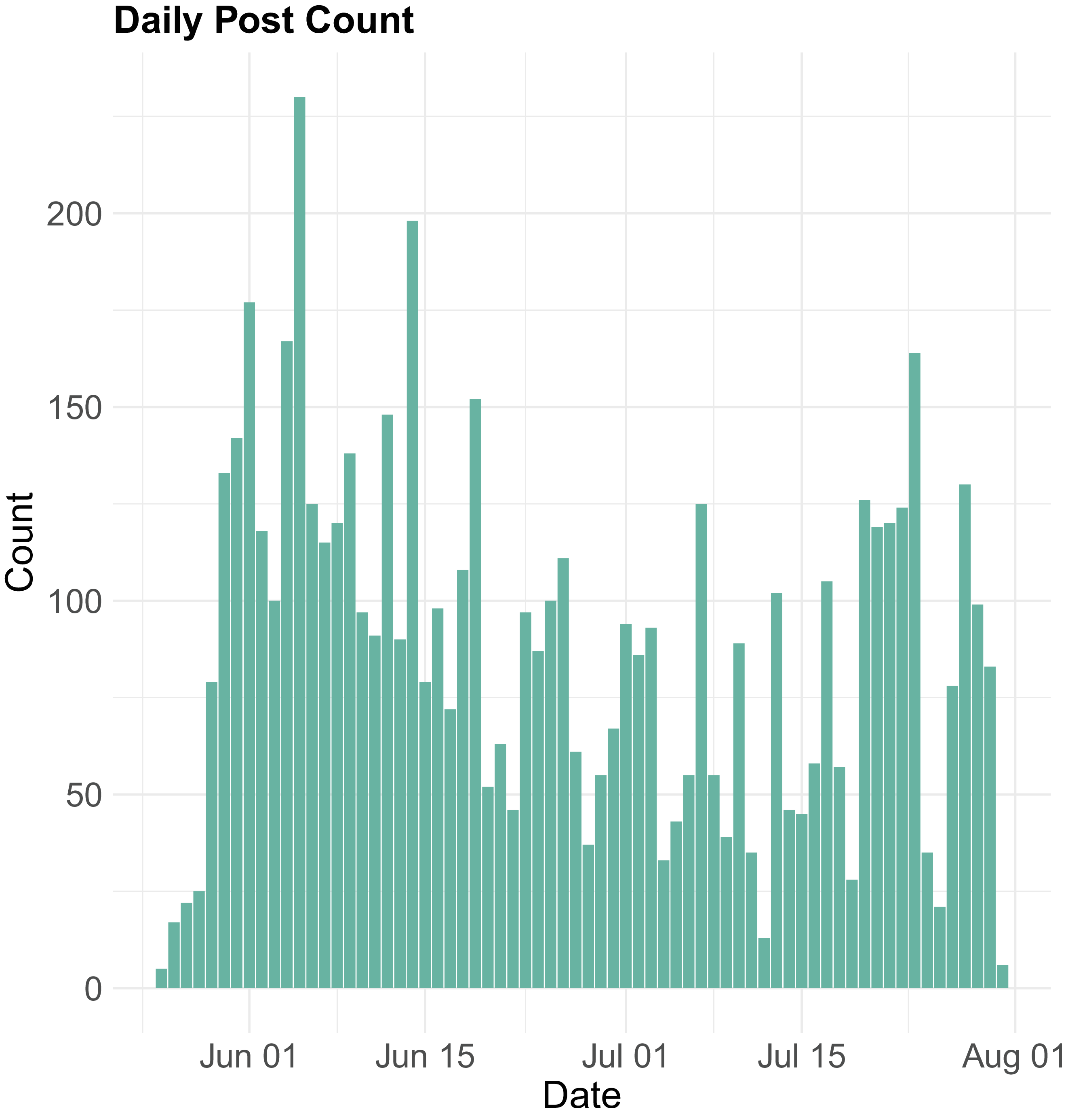
Daily tweet count by all groups May 25, 2020–July 31, 2020.

Figure 1 shows that the data cover early summer, the period of the highest BLM support, the only time the movement received the support of most of the public, as well as some of the subsequent decline (Parker et al. Reference Parker, Horowitz and Anderson2020). The rise and fall in the number of posts in my corpus mirrors the rise and fall in the number of protest events nationally, with activity peaking in early June before declining throughout the summer (Kishi and Jones Reference Kishi and Jones2020). Of these, 7 accounts were listed as official chapters on the global network’s website in April 2020. The majority of the remaining accounts are self-identified as BLM accounts either by name or in their account description.
Methods
Our robust understanding of BLM’s social media use comes primarily from analyses of the context surrounding the spread and use of keywords, including the #BlackLivesMatter hashtag (Chang et al. Reference Chang, Richardson and Ferrara2022; Freelon et al. Reference Freelon, McIlwain and Clark2016; Ince et al. Reference Ince, Rojas and Davis2017; Ray et al. Reference Ray, Brown, Fraistat and Summers2017). Such research provides valuable insights into the public’s participation with BLM on social media, including how themes, topics, and information are conveyed. However, this approach cannot easily distinguish between users who use hashtags, regardless of their support or participation in the movement (Anderson and Hitlin Reference Anderson and Hitlin2016). Using a highly selective sampling strategy, I can assume that posters support BLM, are at least periodically involved in movement leadership, and are using social media to increase support or involvement in the cause.
I used a grounded theory-inspired approach to coding, beginning with inductive process coding to identify patterns in how different BLM chapters communicated during the 2020 protests. Following grounded theory principles, I allowed themes to emerge from the data, rather than imposing predetermined categories, and iteratively broadened groupings in five rounds of coding (Nelson Reference Nelson2017). The first round used process codes that use gerunds to describe unlawful acts (e.g., requesting donations, condemning police violence, encouraging self-care) and are appropriate for describing actions occurring over time (Saldaña Reference Saldaña2021; Searle Reference Searle1969). The codes are not exclusive, and each tweet could receive up to four process codes. I worked with undergraduate coders on the first round, and together we participated in weekly meetings to discuss the coding process, ensure consistency, and share observations about the data. Because the process was inductive, the inter-coder reliability scores were unacceptable, so I reviewed and recoded all undergraduate-coded posts. However, working with the students and regularly discussing the data was helpful in developing the initial categories.
After reading the entire corpus and reviewing the first round of coding, I corrected spelling, eliminated plurals, and cleaned the codes, resulting in 1,200 unique codes (2,228 pre-cleaning). Having confirmed that the initial process codes were accurate, in a third round of coding, I consolidated them into 75 categories. This step was done without referencing the original tweets except for clarification. In a fourth round of coding, I reviewed the 75 categories and consolidated them further into seven groupings. Two of the seven categories seemed too broad, so I recategorized them in a fifth round into a final nine thematic categories that better represented the data: Anti-Respectability, Community and Self-Preservation, Imagining Alternatives, Spotlighting, Demands, Mobilization, Information, and Miscellaneous (Corbin and Strauss Reference Corbin and Strauss2015, 96).Footnote 2 This iterative approach enabled a dynamic interpretation of how decentralized BLM articulated grievances, mobilized supporters, and engaged with particular themes such as police defunding (Saldaña Reference Saldaña2021). See Appendix B for a more detailed description of the coding process.
Descriptive Analysis
To understand how BLM chapters established during different eras communicated differently in 2020, I used inductive coding to categorize Twitter posts made during the peak of mobilization. The analysis reveals that the most common function of tweets during the study period was mobilization (n = 2,104). The posts in this category encouraged participation in the protests (n = 572), either in person, online (n = 129), or through donations (n = 258). The second most frequent category overtly concerned politics (n = 1,874), including criticism of police and public officials (n = 636), connections across historical and contemporary concerns (n = 181), and arguments for policy change (n = 238). The third major category emphasized self and community care (n = 1,113), urging rest (n = 51), encouraging COVID-19 precautions (n = 148), celebrating Black culture (n = 174), and talks, discussions, or collective experiences for care (n = 337). “Anti-respectability” was also a significant category (n = 984), capturing posts honoring victims of police violence (n = 388) and posts criticizing moderate or perspectives that undermined BLM goals (n = 191). The themes are similar to those of other research that analyzes BLM and other organizations in different periods (Edrington and Lee Reference Edrington and Lee2018; Lovejoy and Saxton Reference Lovejoy and Saxton2012; Tillery Reference Tillery2019).
The category of “Demands” included calls for government action with established precedent, such as reallocating funds between existing programs (n = 675). In contrast, “Imagining Alternatives” captured visionary demands without clear precedent, which I interpreted as appeals to the public to consider broader solutions to systemic problems (n = 163). Finally, the “Miscellaneous” category contained a small number of posts not related to the main themes, such as job announcements or corrections for earlier errors (n = 52).
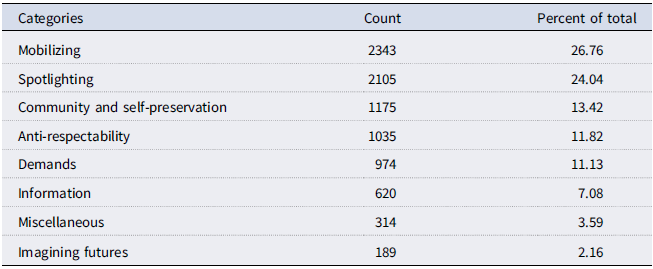
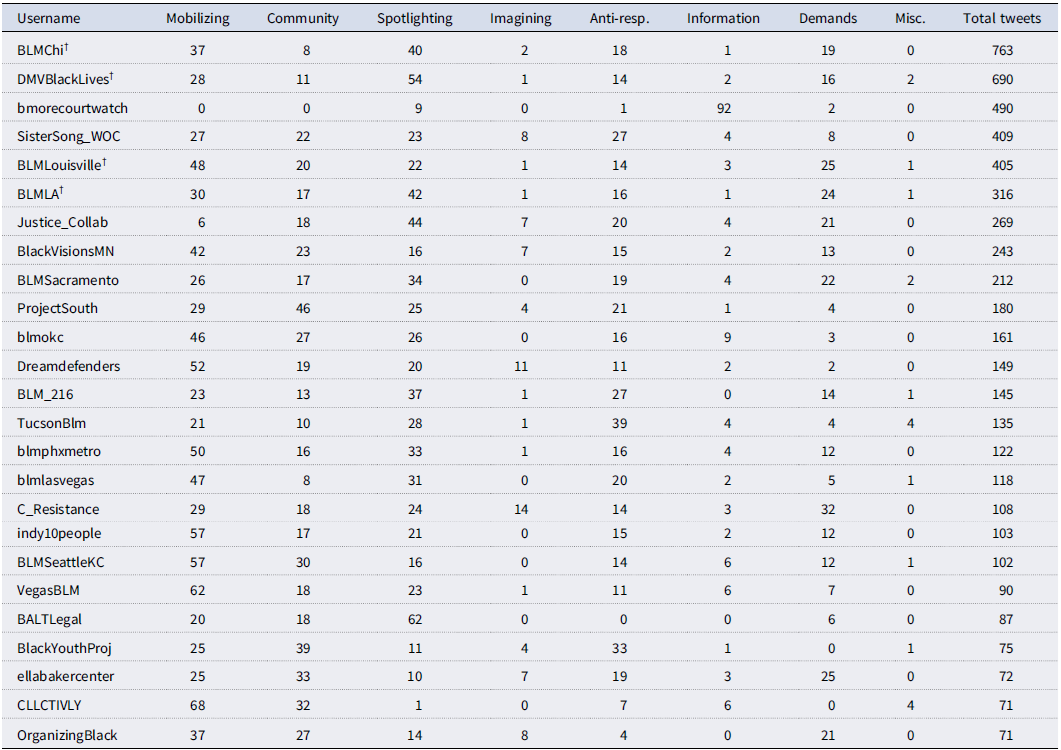
Tables 1 and 2 summarize the variation in content in and between accounts. Although each category is discussed in greater detail below, the table shows that, across accounts, the plurality of tweets carried a Mobilizing message, encompassing communication aimed at generating resources and encouraging participation. Community content was less common and appeared to be somewhat inversely related to the overall volume of tweets an account produced. The Spotlighting category, which refers to tweets that use current events to draw attention to other, often local, issues such as recent police killings, was only the plurality for the DC-based chapter. Imagining Alternatives and Anti-Respectability rhetoric were less frequent across all accounts.
Share of tweets possessing features of each category

Table 1. Long description
A table comparing the share of tweets possessing features of each category. The table has 8 rows and 3 columns. The columns are labeled Categories, Count, and Percent of total. The rows are labeled as follows: Mobilizing, Spotlighting, Community and self-preservation, Anti-respectability, Demands, Information, Miscellaneous, and Imagining futures. The values in the Count column are 2343, 2105, 1175, 1035, 974, 620, 314, and 189. The values in the Percent of total column are 26.76, 24.04, 13.42, 11.82, 11.13, 7.08, 3.59, and 2.16.
Percent of tweets in each rhetorical category by account, summer 2020. The first column lists account names, followed by category percentages; Total is the number of tweets. Official Black Lives Matter chapters are denoted with †. For formatting, the table shows the 25 most prolific accounts

Table 2. Long description
The table presents data on the percentage of tweets in different rhetorical categories by various accounts during summer 2020. It includes 25 rows and 10 columns. The columns are labeled as follows: Username, Mobilizing, Community, Spotlighting, Imagining, Anti-resp., Information, Demands, Misc., and Total tweets. The table lists the account names in the first column and the percentages of tweets in each rhetorical category in the subsequent columns. The last column shows the total number of tweets for each account. Notable accounts include BLMChi, DMVBlackLives, bmorecourtwatch, SisterSong_WOC, and BLMLouisville, among others. Each row provides specific percentages and total tweets for each account, highlighting the distribution of rhetorical categories across different accounts.
The variation in posting volume reflects multiple related factors, including organizational capacity, follower base, and safety concerns. The top three accounts, for example, were well-established official chapters with more than 10,000 followers in cities that saw large, sustained protests met with violent police suppression, including tear gas and fatal shootings. Following a 9:00 PM curfew in Chicago on May 30, for example, most river bridges were raised and BLMChi provided real-time guidance to remaining protesters. While protests in other cities also featured chaotic and violent moments, the size and visibility of accounts in these cities suggest they served as particularly reliable sources of information within their communities.Footnote 3
Tweet Types
In the following sections, I explain the rhetorical categories used to describe the posts that distinguish chapters founded in different eras.
Information & Mobilization
The most frequent posts, comprising 32.5% of all tweets, convey protest logistics such as the locations and times of group actions, encouraging participation, providing websites requesting donations, and providing resources to contact public officials (see Table 1, Supplementary Material). Mobilization tweets can also include real-time updates on protests, such as reports on police presence or actions, or information about organizers.
“Protests are happening all over the City today. Get in where you fit in! If u have a car, join the caravans. If on foot, join the marches! If participating from home, click here”
For most accounts, the plurality of posts include this category, but seldom the majority and not the majority overall. Like Tillery (Reference Tillery2019), I too find that chapters established before 2017 are less likely to use these types of posts than newer chapters. The Global Network account, BlackLivesMatter, is the most prolific in the Tillery (Reference Tillery2019) sample but is excluded from my analysis as it represents the national organization rather than a geographically-bound chapter. Unlike chapters, it is unlikely to make logistical posts about local events. My analysis focuses on the highest national mobilization while Tillery (Reference Tillery2019) covers months of varying activity, including lulls. Many accounts were established in 2020 specifically to mobilize and share protest information, quickly gaining followers when their content proved useful.
“This page will be doing (sic) everything it can to catalog live updates, tips, and cautions in one easy-to-access location. Please DM or @ us with any information so we can post it as soon as possible.”
Community and Self-preservation
BLM’s Black feminist and queer lens prioritizes care for self and community (Woodly Reference Woodly2021), viewing racism as both resource deprivation and a psychological trauma requiring healing. Community and self-preservation posts share online talks, encourage protest care, thank supporters, or celebrate Black culture. This category cultivates identity for strategic and ideological purposes. One account would regularly share a healing hour hosted on Zoom by a professor of African American studies.
“It is ok to rest. We must care for ourselves to care for our people. We will never stop fighting, but we must also never stop valuing and loving ourselves, especially in a world that tries to tear us down.”
In spring 2020, limited knowledge of COVID intersected with economic vulnerability, as marginalized workers faced increased risks of infection. Organizations that previously mobilized around police violence were converted to food drives and resource distribution. Several accounts shared testing locations and safety guidance, demonstrating awareness of COVID’s disparate impact. They also advised on when protesting was appropriate, particularly given curfew restrictions, and expressed concern for inexperienced participants.
“If you are elderly, have children with you, or are otherwise vulnerable, please leave the area by 7 pm. The police are in the area, and we anticipate they will attempt to engage demonstrators to leave the area aggressively.”
Spotlighting
Although early BLM leaders expressed little interest in conventional electoral politics, as participation diversified, so did movement tactics. Tweets in this category celebrate pro-movement policies, criticize elected officials, advocate specific reforms, and share performance records of local or national offices.
I observe that chapters position themselves as relevant to, yet outside, traditional electoral politics in part by their emphasis on local politics. Although BLM protested presidential candidates in their 2016 disruptions of Bernie Sanders and Hillary Clinton, most activities emphasize local accountability. References to President Trump are infrequent (n = 86) and typically link him to local officials (critique by proxy) or circulate his comments on protests. Following violent crowd dispersal in Washington, DC, the local chapter tweeted:
“We are suing Trump for brutalizing our members and DC residents! Support our campaign by painting the city with our demands, use #DefundMPD to get your art RT’d 1) #DefundMPD 2) Stop Criminalizing Protestors (sic) 3) Police Free Schools 4) Ban Stop and Frisk”
While there is limited mention of national politicians in my data, there are numerous examples of tweets implicating mayors, council members, and police chiefs both with respect to their handling of protests and their management of police, generally.
“Alameda County President Valle has voted to spend $108 million//year to hire more cops at #SantaRitaJail in the middle of a recession. We are calling on him to immediately rescind his vote!”
Despite numerous instances in which groups publicly criticize public officials, the critiques of those officials are similar across locations. This is also reflected in the similarity of demands across locations, the most memorable being to defund or abolish the police. Of all the demands, the demand to defund the police was by far the most frequent. Still, it was often accompanied by an explanation or the parallel demand to “invest” in existing pro-social programs such as parks or schools.
“Closing CA’s youth prisons is an opportunity to invest in community-led alternatives to incarceration and punishment like…”
and also
“TOMORROW: Miami County Commissioners are meeting and on their agenda is a proposal for a new $400 MILLION jail, if you’re not down with that be sure to sign this email to commissioners saying not one more dime for racist police; jails killing our people:”
Imagining Alternatives
Posts acknowledging that a different set of priorities and values would be necessary for ideal reforms encourage followers to think beyond what they feel is possible. This category includes abolitionist messages and calls for reparative justice through reparations and other programs.
“The movement is aimed at creating a world where public safety is not defined by police and crime but how communities use their resources to care for each other,”
Imagining alternatives provides the movement with the flexibility to critique the obfuscation and denial of racism (Shin and Bonilla-Silva Reference Shin and Bonilla-Silva2006), without getting mired in the intractable details of partial solutions. This is one reason that Black Millennials believe that BLM has been more effective in shifting cultural than political norms (Durham Reference Durham2023). However, changing policies and norms, such as the availability of data on police-caused deaths in the US, are a direct result of the expectations created by BLM (Francis Reference Francis2014, 445).
Anti-Respectability
By embracing anti-respectability, BLM centers those neglected by past movements (Crowder Reference Crowder2020; Tillery Reference Tillery2019). While initially sacrificing support from those with political capital, this strategy lowers participation barriers for those with the most to gain (Carruthers Reference Carruthers2018). This category includes posts that advocate for marginalized populations, reject dominant norms, honor victims, antagonize police, and criticize allies.
“Years of whitewashing and co-opting our movement has some of y’all confused about what it has always meant to know that Black lives matter. If buildings and professions are more important than lives, see your way out. Why is our right to survival always conditional?”
Conclusion
These findings speak to longstanding debates regarding what happens when movements successfully broaden their coalitions. The primary concern is that moderate concerns overpower radical ones when a movement expands, diluting the voice of the most affected (Harris Reference Harris2015; Piven and Cloward Reference Piven and Cloward1977). This paper suggests that rather than displacing early organizers, the incorporation of newer, less marginalized participants into BLM produced a functional division of labor that mirrors the distinct identities and institutional relationships of different chapters. This division is not evidence of incoherence or decline, but of a decentralized movement adapting its communication to heterogeneous constituencies simultaneously. Whether this complementarity emerges from deliberate movement strategy (Rustin Reference Rustin1965) or the structural features of decentralized organizing, and whether it persists as movements consolidate or face repression (McCarthy and Zald Reference McCarthy and Zald1977), are questions with direct implications for how scholars assess movement health and longevity.
The social media landscape at the time likely contributed to this distributed differentiation. In 2020, platforms like Twitter were still relatively open infrastructures for activist communication; they were public, low-barrier, and capable of reaching both committed organizers and casual sympathizers simultaneously. As platforms have since restructured their algorithms, restricted API access, their user base has shifted and the conditions that made Twitter an observable mobilizing resource for the left no longer hold. As researchers continue to grapple with how these changes will impact both mass behavior and the ability to research it (Blakey Reference Blakey2024; Murtfeldt et al. Reference Murtfeldt, Paik, Alterman, Kahveci and West2024), new forms of protest are taking shape.
During Trump’s second term, national “No Kings” protests have attracted millions with a similar institutional structure to the Movement For Black Lives. Like M4BL, these protests combine high-level institutional organizing with decentralized mobilization in periodic actions comprising millions of Americans (Fisher Reference Fisher2020; Han Reference Han2014). However, in a social media environment hostile to grassroots leftist organizing, the “No Kings” protests are organized by professional social movement organizations such as the American Civil Liberties Union, The American Federation of Teachers, and Planned Parenthood. The returning dominance of major institutions and their ability to mobilize in a decentralized manner reveals an increasingly narrow path to leftist organizing in this era.
Ultimately, the story of BLM in 2020 is a story about the possibilities and limits of democratic inclusion. The protests that summer represented a rare moment when a movement rooted in the experiences of one of America’s most politically marginalized groups briefly commanded majority public support, forcing questions about policing, structural racism, and political representation onto the national agenda. This paper shows that even within that moment, the work of sustaining radical demands, building collective identity, and imagining structural alternatives fell disproportionately to those with the deepest stakes in the outcome. As movements expand, they gain power, but also absorb constituencies with different relationships to the problem and existing institutions. This paper illustrates how the ongoing tension between protest and politics, central to Black American organizing for decades, has been reorganized rather than resolved (Rustin Reference Rustin1965). Evolving technologies enable new organizational forms and constituencies, reshaping the relationship between grievance and participant in ways that matter to who mobilizes, who leads, and who ultimately bears the brunt of backlash when movements act on behalf of the disadvantaged.
Supplementary material
The supplementary material for this article can be found at https://doi.org/10.1017/rep.2026.10099.
Data availability statement
The data that support the findings of this study are openly available in Dataverse at https://doi.org/10.7910/DVN/UPBSOR.
Acknowledgments
I thank the editors and anonymous reviewers at the Journal of Race, Ethnicity, and Politics, Deva Woodly, Shea Streeter, Crystal Robertson, attendees of the Towards Liberation Conference at the University of California, Irvine, and my adviser Bernard Fraga for helpful comments and suggestions.
Funding statement
The author has no relevant financial or non-financial interests to disclose. No funding was received to assist with the research or authorship of this manuscript.
Competing interests
The author declares no conflict of interest.


 Open access

