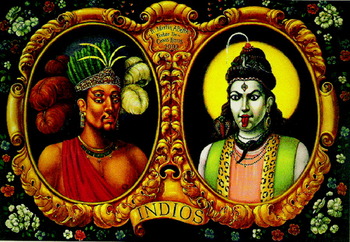
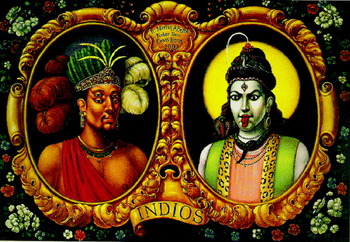
In 2007 the New Mexico Museum of Art's exhibition, How the West Is One, charted the intercultural encounters shaping New Mexican art. In the accompanying text, curator Joseph Traugott begins his discussion with Ray Martín Abeyta's Indios (2002) (Figure 1). Replicating the baroque in painted form, Abeyta presents a double portrait – the pre-Columbian deity Quetzalcoatl coupled with the Hindu deity Shiva – which mocks Columbus's “mis-discovery” of the Americas as the Indies. For Traugott, Indios “challenges viewers to think sensitively about the aesthetic fusions that have occurred in New Mexico art and culture.”Footnote 1 What remains unclear, however, is that Abeyta's global imaginary draws explicitly on Spanish colonial art forms, forms which were viewed by Anglo-American patrons in New Mexico as products of isolation rather than evidence of intercultural mixing across the centuries. The joining of Quetzalcoatl with Shiva not only represents the “mis-discovery” of America; it also represents the persistent “mistranslation” of Spanish colonial art and Hispano identity as authentic “Spanish” entities unadulterated by local processes of mestizaje (cultural and ethnic mixing) and global economic and artistic exchange.Footnote 2 Abeyta belongs to a generation of contemporary Hispano artists and cultural activists who revisit and rework this Spanish colonial paradigm.Footnote 3 Abeyta's work, and that of his contemporaries, involves “pulling back the layers and seeing the deeply embedded mixtures in [New Mexican] communities,” to quote historian Estevan Rael-Gálvez.Footnote 4 These mixtures destabilize long-held myths about Spanish colonial rule and tri-cultural harmony in New Mexico, myths which continue to dominate the state's heritage industry and much of its contemporary cultural expression.Footnote 5
Ray Martín Abeyta (b. 1956), Indios, 2002, oil on linen, 37×54 in. Collection of the New Mexico Museum of Art. Gift of Ray Graham and Ray Martín Abeyta, 2004 (2004.11.1).
The Spanish Colonial Paradigm
From the early 1900s, Anglo-Americans found inspiration in the Hispano and Native American arts of New Mexico. The conjoined lenses of primitivism and modernism shaped the Anglo response to Hispano art. Incoming Anglos viewed Hispano culture as shaped by centuries of cultural and geographic isolation, first from the rule of colonial Spain, then from an independent Mexico, and lastly from the United States. In this narrative, isolation fostered “primitive” forms of expression – a folk Catholicism lost in time, superstition and archaic rites, and an accompanying folk art divorced from external influences, new markets, tools and technology. These primitivist visions helped promote the elevation of Spanish colonial-style art, manifest in the commodification of Hispano religious iconography through cultural tourism, the curio trade and the collecting of santos (images of saints) in particular by Anglo patrons and artists such as Mabel Dodge Luhan, Andrew Dasburg, Cady Wells and Ansel Adams. These collectibles found their way onto the modernist's canvas: in their search for an indigenous modernism, Georgia O'Keeffe, Marsden Hartley and Ansel Adams all turned to the landscapes and artifacts of Hispano Catholicism – heavy, wooden crosses and isolated moradas (chapel houses) belonging to the Penitente Brotherhood, bultos and retablos (images of saints carved in the round and in two-dimensional form), and the flat, linear walls of New Mexico's adobe churches.
Anglo preservationists also revived Spanish colonial art by sponsoring Hispano artists to craft reproductions of existing museum pieces. In 1925 writer Mary Austin and artist Frank Applegate established the Spanish Colonial Arts Society and Spanish Market in Santa Fe, whose competition guidelines stated, “All articles must be genuine Spanish Colonial. That is they must be of the kind and style in use in Spanish Colonial times. They must not be new American materials or designs.”Footnote 6 In 1937, Russell Vernon Hunter, director of New Mexico's Federal Art Project (FAP), concurred that Spanish colonial art was “in the last analysis … the soul of Spain laid bare in a manner more effectual than the art of Spain had done.”Footnote 7 Yet Spanish colonial art was never static. While Mexican-born folklorist Arthur Campa decried the notion of an authentically “Spanish” New Mexican culture in the 1930s, Claire Farago and Donna Pierce have shown more recently that global trading networks bringing aesthetic influences from Europe, Mexico and Asia shaped the production of religious iconography in New Spain's northernmost frontier, not to mention the direct influence of local Pueblo artists, design and cosmology.Footnote 8
The revival of the Spanish Colonial Arts Society in 1952 under E. Boyd (director of the FAP's Portfolio of Spanish Colonial Design in 1937), along with Spanish Market in 1965, perpetuated the view of Hispanos as “traditional” artists who reproduced an “authentic” Spanish colonial style. Boyd, for example, encouraged Hispanos to replicate items on display in the society's museum.Footnote 9 More recently, Anglos have continued to dominate the SCAS's board, while the society limits artists from exploring secular themes and employing new materials such as acrylic paints.Footnote 10 Echoing Campa, who in the 1930s called the “materialized knowledge” of Anglo art patrons a “dictatorship which does not permit growth within popular art,” artist–activist Federico Vigil concluded that the organization “does what any dictatorship does to an artist.”Footnote 11Santero Nicholas Herrera is a case in point. Herrera's satirical self-portrait, The Good Old Days of Spanish Market (2003), depicts the artist selling santos to a female tourist whose handbag contains a traditional-style retablo; one of Herrera's controversial and politically charged “death carts” stands next to him, unsold and overlooked by the tourist, perhaps for its all-too-revealing critique of New Mexico's dominant order. Herrera began showing at Spanish Market in 1988. Yet tired of disparaging comments from the “art police” and “purists” who labelled his work stylistically “primitive” and who failed to engage his sociopolitical messages, Herrera left Spanish Market in 1997. Although Herrera appeared on the cover of Spanish Market Magazine in 1994, SCAS failed to acquire a single Herrera piece for their “permanent collection.” “They made a big deal over me, but they would never buy my work,” claimed Herrera, who found a way into SCAS only when the Museum of Spanish Colonial Art acquired his work through the generosity of a donor.Footnote 12
During the 1970s, these artistic constraints and conventions generated breakaway groups of Hispano artists such as La Cofradía de Artes y Artesanos Hispánicos (Brotherhood of Hispanic Arts and Artisans), cofounded by Federico Vigil and Luis Tapia, the santero group La Gavilla (the Gang) under Charlie Carrillo, and La Escuelita in Española under José Benjamin López. La Cofradía's first exhibition in 1979, at the Santuario de Guadalupe, Santa Fe, featured Hispano artists who were sidelined from mainstream shows. Although La Cofradía ended in 1983, its series of grassroots shows in community centres, churches, galleries and museums inspired the creation of alternative markets for Hispano artists working beyond traditional materials, style and subject matter. Hispanos established Contemporary Hispanic Market in 1986 as a counterpart to Spanish Market and, in the early 1990s, El Museo Cultural de Santa Fe after a 1993 city report revealed that Hispanos felt deeply “disenfranchised” from the local art market.Footnote 13 The campaign for El Museo paralleled the bid for a more inclusive arts centre outside Santa Fe, which resulted in the creation of Albuquerque's National Hispanic Cultural Center in 2000. Since then, the NHCC has been “aggressively collecting work, the kinds of work that wouldn't have found a home in Santa Fe,” argues photographer Miguel Gandert, and by exhibiting work from across Latin America, the centre has sought to “keep Hispanos within the Latino diaspora.”Footnote 14
Galleries such as the Museum of Spanish Colonial Art have also reconsidered the purist approach to local art. The museum explored aesthetic linkages across the Americas in its debut exhibition, Conexiones: Connections in Spanish Colonial Art (2002), and more recently the confluences between Hispanic and Pueblo art, architecture, material culture and performance in Converging Streams: Art of the Hispanic and Native American Southwest (2009–10), which placed Indo-Hispano culture at the heart of New Mexico's mestizo dynamic. Contrary to the SCAS's strict regulation of Spanish colonial art, the museum celebrated the far-from-traditional santeros Luis Tapia, Celso Gallegos and Horacio Valdez in the 2008 exhibition “Three New Mexican Innovators.”Footnote 15 When asked if Tapia's work was indeed “Spanish colonial” art, director Stuart Ashman conceded, “These things don't have a direct precedent.” Ashman, however, acknowledged his interviewer's claim that “because much of the imagery of Spanish colonial art is religious, the degree of departure from tradition is tricky,” and that ultimately the inclusion of nontraditional work “would have to [be] decided on a case-by-case basis.”Footnote 16 These claims underscore the prevailing view that modern art and religiosity inhabit separate domains, on the basis that the latter is historically resistant to experimentation.Footnote 17
Yet it is through the spiritual realm more widely, and the exploration of “hybrid spiritualities” and religious performance in particular, that New Mexican artists have been able to experiment. As in the field of visual studies, literary scholars view hybrid spirituality as a mode of cultural and political resistance for Latina/os seeking to challenge multiple forms of subordination. Hybrid spirituality, argues Theresa Delgadillo in her reading of Ana Castillo's New Mexican novel So Far from God, is forged from “multiple forms and systems of knowledge, including the intuitive, mythical, native, psychic, folkloric, spiritual, material, and rational, as well as traditional practices and ceremonies.” Moreover, its power often springs from the process of mestizaje and the encounter between Catholicism and Native religion.Footnote 18 Hispano artists who engage forms of hybrid spirituality have enacted a shift in the politics of identity, challenging the purist dictates of Anglo patronage and the marketplace by embedding Spanish colonial art forms within past, present and future processes of mestizaje. These critical interventions in the debate about Hispano art, identity and patronage help reveal the multilayered texture of what Silvia Spitta calls the “New Mestizo effect.”Footnote 19
Luis Tapia's Spiritual Vernacular
The work of Luis Tapia, cofounder of La Cofradía and great-great-nephew of early twentieth-century santero Celso Gallegos, represents one of the first attempts to reclaim santero art from Anglo patrons and to contemporize and politicize a tradition that remains central to the market for “authentic” Spanish colonial art. Having exhibited at Spanish Market from 1974, Tapia began experimenting with the form and content of the santero tradition, using bright colours, watercolour, egg tempera, gesso and acrylic paints, as well as contemporary themes and politicized iconography. Instructed by Spanish Market to employ natural dyes for a “softer” colour, Tapia resisted accusations that he was “abandoning … tradition.”Footnote 20 He declared,
It's too difficult for the Spanish Colonial Arts Society to maintain rules that make sense. Rules … stagnate the culture … I speak for my generation. Why should I try to be a Rafael Aragon … Tradition grows. It doesn't just start 400 years ago and stop. I believe in the tradition; I am the tradition. But tradition is not copying. What I do to continue my heritage is to renew it, like a growing plant.Footnote 21
Tapia left Spanish Market in the early 1980s for La Cofradía, then for Contemporary Hispanic Market and, in 1988, for Santa Fe's fine-art Owings Gallery, where he remains today. While Tapia has since exhibited at the Smithsonian and Corcoran, the paradox underlying his experimentation is that research by the Smithsonian Institution suggests that Tapia's polychromed carvings more closely resemble traditional santos than the “authentic” unpainted images typically embraced by tourists and Spanish Market.Footnote 22 Like Nicholas Herrera in The Good Old Days of Spanish Market (2003), Tapia satirizes the commercialization and misappropriation of local Hispano culture, and the broader terrain of ethno-tourism. In Folk Art Collectors (1992), two stereotypical tourists adorned with cameras, garish T-shirts and “ethnic” jewellery, their hands and pockets stuffed with green dollar bills, hold aloft their traditional, newly acquired bultos like trophies. Yet their impassive stance represents the rigidity of the market in which Hispano art is produced and sold. It is Tapia's engagement with contemporary barrio life and popular culture which most forcefully pushes the boundaries of santero art, however. Tapia explains,
Hispanic artists weren't dealing with Hispanic life as it is today, and I started to look around for new images … Religion is everywhere, altars are everywhere – on top of the TV, on the dashboards of cars, in body tattoos of religious iconography. This is what's happening today. People are using their vehicles, their bodies, as altars.Footnote 23
Tapia identifies ritual in the everyday, extending the ways in which “religious performativity and syncretic practices have … [historically] enacted Latin American [and Latino] space in very specific ways,” through pilgrimages, home altars and yard shrines.Footnote 24 For Tapia, the spiritual adorns walls, automobiles, bodies and washing lines, not just the inside of churches. Both Northern New Mexico Clothesline (2002) (Figure 2) and “Spanish Colonial” Carreta (1993) satirize purist notions of Spanish colonial art by transforming icons of mainstream consumerist and everyday Latino popular culture – the Budweiser logo, blue jeans, José Guadalupe Posada's calavera, the lowrider automobile – into contemporary expressions of religious sensibility and performance. Here, the secular becomes divine: the clothesline mimics the wooden penitente crosses which mark New Mexico's landscape as memorials for the deceased, while the car references the carreta, the death cart drawn during Holy Week processions by members of the Penitente Brotherhood.Footnote 25
Luis Tapia, Northern New Mexico Clothesline (Two Weeks of Laundry), 2002, carved and painted wood, 16⅜ × 38×7½ in. Photo: Owings-Dewey Gallery, Santa Fe. Reproduced with the permission of the artist.

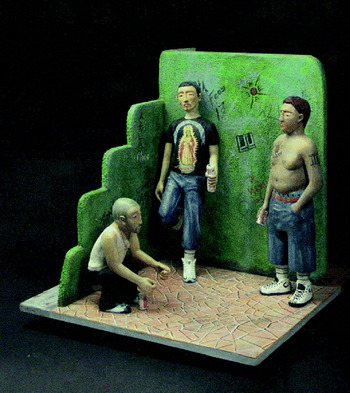
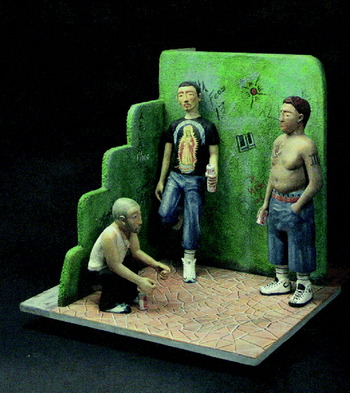
Similarly, the multiple-figure work Untitled (2002) (Figure 3) blurs sacred and secular domains, outside and inside space, the traditional domestic home altar and urban street art. By creating “multi-figure works in expanded architectural environments,” notes Jacinto Quirarte, Tapia “has literally shifted the visual position from which santos are ordinarily viewed.”Footnote 26 Rather than contained within a church or an altar, Tapia's bulto becomes a piece of installation art, a living shrine where the viewer is obliged to move physically in order to view the work in its totality. Untitled juxtaposes interior and exterior space, moving religion onto the street, the car, the wall and the bodies of the three men: the Guadalupe T-shirt and Rosa tattoo invoke the notion of “divine perfection,” the rose being central to the narrative of the Virgin Mary of Guadalupe's appearance to the Indian Juan Diego in Tepeyac, near Mexico City, in 1531. Meanwhile, the man's bodily inscriptions underscore the significance of tattooing, placas and graffiti in Chicano–Hispano barrio culture as memorial markers for the living and deceased.
Luis Tapia, Untitled, 2002, 21¼ × 19¾ × 21¾ in. Photo: Owings-Dewey Gallery, Santa Fe. Reproduced with the permission of the artist.
Tapia's Dos Pedros Sin Llaves (Two Peters without Keys) (1994) extends this perspective by considering the significance of religious iconography in tattooing or pinto (prison inmate) art. Here, pinto art expresses a religious sensibility capable of reclaiming and redeeming the oppressed Latino body.Footnote 27 Two prison inmates are canonized and sacralized as they stand before a gate that doubles as prison and pathway to heaven, mirroring the notion that Hispano inmates are crucified Christ-like figures who bear the markings of stigmata on their oppressed bodies through tattoos which serve to heal and transform. If these bodily inscriptions and images of Guadalupe underscore the historical importance of the Latino body as a site of racialization, difference and resistance, they also establish the parallel significance of cloth and human skin in Christian and pre-Columbian ritual: Aztecs worshipped the god of regeneration, Xipe Totec, by wearing the flayed skin of their sacrificed subjects, and while Guadalupe's image appeared on the Aztec tilma (cloak) of Juan Diego in 1531, recent studies of paño (handkerchief art) by Hispano prison inmates also suggest that “salvific action can be transmitted through cloth.”Footnote 28 Here, Tapia is closer to understanding the syncretic and material realities of seventeenth-century santos, which were created on “hides, textiles, and walls” rather than on cottonwood with locally made dyes and pigments.Footnote 29
Tapia employs aspects of what Tomás Ybarra-Frausto defines as a rasquache aesthetic. In Ybarra-Frausto's concept of rasquachismo, “art objects” rooted in everyday, working-class contexts and vernacular sites and rituals invoke a carnivalesque aesthetic that “turn[s] ruling paradigms upside down.”Footnote 30 For example, Tapia's santos challenge spatial, temporal and artistic binaries, often transforming the secular into the divine and divine images into a popular iconography of resistance. As Dinah Zeiger writes of contemporary santos, it is precisely their “multivalent meanings” which allows them to “appeal across a spectrum of religious practice and belief.” Tapia replicates the historical and contemporary everyday realities of santos, not simply in the material sense, but in terms of their usage. By creating santos “for a practical kind of Christianity,” Tapia simultaneously resists the commercialized meanings attached to santos as they pass through the marketplace, while acknowledging the power of global consumerism at the local level to channel religiosity through the iconography of popular and barrio cultures.Footnote 31 Ultimately, by adorning cars, cloth and bodies with a hybrid spiritual aesthetic, Tapia enacts a mode of religious performativity in which multiple-figure bultos celebrate everyday life as art and barrio iconography as spiritually “redemptive.” Elsewhere, Tapia has affirmed the syncretic realities of colonial and religious art by exploring the interpenetration of Hispano and indigenous cultures, as in the altar screen that he produced for San Ildefonso Pueblo, which integrated a Native pantheon and santography.Footnote 32 In the pieces discussed above Tapia's hybridity engages less the crossing of ethno-cultural lines and more the permeable borders between traditional and contemporary expression, secular and sacred realms, high and low art forms, and local and global forces. Tapia's hybridity shares elements with the boundary-crossing rasquache aesthetic, particularly in terms of its ability to destabilize prevailing visual, cultural and social norms.
Ray Martín Abeyta's “Mestizo” Baroque
Ray Martín Abeyta, born near Española but now residing in Brooklyn, New York, also finds inspiration in Spanish colonial art forms. Abeyta reworks Spanish colonial baroque painting from the seventeenth and eighteenth centuries, fusing Catholic imagery, pre-Columbian mythology, santería and pop culture to underscore the complex, diasporic meaning of the colonial in the Americas. Having rejected abstract expressionism at art school, Abeyta experimented with baroque realist painting and its core elements of light, decoration, pastoralism, performance and theatricality, all the time pondering how he could “use traditionalism to go into the future.” Abeyta describes himself as “not religious at all,” yet remains drawn to the “rituals and imagery of Catholicism.” Of his childhood, he declared, “I loved looking at the santos, those wooden-paneled paintings of really gruesome Jesuses, even though they frightened me. As a kid I would go to the hillside chapels where the whole community gathered.” Abeyta's memories testify that while the baroque failed to flourish as an “artistic aesthetic” in New Mexico (as it did in Mexico and Peru), it certainly flourished through religious ceremony and performance, through pilgrimages and the rites of the Penitente Brotherhood.Footnote 33
A synthesis of European, African and indigenous influences, the baroque is no longer viewed as “a seventeenth-century instrument of empire”; rather, it is “a contemporary instrument of cultural revision and renewal,” claim Zamora and Kaup.Footnote 34 This template for a mestizo or New World baroque is useful for reframing purist notions of Spanish colonial art. Abeyta's La Ofrenda II, Los Corazones (The Offering II, The Hearts, 1993) uses the baroque mixed-media stylings of the retablo to explore cross-cultural exchange in the New World. Christ and the Aztec god of regeneration, Xipe Totec, are positioned together, almost mirroring one another: they are framed by a white dove and a hummingbird, symbolizing peace and war, and by the Sacred Heart of Catholicism and the sacrificial Aztec heart.Footnote 35 Abeyta's mirroring strategy explores the apparent equivalences between European and indigenous belief systems, which helped pattern syncretic religious practices and the persistence of indigenous forms behind Spanish Catholic facades or, as in Abeyta's work, beneath a baroque veneer. There are moments in Abeyta's paintings when these juxtapositions suggest rupture, making the process of transculturation tangible, while at other times it is difficult to discern anything but a seamless image.Footnote 36 On first glance, for example, we fail to notice that in Abeyta's Santiago (1994), Saint James the Moor Killer is dressed as a Latin American general, for as Zamora and Kaup claim, New World baroque “includes mimicry and subversion … but also the more ambiguous processes of selection, synthesis, exaggeration, sublimation, mediation, and revision.”Footnote 37 Abeyta notes that mestizo baroque
started as a miscommunication and a bad translation of a certain kind of aesthetic that was imported to the Americas and forced on people, mostly Native Americans and Africans, and into their cultures and religions … That's when the artwork became re-adapted, a translation of someone else's ideas,
transitioning from a tool of empire and subjugation to a tool of resistance and redemption. Abeyta adds, “To me it has become much more interesting, powerful, dangerous, and beautiful than it was intended to be. The mestizo-baroque movement has a transformative quality, and because politics, religion, colonialism, and conquest all come into play, it's also very complex.”Footnote 38 Because mestizo baroque asserts “an impulse towards inclusion … an effort to bridge historical and cultural rupture, to assemble disparate cultural fragments – past and present, European and non-European,” it offers possibilities for transformation.Footnote 39 Abeyta describes the mestizo baroque as “a moment that continues to resonate into the present,” and his aesthetic mirrors Frausto's playful, subversive rasquachismo with its focus on display, performance and layering.Footnote 40
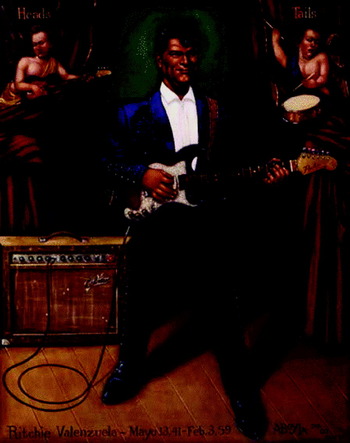
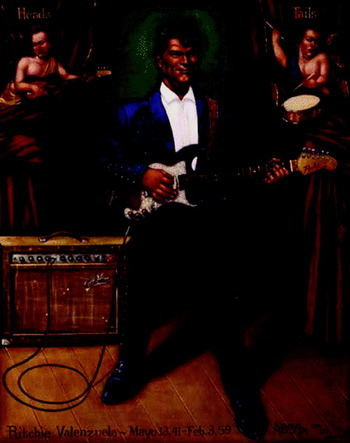
Abeyta achieves this cultural, spatial and temporal “bridging” by embedding the mestizo baroque within popular culture and the Latinization of the United States, thus reflecting his own wanderings within the Latino diaspora as a native New Mexican now living in Brooklyn, New York. In Ritchie Valenzuela (2004) (Figure 4), Abeyta wraps Mexican American and US popular culture within Spanish colonial art forms. Abeyta re-Mexicanizes the singer Ritchie Valens with his original surname, Valenzuela, challenging the music industry's capacity for cultural appropriation and homogenization. Yet Ritchie is neither Mexican nor Anglicized, but something in between: he is a symbol of mestizaje and the pioneer of Chicano rock, itself a deeply mestizo cultural expression which blended Mexican song with mainstream rock and roll. Valenzuela becomes a saintly Chicano icon, as resplendent in his mestizaje as Guadalupe: illuminated and sacralized, Valenzuela is framed by two angels and lavish curtains which mimic his deep-blue velvet costume, the embellished costume of the traditional Mexican charro, and his pompadour hairstyle, popularized by both Mexican Americans and Anglos in 1950s America. Here, the spiritual is enacted through hybridity and performativity. The inscription below, Valenzuela's date of birth and death, transforms this image into an obituary, or rather an ofrenda (a commemoration or altar offering) to the deceased, layering 3 February 1959, the “Day the Music Died,” onto Mexico's Day of the Dead, and US popular culture onto Mexican popular culture. Like Abeyta's La Ofrenda II, Ritchie Valenzuela mimics the colonial pattern of religious syncretism in terms of layering, the curtains signifying not simply the theatricality of the baroque but the existence of a baroque veneer.
Ray Martín Abeyta, Ritchie Valenzuela, 2004, oil on linen, 60×48 in. Photo: Patricia Correia Gallery, Los Angeles. Reproduced with the permission of the artist.
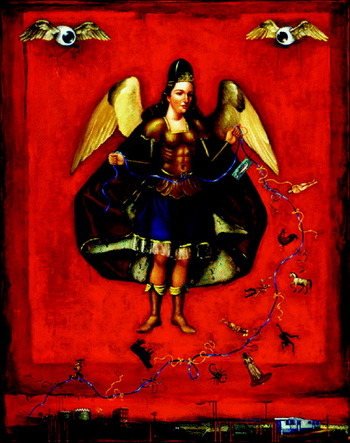
Abeyta's residence in Brooklyn has perhaps inspired his exploration of the creolization and Caribbeanization that characterize an increasingly Latinized New York, and the centrality of African-based cultural religions, such as santería, voodoo/vodou and candomblé, which fuse Yoruba deities with Catholic saints. In Santa Barbara/Chango, Reina de los Orishas (2002), Santa Barbara/Chango becomes “our lady of the projects,” a female Catholic saint-cum-male Yoruba deity who represents the power of transnational religion to palliate inequality in the contemporary Latino metropolis. San Raphael (2003) (Figure 5) revisits this theme, extending Abeyta's experimentation with the ofrenda and retablo form. Floating eyes signify San Raphael's status as patron of the blind, travellers and healing. Yet Abeyta inverts the traditional pastoral landscape of the baroque, depicting instead an urban industrial wasteland, the home of contemporary travellers and recent Latin American migrants. The blood-red background frames Raphael, mimicking the intensity and opulence of the baroque and evoking a stage-like performance. Yet as the red paint drips like blood to the bottom of the canvas, invading and infesting the urban wasteland below, it no longer signifies the theatricality of the baroque but the perils of environmental racism in the contemporary Latino metropolis.
Ray Martín Abeyta, San Raphael, 2003, oil on canvas, 60×48 in. Photo: Owings-Dewey Gallery, Santa Fe. Reproduced with the permission of the artist.

Scanning the minutiae of this urban desert scene, we encounter Old and New World symbols recycled from Abeyta's earlier works: Raphael holds not only the fish that he told Tobias to catch and with which Raphael heals Tobit's blindness, but Santa Barbara/Chango, a bull, rooster, monkey, scorpion, a Latin American general, charro-matador, Quetzalcoatl and Eve. These recycled elements become recuerdos (memories), registering the labyrinthine nature of space and time and the parallels between disparate religious, cultural and artistic systems. Like traditional ofrendas, Abeyta's image engages in syncretic accumulation, mixing devotional objects, mementos and personal memorabilia. If Abeyta's bricolage-style composition melds the repetition of pop art ephemera with aspects of a Chicano rasquache aesthetic, these objects also resemble pre-Columbian glyphs, codices and Mexican almanaques (calendars), which depict images ranging from saints to bull- and cockfighting scenes.Footnote 41 They also resemble relics with their ability to migrate and “mediate between the living and the dead,” and milagros – objects, often silver amulets, which are pinned to a saint as an offering or request for aid.Footnote 42 The tying of the objects to string also mimics paper arts such as piñatas and papel picado (paper cut-outs), which were used as banners in Aztec ceremonies for their spiritual and healing properties. Although believed to originate in China and then adopted by Europeans in the Americas, the piñata found a pre-Columbian counterpart in the breaking of a clay pot with a stick, said to celebrate Huitzilopochtli, the Aztec god of war. Europeans deployed the piñata to Christianize indigenous communities; the blindfolded person breaking the piñata became a subject of “blind faith” whose stick, like Raphael's, symbolized virtue.Footnote 43
The objects become “holy in themselves”; they are “images-as-presence” in the Catholic sense and images “embodied and spectacular” according to the pre-Columbian concept of ixiptla.Footnote 44 In turn, the scene invokes a ritual performance, an offering of the syncretic religio-cultural symbols of latinidad. If these symbols register the trauma of the colonial encounter – loss, fragmentation and deculturation – they also signify the process of cultural reclamation as they become “power objects” embedded within a new contemporary setting.Footnote 45 This multivalent, altar-like scene serves as both performance and social critique: it embodies the possibility for healing and transcendence through the symbols of transculturation and transmigration and through Abeyta's saint, who is suspended as an intercessor in a reworked retablo form.
Marion Martinez's “Mixed-Tech Media”
Mixed-media artist Marion Martínez also explores the terrain of hybrid spirituality and religious performance by reconfiguring established forms of Spanish colonial art. Martínez recycles the detritus of global capitalism by salvaging and reusing computer parts – circuit boards, wires, resistors, audio plugs and cables – thereby employing technology to rework religious iconography and the santero tradition. Born in Española but raised in Los Luceros, forty-five miles from Los Alamos, Martínez trained as a psychotherapist working with Hispano and Native American families. After experimenting with video art during the 1980s, Martínez opened up the back of a computer in the 1990s and began recycling circuit boards, transforming them into retablos, bultos and what she calls “mixed-tech media.” As Martínez notes, “My [art] works on many levels. It's recycling a medium that gets discarded by the tons, locally, nationally, worldwide.”Footnote 46 Like Tapia's and Abeyta's works, Martínez's “mixed-tech media” demonstrates elements of a rasquache and recycling aesthetic, integrating everyday found items into art and the santero tradition of New Mexico, to express a hybrid spirituality rooted in both local and global contexts.
Martínez's recycled materials derive from the Black Hole Los Alamos Salvage Laboratory Yard. Los Alamos National Laboratory (LANL) occupies an ambiguous position in the Hispano community: while LANL opened up Hispano New Mexico to postwar industry and employment, it also generated environmental racism and exploitative low-wage labour. While a student, Martínez worked at LANL; so too did her mother and sister, while another of Martínez's sisters worked at Sandia National Laboratories in Albuquerque. As Catherine Ramírez notes, Martínez's use of discarded computer technology challenges primitivist discourses about rural Hispanos while critiquing the global systems that perpetuate local-level racism.Footnote 47 Martínez's critique of New Mexico is also evident in the “death truck” series of santero Nicholas Herrera. Playing with the image of the skeletal Doña Sebastiana in the traditional death cart or carreta, Herrera redeploys Spanish colonial art to critique New Mexico's structural inequalities. After handing in his notice at Los Alamos Laboratory when ordered to clear away radioactive waste, like many of Los Alamos's Hispano road workers, Herrera made Los Alamos Death Truck (1995). Here, three skeletons drive a truck loaded with barrels of radioactive waste; as they smoke and drink, the devil dances in the back of the truck, intimating the sacrificial nature of Hispano life and the deep connection between racialization, poverty and death in a state which is more accurately characterized as a land of disenchantment, to quote ethnographer Michael Trujillo.Footnote 48
If Herrera's references to global technology inject a sociopolitical critique into the santero tradition by underscoring the dystopian, subjugating force of technology, Martínez employs technology as both critique and transformation: discarded computer parts allow Martínez to materially reinvent the santero tradition while technology's power as a new secular religion offers the possibility of healing cultural and generational conflicts at the local level, in much the same way that established forms of faith and healing practices such as curanderismo possess curative properties. For Martínez, technology is a new form of ritual communion, which, despite its seemingly omnipresent, god-like power, should be simultaneously demystified and celebrated, literally, by taking the computer apart. She says, “Once you get beyond the awesomeness of computers and what they do and go internal, there's beauty in them and they're not so ominous.” Martínez views technology as a “universal language” capable of transmitting cultural and religious symbols across time and space so that religion never becomes a redundant force. She explains, “you can take from the old and use the new in a way that enhances and enriches our culture.” Although “technology changed a lot of things,” claims Martínez, it is also a vehicle for sustaining and channelling tradition into the shaping of hybrid spirituality.Footnote 49
Martínez's circuit-board retablos experiment with established symbols of hybrid spirituality, the syncretic mestiza virgin, La Virgen Morena, and the sacred heart, symbol of Christian and pre-Columbian sacrifice. Martínez explains that the Virgin Mary of Guadalupe
has and continues to be my spiritual Mother, the compassionate Mother, the Divine feminine, available to comfort and protect … she also represents my connection to the earth, the sacred earth that nurtures and sustains life, and as La Virgen Morena, she is a reflection of my culture, of myself.Footnote 50
Through her deep connection with the “sacred earth,” Martínez's Virgin is simultaneously the Aztec earth goddess, Tonantzín, a composite deity who embodies the local cultural politics of mestizaje and contemporary global environmental concerns. “The Virgin appears in many fashions and many places,” asserts Martínez, suggesting not only the Virgin's deeply syncretic character – Guadalupe appeared before Juan Diego at the site of Tonanztín's shrine on Tepeyac Hill in 1531 – but her transfiguration through technology.Footnote 51 Indeed, the act of re-creating La Virgen's image is an act of faith for Martínez, a performance in itself. Like Tapia's multiple-figure bultos, Martínez's santos are “multivalent,” responsive to personal and communal needs, and, in their mestizaje, destabilizing of the purist dictates of the marketplace.
In New Mexico, nowhere are these elements of mestizaje and hybrid spirituality more evident than in the religious dance-drama known as los Matachines. The Matachines dance is an “Indo-Hispano ritual” performed on feast days in Hispano and Pueblo communities and across Greater Mexico, to celebrate the Virgin Mary of Guadalupe, among other saints.Footnote 52 Los Matachines is allegedly based on a fifteenth-century Spanish sword dance that narrates the conquest of the Moors by the Christians and the triumph of good over evil. Once transferred to the New World, the dance became a tool for evangelizing local indigenous populations. In the Americas, the Moor-versus-Christian narrative became that of the Conquest: dancers wearing ceremonial headdresses with fringed masks, ribbons and swords narrate the story of Montezuma's conversion by La Malinche, Hernan Cortes's Indian mistress and intermediary. Recent anthropological research by Brenda Romero and Enrique Lamadrid, as well as photographic documentation of contemporary Matachines performances by Miguel Gandert, challenges the Hispanophile tendency to elevate the “Spanish” origins of Hispano identity and cultural production at the expense of mestizo, indigenous and Mexican influences. Los Matachines, notes Romero, is “the result of syncretism and adaptation to intercultural coexistence in the New World.”Footnote 53 As the dance evolved, indigenous elements became embedded within it, such as the trickster-style figures los Abuelos (grandfathers) who, tellingly, kill the Spanish bull, el torito, as it attempts to abduct La Malinche, while recently arrived Mexican immigrants continue to alter its content, narrative and structure.Footnote 54 This dance underscores the intercultural realities that make New Mexico deeply Indo-Hispano and mestizo.
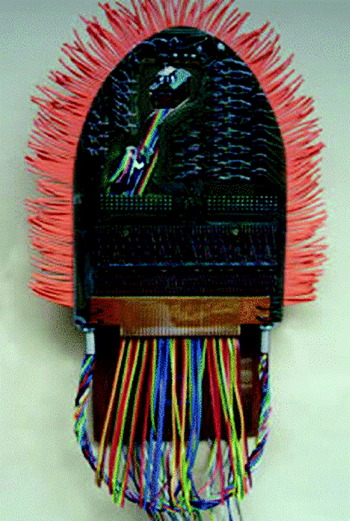
By fusing technology with the santero tradition, Martínez reproduces the ritual objects that have traditionally been part of the Matachines performance as pieces of artwork. Her choice to do so is doubly significant. First, the melding of religious ritual with technology suggests that, rather than serving as incompatible domains, both the contemporary secular and spiritual realms facilitate aesthetic experimentation. Second, Martínez marries a deeply mestizo and diasporic ritual performance with an established local art form that is too often viewed as expressive of Hispanos’ “Spanish” roots. Martínez re-creates the ceremonial matachin headdress, which mimics a bishop's mitre but is known locally by the Nahuatl word cupil. In Sueño del Matachine (2005) (Figure 6) and Matachine Mask with Guadalupe (2002), Martínez recycles circuit boards and wires, using the ribbon cables to create the fringed mask of the matachin dancer and insetting each headdress with a tiny image of Guadalupe. In Tortugas, a mestizo community near Las Cruces, the December pilgrimage to the top of Tortugas Mountain in celebration of Guadalupe is followed by los Matachines. The dancers’ headdresses display the image of the Virgin and are adorned with mirrors and milagros; in Martínez's headdresses, the shininess of the circuit-board elements simulate a jewel-like appearance.Footnote 55 Similarly, in the centre of El Sueño (The Dream), Martínez reenacts this pilgrimage by depicting a tiny caped figure, both Juan Diego and the contemporary pilgrim, ascending the hill towards a shrine. The different colours of the circuit-board ribbons mirror the patterned cloak of the climbing pilgrim, also the sacred tilma of Juan Diego, while extending downwards to embrace the three-pronged palma, which signifies not simply the Holy Trinity, but the status of the pre-Columbian feathered serpent deity, Quetzalcoatl, as god of air, land and water.Footnote 56 Meanwhile, the shininess of the circuit-board background illuminates and sacralizes the entire scene: the centrepiece has the illusion of being embalmed in a halo-like light when viewed from a particular angle, resembling a retablo as well as a headdress. Ultimately, the matachin headdress represents what Martínez, with reference to her broader aesthetic, calls “the coming together of ancient wisdom with present-day and futuristic icons.”Footnote 57 The headdress is a “reflection of sacred public space,” a symbolic re-creation of the pilgrimage which maps an alternative, hybrid “spiritual geography.”Footnote 58 As a symbol of religious performativity and hybridity, Martínez's headdress invokes the transformation of the santero tradition, and the Virgin of Guadalupe, into the twenty-first century.
Marion Martínez, Sueño del Matachine, 2005, 20×10×1½ in. Reproduced with the permission of the artist.

For Martínez, who was raised in a Hispano household without denying her Native American roots (she attended San Juan Pueblo's school), hybrid spirituality serves to heal ethnic, cultural and generational schisms, not least because religious sensibility and performance lie at the heart of New Mexico's lived, intercultural history. “As a culture in Northern New Mexico, most of us have been influenced by each other, and religion plays a part in that,” claims Martínez. “My artwork represents the coming together of the dichotomy of my life experiences,” she concludes. Like Tapia and Abeyta's work, Martínez's hybrid spirituality heals by resolving the binaries that have historically confined Hispano art and identity: high versus low art, tradition versus modernity, local versus global, and Hispanophilia versus indigenism. Having worked with Hispano and Native American communities as a therapist, Martínez realized that both communities displayed “three-generational family systems with very deep issues surrounding loss of culture.” Yet, for Martínez, “Culture isn't biodegradable … nor should it be.” “We can't forget where we came from and who we are as people; the consequences are too great.”Footnote 59 Ultimately, culture becomes synonymous with the earth; with regrowth, renewal and recycling; and with the act of remembering through performance. By embedding religious iconography in new technological forms and an environmentalist aesthetic, Martínez also celebrates and perpetuates the Indo-Hispano heritage as a dynamic force in contemporary Nuevomexicano life.
The celebration of the Indo-Hispano heritage and Martínez's creative engagement with mestizaje constitute a powerful challenge to purist notions of Spanish colonial art and Hispano identity, for, as critic Rafael Pérez-Torres argues, mestizaje not only “suggests the volatility and mutability of racial identity,” but it also reveals the oppressive colonial and neocolonial struggles that have historically shaped racial and ethnic subjectivities in the region. Martínez's engagement with mestizaje invokes Pérez-Torres's model of critical mestizaje in which “the weight of historical legacies and the hope of a transformative future” are revealed, critiqued and conjoined.Footnote 60 By confronting environmental racism and the region's history of ethnic erasure, Martínez generates new possibilities for artistic experimentation, ethnic reidentification and cultural critique.
Conclusion
Chicana artist Amalia Mesa-Bains notes that in the colonial Americas “the sacred and the spiritual were imbued with political meanings as signs of indigenous survival … The arts have often sustained and disguised the politicized spirituality of Chicano/a communities.” Likewise, Laura Pérez has recently traced “the politics of spiritual and aesthetic altarities” in contemporary Chicana art, countering the prevailing dichotomy between the political and the spiritual in Western thought, evident in academic and art discourse in particular.Footnote 61 Tapia, Abeyta and Martínez continue this politicized hybrid spirituality, linking New Mexico with a wider Chicano diaspora, by exploring the interpenetration of Spanish colonial artforms and religious sensibilities with technology, consumerism, popular culture, indigenous worldviews and new Latino migrations. Martínez's “mixed-tech media,” Abeyta's “mestizo baroque” and Tapia's multiple-figure bultos challenge the SCAS's purist notions of art and ethnocultural identity. Mirroring Laura Pérez's view of art as transformation and ofrenda, these artists explore “hybrid spiritualities” and ritual performance in particular, enacting a shift in the politics of Hispano identity and cultural ownership, towards a mestizo past, present and future based not on abandoning but on redefining the Hispano heritage. They do so without abandoning tradition, for Hispano spirituality and its varied aesthetic expressions are, and always have been, mestizo formations tied to wider Latino, Latin American, indigenous and transnational worlds. And, as Amalia Mesa-Bains reminds us, far from preventing experimentation, it is the spiritual realm more broadly that has continually fostered such transformations.
Most importantly, just as mestizaje has been forged from histories of struggle and oppression, these aesthetic practices remind us that “multiplicity and complexity [are] … a result of domination.”Footnote 62 Tapia's use of the racialized Latino body as a site of performance and spiritual redemption, Abeyta's memory of violent colonial encounters as a bridge to the new Latino metropolis, Martínez's recuperation of indigeneity through global technology in response to ethnic erasure and environmental racism locally, all suggest that forms of critical mestizaje are embedded in these artists’ works. Together, these forms of critical mestizaje reveal that hybrid spiritualities are rooted in “processes of rejection and reclamation,” illuminating histories of pain and oppression while building new templates for ethnic and cultural belonging.Footnote 63