INTRODUCTION
Early vocabulary as predictor of toddlers' later vocabulary and grammar acquisition
Toddlerhood is a period of rapid vocabulary development (Brooks & Meltzoff, Reference Brooks and Meltzoff2008; Fenson et al., Reference Fenson, Dale, Reznick, Thal, Bates, Hartung, Pethick and Reilly1994). Toddlers typically show signs of word comprehension before their first birthday, while producing their first words a few months later. Toddlers' vocabulary size increases very quickly after the age of 1;6 (Bates & Goodman, Reference Bates, Goodman, Tomasello and Bates2001; Fernald, Pinto, Swingley, Weinberg & McRoberts, Reference Fernald, Pinto, Swingley, Weinberg, McRoberts, Tomasello and Bates2001), accelerating especially as toddlers begin to produce simple word combinations (Fernald & Marchman, Reference Fernald and Marchman2012). Kauschke and Hofmeister (Reference Kauschke and Hofmeister2002), for instance, found that there was an exponential increase in vocabulary production of German-speaking toddlers in the second year, and that this was followed by a further expansion. The findings of a cross-sectional study (Marjanovič-Umek, Fekonja-Peklaj & Podlesek, Reference Marjanovič-Umek, Fekonja-Peklaj and Podlesek2013), carried out on a Slovenian-speaking sample of infants and toddlers, showed that during the period between 0;8 and 2;6 vocabulary increased in line with a quadratic function, indicating that vocabulary growth accelerated over time. Similarly, Bates, Dale, and Thal (Reference Bates, Dale, Thal, Fletcher and MacWhinney1995) state that for most of the toddlers the vocabulary growth is positively accelerated after 1;0. Several longitudinal studies (e.g. Bates et al., Reference Bates, Dale, Thal, Fletcher and MacWhinney1995; Reznick & Goldfield, Reference Reznick and Goldfield1994) have proved the high stability of vocabulary size over time with test–retest correlations in the period between 0;8 and 2;6 of around .90. The greatest discontinuity in individual differences was typically found to occur at approximately 1;0, which, according to Bates et al. (Reference Bates, Dale, Thal, Fletcher and MacWhinney1995), might reflect a general reorganization of infant cognition at 1;0 or a discontinuity in parental perceptions of infant's language.
However, there are striking differences among toddlers in patterns of early vocabulary growth (Bleses et al., Reference Bleses, Vach, Slott, Wehberg, Thomsen, Madsen and Basbol2008; Devescovi, Caselli, Marchione, Pasqualetti, Reilly & Bates, Reference Devescovi, Caselli, Marchione, Pasqualetti, Reilly and Bates2005; Fenson et al., Reference Fenson, Dale, Reznick, Thal, Bates, Hartung, Pethick and Reilly1994; Fernald et al., Reference Fernald, Pinto, Swingley, Weinberg, McRoberts, Tomasello and Bates2001); children vary widely in the rate at which they acquire words – some start slow and speed up, others start fast and continue at a steady pace (Rowe, Raudenbush & Goldin-Meadow, Reference Rowe, Raudenbush and Goldin-Meadow2012). Some infants start speaking before their first birthday, while others do not produce words until the end of the second year (Fenson, Marchman, Thal, Dale, Reznick & Bates, Reference Fenson, Marchman, Thal, Dale, Reznick and Bates2007). Fernald and Marchman (Reference Fernald and Marchman2012) emphasize that although delayed onset of expressive language can be a risk factor for later language and academic difficulties, early delays in vocabulary development are often short-lived. On the other hand, longitudinal data also show that although some late talkers catch up in vocabulary a few months later, others may continue to show slower trajectories of language growth and achieve lower levels of language proficiency at later ages (Bates et al., Reference Bates, Dale, Thal, Fletcher and MacWhinney1995; Fernald & Marchman, Reference Fernald and Marchman2012).
There are several CDI studies which have been carried out on cross-sectional samples of infants and toddlers that do not allow for constructing a growth curve from two points of assessment nor making conclusions about the developmental changes in vocabulary development. Our study is designed as a longitudinal study, carried out during a 15-month period with toddlers aged 1;4 at the time of the first assessment and 2;7 at the time of the last of the six assessments. The questions we ask are how vocabulary develops between 1;4 and 2;7 years of age, and whether toddler's vocabulary remains stable over time, as well as whether the differences in the rate at which vocabulary is acquired in the earliest stages predict toddlers' vocabulary and grammar at the later age of 2;7. In addition, we examined the role of parental education and the frequency of shared reading in a child's vocabulary and grammar at 2;7.
The findings of several studies show that across different languages toddlers' vocabulary is related to their acquisition of grammar (e.g. Bleses et al., Reference Bleses, Vach, Slott, Wehberg, Thomsen, Madsen and Basbol2008; Caselli, Casadio & Bates, Reference Caselli, Casadio and Bates1999; Conboy & Thal, Reference Conboy and Thal2006; Devescovi et al., Reference Devescovi, Caselli, Marchione, Pasqualetti, Reilly and Bates2005; Jackson-Maldonado, Thal, Marchman, Bates & Gutiérrez-Clellen, Reference Jackson-Maldonado, Thal, Marchman, Bates and Gutiérrez-Clellen2000; Marchman & Bates, Reference Marchman and Bates1994; Marjanovič-Umek et al., Reference Marjanovič-Umek, Fekonja-Peklaj and Podlesek2013; Stolt, Haataja, Lapinleimu & Lehtonen, Reference Stolt, Haataja, Lapinleimu and Lehtonen2009). The new types of words that are increasingly included in toddlers' vocabulary enable them to combine words into grammatically more and more complex utterances (Bates & Goodman, Reference Bates and Goodman1997; D'Odorico & Carubbi, Reference D'Odorico and Carubbi2003; Tomasello & Bates, Reference Tomasello, Bates., Tomasello and Bates2001). According to Bates et al. (Reference Bates, Dale, Thal, Fletcher and MacWhinney1995), lexicon and grammar in normally developing toddlers are closely related. In fact, the findings of a Slovenian cross-sectional study, carried on a sample of toddlers, aged from 1;4 to 2;6, suggest that with every increase of one word in vocabulary, the probability that a toddler combines words into sentences increases by 1·4% (Marjanovič-Umek et al., Reference Marjanovič-Umek, Fekonja-Peklaj and Podlesek2013).
Overall, vocabulary size has been proved to better predict the development of grammar than toddlers' age (e.g. Bates, Reference Bates, Levi-Montalcini, Baltimore, Dulbecco, Jacob, Bizzi, Calissano and Volterra2003; Devescovi et al., Reference Devescovi, Caselli, Marchione, Pasqualetti, Reilly and Bates2005). The findings of one English longitudinal study, carried out by Bates, Bretherton, and Snyder (Reference Bates, Bretherton and Snyder1988), suggest that there is more continuity from early vocabulary to grammar than from early vocabulary to later vocabulary, with the age 1;1 lexical measures predicting 2;4 MLU better than they predicted 2;4 vocabulary. In addition, Can, Ginsburg-Block, Michnick Golinkoff, and Hirsh-Pasek (Reference Can, Ginsburg-Block, Michnick Golinkoff and Hirsh-Pasek2013) found that early vocabulary at 1;10 accounted for 17% of the variance in expressive vocabulary, 11% of the variance in syntax, and 7% of the variance in semantics at 6;1. However, the relationship between vocabulary and grammar was not found to be of the same nature in different languages; for example, while Devescovi et al. (Reference Devescovi, Caselli, Marchione, Pasqualetti, Reilly and Bates2005) found that the relation between MLU and vocabulary of Italian-speaking toddlers assessed with the CDI is linear, the relation between these two measures in English-speaking toddlers was found to be non-linear (Bates et al., Reference Bates, Bretherton and Snyder1988).
Although the characteristics of early vocabulary development and its relation to later grammar acquisition have been well examined, especially in the English language, less is known about the role of early family literacy activities in toddlers' vocabulary development and acquisition of grammar. As Raikes et al. (Reference Raikes, Pan, Luze, Tamis-LeMonda, Brooks-Gunn, Constantine, Tarullo, Raikes and Rodriguez2006) argue, there is a surprising lack of research on the importance of reading to toddlers before the age of three. That is why, in our study, we also aimed to establish the importance of early parent–child book-reading for toddlers' vocabulary and grammar.
The role of shared book-reading in toddlers' early language development
Variations in early social-interactive environments are proved to be associated with variations in vocabulary growth rates, thus highlighting the importance of understanding the role that parental and family factors play in a child's language development (Rowe et al., Reference Rowe, Raudenbush and Goldin-Meadow2012). Parents often interact with their toddlers through children's books even before they speak their first word (Pellegrini & Galda, Reference Pellegrini and Galda1998; Sénéchal & LeFevre, Reference Sénéchal and LeFevre2002; Silvén, Ahtola & Niemi, Reference Silvén, Ahtola and Niemi2003). Several authors (e.g. Baldwin, Reference Baldwin, Moore and Dunham1995; Farrant, Reference Farrant2012; Farrant & Zubrick, Reference Farrant and Zubrick2011) emphasize that parent–child book-reading simultaneously involves joint attention, pointing gestures, and verbal labelling, thus providing toddlers with an opportunity for acquiring new words in a well structured setting. Silvén et al. (Reference Silvén, Ahtola and Niemi2003) argue that in the process of shared book-reading, parents frequently engage their children in verbal interaction, use statements to direct their attention, ask questions, name the illustrations, and encourage children's responses.
Parent–child shared reading has been found to promote different aspects of child language development, particularly vocabulary acquisition and grammar (e.g. Mol & Bus, Reference Mol and Bus2011; Reese & Cox, Reference Reese and Cox1999; Sénéchal, Pagan, Lever & Ouellette, Reference Sénéchal, Pagan, Lever and Ouellette2008; Sénéchal, Thomas & Monker, Reference Sénéchal, Thomas and Monker1995). Shared book-reading, especially a dialogic one, provides children with opportunities for learning the meaning of new words, as well as for hearing complex language used by adults when interacting with children around a book (Duursma, Augustyn & Zuckerman, Reference Duursma, Augustyn and Zuckerman2008). Westerlund and Lagerberg (Reference Westerlund and Lagerberg2008), for instance, found that frequent shared book-reading was significantly related to toddlers' expressive vocabulary at age 1;6. The authors established that reading to a toddler at least six times a week added more than 0·3 of standard deviation to toddlers' vocabulary. Similarly, in their longitudinal study of 2,369 Australian children, Farrant and Zubrick (Reference Farrant and Zubrick2013) found that children who had low levels of parent–child book reading from 1;9 to 4;10 were two and a half times more likely to have poor receptive vocabulary at 4;10. In their longitudinal study, Raikes et al. (Reference Raikes, Pan, Luze, Tamis-LeMonda, Brooks-Gunn, Constantine, Tarullo, Raikes and Rodriguez2006) also found that maternal book-reading was positively related to toddlers' vocabulary at the ages of 14, 24, and 36 months. In addition, Malin, Cabrera, and Rowe (Reference Malin, Cabrera and Rowe2014) highlight the importance of parental use of metalingual talk during shared book-reading for the receptive vocabulary of toddlers. The authors found that, although the frequency of parental reading to a toddler was not associated with a toddler's receptive vocabulary, the reading quality was proved to promote receptive vocabulary in toddlers aged 2;0. According to Farrant (Reference Farrant2012), the beneficial effects of parent–child book-reading continue into later development, where it provides opportunities for children to learn the meanings of new words in terms of their existing vocabulary. Shared book-reading is also associated with the child's development of grammar. In several studies it has been found to be related to the length of children's utterances, as a general index of syntactic development, in the first three years of life (Blake, Macdonald, Bayrami, Agosta & Milian, Reference Blake, Macdonald, Bayrami, Agosta and Milian2006; Huebner, Reference Huebner2000; Lyytinen, Laakso & Poikkeus, Reference Lyytinen, Laakso and Poikkeus1998). According to Whitehurst et al. (Reference Whitehurst, Falco, Lonigan, Fischel, DeBaryshe, Valdez-Menchaca and Caulfield1988), particularly the use of interactive strategies (e.g. using open-ended questions, function/attribute questions and expansions; appropriately responding to children's attempts to answer questions) during the shared reading positively affects a child's mean length of utterance and the frequency of phrases use.
A review of several studies shows that shared book-reading is closely related to maternal education (e.g. Lyytinen et al., Reference Lyytinen, Laakso and Poikkeus1998; Raikes et al., Reference Raikes, Pan, Luze, Tamis-LeMonda, Brooks-Gunn, Constantine, Tarullo, Raikes and Rodriguez2006; Scarborough & Dobrich, Reference Scarborough and Dobrich1994; Westerlund & Lagerberg, Reference Westerlund and Lagerberg2008). Along with engaging their children in more complex verbal interactions and using more complex child-directed speech than lower-educated mothers (Bernstein, Reference Bernstein1973; Hoff, Reference Hoff, Bornstein and Bradley2003; Rowe et al., Reference Rowe, Raudenbush and Goldin-Meadow2012), higher-educated mothers typically engage their children in more frequent literacy activities, including shared book-reading (e.g. Dickinson & Tabors, Reference Dickinson and Tabors2001; Lonigan, Reference Lonigan and Wasik2004; Marjanovič-Umek, Podlesek & Fekonja, Reference Marjanovič-Umek, Podlesek and Fekonja2005). According to Silvén et al. (Reference Silvén, Ahtola and Niemi2003), mothers with a higher level of education use more complex strategies in reading books with children, teaching them new words and directing their attention to the text being read, which in turn results in the child's more developed language skills.
In addition, there are several studies indicating that the quality of family environment and home learning experiences mediate the relations between family socioeconomic status (SES) and child outcomes, such as vocabulary size (Farrant & Zubrick, Reference Farrant and Zubrick2011), cognitive ability and aggressive behaviour (e.g. Mistry, Biesanz, Chien, Howes & Benner, Reference Mistry, Biesanz, Chien, Howes and Benner2008), and emergent literacy competence and social functioning (e.g. Foster, Lambert, Abbott-Shim, McCarty & Franze, Reference Foster, Lambert, Abbott-Shim, McCarty and Franze2005). For instance, Farrant and Zubrick (Reference Farrant and Zubrick2011) found that although maternal education had no direct effect on toddlers' vocabulary at age 2;10, the indirect effect of maternal education via shared book-reading was significant. The authors emphasize the importance of proximal processes, such as shared book-reading, which seem to have a greater impact on child language than SES factors per se, mediating the effects of individual and environmental characteristics on child development.
The research problem
There were three main research questions guiding our longitudinal study:
-
– First, we aimed to analyze the developmental changes, individual differences, and stability over time in early vocabulary development. As different (cross-sectional and longitudinal) studies provided different findings about the rate and pattern of early vocabulary development, we aimed to analyze the vocabulary growth curve in the period between ages 1;4 and 2;7.
-
– Second, we aimed to establish the relations between toddler's early vocabulary at age 1;7 and later vocabulary and grammar acquisition as measured by sentence complexity and MLU at 2;7. Based on previous studies that included samples of toddlers speaking different languages, we hypothesized that there would exist significant relations between a toddler's early vocabulary size and later grammar acquisition.
-
– Third, we were interested in the effect of family factors, namely parental education and the frequency of shared reading, on toddlers' vocabulary and grammar at age 2;7. There are several studies indicating that the quality of family environment and home learning experiences mediate the relations between family SES and the child's outcomes. Thus, a mediational model was hypothesized and tested, with the frequency of shared reading mediating the effect of parental education on toddlers' vocabulary, sentence complexity, and MLU at 2;7.
METHOD
Participants
The initial sample of this longitudinal study included ninety-seven Slovenian-speaking toddlers, aged 1;4. The study was carried out as a follow-up during five 3-month intervals at the ages of 1;4, 1;7, 1;10, 2;1, 2;4, and 2;7. Only toddlers from families in which both parents spoke Slovenian with the child were selected. All the toddlers were born at full term and had been enrolled into preschools between the ages of 0;11 and 1;00. At each assessment time, parents assessed the language competence of their toddlers. The complete data from all six assessments was gathered for fifty-one toddlers (28 boys and 23 girls), who represented the final sample of our study (the number of toddlers for which complete data were obtained at each of the six assessment times was as follows: time 1: 97 toddlers, time 2: 82 toddlers, time 3: 64 toddlers, time 4: 54 toddlers; time 5: 53 toddlers, and time 6: 51 toddlers). To establish whether the final sample of fifty-one toddlers differed from the sample of forty-six toddlers who dropped out in the period between the first and the sixth assessment, we tested for the differences in vocabulary size between the final and the drop-out sample at age 1;4. We found no statistically significant difference between the two samples of toddlers in the vocabulary size at the time of the first assessment (MS = 1327·27, F = ·88, p = ·34).
Materials and measures
Toddlers' language was assessed using the Slovene adaptation of the MacArthur-Bates Communicative Development Inventories (CDI; Fenson et al., Reference Fenson, Dale, Reznick, Thal, Bates, Hartung, Pethick and Reilly1994), namely the CDI: Words and Sentences (Marjanovič-Umek, Fekonja-Peklaj, Sočan & Komidar, Reference Marjanovič-Umek, Fekonja-Peklaj, Sočan and Komidar2011). Although the CDI: Words and Sentences is intended for toddlers aged from 1;4 to 2;6, we used it to assess the language also in the toddlers at the last of the six assessments, at 2;7.
Vocabulary size. Toddlers' vocabulary was assessed at each of the six time points using the Vocabulary checklist of the CDI, which contains 680 words divided into 22 groups. In the checklist, a parent indicated the words that his/her toddler already spoke (max. score = 680). The Guttman's λ 2 coefficient of reliability for Vocabulary is 0·98, calculated on the sample of 360 Slovenian-speaking toddlers, aged from 1;4 to 2;6.
Mean length of utterance. MLU was assessed at each of the six time-points, but only the MLU score at age 2;7 was taken into analysis as one of the two measures of toddlers' grammar. The MLU was calculated from the three longest utterances that the toddler produced according to the parent's record.
Sentence complexity (SC). SC was assessed at each of the six time-points, but only the SC score at age 2;7 was taken into analysis as one of the two measures of toddlers' grammar. The SC section of the CDI contains thirty-seven pairs of sentences, with the first sentence being grammatically less complex and the second one being grammatically more complex. Parents indicate which one of the two sentences more accurately describes the sentences spoken by their toddler (max. score = 37).
Parental education. Parents indicated which of the following levels of education was achieved by the mother and father separately: (1) primary education (8 years of formal education); (2) vocational education (11 years of formal education); (3) general secondary education (12 years of formal education); (4) bachelor's degree (16 years of formal education); (5) master's or doctoral degree (18 years of formal education). Parental education was then computed as the average of the years of formal education of both parents. The values of the educational level variable ranged from eleven to eighteen years (M = 15·01, Mdn = 16, SD = 1·72).
The frequency of shared reading. Parents indicated the frequency of reading to a child in a typical week on a 6-point Likert scale and included: (1) never; (2) once or twice; (3) three or four times; (4) five or six times; (5) seven times; (6) more than seven times (Mdn = 4, Q1 = 3, Q3 = 5).
Procedure
Toddlers were gathered for the sample through preschools. Only toddlers for whom the signed parental consents to participate in the study were collected were included in the sample. Toddlers' language was assessed six times at 3-month intervals during a 15-month period, at the ages of 1;4, 1;7, 1;10, 2;1, 2;4, and 2;7. Parents themselves decided which one of them would participate in the study and assess their toddler's language (according to the instruction on the CDI, the parent who spends more time with a toddler should fill in the inventory; 49 mothers and 2 fathers participated). The CDI was sent to the parents either by e-mail or by regular mail 7 days before the time of a separate assessment. Parents returned the CDI either via regular mail or via e-mail (49 parents chose to send the CDI via e-mail and 2 via regular mail) within 7 days of receiving it.
At the last assessment, when toddlers were aged 2;7, a demographic questionnaire was sent to the parents to collect information about their educational level and their frequency of shared reading in a typical week.
Latent growth modelling and path analyses were performed using Mplus 7 software (Muthén & Muthén, Reference Muthén and Muthén1998–2014). Robust estimators were used because of non-normal distributions. The statistical significance level was set to 5% for all analyses.
Results
Developmental changes and individual differences in vocabulary growth between ages 1;4 and 2;7.
In accordance with the first aim of this study, we analyzed the developmental characteristics and individual differences in vocabulary development between ages 1;4 and 2;7.
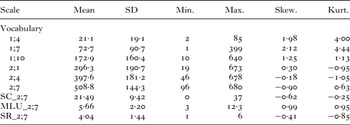
Table 1 presents the descriptive statistics for vocabulary scores. Both the average score and the variability of scores increased with age. In the lower age groups, the scores were positively skewed: most of the toddlers used only a small number of words, while some toddlers had a considerably larger vocabulary than the majority. The situation changed at the age above 2;1, when the skewness became negative.
Descriptive statistics for vocabulary scores, SC, MLU, and the frequency of shared reading

notes: SC_2;7 = sentence complexity at age 2;7; MLU_2;7 = mean length of utterance at 2;7; SR_2;7 = the frequency of shared reading at 2;7.
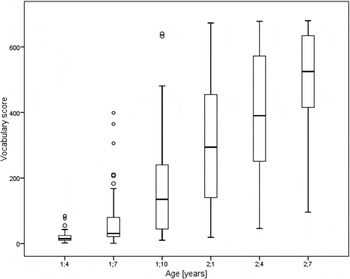
Figure 1 presents box-plots for vocabulary scores at different time-points. Medians, 1st and 3rd quartiles, ranges, and outliers are presented. The box-plots make clear that, apart from the median vocabulary score, the variability of the vocabulary scores increased over time, too, and that the skewness shifted from positive to negative. Although the increase in toddlers' vocabulary size across different times of assessment seems to be close to linear, the analysis of polynomial contrasts revealed three statistically significant contrasts, namely linear (p < ·001), quadratic (p = ·050), and cubic (p = ·007). When gender and parental education were added to the model as a fixed factor and a covariate, respectively, neither of them had a statistically significant effect on the vocabulary score.
Box-plots for vocabulary at different assessment times.

To further examine the growth patterns, we performed a growth curve analysis. Table 2 presents fit statistics for successive models. It is clear that the cubic model fitted very well, while the fit indices of the more restrictive models were not satisfactory. The difference in fit between the quadratic model and the cubic model was statistically significant (scaled χ 2 = 10·78, p = ·01). The comparison of the AIC values also supports the choice of the cubic model. Using the average values of growth factors, the growth equation implied by the cubic model would be:
 $${\rm vocabulary} = 21.098 + 25.517 \times t + 31.585 \times {t^2}-3.436 \times {t^3}$$
where t is the successive number of a particular time-point, counting from 0 to 5. It should be noted, however, that this equation is given for illustration only and that the actual values of the coefficients differ across children. The cubic function implies a slightly S-shaped growth curve, allowing for a slower growth rate in both the first and the last time-point compared to the intermediate time-points. In the next step, we added the child's gender and parental education as predictors of the growth factors. The extended model fitted well (χ 2 = 15·408, p = ·28, RMSEA = ·06, CFI = ·989, SRMR = ·02). None of the effects of parental education was significant. On the other hand, the quadratic component was significantly lower (Qgirls – Qboys = –31·035, p = ·037), and the cubic component was significantly higher for girls in comparison to the boys (Cgirls – Cboys = 4·050, p = ·048), resulting in the average curve being closer to linear in the female subsample than in the male subsample.
Fit statistics for the growth models

As a purely descriptive measure of average vocabulary gains, we computed slopes for regression of vocabulary scores on time (months) for each toddler separately. The individual slopes, which can be interpreted as an individual mean increase of vocabulary score per month, ranged from 6·3 words to 50·8 words for individual toddlers, with a mean of 33·7 words and standard deviation of 10·4 words. Therefore, although all toddlers in our sample increased their vocabulary across the six assessment times, the rate of increase varied considerably across toddlers. The distribution of slopes was somewhat negatively skewed (skewness = –0·69). This indicates that there were several children with very low (that is, notably below-average) rates, while on the other hand children with above-average rates were closer to the average.
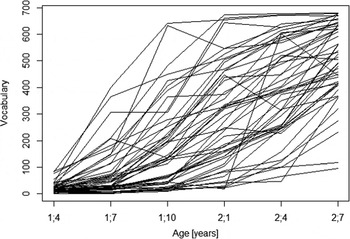
Figure 2 presents growth lines for each toddler. Although the individual patterns differed in shape, the patterns were mostly monotonic, indicating a general positive trend of vocabulary across time. Many patterns also seemed to be close to a straight line, but there were also several toddlers whose vocabulary stayed low at the first two or three assessment times, and increased rapidly afterwards.
Individual vocabulary changes over time.

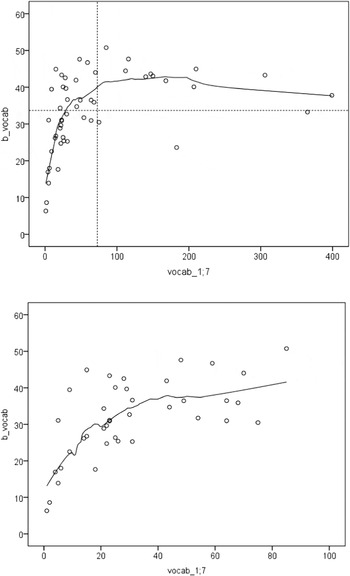
Figure 3 presents the scatter-plot with the locally weighted smoother (LOWESS) for the relationship between vocabulary, measured at age 1;7, and the slope of vocabulary on time, that is, the mean monthly increase of vocabulary. The figure aims to answer the question of whether the rate of vocabulary acquisition depends on the size of vocabulary at 1;7. Vocabulary at 1;7 was considered an early measure of vocabulary, instead of vocabulary at 1;4, as there were several toddlers who spoke only a few words at the time of the first assessment (59·6% of toddlers, aged 1;4 spoke less than 20 words, while at 1;7, 24% of toddlers spoke less than 20 words). The upper panel presents data for all children. It is clear that in the subgroup with the below-average vocabulary at 1;7 (i.e. below 73), the relationship was quite strong: toddlers with a larger early vocabulary had a larger average rate of vocabulary acquisition. On the other hand, in the subgroup with the above-average vocabulary at 1;7, early vocabulary and the vocabulary slope seemed to be unrelated. At the same time, a vast majority of toddlers in this subgroup had an above-average vocabulary slope. In the lower panel, children with vocabulary scores of 100 or higher were excluded, in order to more clearly present the growth pattern in the range where the majority of children were distributed. The lower plot shows the positive but decelerating relationship in the subgroup of children whose vocabulary was not notably above-average.
The relationship between vocabulary at age 1;7 and individual vocabulary slopes.

Stability in vocabulary development and its relations to grammar at age 2;7
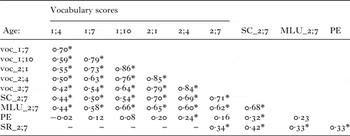
To establish the stability of toddlers' vocabulary across the age period between ages 1;4 and 2;7, we computed the Pearson correlation coefficients between vocabulary scores at various times of assessment (presented in Table 3). The correlation matrix exhibits a clear hierarchical pattern, that is, correlations decreased according to the time distance. Correlations between scores in consecutive time-points suggested that the toddler's relative standing on vocabulary remained relatively stable across a 3-month period, especially for toddlers older than 1;10. On the other hand, the correlation coefficient between the scores at the ages of 1;4 and 2;7, respectively, showed that about 18% of variance in vocabulary size at 2;7 could be explained by the vocabulary score at 1;4.
Correlations between vocabulary scores at various assessment times, parental education, SC, MLU, and SR

notes: * one-tailed p < ·05; voc = vocabulary score; SC_2;7 = sentence complexity at age 2;7; MLU_2;7 = mean length of utterance at 2;7; PE = parental education; SR_2;7 = the frequency of shared reading at 2;7.
We were further interested in the relationship between toddlers' vocabulary development and grammar. The computed correlations between vocabulary scores at different ages and sentence complexity and MLU at age 2;7 were all statistically significant (ranging from .44 to .71 for vocabulary and SC and from .44 to .66 for vocabulary and MLU) (see Table 3).
The correlations between parental education and vocabulary scores at different assessment times were not statistically significant, with the exception of the vocabulary score at age 2;4. The frequency of shared reading at 2;7 correlated statistically significantly and positively with parental education and vocabulary size, SC, and MLU at 2;7 (see Table 3).
Prediction of toddlers' vocabulary and grammar at age 2;7 by parental education and frequency of shared reading
The third goal of this study was to analyze the direct and indirect effects of the two measures of family environment (parental education and frequency of shared reading) and early vocabulary score on toddlers' later vocabulary and grammar. For this purpose, we fitted four path models to explain toddlers' SC, MLU, and vocabulary at age 2;7 by means of parental education, frequency of shared reading, and vocabulary at 1;7.
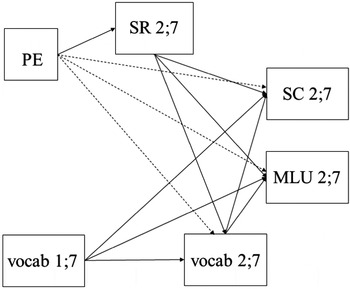
In the first three path models, we tested the direct effects of parental education on child vocabulary and grammar at age 2;7. In each of the three models, we added the direct effect of parental education on either vocabulary, SC, or MLU at 2;7 in addition to the indirect effects through the frequency of shared reading (see Figure 4). None of the direct effects of parental education on any of the three measures of toddlers' language at 2;7 proved to be statistically significant, which supported our hypothesis that the effects of parental education on toddlers' language were mostly mediated via shared reading.
Conceptual path diagram for preliminary models.

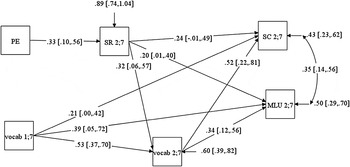
The fourth model anticipated only the indirect effect of parental education on vocabulary, SC, and MLU at age 2;7, which was mediated by the frequency of shared reading. Figure 5 presents the final model structure and standardized parameters (with 95% confidence intervals in brackets). The model assumes that sentence complexity, MLU, and vocabulary score at 2;7 can be predicted by both early vocabulary (at 1;7) and the frequency of shared reading, which is further affected by parental education.
Path diagram with standardized parameters.

The fit of the model was very good (χ 2(4) = 2·146, p = ·71, RMSEA = ·000, 95% CI for RMSEA = [0·000, 0·157], CFI = 1·00, TLI = 1·06, SRMR = 0·026). The coefficients of determination for vocabulary score at the age of 2;7 was .395. Vocabulary score at 2;7 was strongly related to the earlier vocabulary at 1;7 (path coefficient was .53). Vocabulary at 2;7 was also significantly predicted by the frequency of shared reading, which in turn was predicted by parental education. Both SC and MLU were significantly predicted by both vocabulary measures. In addition, MLU was also significantly predicted by the frequency of shared reading. The analysis of indirect effects revealed small but statistically significant indirect effects of parental education (via shared reading) on vocabulary at 2;7 (standardized total indirect effect = 0·10, p = ·02), SC (standardized total indirect effect = 0·13, p = ·023), and MLU (standardized total indirect effect = 0·10, p = ·020). The analysis of indirect effects of vocabulary at 1;7 mediated by the vocabulary at 2;7 showed statistically significant indirect effects on both SC (standardized total indirect effect = 0·27, p = ·004), and MLU (standardized total indirect effect = 0·18, p = ·020).
DISCUSSION
The first aim of our study was to analyze the developmental changes, individual differences, and stability over time in early vocabulary development in the period between ages 1;4 and 2;7. Based on our longitudinal data, we found that at the earliest age of 1;4 all toddlers already used words, although there were great individual differences among them; while some of them only spoke a few words, there were a few toddlers using more than fifty words. Several other studies also showed that most toddlers spoke their first word between the ages of 1;0 and 1;8, although there were large individual differences among them (Bleses et al., Reference Bleses, Vach, Slott, Wehberg, Thomsen, Madsen and Basbol2008; Devescovi et al., Reference Devescovi, Caselli, Marchione, Pasqualetti, Reilly and Bates2005; Fernald et al., Reference Fernald, Pinto, Swingley, Weinberg, McRoberts, Tomasello and Bates2001). Large individual differences in vocabulary size, found in our study, persisted across all ages, so that at 2;7 toddlers spoke from a minimum of 96 words to a maximum of 680 words. Furthermore, the results showed that, in the period between 1;4 and 2;1, the majority of toddlers used only a small number of words while individual toddlers had a considerably larger vocabulary than the majority; however, this situation changed at 2;4.
We also aimed to establish whether the rate of vocabulary acquisition depended on the size of early vocabulary. Interestingly, the findings showed that only in the group of toddlers with a small initial vocabulary size (with approximately 40 words at the second assessment time), the rate of vocabulary growth was related to vocabulary size at 1;7. In toddlers with an initial vocabulary size of approximately 100 words or more, there were no significant relations between their vocabulary size at 1;7 and the rate of vocabulary growth. These findings indicate that a small early vocabulary size at 1;7 might represent an indicator for slower later vocabulary growth.
Although the individual growth curves suggested that the pattern of the increase in toddlers' vocabulary size might be close to linear, a more detailed examination of the patterns in vocabulary growth indicated a more complex, slightly S-shaped growth curve. This finding is different from the finding of a previous cross-sectional study (Marjanovič-Umek et al., Reference Marjanovič-Umek, Fekonja-Peklaj and Podlesek2013) that was carried out on a Slovenian-speaking sample of infants and toddlers, aged from 0;8 to 2;6 and suggested that vocabulary growth accelerated over time, in that our longitudinal data indicated a slower vocabulary growth rate at 1;4 and 2;7 compared to the intermediate assessment times. Our findings also do not support the findings of Bates et al. (Reference Bates, Dale, Thal, Fletcher and MacWhinney1995), who found that vocabulary growth was positively accelerated after one year of age. In addition, we found that although toddlers' gender and parental education did not have a significant effect on toddlers' vocabulary size at different ages, toddlers' gender had a significant effect on the shape of the vocabulary growth curve, with the average curve being slightly more close to linear for girls than boys.
Toddlers included in our sample seemed to have started with a very variable vocabulary size at age 1;4, and differed in the pace of vocabulary development as well as in the shape of the vocabulary growth curve, acquiring from 6·3 words to 50·8 words each month. These findings support the findings of several other studies emphasizing the differences among toddlers in both the pattern and rate of early vocabulary growth (Devescovi et al., Reference Devescovi, Caselli, Marchione, Pasqualetti, Reilly and Bates2005; Fenson et al., Reference Fenson, Dale, Reznick, Thal, Bates, Hartung, Pethick and Reilly1994; Rowe et al., Reference Rowe, Raudenbush and Goldin-Meadow2012). The analysis of the stability of vocabulary development over time showed that a toddler's standing on vocabulary remained relatively stable across a 3-month period, which is in line with the result of several other studies suggesting a high stability of early vocabulary size over time (Bates et al., Reference Bates, Dale, Thal, Fletcher and MacWhinney1995; Reznick & Goldfield, Reference Reznick and Goldfield1994).
Our second aim in this study was to establish relations between a toddler's vocabulary development between ages 1;4 and 2;7 and the acquisition of grammar at 2;7. As we have anticipated, we found that vocabulary size at different ages was positively related to the complexity and the mean length of toddlers' utterances at 2;7. Our findings are in line with the findings of several other studies, carried out in other languages, suggesting that toddlers' vocabulary is closely related to the acquisition of grammar (e.g. Bleses et al., Reference Bleses, Vach, Slott, Wehberg, Thomsen, Madsen and Basbol2008; Caselli et al., Reference Caselli, Casadio and Bates1999; Devescovi et al., Reference Devescovi, Caselli, Marchione, Pasqualetti, Reilly and Bates2005; Jackson-Maldonado et al., Reference Jackson-Maldonado, Thal, Marchman, Bates and Gutiérrez-Clellen2000; Stolt et al., Reference Stolt, Haataja, Lapinleimu and Lehtonen2009). The results obtained indicate that toddlers who show a larger vocabulary size between 1;4 and 2;7 use more complex and longer utterances at 2;7. According to other studies (Bates & Goodman, Reference Bates and Goodman1997; D'Odorico & Carubbi, Reference D'Odorico and Carubbi2003; Tomasello & Bates, Reference Tomasello, Bates., Tomasello and Bates2001), acquiring new words enables toddlers to combine them into grammatically more complex and longer utterances. On the other hand, a more complex grammar might further support vocabulary development as well. Toddlers with a more advanced grammar might engage in more complex verbal interactions with their parents during different activities, including family literacy activities, thus acquiring new words and expanding their vocabulary. Furthermore, we found that the relationships between vocabulary at different ages and sentence complexity as well as MLU at 2;7 departed from linearity. The relation between MLU and the vocabulary of English-speaking toddlers was also found to be non-linear (Bates et al., Reference Bates, Bretherton and Snyder1988), although this was not the case in all languages (e.g. Devescovi et al., Reference Devescovi, Caselli, Marchione, Pasqualetti, Reilly and Bates2005).
The third goal of this study was to establish possible direct and indirect effects of parental education and frequency of shared reading on toddlers' vocabulary and grammar at age 2;7. We found that parental education had no direct effect on any of the three measures of toddlers' language, namely, vocabulary, sentence complexity, and MLU. Based on the findings of several studies in which parental education was proved to be an important factor of a child's language development (e.g. Fernald, Marchman & Weisleder, Reference Fernald, Marchman and Weisleder2013; Hoff, Reference Hoff, Bornstein and Bradley2003), as well as of those which found that the quality of family environment mediated the effect of SES on a child's outcomes (e.g. Farrant & Zubrick, Reference Farrant and Zubrick2011; Mistry et al., Reference Mistry, Biesanz, Chien, Howes and Benner2008), we hypothesized that it was through shared reading that highly educated parents supported the language development of their toddlers.
The proposed model, which assumed that sentence complexity, MLU, and vocabulary size at the age of 2;7 could be predicted by both early vocabulary at 1;7 and the frequency of shared reading, which mediated the effect of parental education, was proved to fit very well. First, we found that parental education was an important predictor of the frequency of shared book-reading, suggesting that more educated parents more frequently engaged their toddlers in shared book-reading at 2;7. These findings are in line with the findings of several other studies (Lyytinen et al., Reference Lyytinen, Laakso and Poikkeus1998; Raikes et al., Reference Raikes, Pan, Luze, Tamis-LeMonda, Brooks-Gunn, Constantine, Tarullo, Raikes and Rodriguez2006; Westerlund & Lagerberg, Reference Westerlund and Lagerberg2008). Overall, the parents in our sample indicated that they frequently read to their toddlers – that is, on average five or six times a week. However, we should note that parental self-reports on shared book-reading might also be somewhat biased as it is seen as more socially desirable. According to Sénéchal, LeFevre, Thomas, and Daley (Reference Sénéchal, LeFevre, Thomas and Daley1998), the majority of parents highly value reading books to their children, and that is why, when they answer questions about shared reading, they may not necessarily describe their actual behaviour but may state what they think is appropriate. Second, the findings showed that vocabulary and MLU at 2;7 were both directly predicted by the frequency of shared reading, suggesting that toddlers who were more frequently read to showed a larger vocabulary and formed longer utterances. And third, both measures of grammar at 2;7 were also predicted directly by vocabulary size at 2;7, as well as indirectly by vocabulary at 1;7 via vocabulary at 2;7. These findings indicate that toddlers' early and current vocabulary size play an important role in their acquisition of grammar, predicting the grammatical complexity as well as the length of their utterances.
Moreover, the analysis of indirect effects revealed that parental education had a significant indirect effect on toddler's language at age 2;7, on vocabulary, sentence complexity, and MLU, via the frequency of shared book-reading. Our findings are in line with those of several other studies in which parent–child book-reading was found to be an important factor in a child's language development (e.g. Farrant & Zubrick, Reference Farrant and Zubrick2013; Mol & Bus, Reference Mol and Bus2011; Sénéchal, Cornell & Broda, Reference Sénéchal, Cornell and Broda1995; Westerlund & Lagerberg, Reference Westerlund and Lagerberg2008). In our study, shared reading was not only proved to have a significant effect on toddlers' vocabulary and grammar, it was also found to be an important mediating activity through which parental education effects toddlers' vocabulary and grammar at 2;7. Similarly, Farrant and Zubrrick (Reference Farrant and Zubrick2011) found that maternal education effected a toddler's vocabulary via parent–child book-reading, thus emphasizing the mediating role of proximal processes for child development. Shared reading represents an important context for acquiring new words and building both receptive and expressive vocabulary. Montag, Jones, and Smith (Reference Montag, Jones and Smith2015), for instance, found that one potential source of a child's lexical diversity was the text of picture books that caregivers read aloud to them. In their opinion, the text of picture books may be an important source of vocabulary for young children, containing more unique word types than child-directed speech. On the other hand, the relationship between shared reading and a child's vocabulary and grammar might in our opinion be bi-directional, in that more frequent shared reading might result in a child's larger vocabulary and more complex grammar, while at the same time the child's larger vocabulary and grammatically advanced utterances might encourage parents to engage in more frequent shared reading with their child. This hypothesis could be supported with the findings of Sénéchal, Cornell, and Broda (Reference Sénéchal, Cornell and Broda1995), who found that, besides reading more frequently with older children, parents also read differently to children depending on their age. According to the authors, parents adapt their reading style to suit the age of the children; parents of older children tend to use more questions and give more feedback in the process of shared reading, while parents of younger children use more elaborations, verbalizations, and finger-pointing to draw the child's attention to the book. Silvén et al. (Reference Silvén, Ahtola and Niemi2003) also found that the size of a child's vocabulary affects the work that mothers have to do to maintain his/her attention while reading. The authors argue that a child's larger vocabulary may result in his/her better comprehension of the text being read, which, in turn, enhances the child's motivation to listen to the reading.
Our findings indicate that the promotion of parent–child book-reading in families, especially families of lower-educated parents, might represent an effective way of supporting toddlers' language development and preventing the differences in language ability between children deriving from different family backgrounds. Farrant and Zubrick (Reference Farrant and Zubrick2011) also argue that interventions which provide children's books and instructions on shared reading that increase both the frequency and the quality of parent–child book-reading have a positive effect on children's vocabulary development. However, we did not collect data on the quality of shared reading, which represents one of the drawbacks of our study. Thus, we have no insight in the quality of the process of shared reading which has in several studies also proved to be related to a child's language outcomes (e.g. Malin et al., Reference Malin, Cabrera and Rowe2014; Silvén et al., Reference Silvén, Ahtola and Niemi2003).
Our study has several other limitations, with the first one being the relatively short 15-month period of the follow-up, which provides us with insight into the characteristics of vocabulary and grammar development in the period between ages 1;4 and 2;7, but we cannot conclude anything about the long-term effects of early vocabulary or shared reading on a child's later language development. Also, the majority of toddlers in our sample came from a relatively supportive family environment, while none of them came from an extremely unfavourable family background. Based on our findings, it would seem important to get a more clear insight in the literacy activities of the families of lower-educated parents as well as to find appropriate ways to promote early shared reading in parents and children from less favourable family backgrounds. When interpreting the results obtained, we should also note that the same assessors, namely the parents, assessed both the frequency of shared reading and toddlers' vocabularies. In future studies, other approaches to assessing vocabulary and shared reading should also be applied.
The frequency of shared reading was estimated only at the last assessment, when toddlers were aged 2;7, thus we obtained no information on parent–child shared reading at the first assessment. In this respect, we should note that introducing book reading to toddlers already in the first year of life was found to be related to toddlers' vocabulary in other studies (Richman & Colombo, Reference Richman and Colombo2007) and should be further examined. All the toddlers were also enrolled in preschools where shared reading represents an important curriculum activity, suggesting that family environment was not the only context in which the toddlers from our sample were exposed to children's books. However, the findings of our study provide an insight into the mediating role of the frequency of early shared book-reading and the processes lying behind the relationship between parental education and a child's language. While several other studies on the importance of shared reading included samples of older preschool and schoolchildren, this study focuses on early shared reading in the period of toddlerhood when language develops rapidly. This study is also the first longitudinal study of Slovenian-speaking toddlers, and as such provides important information on the development of vocabulary and grammar in one of the Slavic languages.