Introduction
The United Kingdom and other EU countries have witnessed an increase in immigration in recent years. High economic performance, the need for migrant workers and an increase in asylum seekers due to global conflict, all led to increases in the number and nature of arrivals. These flows and channels have become known as new migration (Vertovec, Reference Vertovec2008). Whilst previous migrations related to large groups of post-Commonwealth migrants and thus diversity consisted of relatively discrete, if not homogenous, ethnic ‘communities’ of post-colonial economic migrants and their families, the arrival of hundreds of thousands of migrants from many different countries means that the number of ethnic groups living in the UK has proliferated and the growth of smaller groups has ‘radically transformed the social landscape in Britain’ (Vertovec, Reference Vertovec2008: 1028). This transformation of diversity is now commonly termed super-diversity (Cantle, Reference Cantle and Johnson2008; Schierup et al., Reference Schierup, Hansen and Castles2006; Parekh, Reference Parekh2008; Law, Reference Law and Millar2009).
While migrants arrive in the UK with a range of different immigration statuses, asylum seekers and refugees have received the most attention in both policy and academic terms. The majority of immigration policy and legislation has adopted a restrictionalist stance on asylum, placing emphasis on securing borders and restricting access to social welfare for asylum seekers (Sales, Reference Sales2002; Phillimore, Reference Phillimore and Salah2009). However, a separate, less publicised, strand of policy has developed around promoting the settlement of refugees. The UK Government and the EU have set out integration strategies (Home Office, 2005, 2009) aimed at encouraging the development of policy that could aid refugee integration. These policies outline what refugee settlement should look like, why it is important and how it might be achieved. Much policy emphasis, and a considerable amount of funds, have been invested in initiatives that seek to ensure the development of cohesive communities through bringing together old and new communities and different ethnic groups (Cantle, Reference Cantle2005; CIC, 2007). Initiatives such as those funded by the European Refugee Fund and Migrant Impact Fund place a great deal of emphasis on ensuring the integration of refugees is promoted through the provision of language and skill development, and through opportunities for cross-cultural dialogue.
Despite the attention given to integration and cohesion in recent times, and the development of policy aimed at promoting refugee integration, little empirical work has been undertaken to explore the circumstances in which refugee integration occurs. Most academic attention has focused upon the meaning of integration (Castles et al., Reference Castles, Korac, Vasta and Vertovec2002; Fyvie et al., Reference Fyvie, Ager, Curley and Korac2003), the conditions or relationships necessary for integration to occur (Zetter et al., Reference Zetter, Griffiths, Sigona and Hauser2002; Ager and Strang, Reference Ager and Strang2008) or the dynamism and fluidity of the settlement process (Hall, Reference Hall and Rutherford1990). While it is acknowledged that groups and individuals become integrated in different ways, little research has looked at the experiences that influence refugee arrival and settlement in new countries. Neither has there been much consideration of how those experiences cause psychosocial stress and how they, or associated stresses, impact upon refugees’ pathway to, or away from, integration. This paper turns to cross-cultural psychology's discussion of acculturation processes and in particular Berry's acculturation strategies (Berry, Reference Berry1997) to look at the different factors that influence acculturation and how these factors impact upon the ability of individual refugees to integrate or not. Consideration is also given to the extent to which acculturation strategies lead individuals to experience stress and how stresses may, in turn, affect ability to become integrated.
New migration and the importance of integration
Migration is possibly one of the most politicised policy areas in the EU, if not the world (Huysmans, Reference Huysmans, Miles and Thränhardt1995; Schierup et al., Reference Schierup, Hansen and Castles2006). The subject of migration, with a particular focus on refugees and asylum seekers, is rarely out of the public eye, with sustained media attention and public polls showing that migration is one of the key concerns of the British public (Hubbard, Reference Hubbard2005). The UK government has resolutely pursued a strategy of restrictionism, successfully limiting the ‘universal right to asylum’ by introducing stricter border controls, safe country of origin lists, a reduction of social benefits, detention and narrow legal interpretations of refugee definitions (Boswell, Reference Boswell2000). Immigration and asylum policy has taken a deterrent stance, the object of which is to send out the message that asylum seekers are not welcome in the UK.
The paucity of immigration data means that there is no reliable information about the numbers of asylum seekers and refugees living in the UK. By 2003, some 290,000 refugees were estimated to reside there (UNHCR, 2008), in excess of 20,000 asylum seekers arrive annually and thousands of them gain refugee status or right to remain, while even more are unsuccessful and disappear into the grey economy, rely on vouchers for survival or are deported. Large numbers of asylum seekers wait several years for a decision; some 460,000 legacy cases had been waiting in excess of two years in 2007 (Home Office, 2007). The asylum seeker and refugee population of the UK continues to expand with the continuance of global conflict and despite restrictionalist immigration policy.
The New Labour Government set out its desire to make refugees ‘full and equal citizens’ (Home Office, 2002). They and others outlined the positive role of migrant and refugee community organisations (MRCOs) in aiding the integration process (Home Office, 2005; Phillimore and Goodson, Reference Phillimore and Goodson2010; Gameledin-Adhami et al., Reference Gameledin-Adhami, Cooper and Knight2002; Griffiths et al., Reference Griffiths, Sigonda and Zetter2006). Some policy emphasis was placed upon seed-corn funding MRCOs to help them facilitate refugee integration through the provision of advocacy, support and opportunities to celebrate cultural identity. More recently, a national Refugee Integration and Employment Service (RIES) was established in an attempt to ensure that refugees are integrated as quickly as possible once they have been given leave to remain in the UK. While integration has been the focus of some conceptually based discussion in social science literature, little attention has been given to the ways in which social and public policy can facilitate, or militate against, integration.
The meaning of integration is contested, and the various aspects of what constitutes an ‘integrated community’ continue to be the focus of much debate (Crisp, Reference Crisp2004; Castles et al., Reference Castles, Korac, Vasta and Vertovec2002; Castles and Davidson, Reference Castles and Davidson2000). Favell (Reference Favell1998: 3) believes the term integration has been used to characterise ‘progressive-minded, tolerant and inclusive approaches to dealing with ethnic minorities’. This school of thought has tended to think of integration as a process through which people pass en route to assimilation. In an attempt to produce a set of indicators of integration, Ager and Strang (Reference Ager and Strang2004) consider positive and negative factors that can impact upon the process. Positive factors, such as access to education, training, housing, employment and social capital, can help refugees to integrate. Negative experiences can include lack of effective integration policy, negative public attitudes to refugees, the frequency of racial incidents, reported feelings of fear and insecurity and experiences of bullying or racial abuse, and can mitigate against integration.
Several authors comment on the need to explore integration as a multidimensional process in which individuals, MRCOs, the institutions and society all have a role (Ager and Strang, Reference Ager and Strang2004; Mestheneos and Ioannidi, Reference Mestheneos and Ioannidi2002; Schibel et al., Reference Schibel, Fazel, Robb and Garner2002). The need for research around refugee integration to focus on the full range of factors and their inter-connectedness has been outlined (Korac, Reference Korac2003), together with the importance of considering refugees’ perceptions of their experiences in analysing the dynamics of integration (Schibel et al., Reference Schibel, Fazel, Robb and Garner2002). Yet little work has looked at the experiences of individuals and considered how personal, cultural, policy and experiential factors combine to influence settlement experiences. We now turn to acculturation theory in a bid to explore the factors that impact on refugee integration.
Acculturation strategies
The term acculturation has been in use for many decades and generally relates to the changes that happen to groups and individuals when two different cultures meet. Two main theoretical perspectives can be identified in relation to acculturation. On the one hand the social psychology approach led by Berry (Reference Berry1997) and Berry et al. (Reference Berry, Kim, Minde and Mok1987) looks at migrant incorporation as a series of phases that eventually leads to permanent settlement within the host society. This approach is influenced by research looking at the incorporation of European migrants into US society. On the other hand the diaspora studies, and cultural identity approach, initiated by Hall (Reference Hall and Rutherford1990, Reference Hall and King1997) and developed by Bhatia and Ram (Reference Bhatia and Ram2001), based largely upon the study of post-colonial migrants into UK and US society, views ‘the formation of immigrant identity within a historical context, bound up in a set of political positions, based on negotiation, dislocation and conflict’ (Bhatia and Ram, Reference Bhatia and Ram2009: 143). While it is recognised that both perspectives have validity, in this paper we turn to Berry's (Reference Berry1997) work on acculturation because it provides an analytical framework within which it is possible to explore the different factors influencing acculturation experiences, the way these factors influence refugees’ pathways towards, or away from, integration and the extent to which they experience psychosocial stresses.
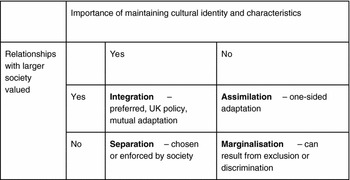
Although in theory acculturation affects both the host and the newcomer populations as they meet and adapt to the advent of a more diverse society, in practice more change tends to be experienced by one group than another (Berry, Reference Berry1997). Recognising power imbalances, Berry (Reference Berry1997: 8) describes established cultures as ‘dominants’ and new arrivals as ‘non-dominants’. He argues that there is a process of adaptation that is common to most migrant groups, but that the eventual outcome of processes is mediated by a range of factors which will be discussed later. In the meantime, it is important to understand that all participants in an acculturating society have to identify ways of acculturating. These acculturation strategies are said to develop in relation to two issues. The first is cultural maintenance, described by Berry as the extent to which cultural identity and characteristics are valued and maintained. The second is contact and participation, the extent to which contact between cultural groups is sought or avoided – the latter, as we outlined earlier, being a key concern to policy-makers concerned with community relations. Bringing these two issues together creates a conceptual framework that results in the four possible acculturation strategies illustrated in Figure 1. While Berry and many of his peers place most emphasis on these two variables, he also notes, reinforcing the claims outlined above (Mestheneos and Ioannidi, Reference Mestheneos and Ioannidi2002; Schibel et al., Reference Schibel, Fazel, Robb and Garner2002), that for ‘non-dominants’ to be able to follow their favoured acculturation strategy, existing communities and institutions also need to adapt to accept increased diversity and to provide specialist support services to ensure that the needs of newcomers can be met.
Acculturation strategies (after Berry, Reference Berry1997).

The process of acculturation is acknowledged to be stressful and can be associated with social and psychological problems (Berry, Reference Berry1997). The extent, speed and type of cultural changes necessary can all impact upon individuals’ psychological well-being. Too much change, lack of support, pressure to adapt too quickly or inability to follow desired strategy can all result in acculturative stress, and when major problems are experienced individuals can be susceptible to mental illness. Berry argues that the most positive acculturation strategy in societal and psychological terms is integration. Integration as we have noted tends to be favoured by policy-makers. For Berry (Reference Berry1997), it results from a situation where new arrivals develop relationships with the dominant community while maintaining their own culture. Specific integration policies may be necessary to ensure that the development of inter-cultural relationships are possible, and thus it is important that institutions act to facilitate interaction whilst at the same time ensure that services can be adapted to meet newcomers’ needs. The encouragement of cultural maintenance may emerge through supporting the development of MRCOs and celebrating diversity.
Conversely, Berry considers assimilation, wherein traditional cultures are abandoned and new relationships pursued, or separation, wherein relationships are not formed with larger society but cultural traditions are maintained, as less positive strategies. The least positive strategy is that of marginalisation, where neither culture is maintained or new relationships developed. Looking at acculturation strategies from the perspective of non-dominants, it is possible that strategies might be chosen, as new arrivals decide to mix with the dominant population, or imposed, if perhaps the dominant population is reluctant to engage with new arrivals, or if policies are not in place to support integration, and institutions do not adapt to meet their needs.
The choice or ability to engage in new relationships and maintain cultural traditions are themselves influenced by a range of factors. These occur on a group level and may relate to group experiences before acculturation, such as political context, economic situations, social and cultural factors. They can also occur after acculturation and may include the attitudes of ‘dominants’ towards migrants, and the extent of support they receive from their own ethnic community and wider society. The strategy adopted is also moderated by individual factors, again relating to situations and experiences that were in place before migration and upon arrival. These include age, gender, status and cultural distance, as moderating factors prior to acculturation and prejudice; discrimination, coping strategies, resources and social support received, as moderating factors during acculturation (Berry, Reference Berry1997).
In order to explore the ability of refugees in the UK to follow their preferred strategy of integration, it is important to examine the group and individual factors that impact on their choice of acculturation strategy, to explore the ways in which the acculturation experience causes stresses and the impact that the combination of strategy and psychological stresses has on their ability to integrate. This paper moves on to discuss the methods utilised to collect data to explore acculturation strategies.
Methods
This paper utilises data that were collected in a study exploring refugees’ well-being, mental health and settlement experiences. This study formed part of the Joseph Rowntree Foundation-funded Making a Difference Project (Phillimore et al., Reference Phillimore, Ergun, Goodson and Hennessy2009) wherein a partnership was formed between university researchers and MRCOs to identify and research areas of importance to refugee communities. The fieldwork was undertaken in 2007 and situated within Birmingham, although many of the respondents had previously lived elsewhere in the UK. Some 16 MRCO leaders participated in accredited research training in qualitative and quantitative skills. They worked with the wider research team to identify research problems and questions, and to design research tools. Community researchers facilitated contact with respondents who, because many had no contact with community or other organisations, would have been difficult for white, English-speaking, university-based, researchers to reach. Thus, the impact of language and cultural barriers were minimised, whilst rigour and reliability were monitored through one-to-one mentoring and quality control.
In total, 138 interviewees were undertaken with refugees who had arrived in the UK as asylum seekers and subsequently gained refugee status. They were identified via a combination of community researchers’ own social networks and snowballing. Full details of the methods employed in this study can be seen in Phillimore et al. (Reference Phillimore, Ergun, Goodson and Hennessy2007a, Reference Phillimore, Ergun, Goodson and Hennessy2009). Interviews were either undertaken in interviewees’ mother tongue or English, according to their preference. Some 36 per cent of respondents were female. They ranged in age between 17 and 55 and came from 20 different countries of origin, including the key asylum-sending countries of Iraq, Afghanistan, Somalia, Sudan, Rwanda, Zimbabwe, Iran and Congo. While these 138 interviews with refugees were undertaken with the general refugee population, the community researchers undertook an additional 17 in-depth interviews with respondents identified from the earlier wave of interviews, who had been diagnosed with a mental health problem in the UK. This interview explored in some depth the nature of their mental health problem, how it had emerged and the ways in which it impacted upon their everyday lives and ability to settle. Questioning explored refugees’ settlement experiences, well-being, mental health and factors that impacted upon their well-being and the impact of those factors on their ability to integrate. The data were analysed by the research team using a systematic thematic analysis approach, with community researchers helping to identify themes.
Group-level experiences in society of origin
Although refugees came from a wide range of locations and all had different experiences of war, persecution and flight, a number of experiences were common to refugees as a group, regardless of where they had originated. A key issue was the absence of voluntariness in migration. Refugees discussed the trauma of having to leave their country of origin, and crucially their inability to return either permanently or to visit friends and family. Consequently, they felt displaced and unsettled as well as concerned about the political situation in their homeland.
I think the political situation of Iran affects the well-being of Iranians living here because the people living here cannot go back and are worried about the situation in their country. (Iranian male, 38)
Refugees also shared common ground in that they had direct experience of living through war or surviving persecution. These experiences impacted on their ability to settle because they struggled to look forward and focus upon developing a new life, instead trying to find ways to process their experience and get through each day.
People suffer post traumatic depression because of the war and the stress it caused. From ill treatments and abuse they have gone through. (Albanian male, 30)
Associated with both flight and war was the grief experienced following the loss of friends and family. Some had actually witnessed the murder of their relatives; others had ‘lost’ their relatives and had no idea whether they were dead or alive.
Speaking about families, I can't really say I have got one, because from my background I have lost my family, my entire family. (Ivorian male)
Much of their energy went into trying to trace lost relatives or mourning the death of loved ones. In these situations many refugees were extremely distressed and unable to interact with others. While the individual experiences varied, it was clear that the experience of being a forced migrant brought with it a range of stresses that varied from anxiety and sleeplessness to symptoms that individuals themselves described as post-traumatic stress disorder (PTSD).
Group-level experiences in society of settlement
Refugees as a group also shared a common experience of the asylum system. Many had expected to arrive in the UK to a sympathetic reception, particularly those from countries where the UK had been a vocal opponent of the political regime in their country of origin.
I was hoping to be welcomed and to be taken care of, because when you flee your country, you hope that you will get people to welcome you and understand and feel sympathy of what you went through. But I did not get that. It makes it difficult to integrate into society. (Zimbabwean woman, 40)
On arrival they experienced additional stresses to those associated with their flight. Respondents spoke of feeling criminalised as their identity as asylum seeker was questioned; they had to tell, retell and defend their story, were detained, dispersed and then made to report to police stations. For those escaping persecution, the interrogation and incarceration by uniformed immigration officers was reminiscent of the persecution in their country of origin and left them feeling stressed and afraid.
For instance, where I was back home, the reason that made me run away I was in a situation where I was hiding myself. And for me to go through that and come all the way here, again you are taken into detention. (Kenyan woman, 39)
For most, however, the anxiety associated with uncertainty of the outcome of the asylum process was the main factor that impacted upon their ability to feel settled, both while their claim was being assessed and after they had received a positive decision.
The rejection that refugees had felt when treated as ‘bogus’ until otherwise proven by the state was exacerbated by general attitudes towards asylum seekers and refugees. Refugees were painfully aware that they were perceived as a problem, were familiar with government discourse around reducing the numbers of asylum seekers entering the UK and dealing with ‘bogus’ asylum seekers. They saw that the media was full of headlines and images vilifying asylum seekers and reporting their criminal or even terrorist behaviour. Worse still, they saw the way that people looked at them, and witnessed the way people moved away from them in crowded areas. In these circumstances, refugees lacked the confidence to seek relationships with local people so tended to withdraw from social contact.
People don't take refugees as human being. I am ashamed to say that I am a refugee. (Rwandan male, 22)
Refugees have been portrayed as people who come to take money. We are stressed because people don't like us. (Congolese male, 30)
In addition, the segregation that occurred with dispersal and movement away from established communities and MRCOs in London to unpopular but cheap housing in regional cities, moved them away from connections with their ethnic community in the UK, a problem noted elsewhere by Phillips (Reference Phillips2006). Asylum seekers were not permitted to work and thus compelled to remain in the accommodation they shared with other asylum seekers, or were alone and isolated, unable to contradict accusations of ‘scrounging’ by becoming self-supporting.
[When I first came] I couldn't see my family or complete my education and I became depressed . . . Newcomers can't see their family, can't study and can't work. So they become depressed and suicidal. (Kurdish Iraqi woman, 26)
The lack of support services to help asylum seekers access the services they need to deal with health problems or unfit housing continued once they were refugees. Upon gaining leave to remain, most new refugees were given a maximum of 28 days to leave their accommodation and were expected to find their own way to access housing, benefits and employment. At this point, many refugees became homeless and relied upon the generosity of asylum seekers to allow them to continue sleeping on the floor of their UKBA (UK Border Agency)Footnote 1 supplied housing. While some did eventually find their way around the system, others took months to settle.
It was very hard. I have not received any support for six months. No house, no money. (Rwandan woman, 35)
Research undertaken previously in Birmingham indicated that even after three years many refugees were not securely housed (Phillimore et al., Reference Phillimore, Tice, Craig and Sankey2005: 7) and that they struggled to access health services for extended periods (Phillimore, in press). The development of relationships with local people or maintenance of their own cultural traditions were particularly difficult, as most of their energy focused upon survival and there were few MRCOs or other third-sector organisations with the capacity to meet their needs.
Individual-level variables prior to acculturation
Naturally, while there were common experiences, the ability to build relationships and to maintain cultural identities were mediated by individual characteristics, personality and experiences. Asylum seekers arrived in the UK from many different socio-economic backgrounds. It appeared that those who were educated, had been in powerful positions, or wealthy, in their country of origin, experienced the greatest shock on arriving in the UK as they moved from positions of privilege to living in poverty, in poor quality, often overcrowded, accommodation.
We are educated back home, but here we are nothing. (Kurdish Iraqi, Male, 23)
When I first came, I wanted to go back. I missed my home, my family, my profession and my car. (Yemeni woman, 42)
Those who were unable to speak English were unable to even contemplate building relationships with local people and experienced high levels of isolation.
First of all when you come to a different country, you don't speak English. When you cannot express yourself, the door is closed, the window is closed. (Afghani male, 31)
In addition, those whose home cultures were very different experienced the greatest difficulty readjusting. This was particularly the case for African refugees who found the UK different in every way to life in Africa.
It was very hard to fit into new culture, because everything is totally different . . . the culture and the food is different. Everything is different here. (Chad woman, 18)
A key factor in preventing refugees from developing relationships with local people were the differences in ways of living and interaction. Refugees from Africa and the Middle East described how British society was ‘closed’ and much more formal than life in their country of origin. They were unable just to walk into their neighbour's house, or ask for, or offer help to a stranger. They feared causing offence or getting into trouble, so avoided interaction, and as a consequence felt isolated and lonely.
Imagine when you go to a country where you are new and you don't know anybody and you don't have any relative and no friends. You don't know anything about their culture and nothing from the language. Would that be easy to live or hard? (Afghani male, 27)
It was very hard to adjust; I can't do anything. (Kenyan male, 41)
There were particular difficulties for refugees who wore traditional Islamic dress. Post 9/11, this type of clothing has become associated with terrorism, and some of the refugees from places such as Afghanistan and Iraq experienced harassment or discrimination on the grounds of their religion and country of origin, which made them fearful about interaction with local people.
I escaped from war and Al-Qaeda, but I still hear from different people that we are from Al-Qaeda. Even I hear from people from Pakistani background. They say that Afghanistan is a sh.. country. (Afghani male, 18)
There were also differences in experience between those who had previously lived in remote rural areas and those who were used to urban living, and those who were unaccustomed to cold weather. Refugees originating from rural areas tended to stay indoors because they were nervous of urban life and the high levels of crime associated with some of the deprived areas to which they had originally been dispersed. Others stayed indoors during the winter because they lacked the clothing or resilience to go outside in cold or wet weather.
Gender was a key variable impacting upon refugees’ acculturation experience. For some cultures, women were considered to be the bearer of family honour with responsibility for upholding cultural traditions.
Women suffer more, because they have more traditional obligations. It is difficult to manage it with this new culture. (Somali male, 38)
Maintaining these traditions could be difficult in a new environment, particularly for those women refugees who were accustomed to communal living. Often, women's social networks had previously consisted of their extended family. Being separated from family and living alone for the first time was particularly difficult. Women refugees were said to be more likely than men to feel isolated, unable to interact with their peers, to speak their own language or share food. They also felt culturally constrained and lacked the confidence to build relationships with people from outside their cultures or even their extended family.
There is depression, isolation. There is fear. (Rwandan woman, 27)
A number of women had arrived in the UK as single parents. Having been used to communal childrearing, they found that single parenthood particularly difficult and isolating.
[When I first came] it wasn't easy to deal with children and look after them compared to Africa. (Sudanese woman, 37)
There were also particular problems for those women who had experienced sexual violence in their countries of origin. These women felt they could only discuss their experiences with others who had been through the same experience, other African women.
There are many kinds of problems which you cannot talk about in front of male, because culturally you cannot talk to a male about a problem you experienced during the war. Then you choose to keep quiet, it means you live with your own problems. You can be angry inside and not talk to anyone. (Burundian woman, 25)
Without those connections locally, and in the absence of support from MRCOs, they were isolated. There was no specialist medical or counselling provision for women who had experienced sexual violence, yet such women felt unable to seek medical attention from Western doctors. In addition, refugee women were particularly distressed during the asylum process for fear that they would have to return to face their abusers.
Those who were raped back home. They are afraid to go back home and face those who raped them. (Rwandan woman, 27)
When separated from their own communities, women reported feeling traumatised, isolated and either depressed or anxious.
Individual-level variables during acculturation
Refugees who had friends or relatives living close to them in the UK or had access to an active MRCO were able to maintain their cultural traditions through shared meals and conversation. Those without these connections described their feelings of isolation and of being unable to interact with local people or their peers.
I came here and I didn't have family. I was lonely. I got sick and spent a lot of time in hospital. (Somali male, 18)
In addition, those refugees who had been able to gain work were better able to acculturate than those who were unemployed. Having a job impacted upon their self-esteem and enabled them to meet other people.
Getting a job would make me integrate more and think more positive about my life. (Kosovan woman, 34)
While all refugees had to go through the asylum process, the length of time they had to wait for a decision was a key variable impacting on their ability to acculturate. Those who waited a long time essentially put their lives on hold and were unable to take any steps to reunite with people from their own culture or engage in education or employment to meet others.
Some people are living here more than four or five years, but they still have problems. Because they have no decision from the Home Office and they live without hope. They think that every day they might be sent by force to their countries. (Afghani male, 19)
A final key variable that impacted on acculturation once in the UK was whether a refugee had experienced racist harassment or discrimination. Previous research in Birmingham indicated that in excess of 30 per cent of refugees experienced some kind of harassment from name-calling to serious physical attack (Phillimore et al., Reference Phillimore, Tice, Craig and Sankey2005, Reference Phillimore, Ergun, Hennessy and Lee2007b), and that a key variable in deciding where to live was avoidance of racism (Phillimore et al., Reference Phillimore, Goodson, Hennessy and Thornhill2008). Refugees who had experienced some kind of harassment sought to avoid interaction with local people.
My children are prisoners in their bedroom, because I am afraid of the fact that they are racially abused by other children. (Sudanese woman, 36)
Acculturation and social and psychological stresses
Berry (Reference Berry1997) argues that inability to follow the preferred acculturation strategy or too much pressure to acculturate quickly can lead to psychosocial stress in the non-dominant community. As indicated in the above discussion of acculturation variables, refugees experienced high levels of isolation. There were clear signs that many of our interviewees were experiencing varying levels of distress, some of which had their origins in the trauma experienced while in, or fleeing from, their countries of origin. For others, stress related to experiences in the country of arrival. In many cases individuals experienced stress both before and after arrival.
While it was evident that our respondents had, or were, experiencing high levels of stress, it was difficult to gauge clinical problems as many respondents had not visited a doctor or been given a diagnosis. Nonetheless, a small number discussed the prevalence of post-traumatic stress disorder (PTSD) within refugee communities that related to their pre-departure experiences. Others spoke of a range of symptoms, including depression, anxiety, fearfulness and feeling suicidal, that are associated with PTSD (Burnett and Peel, Reference Burnett and Peel2001). In the above discussion, there were several examples where refugees discussed their feelings of distress in relation to different variables. Some made a direct connection between their experiences of becoming an asylum seeker and then a refugee, stress, and their ability to integrate. Those who had a diagnosed mental health problem felt particularly isolated, and struggled to engage in activities that might lead them to integrate, unable as they were to develop relationships with local people, seek employment, learn the language or even communicate with their peers.
I can no longer sleep well, I have insomnia, I dream that I am in war, I see what was happening and I have headaches. I am no longer able to concentrate on things as I used to be. (Congolese male)
I developed very low self esteem, which I never used to have. I have always been confident, I always had high esteem, I used to like challenges and look forward to the future. (Zimbabwean woman, 40)
I know a few who had committed suicide because of mental pressure and have been taken to hospitals or mental hospitals, lots have committed suicide with their problems. (Iranian Kurdish male, 34)
No respondent who experienced stress, PTSD symptoms or had a diagnosed mental health problem had received the sorts of services they needed from the health services or any other sector. Those who had sought help from a GP found that they were unable to get their psychological problems understood.
They do not understand the problem I have, even if I explain to them they give me Panadol. They do not help me at all. (Kenyan male, 41)
Those with diagnosed mental health problems were either given medication or sent to conventional counselling. There were no specialist services available to help refugees deal with the traumas and stresses they had experienced.
I had depression. I went to see somebody to do counselling. I went just once because I did not see it helping at all. What the counsellor was concentrating on was my background, whether I had a happy childhood which I thought was irrelevant. (Zimbabwean woman, 40)
For the majority of respondents the main source of help with psychological stresses was their peers. While many defined their community as a community organisation based around ethnicity, generally a MRCO, others saw community as being based around faith. It could take over a year to find somewhere they felt they were welcome. Some two thirds of refugees identified an MRCO or some kind of cultural or faith community, but opportunities for those communities to meet were rare because they were restricted by lack of social space and resources. Not all refugees in the study felt part of a community. Some respondents were unable to identify peers, or a community, MRCO or faith group, and were completely isolated.
It could be argued that those experiencing stresses or diagnosed with mental health problems had entered a vicious circle whereby the variables encountered both prior to and during acculturation had made them more susceptible to stress or mental illness, and then those stresses left them feeling they were unable to build the relationships they needed to follow the more positive routes to acculturation. Certainly, many of the refugees in our study had been unable to build relationships with local people, or find a place or community where they were able to meet frequently enough to maintain their own culture. Unable to interact with local people, and unconnected to peers, they were doubly disadvantaged and much more likely to become marginalised rather than integrated.
Discussion
While it is important to acknowledge that – given the wide range of individual variables that impact on the acculturation experience – every refugee's experience of acculturation is different, it is possible to make some generalisations. There is no doubt that when refugees arrive in the UK as asylum seekers they face particularly challenging circumstances, having been forced to flee from persecution, and having lost connections to their family, and sometimes culture, their job, their home and their possessions. Upon arrival they have to tackle the asylum system, are dispersed away from established refugee communities and MRCOs in London, and placed in poor-quality accommodation for indefinite periods of time, fully aware that both the state and the population at large are at best reluctant to offer them the sanctuary they are seeking. Given the extreme nature of these experiences, it is unsurprising that they impact negatively on acculturation processes and have a knock-on effect on the ability of refugees to settle once they gain the right to remain.
Once refugee status is gained, they are unable to build relationships with local people for a range of reasons. They lack opportunity as they struggle to access employment (see also Bloch, Reference Bloch2002), and are not securely housed (see also Phillips, Reference Phillips2006). As psychological stresses, PTSD and other mental health problems emerge, accessing health services is problematic. They often lack an understanding of how the service operates, or live in areas where there is a shortage of GPs (Phillimore, in press). The lack of specialist services to aid settlement or deal with asylum and acculturation-related psychological stresses is a further problem, commonly noted in many regional dispersal cities (Murphy et al., Reference Murphy, Ndegwa, Kanani, Rojas-Jaimes and Webster2002; Watters, Reference Watters2001). The paucity of resources available to support the development and maintenance of MRCOs as a tool of integration, outside of London, has been outlined elsewhere (Phillimore and Goodson, Reference Phillimore and Goodson2010). The absence of MRCOs or faith organisations able to provide opportunities for cultural maintenance and mutual support combine to impact on refugees’ well-being and ability to settle.
At the present time, refugees’ acculturation choices appear limited and there are signs that they are becoming separated or marginalised instead of integrated or assimilated. While commentators have made clear the links between restrictionalism and deterrence, and the marginalisation of asylum seekers (Sales, Reference Sales2002; Duvell and Jordan, Reference Duvell and Jordan2002), little empirical work has to date been undertaken to demonstrate the ways in which marginalisation extends into the refugee experience. This research supports Berry's (Reference Berry1997) argument that national policies, ideologies, attitudes and support provision impact upon quality of acculturation. It has indicated that the combination of migration policies which aim to marginalise asylum seekers – lack of support, and negative attitudes and discrimination towards both asylum seekers and refugees – mitigate against contact and participation with dominant communities. At the same time, opportunities for cultural maintenance are restricted both by dispersal, and the absence of effective MRCOs. While there have been some attempts to introduce a national integration service, approaches to integration in the UK can at best be described as laissez faire. The flagship Refugee Integration and Employment Service (RIES) merely signposts to existing services, rather than providing specialist integration services. Seed-corn funding for MRCOs has been withdrawn. This approach stands in contrast to integration policy in other Northern European countries, which involve significant investment in integration services, providing mentoring, opportunities for inter-cultural dialogue, free language classes and work placements (Phillimore, Reference Phillimore and Mckay2008, Reference Phillimore and Salah2009, Reference Phillimore2010; Phillimore and Goodson, Reference Phillimore and Goodson2008).
Conclusions
The findings of this study raise a series of issues that have implications for the development of immigration and social policy in the UK. It may be necessary to rethink the ways that asylum, and migration more generally, are addressed and discussed if those asylum seekers who later become refugees are to become integrated. More balanced discussion of migration may move us from a position where asylum seekers and refugees are vilified by the state, media and general population to a point where the reality of the refugee experience is understood, and they are treated with more sympathy and less fear, and provided with appropriate support to settle. More humane asylum policy, with clear and transparent decision-making processes, rapid and efficient processing and better conditions for those waiting for a decision, may make the experience of being an asylum seeker less stressful and marginalising. Berry (Reference Berry1997) stressed the need for institutions to adapt to the needs of newcomers, and the role that specialist acculturation services may have in ensuring that newcomers can follow the most psychologically positive routes to settlement. It is important to explore the efficacy of exiting integration policy and to consider the development of more structured, and better resourced, integration services that can help to reduce the stresses associated with refugee settlement. We also need to consider whether the adaptation of wider services is necessary, to better meet the needs of new arrivals, particularly in the area of health and psychological well-being.
Berry's framework of acculturation has provided a useful analytical tool for identifying and exploring the different variables that contribute to acculturation, and for understanding the ways in which those variables combine to shape refugee acculturation strategies. But it is important to consider that Berry's approach to understanding acculturation as a series of linear paths is just one theoretical perspective. Others have criticised this approach as ‘fixed, invariant, and apolitical’ (Bhatia and Ram, Reference Bhatia and Ram2009: 140) and proposed that acculturation be understood instead as an ongoing negotiation between past and present, and country of origin and country of refuge, wherein identity is contested and constantly moving. The emerging field of psychosocial approaches to social welfare may offer an alternative mechanism for exploring migrants’ settlement experiences, since this paper has demonstrated that migrants’ settlement problems often have a psychological dimension that is itself associated with social, material and cultural issues (see Stenner et al., Reference Stenner, Barnes and Taylor2008).
This paper has provided an initial analysis of the acculturation experiences of refugees living in the UK. Further research is needed that explores the acculturation experiences of a wide range of migrants to understand how different groups respond to different factors, and the ways in which experiences of acculturation change over time in response to individual experience, policy and politics. From a policy perspective, it is also important to understand whether and why acculturation experiences vary, and to identify when and how integration does happen.