Women now constitute a substantial and growing presence as candidates and elected officials in state legislatures and the U.S. Congress. In the face of this change, a rich literature has developed that explores the influence of women on legislative institutions. There is clear evidence that female legislators have leadership styles and priorities that are different than their male counterparts (see, for example, Bratton and Haynie Reference Bratton and Haynie1999; Dolan and Ford Reference Dolan, Ford, Thomas and Wilcox1998; Gerrity, Osborn, and Mendez Reference Gerrity, Osborn and Mendez2007; Kathlene Reference Kathlene1994; Reingold Reference Reingold2000; Rosenthal Reference Rosenthal2000; Swers Reference Swers2002; Thomas Reference Thomas1994). With respect to ideology and voting records, the assumption, particularly among voters, is that female legislators are also different from men. Female officeholders are perceived as more liberal than the men with whom they serve. Similar perceptions hold for candidates of both parties; voters see female Democrats as more liberal than they actually are and female Republicans as less conservative than they actually are (Alexander and Anderson Reference Alexander and Anderson1993; Huddy and Terkildsen Reference Huddy and Terkildsen1993; Koch Reference Koch2000). Thus, there exists an expectation that “all things being equal, the more women there are in the House and Senate, the more liberal those institutions will become” (Poole and Ziegler Reference Poole and Zeigler1985, 156). However, the research that investigates gender-based differences in ideology and voting behavior has produced a mixed picture. Depending on the time period and the ideological measures used, women legislators have been found to be more liberal, less liberal over time, or equally liberal as their male counterparts (see, generally, Swers Reference Swers2001).
Our analysis is designed to investigate the ideological differences in the voting records of male and female members of the U.S. House of Representatives. Are the voting records of women in the U.S. House more a function of their gender or the constituencies that elect them? Using a natural experiment, we focus on differences between successors and predecessors within the same constituency and assess whether it makes a difference when a woman succeeds a man or a man succeeds a woman in a particular district. This method provides a simple, yet complete, way to account for the tremendous variety among congressional districts. In the case of intraparty change (e.g., a Democrat replaces a Democrat), we find that there is no significant difference in the voting scores of female and male members of the House. Even more striking is that when interparty change occurs in a district (e.g., when a Democrat is replaced by a Republican), there is little evidence that ideological change is greater when the successor or predecessor is a woman.
This is not to imply that women do not have an impact on the legislative arena; they clearly do, as was shown, for example, by Jessica Gerrity, Tracy Osborn, and Jeanette Morehouse Mendez (Reference Gerrity, Osborn and Mendez2007) using a similar methodology. Women in Congress have changed the agenda, the contours of debate, and even the institution itself. But what our findings suggest is that with regard to the ideological positions of female members, recognizing the importance of types of districts where women are successful is paramount in understanding their voting behavior; female members of Congress do not necessarily vote the way they do because they are women but because of their constituencies.
GENDER AND LEGISLATIVE BEHAVIOR
How does the growing number of women elected to legislatures influence these institutions and public policy? The predominant conclusion to emerge from research in this area is that female legislators differ from their male counterparts in two distinct ways: in their legislative agendas and their legislative styles. There appears, however, to be less agreement over whether male and female legislators vote differently. There is some evidence that beginning in the 1970s, when women first began making inroads to male-dominated political institutions, distinctions in the legislative agendas of male and female legislators were difficult to discern (Mezey Reference Mezey1978; Thomas Reference Thomas1994). One explanation for this is that given their token status, women were unable or unwilling to risk what little power they had on issues that their male colleagues did not view as legitimate (Frankovic Reference Frankovic1977; Thomas Reference Thomas1994; but see Bratton Reference Bratton2005).
As the number of women elected to legislatures has increased, however, gender differences in legislative agendas have become clearer. Women are far more likely to pursue and support legislation of concern to women, children, and families (Gerrity, Osborn, and Mendez Reference Gerrity, Osborn and Mendez2007; Reingold Reference Reingold2000; Swers Reference Swers2002; see, generally, Swers Reference Swers2001). Studies of state legislatures find that women were more likely to list women's issues as their top priorities (Dolan and Ford Reference Dolan, Ford, Thomas and Wilcox1998; Reingold Reference Reingold2000; Thomas Reference Thomas1994; Thomas and Welch Reference Thomas and Welch1991), sponsor such legislation (Berkman and O'Connor Reference Berkman and O'Connor1993; Bratton and Haynie Reference Bratton and Haynie1999; Dodson and Carroll Reference Dodson and Carroll1991; Dolan and Ford Reference Dolan and Ford1995; Saint-Germain Reference Saint-Germain1989; Thomas Reference Thomas1994), and be more successful than men in securing passage of such legislation (Saint-Germain Reference Saint-Germain1989; Thomas Reference Thomas1994; see also Dodson Reference Dodson, Thomas and Wilcox1998; Dodson et al. Reference Dodson1995). Moreover, this commitment crosses region and political culture (Thomas Reference Thomas1994). In addition, women at the state and national level are more supportive of women's rights and abortion issues (Burrell Reference Burrell1994; Dodson Reference Dodson, Thomas and Wilcox1998; Dodson et al. Reference Dodson1995; Dolan Reference Dolan1997; Levy, Tien, and Aved Reference Levy, Tien, Aved and O'Connor2001; Reingold Reference Reingold2000; Swers Reference Swers1998, Reference Swers2002; Tamerius Reference Tamerius, Duerst-Lahti and Mae Kelly1995; Tatolovich and Schier Reference Tatolovich and Schier1993; Thomas Reference Thomas1994; Vega and Firestone Reference Vega and Firestone1995).
In addition to differences in legislative agendas, women often are able to reframe policy debates and integrate women's issues into legislation (Dodson Reference Dodson, Thomas and Wilcox1998; Dodson et al. Reference Dodson1995; Gertzog Reference Gertzog1995; Kathlene Reference Kathlene, Thomas and Wilcox1998; Swers Reference Swers2002). For example, in abortion legislation, women in Congress have turned the debate away from issues of morality to a discussion of health and pregnancy (Levy, Tien, and Aved Reference Levy, Tien, Aved and O'Connor2001). Moreover, there is evidence that women have a distinct approach to legislation in general. For example, Lyn Kathlene (Reference Kathlene1995) found that while men tended to define crime policy in terms of prisons and punishment, women tended to focus on rehabilitation. As women have gained seniority and obtained leadership positions in state legislatures, they are more likely to exhibit a consensus-building, team-oriented style of leadership, whereas men are more likely to exhibit a command style (Carey, Niemi and Powell, Reference Carey, Niemi, Powell, Thomas and Wilcox1998; Duerst-Lahti and Kelly Reference Duerst-Lahti and Mae Kelly1996; Kathlene Reference Kathlene1994, Reference Kathlene, Thomas and Wilcox1998; Rosenthal Reference Rosenthal1998, Reference Rosenthal2000; Whicker and Jewell Reference Whicker, Jewell, Thomas and Wilcox1998).
Given these differences in agenda priorities and legislative style, do women in Congress vote differently than their male counterparts? One relatively consistent finding is that women tend to vote in support of women's rights issues more often than do men (see, for example, Burrell Reference Burrell1994; Clark Reference Clark, Thomas and Wilcox1998; Dolan Reference Dolan1997; Leader Reference Leader, Maisel and Cooper1977; Norton Reference Norton1999; Swers Reference Swers1998; Tatolovich and Schier Reference Tatolovich and Schier1993). More general analyses of voting behavior, however, produce decidedly mixed results (see, for example, Reingold Reference Reingold2000). Using party unity and bipartisan support scores, Frieda Gehlen's (Reference Gehlen, Githens and Prestage1977) early study of the 88th (1963–64) and 91st Congresses (1969–70) found almost no ideological differences between male and female members. But two other studies published in the same year used other measures (e.g., Americans for Democratic Action scores) and came to very different conclusions: even though party was the best predictor of how members voted, women were much more liberal than their male counterparts (Frankovic Reference Frankovic1977; Leader Reference Leader, Maisel and Cooper1977). Using Congressional Quarterly's conservative coalition support scores from 1972 to 1980, Susan Welch (Reference Welch1985) found that women were more liberal than men, even after controlling for district characteristics, such as urbanization, region, and percent African American, but that these differences had declined over time. Arturo Vega and Juanita Firestone (Reference Vega and Firestone1995) updated Welch's study from 1981 to 1992 and found that women were more liberal than men, but after controlling for constituency factors, these differences were only statistically significant in 1991 and 1992. Barbara Burrell (Reference Burrell1994) also used conservative coalition support scores from 1987 to 1992 and found that the differences tended to wash out when controlling for district factors, but on the basis of the National Journal's vote ratings, she concluded that women were more liberal than their male partisan counterparts. Using American Conservative Union scores, Janet Clark (Reference Clark, Thomas and Wilcox1998) found a substantial gender gap between male and female legislators in 1994.
In sum, while roll call voting may be the legislative activity where we are least likely to find differences, the research on gender and voting in Congress produces no consistent conclusion. Gender differences in roll call voting appear and disappear depending upon the measures used to tap ideology and the time period analyzed in the individual studies. From a research standpoint, the relationship between gender and ideology is relatively ambiguous.
THE ROLE OF THE DISTRICT
Of course, beyond gender, the key to understanding congressional voting records is the fundamental relationship between members and their districts. The premise of this constituency-based perspective is that the particular constellation of district characteristics will influence both the electoral competitiveness of the district and the member's ideology. Members' voting records are a product not only of ideology and party—or even gender—but of differences in the constituencies they represent (see, for example, Arnold Reference Arnold1990; Clausen Reference Clausen1973; Erickson and Wright Reference Erickson, Wright, Dodd and Oppenheimer1993; Fenno Reference Fenno1978; Fiorina Reference Fiorina1974; Glazer, Grofman, and Robbins Reference Glazer, Grofman and Robbins1987; Glazer and Robbins Reference Glazer and Robbins1985; Miller and Stokes Reference Miller and Stokes1963).
Linking members' voting records to their districts is a serious challenge, however. It assumes that constituents are informed and have opinions on major policy issues (see Hurley and Hill Reference Hurley and Hill2003; Levendusky, Pope, and Jackman Reference Levendusky, Pope and Jackman2008; Weissberg Reference Weissberg1979). Quite often, such opinion data are inadequate or unavailable at the district level. As a result, scholars must develop proxy measures of constituent preferences, usually through the use of demographic indicators, and then estimate the level of correspondence between these measures and the roll call behavior of the members. Congressional districts vary in their demographic, socioeconomic, and partisan composition and in the extent to which they are homogeneous or heterogeneous (see, for example, Bullock and Brady Reference Bullock and Brady1983; Fiorina Reference Fiorina1974). To tap these constituency differences, a variety of demographic measures are often used, such as percentage urban, percentage African American, and median income (see, for example, Barrett Reference Barrett1995; Bratton and Haynie Reference Bratton and Haynie1999; Bullock and Brady Reference Bullock and Brady1983; Combs, Hibbing, and Welch Reference Combs, Hibbing and Welch1984; Nechemias Reference Nechemias1985; Rule Reference Rule1981; Welch Reference Welch1985). Researchers typically estimate a “representation equation,” where a measure of the member's voting ideology is a function of the political geography of congressional districts (see, for example, Ardoin and Garand Reference Ardoin and Garand2003; Cameron, Epstein, and O'Halloran Reference Cameron, Epstein and O'Halloran1996). Ultimately, although measuring district-level ideology using these traditional methods is quite difficult, this research shows that there are particular configurations of district characteristics that produce liberal, moderate, and conservative members of the U.S. House of Representatives.
DATA AND METHODS
This survey of extant research leads to two observations about the study of gender-based differences in roll call voting. First, there is a need to clarify the relationship among gender, ideology, and congressional voting records. Second, gender cannot be evaluated in isolation: consideration must be given to district-based forces that potentially influence members' ideology. To address these concerns, our analysis adopts a relatively novel methodological approach, using a natural experiment wherein we examine pairs of House predecessors and successors and assess the impact of men replacing women and women replacing men. Most importantly, by using this method instead of traditional demographic indicators, we are able to capture all of the unique characteristics of a given congressional district in a simple yet complete way.
Of course, an analysis of roll call voting provides only a small window into all of the legislative activity in which members engage. Roll call votes only capture a member's “yea” or “nay” at the end of often lengthy and complex negotiations over language and amendments. Roll call votes give us no indication of how strongly the members supported or opposed the bill or how involved they were in the process. However, Gerrity, Osborn, and Mendez (Reference Gerrity, Osborn and Mendez2007) have used the predecessor-successor method to assess whether female House members who replace male House members of the same party are more likely to introduce bills dealing with women's issues. Their data are drawn from the 105th through 107th Congresses (1997–2002) and examine 37 predecessor-successor pairs. Because of the power of the natural experiment design, the authors are able to show that women of both parties are more likely to sponsor legislation concerning women's issues than are men, even after controlling for district-level effects.
Capitalizing on this methodology to compare the overall voting patterns between men and women in Congress, we rely upon the congressional voting scores developed by Keith Poole and Howard Rosenthal (Reference Poole and Rosenthal1997; see also Poole and Rosenthal Reference Poole and Rosenthal2007) as a measure of a House member's general ideology from the outset of the 75th Congress on January 5, 1937, to the last House roll call of the 110th Congress on December 11, 2008.Footnote 1 The advantage of using the Poole and Rosenthal scores is that they provide a broad measure of a particular member's ideology (but see Norton Reference Norton1999). These scores are based upon all nonunanimous recorded votes in a given Congress and are calculated by estimating a spatial model of floor votes in the U.S. House (Poole and Rosenthal Reference Poole and Rosenthal1997, 11–26, 263). In our analysis, we use the scores on the first dimension, which initially was interpreted to represent the “conflict over the role of government in the economy” (Poole and Rosenthal 1997, 35). In their more recent work, Poole and Rosenthal interpret this dimension more broadly as a more encompassing “liberal-conservative dimension” (McCarty, Poole, and Rosenthal Reference McCarty, Poole and Rosenthal2006, 22). We begin with the 75th Congress in March 1937 because it marks the completion of the New Deal realignment era and a period of party stability, both of which are criteria necessary for combining and comparing scores across time.Footnote 2 Over this lengthy time period, there are 15,780 observations representing the roll call ideology of every member serving in each Congress.Footnote 3 The scores range from –1.00 (most liberal) to 1.00 (most conservative).Footnote 4 In addition to the 14,918 scores of 2,865 men in the House, our data include a total of 862 scores for the 201 female members who served in the 75th to the 110th Congresses. The partisan breakdown of these female members is 135 Democrats and 66 Republicans.
We pursue a two-step strategy for evaluating differences in the voting behavior of the men and women in Congress. The first step uses a traditional method designed to compare the average voting scores of the men and women in the U.S. House. The unit of analysis is the Poole and Rosenthal score for each member in each Congress. We then calculate the mean scores for male and female members generally, as well as the mean scores for male and female Democrats and Republicans, respectively. In the second step of our study, we employ the natural experiment approach and shift the unit of analysis from individual members to successor-predecessor pairs. This allows us to hold the district and its characteristics constant.
There are three routes to winning a seat in Congress. The first is a product of intraparty change, when a member from one party is replaced with a member from the same party. This can be the result of defeating a sitting incumbent in the party primary, winning an open seat upon the retirement of an incumbent, or winning a special election held after the death or resignation of an incumbent. Second, winning a House seat can also be a product of interparty change. This can occur by defeating an incumbent of the opposition party in the general election or winning the seat vacated by an incumbent of the opposition party in either a special or regularly scheduled election. Regardless of which of these circumstances prevails, it is possible to identify the successor and predecessor in the congressional district. Finally, a candidate can win a seat that is newly created by the reapportionment and redistricting process that occurs after each census. In this instance, however, there is no predecessor since the district is new and a product of redividing the geographic territory within a state. For this reason, members who first win their seat in a newly created district are excluded from the analysis of predecessors and successors.Footnote 5
To examine the impact of gender in cases where a House seat changes hands, we first identified all instances of intraparty and interparty change in the set of all House elections held between the beginning of the 75th Congress (1937) and the conclusion of the 110th Congress (2008). During this period, there were 2,552 instances of a seat changing hands; 1,327 (52.0%) were cases of intraparty change and 1,225 (48.0%) involved interparty change. This set of changes serves as the data base for the second phase of the analysis. In each instance of change, we identified the successor and the predecessor and then recorded the voting score for the last Congress in which the predecessor served and the score of the successor in his/her first Congress.Footnote 6
ANALYSIS OF THE ROLL CALL BEHAVIOR OF MEN AND WOMEN IN THE HOUSE
We begin with a general comparison of the ideological scores of the men and women who served in the House over the time span encompassed by the 75th (1937) to the 110th (2008) Congresses. If, as some have hypothesized, women are more liberal than their male counterparts, the average ideological scores of women should be significantly different from the scores of their male counterparts. If the “women are more liberal hypothesis” applies to both parties, the theoretical arrangement on a left-to-right continuum would be depicted as:

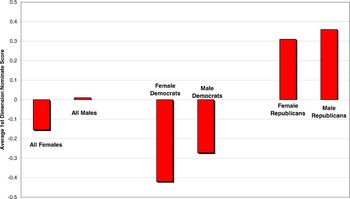
Figure 1 displays the average voting scores of all men and women, along with the four partisan groups (male and female Democrats, male and female Republicans). The figure suggests that there are significant gender-based differences in roll call voting. Among all men and women who served in the House during the period of our study, women, in general, were more liberal (−0.155) than their male counterparts (0.010). Among Democrats, there is nearly a 15-point difference between the average female (−0.420) and male (−0.273) scores. Among Republicans, the gap is five points (0.309 for women vs. 0.360 for men).Footnote 7 In all instances, women are “to the left” of their male counterparts.
Average ideological voting scores, by party and sex, 75th Congress to 110th Congress (1937–2008).

We also examined these gender differences over time by dividing the years included in our study into seven periods. These periods correspond to the decennial census and the reapportionment that occurs in the wake of each census. For each time period or districting regime (e.g., 1982–90), we calculated the mean scores for men and women within each party. The results show that the gender differences in floor voting are not confined to a particular period of time. We performed a difference of means test for comparing men and women overall and within both party groups in each time period. For the general comparisons, the voting ideology of women was distinct from men in all redistricting periods since 1952. For Republicans, the difference in means is statistically significant in six of seven cases (the exception being the 1952–60 period).Footnote 8 A similar result is obtained for the Democrats. In only one instance (1982–90) was the difference in means statistically insignificant.
To summarize, using a time frame that spans 36 Congresses and a broad measure of ideology in roll call voting, our initial analysis shows that women are more liberal than men, that the differences hold within both congressional parties, and that the differences are consistent over time. At issue, then, is whether these differences persist when our research design shifts in order to consider the natural experiment that flows from comparing predecessors and successors elected from the same congressional district.
ACCOUNTING FOR THE DISTRICT: SUCCESSORS AND PREDECESSORS
We now shift our unit of analysis to pairs of successors and predecessors. In each instance of personnel change, we compare the voting score for the last congress in which the member served with the score of the successor in his/her first congress. In this manner, we can examine the “immediate” impact of a change in personnel.
The Case of Intraparty Change
There are four possible patterns of intraparty change (i.e., Democrat to Democrat, Republican to Republican) and the sex of the officeholder; each of these four patterns can occur within each of the two parties, producing eight possible outcomes:
Case 1: Female Democrat succeeds male Democrat
Case 2: Male Democrat succeeds female Democrat
Case 3: Male Democrat succeeds male Democrat
Case 4: Female Democrat succeeds female Democrat
Case 5: Female Republican succeeds male Republican
Case 6: Male Republican succeeds female Republican
Case 7: Male Republican succeeds male Republican
Case 8: Female Republican succeeds female Republican
There are four cases that provide, in principle, a baseline for evaluating the ideological consequences of intraparty change. We expect that a change from a male Democrat or Republican to a man of the same party (Cases 3 and 7) will not produce a substantial shift in roll call behavior; a similar expectation holds for shifts from a female Democrat or Republican to a woman of the same party (Cases 4 and 8). Even though our analysis covers 72 years, the number of predecessor-successors pairs who are both female is small. In fact, there are no instances of female to female succession within the Republican Party. In the case of the Democrats, there are only eight instances.Footnote 9
Insofar as the gender-based differences are concerned, four situations—Cases 1, 2, 5, and 6—are critical. If female members are more liberal than their male counterparts, we would expect a shift to the left. This implies that the difference in scores between female successors and their male predecessors will, given the scale of the Poole-Rosenthal measure, be negative and statistically distinct from zero. The intraparty replacement of a female by a male is expected to produce a rightward shift. Thus, when men succeed women, the difference in scores will be positive and statistically different from zero.
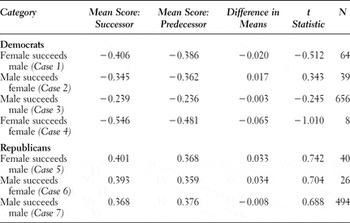
Table 1 is designed to evaluate these expectations. It presents the mean scores of the predecessor-successor pairs, along with the difference in means and t statistics for Democrats and Republicans. The table first shows that there are no significant differences when a male Democrat succeeds a male Democrat (Case 3), when a male Republican succeeds a male Republican (Case 7), or when a female Democrat succeeds a female Democrat (Case 4). More importantly, the results indicate that female successors are not more liberal than their male predecessors. The differences in voting scores are uniformly small; the difference in means in Cases 1, 2, 5, and 6 are statistically insignificant. Within either party, when a woman succeeds a man or a man succeeds a woman, there are no differences in voting behavior. Overall, then, there is no evidence that the sex of the member per se produces shifts in roll call liberalism within any of the partisan groups.
Ideology, sex and intraparty seat change in the U.S. House of Representatives, 75th to 110th Congresses (1937–2008)

Notes: None of the t values reported in the table are statistically significant. There were no cases of a Republican woman succeeding a Republican woman.
The cell entries in columns 2 and 3 are the mean voting scores on the first or economic dimension of the Poole and Rosenthal model.
The results in Table 1 lead to another and more subtle observation. In the case of Democrats, districts that elect women tend to produce more liberal representatives than the districts where the pattern of succession is male to male. This can be seen by comparing both successor and predecessor scores for districts that elected a woman (Case 1 in which female succeeds male and Case 2 in which male succeeds female) to districts where no woman was elected (Case 3 in which male succeeds male). In Cases 1 and 2, the mean scores for both the men and women in columns 2 and 3 of Table 1 are lower, that is, more liberal, than the mean scores in Case 3, districts where only men served. While far from conclusive, this does suggest that, within the Democratic Party, districts that elect liberal members to the U.S. House are more hospitable to female candidates. The configurations of characteristics that lead a district to elect a “liberal” appear to make it more likely to elect a woman. This may help in understanding why female candidates fare better within the Democrat Party than the Republican Party (see, for example, Cooperman and Oppenheimer Reference Cooperman, Oppenheimer, Dodd and Oppenheimer2001; Palmer and Simon Reference Palmer and Simon2008).
The Case of Interparty Change
The final step in our examination of gender-based voting differences involves those cases where Republicans replace Democrats and vice versa. With respect to this interparty change and our data on successor-predecessor pairs, there are eight possible outcomes:
Case 9: Republican man succeeds Democratic woman
Case 10: Democratic woman succeeds Republican man
Case 11: Republican man succeeds Democratic man
Case 12: Democratic man succeeds Republican man
Case 13: Republican woman succeeds Democratic man
Case 14: Democratic man succeeds Republican woman
Case 15: Republican woman replaces Democratic woman
Case 16: Democratic woman replaces Republican woman
Thus arrayed, Cases 9, 11, 13, and 15 represent a shift from Democrat to Republican, while Cases 10, 12, 14, and 16 denote a shift from Republican to Democrat.
Of necessity, this analysis must exclude the female-to-female pattern of succession (Cases 15 and 16). There are no instances where a female Democrat replaces a female Republican. Moreover, there are only three instances where a female Republican replaced a female Democrat. In 1994, Republican Enid Greene defeated Democrat Karen Shepherd in the 2d District of Utah, and Republican Linda Smith defeated Democrat Jolene Unsoeld in the 3d District of Washington. In 2002, Republican Virginia Brown-Waite defeated Karen Thurman, the Democrat, in the 5th District of Florida.
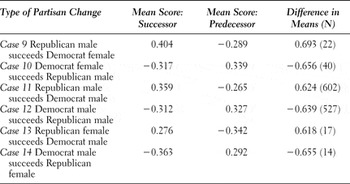
The results for the remaining cases are reported in Table 2. For each type of partisan change, the table reports the mean score of successors and predecessors, and the mean difference between the successor-predecessor pairs. Not surprisingly, a partisan shift in seats produces a substantial change in ideology. When a Republican replaces a Democrat, there is a shift from the left side of the spectrum (denoted by a negative score for the predecessor) to the right side (denoted by a positive score for the successor). As an illustration, consider the shift from a male Democrat to a male Republican (Case 11). The average score of male Republican successors is 0.359, whereas the average score of the male Democrat predecessors is −0.265. Subtracting the predecessor score from the successor's yields an overall change, interpreted as a shift to the right, of 0.624. Next, consider Case 9, where male Republicans succeed female Democrats. The average score of the successor is 0.404; the average predecessor score is −0.289; the resulting ideological shift is 0.693. In instances where a Democrat replaces a Republican, the shift is to the left, denoted by a negative score. For example, in Case 10, the mean score of Republican male predecessors (0.339) is subtracted from the mean score of their female Democrat successors (−0.317) to produce a leftward change of −0.656. Overall, then, the entries of Table 2 conform to expectations about partisan change. Democrats replacing Republicans produce a sizable leftward shift (Cases 10, 12, and 14), while Republicans replacing Democrats generate a substantial shift to the right (Cases 9, 11, and 13).
Ideology, sex and interparty seat change in the U.S. House of Representatives, 75th to 110th Congresses (1937–2008)

Note: The cell entries in columns 2 and 3 are the mean voting scores on the first or economic dimension of the Poole and Rosenthal model.
Having demonstrated the impact of partisan change within districts, we next question whether the magnitude of change varies with the gender of predecessors and successors. The largest ideological shifts are expected to occur when Republican males – the most conservative group—replace Democratic females—the most liberal group (or vice versa). Similarly, the smallest ideological shifts are expected to occur when Republican females replace Democratic males (or vice versa). Spatially, this hypothetical alignment can be illustrated as follows:

These spatial relationships can be used to formulate six hypotheses. Each hypothesis is based upon an expected inequality between pairs of partisan changes:
Case 9 > Case 11Case 10 > Case 12
Case 9 > Case 13Case 10 > Case 14
Case 11> Case 13Case 12 > Case 14
For example, as noted earlier, Case 9 represents the instance where a Republican male replaces a Democratic female. The spatial representation shows that if gender-based differences exist, Case 9 represents the largest ideological change expected. As a result, the change associated with Case 9 should exceed case 11 (where the Republican male succeeds a Democratic male) and case 13 (where a Republican female succeeds a Democrat male). The hypotheses involving Case 10 are “mirror images” of these where a Democratic female replaces a Republican male. Thus, Case 10 should be greater than Case 12 (Democratic male succeeds Republican male) and Case 14 (Democratic male succeeds Republican female). Finally, we make use of the fact that the smallest change is expected to occur when a Republican female replaces a Democratic male or vice versa. From this it follows that Case 11 (Republican male replaces Democratic male) should be greater than Case 13 (Republican female replaces Democratic male); similarly, Case 12 (Democratic male replaces Republican male) will be greater than Case 14 (Democratic male replaces Republican female).
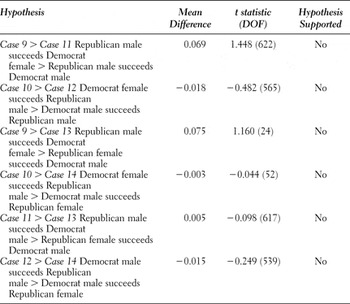
To evaluate these hypotheses, we perform a difference of means test on the ideological change associated with each case. This requires that for each hypothesis, we use the relevant change values reported in the fourth column of Table 2. For example, the first hypothesis is that the change associated with a Republican male succeeding a Democratic female (Case 9) will be greater than the change associated with a shift from Democrat to Republican involving males only (Case 11). The mean change score for Case 9, as reported in Table 2, is 0.693; for Case 11, the value is 0.624. We then use a t-test to determine whether the difference, 0.068, is statistically significant.
The results of these tests are presented in Table 3 and offer little support for sex-based differences in ideology. None of the hypotheses are supported by the results of the statistical tests. The tests do suggest that there is a slightly greater shift to the right when a Democratic female is replaced by a Republican male, compared to the instances where Democratic males are the predecessors (approximately a 7-point difference). Similarly, there is a greater change when a male Republican replaces a female Democrat, compared to a female Republican replacing a male Democrat (approximately a 7.5-point difference). Neither of the changes, however, is statistically significant. There is virtually no sex-based difference among Democrats who succeed Republicans. Our consideration of interparty change thus leads to the conclusion that while the ideological changes associated with partisan turnover in office are substantial, the magnitude of these changes is not associated with the sex of either the successor or predecessor.
The case of interparty change: Testing the impact of sex on ideological change, 75th to 110th Congresses (1937–2008)

CONCLUSION AND DISCUSSION
The point of departure in this analysis is perhaps one of the major political changes during the last 25 years: the movement of women into the electoral arena and the growing number of women who now pursue careers in legislatures, both state and national. The objective was to examine the question of sex-based differences in congressional voting behavior by taking advantage of predecessor-successor pairs as an opportunity to control for district-level factors. Although we can find aggregate differences in the roll call behavior of women and men by comparing the average Poole Rosenthal scores and, once we move into the natural experiment of using predecessor-successor pairs in the same district, these differences all but disappear. When using this design, we find that in the case of intraparty change, there are no ideological differences in the voting records of women who replace men or men who replace women. A similar result holds even for interparty change; the shift in ideology marked by a change in party control of a district does not depend upon the sex of the successor or predecessor. In other words, the voting records of consecutive members of Congress who come from a particular district are virtually the same, regardless of their gender. Once differences in constituencies are accounted for, gender differences recede.
The question then becomes whether or not women in Congress do tend to come from particular districts that are different than the districts that elect men. And there is some evidence that this is, in fact, the case. Districts that elect women have a demographic profile that is distinct from those that elect only men. Research done in the 1980s found that female members tend to come from districts that were more urban and more diverse in their populations (Nechemias Reference Nechemias1985; Rule Reference Rule1981; Welch Reference Welch1985). More recent research shows that in addition to coming from districts that have an urban and diverse character, women are elected from districts that are “tonier”—wealthier and with higher levels of educational achievement along with smaller proportions of blue collar workers and school age children (Palmer and Simon Reference Palmer and Simon2008). When viewed against the backdrop of this demographic-based research, our results imply that it is not the sex of the member that influences roll call voting; rather, districts with a particular configuration of characteristics—what Barbara Palmer and Dennis Simon (Reference Palmer and Simon2008) call “women friendly districts”—will elect more liberal members of the House, be they men or women. It is important to emphasize that our findings do not imply that there are no differences in how women campaign or how they conduct themselves after they are elected. However, any differences in the voting behavior of male and female members of the U.S. House are a function not of sex but of the constituencies they represent.