Introduction
Depression in the elderly is a serious public health problem, and is one of the leading causes of disability in an elderly population. Depression has profound adverse effects on the quality of life, increased morbidity and mortality, and heightened risk for suicide (Lebowitz et al., Reference Lebowitz1997; Unützer et al., Reference Unützer, Patrick, Diehr, Simon, Grembowski and Katon2000; Shmuely et al., Reference Shmuely, Baumgarten, Rovner and Berlin2001; Doraiswamy et al., Reference Doraiswamy, Khan, Donahue and Richard2002). Over half of all geriatric psychiatric hospitalizations are due to severe depression, commonly with excessive functional impairment that necessitates hospitalization. The quality of life (QOL) of depressed hospitalized elderly people may be more significantly affected than that of young adults given the severity of their illness. In elderly individuals with recurrent severe depression, quality of life may be a marker of well-being, which measures much more than the change in the level of depression (Mazumdar et al., Reference Mazumdar, Reynolds, Houck, Frank, Dew and Kupfer1996).
Quality of life (QOL) is a multidimensional construct that encompasses the physical, mental, psychological, social, and spiritual components of health (Bretscher et al., Reference Bretscher1999; Mytko and Knight, Reference Mytko and Knight1999; Rummans et al., Reference Rummans, Bostwick and Clark2000). QOL research is important in persons with depression because it addresses their subjective life experience, an area generally not captured by the objective criteria most often used to assess depression. There is a strong association between QOL and the severity of depression. The factors that have been found to be associated with both depression and QOL in the elderly include physical health, cognitive functioning, social support, and spirituality (Warner, Reference Warner1998; Unützer et al., Reference Unützer, Patrick, Diehr, Simon, Grembowski and Katon2000; McKenna et al., Reference McKenna2001; Shmuely et al., Reference Shmuely, Baumgarten, Rovner and Berlin2001; Ceroni et al., Reference Ceroni, Rucci, Berardi, Berti Ceroni and Katon2002; Doraiswamy et al., Reference Doraiswamy, Khan, Donahue and Richard2002; Herrman et al., Reference Herrman2002). Elderly individuals with comorbid medical illnesses with consequent impairment and disability are more likely to report more severe depressive symptoms, poorer recovery outcomes, and poorer QOL than those who are physically healthy (Ware, Reference Ware1993; Bruce et al., Reference Bruce, Seeman, Merrill and Blazer1994; Krach et al., Reference Krach, DeVaney, DeTurk and Zink1996; Lebowitz et al., Reference Lebowitz1997; Roberts et al., Reference Roberts, Kaplan, Shema and Strawbridge1997; Steffens et al., Reference Steffens, Hays and Krishnan1999; Ceroni et al., Reference Ceroni, Rucci, Berardi, Berti Ceroni and Katon2002; Doraiswamy et al., Reference Doraiswamy, Khan, Donahue and Richard2002; Taylor and Lynch, Reference Taylor and Lynch2004). The causality of the relationship is not clear. Chronic late life depression has been linked to the severity of cerebrovascular risk factors, apathy, and poor QOL (Lavretsky et al., Reference Lavretsky, Lesser, Wohl, Miller and Mehringer1999). Depressive symptoms may be a consequence of medical illness or disability, but they may actually foster or exacerbate disability and serve as obstacles to recovery from medical illness or surgery. The resulting or continued impairment can, in turn, impact QOL and impede recovery from depression (Warner, Reference Warner1998).
The extent of impairment of QOL in the hospitalized depressed elderly is understudied, yet this is a very important area to investigate given the opportunity to improve not just depression in this population, but also to impact overall QOL. It has been proposed that effective treatment of depression may improve the QOL of the elderly. Among the pharmacological, biological, and psychotherapeutic modalities which are the standard treatment of depression in the inpatient setting, electroconvulsive therapy (ECT) in particular has been demonstrated to be effective in treating major depression in the elderly, with a response rate of 80–90% (O'Connor et al., Reference O'Connor2001). There is a growing literature on the impact of ECT on the QOL of individuals who receive this treatment. Overall, ECT has demonstrated effectiveness in improving QOL for depressed individuals (Fisher et al., Reference Fisher, Goldney, Furze, Williams, Mattner and McCleave2004), maintaining the QOL weeks to months after ECT (McCall et al., Reference McCall, Dunn and Rosenquist2004; Reference McCall, Prudic, Olfson and Sackeim2006), better improvement of QOL compared to those treated with drugs alone (McCall et al., Reference McCall, Reboussin, Cohen and Lawton2001), and concordance between patients’ and physicians’ perspectives on the improved QOL (Antunes and Fleck, Reference Antunes and Fleck2009).
The aim of this prospective descriptive study was to contribute to the understanding of the QOL in depressed geropsychiatric inpatients. We sought to describe depression and QOL in elderly individuals while hospitalized for depression, to explore the associations between depression and QOL, and to examine whether those receiving ECT would demonstrate better QOL outcomes compared to those who do not receive ECT. The study hypothesized that both depression and QOL would improve at the end of hospitalization, and that improvements in depression would be strongly associated with improvements in QOL.
Methods
Setting
The setting of this study was an inpatient geriatric psychiatric unit within a tertiary care academic medical center in the mid-western U.S.A. This unit provides comprehensive, interdisciplinary care to individuals aged 65 years and older with psychiatric illnesses. The inpatient multidisciplinary treatment team is led by geriatric psychiatrists, and composed of care providers from various disciplines with expertise in psychiatric care, including psychiatric trainees, psychologists, internists, residents and medical students, nurses, social workers, pharmacists, physical therapists, occupational therapists, recreational therapists, and chaplains. Acute geropsychiatric inpatient treatment represents the most intensive level of psychiatric care, where the goal is stabilization of highly acute and severe psychiatric conditions associated with danger to self or others and/or marked functional impairment. The inpatient setting provides a 24-hour secure environment that is highly structured and supervised. Following multidisciplinary assessments, treatment planning is individualized appropriate to an individual's condition with realistic and attainable goals. Multimodal interventions are initiated, including psychopharmacological management, biological treatments such as ECT, and psychotherapeutic interventions involving both individual and group therapy. Patients, families, or healthcare agents actively participate in the plan of care and treatment to the extent possible.
Study participants
Recruited patients comprised those admitted to the inpatient unit aged 65 years and older, and who carried an admission diagnosis of unipolar or bipolar major depression, or schizoaffective disorder, depressive type, according to the criteria of the Diagnostic and Statistical Manual for Mental Disorders (DSM-IV) (American Psychiatric Association, 2000). Excluded were those with a Mini-mental State Examination score of less than 18 and insufficient communication skills to participate in an interview.
Procedure
Recruitment began in June 2006, following Institutional Review Board (IRB) approval. Consecutive patients admitted to the inpatient unit were screened for eligibility. Those who were eligible were approached by a member of the research team and invited to participate. Participants who provided written consent according to the requirements of the IRB were enrolled. Surveys were conducted at two time points during hospitalization. Admission surveys were conducted within 72 hours of hospitalization, and final surveys within 48 hours of discharge. The electronic medical records were reviewed for demographic information, medical and psychiatric history, medications, current evaluation and treatment, and relevant treatment outcomes.
Instruments
All instruments were reviewed by the investigators for their suitability for this study and permissions were secured for copyrighted instruments.
Measure of depression
The Hamilton Depression Rating Scale (HDRS; Hamilton, Reference Hamilton1967) is a 24-item instrument which has been widely used to measure the severity of illness in adults already diagnosed with depression, and was administered by trained research personnel. It was chosen for this study because of its high validity and reliability in measuring treatment response in those with mood disorders. It contains items that assess somatic symptoms, insomnia, working capacity and interest, mood, guilt, psychomotor retardation, agitation, anxiety, and insight.
Measures of QOL
In order to provide a comprehensive assessment of overall QOL and specific domains of QOL, three self-report instruments were used: the Spitzer Uniscale (Spitzer et al., Reference Spitzer1981), the Linear Analogue Scales of Assessment of QOL (LASA) (Locke et al., Reference Locke2007), and the Medical Outcomes Short Form-36 Health Survey (SF-36) Acute (Ware, Reference Ware1993). The Spitzer Uniscale asks patients to rate their overall QOL during the past week on a scale of 0 to 10, with zero describing QOL “as bad as it can be” and ten describing QOL “as good as it can be.” This instrument has been shown to be sensitive to changes in QOL over time (Spitzer et al., Reference Spitzer1981; Sloan et al., Reference Sloan1998). This single-item question will be called the LASA overall QOL for the remainder of the paper. It was incorporated into the 11-item LASA questionnaire that uses the same rating scale to address the physical, cognitive, emotional, social, and spiritual domains of QOL. This adaptation has been used in several previous research studies with cancer patients (Bretscher et al., Reference Bretscher1999; Rummans et al., Reference Rummans2006) and has been validated as both measures of overall and specific components of QOL (Grunberg et al., Reference Grunberg, Groshen, Steingass, Zaretsky and Meyerowitz1996; Gudex et al., Reference Gudex, Dolan, Kind and Williams1996; Bretscher et al., Reference Bretscher1999; Locke et al., Reference Locke2007).
The SF-36 (Ware, Reference Ware1993) is a self-report general health QOL survey that consists of 36 items grouped into two summary scales (mental and physical components) and eight subscales. General mental health, vitality, role limitations due to emotional problems, and social functioning are subscales contributing to the mental component score. General health perceptions, bodily pain, role limitations due to physical problems, and physical functioning are subscales contributing to the physical component score. The average score of the U.S. adult population, adjusted for age and sex, is 50, with poorer QOL represented by lower scores, and better QOL represented by scores higher than 50. The acute form of the SF-36 was used in this study because it has the sensitivity to detect recent changes in health status measures. It differs from the standard SF-36 in recall period, asking participants to evaluate their QOL in the previous week, rather than the previous four weeks (Ware et al., Reference Ware, Kosinski and Dewey2000).
Measures of cognition
Two clinician-administered instruments were used to assess cognitive functioning at admission and discharge. The Mini-mental State Examination (MMSE) (Folstein et al., Reference Folstein, Folstein and McHugh1975) is a widely used screening test for cognitive functioning that includes items related to orientation, memory, executive functions, language, and visuospatial skills (Folstein et al., Reference Folstein, Folstein and McHugh1975). Scores range from 0 to 30, with higher scores reflecting better global cognitive functioning. It has been demonstrated that persons with scores of 18 or higher demonstrate adequate ability to provide consent (Kim et al., Reference Kim, Caine, Currier, Leibovici and Ryan2001), so this minimum score was used to determine eligibility when screening potential participants.
The Executive Interview (EXIT 25; Royall et al., Reference Royall, Mahurin and Gray1992) is a 25-item interview used to assess domains of executive function control, including frontal release signs (e.g. grasp reflex), motor or cognitive perseveration (e.g. echopraxia), verbal intrusions, disinhibition, loss of spontaneity (e.g. word fluency), imitation behavior, environmental dependence and utilization behavior. Each item is scored from 0 (intact) to 2 (specific incorrect response or failure to perform a task). Scores range from 0 to 50, with higher scores suggesting greater impairment. A total score of 15 out of 50 best discriminates normal elderly from all dementias.
Measure of coping
The Brief COPE Inventory (COPE) is a 28-item self-report measure of both adaptive and maladaptive coping skills (Carver, Reference Carver1997). It is a shorter version of the full COPE inventory that assesses a wide range of coping responses, and it has been used in research with breast cancer patients (Carver et al., Reference Carver, Scheier and Weintraub1989).
Measure of medical burden
The Cumulative Illness Rating Scale (CIRS) evaluates the degree of impairment in cardiovascular, respiratory, gastrointestinal, genitourinary, musculo-skeletal-integumentary, neuropsychiatric, and endocrine-metabolic systems. Scoring on each of the 13 items ranges from no impairment (0) to extremely severe impairment (4). Total scores may range from 0 to 52 (Miller et al., Reference Miller1992). While there is no cut-off score, higher scores indicate more coexisting medical conditions that contribute to the medical burden.
Data analysis
The analysis for the first hypothesis (i.e. there will be an improvement in scores of depression and QOL during inpatient psychiatric hospitalization) was performed in two stages. First, the observed measurements of depression as measured by the HDRS, and QOL as measured by the LASA overall QOL and SF-36 mental and physical component scores, were summarized at each time point using the mean, standard deviation, median, range, and appropriate plots for continuous variables, and number and percent for categorical variables. Scores were adjusted for age and sex for SF-36. Wilcoxon signed rank tests were performed to determine if there was evidence that these measures changed significantly from admission to discharge. As secondary outcomes, subscales of the LASA (physical, cognitive, emotional, social, and spiritual) and SF-36 were compared from baseline to discharge using the Wilcoxon signed rank test. In all cases, two-tailed p-values ≤0.050 were considered statistically significant.
The analysis for the second hypothesis (i.e. there will be positive associations between depression and QOL) consisted of performing a correlation analysis using Spearman correlation coefficient. The associations between depression and QOL were assessed at admission and discharge. Additionally, changes in scores on HDRS, LASA, and SF-36 from baseline to discharge were determined and their associations were evaluated using the Spearman correlation coefficient.
Sample size and power
With a sample size of 45, we had 80% power to detect changes over time of 0.33 standard deviation units or more with a two-sided α = 0.05 paired t-test. This also approximates the magnitude of differences that one would detect with a Wilcoxon signed rank test. Differences of 0.33 standard deviations are considered to be small to moderate in size (Cohen, Reference Cohen1988). Similarly, this sample size would provide 80% power to detect correlations larger than 0.31 with a two-sided α = 0.05 level test (Cohen, Reference Cohen1988). Correlations of this magnitude are considered to be moderate in size (Burns and Grove, Reference Burns and Grove1993) and correspond to the situation where one variable explains 9.6% or more of the variance of the other.
Results
Over the course of 16 months, a total of 139 eligible persons were admitted to the inpatient psychiatric unit. Of these, 58 provided written informed consent and were enrolled in the study. Those who declined stated such reasons for their decision as “feeling overwhelmed”, “not up to it”, “too depressed”, and “not interested”. Forty-five (78%) of those enrolled completed the intake and discharge measures and served as the participant group for this investigation.
Participant characteristics
Mean age was 74.3 ± 6.7 years, most participants were female (67%), married (58%), Protestant (60%), and had at least high school education (78%). Major depressive disorder was the predominant depression diagnosis (93%), and a few were diagnosed with bipolar depression (7%). Other comorbid psychiatric conditions included anxiety disorder (31%), substance use disorder (20%), and delirium (2%). There was a moderate amount of chronic medical burden on the CIRS (mean 13.6 ± 5.7), with the cardiac (76%), endocrine (56%), and gastrointestinal (53%) organ systems most commonly affected. Thirty-eight percent received electroconvulsive therapy (ECT) during hospitalization, with a mean (SD) number of ECT treatments 6.4 ± 2.6. The mean length of hospital stay was 11 ± 6 days.
Changes in depression, QOL, cognitive functioning, and coping skills
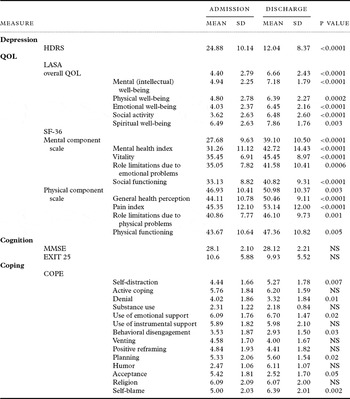
Upon admission, participants in general showed high HDRS scores demonstrating severe depression, and low LASA and SF-36 scores indicating poor QOL (Table 1). However, at the end of hospitalization, all discharge scores for depression and QOL improved across the board. There was a significant reduction in HDRS scores (p < 0.0001) indicating significant improvement of depression.
Admission and discharge measures of depression, QOL, cognition, and other measures

QOL = quality of life; HDRS = Hamilton Depression Rating Scale; LASA = Linear Analogue Scales of Assessment of QOL; SF-36 = Medical Outcomes Short Form-36 Health Survey Acute Form; MMSE = Mini-mental State Examination; EXIT 25 = Executive Interview; COPE = Brief COPE Inventory; NS = not significant.
Overall QOL improved significantly (p < 0.0001) as measured on the LASA, as well as several other LASA domains of QOL, including mental, physical, emotional, and spiritual well-being, social activity, pain frequency, and fatigue (all p ≤ 0.003). While scores also improved on LASA pain severity, financial concerns, legal concerns, and support from family and friends, the difference was not statistically significant. QOL also improved as shown by SF-36 mental (p < 0.0001) and physical (p < 0.0032) component scores. Furthermore, all of the SF-36 items contributing to both the mental component scores (general mental health, vitality, role limitations due to emotional problems, social functioning) and physical component scores (general health perceptions, bodily pain, role limitations due to physical problems, physical functioning) improved significantly at the end of hospitalization (all p ≤ 0.005).
With respect to cognitive measures upon admission, participants had a high level of global cognitive (MMSE mean 28 ± 2.1) and executive function (EXIT 25 mean 10.6 ± 5.88). There were no significant changes in global cognitive and executive functioning at the end of hospitalization. In the area of coping skills, participants endorsed several significant changes including improved use of self-distraction (p = 0.007), emotional support (p = 0.02), and planning (p = 0.02); and increased acceptance (p = 0.05) at the end of hospitalization. In contrast, there was a significant reduction of denial (p = 0.01), behavioral disengagement (p = 0.03), and self-blame (p = 0.002) at the end of hospitalization. There were no significant changes in other coping skills of active coping, substance use, venting, positive reframing, humor, and religion.
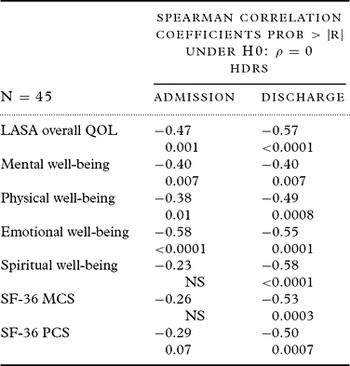
Associations between depression and QOL are shown in Table 2. Upon admission, depression as measured by HDRS had significant negative associations with LASA overall QOL (r = −0.47; p = 0.001), mental well-being (r = −0.40; p = 0.007), physical well-being (r = −0.38; p = 0.01), and emotional well-being (r = −0.58; p < 0.0001). Depression at admission was not significantly associated with SF-36 mental and physical component scores adjusted for age and sex. At discharge, several associations between scores of depression and QOL were stronger and demonstrated a higher level of significance. Depression was more negatively correlated with overall QOL (r = −0.57; p < 0.0001), physical well-being (r = −0.49; p = 0.0008), and spiritual well-being (r = −0.58; p < 0.0001). The negative associations with depression and mental (r = −0.40; p = 0.007) and emotional well-being (r = −0.55; p = 0.0001) remained. Depression at discharge also negatively correlated with mental (r = −0.53; p = 0.0003) and physical (r = −0.50; p = 0.0007) component scores on the SF-36.
Correlations between depression and QOL

HDRS = Hamilton Depression Rating Scale; LASA = Linear Analogue Scales of Assessment of QOL; QOL = quality of life; SF-36 = Medical Outcomes Short Form-36 Health Survey Acute Form; MCS = Mental Component Summary; PCS = Physical Component Summary; NS = not significant.
We also examined whether the changes in depression and QOL were correlated with other variables. The changes in depression and QOL were not found to be correlated with age, gender, length of hospital stay, cognitive functioning, or medical burden. Several coping skills items measured on the brief COPE were also found to be correlated with changes in depression and QOL scores. Self-distraction was correlated with changes in mental well-being (p = 0.03), emotional well-being (p < 0.0001), spiritual well-being (p = 0.008), and change in mental component score (p = 0.006). Active coping was correlated with change in mental component score (p = 0.02). Denial as a coping skill was correlated with emotional well-being (p = 0.03), spiritual well-being (p = 0.002), and change in mental component score on the SF-36 (p = 0.006). Positive reframing was correlated with emotional well-being (p = 0.02). Planning (p = 0.04), humor (p = 0.004), and religious coping (p = 0.04) were correlated with changes in the SF-36 physical component score.
Comparison between ECT and non-ECT groups
To examine whether ECT made any difference, we compared groups based on whether or not they received ECT as treatment for depression. At baseline, the ECT group did not differ from the non ECT group with regards to age, gender, and marital status. Not surprisingly, length of stay was twice as long for those who received ECT than those who did not (16 v 8 days, p < 0.0001). On admission, there was no difference found in the overall medical burden or severity index of medical comorbidities to the hospital between the ECT and non ECT groups as measured by the CIRS. However, the non-ECT group showed more level 3 categories on the CIRS, which indicates a higher rate of severe disabling chronic conditions than the ECT group (1.79 v 0.94, p = 0.02). There were also no significant differences in all measures of global (MMSE) and executive (EXIT 25) functioning, level of depression (HDRS), quality of life (LASA, SF-36), and coping abilities (COPE). The only difference found between the two groups on admission is a higher level of spiritual well-being in the non-ECT group (7.18 v 5.35, p = 0.03).
There were, however, interesting differences demonstrated by the group that received ECT at the time of discharge from the hospital. As expected, the ECT group had a longer length of hospital stay (16 v 8, p < 0.0001). Cognitively, those who received ECT showed worsening executive function as measured by higher EXIT 25 scores at discharge (12.47 v 8.39, p = 0.008). When comparing this change in EXIT 25 scores, the ECT group showed a greater degree of worsening of scores compared to the non ECT group (1.59 v −2.04, p = 0.002). Interestingly, the ECT group on discharge demonstrated better QOL in some areas as measured by the SF-36. They scored higher on measures of vitality (49.30 v 43.38, p = 0.03), general health perception (55.24 v 47.90, p = 0.009), and physical component scale (55.49 v 48.00, p = 0.05). It is also interesting to note that those who were treated with ECT showed a much greater magnitude of improvement in vitality (16.14 v 6.71, p = 0.002) and general health perception (10.81 v 3.96, p = 0.04) in comparison to those who did not receive ECT. In terms of coping skills, the ECT group at discharge endorsed utilizing less active coping skills (5.56 v 6.57, p = 0.02) and positive reframing (5.56 v 6.43, p = 0.03) compared to those who did not receive ECT.
Discussion
In this sample of psychiatrically hospitalized elderly, depression and QOL improved over the course of hospitalization. The finding that depression improved is not surprising as treatment was focused on depression, and as such participants received psychotropic medications, psychotherapy and some had ECT. However, QOL was not a target of the treatment so this study provides more information on QOL changes during hospitalization for depression in the elderly. As hypothesized, improvements in depression and QOL were strongly correlated with each other. Our results also include the finding that upon admission to the hospital these elderly people who suffered from depression severe enough to require psychiatric hospitalization also suffered from extremely low QOL. It therefore appears plausible that assessment and treatment of diminished QOL may be important in this population.
The most important finding is that at discharge these severely depressed elderly individuals experienced not just improvement or remission of depression, but an overwhelming improvement of QOL as well. QOL is frequently identified as being very important to individuals; i.e. not just longevity of life, but satisfaction with life. The alterations in depression and QOL were significant both statistically and clinically. The diminishment of depression was clinically significant as shown by a 50% reduction of HDRS scores. A one-point change on the LASA is considered clinically significant (Rummans et al., Reference Rummans2006). When measured on the LASA, overall QOL (two points), mental (two points), physical (one and a half points), emotional (two and a half points), spiritual well-being (one point), and social activity (almost three points), were all enhanced. When using the SF-36 instrument, not only did the overall mental and physical QOL improve, but so did the specific QOL domains that contribute to these summary scores, including general mental health, vitality, role limitations due to emotional problems, social functioning, general health perceptions, bodily pain, role limitations due to physical problems, and physical functioning.
Although there was significant improvement on SF-36 compared to the index scores, our study group had discharge scores mostly below 50, which is low compared to the general population. This finding highlights the poor QOL experienced by elderly people who suffer from severe depression. However, despite these low QOL scores, the magnitude of the observed improvement of the QOL for these depressed elderly indicates that quality of life can indeed be enhanced when depression improves. It is also important to note that depression and QOL improved despite age, gender, length of hospital stay, cognitive functioning, or medical burden. It seems apparent that these factors do not prohibit improvement in QOL and depression. The treatment provided on the inpatient unit did not specifically target QOL. Perhaps incorporating QOL interventions into inpatient treatment would be effective in bringing about even greater improvements in QOL.
Although our study observed the naturalistic course of hospitalization for these depressed elderly and was not designed to examine the specific aspects of the psychiatric and medical care they received, the standard of care for depression in this inpatient unit is a multidisciplinary biopsychosocial treatment to actively address both acute psychiatric and medical illnesses. In a study by Cohen and colleagues that compared care received by frail elderly patients in inpatient geriatric units versus usual inpatient care, patients who were assigned to inpatient geriatric units were found to demonstrate greater improvements in SF-36 subscales of physical functioning, bodily pain, energy, and general health, as well as activities of daily living, and physical performance compared to those who received usual inpatient care (Cohen et al., Reference Cohen2002). The study further showed that inpatient geriatric evaluation and management led to significant reductions in functional decline, and if followed by outpatient geriatric evaluation and management, was linked with improvements in mental health with no increase in costs. Therefore, perhaps some of the improvements found in QOL in this study were due to participants being treated in a geriatric unit.
It is important to note that there were differences in the improvement of QOL based on whether participants received ECT or not. In this study, the ECT group demonstrated higher scores than the non-ECT group on some QOL domains (vitality, general health perception, and physical component) but not all. This finding is only partially consistent with other studies that showed ECT being associated with superior QOL measures than those who did not receive ECT (McCall et al., Reference McCall, Reboussin, Cohen and Lawton2001; Reference McCall, Dunn and Rosenquist2004; Fisher et al., Reference Fisher, Goldney, Furze, Williams, Mattner and McCleave2004). One published study explored differences between depressed adult inpatients who did and did not receive ECT, and reported that elderly patients were more likely to receive ECT based on the negative impact of depression on QOL, specifically functional decline in activities of daily living (McCall et al., Reference McCall, Cohen, Reboussin and Lawton1999). Other than these, no published literature currently exists that examines specific interventions to improve depression and QOL in depressed elderly inpatients. Findings from our study are different from other published studies in that our study group demonstrated similar levels of depression and QOL before and after treatment, regardless of ECT. Specifically, overall QOL for both ECT and non-ECT groups were poor on admission, but significantly improved at time of discharge.
There were two interesting findings that our ECT group did demonstrate at the end of hospitalization. First is the endorsement of better physical QOL compared to the non-ECT group, including vitality, general health perception, and physical component scale on the SF-36. A study comparing demographic, clinical, and quality of life measurements between those who received and did not receive ECT found that patients who received ECT were older, had greater weight loss, and more functional impairment (McCall et al., Reference McCall, Cohen, Reboussin and Lawton1999). Another study looked at predictors for choosing ECT as a treatment option, and found that patients who are likely to choose ECT were more depressed before treatment, had more impairment in instrumental activities of daily living, and experienced a more robust improvement in depressive symptoms (Rosenquist et al., Reference Rosenquist, Dunn, Rapp, Gaba and McCall2006). Despite the lack of statistically significant differences between our ECT and non-ECT groups with regards to age, physical measures, and the level of depression before and after treatment, perhaps our ECT group still had a higher severity of depression and functional impairment before treatment and therefore demonstrated and perceived a greater magnitude of improvement in QOL because they had more room for improvement. The second interesting finding from the ECT group is the reduced utilization of active coping and positive reframing coping skills on discharge. This finding suggests that perhaps the ECT group was coping better than the non-ECT group at the end of hospitalization, and therefore exerting less effort in actively utilizing coping skills.
The finding that both global cognitive and executive function remained stable throughout depression treatment suggests that neurocognitive dysfunction may not necessarily affect the outcome negatively. While neurocognitive dysfunction has been recognized as a predictive factor for poor outcomes in geriatric depression and is associated with limited antidepressant response (Story et al., Reference Story, Potter, Attix, Welsh-Bohmer and Steffens2008), we did not observe this in our study group, although a follow-up post hospitalization would help determine whether improvements in depression and QOL for those with neurocognitive dysfunction were sustained. Even though those who received ECT in the study showed worsening of executive function, this same group endorsed improvement of vitality, general health perception, and physical well-being more than those who did not receive ECT. When they do occur, cognitive side effects related to ECT are expected to be temporary, and may or may not have an impact on one's overall QOL. For some, depression manifests with impairment in memory and concentration which can improve with ECT. What is more important is to treat depression adequately, which we know positively impacts QOL. This improvement in QOL may be a benefit that outweighs the impact of any cognitive side effects that occur with ECT.
Our study has several limitations. The nature of the study is a prospective naturalistic survey of the depressed elderly patients during psychiatric hospitalization and was not designed to examine closely each aspect of depression treatment that patients received. It is thus not possible to identify which specific treatment contributed to improving depression and QOL. Second, the patient population represents the most severely ill individuals with the highest acuity of psychiatric illness, with or without concurrent medical conditions that required active interventions. Our results therefore may not be generalizable to those who have mild to moderate depression, or those receiving outpatient psychiatric care. Third, the scope of the study does not include follow-up to examine whether and how long the improvement or remission of depression, as well as the improvement of QOL, were sustained post-discharge from the hospital. ECT can potentially lead to short-term memory difficulties and confound self-report measurements, although QOL is a subjective measure and therefore what is important is what the patients perceive their quality of life to be. Finally, our sample was mostly female, married, white and well educated, and these results may not apply to diverse or underserved populations.
In conclusion, elderly patients in this study whose depression was severe enough to require psychiatric hospitalization demonstrated poor QOL at admission to the hospital. At the time of discharge they experienced statistically and clinically significant improvements in their mood and QOL. QOL is clearly positively impacted when depression improves, globally with overall QOL, as well as the individual domains of emotional, physical, social, and spiritual QOL. Psychiatric treatment in an inpatient setting is effective for treating depression and for improving quality of life, and ECT may have not only mood benefits, but QOL benefits.
QOL interventions have a broader and more comprehensive approach in addressing multiple domains of quality of life. An example of a structured multidisciplinary QOL intervention has been described in the literature, and has been shown to improve and maintain the quality of life of geriatric patients with advanced cancer (Lapid et al., Reference Lapid2007). Such interventions, if integrated into depression treatment, would complement and further enhance treatment response and QOL. Future larger and longer-term studies are needed to identify or develop specific multimodal treatment strategies designed not only to alleviate depression in the elderly, but more importantly to address and improve their quality of life during hospitalization and following discharge.
Conflict of interest
None.
Description of authors' roles
Maria I. Lapid and Katherine M. Piderman were responsible for study concept, design and implementation, the acquisition of subjects and data, analysis and interpretation of data, and preparation of the paper. Susan M. Ryan was involved in the acquisition of subjects and data, analysis and interpretation of data, and preparation of the paper. Kristin J. Somers was involved in the implementation of the study, as well as in the acquisition of subjects and data, analysis and interpretation of data, and preparation of the paper. Matthew M. Clark and Teresa A. Rummans assisted with the study concept and design, analysis and interpretation of data, and preparation of the paper.
Acknowledgments
This study was conducted at Mayo Clinic, Rochester, MN, U.S.A. The findings were presented as a poster at the International Psychogeriatric Association 14th International Congress in Montreal Canada, September 2009 (Lapid et al., Reference Lapid, Piderman, Stevens, Ryan, Clark and Rummans2009). The work was supported by the Saint Mary's Hospital Sponsorship Board and the Mayo Clinic Department of Psychiatry and Psychology.