


I. INTRODUCTION
On September 29, 2016 Rosetta spacecraft died as programed by the European Space Agency (ESA). A successful space mission ended but a shadow remains on the overall picture of this amazing adventure. The space probe “Philae” launched from the Rosetta spacecraft on November 12, 2014 landed on the comet in the shadowed zone by a nearby cliff. Philae was unable to collect solar power and charge properly its batteries. Consequently, its scientific mission was drastically amputated once its batteries discharged. Due to this DC power problem Philae performed only a few days of scientific experiments during the 2 years of Rosetta mission. This issue highlighted one of the key sub-systems in space exploration and monitoring: energy availability and energy generation. Energy is mostly generated using solar panels, and sometimes fossil and/or atomic generators. However, they have always specific problems: fossil is limited, atomic collides with legal and societal constraints and both requires high lift-off costs at the launching phase.
In many situations solar harvesting is the best option, but there is imposition that this source of energy be available (by solar availability we assume that sun is within the line of sight and that the spacecraft or probe has a direct solar illumination), this is not always the case. In the recent Rosetta mission the Philae probe landed on a comet surface and the landing site did not allow for a continuous solar exposition, as shown in Fig. 1, thus limiting the available energy and subsequently the operation of the probe.
The likely orientation of Philae probe, shown in a visualization of a topographic model of the comet's surface. Credits: ESA/Rosetta/Philae/CNES/FD, from http://www.esa.int/Our_Activities/Space_Science/Rosetta.

One alternative solution to overcome such situations is to use another energy path, leading to the potential solution of far-field wireless power transmission (WPT). This is the case of probes that are powered up by RF/microwave beams from a main spacecraft, which may be in direct line-of-sight (LoS) with sun light. The solution may use a microwave source of energy with energy beams tuned in order to maximize the energy availability in the probe as is explored in [Reference Brown and Eves1] for the dark side of the moon probes.
II. WIRELESS POWER TRANSMISSION CONCEPT AND ITS MAIN BUILDING BLOCKS
WPT has three main alternatives: inductive/capacitive coupling, resonant inductive/capacitive coupling, and far-field electromagnetic transmission. The coupling solutions are quite interesting for small distances, around tens of meters are reported in the literature, one of those examples already tested in space by NASA is the concept of RINGS (Resonant Inductive Near-field Generation System)Footnote 1 that was used to power up Synchronized Position Hold, Engage, Reorient Experimental Satellites (SPHERES) (http://www.nasa.gov/content/rings-resonant-inductive-near-field-generation-system/#.VPgtkPmsUeo). These tests allow pico-satellites to be powered up around the international space station. Nevertheless if the objective is to go further in distance, the alternative is actually to use far-field WPT based on electromagnetic microwave beams.
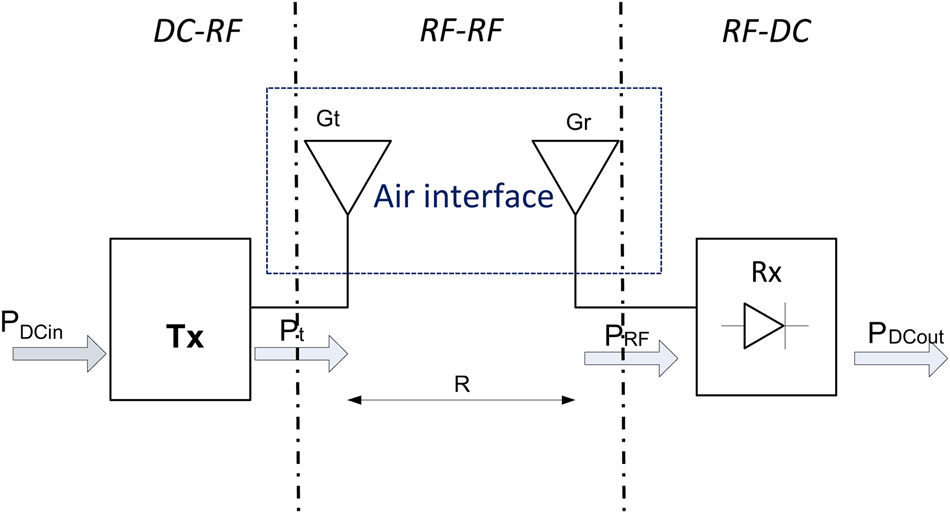
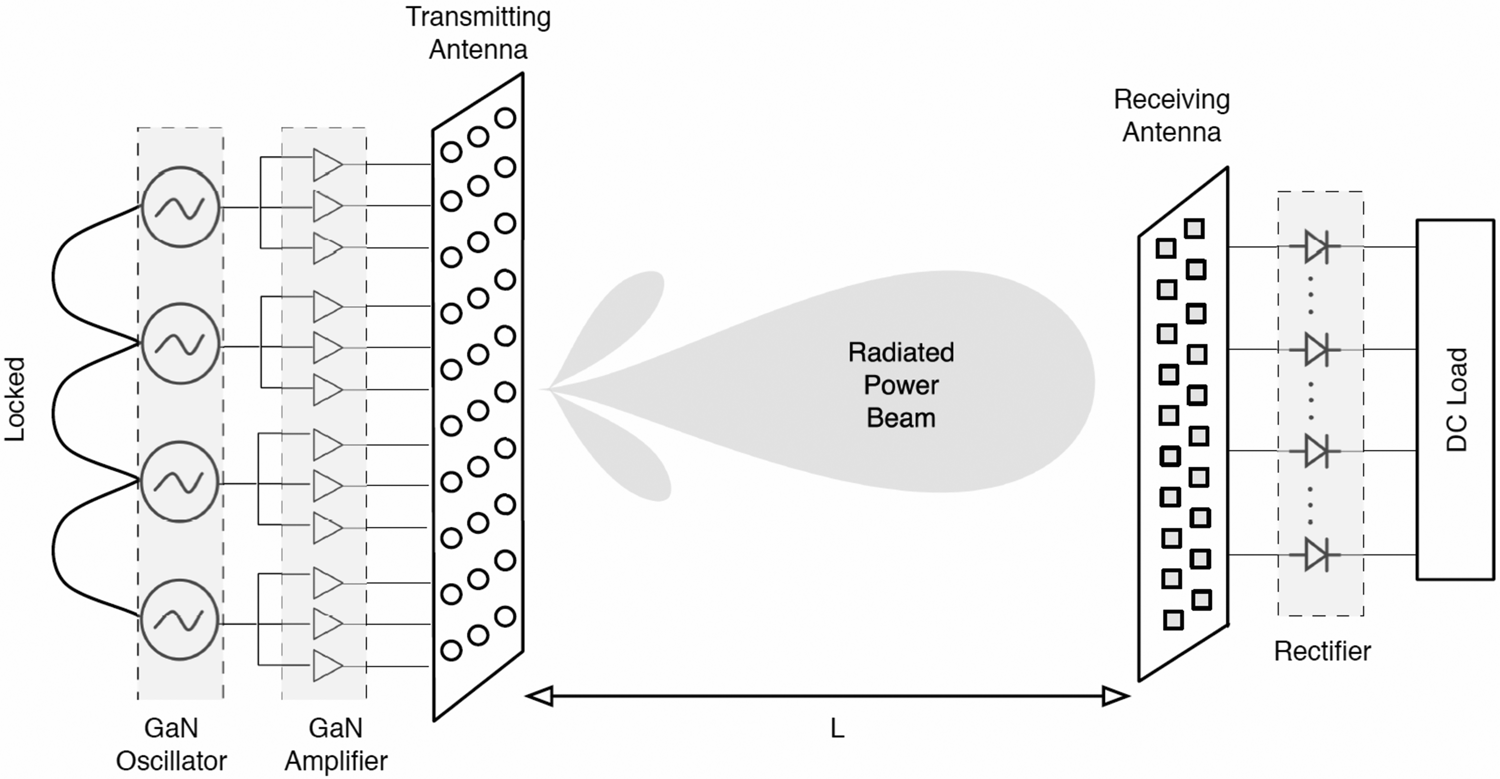
Figure 2 shows the general concept of WPT far-field systems, where three main components can be seen:
1. DC–RF generator, which converts solar DC energy to RF microwave beams. In this case the breakthrough advancing state of the art is on the increase of the DC–RF energy efficiency [Reference Roberg, Reveyrand, Ramos, Falkenstein and Popovic15].
2. RF–RF air interface, which transmits the RF energy from the source (Tx: transmitter) to the probe (Rx: receiver). In this case the breakthrough advancing state of the art is on the increase of the RF–RF energy efficiency, called beam efficiency.
3. RF–DC converter that converts the energy back from RF to DC to power up the probe. In this case the breakthrough advancing state of the art is on the increase of the RF–DC energy efficiency [Reference Roberg, Reveyrand, Ramos, Falkenstein and Popovic15].
Typical far-field WPT arrangement.

The main objective of our approach is actually to demonstrate that an electromagnetic beam can be used as a mean to transfer (via RF) wirelessly an amount of electric power from the satellite to the probe, maintaining a continuous energy level in the probe. For this to be achieved the whole chain has to be optimized from the efficiency point of view: (i) DC–RF conversion, η DC–RF; (ii) transmitting antenna beam efficiency at the spacecraft as well as receiving antenna beam efficiency at the probe and their respective optimum location and polarization, η RF–RF; and (iii) RF–DC power conversion efficiencies at the probe side, η RF–DC [Reference Costanzo14].
The overall efficiency is evaluated as, from Fig. 2:
 $$\eta _{DC-DC} = \eta _{DC-RF}\eta _{RF-RF}\eta _{RF-DC} = \displaystyle{{P_{DC,in}} \over {P_{DC,out}}}$$
This overall DC to DC efficiency can be optimized by exploring each of the sub-systems individually. Actually in the case of powering up the space probes the efficiency is not the main issue to be resolved, because the need to supply the power to the probe is much more important even if we lose power within the conversion process. Thus the first step for this approach is to guarantee that the system level calculations make sense and that the required technical solutions are feasible (size of the antennas, RF power capability of the amplifiers, etc.).
III. ROSETTA MISSION CASE STUDY
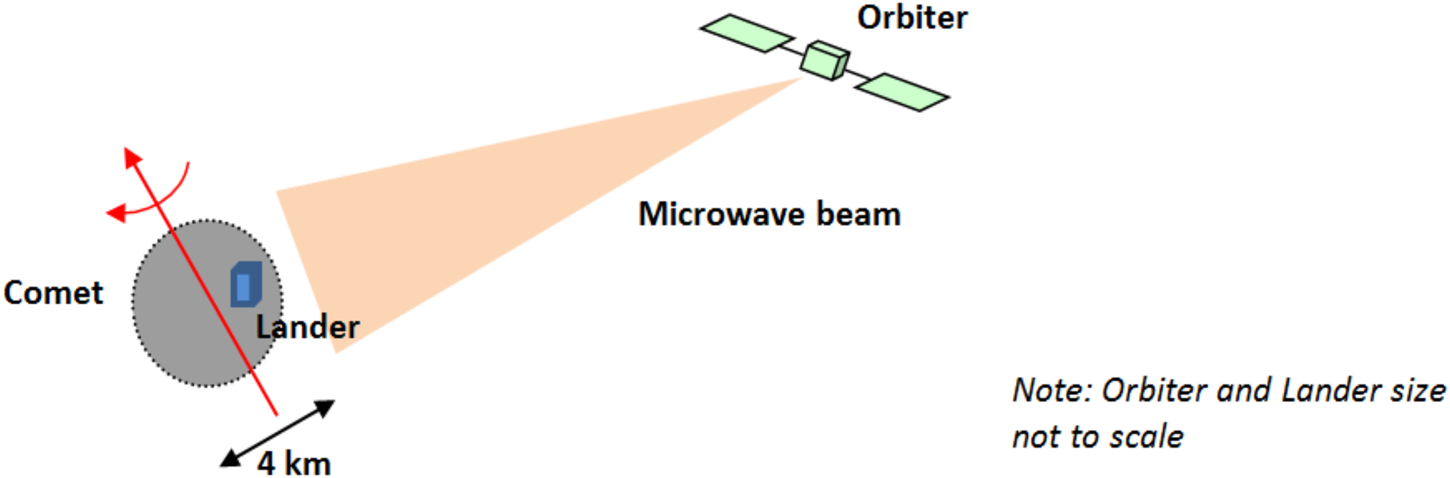
The Rosetta Mission case study was selected as the baseline for this paper, in order to demonstrate the interest and motivation of WPT in space environments. The situation in this approach assumes that we have an orbiter, the Rosetta spacecraft, and a probe/lander, the Philae, as shown in Fig. 3.
Rosetta mission case study.

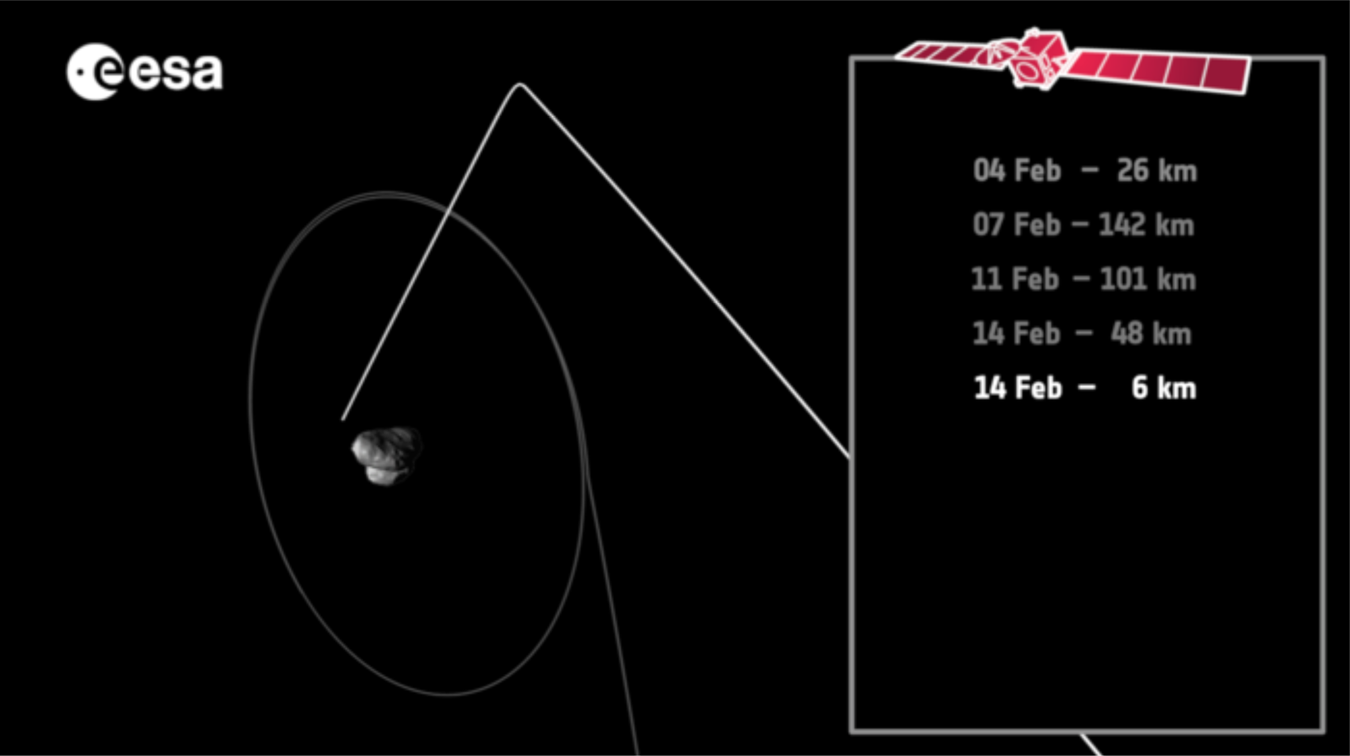
A real approach to this mission can be seen in Fig. 4, where the orbiter can get as close to the probe as 6 km.
Rosetta mission orbits from http://www.esa.int/Our_Activities/Space_Science/Rosetta.

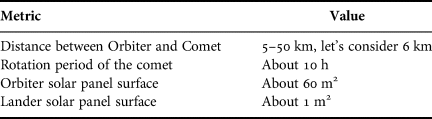
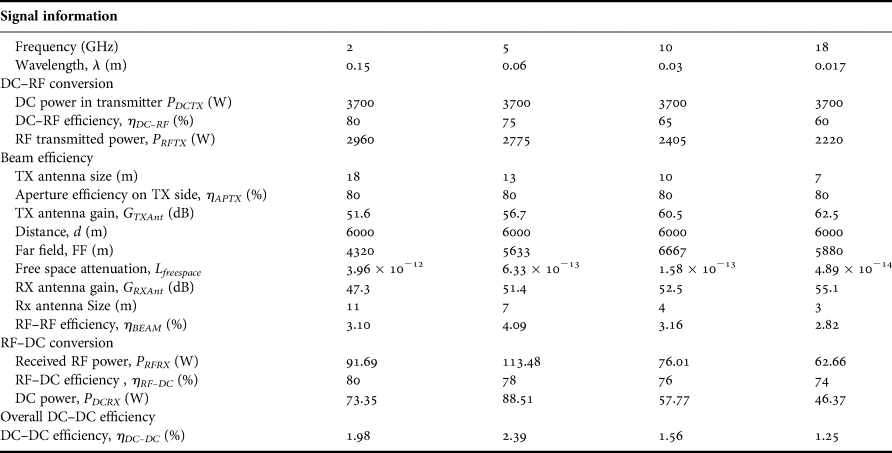
With this mission in mind, the approach is to calculate the overall need to implement a WPT system. Thus we will assume the parameters given in Table 1.
Baseline metrics for the WPT link case study.

At present, comet is at 2.25 AU to sun (with 1.25 AU minimum distance of its orbit). So we can consider at this moment Power density = (300/2.252) = 60 W/m2 for the solar panels.Footnote 2
With this assumption it follows that the available power on board the Orbiter from solar panels is in the range of 3–4 kW.
Potential available power on the Lander (Philae) from solar panels is about 60 W if the solar panels were receiving direct sun light, which may not be the case.
Range of power consumption for typical Lander from it's on board instruments is 10–100 W, we will consider 20 W for our calculations. The Sun visibility from the Lander is at this moment <10% time, close to zero in most of the situations.
In order to get an estimate of the visibility time between orbiter and lander, at first the orbiter is assumed to be in a fixed position. This choice can be justified since the comet rotation time is much longer than the spacecraft orbit time about the comet. Furthermore, the comet shape is irregular shape and far from being spherical one.
As a result the percentage of time with LoS condition can be estimated roughly 2 h over 10 h (20% of time).
Thus, a tentative reference requirement for WPT in this scenario could be:

We assume that the Lander is equipped with batteries to be re-charged by sun or WPT. Using the Friis formula at this stage for free space and the beam efficiency calculated above, we can actually estimate the overall mission power needs. For these calculations we assume the following potential frequencies of operation: 2, 5, 10, and 18 GHz. The calculations are made for 80% of aperture efficiency,Footnote 3 and the distance between the lander and the orbiter is 6 km. The frequencies were selected to show the pros and cons of each band. Higher frequencies allow better beam efficiency, but the DC–RF and RF–DC efficiencies are lower due to technological constraints.
The assumptions are then:
• For each frequency, the beaming efficiency is optimized to be higher than 1%, i.e. the relation between the RF transmitted antenna aperture and the RF receiving antenna aperture can be given by: A TA R = 0.01λ 2(6000)2 to guarantee a minimum of 20 W in the probe [Reference Brown and Eves1].
• The far-field condition FF ~ 4A/λ [Reference York and Popovic2] is calculated with respect to the transmitting aperture area (A) and the wavelength (λ), since the rectenna elements could have individual detectors, and RF-wise they are not in an array (only the DC adds).Footnote 4
The calculations implemented in Table 2, can be summarized as:
 $$P_{RF_{TX}} = P_{DC_{TX}}\eta _{DC-RF}$$
 $$G_{TXAnt} = 4\pi \displaystyle{{AntennaSize_{TX}^2} \over {\lambda ^2}}\eta _{APTX} \ $$
 $$L_{freespace} = \left( {\displaystyle{\lambda \over {4\pi d}}} \right)^2$$
 $$G_{RXAnt} = 4\pi \displaystyle{{AntennaSize_{RX}^2} \over {\lambda ^2}}\eta _{APRX}$$
 $$P_{RF_{RX}} = P_{RF_{TX}}G_{TX_{Ant}}L_{freespace}G_{RX_{Ant}}$$
 $$\eta _{BEAM} = \displaystyle{{P_{RF_{RX}}} \over {P_{RF_{TX}}}}$$
 $$P_{DC_{RX}} = P_{RF_{RX}}\eta _{RF-DC}$$
Potential figures for the case study feasibility.

This can be simplified using some simplifications, for instance the transmitter and receiver antenna aperture can be given by
 $$A_T = AntennaSize_{TX}^2 \eta _{APTX}$$
 $$A_R = AntennaSize_{RX}^2 \eta _{APRX}$$
Thus
 $$\eta _{beam} = \displaystyle{{A_TA_R} \over {\lambda ^2d^2}}$$
And the overall efficiency will be:
 $$\displaystyle{{P_{DC_{out}}} \over {P_{DC_{in}}}} = \eta _{DC-RF}\eta _{beam}\eta _{RF-DC}$$
The results presented in Table 2, clearly prove the feasibility of the proposed scheme, the computed DC power exceeds the threshold of 20 W. Higher powers can be achieved if the distance is reduced, as is the case in a space probe or pico-satellite scenario. The achieved efficiencies considered in Table 2 are viable and can be obtained as in [Reference Brown and Eves1] and http://www.teslasociety.com/columbia_expo.htm. The low overall efficiency (DC to DC) is the price to pay for a technical solution which can save a lander mission when the solar power is unavailable or limited.
The overall systems can be described as shown in Fig. 5. On the transmitter side (Tx, Rosetta spacecraft) several phased locked RF oscillators are combined with a high efficiency GaN power amplifier (PA) in order to feed the corresponding element of the transmitting antenna. In this way fairly low power GaN devices can be used to power up the overall energy beam with a power in the order of several kilowatts. As an example, 4 kW of the RF power can be obtained by using an array of 500 GaN PAs. The amount of energy per element should be around 8 W, which is feasible at the current state of space hardness GaN solutions available on the market [Reference Brown and Eves1]. Since the objective is WPT and not data communications, the PA could be pushed into compression (using very high efficiency configurations as class E, F, etc.) to pursue its maximum power efficiency and thus contributing to the optimization of the overall efficiency on the whole chain. The antenna implementation on Tx side will benefit from the recent advances in antennas for space communications [Reference York and Popovic2–Reference Romier13].
WPT demonstrating proposed solution.

Multiple-beam antennas composed of a multiple feed per beam (MFB) focal array and a deployable reflector seem to be ideal candidates because of their beam shaping (the spacecraft needs to shape the microwave beam in order to track the position of the space probe) and power handling capabilities. The MFB focal arrays, having excellent power handling capabilities, are traditionally manufactured by using a mechanical/milling technological process and their performances have been proved for satellite broadcasting data links.
A recent interesting solution has been presented in [Reference Lipworth4] consisting of a very large planar holographic metasurface reflectarray at 5.8 GHz to form a focused spot in the Fresnel-zone (for the present case 6.5 m) for microwave wireless power transfer experiment. A 40% of the transmitted power was estimated to incident onto the receiver at the focus point.
The emerging 3D printing techniques can offer new perspective for manufacturing such antennas.
Regarding the receiver, RF–DC converter, the approach to be followed is to use high efficiency RF–DC converters using approaches based on class E or F rectifiers, followed by DC to DC sub-system to guarantee constant impedance at the output of our RF–DC converter.
IV. DISCUSSION
In this paper we show that the powering up by means of remote far-field WPT of space probes/landers could be a viable solution for the last Rosetta mission, and could actually be a “must” solution for next space missions with the purpose to significantly improve their probability of success. By using theoretical computation and based on the today state-of-art solutions for PAs, antennas, and RF–DC converters a realistic FF WPT approach was proposed. A DC power exceeding 20 W can be transferred over a distance of 6 km offering a reliable alternative solution to power up space probes when the solar power is unavailable or limited. We note also that all the building blocks of the proposed FF WPT solution are based on mature technologies that were already used in space missions or are selected for the next (decade) space missions.
The data reported in Table 2 actually demonstrate that the proposed solution can be achieved with current state of the art technologies for PAs, antennas, and RF–DC converters; it is mainly a matter of developing the next missions with this WPT capability in mind in order to avoid DC power issues as recently Philae experienced.
 Alessandra Costanzo is a full professor at the University of Bologna, Italy. Her research activities are dedicated to CAD algorithms for multi-domain co-design and modeling of active nonlinear microwave/RF circuits. Recently she has proposed novel solutions for energy autonomous RF systems based on wireless power transmission, adopting both far-field and near-field solutions, for several power levels and operating frequencies. She has authored more than 200 scientific publications in peer-reviewed international journals and conferences and several book chapters. Dr. Costanzo is a co-founder of the EU COST Action IC1301 WiPE Wireless Power Transfer for Sustainable Electronics, where she chaired WG1: Far-Field Wireless Power Transfer. She is past-chair of the MTT-26 Committee on Wireless Energy Transfer and Conversion and member of the MTT-24 Committee on RFID. Since 2016, she has been the Steering Committee Chair of the new IEEE Journal of Radio Frequency Identification. She is the MTT-S representative and Distinguished Lecturer of the Council on Radio Frequency Identification (CRFID). She serves as an Associate Editor for IEEE Transactions on Microwave Theory and Techniques, the Cambridge International Journal of Microwave and Wireless Technologies, and the Cambridge International Journal of Wireless Power Transfer. She is an IEEE senior member.
 Luca Roselli MG in 1988 (IEEE-FM18, -M92, -SM01). In 1991 he joined the University of Perugia, where he is currently teaching Electronic Circuits and System and circuits for IoT, and where he is coordinating the HFE-Lab as a Qualified Full-Professor. In 2000 he founded the spin-off WiS Srl. From 2008 to 2012 he has been member of the Board of Directors of ART srl. He organized the VII “Computational Electromagnetic Time Domain” (CEM-TD-2007) and the first IEEE-Wireless Power Transfer Conference (WPTC-2013). He had been member of the ERC Panel PE7 and he still serves for H2020 evaluation. He is member of the list of experts of Italian Ministry of Research and he is serving as an expert reviewer for several European and national institutions. He is member of the board of Italian Ministry of Research for editing of the National Research Plan (PNR—Group 12 “Green Technologies”). He is involved in several conference boards and committees: IEEE Technical Committees MTT-24-RFID (past chair), -25-RF nanotechnologies (vice-chair), and -26-Wireless Power Transfer (chair); Advisory Committee of IEEE-WPTC, chairman of the SC-32 of IMS; and co-chair of the IEEE Wireless Sensor Network Conference (WiSNet). He is an Associated Editor of IEEE-Microwave Magazine. He is a reviewer for many international reviews (including IEEE-Proceedings, -MTT, and -MWCL). His research interest includes HF electronic systems, with special attention to RFID, green electronics, and WPT. In the last 7 years he worked mostly on electronic technologies for IoT. He has published more than 280 contributions (H-i 28, i10 82, more than 3000 citations—Scholar). He is author of the Cambridge University book: “Green RFID System” and he is under contract, still with CUP, for the publication of the book: “IoT technologies” (publication expected end of 2019).
 Apostolos Georgiadis (S'94-M'02-SM'08) was born in Thessaloniki, Greece. He received his B.S. degree in physics and M.S. degree in telecommunications from the Aristotle University of Thessaloniki, Thessaloniki, Greece, in 1993 and 1996, respectively, and his Ph.D. degree in electrical engineering from the University of Massachusetts, Amherst, MA, USA, in 2002. In 2002, he joined Global Communications Devices, North Andover, MA, USA, as a Systems Engineer where he involved in CMOS transceivers for wireless network applications. In 2003, he joined Bermai Inc., Minnetonka, MN, USA, as an RF/Analog Systems Architect. In 2005, he joined the University of Cantabria, Santander, Spain, as a Juan de la Cierva Fellow Researcher. In 2006, he worked as a consultant for Bitwave Semiconductor, Lowell, MA, USA. He collaborated with ACORDE S.A., Santander, Spain, where he involved in the design of integrated CMOS VCOs for ultra-wideband applications. In 2007, he joined the Technological Telecommunications Center of Catalonia (CTTC), Spain, as a Senior Researcher of communications subsystems. From 2013 to 2016, he was a Group Leader with the Microwave Systems and Nanotechnology Department, CTTC. In 2016, he joined Heriot-Watt University, Edinburgh, U.K., as an Associate Professor. He has authored more than 200 papers in peer-reviewed journals and international conferences. His current research interests include energy harvesting and wireless power transmission, RFID technology, active antennas and phased-array antennas, inkjet and 3-D printed electronics, and millimeter-wave systems. Dr. Georgiadis was a recipient of the Fulbright Scholarship for graduate studies at the University of Massachusetts, in 1996. He was the General Chair of the 2011 IEEE RFID-TA Conference and the General Co-Chair of the 2011 IEEE MTT-S IMWS on Millimeter Wave Integration Technologies. He is an EU Marie Curie Global Fellow. He is member of the IEEE MTT-S TC-24 RFID Technologies (past Chair) and a member of the IEEE MTT-S TC-26 Wireless Energy Transfer and Conversion. He was an Associate Editor of the IET Microwaves Antennas and Propagation journal, IEEE Microwave and Wireless Components Letters, and the IEEE Radio Frequency Identification (RFID) Virtual Journal. He is co-founder and past Editor-in-Chief of the Wireless Power Transfer Journal of Cambridge University Press. He serves as an Associate Editor for the IEEE Journal of RFID. He was an AdCom member of the IEEE Council on RFID serving as the Vice President of conferences. He was a Distinguished Lecturer of the IEEE Council on RFID. He is URSI Fellow and the Chair of the URSI Commission D, Electronics, and Photonics. In 2016, his proposal for Inkjet/3-D printed millimeter-wave systems received the Bell Labs Prize, third place among more than 250 proposals recognizing ideas that “change the game” in the field of information and communications technologies.
 Nuno Borges Carvalho (S’97–M’00–SM’05-F’15) was born in Luanda, Angola, in 1972. He received his Diploma and Doctoral degrees in electronics and telecommunications engineering from the University of Aveiro, Aveiro, Portugal, in 1995 and 2000, respectively. He is currently a Full Professor and a Senior Research Scientist with the Institute of Telecommunications, University of Aveiro and an IEEE Fellow. He coauthored Intermodulation in Microwave and Wireless Circuits (Artech House, 2003), Microwave and Wireless Measurement Techniques (Cambridge University Press, 2013), and White Space Communication Technologies (Cambridge University Press, 2014). He has been a reviewer and author of over 200 papers in magazines and conferences. He is the Editor in Chief of the Cambridge Wireless Power Transfer Journal, an associate editor of the IEEE Microwave Magazine and former associate editor of the IEEE Transactions on Microwave Theory and Techniques, and IET Microwaves Antennas and Propagation Journal. He is the co-inventor of six patents. His main research interests include software-defined radio front-ends, wireless power transmission, nonlinear distortion analysis in microwave/wireless circuits and systems, and measurement of nonlinear phenomena. He has recently been involved in the design of dedicated radios and systems for newly emerging wireless technologies. Dr. Borges Carvalho is a member of the IEEE MTT ADCOM, the past-chair of the IEEE Portuguese Section, MTT-20 and MTT-11 and also involved in the technical committees, MTT-24 and MTT-26. He is also the vice-chair of the URSI Commission A (Metrology Group). He was the recipient of the 1995 University of Aveiro and the Portuguese Engineering Association Prize for the best 1995 student at the University of Aveiro, the 1998 Student Paper Competition (Third Place) of the IEEE Microwave Theory and Techniques Society (IEEE MTT-S) International Microwave Symposium (IMS), and the 2000 IEE Measurement Prize. He is a Distinguished Microwave Lecturer for the IEEE Microwave Theory and Techniques Society.
 Alexandru Takacs (M’12) was born in Simleu Silvaniei, Romania, in March 1975. He received his Engineer diploma in electronic engineering from the Military Technical Academy, Bucharest, Romania, in 1999, and his Master degree and Ph.D. degree in microwave and optical communications from the National Polytechnic Institute of Toulouse (INPT), Toulouse, France, in 2000 and 2004, respectively. From 2004 to 2007, he was a Lecturer with the Military Technical Academy of Bucharest, and an Associate Researcher with the Microtechnology Institute of Bucharest. From 2008 to 2010, he occupied a Postdoctoral position with the Laboratory for Analysis and Architecture of Systems (LAAS), National Center for Scientific Research (CNRS), Toulouse, France. During 2011, he was an R&D RF Engineer with Continental Automotive SAS France, where he was in charge of antenna design and automotive electromagnetic simulation. Since 2012, he has been an Associate Professor with the University (Paul Sabatier), Toulouse, France, where he performed research within LAAS-CNRS. He has authored or coauthored one book, one book chapter, 15 papers in refereed journals, and over 70 communications in international symposium proceedings. His research interests include the design of microwave and RF circuits, energy harvesting and wireless power transfer, microelectromechanical systems (MEMS) circuits and systems, small antenna design, electromagnetic simulation techniques, and optimization methods.
 Pier Giorgio Arpesi received a Laurea degree in Electronic Engineering from the University of Pavia (Italy) in 1990. From 1990 to 1996 he worked for Siemens Telecomunicazioni in Milano (Italy); from 1996 to 2001 he was with Laben/Alenia Aerospazio (Italy), then moved to Leonardo SpA, where he is currently head of the “Atomic Clocks & RF Systems” group within the Space Engineering section. His work has been mainly concerned with the design and development of RF and microwave equipment for space applications, with particular regard to extremely low noise receivers, frequency synthesizers and UHF solid state high power amplifiers. His research interests include the use of wireless RF-based technology in space for sensing, navigation and remote power supply applications.
 Rodolfo Martins is Founder and General Manager of EVOLEO Technologies, Lda. He has studied his degree and post-graduation in Electrical and Computer Engineering at the Polytechnic Institute of Porto. He started his industrial career in 1999 in the department of test of a production unit. Since 2003 has been involved in the development of Hi-Rel electronics and systems for the space business, mainly with ESA projects. In 2007 founded Evoleo and since then has been worked in the coordination and management of R&D activities. His technical expertise within the company concentrates in the HW electronics design and system engineering.