Introduction
In the life history of organisms, resources to invest in reproduction can be gained following two main strategies (Stephens et al., Reference Stephens, Boyd, McNamara and Houston2009). Capital breeders are born with an accumulation of resources in their bodies that can be directly invested into reproduction, while income breeders acquire the needed resources immediately before reproduction (Stephens et al., Reference Stephens, Boyd, McNamara and Houston2009). Among insects, these two strategies are often referred as pro-ovigeny and synovigeny, where the first one indicates females born with a complete stock of mature eggs, while in the second one this stock is absent or limited and eggs are produced throughout adult life (Jervis et al., Reference Jervis, Copland, Harvey and Jervis2007, Reference Jervis, Ellers and Harvey2008). Most hymenopteran parasitoids are however between these two extremes and are considered to be moderately synovigenic, usually emerging with very limited larval reserves and die within few days without access to a suitable adult food source (Jervis et al., Reference Jervis, Heimpel, Ferns, Harvey and Kidd2001; Boivin, Reference Boivin, Cônsoli, Parra and Zucchi2010). Thus, adults require suitable non-host food sources to satisfy their energy needs (Bianchi & Wäckers, Reference Bianchi and Wäckers2008), enhancing their life expectancy, realized fecundity and dispersal capacity (Wäckers, Reference Wäckers2004; Romeis et al., Reference Romeis, Babendreier, Wäckers and Shanower2005; Wäckers et al., Reference Wäckers, Lee, Heimpel, Winkler and Wagenaar2006, Reference Wäckers, Romeis and van Rijn2007; Bernstein & Jervis, Reference Bernstein, Jervis, Wajnberg, Bernstein and van Alphen2008; Géneau et al., Reference Géneau, Wäckers, Luka, Daniel and Balmer2012). Also small egg parasitoids from the genus Trichogramma benefit from sugar-rich food sources, as shown for T. pretiosum Riley (Hymenoptera: Trichogrammatidae) and T. platneri Nagarkatti (Hymenoptera: Trichogrammatidae) (Ashley & Gonzalez, Reference Ashley and Gonzalez1974; McDougall & Mills, Reference McDougall and Mills1997). Trichogramma spp. are widely used in agriculture as biocontrol agents (Parra, Reference Parra, Cônsoli, Parra and Zucchi2010), but because Trichogramma spp. are clearly synovigenic, it can be challenging to apply them efficiently for pest control and keep the maintenance costs as low as possible (Mills et al., Reference Mills, Pickel, Mansfield, McDougall, Buchner, Caprile, Edstrom, Elkins, Hasey, Kelley, Krueger, Olson and Stocker2000). Indeed, studies in agricultural fields conducted on Trichogramma spp. demonstrated the importance of a constant food provision throughout the parasitoid life and not just before their release in the field to ensure high parasitation rates (Ashley & Gonzalez, Reference Ashley and Gonzalez1974; Leatemia et al., Reference Leatemia, Laing and Corrigan1995; Díaz et al., Reference Díaz, Ramírez and Poveda2012). Under field conditions, Trichogramma spp. were observed to consume nectar of different flowers near crop fields, like e.g. red clover (Trifolium pratense L.), buckwheat (Fagopyrum esculentum Moench), mustard (Brassica juncea L.), dill (Anethum graveolens L.) or avocado flowers (Persea americana Mill.) (Wellinga & Wysoki, Reference Wellinga and Wysoki1989; Begum et al., Reference Begum, Gurr, Wratten and Nicol2004, Reference Begum, Gurr, Wratten, Hedberg and Nicol2006; Witting-Bissinger et al., Reference Witting-Bissinger, Orr and Linker2008; Díaz et al., Reference Díaz, Ramírez and Poveda2012). Therefore, herbs in flower strips, planted next to the crop plants threatened by pest insects, could serve as nectar sources providing sugar and other nutrients (Witting-Bissinger et al., Reference Witting-Bissinger, Orr and Linker2008; Balzan & Wäckers, Reference Balzan and Wäckers2013; Balzan et al., Reference Balzan, Bocci and Moonen2016). However, apart from nectar quality and quantity, nectar accessibility, determined by flower morphology and the presence of extra-floral nectar, is decisive for small-bodied parasitoids. This emphasizes the importance to select the right plant species for flower strips depending on the parasitoid of interest (Patt et al., Reference Patt, Hamilton and Lashomb1997; Tooker & Hanks, Reference Tooker and Hanks2000; Vattala et al., Reference Vattala, Wratten, Phillips and Wäckers2006).
The present study is focused on Telenomus laeviceps (Förster, 1861) (Hymenoptera: Scelionidae), an egg parasitoid distributed across Europe, able to parasitize eggs of different insect pests belonging to the Noctuidae, Geometridae and Nolidae (Mexia et al., Reference Mexia, Figueiredo and Godinho2004; Klemola et al., Reference Klemola, Heisswolf, Ammunét, Ruohomäki and Klemola2009; Bayle, Reference Bayle2012; Petrov, Reference Petrov2012). This parasitoid can be used in brassica fields as a biocontrol agent against the cabbage moth Mamestra brassicae L. (Lepidoptera: Noctuidae). We conducted studies on its biology and the results clearly showed that T. laeviceps emerges with limited larval reserves. This implies that, in order to reach a maximum parasitation performance and proportion of female offspring, sugar-rich food sources are needed directly after adult emergence. Since T. laeviceps is released via field delivery systems as parasitized eggs, similar to the one commercially used for different Trichogramma species, adult wasps emerge directly in the field, benefiting from an easily exploitable food source near the release point. A possible solution would be the addition of honey to the field delivery systems. However, preliminary field trials revealed that the provided honey indirectly increased predation of the exposed parasitized eggs, reducing the effective number of released parasitoids. Furthermore, honey should be provided only shortly before the exposition in the field of the field delivery systems, causing additional efforts and costs for end users. Besides honey, a further solution can be the provision of nectar sources near the crop field, for example, as sown flower strips, as already implemented for some Trichogramma spp. that are used as biocontrol agents (Wellinga & Wysoki, Reference Wellinga and Wysoki1989; Begum et al., Reference Begum, Gurr, Wratten and Nicol2004, Reference Begum, Gurr, Wratten, Hedberg and Nicol2006; Díaz et al., Reference Díaz, Ramírez and Poveda2012).
Here, we focused on the promotion of released T. laeviceps through the provision of nectar sources. Studies were already conducted to promote natural enemies of different cabbage pests, such as M. brassicae or Plutella xylostella (Linnaeus, 1758) (Lepidoptera: Plutellidae) (Géneau et al., Reference Géneau, Wäckers, Luka, Daniel and Balmer2012, Reference Géneau, Wäckers, Luka and Balmer2013; Balmer et al., Reference Balmer, Pfiffner, Schied, Willareth, Leimgruber, Luka and Traugott2013, Reference Balmer, Géneau, Belz, Weishaupt, Förderer, Moos, Ditner, Juric and Luka2014; Belz et al., Reference Belz, Kölliker and Balmer2013). Based on these studies, Centaurea cyanus L. (Asteraceae); buckwheat, F. esculentum Moench (Polygonaceae) and common vetch, Vicia sativa L. (Fabaceae) were selected as the main components of a tailored flower strip for the promotion of beneficial insects of cabbage pests. These flowers, besides being part of the tailored flower strip for the cabbage production, were already implemented to promote other parasitoid species, like Microplitis mediator (Haliday, 1834) (Hymenoptera: Braconidae), Dolichogenidea tasmanica (Cameron) (Hymenoptera: Braconidae), Trichogramma spp. or Anagyrus pseudococci (Girault) (Hymenoptera: Encyrtidae) (Berndt et al., Reference Berndt, Wratten and Hassan2002; Witting-Bissinger et al., Reference Witting-Bissinger, Orr and Linker2008; Géneau et al., Reference Géneau, Wäckers, Luka, Daniel and Balmer2012, Reference Géneau, Wäckers, Luka and Balmer2013; Irvin & Hoddle, Reference Irvin and Hoddle2015). Furthermore, these flowers did not increase the survival nor the fecundity of M. brassicae, the most important host of T. laeviceps (Géneau et al., Reference Géneau, Wäckers, Luka, Daniel and Balmer2012). In Switzerland, to increase the pest control achieved by the tailored flower strip, T. laeviceps can be released as biocontrol agent. Under laboratory conditions we investigated the suitability of C. cyanus, F. esculentum and V. sativa to attract released T. laeviceps and increase their parasitation performance. The olfactory attractiveness can help reducing the time spent searching for food and thus increase the per capita host searching efficiency (Wäckers & Swaans, Reference Wäckers and Swaans1993; Hegazi et al., Reference Hegazi, Khafagi and Hassan2000; Jervis & Heimpel, Reference Jervis, Heimpel and Jervis2007; Jervis et al., Reference Jervis, Ellers and Harvey2008). However, attractiveness alone is not enough to reach the desired pest control. In fact, flowers should also promote the performance of the target beneficial. To this end, we conducted (i) olfactometer trials to determine the attractiveness potential of the selected flowers for T. laeviceps and (ii) laboratory experiments testing their influence on survival and parasitation performance of T. laeviceps.
Material and methods
Parasitoid
Rearing of the egg parasitoid T. laeviceps started in 2012 at the Research Institute of Organic Agriculture (FiBL), Switzerland, from individuals collected with trap eggs (cabbage moth M. brassicae) from organic cabbage fields in the Swiss Plateau (47th parallel north). T. laeviceps was reared in glass tubes (14.5 cm, ø 3 cm) on cabbage moth eggs in a climatic chamber at 22 ± 2°C, 16:8 (L:D) photoperiod and 55 ± 5% relative humidity (RH). To ensure the supply of a sufficient number of adult wasps for the experiments, three new rearing units were started weekly. A rearing unit consisted of 1500–2000 cabbage moth eggs (<24 h old) and approximately 100 10-day-old wasps (70% females and 30% males). Females were allowed to parasitize the provided batch of eggs during 7 days. Afterwards, the parasitized eggs were placed in an empty rearing unit until wasp emergence. Parasitoids were fed with honey–gelatine ad libitum (200 g flower honey (Switzerland), 100 ml demineralized water and 3 g gelatine (Dr Oetker, Germany)), provided on a piece of white paper placed in each rearing unit. With these rearing conditions, following generations of parasitoids emerge 14 days after parasitation started.
Plants
The flowering plants used in these experiments were grown in climatic chambers (GroBanks (CLF Plant Climatics, Germany)) at 24°C (day) and 18°C (night), 55 ± 5% RH and with a 16:8 (L:D) photoperiod. To ensure a constant supply of flowers, weekly 14 seeds per flower species were sown in 4 × 4 cm pressed soil blocks (Schwarz AG, Villigen, Switzerland). After 3 weeks, seedlings were transplanted to 12 cm diameter pots (10 cm height) in soil (Einheitserde Classic, Gebrüder Patzer GmbH & Co.KG, Germany) fertilized with slow-release formulation fertilizer (3 g l−1 of Tardit 3 M (Haubert HBG Dünger AG, Switzerland)). Plants were regularly checked and watered as needed.
Olfactory attractiveness of different flowers for T. laeviceps
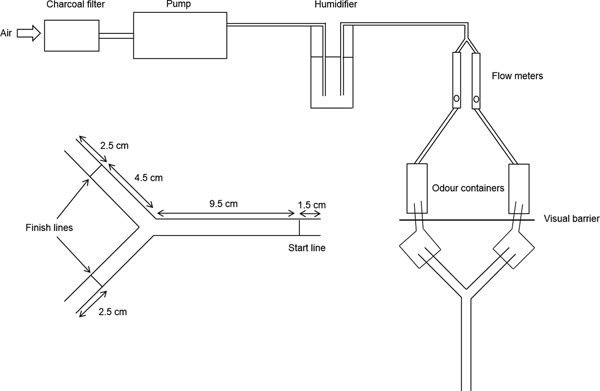
The attractiveness of the flowering plants was tested in a Y-tube olfactometer as described by Belz et al. (Reference Belz, Kölliker and Balmer2013). The experiments were conducted in a dark room, during the period of main parasitoid activity, between 10 and 12 am. An artificial light source (20 W) was placed 28 cm above the Y-tube glass. The humidified charcoal-filtered air passed at a speed of 757 ml min−1 through two glass containers, each containing one odour. A visual barrier was placed between the Y-tube and the two odour containers (fig. 1).
Set up of the Y-tube olfactometer. Air passes through two odour containers and enters the Y-tube. Parasitoids were inserted at the base of the Y-tube and the assessments were started when the wasps crossed the start line.

Newly hatched (<24 h old) and unfed T. laeviceps females were used for the experiments. Females were inserted at the base of the Y-tube and the assessment started when they crossed the start line (fig. 1). They had 5 min time to take a decision by crossing one of the two finish lines (fig. 1). If they did not chose within the given time, they were discarded from the experiment.
We tested the attractiveness of the three flower species C. cyanus, V. sativa and F. esculentum against ambient air only. C. cyanus and F. esculentum were, in addition, tested one against the other. During the experiments, V. sativa flowers were absent, therefore only the attractiveness of plants displaying extra-floral nectar was tested. Thirty parasitoids were tested per comparison. Flower buds for V. sativa or inflorescences for C. cyanus and F. esculentum were freshly cut and placed in the odour containers. For V. sativa, the presence of extra-floral nectar was confirmed with the help of a binocular. After six tested wasps, the odour sources were renewed. The position of the odour sources was switched after three wasps had been tested to avoid biases due to positional effects.
Survival and parasitation performance of T. laeviceps in the presence of different nectar resources
We tested the influence of nectar availability of C. cyanus, F. esculentum, V. sativa and a water control on the survival and parasitation performance of T. laeviceps. During the experiments, flowers of V. sativa were absent, therefore only plants presenting extra-floral nectar were used.
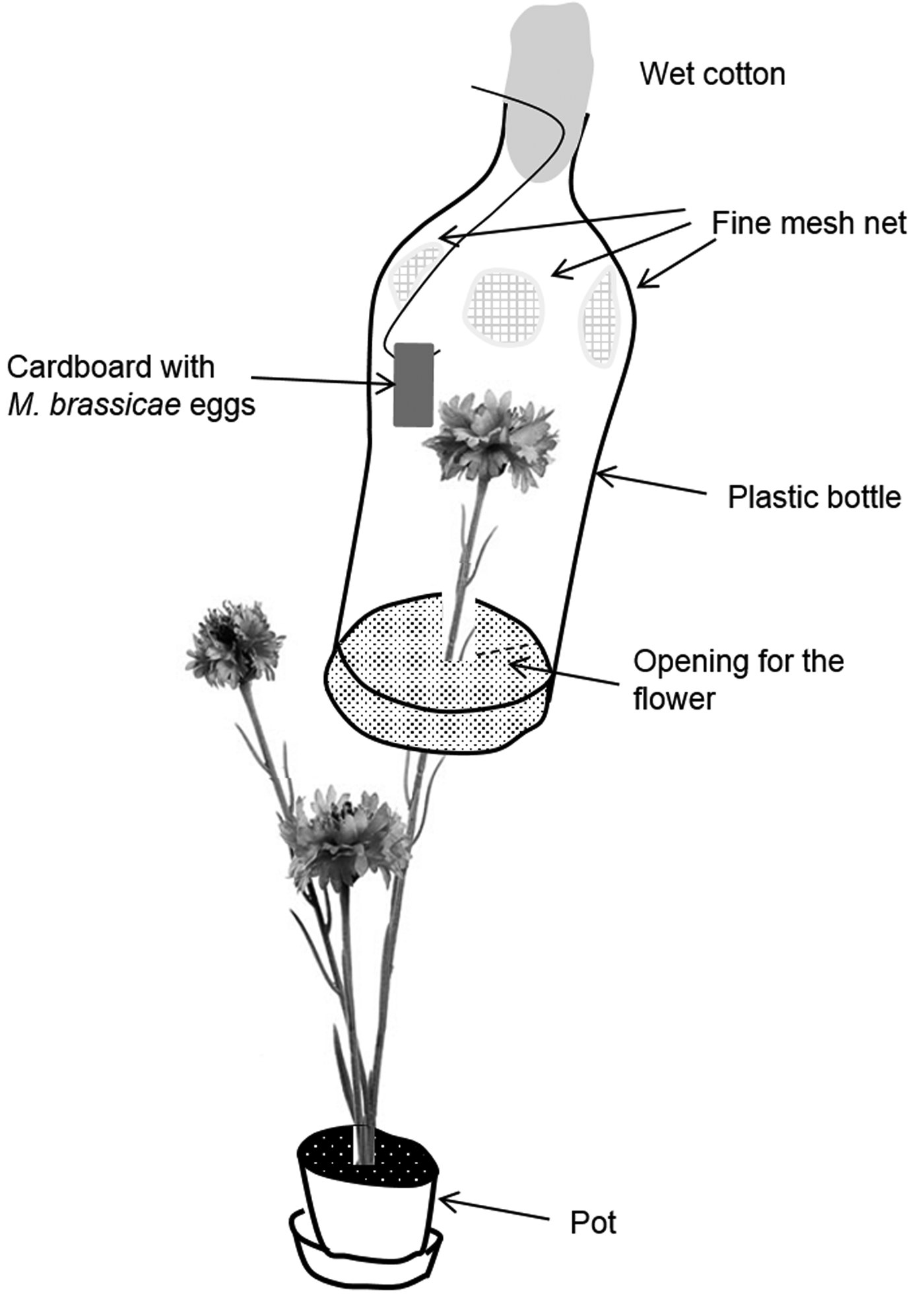
Parasitation performance and survival experiments were conducted in plastic cages (fig. 2) in a laboratory at 23 ± 2°C and 90 ± 9% RH in the presence of flowers and at 23 ± 1°C and 46 ± 6% RH in the negative control. Temperature and RH were measured inside the cages with small data loggers (DS1923 Hygrochron, Thermodata). In contrast to temperature, RH in the plastic cages differed between the control and the three flowers. To exclude biases in the results due to this difference, a small trial was conducted in a climatic chamber with higher RH values compared with the laboratory (55 ± 5%). Here, we compared the survival of females when provided with water only. Under higher RH, the parasitoids died within 1 or 2 days, as in the control with lower RH (data not shown). We thus concluded that this difference in the RH between flowers and control should not influence the outcome of the trials. Plastic cages were designed to allow air circulation and at the same time to prevent the small parasitoids from escaping. One and half litre plastic bottles opened at the bottom and closed with a sponge cut in the middle were used as cages. This opening allowed the insertion of the flowers in the cages (fig. 2). On the top, bottles were closed with wet cotton, which was daily watered to ensure water provision during the whole experiment. Plants in pots were used for the trials. To assess the survival of T. laeviceps, one female and one male (both <24 h old) were placed in a plastic cage in the presence of one of the four treatments. For the fecundity experiment, cabbage moth eggs were additionally provided at the top of the bottle, on a daily basis, until female death (fig. 2). In both trials, mortality was assessed daily at 9.30 am. For both trials, ten replicates per treatment were tested. One replicate per treatment was started weekly. The parasitized eggs were counted, as well as the number of emerging parasitoids. The sex of the offspring was also determined.
Set up of the cage used for the fecundity and survival experiments. A plastic bottle was opened at the bottom and closed with a sponge, cut in the middle to allow the positioning of the flower. For the fecundity experiments, additional to the flower, Mamestra brassicae eggs were provided.

Statistical analysis
Data analyses were conducted with R version 3.3.0 (R Core Team, 2016). The count data from the olfactometer experiment were analysed with a Pearson's χ2 test by comparing the observed frequencies against 0.5 (expected frequency of the zero hypotheses: no preference).
Data from the survival experiment were interval censored and therefore plotted following the non-parametric maximum likelihood estimate for the distribution of interval censored data. The overall influence of treatments on survival was tested by an asymptotic log-rank k-sample test. Since this kind of analysis does not allow a post-hoc test for the pairwise comparison of the different treatments, single analyses were conducted through the asymptotic log-rank two-sample test. The resulting P-values were adjusted with the Bonferroni correction for multiple comparisons. The survival data were fitted to the model with the icfit and ictest functions included in the interval package.
The number of parasitized eggs and the number of females produced were analysed with generalized linear models with Poisson errors (glmer function from the package lme4) and the fixed factor treatment (four levels: water and the three flower species), corrected for overdispersion.
Results
Olfactory attractiveness of different flowers for T. laeviceps
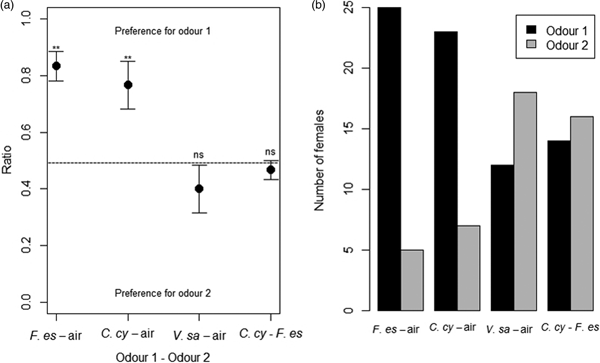
Out of the three flowers tested, only C. cyanus and F. esculentum were significantly attractive for T. laeviceps females compared with the control (fig. 3a, b). We found no significant difference between V. sativa (extra-floral nectar only) and the control (fig. 3a, b). C. cyanus and F. esculentum were found to be equally attractive (fig. 3a, b).
(a) Proportion of females choosing odour 1. Values above the dotted line (expected frequency = 0.5) indicate a preference for odour 1 and below for odour 2. (b) Number of females choosing either odour 1 or odour 2. F. es, Fagopyrum esculentum; C. cy, Centaurea cyanus; V. sa, Vicia sativa. Pearson's χ2 test, **P < 0.01; ns: not significant (P > 0.05), N = 30 per treatment.

Survival and parasitation performance of T. laeviceps in the presence of different nectar resources
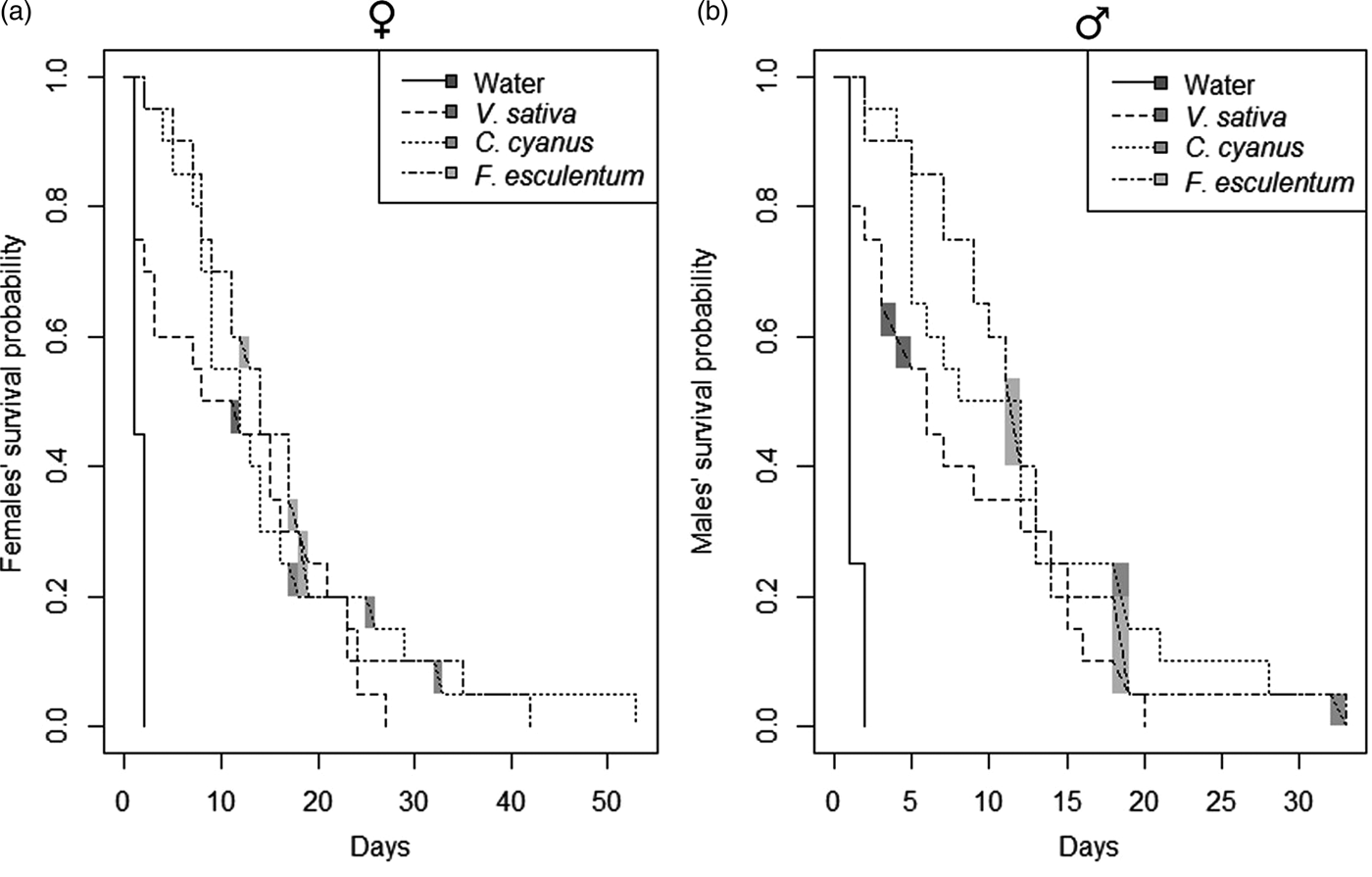
The presence of eggs during the survival experiment did not influence the survival of both females and males (asymptotic log-rank two-sample test, all P < 0.3). Therefore, we pooled the data for each treatment. We found a significantly higher survival rate of T. laeviceps females for all three flowers tested compared with the control (asymptotic log-rank two-sample test, N = 20, all P < 0.0001) (fig. 4a). In the presence of V. sativa (extra-floral nectar only), F. esculentum and C. cyanus (floral and extra-floral nectar), females survived significantly longer compared with water (fig. 4a). No difference was found in the survival of females between the three flowers (asymptotic log-rank two-sample test, N = 20, all P > 0.8). Similar results were found for males (fig. 4b).
(a) Survival of Telenomus laeviceps females in the presence of Vicia sativa, Centaurea cyanus, Fagopyrum esculentum and water. The three flowers significantly increased their longevity (asymptotic log-rank k-sample test, N = 20 per treatment, χ2 = 17.87, P = 0.0005). (b) Survival of T. laeviceps males in the presence of V. sativa, C. cyanus, F. esculentum and water. The three flowers significantly increased their longevity (asymptotic log-rank k-sample test, N = 20 per treatment, χ2 = 20.517, P = 0.0001).

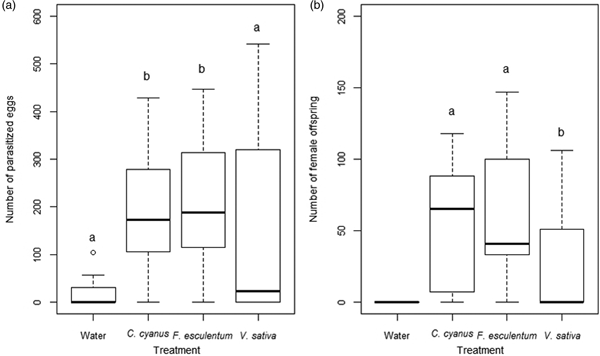
Similar to survival, the number of parasitized eggs in the water control (19.1 ± 11.2 eggs) was significantly lower than in the F. esculentum (204.7 ± 42 eggs; generalized linear model, z = 3.542, P < 0.0001) and C. cyanus (202.5 ± 42.8 eggs; generalized linear model, z = 3.531, P < 0.0001) treatment.
No significant difference was found between the water control and V. sativa (144.8 ± 67.91) (generalized linear model, z = 1.666, P = 0.09). C. cyanus and F. esculentum equally enhanced the fecundity of T. laeviceps females (generalized linear model, z = −0.013, P = 0.989), but significantly differed with V. sativa (generalized linear model, both P < 0.03) (fig. 5a).
(a) Number of parasitized eggs and (b) number of female offspring produced in the presence of the four treatments. Different letters indicate significant differences (generalized linear model, P < 0.05, N = 10 per treatment).

The number of female offspring produced depended also significantly on the specific food source. Compared with V. sativa (25.5 ± 13.72 female offspring), parasitizing females produced significantly more female offspring in the presence of C. cyanus (generalized linear model, z = −2.4, P = 0.016) and F. esculentum (generalized linear model, z = −2.42, P = 0.016), respectively, 57.2 ± 13.94 and 55.2 ± 15.22 female offspring. The number of female offspring did not significantly differ between C. cyanus and F. esculentum (generalized linear model, z = 0.024, P = 0.98). No females were produced in the water control (fig. 5b).
The daily fecundity of T. laeviceps females was approximately the same in all treatments. Females were able to parasitize right after hatching on average 9.6 ± 2.9 eggs, with a rapid increase up to 26.1 ± 8 eggs on the second day. Female offspring was produced from the third to the fourth experimental day, while the production of males started from the first day and stayed constant until death of the parasitizing female.
Discussion
The aim of the present study was to clarify if selected flowers can increase the longevity and parasitation performance of the biocontrol agent T. laeviceps, as well as attract them through volatile cues. Results clearly showed that C. cyanus and F. esculentum enhance the performance of T. laeviceps and further, successfully attract them.
The olfactory attractiveness of the selected flowers is important in some biological control programmes, like conservation biocontrol, where natural enemies have to be attracted into the crop field (Jervis & Heimpel, Reference Jervis, Heimpel and Jervis2007; Balmer et al., Reference Balmer, Pfiffner, Schied, Willareth, Leimgruber, Luka and Traugott2013, Reference Balmer, Géneau, Belz, Weishaupt, Förderer, Moos, Ditner, Juric and Luka2014). In an augmentative biological control programme, natural enemies are released into the crop field, reducing the need to select highly attractive food sources. On the other hand, flowering strips are usually sown at the field margin and in big crop fields several hundred metres should be covered by parasitoids to reach them. If the sown flowers are not only beneficial, but also attractive, the food searching time can be considerably reduced and the per capita host searching efficiency increased (Jervis & Heimpel, Reference Jervis, Heimpel and Jervis2007). Two of the three tested flower species, cornflowers and buckwheat, equally attract T. laeviceps and can successfully be applied to decrease their food searching time. As already pointed out, we were able to test only the extra-floral nectar of the common vetch. The lack of attractiveness of the volatiles released by the extra-floral nectar is in line to what was shown by Géneau et al. (Reference Géneau, Wäckers, Luka and Balmer2013) and Rose et al. (Reference Rose, Lewis and Tumlinson2006), for respectively, cornflower and cotton. Further experiments should be conducted to assess the olfactory attractiveness of common vetch floral nectar.
Once the parasitoid located the food source, it should be able to take advantage of it. Carbohydrates represent an important source of energy for many adult parasitoids (Leatemia et al., Reference Leatemia, Laing and Corrigan1995; Steppuhn & Wäckers, Reference Steppuhn and Wäckers2004). A minor source of carbohydrate is represented by host-feeding, which is found to take place in some egg parasitoids (Rivero & West, Reference Rivero and West2005; Ferracini et al., Reference Ferracini, Boivin and Alma2006), but was never been described for T. laeviceps. Despite that, in Lepidopteran eggs, carbohydrates are present as glycogen and most parasitoids, lacking the specific debranching enzyme, could not utilize it (Leatemia et al., Reference Leatemia, Laing and Corrigan1995; Romeis et al., Reference Romeis, Babendreier, Wäckers and Shanower2005). An important sugar source is represented by floral nectar, but not every flower is equally suitable for a particular insect. In fact, factors determining nectar accessibility, like floral morphology, are of crucial importance (Jervis, Reference Jervis1998; Jervis & Heimpel, Reference Jervis, Heimpel and Jervis2007). Small-bodied parasitoids, such as T. laeviceps or Trichogramma spp., have difficulties exploiting floral nectar, because petals and stamen filaments can act as barriers (Patt et al., Reference Patt, Hamilton and Lashomb1997). Therefore, the presence of easily accessible extra-floral nectar and other exposed nectaries can sensibly enhance the fitness of these small parasitoids (Patt et al., Reference Patt, Hamilton and Lashomb1997; Jervis, Reference Jervis1998).
Our results clearly showed that T. laeviceps longevity is significantly enhanced by C. cyanus, F. esculentum and V. sativa. Both C. cyanus and V. sativa display extra-floral nectar, explaining the increased longevity of T. laeviceps. Therefore, also if extra-floral nectar of V. sativa does not attract T. laeviceps, combined with highly attractive flowers, like C. cyanus, can be successfully used to enhance this parasitoid. On the other hand, F. esculentum did not present any extra-floral nectar, but its simple floral structure allows T. laeviceps to easily reach the nectar, as already demonstrated for Trichogramma spp. (Witting-Bissinger et al., Reference Witting-Bissinger, Orr and Linker2008). Besides floral structure, nectar composition also plays an important role determining the suitability of a nectar source for the target parasitoid. The two main components of nectar are sugars and amino acids (Gardener & Gillman, Reference Gardener and Gillman2002), the first being important for somatic maintenance and locomotion, while the second for egg manufacture (Bernstein & Jervis, Reference Bernstein, Jervis, Wajnberg, Bernstein and van Alphen2008). The presented results indicate that the three flowers tested display an exploitable sugar composition, allowing the processing into blood sugar and glycogen, both important fuel of somatic functions (Bernstein & Jervis, Reference Bernstein, Jervis, Wajnberg, Bernstein and van Alphen2008). Results about fecundity of T. laeviceps reveal something interesting. Two out of the three tested flowers, C. cyanus and F. esculentum, equally increased the parasitation performance of the parasitoid, but V. sativa did not, although it increased their survival. This suggest that the nectar of V. sativa lack some kind of component important for egg manufacture. As a moderate synovigenic parasitoid, egg-limitation is a major constrain for T. laeviceps, which emerge with a limited stock of mature eggs and need a suitable food source throughout their life to continuously produce those. An important component of the dietary intake of many insects responsible for egg manufacture is represented by amino acids (Mevi-Schütz & Erhardt, Reference Mevi-Schütz and Erhardt2005; Bernstein & Jervis, Reference Bernstein, Jervis, Wajnberg, Bernstein and van Alphen2008). Nectar is the most relevant amino acid source for insects and can significantly vary between flower species, as well as within the same family (Gardener & Gillman, Reference Gardener and Gillman2002). The nectar amino acid composition of V. sativa was analysed by Gardener & Gillman (Reference Gardener and Gillman2002) and revealed a total amount of amino acids of 4581 ± 1928.1 pmol µl−1 of nectar. The total amount of amino acids present in the nectar of C. cyanus is similar to the one of V. sativa, namely 5496 ± 1627 pmol µl−1 of nectar (Gardener, personal communication). Looking at the data more carefully shows that the major difference in the nectar amino acid composition of these two flowers lays in the absence of proline in V. sativa, against the 1937 ± 360 pmol µl−1 of nectar present in C. cyanus. Proline is a rapidly metabolized amino acid, resulting in high levels of adenosine triphosphate (Hajirajabi et al., Reference Hajirajabi, Fazel, Harvey, Arbab and Asgari2016). In the egg parasitoid Trissolcus grandis (Thomson, 1861) (Hymenoptera: Scelionidae), proline added to a normal sugar-rich diet was shown to enhance fecundity (Hajirajabi et al., Reference Hajirajabi, Fazel, Harvey, Arbab and Asgari2016). With these results, we additionally confirm the importance of proline for the egg manufacture in egg parasitoids. Amino acid analysis of F. esculentum nectar could further confirm this point, by potentially showing a similar amount of proline as in C. cyanus.
The back-up of a released biocontrol agent through food provision could downsize the necessary number of parasitoid releases and ultimately reduce the costs for the end user. Our results clearly showed that T. laeviceps longevity and fecundity are significantly increased by C. cyanus and F. esculentum. These two flower species, together with V. sativa, are the main components of an already existing tailored flowering strip for brassica crops (Balmer et al., Reference Balmer, Pfiffner, Schied, Willareth, Leimgruber, Luka and Traugott2013, Reference Balmer, Géneau, Belz, Weishaupt, Förderer, Moos, Ditner, Juric and Luka2014). In Switzerland, this flowering strip is implemented by farmers as part of a conservation biocontrol programme to promote natural enemies of different cabbage pests, like the parasitoids M. mediator and Diadegma fenestrale (Hymenoptera: Ichneumonidae) or predators like carabid beetles or spiders (Balmer et al., Reference Balmer, Pfiffner, Schied, Willareth, Leimgruber, Luka and Traugott2013, Reference Balmer, Géneau, Belz, Weishaupt, Förderer, Moos, Ditner, Juric and Luka2014; Ditner et al., Reference Ditner, Balmer, Beck, Blick, Nagel and Luka2013). Furthermore, there is evidence that the presence of non-target habitats, like flowering strips, give the released parasitoids the chance to overwinter in the proximity of the field, being already present at the beginning of the next growing season (Babendreier et al., Reference Babendreier, Kuske and Bigler2003; Kuske et al., Reference Kuske, Widmer, Edwards, Turlings, Babendreier and Bigler2003). With the present work, we showed that T. laeviceps can take advantage of nectar sources and therefore that the combination of augmentative biological control with habitat management could lead to an even more efficient pest control in brassica fields, potentially reducing, or even replacing, the use of insecticides applied against the cabbage moth.
Acknowledgements
This study was funded by the European Union Seventh Framework Programme (FP7/2007–2013) under grant agreement no 612713. The authors are thankful to Schwarz AG, Villigen (Switzerland) and UFA Samen (Switzerland) for the provision of the material needed for flower propagation. Special thanks go to Shakira Fataar for valuable discussions about the manuscript and Fabian Cahenzli for helping with the statistical analysis and for comments on the manuscript. The authors would also like to thank Pius Andermatt and Oliver Kindler (Syngenta, Stein, Switzerland) for the provision of the artificial diet used to rear the cabbage moths.