Depressive symptoms represent serious problems that affect many youth (Zahn-Waxler, Klimes-Dougan, & Slattery, Reference Zahn-Waxler, Klimes-Dougan and Slattery2000). Multiple factors have been explored to try to explain the emergence of depressive symptoms, such as genetics, cognitive processes, personality traits, and neurological and biological predispositions. Many of these factors studied to date focus on characteristics of the individual. In contrast, developmental psychopathologists have suggested a need to move beyond individual factors to consider interpersonal relationships in the development of psychopathology, including depressive symptoms (Crick & Zahn-Waxler, Reference Crick and Zahn-Waxler2003; Leadbeater, Blatt, & Quinlan, Reference Leadbeater, Blatt and Quinlan1995; Rose & Rudolph, Reference Rose and Rudolph2006; Rudolph, Reference Rudolph2002, Reference Rudolph, Hilt and Nolen-Hoeksema2009). Stressful life events have been shown to be a risk factor for depressive symptoms (e.g., Ge, Lorenz, Conger, Elder, & Simons, Reference Ge, Lorenz, Conger, Elder and Simons1994), and for adolescents, these events may often take the form of interpersonal stress. For example, one study found that of the stressful life events preceding depression in adolescents, 95% were interpersonal in nature (Cyranowski, Frank, Young, & Shear, Reference Cyranowski, Frank, Young and Shear2000). Rudolph (Reference Rudolph, Hilt and Nolen-Hoeksema2009) identifies a number of interpersonal domains, such as problematic appraisals of relationships, social-behavioral deficits, and relationship disturbances and how these interact with sex and the challenges of adolescence in the development of depressive symptoms. Thus, peer stress and interpersonal relationships appear to be particularly important in understanding the development of depressive symptoms in adolescents.
While peer stress and interpersonal relationships are broad areas to consider, one specific peer construct that may be particularly important to consider is relational victimization. Relational victimization occurs when one is victimized by relationally aggressive behaviors, which occur when the relationship is used as the vehicle for harm and include acts such as excluding, ignoring, and spreading rumors (Crick & Grotpeter, Reference Crick and Grotpeter1996). There is evidence that relational victimization is associated with psychopathology in adolescence. What is less well understood are the potential mechanisms by which victimization may promote depressive symptoms during this important developmental context.
The Importance of Developmental Context: Relational Victimization During Adolescence
Relational victimization may be particularly salient as a risk factor for depressive symptoms during adolescence owing to the changing nature of friendships during adolescence. Adolescents increasingly place a high level of importance on peer relationships and begin to spend much more time with peers (Parker, Rubin, Erath, Wojslawowicz, & Buskirk, Reference Parker, Rubin, Erath, Wojslawowicz, Buskirk, Cicchetti and Cohen2006). As such, peer relationships in adolescence can be a source of stress. Relational aggression and victimization are more prevalent than overt aggression and victimization during adolescence (e.g., Prinstein, Boergers, & Vernberg, Reference Prinstein, Boergers and Vernberg2001). This coincides with increased approval for the use of relational aggression over the transition to middle school (Werner & Hill, Reference Werner and Hill2010). In addition, relational aggression may be more prevalent in adolescence because it is a “safer” option (in terms of consequences) than physical aggression, which is associated with increasingly serious consequences during adolescence (Cairns, Cairns, Neckerman, Ferguson, & Gariepy, Reference Cairns, Cairns, Neckerman, Ferguson and Gariepy1989). Furthermore, adolescents' friendships are characterized by higher intimacy and more self-disclosure than are younger children's friendships (Buhrmester & Prager, Reference Buhrmester, Prager and Rotenberg1995; Parker et al., Reference Parker, Rubin, Erath, Wojslawowicz, Buskirk, Cicchetti and Cohen2006), and intimacy/self-disclosure provides more “ammunition” for relational victimization and aggression (Crick & Rose, Reference Crick, Rose, Miller and Kofsky Scholnick2000). For example, Murray-Close and Crick (Reference Murray-Close and Crick2007) found that increases in intimate disclosure from fourth grade to fifth grade were associated with increases in relational aggression for girls. Similarly, Grotpeter and Crick (Reference Grotpeter and Crick1996) found that relationally aggressive children's friendships were characterized by particularly high levels of intimacy. Therefore, there are multiple reasons why relational victimization and aggression appear to be particularly salient during adolescence and, thus, may have particular importance to an understanding of the development of depressive symptoms during this period.
Relational Victimization and Depressive Symptoms
Substantial research has demonstrated that peer victimization is associated with depressive symptoms (Hawker & Boulton, Reference Hawker and Boulton2000). However, much of the previous research focused on physical victimization, whereas more recent research has expanded to include the association between relational victimization and depressive symptoms. There is now considerable evidence to support an association between relational victimization and depressive symptoms in adolescents (Cole, Maxwell, Dukewich, & Yosick, Reference Cole, Maxwell, Dukewich and Yosick2010; Desjardins & Leadbeater, Reference Desjardins and Leadbeater2011; Hoglund & Leadbeater, Reference Hoglund and Leadbeater2007; La Greca & Harrison, Reference La Greca and Harrison2005; Leadbeater, Boone, Sangster, & Mathieson, Reference Leadbeater, Boone, Sangster and Mathieson2006; Prinstein et al., Reference Prinstein, Boergers and Vernberg2001; Zimmer-Gembeck, Trevaskis, Nesdale, & Downey, Reference Zimmer-Gembeck, Trevaskis, Nesdale and Downey2013). For example, Leadbeater et al. (Reference Leadbeater, Boone, Sangster and Mathieson2006) demonstrated that relational victimization was associated with depressive symptoms in adolescents. In addition to an overall correlation between relational victimization and depressive symptoms, in their study, person-centered analyses demonstrated that adolescents categorized as highly relationally victimized reported more depressive symptoms than did those adolescents who were categorized as low on relational victimization (including those who were relationally aggressive by not victimized). Despite these broader links that are now well established between relational victimization and depressive symptoms, less is known about the potential mechanisms that might help to explain the associations.
Relational Victimization and Rumination
One potential mechanism that should be considered in explaining the association between relational victimization and depressive symptoms is rumination. Rumination has been defined as “passively and repetitively focusing on one's symptoms of distress” (Nolen-Hoeksema, Larson, & Grayson, Reference Nolen-Hoeksema, Larson and Grayson1999, p. 1062). Rumination appears to increase during adolescence (Jose & Brown, Reference Jose and Brown2008) and is linked to depressive symptoms in adolescents (Rood, Roelofs, Bögels, Nolen-Hoeksema, & Schouten, Reference Rood, Roelofs, Bögels, Nolen-Hoeksema and Schouten2009). It is possible that risk for depressive symptoms is greatest for those adolescents who are not able to aptly disengage and process experiences of relational victimization.
Rumination could function as a mediator, such that relational victimization may lead to rumination, which may then lead to symptoms of depression. For example, a girl who is relationally victimized might ruminate about her victimization experiences, which may lead to further feelings of distress and, ultimately, depressive symptoms. There is some support for rumination as a mediator between relational victimization and depressive symptoms. For example, McLaughlin, Hatzenbuehler, and Hilt (Reference McLaughlin, Hatzenbuehler and Hilt2009) found that emotion dysregulation (which included rumination) mediated the association between relational victimization and internalizing problems in a sample of early adolescents. In addition, one study found that rumination mediated the association between relational victimization by friends in the context of expressing negative emotions with internalizing problems in adolescents (Mathieson et al., Reference Mathieson, Klimes-Dougan, Crick, Hastings, Brand and Zahn-Waxler2013). Therefore, rumination may be an important factor to consider in conjunction with relational victimization and depressive symptoms.
Rumination could also potentially function as a moderator, interacting with relational victimization to confer risk for depressive symptoms. It is plausible that relational victimization may be more problematic for those individuals who ruminate about their victimization experiences. That is, the association between relational victimization and depressive symptoms may be stronger in adolescents who also have a tendency to ruminate about their victimization experiences. Rudolph (Reference Rudolph, Hilt and Nolen-Hoeksema2009) proposes that the interplay between regulatory problems, including rumination, and interpersonal problems may confer risk for depressive symptoms. One recent study provides some tentative support for this understanding of risk. Although not specifically focusing on victimization, Marks, Sobanski, and Hine (Reference Marks, Sobanski and Hine2010) found that the association between life hassles (which included interpersonal stress) and depressive symptoms was stronger for those adolescents who ruminated.
Potential Sex Differences
When exploring interpersonal models of depressive symptoms, it is important to consider the role of sex (e.g., Crick & Zahn-Waxler, Reference Crick and Zahn-Waxler2003; Rudolph, Reference Rudolph, Hilt and Nolen-Hoeksema2009). While there is strong evidence of sex differences in depressive symptoms (Nolen-Hoeksema & Hilt, Reference Nolen-Hoeksema, Hilt, Gotlib and Hammen2009) and rumination (Rood et al., Reference Rood, Roelofs, Bögels, Nolen-Hoeksema and Schouten2009), with adolescent girls showing higher risk for both, the findings are more mixed with regard to relational victimization.
With regard to prevalence of relational victimization, some studies have shown higher levels in girls (e.g., Schafer, Werner, & Crick, Reference Schafer, Werner and Crick2002), but many have found either no sex difference (Hoglund & Leadbeater, Reference Hoglund and Leadbeater2007; Prinstein et al., Reference Prinstein, Boergers and Vernberg2001; Storch, Crisp, Roberti, Bagner, & Masia-Warner, Reference Storch, Crisp, Roberti, Bagner and Masia-Warner2005; Sullivan, Farrell, & Kliewer, Reference Sullivan, Farrell and Kliewer2006) or a higher prevalence in boys (La Greca & Harrison, Reference La Greca and Harrison2005; Leadbeater et al., Reference Leadbeater, Boone, Sangster and Mathieson2006). With regard to the association between relational victimization and depressive symptoms, only a few studies have found that the association between relational victimization and depressive symptoms is specific to girls (Prinstein et al., Reference Prinstein, Boergers and Vernberg2001; Storch, Nock, Masia-Warner, & Barlas, Reference Storch, Nock, Masia-Warner and Barlas2003), while many others have not shown a sex difference.
However, there is considerable evidence that girls find relationally aggressive acts more distressing, hurtful, harmful, wrong, and/or unacceptable than boys in preschool (Giles & Heyman, Reference Giles and Heyman2005; Goldstein, Tisak, & Boxer, Reference Goldstein, Tisak and Boxer2002), in middle childhood (Crick, Reference Crick1995; Crick, Bigbee, & Howes, Reference Crick, Bigbee and Howes1996; Galen & Underwood, Reference Galen and Underwood1997; Giles & Heyman, Reference Giles and Heyman2005; Murray-Close & Crick, Reference Murray-Close and Crick2007; Waasdorp, Bagdi, & Bradshaw, Reference Waasdorp, Bagdi and Bradshaw2010), and in adolescence (Coyne, Archer, & Eslea, Reference Coyne, Archer and Eslea2006; Galen & Underwood, Reference Galen and Underwood1997; Goldstein & Tisak, Reference Goldstein and Tisak2010; Paquette & Underwood, Reference Paquette and Underwood1999).
In addition, research generally suggests that girls experience more interpersonal stress than do boys (Wagner & Compas, Reference Wagner and Compas1990) and that girls find stressful interpersonal events more distressing than boys (Cross & Madsen, Reference Cross and Madsen1997; Gavin & Furman, Reference Gavin and Furman1989; Leadbeater et al., Reference Leadbeater, Blatt and Quinlan1995). Furthermore, interpersonal stress may be more strongly linked to depressive symptoms for girls. For example, Hankin, Mermelstein, and Roesch (Reference Hankin, Mermelstein and Roesch2007) found that adolescent girls experienced more stressors (particularly related to peers) than did boys, and girls also reacted more strongly to stressors with depressive symptoms than did boys.
Therefore, it is important to at least consider the role of sex differences in associations between relational victimization, rumination, and depressive symptoms.
The Role of Relational Aggression
Although the focus of this study was on relational victimization, it is also important to consider relational aggression for a number of reasons. First, there is substantial support for the notion that relational aggression and victimization often co-occur. That is, some individuals who are relationally victimized by their peers also engage in relational aggressive behavior directed at their peers (Espelage & Holt, Reference Espelage and Holt2007; Fekkes, Pijpers, & Verloove-Vanhorick, Reference Fekkes, Pijpers and Verloove-Vanhorick2004; Kumpulainen & Rasanen, Reference Kumpulainen and Rasanen2000; Leadbeater et al., Reference Leadbeater, Boone, Sangster and Mathieson2006). Second, in addition to relational victimization, relational aggression has also been shown to be a risk factor for internalizing problems (e.g., Crick, Reference Crick1997; Murray-Close & Crick, Reference Murray-Close and Crick2007). Meta-analytic findings have shown that relational aggression is more strongly associated with internalizing outcomes than is physical aggression (Card, Stucky, Sawalani, & Little, Reference Card, Stucky, Sawalani and Little2008). In addition, studies that have examined depressive symptoms specifically have established a link between relational aggression and depressive symptoms in school-aged children (Crick & Grotpeter, Reference Crick and Grotpeter1995; Kawabata, Crick, & Hamaguchi, Reference Kawabata, Crick and Hamaguchi2010; Zimmer-Gembeck, Hunter, & Pronk, Reference Zimmer-Gembeck, Hunter and Pronk2007), adolescents (Ellis, Crooks, & Wolfe, Reference Ellis, Crooks and Wolfe2009; Herrenkohl, Catalano, Hemphill, & Toumbourou, Reference Herrenkohl, Catalano, Hemphill and Toumbourou2009), and young adults (Kolbert, Field, Crothers, & Schreiber, Reference Kolbert, Field, Crothers and Schreiber2010). Therefore, it is also important to consider the role that relational aggression might play when considering the association between relational victimization and depressive symptoms.
The Current Study
The primary purpose of this study was to extend previous work by exploring a potential mechanism that would help to better explain the association between relational victimization and depressive symptoms. Considering adolescents who continually ruminate or dwell on victimization by their peers may provide enhanced understanding of a critical mechanism of depressive symptoms. Therefore, rumination about relational victimization was examined as a potential mechanism that would help to better explain the association between relational victimization and depressive symptoms. This focus on a specific type of rumination was somewhat unique, because previous research has typically focused on rumination more generally and not examined ruminating about victimization. Given the aforementioned discussion of the importance of considering sex differences, for each hypothesis we also explored whether sex moderated the associations. We also controlled for relational aggression, given that there is often overlap between relational victimization and relational aggression. Three main hypotheses were explored with regard to relational victimization:
-
Hypothesis 1: Relational victimization will be associated with depressive symptoms.
-
Hypothesis 2: Ruminating about relational victimization will mediate the association between relational victimization and depressive symptoms.
-
Hypothesis 3: Ruminating about relational victimization will moderate the association between relational victimization and depressive symptoms.
A secondary aim of this study was to test the same models for relational aggression as we proposed for relational victimization in order to establish specificity of the model of relational victimization. That is, we wanted to ensure that our findings were specific to relational victimization because relational victimization and aggression were correlated. For these models, we again tested sex as a moderator. Therefore, the following hypotheses were explored with regard to relational aggression:
-
Hypothesis 4: Relational aggression will be associated with depressive symptoms.
-
Hypothesis 5: Ruminating about relational victimization will mediate the association between relational aggression and depressive symptoms.
-
Hypothesis 6: Ruminating about relational victimization will moderate the association between relational aggression and depressive symptoms.
Method
Participants
Participants included 499 middle school students (51% female) who were recruited from general education classes at a public middle school in a Midwestern suburb. The sample included 140 students in sixth grade, 148 students in seventh grade, and 211 students in eighth grade, who ranged in age from 10.9 to 15.2 years (M = 13.4 years). The racial/ethnic composition of the sample was as follows: 80.8% Caucasian, 4.2% Black, 2.6% Latino/Hispanic, 4.0% biracial/multiracial, 2.8% Asian, 0.2% Native American, 1.0% other, and 4.4% were missing data on this variable. Approximately 8.4% of students at the participating school received free or reduced-price lunch.
The teachers of the participating students were also recruited to participate in the study. Twenty-seven teachers participated. Each teacher completed questionnaires on students in their homeroom (although they also taught the students in other classes). The majority of teachers completed questionnaires on a number of students, ranging from 12 to 27. One exception was a teacher who completed questionnaires for 41 of the health class students. There was one other exception of a participant who was in gifted classes for whom a separate teacher completed the measures.
Procedure
The study was approved by the institutional review board at the authors' institution and by the school principal and superintendent of the participating school. All participants were treated within the ethical guidelines outlined by the American Psychological Association.
Half of the sixth- and seventh-grade homeroom classes and all of the eighth-grade homeroom classes at the participating school were recruited to participate. In addition, students currently enrolled in health class were also recruited. Parents of students in participating classrooms were provided with information about the study and consent forms through parent–teacher conferences or through letters sent home. Only those students who returned a consent form with signed parent approval were eligible for participation in the study. The consent rate was 73%.
The student participants completed paper-and-pencil questionnaire measures at school during two homeroom periods, each lasting approximately 20 min, or during health class. Students not participating in the study engaged in regular homeroom activities. Participants received their choice of either a food snack (e.g., a granola bar) or a small item (e.g., a pen) as compensation for participation.
Participating teachers completed paper-and-pencil questionnaires on their own time outside of class. They received compensation in the form of a gift card for completing the questionnaires for the participating students in their class.
Measures
Measures fell into two categories, based on reporter: teacher reports and self-report. Specifically, teachers reported on participants' relational victimization and relational aggression, and participants reported on rumination and depressive symptoms. This approach was used for multiple reasons. First, having multiple sources of data helps to eliminate shared reporter bias in analyses. Second, teacher reports of aggression and victimization were chosen because it was hypothesized that adolescents might not accurately report their own aggression because of social desirability bias (see discussion in Pakaslahti & Keltikangas-Jarvinen, Reference Pakaslahti and Keltikangas-Jarvinen2000). Teachers should have an accurate assessment of the adolescents' behavior with their peers at school. At the participating school, students in each grade were randomly assigned to “teams” in the school. Each team had a set of teachers who taught the students within his/her team. The teachers on each team met regularly to discuss how their students were doing. Typically, the homeroom teachers completed questionnaires for students in their own homeroom, but they also taught the students in at least one additional class. Furthermore, they knew each student well from discussions with the other team teachers. The teachers all expressed that they felt that they knew the students quite well and could easily report on their social behaviors in the school context.
In contrast, it was hypothesized that adolescents would be best able to report on their own depressive symptoms, because many depressive symptoms are based on internal feelings, which may not be easily visible to others (Essau & Ollendick, Reference Essau, Ollendick, Hilt and Nolen-Hoeksema2009).
Relational victimization and aggression
Teachers completed the Children's Self-Experience Questionnaire—Teacher Report (Cullerton-Sen & Crick, Reference Cullerton-Sen and Crick2005) to assess participating students' relational victimization. The relational victimization subscale consists of three items (e.g., “This child is the target of rumors or gossip in the group”). All items were rated on a 5-point scale, ranging from never true to almost always true. Items were summed to yield a total relational victimization score, which demonstrated good internal consistency (α = 0.92).
Teachers also completed the Child Social Behavior Scale—Teacher Report (Crick, Reference Crick1996) to assess participating students' relational aggression. The relational aggression subscale consists of five items (e.g., “This child spreads rumors or gossips about some peers”). All items were rated on a 5-point scale, ranging from never true to almost always true and were summed to yield a total relational aggression score. The subscale demonstrated good internal consistency (α = 0.93).
Depressive symptoms
Participating adolescents completed the Children's Depressive Inventory (Kovacs, Reference Kovacs1982), which was used to assess depressive symptoms. The items assessing suicidality were dropped, and a few positive filler items were added. Twenty-six items were used to assess depressive symptoms. For each item, participants indicated which of three responses best described how they felt (e.g., 0 = I feel like crying everyday, 1 = I feel like crying many days, and 2 = I feel like crying once in awhile). Items were summed to yield a total depressive symptoms score. The scale demonstrated good internal consistency (α = 0.89).
Rumination
A rumination scale was created for the study, adapted from the Rumination Scale of the Response Style Questionnaire (Nolen-Hoeksema & Jackson, Reference Nolen-Hoeksema and Jackson2001), to assess ruminative behaviors specifically in response to victimization experiences. In other words, participants were asked what they do when someone from school is mean to them (e.g., they were excluded from a group, someone spread a rumor or gossiped about them, or someone threatened to not be their friend anymore). They were then asked to respond to seven items (e.g., “think about what happened over and over again”) on a 5-point Likert scale, ranging from 1 (not at all true) to 5 (really true). Items were summed to yield an overall rumination score. The scale demonstrated good internal consistency (α = 0.91).
Results
Descriptive statistics
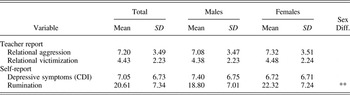
Descriptive statistics were first computed on all of the variables. Table 1 presents the means and standard deviations for each variable, both for the overall sample and by sex. To examine sex differences in each of the variables, t tests were used. There were no sex differences in teacher-reported relational victimization or in relational aggression (all ps > .05). Girls reported more rumination than did boys, t (484) = –5.45, p < .01. There was no sex difference in depressive symptoms, t (477) = 1.11, p > .05.
Descriptive statistics for all variables for the overall sample and by sex

Note: CDI, Children's Depressive Inventory.
**p < .01.
Correlations
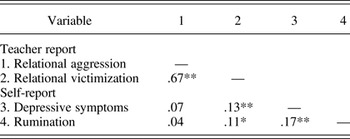
To assess initial associations between the constructs, bivariate correlations were computed. As shown in Table 2, relational victimization was significantly associated with relational aggression. Relational victimization was significantly associated with depressive symptoms and rumination.
Bivariate correlation coefficients

*p < .05. **p < .01.
Description of main analyses
Hierarchical linear regressions were used to test the main hypotheses. Given the correlation between relational aggression and victimization, relational aggression was entered as a control when examining the models for relational victimization (Hypotheses 1 through 3). Similarly, relational victimization was entered as a control for the models of relational aggression (Hypotheses 4 through 6).
Hypothesis 1
In the first regression, sex and relational aggression were entered in Step 1, relational victimization in Step 2, and then Sex × Relational Victimization interaction in Step 3. After controlling for sex and relational aggression, relational victimization was significantly associated with depressive symptoms (β = 0.15, p < .05); overall model F (4, 465) = 3.22, p < .05. Sex did not moderate this association (β = 0.06, p > .05). Thus, those individuals who were relationally victimized (according to their teachers) reported higher levels of depressive symptoms with a similar association noted for both boys and girls. We also examined whether the interaction between relational victimization and relational aggression would better predict depressive symptoms, but neither that interaction nor a three-way interaction between those variables and sex was significant.
Hypothesis 2
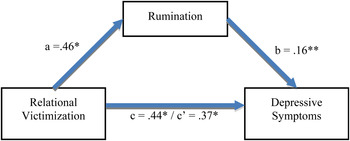
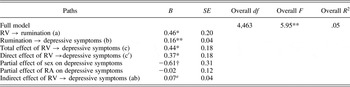
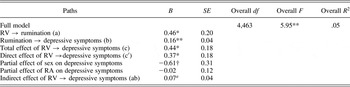
Hypothesis 2 stated that rumination would mediate the association between relational victimization and depressive symptoms. The approach and Statistical Package for the Social Sciences macro described by Preacher and Hayes (Reference Preacher and Hayes2008) was used to analyze the mediation model. Similar to the other models, sex and relational aggression were entered as control variables. The results are presented in Table 3 and Figure 1. As shown, relational victimization was associated with both rumination (path a) and depressive symptoms (path c), and rumination was associated with depressive symptoms (path b). To test the indirect pathway, Preacher and Hayes propose bootstrapping as a superior method to comparing the results to a normal distribution. Through this approach, the indirect pathway from relational victimization to depressive symptoms through rumination (path ab) was significant, as evident by the fact that the confidence interval did not include zero. Given that the association between relational victimization and depressive symptoms was significant after accounting for the mediator and control variables (path c′), we can conclude that rumination partially mediated the association between relational victimization and depressive symptoms and that relational victimization was also directly associated with depressive symptoms.
(Color online) Mediation of the association between relational victimization and depressive symptoms by rumination (controlling for sex and relational aggression). Values represent unstandardized coefficients. *p < .05, **p < .01.

Analysis of rumination as a mediator of the association between relational victimization and depressive symptoms
Note: RA, Relational aggression; RV, relational victimization.
a Bootstrap confidence interval = 0.01–0.17.
†p < .10. *p < .05. **p < .01.
Sex differences were also examined for this mediation model. The approach and macro are described in Preacher, Rucker, and Hayes (Reference Preacher, Rucker and Hayes2007). Specifically, sex was tested as a moderator of both pathways in the indirect effect but was not found to be a significant moderator.
Hypothesis 3
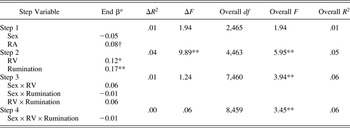
Hypothesis 3 stated that relational victimization would interact with rumination to predict depressive symptoms. To test this hypothesis, a regression was computed (see Table 4). In this regression, sex and relational aggression were entered in Step 1, relational victimization and rumination were entered in Step 2, the two-way interactions (Sex × Relational Victimization, Sex × Rumination, and Relational Victimization × Rumination) were entered in Step 3, and the three-way interaction (Sex × Relational Victimization × Rumination) was entered in Step 4. There was no evidence that rumination moderated the association between relational victimization and depressive symptoms. Neither the Relational Victimization × Rumination nor the Sex × Relational Victimization × Rumination interaction was significant (β = 0.06, p > .05 and β = –0.01, p > .05, respectively).
Hierarchical regression analysis of the interaction between relational victimization and rumination in predicting depressive symptoms

Note: RA, Relational aggression; RV, relational victimization.
a β values are standardized.
†p < .10. *p < .05. **p < .01.
Hypothesis 4
To explore whether relational aggression was associated with depressive symptoms, another regression was computed. Sex and relational victimization were entered in Step 1, relational aggression in Step 2, and then Sex × Relational Aggression interaction in Step 3. After controlling for sex and relational victimization, relational aggression was not associated with depressive symptoms (β = –0.02, p > .05); overall model F (4, 466) = 3.22, p < .05. Furthermore, the interaction between sex and relational aggression was not significant (β = 0.02, p > .05). As previously mentioned, even without controls, the correlation between relational aggression and depressive symptoms was not significant.
Hypothesis 5
This hypothesis stated that rumination would mediate the association between relational aggression and depressive symptoms. Given that there was no association between relational aggression and depressive symptoms, this hypothesis could not be tested.
Hypothesis 6
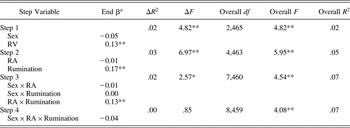
Hypothesis 6 stated that rumination would moderate the association between relational aggression and depressive symptoms. In this regression, sex and relational victimization were entered in Step 1, relational aggression and rumination were entered in Step 2, the two-way interactions (Sex × Relational Aggression, Sex × Rumination, and Relational Aggression × Rumination) were entered in Step 3, and the three-way interaction (Sex × Relational Aggression × Rumination) was entered in Step 4 (see Table 5).
Hierarchical regression analysis of the interaction between relational aggression and rumination in predicting depressive symptoms

Note: RA, Relational aggression; RV, relational victimization.
a β values are standardized.
*p ≤ .05. **p < .01.
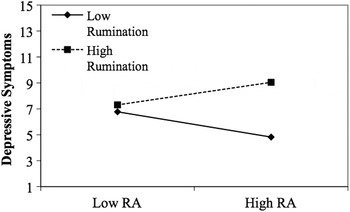
In contrast to the aforementioned findings for relational victimization, there was evidence that rumination moderated the association between relational aggression and depressive symptoms (β = 0.13, p < .01); however, this interaction was not moderated by sex (β = –0.04, p > .05). The addition of the two-way interactions at Step 3 was associated with a significant change in variance accounted for (ΔR 2 = .02, ΔF = 2.57, p = .05).
Following Aiken and West (Reference Aiken and West1991), simple slopes were plotted and tested at one standard deviation above and below the mean for rumination. Figure 2 shows a graphical depiction of the interaction. Both of the simple slopes were significant at a trend level. For low rumination, relational aggression was negatively associated with depressive symptoms (β = –0.14, p < .10). For high rumination, relational aggression was positively associated with depressive symptoms (β = 0.13, p = .10). Thus, for those adolescents who ruminate, relational aggression was associated with higher levels of depressive symptoms. The interaction was further evaluated using the Johnson–Neyman technique and the Statistical Package for the Social Sciences macro described by Hayes and Matthes (Reference Hayes and Matthes2009). This approach identifies regions of significance, or values for the moderator, for which the predictor variable is associated with the outcome variable. Variables were centered; thus, the results are based on variables for which the means are 0. The results of this approach showed that there were two regions of significance. When rumination was lower than –7.99 (which is just greater than 1 SD below the mean), relational aggression was inversely associated with depressive symptoms. In contrast, when rumination was high (>10.14), relational aggression was positively associated with depressive symptoms.
Rumination moderated the association between relational aggression and depressive symptoms.

Discussion
This was the first study to examine rumination about victimization experiences and explore this construct as a potential contributing factor to better understanding the association between relational victimization and depressive symptoms in adolescents. Similar to previous findings, the study provided support for the association between relational victimization and depressive symptoms in adolescents. Furthermore, there was support for the hypothesis that rumination about victimization experiences would partially mediate the association between relational victimization and depressive symptoms. Thus, it appears that adolescents who are relationally victimized may ruminate about those experiences, which in turn puts them at risk for depressive symptoms. Although it is difficult to know exactly how this process works, a number of possibilities are plausible. For example, adolescents who are relationally victimized may be rejected and isolated by peers, and not have social supports in place for talking about their experiences. Another possibility is that they may have people to talk to but feel embarrassed or ashamed about the experience and so choose to dwell on their feelings alone. Given how important peer relations are during adolescence, being relationally victimized during this developmental period may be particularly harmful for adolescents and lead them to dwell on the experience, rather than brushing the incident off as not important. Finally, adolescents who are relationally victimized may develop regulation problems, such as difficulty regulating both their negative feelings and any negative cognitions they may be having about the victimization experiences, which may in turn lead them to feeling depressed.
Overall, this finding is consistent with one study demonstrating that emotional dysregulation, which included a measure of rumination, mediated the association between relational victimization and internalizing symptoms (McLaughlin et al., Reference McLaughlin, Hatzenbuehler and Hilt2009). Furthermore, in another study, rumination partially mediated the association between being relationally victimized by a friend in response to displaying negative emotions and internalizing symptoms (Mathieson et al., Reference Mathieson, Klimes-Dougan, Crick, Hastings, Brand and Zahn-Waxler2013). Furthermore, in a study of urban, low-income, primarily African American children, Waasdorp et al. (Reference Waasdorp, Bagdi and Bradshaw2010) found that both boys and girls reported they would use rumination as a strategy for coping with relational victimization. Therefore, rumination appears to be an important process in better understanding the link between relational victimization and depressive symptoms in adolescents.
Ruminating about relational victimization was also explored as a moderator of the association between relational victimization and depressive symptoms, but there was no support for this hypothesis. Thus, it seems for relational victimization, ruminating functions only as a mediator in this sample. There was evidence of ruminating about relational victimization being associated with depressive symptoms. Therefore, it appears that each of these constructs independently predicted depressive symptoms, rather than interacting, which is consistent with findings from a previous study of adolescents that rumination and victimization (including relational, physical, and verbal victimization) each independently predicted depressive symptoms in adolescents (Erdur-Baker, Reference Erdur-Baker2009).
In contrast, and rather unexpectedly, there was evidence that rumination moderated the association between relational aggression and depressive symptoms. For those who have a tendency to ruminate about victimization, relational aggression was more strongly associated with depressive symptoms than for those who did not tend to ruminate. Given that many individuals who engage in relational aggression may also be victimized by peers, it is possible that ruminating about victimization puts aggressive adolescents at heightened risk for depressive symptoms. For example, there may be something different about those adolescents who have regulatory difficulties, reflected by rumination, than those who do not, such that those who are also aggressive may be at more risk for depressive symptoms. Relationally aggressive individuals may also ruminate about victimization experiences or about relationally aggressive acts they have been involved in (e.g., if an act of relational aggression ended a friendship, the individual may ruminate about this, which may be associated with depressive symptoms).
This moderation finding may reflect important differences across individuals. It may be that some individuals who ruminate about victimization do nothing in response to their victimization, whereas others retaliate. While not assessed in this study, there are different functions of relational aggression. Specifically, reactive aggression is thought to be more retaliatory in nature, whereas proactive aggression is defined as goal directed (Crick & Dodge, Reference Crick and Dodge1996). Research has shown that reactive relational aggression, but not proactive relational aggression, is associated with higher internalizing problems (e.g., Mathieson & Crick, Reference Mathieson and Crick2010). Therefore, it is possible that the combination of ruminating about victimization experiences and using reactive relational aggression puts one at heightened risk for depressive symptoms. In contrast, those who do not ruminate about victimization and possibly just use relational aggression as part of maintaining status in their peer group are not at risk for depressive symptoms. In line with this notion, Rose and Swenson (Reference Rose and Swenson2009) found that perceived popularity provided a “buffer” against internalizing problems in adolescents who were relationally aggressive. That is, relational aggression was not associated with internalizing problems when perceived popularity was high. This may shed some light on one of the unexpected findings from the current study: for those who engaged in low levels of rumination, relational aggression was actually associated with lower levels of depressive symptoms. Again this supports the idea that there may be some individuals who are socially skilled, possibly perceived as popular, who do not have regulatory difficulties (such as rumination) and who use relational aggression to achieve or maintain social status. These individuals may not show risk for depressive symptoms. Future research is needed to replicate the moderation finding and to tease apart the specific mechanisms underlying this interaction.
We were not surprised that rumination did not mediate the association between relational aggression and depressive symptoms, as was explored to establish the specificity of the association for relational victimization. However, what was surprising was the lack of direct association between relational aggression and depressive symptoms. This was interesting, given that this was a well-established finding in previous studies (e.g., Card et al., Reference Card, Stucky, Sawalani and Little2008). This supports the notion that the association between relational aggression and depressive symptoms may be more complex and nuanced than a simple association, and further research is needed to more fully understand this complexity.
Overall support was not found for sex differences in the models tested. That is, the results applied more generally to boys and to girls. Although acts of relational aggression and relational victimization appear to be more distressing for adolescent girls (Coyne, Archer, Eslea, & Liechty, Reference Coyne, Archer, Eslea and Liechty2008; Galen & Underwood, Reference Galen and Underwood1997; Goldstein & Tisak, Reference Goldstein and Tisak2010; Paquette & Underwood, Reference Paquette and Underwood1999), it does not appear that engaging in either relational aggression or relational victimization puts girls at any more risk of developing depressive symptoms than boys. This is consistent with meta-analytic findings showing that sex did not moderate the association between relational aggression and internalizing problems (Card et al., Reference Card, Stucky, Sawalani and Little2008). With respect to relational victimization, there is very limited evidence that the association is stronger for girls (Prinstein et al., Reference Prinstein, Boergers and Vernberg2001; Storch et al., Reference Storch, Nock, Masia-Warner and Barlas2003), with the majority of studies not reporting gender moderation effects. Thus, the results of the current study are best viewed as applying to both boys and girls.
The current study focused on rumination about relational victimization experiences. However, given that adolescents who are relationally victimized may have friends, it may be important to also consider co-rumination.Footnote 1 Rose (Reference Rose2002) defines co-rumination as “extensively discussing and revisiting problems, speculating about problems, and focusing on negative feelings” (p. 1830), and it is often studied in the context of friendships. Research has established a link between co-rumination and depressive symptoms (Calmes & Roberts, Reference Calmes and Roberts2008; Hankin, Stone, & Wright, Reference Hankin, Stone and Wright2010; Rose, Reference Rose2002; Rose, Carlson, & Waller, Reference Rose, Carlson and Waller2007; Stone, Urhlass, & Gibb, Reference Stone, Urhlass and Gibb2010). Similar to rumination, as part of the larger study in which the current study was embedded, we also examined co-ruminating about relational victimization experiences. However, we did not find any support for co-ruminating about relational victimization as a moderator or mediator of the associations between either relational victimization and depressive symptoms or relational aggression and depressive symptoms.
Strengths and limitations
The current study had a number of strengths. First, a large sample size was employed spanning three grade levels. The sample size allowed for an examination of the complex moderation analyses computed. Second, multiple reporters (viz., teacher and self) were used to gather data on the key variables of interest: relational aggression, relational victimization, and depressive symptoms. This allowed for use of teacher reports of aggression and victimization with self-reports of depressive symptoms to avoid shared reporter bias, which ultimately resulted in a more stringent test of the hypotheses. Third, a strength of this study was the measurements of rumination, which was specifically assessed in the context of relational victimization experiences. To date, this is the first study to examine that specific type of rumination.
Although there are a number of strengths associated with the current study, it is not without limitations. One limitation of the study was the lack of peer nomination measures for relational aggression and victimization. Peer nominations are often seen as preferable to other assessments because it can be difficult for those outside the peer group to report on experiences happening within the peer group (Crick & Grotpeter, Reference Crick and Grotpeter1995). With respect to the teacher reports used in the current study, past research has demonstrated strong correlations between teacher reports and peer nominations of relational aggression (Crick, Reference Crick1996), and more modest correlations between teacher reports and peer nominations of relational victimization (Cullerton-Sen & Crick, Reference Cullerton-Sen and Crick2005). Thus, although there is significant overlap between teacher reports and peer nominations, collecting peer nominations may have offered some additional information that could have been used in analyses. In this study, the participating school would not allow peer nominations to be collected. Furthermore, peer nominations can be difficult to conduct in middle school, where adolescents are in multiple classes with different peers, as opposed to elementary school, where children are typically in one class with the same peers. Although peer nominations were not used, the study benefited from having teacher reports of aggression and victimization, which are thought to be less subject to social desirability bias than are self-reports (Pakaslahti & Keltikangas-Jarvinen, Reference Pakaslahti and Keltikangas-Jarvinen2000). Future research employing peer nominations, though, would be helpful to further assess the associations tested in the current study.
An additional limitation was that, because of the nature of the study, directionality could not be assessed. For example, with respect to relational victimization and depressive symptoms, it is possible that relational victimization leads to depressive symptoms, depressive symptoms lead to relational victimization, or the association is bidirectional. Researchers have explored the direction of the association between victimization (not necessarily relational) and depressive symptoms, and found it to be bidirectional (Nishina, Juvonen, & Witkow, Reference Nishina, Juvonen and Witkow2005; Snyder et al., Reference Snyder, Booker, Patrick, Snyder, Schrepferman and Stoolmiller2003; Sweeting, Young, West, & Der, Reference Sweeting, Young, West and Der2006), whereas other studies have found that victimization predicts depressive symptoms but not vice versa (Bond, Carlin, Thomas, Rubin, & Patton, Reference Bond, Carlin, Thomas, Rubin and Patton2001). Studies of interpersonal stress also suggest that it may be important to examine directionality of the effect between interpersonal stress and depressive symptoms. For example, Rudolph (Reference Rudolph2008) found that depressive symptoms predicted increases in the generation of interpersonal stress for early-maturing youth but not late-maturing youth. In another study, Rudolph, Flynn, Abaied, Groot, and Thompson (Reference Rudolph, Flynn, Abaied, Groot and Thompson2009) found that depressive symptoms predicted subsequent interpersonal stress, which in turn predicted future depressive symptoms in adolescent girls. The finding that rumination mediated the association between relational victimization and depressive symptoms would be strengthened if replicated in a longitudinal study. Therefore, future longitudinal studies are needed to tease apart the temporal sequencing of these associations.
Practical implications
The current study not only adds to the advancement of knowledge about the development of depressive symptoms during adolescence but also offers a number of practical implications. It supports the need for parents and school personnel to monitor adolescents who are relationally victimized for depressive symptoms. Thus, preventative measures could be taken to help individuals who are relationally victimized cope with their victimization experiences.
Furthermore, given the findings with respect to ruminating about victimization, it may be helpful for school-based interventions targeted at relational aggression/relational victimization to specifically address those types of cognitions. For clinicians working with individuals who are relationally aggressive, victimized, or both, it may be beneficial to address such cognitions with their clients and assist them in developing other ways of thinking about their victimization experiences. This could include finding ways of regulating negative emotions and developing more solution-focused ways of thinking about conflicts with peers. Similarly, it may be helpful for clinicians to encourage their clients to discuss their victimization experiences in a healthy way, with friends, parents, or with the clinicians themselves, rather than ruminating about them by themselves.
Conclusions and directions for future research
Overall, the current study advances the field by exploring the role that a specific cognitive process, namely, ruminating about victimization experiences, plays in the association with interpersonal processes (relational victimization and aggression) and depressive symptoms. This is the first study to examine these constructs in concert. Furthermore, it is the first study to specifically examine rumination in response to relational victimization experiences. The findings offer important information for the field as well as for those who work with adolescents.
According to a developmental psychopathology perspective on depressive symptoms, further research is needed to explore how these constructs interact with other constructs at multiple levels (e.g., genetic, biological, neurological, family, neighborhood, and cultural) to identify various pathways that may lead to depressive symptoms during adolescence (Cicchetti & Toth, Reference Cicchetti, Toth, Hilt and Nolen-Hoeksema2009). Furthermore, in interpersonal models of adolescent depressive symptoms, it is suggested that multiple interpersonal factors, such as rejection sensitivity, withdrawal, excessive reassurance seeking, and negative perceptions about relationships, are all important to consider (Rudolph, Reference Rudolph, Hilt and Nolen-Hoeksema2009). For example, one recent study showed that rejection sensitivity partially mediated the association between relational victimization and depressive symptoms in adolescents (Zimmer-Gembeck et al., Reference Zimmer-Gembeck, Trevaskis, Nesdale and Downey2013). In addition, research has begun to explore physiological processes associated with rumination (Ottaviani, Shapiro, Davydov, Goldstein, & Mills, Reference Ottaviani, Shapiro, Davydov, Goldstein and Mills2009) and relational stressors, including relational aggression and victimization (Murray-Close & Crick, Reference Murray-Close and Crick2007; Sijtsema, Shoulberg, & Murray-Close, Reference Sijtsema, Shoulberg and Murray-Close2011). Future research could explore the role of physiological arousal in both experiencing relational victimization or aggression and ruminating about victimization experiences as well as examine the links with depressive symptoms. Thus, while the current study has contributed to an understanding of adolescent depressive symptoms, future research could expand on this work by examining a broader network of interpersonal constructs as well as other factors across multiple levels. Therefore, this study has laid the groundwork for future research to continue the exploration of how relational aggression and victimization fit into interpersonal and interactive models of depressive symptoms during adolescence.