Introduction
Some of the single genes responsible for qualitative traits in poultry, such as the gene affecting feathering growth rate, are responsible for improving production efficiency (Zakrzewska, Reference Zakrzewska1995) and distinguish sex based on the growth rate of external feathers at early ages (Genchev et al., Reference Genchev, Kabakchiev and Mihailov2008). Hutt (Reference Hutt1949) put forward two theories about the advantages of rapid-feathering birds: firstly, the gene for rapid feathering promotes not only the growth rate of all feathers but also other body processes, resulting in faster growth; secondly, rapid-feathering birds require less energy for maintenance of body temperature and, having better insulation against heat loss, more energy is available for growth. If a gene affecting feather development is sex-linked, it could be applied in commercial quail production with considerable economic impact, allowing producers to reduce some of their production costs. Wheeler and Latshaw (Reference Wheeler and Latshaw1981) observed that the beginning of fast feather growth continued up to the end of the second week after hatching. Khosravinia (Reference Khosravinia2009) found that rapid-feathering broilers had significantly heavier live body weight (BW) and carcass weight than slow-feathering ones. According to Fotsa et al. (Reference Fotsa, Mérat and Bordas2001), fast-feathering genotypes had more effective protection against chilling, so these genotypes grew faster than slow-feathering genotype in broiler flocks. Moreover, feather sexing is a very common method of sex identification at 21 days of age in Japanese quail (Coturnix japonica), depending on feather colour; however, the accuracy of this method is dependent upon good feather development. A major problem in identifying sex is seen in 0.11–0.17 of birds, where feather growth is delayed due to individual features in the growth rate of external feathers. Late growth of feathers and insufficient feathering results in failure to detect the gender of quails, even at the age of 17 days (Genchev et al., Reference Genchev, Kabakchiev and Mihailov2008).
Avian species differ in the number of primary and secondary feathers; also, the structure of primary feathers differs from that of secondaries, with primary remiges (flight feathers) being very long, irregular and harder than the secondaries, which are slightly more delicate (Somes, Reference Somes and Crawford1990). Somes (Reference Somes and Crawford1990) also reported that there are about ten primary remiges and 15 secondaries located on each wing of the common Coturnix, but that two completely dominant autosomal genes can affect the number of primary remiges. Also, the number of tail feathers is affected both by species and genetic factors. Warren (Reference Warren1930) indicated that in crosses between males having the gene for fast-feathering rate and females having the gene for slow-feathering rate, gender may be detected by the extent of growth in primary and secondary wing feathers at 1 day old and by the existence or absence of tail feathers at 10 days old. Females have been reported to have significantly higher feather weight (Wecke et al., Reference Wecke, Khan, Sünder and Liebert2017) and heavier BW (Taskin et al., Reference Taskin, Karadavut, Tunca, Genc and Cayan2017) than males across generations.
Most programmes constructed for genetic improvement in Japanese quail start at 4 weeks of age because of maternal effects, which is the causal impact of the maternal phenotype or genotype on the offspring phenotype or performance, which can play an important role in evolutionary processes and performance of offspring (Sefton and Siegel, Reference Sefton and Siegel1974; Jahanian and Goudarzi, Reference Jahanian and Goudarzi2010). Therefore, it is the aim of both researchers and breeders/producers to find alternative methods of predicting productive qualities through easy to measure traits, such as feathering rate, at an early age. Therefore, the current study aimed to investigate the effect of feathering rate and its relationship with BW and slaughter traits in Japanese quail, which may have a major economic effect on quail production.
Materials and methods
The experimental work was conducted at the Poultry Research Centre, Faculty of Agriculture, Fayoum University, Egypt. A total of 1180 1-day-old Japanese quail chicks were wing banded at hatching. During the first 35 days after hatching, all quail were fed ad libitum on a starter diet containing 12.1417 MJ and 240 g crude protein/kg and clean water. All birds had the same environmental, management and health conditions: after hatching, chicks were reared on the floor at 35 °C for the first 3 days, after which the temperature was decreased gradually. Birds were subjected to continuous light for the first 14 days and then the photoperiod was reduced to 16 h light/day thereafter.
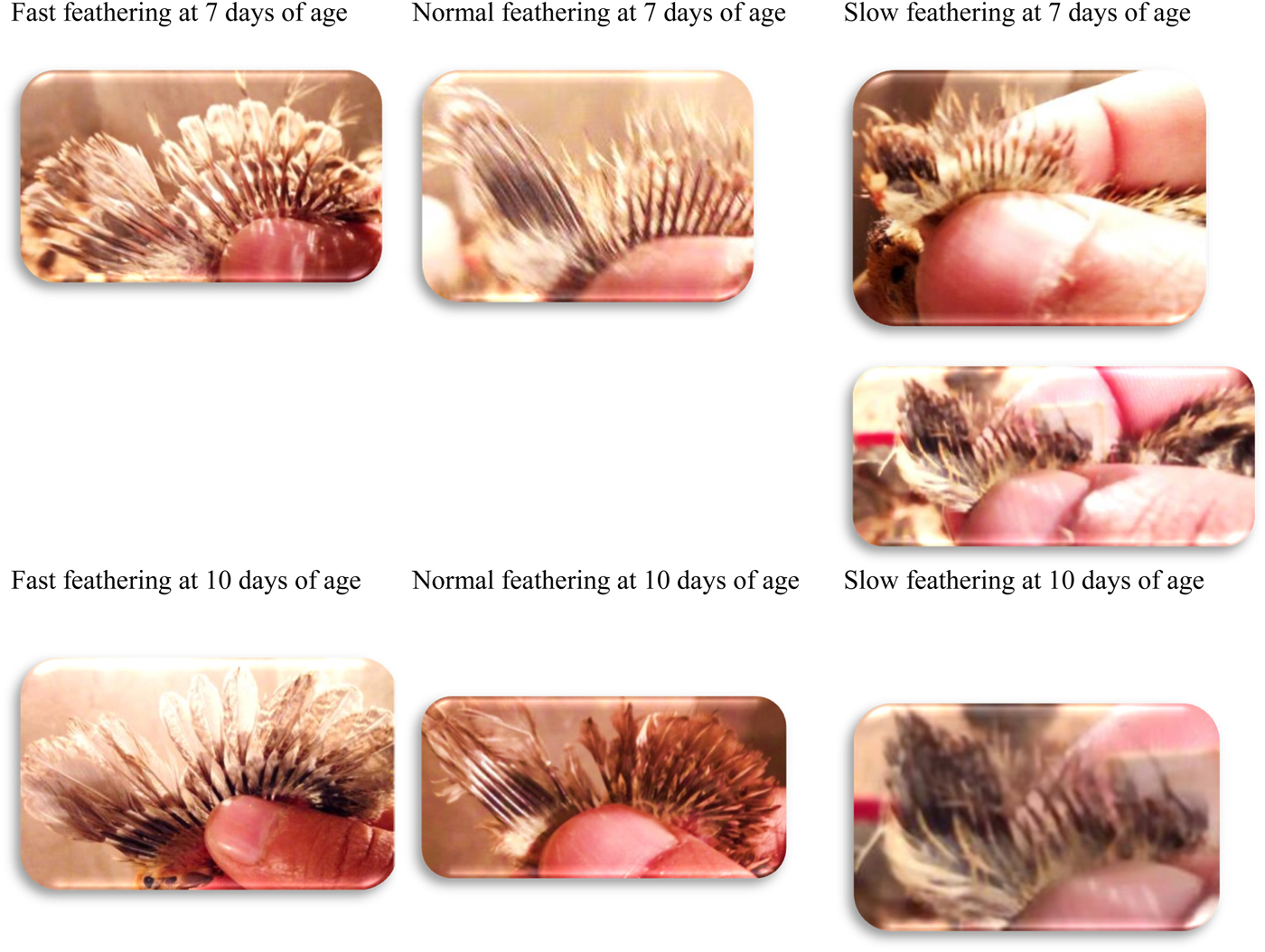
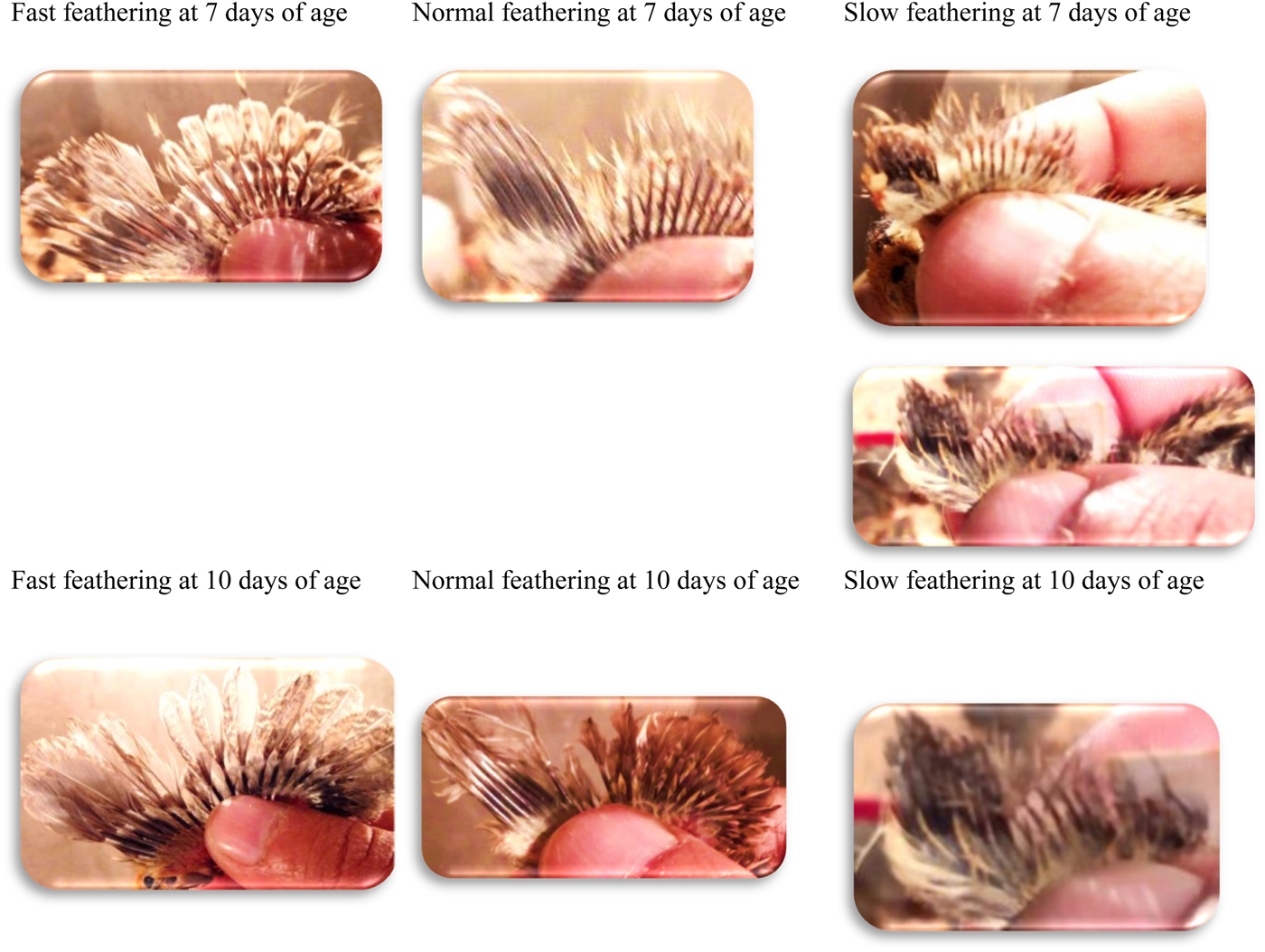
The description of feathering rate was divided into three classes, based on the ranking of individual feather growth rate for both number and length of the primary and secondary feathers at 7 and 10 days of age and tail length at 10 days of age as predictors, using stepwise regression analysis. The three classes (Fig. 1) were:
• Fast-feathering class: quails which had higher numbers (Nusec7, Nupri10) and length (Lensec7, Lensec10) of primary and secondary feathers at 7 and 10 days old, respectively, and tail length at 10 days old (Lentail10) than other classes,
• Slow-feathering class: quails which had lower numbers and length (Nusec7, Nupri10) of primary and secondary feathers (Lensec7, Lensec10) and Lentail10 than other classes.
• Normal-feathering class: quails had normal rates of feathering, used as a control reference of description in the current study. The normal feathering class has lower numbers (Nusec7, Nupri10) and length (Lensec7, Lensec10) of primary and secondary feathers at 7 and 10 days old, respectively, and tail length at 10 days old (Lentail10) than the fast-feathering class, but higher numbers (Nusec7, Nupri10) and greater length (Lensec7, Lensec10) of primary and secondary feathers at 7 and 10 days old, respectively, and tail length at 10 days old (Lentail10) than the slow-feathering class.
The three morphological classes of feathering rates.
The traits studied were:
• Numbers of primary and secondary feathers: numbers of primaries (Nupri7, Nupri10) and secondaries (Nusec7, Nusec10) feathers at 7 and 10 days of age,
• Lengths of primary, secondary feathers and tail: lengths of primaries (Lenpri7, Lenpri10) and secondaries (Lensec7, Lensec10) feathers at 7 and 10 days of age and tail length at 10 days of age (Lentail10).
• Body weight (g): weekly live BW from 14 up to 35 days of age were individually recorded using a sensitive digital electronic balance.
• Slaughter traits: at the end of the fifth week after hatching, a slaughter test was performed on 60 birds, randomly chosen from the fast- and slow-feathering rate classes (15 males and 15 females of each class). The chosen birds were fasted for 12 h, weighed individually and slaughtered by cutting the jugular vein. Bleeding was continued for c. 4 min then feathers were dry-plucked. The head, neck, legs, viscera and giblets (liver, heart, spleen and gizzard) were removed before eviscerated carcasses were weighed individually to obtain dressed weight:
Carcass weight = live BW35 – (weights of blood + feather + head + leg + inedible parts),
Dressing% = 100 × (carcass weight + giblets weight)/live BW35
Statistical analyses
The three models of analysis used in the current study were:
1- PROC CORR, SAS (2011) model was used to estimate Pearson's phenotypic correlations (r p) between the studied traits.
2- PROC reg, SAS (2011) model to calculate stepwise regression analyses.
3- PROC MIXED (SAS, 2011) model was used to calculate the class and sex-specific means for all traits:
 $$Y_{ijk}\, = \,\mu \, + \,C_i\, + \,S_j\, + \,C_i\, \times \,S_j\, + \,e_{ijk}$$
where Y ijk is the observation for a trait, μ is the overall mean; C i is the fixed effect of the i th class (i for the three levels of BW class (fast-, normal- and slow-feathering classes), and two levels for slaughter traits (fast- and slow-feathering classes)), S j is the fixed effect of j th sex, C i × S j is the interaction of C i and S j and e ijk is the random error term; the random variable was the quail within class. Means of classes and their interactions with sex were compared using multiple range test (Duncan, Reference Duncan1955). A probability of P < 0.05 was required for significance.
Results
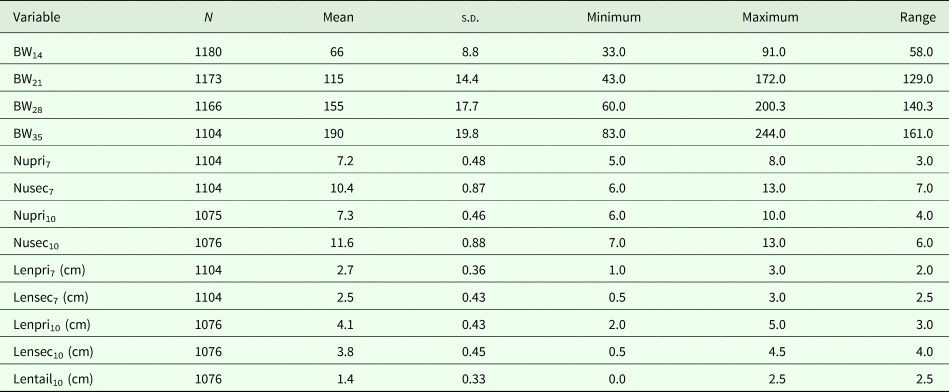
Descriptive statistics of traits studied in the current work are presented in Table 1. As the chicks grew older, variability in range values of BW increased from a minimum at 14 days old and reaching its maximum at 35 days of age, ranging from 58.0 to 161.0 g. As quail chicks increased in age, both numbers and length of primaries and secondaries increased: at 7 and 10 days old, the numbers of secondaries v. primaries were 7 and 6 v. 3 and 4, respectively, and lengths were 2.5 and 4.0 v. 2.0 and 3.0, respectively.
Descriptive statistics of studied traits

N, number of observations; s.d., standard deviation; BW14 to BW35, weights at 14, 21, 28 and 35 days of age; Nupri7, Nusec7, Nupri10, Nusec10, Lenpri7, Lensec7, Lenpri10, Lensec10 and Lentail10, numbers and lengths of primary and secondary feathers at 7 and 10 days of age.
Range = maximum–minimum.
Means of Nupri10, Nusec10, Lenpri10 and Lensec10 were higher than those at 7 days old. Both mean and range for Lentail10 were lower than Lenpri10 and Lensec10.
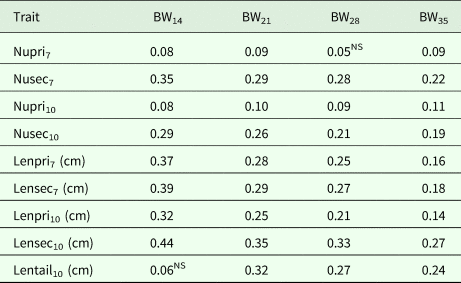
The correlations (rps) between feathering measurement traits and BW traits at different ages are presented in Table 2. All measurements of feathering rate had positive rps with BW at all ages studied, ranging from low to medium (0.05–0.44). Both Nupri7 (0.08–0.09) and Nupri10 (0.08–0.11) had positive, significant (P < 0.05) low rps with BW at all ages, except BW28 which did not correlate significantly with Nupri7. Medium positive rps estimates were found between both Nusec7 and Nusec10 with BW from 14 up to 35 days of age, ranging from 0.19 to 0.35 (Table 2). Similarly, Lentail10 had positive and significant (P < 0.001) medium rps with BW from 21 up to 35 days of age ranged from 0.24 to 0.32.
Phenotypic correlations between feather traits and body weight at different ages
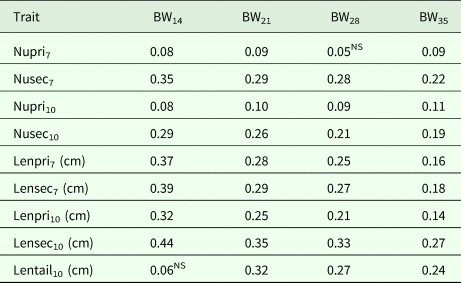
BW14 to BW35 = body weights at 14, 21, 28 and 35 days of age; Nupri7, Nusec7, Nupri10, Nusec10, Lenpri7, Lensec7, Lenpri10, Lensec10 and Lentail10 = numbers and lengths at 7 and 10 days of age; values were ranged from 0.05:0.06 = not significant; rp ranged from 0.05 to 0.06 were not significant.
rp ranged from 0.08 to 0.09 were significant at P ⩽ 0.05.
rp ranged from 0.10 to 0.44 were significant at P ⩽ 0.001.
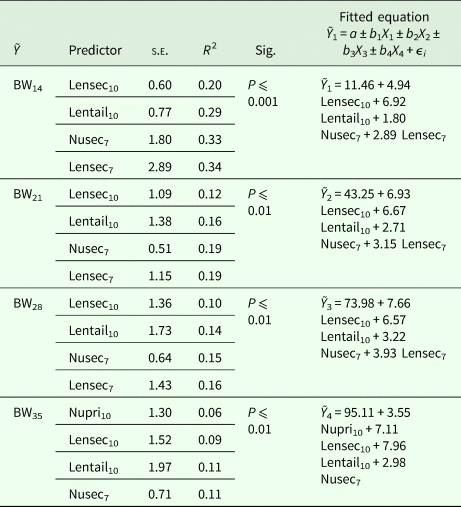
The results of stepwise multiple regressions (Table 3) indicated that BW14, BW21 and BW28 can be predicted using Lensec10, Lentail10, Nusec7 and Lensec7, while BW35 can be predicted with the use of Nupri10, Lensec10, Lentail10 and Nusec7.
Stepwise regression parameters, coefficient of determination (R 2), for predicting body weight at different ages through primaries, secondaries and tail regimes

BW14 to BW35 = weights at 14, 21, 28 and 35 days of age; Nupri7, Nusec7, Nupri10, Nusec10, Lenpri7, Lensec7, Lenpri10, Lensec10 and Lentail10 = numbers and lengths at 7 and 10 days of age; Sig. = significance.
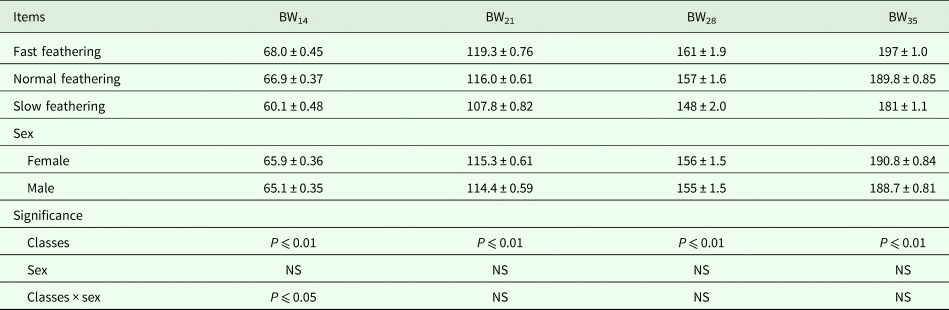
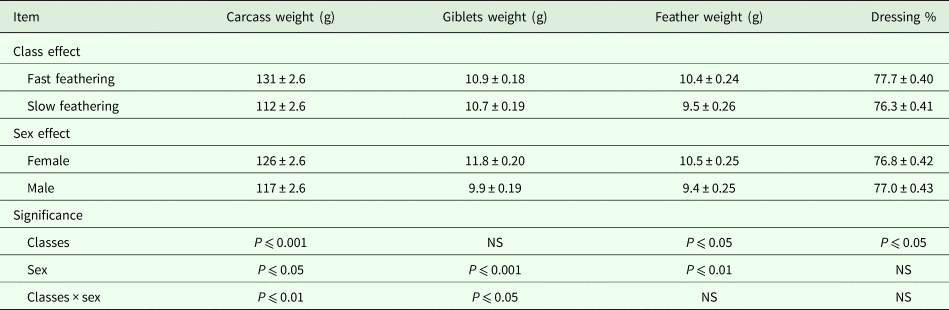
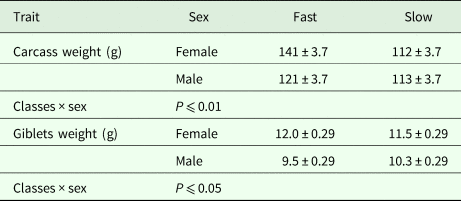
Significant increases (P < 0.01) were observed in class differences at 14 days and at later ages, but sex differences were not significant for any of the studied BW at different ages. Heavier BWs (P < 0.01) were clear from BW21 age up to 35 days of age in the fast-feathering class than the slow-feathering class, which had the lowest BW. The interaction between feathering rate class and sex effects in the current study was significant for BW14 only and not significant for BW at later ages (Table 4). Females of the fast-feathering class had the highest BW14, whereas females and males of the slow class had the lightest BW14 (Table 5). Significant (P < 0.001) class differences were seen for carcass weight, feather weight and dressing% in favour of the fast-feathering class (Table 6). Sex differences were also significant for carcass (P < 0.05), giblets (P < 0.001) and feather weights (P < 0.01), favouring females rather than males. The interaction of feathering class and sex effects was significant for carcass (P < 0.01) and giblet weights (P < 0.05) (Table 6). Females of the fast-feathering class had heavier carcass weights than other sex × feathering rate classes. Females of both fast- and slow-feathering classes had significantly (P < 0.05) higher giblets weight than males of either fast or slow classes (Table 7).
Least-squares means (±s.e.) along with the significance of fixed effects for the body weight at different ages

BW14 to BW35 = body weights at 14, 21, 28 and 35 days of age.
NS, not significant.
Least-squares means (+s.e.) along with the significance of classes × sex interaction for BW at 14 days of age

Least-squares means (±s.e.) along with the significance of fixed effects for slaughter traits

NS, not significant.
Least-squares means (+s.e.) along with the significance of classes × sex interaction for carcass and giblets weights

Discussion
Averages for all BWs studied were higher in the current study than the estimates reported by Barbieri et al. (Reference Barbieri, Ono, Cursino, Farah, Pires, Bertipaglia, Pires, Cavani, Carreño and Fonseca2015), Daida and Rani (Reference Daida and Rani2017) and Rathert et al. (Reference Rathert, Güven and Üçkardeş2017), except for BW35 reported by Barbieri et al. (Reference Barbieri, Ono, Cursino, Farah, Pires, Bertipaglia, Pires, Cavani, Carreño and Fonseca2015; 211.31 v. 189.52 in the current study). This may be due to the differences in genetic background of the flock, environmental conditions and the interaction between them (Falconer, Reference Falconer1989). In the current study, both the numbers and length of primary and secondary remiges increased with age in the quail chicks. These results agreed with those reported by Somes (Reference Somes and Crawford1990), who reported that there are about ten primary remiges and 15 secondaries located on each wing of the common Coturnix, but that two completely dominant autosomal genes can affect the number of primary remiges. Similarly, Wecke et al. (Reference Wecke, Khan, Sünder and Liebert2017) found that feather weight increased with increasing age of birds. In adult birds, weight of feather ranged from 3 to 6% of BW (Leeson and Walsh, Reference Leeson and Walsh2004). Results of the present study indicated that use of feathering rate traits at earlier ages may enable improved growth performance at 35 days of age in Japanese quail, allowing producers to reduce some production costs.
No previous information could be found on the studied feathering rate traits and their relationship with growth performance of Japanese quail. There were significant and positive correlations between most measurements of feathering rate and all BW traits studied at different ages.
The results of the present study revealed that feathering rate traits measured at 7 and 10 days of age can be used successfully as predictors for BW at later ages in Japanese quail.
Yakubu et al. (Reference Yakubu, Okunsebor, Kigbu, Sotolu and Imgbian2012) reported that multiple regression analysis could be used to deduce the complex relationships among BW and some morphometric measurements. Therefore, typically BW is regressed on morphometric measurements to determine a weight prediction equation.
The fast-feathering class had higher BW21, BW28 and BW35 than other classes. However, there were non-significant sex differences for all BW studied at different ages. Similarly, Khosravinia (Reference Khosravinia2009) reported that fast-feathering broilers had significantly higher BW than slow-feathering ones. Thyroid hormones and gonadotrophins have been found to have major effects on feather growth and its development (Spearman, Reference Spearman, Bell and Freeman1971). Thyroid hormones are responsible for increasing metabolic rate and lead to increased glucose levels in the blood as well as increased glucose absorption from the intestines. Thyroid hormones have also been shown to stimulate protein synthesis, may increase lipid metabolism by stimulation of lipoprotein lipase, act on cholesterol metabolism allowing its alteration to bile acids, and stimulate the heart rate as well as blood flow (Lissitzky, Reference Lissitzky, Baulieu and Kelly1990; Capen, Reference Capen, Jub, Kennedy and Palmer1993). The gene for rapid feathering has pleiotropic effects beyond its impact on feathering (Chambers et al., Reference Chambers, Smith, Dunnington and Siegel1994; Leeson and Walsh, Reference Leeson and Walsh2004). Several researchers have demonstrated influences of this gene, such as immunological response (Crittenden et al., Reference Crittenden, McMahon, Halpern and Faldly1987), heat tolerance (Singh et al., Reference Singh, Kumar and Singh2001), skeletal dimensions (Khosravinia, Reference Khosravinia2008), carcass yield (Khosravinia, Reference Khosravinia2009), amino acid requirements (Dozier et al., Reference Dozier, Moran and Kidd2000) and fat deposition (Zerehdaran et al., Reference Zerehdaran, Vereijken, Van Arendonk and Waaijt2004).
However, no significant effect of class appeared for BW at different ages of Leghorn × brown egg type cross as reported by Fotsa et al. (Reference Fotsa, Mérat and Bordas2001). Taskin et al. (Reference Taskin, Karadavut, Tunca, Genc and Cayan2017) found significant sex effect on BW favouring females, which had heavier BW across generations than males. In the current study, class × sex interaction was significant only for BW14 and not significant for BW at later ages. Females of the fast-feathering class had the highest BW14, whereas females and males of the slow class had the lightest BW14.
The estimate for carcass weight and dressing percentage for Japanese quail in the current study falls within the range reported in previous studies by Aksit et al. (Reference Aksit, Oguz, Akbas, Altan and Ozdogan2003), Vali et al. (Reference Vali, Edriss and Rahmani2005) and Kosshak et al. (Reference Kosshak, Dim, Momoh and Gambo2014). The fast-feathering class had significantly higher carcass weight, feather weight and dressing% than the slow-feathering class. Similarly, Khosravinia (Reference Khosravinia2009) reported that the fast-feathering class had significantly higher carcass weight than those of slow-feathering broilers. On the contrary, Fotsa et al. (Reference Fotsa, Mérat and Bordas2001) found no significant effect for feather weight and feather percentage of studied genotypes. The present study showed that females had significantly higher carcass weight, giblet weights and feather weight than males, which confirmed those of previous studies reporting that females had heavier giblets than males, increasing both slaughter weight and carcass weight (Selim et al., Reference Selim, Ibarhim and Ozge2006; Tarhyel et al., Reference Tarhyel, Tanimomo and Hena2012; Kosshak et al., Reference Kosshak, Dim, Momoh and Gambo2014). In the current study, the heaviest carcass weight was seen in females of the fast-feathering class compared with other sex × feathering rate classes. Females of both fast- and slow-feathering classes had significantly higher giblet weights than males of either class. The significant effect of sex on some carcass traits studied was in agreement with the results of Vali et al. (Reference Vali, Edriss and Rahmani2005), Alkan et al. (Reference Alkan, Karabag, Galic, Karsli and Balcioglu2010), Tarhyel et al. (Reference Tarhyel, Tanimomo and Hena2012) and Kosshak et al. (Reference Kosshak, Dim, Momoh and Gambo2014) but not with the results of Ayorinde (Reference Ayorinde1994), who reported no significant effect of sex on carcass traits. Also, Wecke et al. (Reference Wecke, Khan, Sünder and Liebert2017) observed significantly higher feather weight in females than males.
Conclusion
Feathering growth rate in terms of Nupri10, Lensec10, Lentail10 and Nusec7 can be used to predict BW at marketing age (BW35) and slaughter traits (carcass weight and dressing%) in Japanese quail with appropriate precision. Consequently, since fast-feathering birds require less maintenance energy and have better insulation against heat loss, more energy is available for growth therefore allowing producers to reduce some production costs and maximize profits. Therefore, the findings of the present study suggest that designing a programme based on early feathering rate can be recommended to enhance growth performance and slaughter traits in Japanese quail.
Financial support
Authors state that this research did not receive any specific grant from funding agencies in the public, commercial or not-for-profit sectors.
Conflict of interest
None.
Ethical standards
The guidelines approved by the institutional animal care and use committees in Egypt were considered in this research.