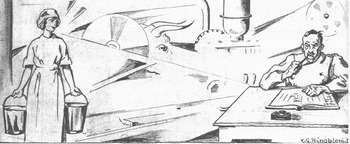
The spectacular marketing of dairy products, with propaganda for the consumption of milk, butter, cream and cheese, came to be a well known phenomenon in Sweden from the early 1920s. The marketing of basic foods like milk was far from uncontroversial, and farmers in particular were averse to advertising food, which was seen as god-given and amongst the necessities of life. The story of dairy marketing in Sweden during the 1920s and 1930s sheds light on producer-consumer relations during a relatively early phase of urbanisation. Moreover it exhibits attempts to handle farm products in a similar way to other products on urban markets, just before the regulation of the agricultural market that, as in many other countries, was launched in the early 1930s. The dairy marketing project was managed by an association, ‘The Milk Propaganda’, which marketed milk with modern arguments and managed to load their marketing with intertwined references to public health, the farmers’ economy and the survival of the countryside.Footnote 1 The term ‘propaganda’, which has an odd sound today, was well accepted in the 1920s and 30s and used as a synonym for ‘information’ or ‘enlightenment’. Figure 1 illustrates ideas about modern dairy production, published in the association's journal in 1935.
‘Milk and Modernity’. An illustration to an editorial that argued for rationalised production but increased office work at Swedish farms.

The association was initiated by a number of dairy producers, but it was given improved legitimacy through engagement with representatives of Swedish society, such as politicians and medical experts. In this way, the Milk Propaganda developed, in effect, into a minor popular movement. During the study period, 1923 to 1939, the Milk Propaganda was visible in urban and rural settings in the form of posters, school campaigns and ‘milk bars’. The project also had a presence in farmers’ households, where its journal was found on kitchen tables all around the country.
Projects of a similar character were found in a number of other countries. Sister associations in the United States, Canada and England seem to have been sources of inspiration for the founding and shaping of the Swedish association. It has not been possible to study every national association but, for example, the British National Milk Publicity Council, founded in 1920, appears to have had much in common with the Swedish organisation that was founded in 1923.Footnote 2 In 1925 readers of the Swedish association's journal could study some reproduced posters from the United States and England and could try to read accompanying texts in English like:
The Swedish initiative seems to have started relatively early and, together with the United States, Canada and England, worked as a model for milk marketing in other European countries. The Swedish association's journal frequently referred to sister organisations, and provides much evidence of similar ideas in other countries. In 1927, for example, the editor refers to a state owned German association for milk propaganda and to its journal Zeitungsdienst des Reichsausschusses zur Förderung Milchverbrauchs.Footnote 4 In the Scandinavian context, the journal reported that similar organisations had been set up in Finland and Norway in 1927 and 1928 respectively, while the establishment of a Danish Milk Promotion Association seems to have been put off until 1932.Footnote 5 Moreover, the Swedish association had been contacted by representatives of the Japanese milk sector in 1929, who wanted to learn about the Swedish Milk Propaganda in order to increase dairy consumption in Japan; in 1931 the editor stated that Japan now had an association for Milk Propaganda.Footnote 6 In the same year, the foundation of a Yugoslavian association was reported.Footnote 7 In 1935, French and Italian efforts for the improved quality and sale of dairy products were mentioned by the Swedish editor.Footnote 8 According to De la Bruhèze and van Otterloo, the Dutch Government supported the dairy industry's initiative to propagandise for increased milk consumption from the 1930s. Later, in 1950 ‘The Dutch Dairy Bureau’ (Nederlands Zuivelbureau) was established, while the Belgian, ‘National Dairy Service’ (Nationale Zuiveldienst) was founded in 1938, primarily working for the home market and emphasising hygiene and quality.Footnote 9 The widespread tendency to set up specific organisations to promote increased dairy consumption should primarily be seen against the background of limited export markets during the interwar period, but also as representative of an ambition to improve consumers’ confidence in dairy products, directed not least at domestic markets, which will be subsequently discussed in more detail.
The Swedish case points at early ambitions to improve all stages along the milk chain, from cowshed to table, in order to use high quality as a selling point. Moreover, the Milk Propaganda is one of many examples of cooperation between industry and politicians during the early stages of the building of the Swedish welfare state, which in this case saw support for the rural economy and public health as mutually beneficial. Yet, the milk marketing project included some ambiguities in relation to its combination of ‘objective information’ to consumers and pronounced ambitions to support the farming economy. Doubts can also be raised about the association's urgent requests for increased consumption of dairy products in order to reduce heavy surpluses of dairy products in the early 1930s, at the same time as it recommended farmers to increase their production even more. Before going more deeply into the Milk Propaganda, a brief overview of Swedish rural society in the 1920s and 30s will be given. As the milk marketing project included both producers and consumers, it is important to establish the demographic balance between urban and rural at this time. Likewise some idea of farm sizes, the scale of milk production, and the degree of market-orientation is useful to understand the context in which the Milk Propaganda was initiated and developed.
Rural and urban Sweden in the 1920s and 1930s
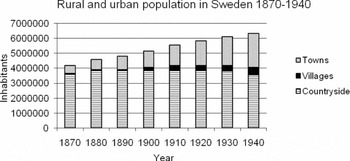
It is important to note that Sweden experienced a notably late process of urbanisation, beginning around 1870 and far from completed during in the 1920s and 1930s. A majority of all Swedes lived in the countryside during the study period, and by the end of the period about one third of the total working population was still engaged in farming. The changing ratio between rural and urban inhabitants is demonstrated in Figure 2. In 1870 only one tenth of the total population lived in towns. By the beginning of the 1920s the urban share had increased to thirty-four per cent, and by the end of the 1930s, forty-four per cent of the Swedish population was categorised as urban. Backyard farming was sometimes operated on the outskirts of towns and in the small settlements and villages that had recently emerged close to factories and railways.
Total population and proportions between the number of rural and urban inhabitants in Sweden between 1870 and 1940.

Three important observations can be made about Figure 2. First, it indicates that interwar Sweden saw a continued process of urbanisation and that this increased the number of urban food consumers to whom it was relevant to direct milk marketing activities. Second, both the rural and urban populations were large and neither of them was able to ignore the other. Third, the low share of urban dwellers in the late nineteenth century meant that the great majority of the total population in the 1920s and 1930s was born in the countryside and still may have had social and emotional ties to farming and rural life. This fact makes it likely that urban inhabitants felt some affinity to the rural population, and that references to the survival of the countryside were good sales arguments for dairy products. Most new urban inhabitants belonged to the working classes but a few had managed to reach high positions as experts or politicians. The rural background of many influential people gave excellent opportunities to develop networks between the Milk Propaganda and politicians and experts, who controlled access to schools, economic support and general acceptance of the milk marketing project.
Farming and milk production
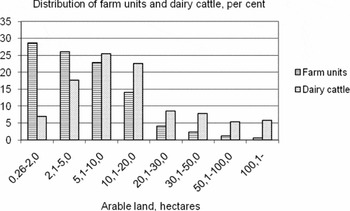
Another important point for understanding the milk marketing project is that rural Sweden was characterised by small-scale mixed farming all over the country, including the favourable south as well as more barren parts further north. When all kinds of farms, small-holdings and cottages are included, the total number of farming units numbered close to 430,000, which should be seen in the light of a total population of six million and a rural population of nearly four million. What is more, dairy cattle were found at almost all farms and holdings, even at more or less landless units. A peak in the number of dairy cattle was reached around 1930 when Sweden had a total of two million dairy cows.Footnote 10Figure 3 presents the distribution of farm sizes and dairy cows in 1944, which is the first year for which this kind of information is available. As farm sizes were relatively stable during the first half of the twentieth century, and as dairy cattle were considered almost obligatory well into the middle of the century, the proportions in Figure 3 are representative also for the 1920s and 1930s.
Distribution of farm sizes and dairy cattle in Sweden (1944).

The diagram in Figure 3 clearly demonstrates the small-scale character of Swedish farming during the studied time period. As much as seventy-seven per cent of all farm units had less than ten hectares of arable land while less than two per cent cultivated more than fifty hectares. A majority of the dairy cows, sixty-six per cent, were found at farm units with between two and twenty hectares of arable land. The relatively low share of cattle in the category with less than two hectares is explained by few heads per herd, usually one or two dairy cows. On the other hand, the relatively high share in the two categories with more than fifty hectares is explained by large herd sizes. Taken together, Figures 2 and 3 show that a clear majority of the rural Swedish population lived on small farms and holdings where milking was part of everyday life.
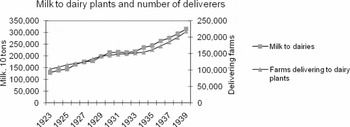
The widespread presence of dairy cattle, and the fact that the years around 1930 saw a peak in the number of animals, meant that enormous volumes of milk were produced. The total production was estimated at about 3.9 million tons in 1927, which had increased to about 4.6 million tons by 1933 (to be compared with the present European Union quota of three million tons).Footnote 11 The enormous increase in production was an effect of concurrent factors, including increased numbers of animals, better breeds, and improved feeding and skills, together with the encouragement for increased production that was provided by the Milk Propaganda, amongst others. Far from all milk was, however, supplied to dairies. By the middle of the study period, only about forty per cent of total milk production is thought to have reached dairy plants, while the remaining sixty per cent was consumed in farmers’ or neighbours’ households, fed to calves and pigs, used as payment in kind, or otherwise included in the local barter economy.Footnote 12 The low degree of market orientation in Swedish milk production was partly due to the fact that many holdings stood outside the commercial dairy sector. In 1923, only 103,000 farms, or less than one fourth of all Swedish milk producers, were dairy suppliers, but by 1939 the number had risen to 218,000.Footnote 13 Another reason for the low degree of commercialisation was that many dairy suppliers combined sales with extensive use in kind.Footnote 14 In spite of this, representatives for the Milk Propaganda argued that farmers’ total income from milk exceeded their total income from all other kinds of farm produce.Footnote 15Figure 4 demonstrates the increased number of dairy suppliers and shows that quantities supplied to dairy plants were doubled during the study period, highlighting the need for milk marketing. As the maximum number of dairy suppliers ever reached 271,000 (1946), the space above the lower graph in Figure 4 gives an approximate illustration of the successively decreasing number of non market-oriented milk producers.Footnote 16
Supplied quantities of milk to dairy plants and number of delivering farms, 1923-39.

As neither all milk nor all farmers were directly involved in the dairy market, the Milk Propaganda did not address all members of the rural society. But even though many holdings were not directly affected by circumstances in the commercial dairy sector, and even though many farmers were sceptical about the idea of food marketing, almost all people in rural areas were indirectly influenced by the dairy economy. Daily deliveries of milk had come to generate a regular and relatively safe influx of ready money to an increasing proportion of rural households. This altered patterns of consumption and methods of production, and made farmers increasingly dependent on purchased commodities and agricultural input resources. These changes certainly influenced almost all members of the rural community, who directly or indirectly got used a new kind of economy. The tendency was clearly evident during the 1920s and 30s, but had already begun during the second half of the nineteenth century when large-scale dairy production for export had been built up and successfully developed. Until the First World War, the sale of dairy products had primarily been a matter of relatively unproblematic export, and during the war dairy products had easily found their way to Swedish tables. But after notably good times before the war and prosperous years during the war, the good years were long in coming back after the war. Several big farms with market-oriented grain and milk production ran into trouble in the early 1920s when bread, grain and butter were not easy to sell on the international market. In this situation, some farmers and other people in the agricultural sector turned their attention to the home market and realised that the ongoing process of urbanisation ought to include an emerging domestic demand for fresh milk and other dairy products.Footnote 17 What is more, increased agricultural productivity pointed to substantially enlarged Swedish milk production. This is the background to the foundation of a relatively small but interesting association for milk marketing, the Milk Propaganda.
An association for milk marketing, ‘the Milk Propaganda’
The initiative for an association for milk marketing seems to have come from a number of dairy producing estate owners who were anxious to encourage domestic demand and saw a potential in modern marketing of milk, cream, butter and cheese. Details of the Milk Propaganda's foundation have not been discovered in the archive, but texts in the association's journal suggest that the initiative takers were inspired by marketing of industrial products and by associations for milk marketing in the United States and England, to which frequent references are made in the journal.Footnote 18 Even though it has not been possible to examine the international sister organisations, it is safe to say that they all had increased sales of milk as their top priority.Footnote 19 In the Swedish case, the first paragraph in the association's rules stated that the objective was to work for increased sales of milk and milk products in order to achieve the best possible economic outcome for dairy suppliers.Footnote 20 The formal goal was also expressed as a slogan: ‘Bättre mjölk-ökad konsumtion’ (Better milk – increased consumption), which was also used in Canada.Footnote 21
The association was equipped with a strategic mix of influential people who contributed to give an official image to the Milk Propaganda. Among the members of the national board were members of parliament, directors, and experts in medicine, nutrition, dairying and livestock farming.Footnote 22 The English sister organisation, the British National Milk Publicity Council, seems to have been of a similar construction, based on producer-distributor initiatives and, according to Peter Atkins, ‘with a small and somewhat cosmetic involvement by Medical Officers and Sanitary Inspectors’.Footnote 23 At the Swedish regional level, the boards likewise included leading members of society, such as county governors, estate owners and agricultural and veterinary experts. Notably, some regional boards also included female teachers in household economics. The formation of the national and regional boards reflects ambitions to create a strategic combination of prominent names and an image of reliable competence. This made it possible to build influential networks among political and agricultural leaders, and to gain the confidence of farmers and rural and urban consumers. Moreover the contacts with politicians and county governors resulted in some economic support to the Milk Propaganda.Footnote 24 It is important to note that in spite of the upper class character of the initiative takers and major parts of the boards, the milk marketing project was given a common touch that had previously hardly been seen in arrangements originating from the Swedish rural elite. As shown later, the association had an outgoing, populist approach that sought to highlight dairy products as modern commodities for contemporary people.
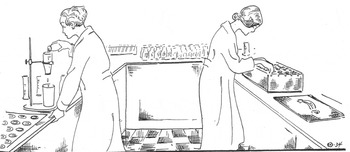
The campaign for better milk and increased consumption included two principal messages, one that urged farmers to work for improved milk quality, and another that tried to attract consumers by means of arguments referring to quality and hygienic standards, nutritional values, taste and merit. Quality and hygiene were used as sales arguments for dairy products in other countries as well. Canada has already been mentioned and as regards England, Peter Atkins points to the role that the dairy industry gave to laboratory analyses as ways to counteract consumers’ mistrust of milk as adulterated or otherwise contaminated.Footnote 25 Laboratory analysis was also cited by the Swedish Milk Propaganda as a means to guarantee quality and hygiene, for example in the drawing in Figure 5.
Women at a Swedish dairy laboratory, illustrating the maximum effort to safeguard the high quality and superior hygienic standards of dairy products.

In the Swedish case, marketing milk by emphasising cleanliness was a way to persuade customers in the emerging food market to trust milk in the new urban context.Footnote 26 The Milk Propaganda thus worked to change the idea of dairy products that many townspeople may have derived from their former rural experiences. This attempt was based on two strategies. First, dairy commodities were presented as more or less originating from the hygienic factory-like dairy plants that were built during the 1920s and 1930s.Footnote 27 In the words of Atkins, this strategy ‘concerns the imposition of standards upon nature, forming a hybrid that can be controlled’.Footnote 28 Second, milk, cream, butter and cheese were given different identities and, in the terms used by Callon et al., expected to make careers as different kinds of commodities.Footnote 29 Swedish milk was portrayed as white and clean and a beverage for modern people. Cream maintained its former role as ‘gilt edge’ in cooking. Butter was presented as a product of nature in contrast to margarine, which until the Second World War was produced from imported oils and at margarine factories that were accused of being in the hands of the international ‘margarine trust’.Footnote 30 Finally, cheese was rebranded as a good value, nutrient rich ‘food’, instead of in its former character as a delicacy for special occasions. Within these four categories, milk, cream, butter and cheese were marketed as standardised and uniform products, distanced from homemade butter and cheese and rather reflecting national eating habits in the emerging welfare state than regional traditions.
The goals of the Swedish association for milk propaganda were to be reached through ‘objective information’ to all actors along the milk chain, from cowshed to table. The messages did however differ, depending on to whom they were directed:
• Dairy suppliers were urged to encourage the best possible hygiene and good handling of milk at farm level.
• Deliverers of milk from farms to dairies, and from dairies to traders and milk-shops, were reminded of the importance of maintaining the milk quality on the way from producers to dairy plants and from there to consumers.
• Dairymen and dairymaids were reminded to work for improved butter and cheese qualities.
• Consumers were informed about the many values in dairy products such as quality and hygienic standards, nutritional values, taste and general praiseworthiness.
• Consumers were also taught about the best possible ways to handle milk and dairy products in consumer households.
Members of the first category, dairy suppliers, were frequently reminded about the importance of good hygiene at the farm, including clean animals and cowsheds, special clothes for milking, rapid cooling of the fresh milk, and careful cleaning of all utensils. The fact that perishable milk for commercial purposes was produced in more than a hundred thousand cowsheds of varying standards contributed to make hygiene at farm level an urgent message from the Milk Propaganda to the producers. Moreover deliverers from farms to dairies, and from dairies further on along the milk chain, were urged to be aware of the perishable nature of the goods they dealt in. Similar messages were directed to dairy plants to encourage improved standards for Swedish butter and cheese. Milk shops were also addressed in order to safeguard the entire milk chain all the way to the consumers who were reminded about the many advantages of dairy products, being nourishing, cheap, tasty, and vitamin rich. Vitamins were relatively recently discovered elements in food, and were thus interesting and fashionable, which spoke for good prospects for vitamins as an argument for dairy consumption. In addition, consumers were told about the optimal means of storing dairy products.
At first sight, the idea of teaching Swedish consumers how to use and store dairy products appears redundant. Did people who were raised in rural areas, surrounded by dairy cattle, milk buckets and farm house butter production, really need this kind of information from the Milk Propaganda? There is no obvious answer but it may be suggested that migration to towns and cities, with overcrowded living conditions and poor storing facilities, brought about the loss of former practices and knowledge about the handling of perishable foods like dairy products. Obviously, the milk marketing project included the whole chain from cowshed to table and argued for the importance of caring for the perishable dairy products all along the milk chain. This understanding was far from new. On the contrary, good hygiene in byres and dairies had been promoted since the mid nineteenth century. County agricultural societies, literature, agricultural schools and institutes, and schools for dairy maids and dairymen had promoted careful handling of milk and dairy products. The new features were the addressing of the entire chain of the commodity, and the highlighting of good handling of milk in the form of a large-scale marketing project. The concept of marketing food was however criticised both by producers and consumers. On the one hand, many farmers argued that the demand for food was given by nature; food was required in fixed quantities, and consequently there was nothing to market. On the other hand, consumers doubted the honesty of the association's mission to promote public health, saw the economic motives behind it, and worried about a rise in prices due to the costs of marketing. Representatives for the Milk Propaganda were well aware of the critics and of the fact that the marketing of basic foods was a new element in society. Already, in the first number of the association's journal, the editor justified the idea of the new association and its purposes by asking ‘Why should we promote milk?’, and answered with references to modern thinking and frequent advertisements for industrial products.Footnote 31 According to the editor, urban consumers were in great need of information. In this context, it is interesting to learn that the editor, on the one hand, wrote disparagingly about urban consumers as distanced from farming and unaware of the many advantages of dairy products. On the other hand, he urged milk producers to do their very best to fulfil consumers’ requirements for high quality, otherwise Swedish farming and the rural community would be threatened.
As will be shown later, the marketing activities made the Milk Propaganda clearly visible for most Swedes. Yet the association itself was small and had little influence in agricultural politics, which was dominated by the SAL (Sveriges Allmänna Lantbrukssällskap), founded in 1917, and the RLF (Riksförbundet Landsbygdens Folk), founded in 1929. The study period chiefly covers a time when the Milk Propaganda was a small more or less freestanding association founded on private initiatives. From the early 1930s the milk marketing project was incorporated into the new umbrella organisation for Swedish dairy production, SMR (Svenska Mejeriernas Riksförening), established in 1932, which was commissioned to organise the milk regulation apparatus. After a brief period of frustration about the new order, the association settled down in the new context, pleased about the financial security that came from belonging to this big organisation. It is worth mentioning that the question of objectivity came up during the process of incorporation and that representatives for the Milk Propaganda explicitly pointed out the necessity of maintaining a neutral character in its work.Footnote 32 The fact that this discussion came up behind closed doors may indicate that the idea of combining producers’ and consumers’ best interests included elements of genuine, even naive, belief. Fragments of the Milk Propaganda still remain today, partly in the form of promotional messages on milk cartons, and partly in the form of milk diplomas and medals for excellent hygienic handling of milk at farm level, discussed below.
The journal Mjölkpropagandan
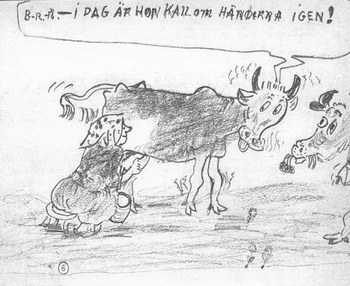
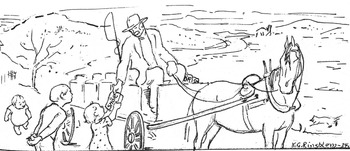
The association's journal Mjölkpropagandan (Milk Propaganda) came to be one of the most important channels for the milk marketing project, especially to the many dairy suppliers. The journal is also the main source for this article. As the name of the journal is similar to the common name of the association, the English term, ‘the Milk Propaganda’, is used for the association and the Swedish term Mjölkpropagandan for the journal in order to avoid confusion. The journal had a modest start in 1924, but from 1925 onwards it was published monthly and subsequently came to enjoy the largest circulation of any journal among Swedish farm households.Footnote 33 Apart from being distributed to the collectively associated dairy suppliers, the journal was delivered to dairies, milk-shops, individual consumers, and prominent members of the board. Occasionally the number of copies was doubled and it was distributed at various ‘milk-events’. Mjölkpropagandan frequently reported milk marketing activities, most often as total successes. Readers could also follow the dairy sector, agriculture and rural life, mirrored in editorials that shifted from encouraging or contemplative themes to pessimistic texts about farmers’ struggles and the dark future prospects for the countryside. Except for this explicit propaganda in support of the milk marketing project, the journal had a rather varied content and was designed like contemporary weekly magazines in terms of lay-out and with many of the same advertisements. The journal focused on contemporary issues except for a few retrospective articles about traditional dairying, which served as a way to dissociate the Milk Propaganda from the old days. Among the subjects covered were the international dairy trade and dairy production, the need to improve milking hygiene, advice on better animal feeding, pictorial pages with photos from abroad, readers’ competitions, butter-rich cookery recipes and children's pages. The children's drawings are an interesting feature as they reflect farm life from the children's perspective, exemplified in Figure 6.
A drawing sent to the children's page. The cow that is being milked says: ‘Brr, she's got cold hands today too’.

Moreover the journal included an interesting mixture of producer- and consumer-directed advertisements. Among the many products marketed were, for example: feed concentrates and fertilisers, insecticides against flies in the cowshed, washing powder, fire wood stoves in the modern style, correspondence courses, novels, bananas and cocoa, the two latter served with milk. It is probable that a journal with such varied content and popular design could have been found at many kitchen tables in the countryside, and that family members and employees at least skimmed the pages as a window on the outside world, and learnt about the perishable milk chain, consumer activities in towns, and a little about life abroad, but also were influenced by the editorials and their rhetoric.
Other channels for marketing dairy products
Farmers were also reached through films that demonstrated cowsheds with limewashed walls and milkmaids in white milking dresses who milked well-groomed cattle without any irritating flies. Among the films was, for example, Från hemarbete till stordrift (From housework to large-scale production), produced in 1932.Footnote 34 Another way to encourage producers, and to draw attention to the milk marketing project, was introduced in 1928 when diplomas began to be awarded to suppliers of high quality milk, emphasising the important mission of dairy production.Footnote 35 As the years went by, higher grades and medals were added to the system. Farmers and their wives who achieved twenty-three years of superior-grade milk production were invited to Stockholm to receive a golden medal from the Swedish king. The system was introduced in order to stimulate milk hygiene at farm level in a cheap way compared with the alternative suggestion, quality-based payment. It is intriguing to consider the combination of rurality, modernity and national identity that was, and still is, included in diplomas and medals. Rurality is represented by worn-out dutiful farmers who, according to the myth, leave the farm once in their lifetime and travel to Stockholm where they are confronted with the modern city. The meeting with the king confirms the importance of all the years of struggle and shows that ambitions for excellent milk hygiene are something of a duty to King and Country.Footnote 36
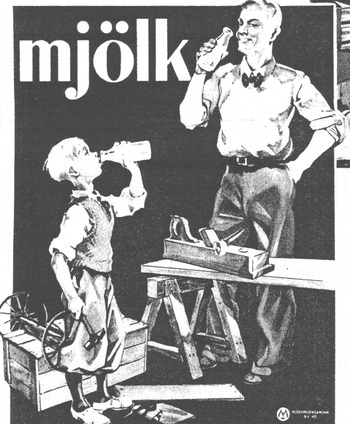
The many thousands of posters from the Milk Propaganda were probably the most conspicuous element in the milk marketing project.Footnote 37 Posters for increased consumption of milk, cream, butter and cheese were distributed all over the country to be put up in milk shops, schools, places of work, fences and other places in the street. In that way the milk marketing project came to be clearly visible and its slogans well remembered. Similar publicity campaigns were found in other countries, for example in England.Footnote 38Figure 7 exemplifies one of the many Swedish posters.
‘Milk (‘Mjölk’) makes strong and healthy men’.

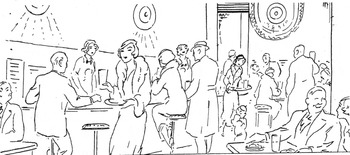
Other long remembered elements in the milk marketing project were the so-called Milk Bars where milk and food were served at affordable prices. The first Milk Bars were mobile constructions at fairs or sports events, but later fixed Milk Bars were established in a number of towns. A spectacular restaurant was built up at the Stockholm exhibition in 1930, known for introducing the functional style in Sweden, at which the Milk Propaganda served milk in an ultramodern building. What is more, a temporarily built cowshed with modern milking equipment and a separate milk room for hygienic handling of milk was also demonstrated at the exhibition.Footnote 39 Hence, modern consumption and rational producer perspectives were shown almost in parallel at this famous event that not only symbolised functional architecture but also modernity as a part of a new national identity. As the restaurant at the Stockholm exhibition was a success, a permanent Milk Bar was soon established at Hamngatan in the very heart of Stockholm (Figure 8). The Milk Bar in Stockholm city was inaugurated in the presence of the Minister of Agriculture, representatives of the capital and of retailers, but also of a number of housewives.Footnote 40 The arrangement is one of many examples of the strategy of giving the association the imprimatur of official approval and wide social acceptance. Moreover the establishment of similar restaurants abroad was now and then reported in the association's journal, among them a Milk Bar at Fleet Street in London in 1935.Footnote 41
Interior from a stylish Swedish Milk Bar.

Already in 1925, one of Stockholm's most famous art galleries, ‘Liljevalchs’, had been put at the Milk Propaganda's disposal for an ‘experiment’ in which three thousand children were served free milk. The upshot was that the healthy ‘milk boy’ easily conquered the weak ‘coffee boy’ in a bicycle competition.Footnote 42 Such a competition may appear ridiculous but there was some relevance in the comparison between milk and coffee. According to a state commission in 1938 heavy overconsumption of (‘addiction to’) coffee was a serious national problem that, district medical officers claimed, threatened public health and caused severe undernourishment among children. For example, the medical officer on the island of Gotland in the Baltic Sea reported that as much as forty per cent of all children below school age had coffee and a piece of bread for breakfast.Footnote 43 The report praised dairy products and clearly stated that milk was the optimal alternative, compared not only with coffee but also with other kinds of food.Footnote 44
As milk was much favoured by public health officials in general and as some of the medical experts were members of the board of the Milk Propaganda, it does not seem to have been too difficult for the association to gain access to schools for ‘Milk Days’ that were arranged at least from the late 1920s onwards. During these occasions, school children were served free milk and other dairy products, usually paid for by the Milk Propaganda member dairies, most of which were farmer-owned cooperatives.Footnote 45 Moreover the children were taught about food nutrients and healthy living, made drawings and wrote essays on milk themes, and engaged in various competitions. These activities certainly made a deep impression on many children, who enjoyed free lunches or easy schooldays during the Milk Days that are still remembered by some elderly people.Footnote 46 In the mid 1930s about 50 000 school children were reached by the Milk Propaganda in schools each year.Footnote 47 Milk Days were, however, single days and not regular school milk programmes.
The Swedish Milk Propaganda certainly agreed with the British sister organisation, the British National Milk Publicity Council, which ‘saw school milk as a double opportunity, first to boost immediate sales and, second, to capture and mould a generation of future consumers’.Footnote 48 The Swedish association was, however, not involved in paid-for milk as was the British association.Footnote 49 Moreover the journal Mjölkpropagandan reported on British school activities and highlighted the milk-feeding experiments that were accomplished in Britain with the support of the authorities and dairy organisations.Footnote 50 Like Peter Atkins in his article ‘Fattening children or fattening farmers’, we need to be critical of this indoctrination of school children, and question how a producer-based association could be allowed to arrange Milk Days in schools. In the Swedish case, the answer most probably lies in the almost official status that the association managed to obtain through the strategic composition of the national and regional boards. At least three arguments could be raised against the Milk Days. The first is scepticism among some consumers, including a number of annoyed parents.Footnote 51 The second is that Sweden, like England, did not yet have complete pasteurisation of milk, which raises the question of the spread of tuberculosis and other serious illnesses through the milk.Footnote 52 It has not been possible to learn whether the milk served through the Milk Propaganda was pasteurised or not, but the mere possibility that it might not have been, and the fact that the association argued that compulsory pasteurisation would reduce farmers’ ambitions for good hygiene, is serious cause for concern.Footnote 53 A third reason to be critical is that the marketing of butter was part of a bitter antagonism between butter and margarine. This is another story, but it should be mentioned that the consumption of butter came to represent sympathy with farmers, and many worker families put margarine on their tables, partly because margarine was cheaper but also, especially in the 1930s, in order to demonstrate their dissociation from the state intervention in the dairy sector, that will be described later.
How dairy production and consumption became a Swedish duty
The original aim, to work for ‘Better milk – increased consumption’, would remain throughout the interwar years, although some modifications were made. Likewise the established marketing methods were maintained, including the journal, poster campaigns, milk diplomas, Milk Days and Milk Bars. Yet three periods of varying character can be distinguished. The first period covered the years 1923 to 1929 and represents a time when the dairy sector aimed at reviving butter exports after a decline during the First World War. This period was comparatively unproblematic and witnessed an expansion in the number of market-oriented milk producers by thirty-eight per cent and an increase in milk volumes supplied to dairy plants of as much as fifty-three per cent from 1923 to 1929.Footnote 54 The dairy sector therefore prospered during the first years of the existence of the Milk Propaganda, when achieving the goals of better milk and increased consumption was chiefly a matter of making use of unutilised potential.
In contrast, the second period was a more turbulent phase, beginning in 1929 and fading out 1933–4. Worries about emerging problems on the international butter market were expressed by the editor of Mjölkpropagandan in the summer of 1929, when the journal and its editorials express disappointment and sometimes desperation.Footnote 55 By this time, the prices paid to farmers were directly linked to the world market which until then had benefited Swedish farmers but now hit dairy producers who, like the association, were taken aback by the new situation. Under these circumstances, the Milk Propaganda recommended that farmers counteract the difficulties through continued efforts to expand production, even though at least one critical voice was published in Mjölkpropagandan.Footnote 56 Conversely, there was a slight decrease in the proportion of milk supplied to dairies between 1931 and 1934, which means that a slight increase in use in kind or direct sales must have taken place during the crucial early years of the 1930s.Footnote 57 At the same time, consumers were urgently requested to buy as much dairy produce as possible. During this middle period marketing became more aggressive and consumers were more or less ordered to buy dairy products to save the farmers, the countryside and the nation. Dairy produce had become more than nourishing, cheap, tasty and vitamin rich; consumption had become a national duty. It is interesting to note that the responsibility to purchase dairy products also was directed explicitly to the many producer-consumer households, for whom it was said to be ‘a duty to have butter on the table’.Footnote 58 Producers, the editor of Mjölkpropagandan wrote, ought to act as good examples and double their consumption of dairy-made butter and cheese through the purchase of dairy products back from the dairy. In addition dairy suppliers were urged to mediate dairy products to other rural households through a system of repurchase (Figure 9).Footnote 59
Dairy products repurchased from the dairy to producer households.

The Milk Propaganda's idea was that farmers’ buying back milk, cream, butter and cheese would reduce the problematic surpluses substantially. This was of course a treadmill but according to the Milk Propaganda it was a win-win concept, with farmers eating part of their surplus production and serving as a good example for other consumers. Another change during the years of crisis, in addition to recommending increased production, aggressive marketing and the repurchase of the farmers’ own products, was that the association altered its ambitions for the agricultural economy from improving to maintaining profitability in dairy production. Furthermore the previous stress on dairy production as the cornerstone of the farming economy was widened to emphasise milk as the backbone for the entire Swedish countryside, in other words for a majority of the Swedish population. The use of backbone as metaphor may have been inspired by a British poster with the message ‘Milk, The Backbone of Britain’. This featured a map and a woman pouring milk from the north to the south, so that the stream of milk was in the shape of a backbone.Footnote 60
The second time period includes the introduction of food regulation, which, as in many other European countries, began in the early 1930s. Sweden experienced the introduction of successive state intervention, beginning with grain and sugar in 1930, followed by milk in 1932.Footnote 61 As mentioned, the Milk Propaganda was a small organisation and it was not involved in the regulation of the dairy sector but, on the contrary, was excluded from the discussions. The opposite would have been inappropriate but it is interesting to note that the Milk Propaganda had a different point of view from the highly influential farmers’ organisations, the SAL and RLF, at the negotiating table. While the two big farmers’ organisations urgently claimed the necessity for state intervention, the Milk Propaganda saw this as a new, dangerous road. According to an editorial leader in Mjölkpropagandan, the political debate and resistance to subsidies would harm the ‘good will’ towards dairy products and thus lead to reduced consumption, especially of butter.Footnote 62 In order to counteract reactions like that, the Milk Propaganda saw an increased need for marketing. Margarine was now highlighted as the main problem, but also as the solution to the crucial situation for the dairy sector. If the sale of margarine could be reduced or forbidden, the association argued, then all Swedish butter could be sold within the country and the dairy sector would thus be relieved from the downward pressure on prices driven by an unregulated international market.Footnote 63
A third period in the history of the Milk Propaganda began around 1933 to 1934 when milk regulation was set in train and when the umbrella organisation, the SMR was founded. As previously mentioned, the Milk Propaganda first experienced the SMR as a competitor but as government financial support to the Milk Propaganda came to be directed through the SMR, the two organisations had to collaborate. After a short period of frustration, the Milk Propaganda found advantages in a large organisation that offered secure financing of marketing activities and the journal.Footnote 64 The combination of this reorganisation, a rapid recovery in the agricultural sector, and state support for surplus production, resulted in less aggressive milk marketing. The urgent requests to consumers to buy and eat as much dairy produce as possible were successively toned down and replaced by an increased focus on matters of production.
From an historical perspective, the history of the Swedish Milk Propaganda provides a fascinating story about the encounter between rurality and urbanity, materialised by the dairy sector. The association's arguments and activities during the 1920s and 1930s reflect hopes to refashion the Swedish dairy sector to take advantage of the rise of urban society and to encourage modern thinking at farm level. The modern approach included the entire milk chain, from farmers to consumers. Hence, references to modern urban life were not contrasted to backward rurality, but were rather accompanied by support for modern methods of production.
During the decade from the founding of the Milk Propaganda in 1923 to the establishment of the milk regulation system in 1932–33, the association made an attempt to market farm produce as if it were an industrial product, through marketing food as a commodity endowed with ‘modern’ virtues such as cleanliness, vitamins, and homogeneity. At the same time, inconsistently, the Milk Propaganda drew attention to dairy production and consumption of milk, cream, butter and cheese as a national project to support farmer incomes and the countryside, as well as for national public health. Almost everybody, rural as well as urban dwellers, was expected to do their duty in this national project, the duty to produce and consume as much dairy produce as possible. As clean and homogenous dairy products were presented to the consumer, the dairy cow was given a relatively anonymous role in the marketing strategy. Likewise there were few signs of folklore, an explicit dissociation from the past, and no references to local specialities or to regional animal breeds. The stress on rural and urban modernity may at least partly be explained by the fact that an absolute majority of all Swedes had immediate rural roots and personal experience of practical farming. In this context, the Milk Propaganda preferred to repackage dairy produce for the new urban context, rather than to romanticise its rural origin.
Even though the milk marketing project was initiated by representatives of the rural elite, the longer-term consequences were just as important for the Swedish rural community (about half the population). The marketing campaigns most probably contributed to increased sales and thus helped to counteract the relative backwardness that was a threat to rural areas during the ongoing urbanisation. Yet the milk marketing project with the nowadays odd-sounding name, ‘the Milk Propaganda’, had an unusual remit that included a number of doubtful elements. The idea of benefiting both producers and consumers and regarding dairy consumption as a Swedish national ‘win-win’ project was a doubtful twofold message. Moreover requests to farmers to increase production, but also to repurchase the products, created a potentially problematic treadmill. There are also strong grounds for criticising the association's negative attitude to pasteurisation and its denial of the evident link between pasteurisation and its many arguments for hygiene and public health. In many ways, the milk marketing project was a sidetrack. Marketing of dairy products as a way to develop and strengthen rural society was interrupted by the introduction of state intervention in the sector. The marketing of dairy products continued, but as the agricultural economy was regulated and the big organization, the SMR, took over the Milk Propaganda, there was a toning down of its ideas about dairy consumption as a way to save the countryside.