INTRODUCTION
In Hong Kong, over 90% of deaf/hard-of-hearing children (hereafter d/hh children) with varying degrees of hearing loss study in mainstream schools with spoken Cantonese, a language variety of Chinese, as the major means of communication. There have been some studies on the development of Cantonese sound systems of these children (e.g. Barry, Blamey, Lee & Cheung, Reference Barry, Blamey, Lee and Cheung2000; Lee, van Hasselt, Chiu & Cheung, Reference Lee, van Hasselt, Chiu and Cheung2002), yet very little has been done on how they acquire the grammar of Cantonese (e.g. Yiu, Reference Yiu2012). Not much is known about the characteristics of such an acquisition process, how far d/hh children lag behind typically developing hearing children, and whether their development deviates from the norm. This paper attempts to fill this gap of knowledge by probing into the development of discourse referencing in spoken Cantonese by fifteen d/hh children (aged from 5;5 to 9;11) studying in a sign bilingual (Hong Kong Sign Language plus spoken languages) and co-enrolment (hearing and d/hh children studying together team-taught by deaf and hearing teachers) education programme in a mainstream setting. Overall, the d/hh children in our study produced fewer existential constructions, pronouns, demonstratives, and expressions involving nominal classifiers, but more bare nouns across all discourse contexts. However, the appropriate use of functional elements in marking (in)definiteness in nominal expressions gradually increased as the spoken language proficiency of the d/hh children improved, albeit with a rate much slower than their hearing peers. Such findings corroborate the previous literature that found that functional elements in spoken languages are difficult for d/hh learners to acquire (de Villiers, de Villiers & Hoban, Reference de Villiers, de Villiers, Hoban and Tager-Flusberg1994). The predominance of bare nouns in the d/hh children's narratives can also be partly attributed to their exposure to written Mandarin as well as Hong Kong Sign Language (hereafter HKSL) in classroom settings, as a natural consequence of the three developing grammars interacting with each other. Despite this, the d/hh children in our study demonstrated pragmatic sensitivity towards the use of existential constructions, null forms, and pronouns in appropriate discourse contexts. Note further that their choice of nominal expressions and the errors concomitantly made, be they morphosyntactic or semantic/pragmatic, bore a striking resemblance to those of the younger hearing children in our study. Taken together, our observations suggest that the d/hh children are likely to be having delayed rather than deviant development in their acquisition of discourse-referencing skills in Cantonese.
This paper is organized as follows. We will first present a literature review that covers the notion of discourse referencing and nominal expressions in Cantonese, as well as previous relevant acquisition studies. Then we will present the methodology, followed by a detailed comparison of the d/hh children's discourse referencing strategies with those of the hearing children and hearing adults in narrative productions. In the discussion part, we will look at several possible factors that may contribute to the predominance of bare nouns in the d/hh children's Cantonese narratives. The final part is the conclusion.
What is discourse referencing?
Discourse referencing refers to the knowledge of using appropriate linguistic means to refer to entities in a discourse. According to Levelt's discourse model (Reference Levelt1989), when adult speakers communicate with each other, they set up a mental model of the shared discourse, maintaining and updating it accordingly as the discourse develops. In this shared discourse, interlocutors introduce or reintroduce referents (persons, things, events, etc.) and make predications about them. Each of these entities can be conceptualized as having an address in the discourse model. When something is said about a referent, the predication is added to its address. The choice of a linguistic expression to refer to an entity is largely determined by the speaker's presupposition about the listener's knowledge of the entity as it is represented in this mental model and whether or not the listener is attending to it at the moment of the utterance. In English, when a speaker wants to introduce a new entity into the discourse, an indefinite expression is used as a signal to invite the listener to jointly set up a new address in the model and add the predication to it (e.g. There was a cat on the table.). If the speaker continues to make another predication about the same referent (i.e. maintenance), the referent is a piece of given information as it is an existing address in the model. In this case, a definite expression is used (e.g. It was sleeping.). If the discourse continues but the same referent is not mentioned further, it remains backgrounded (i.e. known information in the discourse), and is no longer the focus of attention of the interlocutors. This referent can be foregrounded again if it is brought back to discourse at a later time (e.g. … The cat jumped down from the table.), and this is done with a definite expression with sufficient lexical content to signal a switch of reference. Seen in this light, referent introduction in English is generally associated with indefinite expressions, whereas maintenance and reintroduction are coupled with definite expressions. Every utterance by any of the interlocutors participating in the shared discourse can constitute a change to the representation of the referents in this mental model. A successful communicator keeps track of all the changes in the status of the referents in this model, and is able to select the appropriate linguistic means that reflect the information status of the entities referred to.
Development of discourse referencing in hearing and d/hh children
Previous developmental studies across languages demonstrate that discourse referencing is far from easy, even for typically developing children – a complete mastery is usually not attained until age ten (see for English: Brown, Reference Brown1973; Emslie & Stevenson, Reference Emslie and Stevenson1981; Kail & Hickmann, Reference Kail and Hickmann1992; Warden, Reference Warden1976; Wigglesworth, Reference Wigglesworth1990; for Japanese: Clancy, Reference Clancy1992; for Mandarin: Hickmann & Liang, Reference Hickmann and Liang1990; for German: Bamberg, Reference Bamburg1987; for a comparative study involving English, French, German, and Chinese: Hickmann, Reference Hickmann2003; for Cantonese: To, Reference To2006; Wong, Reference Wong2001; Wong & Johnston, Reference Wong and Johnston2004; for Turkish: Küntay, Reference Küntay2002). What makes discourse referencing difficult to acquire is that, on top of the syntactic and semantic properties of all types of nominal expression available in the target language, children also need to learn to create and maintain a mental model of the shared discourse, which necessarily hinges upon their ability to see things from other interlocutors’ perspectives and to make the right presuppositions about the latter's state of knowledge of the referents. This pragmatic knowledge of using appropriate means to package a linguistic message to meet the constantly changing communication needs of the listener is initially lacking in young children. Despite some differences in the exact age at which children are reported to show competence in discourse referencing across studies, the general observation in the literature is that, for children under age six, new referents are very often introduced with definite expressions, including pronouns or even null forms, as if the referents were already known to the listener. More consistent use of indefinite expressions for referent introduction emerges at around age seven, but it is not until age ten or even later that children's performance becomes comparable to adults (e.g. Hickmann & Liang, Reference Hickmann and Liang1990; Warden, Reference Warden1976; Wigglesworth, Reference Wigglesworth1990). In contrast, children perform better in referent maintenance and reintroduction, with some studies suggesting that children from age three onwards begin to use definite expressions such as pronouns and demonstratives for known referents (e.g. Emslie & Stevenson, Reference Emslie and Stevenson1981; Wong, Reference Wong1998; Wong, Reference Wong2001). Initially, young children may use definite referring expressions in a deictic manner: these forms are used to relate with the immediate discourse situation, e.g. the pictures of the characters in the story book (To, Reference To2006). In addition, the ability to use the definite expressions adequately for the listener to identify known referents (i.e. referential adequacy) differs in the maintenance and reintroduction contexts. For example, Wong and Johnston (Reference Wong and Johnston2004) reported that children at age five are better at maintaining than reintroducing a referent, and that only the seven-year-olds can perform adequate referential acts for both functions.
In brief, children of a younger age use definite expressions for known referents more often than they use indefinite expressions for new referents. Such cross-linguistic findings suggest that it is easier for children to presuppose that the listener possesses the knowledge of a known referent than it is for them to presuppose that the listener does not have the knowledge of a newly introduced referent (Wong, Reference Wong2001). This developmental pattern reflects that cognitive maturity (i.e. the ability to see things from others’ perspectives) is likely to play some role in the acquisition of discourse referencing in children.
For d/hh children, acquiring discourse referencing is even more daunting. It is well documented that prelingually d/hh children show significant delays in the development of spoken language relative to hearing age-mates. Research in the past two decades shows that a lot of d/hh children have at least a year of language delay by the time they enter elementary schools, and around 50% of them have a severe language delay as reflected by spoken language assessment tools (Blamey, Paatsch, Bow, Sarant & Wales, Reference Blamey, Paatsch, Bow, Sarant and Wales2001; Cole & Paterson, Reference Cole, Paterson and Castello1984; Davis & Hind, Reference Davis and Hind1999; Geers, Reference Geers2002, Reference Geers, Spencer and Marschark2006; Lam, Lau, Lam, Lee, Tang & Yiu, Reference Lam, Lau, Lam, Lee, Tang and Yiu2012; Ramkalawan & Davis, Reference Ramkalawan and Davis1992; Sarant, Holt, Dowell, Rickards & Blamey, Reference Sarant, Holt, Dowell, Rickards and Blamey2009; Wake, Hughes, Poulakis, Collins & Rickards, Reference Wake, Hughes, Poulakis, Collins and Rickards2004; to name just a few). The extent of delay varies from individual to individual, with a wide range of factors such as degree of hearing loss, cognitive abilities, age at entry to early intervention, family involvement, maternal education, etc. coming into play (Sarant et al., Reference Sarant, Holt, Dowell, Rickards and Blamey2009). With respect to the acquisition of syntactic knowledge, functional elements (e.g. Determiners, Complementizers, and Infinitivals) are found to be more difficult than lexical elements (e.g. nouns and verbs) for d/hh learners to acquire (Berent, Reference Berent, Bhatia and Ritchie1996; de Villiers et al., Reference de Villiers, de Villiers, Hoban and Tager-Flusberg1994). There are at least two reasons why functional elements in English are difficult for d/hh learners. First, despite their high frequency, they are usually unstressed and contracted in natural speech so most d/hh learners do not hear them well. Secondly, many of them are homonyms (e.g. to as an infinitive marker and to as a preposition) or polysemous with subtly related meanings (Trezek, Wang & Paul, Reference Trezek, Wang and Paul2010; Channon & Sayers, Reference Channon and Sayers2007). To capture the late acquisition of functional elements by adult deaf learners of English, Berent (Reference Berent, Bhatia and Ritchie1996) hypothesized that they only possess the lexical category Nouns but not the functional category Determiners in their initial state of English syntax of nominal expressions, resulting in a lack of articles and pronouns in their spoken and written English. He further commented that when they begin to use articles and pronouns, they commit lots of errors, indicating that they merely possess metalinguistic awareness of the existence of these functional elements in the English grammar due to explicit learning at school (e.g. through grammar drills) rather than having acquired them naturalistically. Berent's data came from adult deaf learners with heterogeneous linguistic and education backgrounds; hence it is not yet known to what extent d/hh children educated in a sign-bilingual mainstream setting would also experience the same level of difficulty in acquiring functional elements of a spoken language. If functional elements are developmental hurdles for d/hh children as Berent suggested for deaf adult learners, then such difficulty in the morphosyntax of the spoken language would unavoidably affect the d/hh children's mastery of discourse-referencing skills, as many languages make use of functional elements such as determiners, classifiers, pronouns, numbers, etc. to mark (in)definiteness of noun phrases (Givón, Reference Givón, Greenberg, Ferguson and Moravcsik1978).
Acquiring nominal expressions and discourse referencing in Cantonese
The foregoing discussion has laid out a background on what acquiring discourse referencing means to hearing and d/hh children in general. In this section we would like to focus on the acquisition of nominal expressions and discourse referencing in Cantonese in the Hong Kong context.
Nominal expressions and referential properties in Cantonese
Nouns in Cantonese are not inflectionally marked for gender, number, and case. Nouns (N) can appear on their own (syu1 ‘book’ in example (1)) or can be modified by a combination of functional elements such as demonstratives (DEM), numerals (NUM), and classifiers (CL) (examples (2) to (4)):
(1) Ngo5 soeng2 maai5 [ syu1 ]
I want buy book
N
‘I want to buy a book/some books.’
(2) Ngo5 soeng2 maai5 [ bun2 syu1 ]
I want buy CL book
CL N
‘I want to buy a book/the book.’
(3) Ngo5 soeng2 maai5 [ saam1 bun2 syu1]
I want buy three CL book
NUM CL N
‘I want to buy three books.’
(4) Ngo5 soeng2 maai5 [ go2 saam1 bun2 syu1]
I want buy those three CL book
DEM NUM CL N
‘I want to buy those three books.’
The surface word order of [DEM – NUM – CL – N] is fairly rigid in Cantonese. When a demonstrative and/or a numeral appears in a nominal expression, the presence of a classifier becomes obligatory. Adjectives, relative clauses, and quantifiers (e.g. cyun4bou6 ‘all’, hou2do1 ‘many’) can appear in nominal expressions in Cantonese, but they are not discussed further here as they are not the targeted structures in the story-telling task of this study.
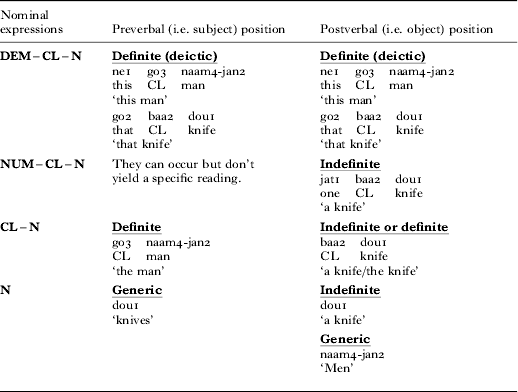
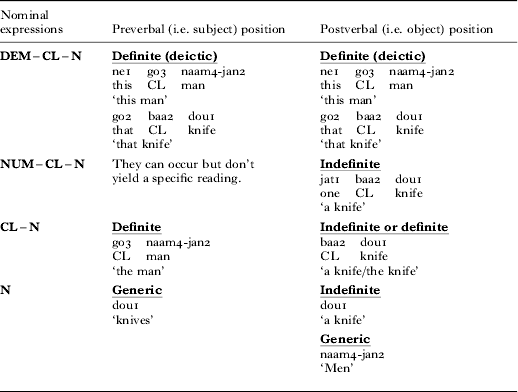
The referential property of a nominal expression in Cantonese is determined by both its internal syntactic composition and position within a clause (Au-Yeung, Reference Au-Yeung1997, Reference Au-Yeung2005; Cheng & Sybesma, Reference Cheng and Sybesma1999; Matthews & Pacioni, Reference Matthews, Pacioni and Xu1997; Matthews & Yip, Reference Matthews and Yip1994; among many others). Referential properties relevant to this study include the notions of specificity, definiteness, and indefiniteness. A nominal expression in Cantonese is said to be specific if the speaker has in mind a particular referent to refer to (cf. Matthews & Pacioni, Reference Matthews, Pacioni and Xu1997). If the speaker assumes that the referent is not identifiable to the addressee, an indefinite expression is used. If the speaker assumes that the referent is identifiable to the addressee, a definite expression is used. A definite expression is always specific, but an indefinite one can be either specific or non-specific. Table 1 shows how internal configuration and syntactic position relative to the corresponding verb determine the referential properties of nominal expressions in Cantonese.
Referential properties of nominal expressions in Cantonese in relation to syntactic position and internal configuration
notes: DEM = demonstrative, CL = classifier, N = noun, NUM = numeral.
As shown in Table 1, a definite reading is present whenever a demonstrative go2 ‘that’ or nei1 ‘this’ is used (example (5)). [CL – N] is definite preverbally (‘the man’ in example (6)), but can be definite, specific indefinite, or non-specific indefinite after a verb (‘the knife’, ‘a knife’, or ‘some knife’ in example (5)). [NUM – CL – N] can be specific indefinite or non-specific indefinite in a postverbal position (‘a knife’ in example (6)), depending on contexts. A stand-alone bare noun yields a generic reading preverbally (‘knives’ in example (7)), but can be specific indefinite (‘a knife’ in example (8)), non-specific indefinite (‘some knife’ in example (8)), or generic postverbally (‘knives’ in example (9)).
(5) [Ne1 go3 naam4-jan2] soeng2 maai5 [ baa2 dou1 ]
this CL man want buy CL knife
DEM CL noun CL noun
‘This man wants to buy the knife/a knife/some knife.’
(6) [go3 naam 4-jan2] zaa1-zyu6 [ jat1 baa2 dou1 ]
CL man hold-ASP one CL knife
‘The man is holding a knife.’
(7) [Dou1] hai6 hou2 ngai4 -him2 ge3
Knife be very dangerous SFP
‘Knives are very dangerous.’
(8) [Keoi5] heoi3 zo2 lo2 [dou1]
S/he go aspect-marker get knife.
‘S/he has gone to get a knife/some knife.’
(9) [Sai3-lou6-zaai2 ] m4 ho2ji3 waan2 [dou1]
Children not can play knife
‘Children cannot play with knives.’[note: ASP = aspectual marker; SFP = sentence-final particle.]
In brief, in Cantonese, the presence of a classifier is essential in signalling definiteness, and bare nouns cannot be interpreted as definite (Cheng & Sybesma, Reference Cheng and Sybesma1999; Del Gobbo, Reference Del Gobbo, Del Bobbo and Hoshi1999). Note, however, that common nouns denoting people, such as sin1-saang1 ‘teacher’, can be definite if used to perform a proper name function or used in a listing context (Au-Yeung, Reference Au-Yeung2005; Cheng & Sybesma, Reference Cheng and Sybesma1999):
(10) sin1-saang1 mou6 lei4
teacher not-have come
‘Teacher didn't come.’ (Cheng & Sybesma, Reference Cheng and Sybesma1999, p. 524, example 24a)
One noteworthy characteristic of Cantonese is that an indefinite expression normally cannot appear in the preverbal subject position unless it is introduced by the existential marker jau5 ‘have’ to form a presentational construction (Matthews & Yip, Reference Matthews and Yip1994):
(11) Jau5 [ (jat1) zek3 maau1] hai2-dou6 fan3-gaau3
Have (one) CL cat here sleep
EXIST-m NUM CL N
‘There is a cat sleeping here.’
The existential marker jau5 can also be preceded by a locative expression:
(12) Toi2 soeng6-min6 jau5 [ (jat1) zek3 maau1]
Table above have (one) CL cat
EXIST-m NUM CL N
‘There is a cat on the table.’
When used as a presentational sentence for a specific indefinite referent, jau5 needs to be followed by a nominal expression that contains a classifier with or without a numeral (example (11)). Jau5 followed by a bare noun is interpreted as non-specific indefinite (‘ambulance’ in example (13)) or non-specific plural (example (14)):
(13) Jau5 [ gau3wu6ce1] lai4 gan2
Have ambulance come aspect-marker
EXIST-m N
‘Some ambulance is coming.’
(14) Toi2 soeng6-min6 jau5 [ syu3 ]
Table above have book
EXIST-m N
‘There are books on the table.’
Apart from the different types of nominal expression discussed above, definite referents can be represented by pronouns or null forms, as Cantonese is a pro-drop language.
The above discussion suggests that the (in)definiteness of a noun phrase in Cantonese is governed by a complex set of grammatical rules. Recall that functional elements are acquired later than lexical elements in deaf learners’ development of English because they are phonologically unstressed/reduced and they are morphosyntactically/semantically complex. Two interesting theoretical questions that naturally arise are: Do functional elements involved in marking (in)definiteness of Cantonese also impose similar levels of difficulty to d/hh children? If such difficulties exist, what would be the possible causes? Note that functional elements in Cantonese are not phonologically reduced, as are those in English. Cantonese is a typical syllable-timed language: it has a simple syllable structure with no lexical stress or phonological reductions of vowels, and basically every syllable receives roughly equal emphasis (Bauer & Benedict, Reference Bauer and Benedict1997; Mok, Reference Mok2008). Hence, perceptual saliency is less likely to be an issue here. If this is the case, are functional elements for marking (in)definiteness in Cantonese easier to acquire? This is one of the questions that we attempt to address in this study.
Previous studies on the acquisition of nominal expressions and discourse referencing in Cantonese
Previous studies on hearing children's acquisition of Cantonese showed that bare nouns and pronouns are mastered slightly before demonstratives/determiners, numerals, and classifiers, and that the syntactic structures of these nominal expressions are well in place by age three. Wong (Reference Wong1998) reported that bare nouns emerge as early as 1;10 in her longitudinal data of child Cantonese. By age two, the children in her data began to combine elements to form more complex nominal expressions such as [DET – CL] (DET in Wong (Reference Wong1998) is equivalent to DEM in this study, as both are D elements), [NUM – CL], [N – N]. Pronouns were produced a few months after age two. Combinations of [DET – CL – N] and [NUM – CL – N] appeared around 2;06. By 2;10, a wide range of classifiers were used, with an extremely low error rate. A similar developmental pattern is reported in Fletcher, Leung, Stokes and Weizman (Reference Fletcher, Leung, Stokes and Weizman2000) and Au-Yeung (Reference Au-Yeung2000). However, Cantonese-speaking children are not fully aware of the semantic distinction of indefiniteness and definiteness marked through the interaction of classifiers and word order until age five in non-deictic contexts (Lee & Szeto, Reference Lee, Szeto, Lee, Wong, Leung, Man, Cheung, Szeto and Wong1996).
When compared with the syntactic and semantic knowledge of nominal expressions, the pragmatic ability to select appropriate nominal expressions in discourse referencing in Cantonese in a narrative context comes rather late, which is in line with the general findings in the literature (To, Reference To2006; Wong, Reference Wong2001; Wong & Johnston, Reference Wong and Johnston2004). The observations are that, for referent introduction, hearing Cantonese-speaking children at age three use null forms or pronouns up to 50% of the time. At age four to five, children begin to introduce referents with definite nominal expressions (around 10%), failing to mark new information with syntactically appropriate structures. Existential markers and more complex forms such as possessive NPs for introductory purposes appear after age five. For referent maintenance, the three-year-olds use null forms more than 80% of the time, showing that they have some knowledge of the referential property of null forms. Children above age five prefer pronouns (around 60%) to null forms (around 30%). These two forms remain dominant as their age increases. For referent reintroduction, the five-year-olds mainly use pronouns and demonstrative NPs. At age seven and above, proper names and relative clauses are observed as well.
To sum up, for typically developing Cantonese-speaking hearing children, the basic syntactic structure of nominal expressions – [DEM – NUM – CL – N] – is acquired by age three, and the semantic knowledge of (in)definiteness via the use of classifiers plus word order is acquired by age five. In a narrative context, however, appropriate use of nominal expressions to serve different discourse functions appears relatively late, with referent introduction proven to be more difficult than maintenance and reintroduction to acquire.
Linguistic input to hearing and d/hh children in the HK context
The foregoing review has highlighted some general issues pertaining to the acquisition of discourse referencing and nominal expressions. This section focuses on the linguistic input the d/hh children are exposed to in the Hong Kong context. While Cantonese is the spoken language used by the majority of hearing people for daily interactions in Hong Kong, written Chinese is based on Mandarin grammar and is a key component for all students, hearing or deaf, in the local education system from kindergarten level up to high school. In addition to written Chinese, the d/hh children in the sign bilingual programme are also exposed to Hong Kong Sign Language, which is one of the instructional languages. How the inputs of these two additional languages work for the d/hh children in the sign bilingual programme will be discussed in more detail in the methodology part. Here we focus more on the linguistic differences between these two languages and spoken Cantonese in order to make predictions on possible transfer patterns.
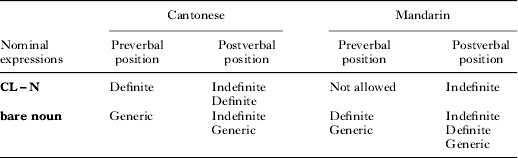
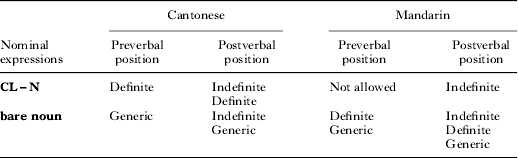
Despite some similarities, Cantonese and Mandarin are significantly different at various linguistic levels. At issue here is the difference in the (in)definite interpretation of bare nouns and [CL – N] phrases. In Mandarin, bare nouns, but not [CL – N], can be definite. In contrast, in Cantonese [CL – N] can be definite but bare nouns can only be indefinite (Cheng & Sybesma, Reference Cheng and Sybesma1999). Table 2 summarizes the referential properties of [CL – N] and bare nouns in Mandarin and Cantonese in preverbal and postverbal positions.
Comparison of the referential properties of [CL – N] and bare nouns in Cantonese and Mandarin
In fact, previous studies on discourse referencing in Mandarin reported a high percentage of bare nouns by hearing adults and hearing children in both indefinite and definite contexts (Hickmann & Liang, Reference Hickmann and Liang1990; Hickmann, Reference Hickmann2003). Unlike hearing children, d/hh children have limited auditory access to spoken Cantonese, hence written Chinese, being visual and far more accessible to them, may potentially be acquired early, and such knowledge might get transferred to the d/hh children's developing Cantonese. In a recent study, for example, Yiu (Reference Yiu2012) observed that the d/hh children's acquisition of double object constructions in Cantonese is influenced by the corresponding structures in Mandarin. In the case of d/hh children's development of discourse referencing, one possible consequence of transfer from Mandarin will be a higher percentage of bare nouns in the d/hh children's spoken Cantonese production.
Another source of linguistic input comes from HKSL, which is used as a medium of instruction in the co-enrolment programme attended by the d/hh children in this study. In HKSL, bare nouns can be both definite and indefinite (Tang & Sze, Reference Tang, Sze, Richard, Quinto and Cormier2002), but nominal expressions consisting of a pointing determiner and a lexical noun (i.e. [Det – N]) are also commonly observed in both contexts in narratives. Pointing determiners can be pre- or postnominal in HKSL, but numerals are usually found postnominally, yielding a [(DET) – N – NUM – (DET)] structure. This is different from Cantonese, in which the word order within a noun phrase is simply [DEM – NUM – CL – N]. There are classifiers in HKSL, but they are pro-forms incorporated into the predicates rather than appearing inside the noun phrases. Like Cantonese, pronouns in HKSL do not show distinction in gender or case, and are realized as pointing signs, just like determiners. As we will discuss shortly, the d/hh children in this study are exposed equally to both spoken language (mostly Cantonese) and HKSL in classroom activities. Hence, there exists a possibility of linguistic transfer from HKSL to the d/hh children's spoken Cantonese, as a natural consequence of two developing grammatical systems interacting with each other.
Research questions
On the basis of previous studies in the literature and the unique language environment surrounding the d/hh children in the Hong Kong context, we would like to address two major research questions in this study:
1. What types of nominal expression do d/hh children use for discourse referencing in Cantonese narratives? Specifically, we would like to probe into the two issues below:
• Can their choices reflect their understanding of the referential properties of various types of nominal expression in Cantonese?
• To what extent are their choices comparable to those by hearing adults and hearing children?
2. Are d/hh children gradually approximating the adult grammar in their use of nominals for discourse referencing as their spoken language proficiency improves?
After addressing these two major issues, we will have an overall discussion on the possible factors that contribute to the developmental patterns of the d/hh children in discourse referencing. The issues mentioned earlier in this paper, namely, the difficulty associated with functional elements and the possible linguistic transfer resulting naturally from constant exposure to written Mandarin and HKSL in school, will be investigated in detail.
METHOD
Design of the story-telling task
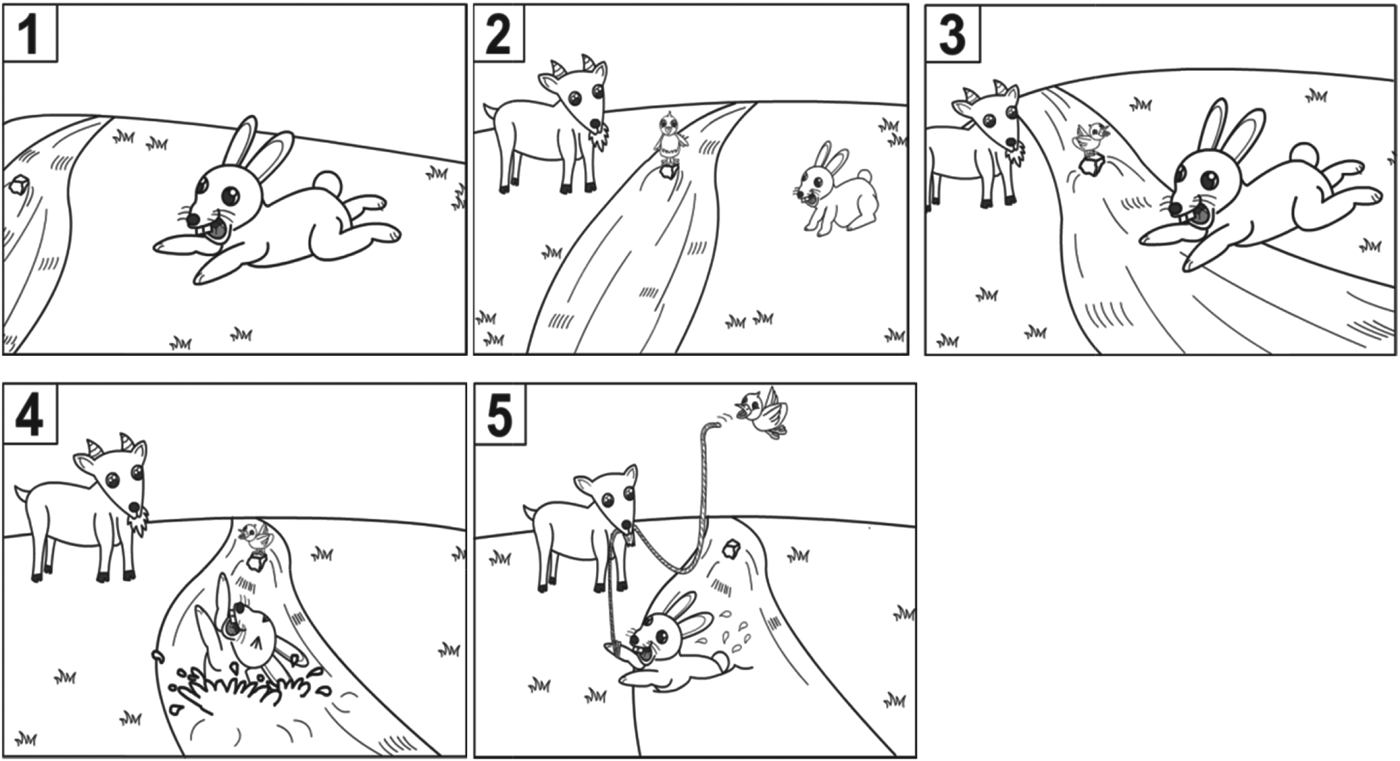
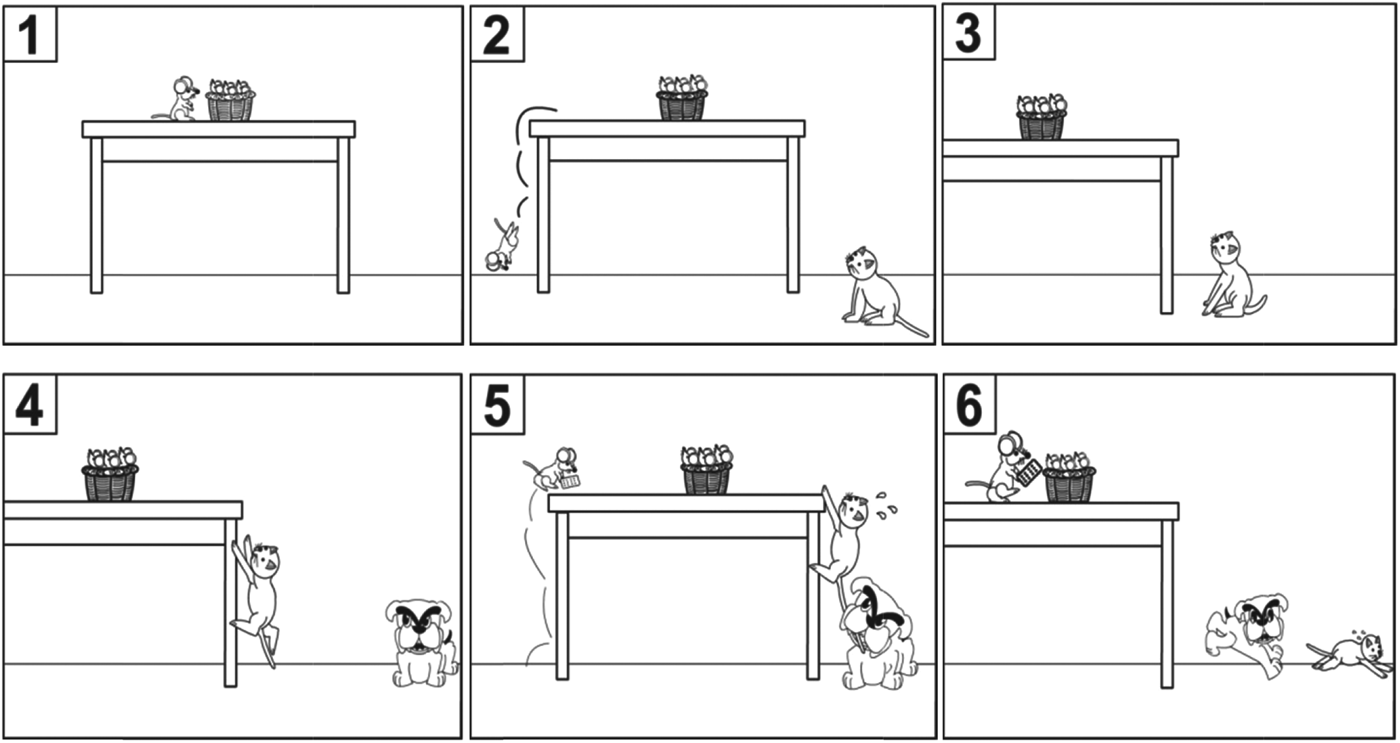
The story-telling data of this study came from the longitudinal documentation of spoken and signed narrative developments of the d/hh children studying in our sign bilingual co-enrolment programme. The experimental design is based on Hickmann's cross-linguistic study on discourse referencing for animate referents in hearing children (Hickmann, Reference Hickmann2003). When our documentation started there were only two cohorts of d/hh students in the programme, and we used Hickmann's original picture-sequenced stories – the Horse Story and the Cat Story – for elicitation. In the second round of documentation, we collected data from these two cohorts again, plus the third cohort. To avoid memory effect or potential boredom associated with repeated stimuli, our team designed the Bunny Story (Figure 1) and the Mouse Story (Figure 2), the features of which (e.g. story plot, number of characters, etc.) resembled the Horse Story and the Cat Story. We planned to use these two similar sets of stimuli alternately to generate comparable data for subsequent documentations. The data analyzed in this study came from the second round of data, hence were based on the Bunny Story and the Mouse Story.
Bunny story.

Mouse story.
The elicitation of the two stories was done one after the other. The participant was told that the pictures made up a coherent story and was asked to memorize the plot. When the participant was ready, the pictures were put aside, and then s/he narrated the story to a blindfolded researcher. The participant was told that the blindfolded researcher had not seen or heard the stories before so s/he needed to provide as many details as possible (for the details of the instructions see ‘Appendix I’). Although retelling a story from memory can be quite taxing, we still consider removal of the pictures more appropriate because otherwise the younger hearing children and the d/hh children may resort to pointing at the characters on the pictures instead of using overt verbal expressions for referencing purpose. After the first story was elicited, the same procedure was applied to the second story.
For the hearing participants, the narrations were recorded by a voice recorder. For the d/hh children, the whole process was also videotaped just in case the gestures that accompanied the narrations may provide useful clues on what they intended to say. Only a few d/hh children with very weak oral language skills signed/gestured as they spoke, and occasionally we used these hand movements to figure out the intended words when the articulations were not clear.
Participants
D/hh children
Fifteen d/hh children who are studying in the sign bilingual co-enrolment programme in either a mainstream kindergarten or primary school participated in this study. In this programme, both spoken languages and HKSL are used in most of the classroom activities (i.e. sign bilingualism). Most subjects are taught in Cantonese. In each of these co-enrolment classrooms, there are around six d/hh children with fifteen to twenty-five hearing classmates. While the d/hh children learn speech and lip-reading through naturalistic interactions with the hearing teachers and students, hearing students are also exposed to HKSL input from the signing teachers (deaf or hearing) and d/hh classmates. Daily interactions among the students and teachers are in signs or speech, depending on the situation, individual abilities, and preferences.
Besides the exposure to Cantonese via the daily interactions with hearing people at large, the d/hh children's learning of Cantonese is in one way or another supported by HKSL under this sign-bilingual pedagogical practice. If they cannot understand the Cantonese-speaking teachers in class, they can turn to the signing teachers or even their hearing classmates, who also know some HKSL, for clarification. The d/hh children receive individual speech training in Cantonese every week (30 minutes per session). Learning of spoken Cantonese, however, is only partially supported by written language at the lexical level, as characters written in Chinese are pronounced in Cantonese, while the grammar of written Chinese is based on Mandarin. There are a lot of expressions, lexical items, and functional elements in Cantonese that differ from Mandarin and do not show up in written Chinese. Besides that, Mandarin is learned through the weekly lesson of spoken Mandarin and some Chinese lessons which adopt spoken Mandarin as the medium of instruction.
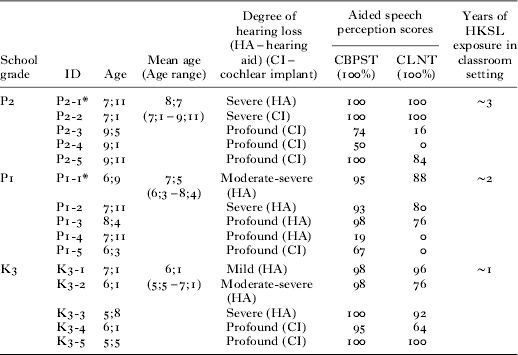
Table 3 shows the background information of these fifteen d/hh children at the time of the data collection. The information includes the school grade, age, degree of hearing loss, hearing assistive devices, the duration of exposure to HKSL in a classroom setting, and the aided speech perception scores of two tests – Cantonese Basic Speech Perception Test (CBSPT; Lee, Reference Lee2006) and Cantonese Lexical Neighborhood Test (CLNT; Yuen, Ng, Luk & Chan Reference Yuen, Ng, Luk and Chan2008). CBSPT is a validated and standardized tool for measuring basic speech perception ability of the Cantonese-speaking population. It is an easier test and is usually used in the field of speech therapy in Hong Kong for judging whether an individual is suitable for other more advanced spoken language assessments. CLNT is an open-set speech recognition test for cochlear implant and/or hearing aid users to track the progress of their rehabilitation. These two Cantonese speech perception tests were conducted with the d/hh children of this study six months after the narrative data were collected to offer us some preliminary idea of how well they can hear with the aid of hearing devices and how this may be related to their spoken language development over time. We did not conduct the tests earlier because CLNT was not yet publicly available when the narrative data were collected.
Background information on the fifteen d/hh children in this study
note: * These two d/hh children are siblings and have deaf signing parents.
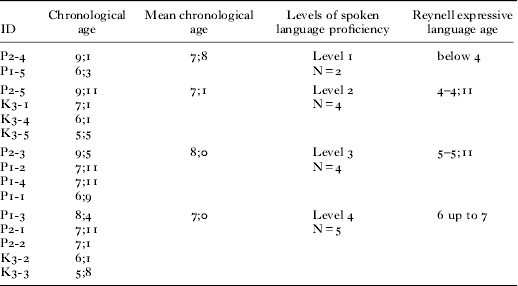
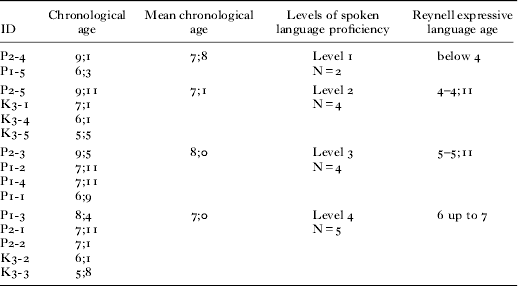
These fifteen d/hh children are grouped into four levels of spoken Cantonese proficiency according to their scores of the Expressive Language Scale of the Cantonese version of The Reynell Developmental Language Scales (Reynell & Huntley, Reference Reynell and Huntley1985; The Committee on Standardization of the Hong Kong version, 1987) in Table 4. We cannot provide standardized scores on the signing proficiency of the d/hh children because we are still in the process of developing an assessment tool for that purpose. When this study commenced there were no readily available assessment tools for measuring signing proficiency of HKSL. From our observations, however, we do not observe a negative correlation between spoken language proficiency and signing proficiency, nor a clear connection between language proficiency and language preference. For example, P2-1 (Reynell Expressive Language Age between 5;00 and 5;11) and P1-1 (Reynell Expressive Language Age 6;00 or above) have high signing proficiency as they have deaf signing parents, but they are also strong in spoken Cantonese. Except for the two d/hh children with the lowest Reynell scores, all could comfortably switch between HKSL and spoken Cantonese depending on situations, regardless of their level of spoken and signing proficiency.
Levels of expressive spoken language proficiency of the fifteen d/hh children
Hearing adults and children
Narrative data from six Cantonese-speaking adults (5 females and 1 male) were collected as baseline data. Recall that the d/hh children were classified into four Reynell expressive language age levels. For each of these levels, four hearing children, two boys and two girls, with a chronological age range (i.e. below 4, 4;0 – 4;11, 5;0 – 5;11, 6;0 – 7;0) comparable to the Reynell expressive age levels, were recruited for comparison. These hearing children study in the same kindergarten/primary school where the co-enrolment programmes are run but they come from other ordinary classes with relative less exposure to sign language. They all have Cantonese-speaking parents and have no reported language or cognitive impairments. Due to some operational constraints we were unable to run the Reynell tests with the hearing children and we assume that they are typically developing in their spoken Cantonese proficiency.
Data transcriptions and coding
The narrative data were first transcribed by two speech therapists who had been providing speech training to the d/hh children. (See ‘Appendix II’ for the sample narratives by the hearing and d/hh children). The data were then coded by other researchers. Information coded include the types of nominal expression used by the participants, characters/entities referred to, discourse functions (i.e. introduction, maintenance, reintroduction), syntactic compositions (e.g. CL – N, DEM – CL – N, etc.), syntactic positions (e.g. subject, object, etc.), and errors (e.g. misuse of classifiers, ambiguous use of pronouns).
Results
The d/hh children's choice of nominal expressions against different discourse functions
Our first research question concerns the types of nominal expression the d/hh children used for referencing in the narratives. Specifically, we examine if the choices of nominal expressions reflect the d/hh children's understanding of the referential properties associated with these expressions, and the extent to which their choices are comparable to those adopted by the hearing adults and children. We will first look at the overall distribution of the nominal expressions that refer to animate referents by the hearing adults and hearing children. Then we will compare their distributional patterns with those by the d/hh children.
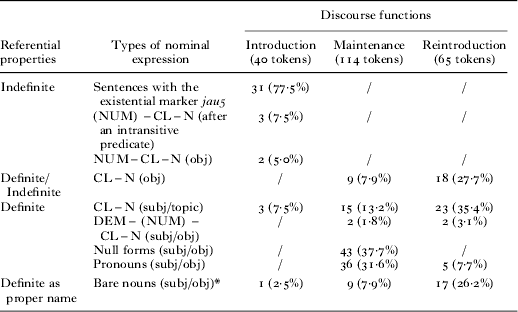
Table 5 shows the types of nominal expression for animate referents used by the hearing adults in their narratives. According to the stimuli there should be 42 tokens of introduction in total (i.e. 6 adults × 7 characters) in the adult data, but 2 of them involved naming the characters as nominal predicates (e.g. On the table is a basket. In fact the basket is a litter of baby mice), and as such they are non-referential (cf. Hopper & Thompson, Reference Hopper and Thompson1984) and not included in the analysis here.
Nominal expressions used by the six hearing adults for animate referents against three discourse functions
note: * Under ‘bare nouns’, there are two instances of reintroduction that involve the prefix ‘ah’.
Among the three possible strategies for referent introduction used by the hearing adults, constructions involving the existential marker jau5 are most frequent (77·5%).
(15) sek6 soeng6min6 [ jau5 zek3 zoek3zai2]
Rock on-top-of have CL bird
‘There is a bird on the rock.’ (hearing adult, introduction)
(16) [jau5 zek3 gau2] ging1gwo3 ne1
Have CL dog pass-by sentence-final particle
‘A dog passes by.’ (hearing adult, introduction)
Much less frequent are (i) the use of an indefinite nominal expression as the object of a transitive verb (example (17), 5%) and (ii) the use of an indefinite nominal expression as an inverted subject of an intransitive verb (example (18), 7·5%):
(17) go3 zyu2jan4 kei4sat6 joeng5 zo2 [jat1 zek3 maau1 ]
CL owner in-fact keep aspect-marker one CL cat
‘The owner in fact keeps a cat (at home).’ (hearing adult, introduction)
(18) gan1 zyu6 zau6 lei4 zo2 [zek3 gau2 ]
afterwards then come aspect-marker CL dog
‘And afterwards a dog comes in.’ (hearing adult, introduction)
Both referent maintenance and reintroduction require definite nominal expressions. However, the types of nominals used by the hearing adults differ distributionally in these two discourse contexts. For referent maintenance, null forms (37·7%) (example (19)) and pronominals (31·6%) predominate. These two means are followed by [CL – N] as subjects/topics (13·2%), [CL – N] as objects (7·9%), and bare NPs (7·9%).
(19) gam2 jau5 zek3 maau1 gin3 dou2 la1,
DM have CL cat see can SFP
zau6 soeng2 paa4 soeng5 zoeng1 toi2 go2-dou6
Ø so want climb up CL table loc
‘A cat sees (what has just happened), and then (it) wants to climb up the table’.[note: DM = discourse marker.]
For referent reintroduction, a reversed pattern is found: full nominal expressions such as [CL – N] (63·1%) (example 20) and bare nouns (26·2%) (example 21) are far more frequent than pronominals (7·7%). Among the bare nouns, two tokens for maintenance are preceded by ‘ah’, which is a prefix that combines with common nouns or names to form proper names in Cantonese.
(20) soeng6min6 jau5 zek3 zoek3zai2 kai5 zo2 hai2dou6
above have CL bird stand aspect-marker loc
‘There is a bird standing there …
gam2 [zek3 zoek3zai2 ] zau5 daam1 jat1 tiu4 sing2
So CL bird then hold one CL rope
… so the bird held a rope (in its beak).’ (hearing adult, reintroduction)
(21) … nei1 go3 si4hau6 [lou5syu2maa4maa1] zau6 lo2zyu6 go2
this CL moment mouse mother then hold CL
beng2gon1 …
biscuit
‘… at this moment the mother mouse holds a biscuit (in her mouth) …’
(hearing adult, reintroduction)
As mentioned in the literature review, bare nouns can sometimes have a proper name interpretation. Our adult data also show this option across the three discourse contexts, though their frequency of occurrences remains relatively low (27 tokens in total).
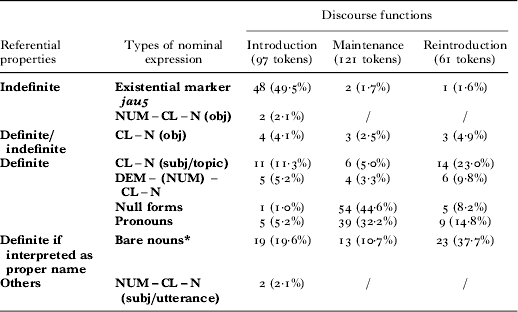
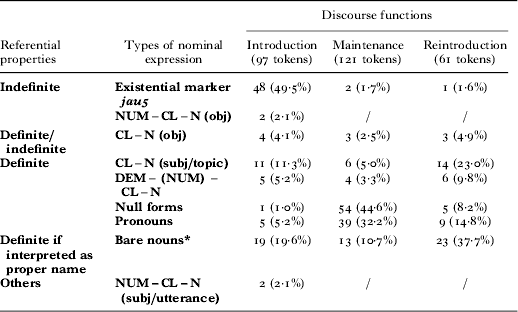
The referencing strategies used by the hearing children differ from the adult data in certain ways. Table 6 shows their referencing strategies against the three discourse functions. An application of Fisher's Exact Test (Mehta & Patel, Reference Mehta and Patel1983) on the data in Tables 5 and 6 suggests that hearing children's strategies for introduction and reintroduction are statistically different from those of the hearing adults (introduction, Exact X2, df = 9, p < ·005; reintroduction, Exact X2, df = 6, p < ·001).
Nominal expressions used by the sixteen hearing children for animate referents against the three discourse functions
note: * Under ‘bare nouns’, there are three instances of introduction and two instances of reintroduction that involve the prefix ‘ah’.
For referent introduction, although the existential marker jau5 ‘have’ was still the most frequent strategy in hearing children's data, its frequency (49·5%) was much lower when compared with that of the hearing adults (77·5%). The hearing children only produced two tokens of [NUM – CL – N] in the object position for referent introduction, and made no attempt to introduce a referent using an inverted indefinite subject with an intransitive verb. This suggests that they have not yet mastered the use of postverbal positions to represent new information in Cantonese. In line with the existing literature, the hearing children in our study used a considerable percentage of definite nominal expressions (around 23%), including demonstratives, definite [CL – N], pronominals, and even null forms to introduce new referents as if they were already known to the addressee. This suggests that at least some of the hearing children in our study were still developing the ability to view a discourse-new referent from the listener's perspective. Interestingly, the hearing children also used bare nouns to introduce referents (19·6%), which was much more frequent than the adult speakers (2·5%). As for referent reintroduction, the two primary means used by the hearing children were nominal expressions that contained a classifier ([CL – N] and [DEM – NUM – CL – N], 23 tokens, 37·7%) and bare nouns (23 tokens, 37·7%). Note, however, that the percentage of classifiers produced by hearing children was much lower than that in the adult data (around 66·2%). With respect to referent maintenance, the difference between the hearing children and adults is not statistically significant (maintenance, Exact X2, df = 6, p = ·074). The hearing children used primarily null forms (44·6%) and pronominals (32·2%), similar to what the adults did. In addition, there were a few tokens (13) of classifiers as a definiteness marker ([CL – N] and [DEM – NUM – CL – N]) and bare nouns (13 tokens).
Overall, and similar to the adults, the hearing children in this study preferred to use null forms and pronouns for referent maintenance, and they also made frequent use of the existential markers and nominal expressions with classifiers for referent introduction and reintroduction respectively. However, in terms of frequency of occurrence, they used fewer existential markers in indefinite contexts (i.e. referent introduction), fewer nominal expressions with classifiers in definite contexts (i.e. reintroduction), and slightly more bare nouns across all contexts.
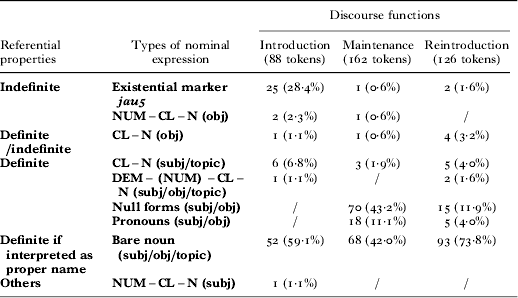
Table 7 shows the referencing strategies used by the d/hh children across three discourse contexts. An application of Fisher's Exact Test on the data in Tables 6 and 7 reveals that, for all three discourse contexts, the d/hh children differed significantly from the hearing children (introduction, Exact X2, df = 8, p < ·001; maintenance, Exact X2, df = 7, p < ·001; reintroduction, Exact X2, df = 6, p < ·001). As expected, significant differences are also found between the d/hh children and hearing adults on the basis of the data in Tables 5 and 7 (introduction, Exact X2, df = 7, p < ·001; maintenance, Exact X2, df = 7, p < ·001; reintroduction, Exact X2, df = 6, p < ·001).
Nominal expressions used by the fifteen d/hh children for animate referents against the three discourse functions
For referent introduction, the d/hh children used bare nouns nearly 60% of the time. This is in stark contrast with the hearing adults and children, who preferred to use constructions that involve the existential marker jau5. The d/hh children did make some use of the existential markers, but the overall occurrence was fewer than 30%. Similarly to the hearing children, the d/hh children only produced a few tokens of [NUM – CL – N] as objects and no tokens of inverted indefinite subjects with intransitive verbs for introduction. Hence, there is no evidence that the d/hh children have acquired the knowledge of using the postverbal position to represent new information in Cantonese. For referent maintenance, the d/hh children used null forms primarily (43·2%), similarly to the hearing adults (37·7%) and hearing children (44·6%). However, d/hh children produced far fewer pronouns (11·1% d/hh children vs. 32·2% hearing children vs. 31·6% hearing adults), but a much higher percentage of bare nouns (42% d/hh children vs. 10·7% hearing children vs. 7·9% hearing adults). As for referent reintroduction, once again bare nouns predominated in the d/hh children's narratives (73·8% d/hh children vs. 37·7% hearing children vs. 26·2% hearing adults), and only a few pronouns and nominal expressions containing classifiers were observed.
Despite the obvious differences regarding the distributions of nominal expressions, the narrative data by the d/hh children do provide some evidence that they were sensitive to the referential properties of the existential marker jau5, null forms, and pronouns. Twenty-five (i.e. 89·3%) out of the 28 tokens of existential markers produced by the d/hh children were used appropriately in indefinite contexts (i.e. referent introduction). This suggests that even though the d/hh children used the marker less frequently, when they used it they did so in the right contexts most of the time, thus reflecting their knowledge of this Cantonese structure. Note that occasional misuse of the existential marker in definite contexts was in fact observed in the hearing children's data, too. Even more accurate performance was observed in the d/hh children's use of null forms and pronouns. In the data, all null forms (85 tokens) and pronouns (23 tokens) produced by the d/hh children were used in definite contexts; misuse of null forms and pronouns in indefinite contexts, which was found in some hearing children's narratives, was entirely absent in the d/hh children's data. In addition, the d/hh children produced a lot more null forms and pronouns for referent maintenance than reintroduction, exactly as the hearing adults and hearing children did. This reflects the fact that the d/hh children, to a great extent, were aware that expressions like pronouns and null forms carry less lexical information and are thus less appropriate than full nominal expressions for referent reintroduction. Note further that all of the definite nominal expressions produced by the d/hh children in the current study are not deictic in the sense that they are not referring to referents present in the real world discourse, as the pictures were put aside when the narrations began. Hence, these definite nominal expressions can truly reflect the d/hh children's state of knowledge of nominal expressions and discourse referencing in Cantonese. Regarding other types of nominal expressions produced by d/hh children, namely [NUM – CL – N] (obj), [CL – N] (subj/topic), [DEM – NUM – CL – N], (possessive NPs), their tokens are too few in number for us to make any significant generalization.
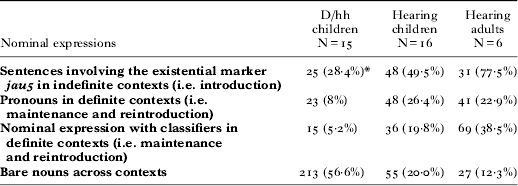
In brief, the d/hh children in this study demonstrated some linguistic knowledge of the referential properties of the existential marker, null forms, and pronouns in Cantonese. However, they produced:
(i) fewer existential constructions with jau5 in indefinite contexts;
(ii) fewer pronouns in definite contexts;
(iii) fewer definite nominal expressions containing classifiers in definite contexts; and
(iv) more bare nouns across contexts, particularly for referent reintroduction.
In the light of the above, a question that naturally arises is: Are these tendencies unique to the d/hh children? Table 8 presents the percentage of these four types of nominal expression by the d/hh children, hearing children, and hearing adults.
Four types of nominal expression produced by the d/hh children, hearing children, and hearing adults
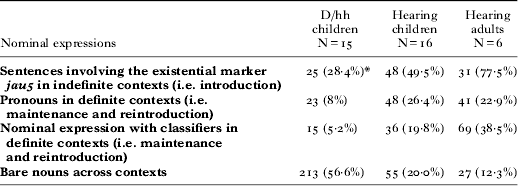
note: * The number indicates the tokens, and the percentage in the parentheses represents the percentage out of all nominal expressions in the specified contexts.
Note that, apart from pronouns, the hearing children also show a similar tendency to use more bare nouns, fewer existential constructions, and fewer classifiers, though to a lesser degree. Such parallels provide us with preliminary evidence that the d/hh children's referencing strategies resemble those of the hearing children, qualitatively speaking. In other words, it is quite likely that the d/hh children are having delayed rather than deviant development in their acquisition of nominal expressions for discourse referencing in Cantonese.
Developmental patterns in the choice of nominal expressions in the narratives by the d/hh children
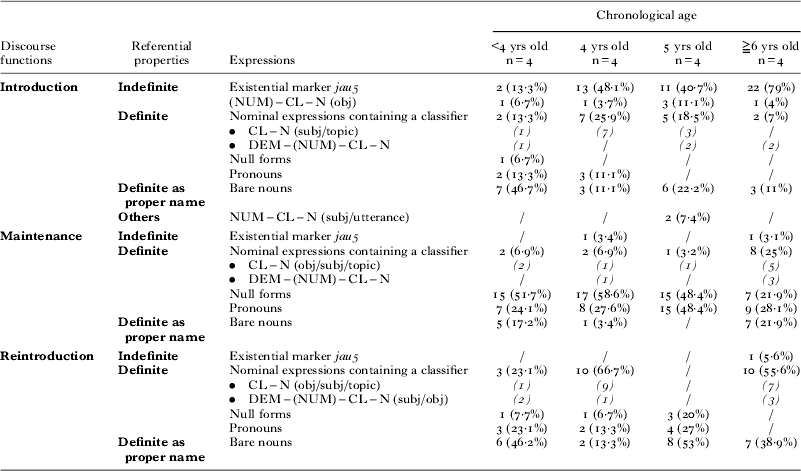
In this section we would like to find out whether the d/hh children are approximating the adult grammar in their acquisition of discourse referencing in Cantonese as their spoken language proficiency improves. We will do this by comparing the referential strategies adopted by the hearing and d/hh children from a developmental perspective. Table 9 shows the hearing children's choice of nominal expressions for referent introduction, maintenance, and reintroduction.
The choice of nominal expressions for discourse referencing among the sixteen hearing children across age groups
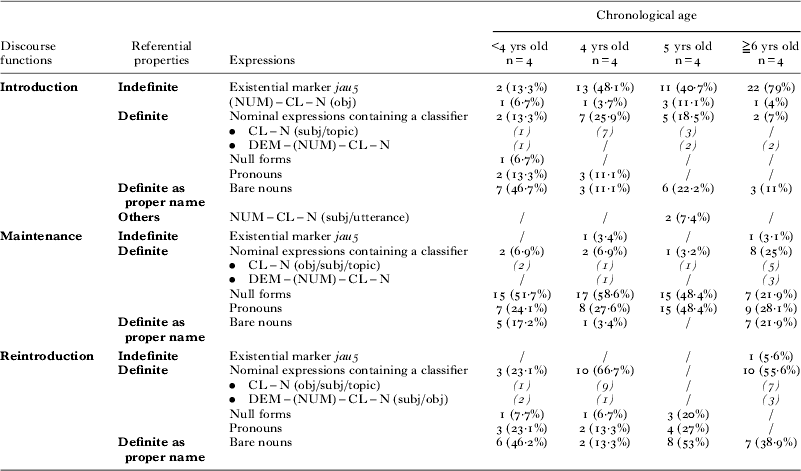
note: The parentheses in italics indicate the number of tokens of each of the subtypes of nominal expression.
For referent introduction, the youngest group of hearing children used a high percentage of bare nouns but relatively fewer of the existential marker jau5. They also used different types of definite nominal expression to introduce new referents. As the chronological age of hearing children increased, there was a steady increase of existential markers but a decrease in definite nominal expressions. There was an abrupt drop of bare nouns at age four, from 46·7% to 11·1%, but the percentage of bare nouns levelled out at ages five and six, and it remained higher than the adult baseline (i.e. 2·5%).
As for referent maintenance and reintroduction, we see a gradual increase of definite nominal expressions with classifiers in hearing children's narratives, except for those at age five. Interestingly, the frequencies of null forms and pronouns for maintenance first increased at ages four and five and then plunged at age six. As we will argue later in this section, the high percentage of null forms and pronouns at ages four and five was partly attributable to the hearing children's overuse of these anaphoric expressions in ambiguous contexts for reference maintenance, and even reintroduction. The oldest group of the hearing children (i.e. age six or above) demonstrated an understanding that null forms and pronouns are appropriate for referent maintenance but not reintroduction. More importantly, a closer look at their use of lexical NPs (i.e. bare nouns [CL – N, DEM – (NUM) – CL – N]) for referent maintenance actually reveals that they were mainly used in sentences where another referent was also mentioned in addition to the targeted referent, e.g. the interaction between the cat and the dog, thus rendering a need for a more specific nominal expression. In contrast, this ability is initially lacking among the youngest children, who used bare nouns for maintenance in contexts where pronouns and null forms are in fact more appropriate. Based on this, we may hypothesize that hearing children, as they grow older, gradually develop the pragmatic awareness of not only the mappings between nominal expressions and discourse functions, but also the appropriate use of lexical NPs in definite contexts to avoid potential ambiguity.
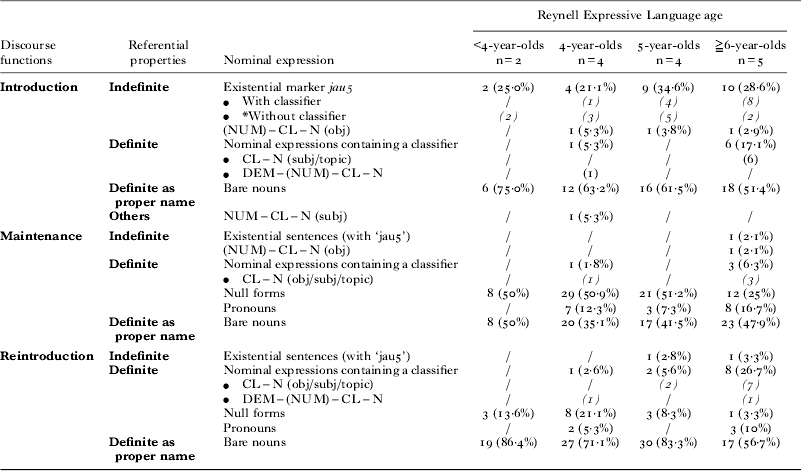
Next, we will discuss the developmental patterns of the d/hh children. Table 10 shows the nominal expressions produced by the d/hh children across four Reynell Expressive Language Age levels.
The choice of nominal expressions for discourse referencing among the fifteen d/hh children across spoken language age groups
note: The parentheses in italics indicate the number of tokens of each of the subtypes of nominal expression.
For referent introduction, the d/hh children demonstrated some knowledge of the introductory function of the existential marker jau5 across all levels of Reynell Expressive Language Age. However, initially they produced existential constructions without a classifier, which were ungrammatical if the intended interpretation was an indefinite referent. As their spoken language proficiency improved, there was no clear upward trend for the use of the existential markers, though there was a mild decrease of bare nouns.
Regarding referent maintenance and reintroduction, the types of definite nominal expression used by d/hh children increased slightly as their spoken language proficiency improved. There was a steady increase of definite expressions with classifiers as well as pronouns. Nevertheless, bare nouns remained prevalent throughout. The frequency of bare nouns among the d/hh children of the highest Reynell Expressive Language Age for both maintenance (47·9%) and reintroduction (56·7%) were still higher than those of the oldest group of hearing children and adults. Recall that for hearing children, there was a sudden drop of null forms and pronouns at age six for reference maintenance. We see exactly the same pattern in d/hh children's use of null forms but not pronouns, probably due to the fact that the latter remain infrequent across all spoken language age levels.
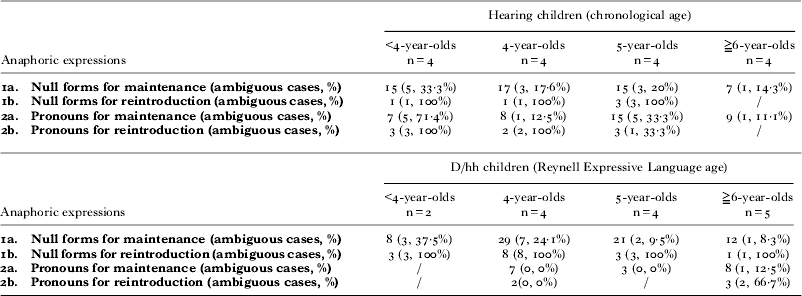
What caused the sudden drop of null forms among the oldest hearing children and d/hh children of the highest Reynell Expressive Language Age? As briefly mentioned earlier, we conjecture that this drop is related to an improved pragmatic ability to judge when to use anaphoric expressions.
Use of anaphoric nominal expressions by the hearing and d/hh children
As shown in Table 11, for both hearing and d/hh children, the ambiguous use of null forms for maintenance decreased as they grew older or as their spoken language proficiency improves, respectively. For hearing children, there is also a downward trend of the ambiguous use of pronouns. This is not so obvious for the d/hh children though, due to the fact that the tokens are too few to show any overall trend. Note that there are two cases of pronouns for reintroduction by d/hh children (fourth group) and two cases of pronouns for reintroduction by hearing children (third group) which are not ambiguous. These pronouns are in plural forms (i.e. keoi5 dei6 ‘they’), thus providing additional clues for referent identification.
In sum, as their Reynell Expressive Language Age increased, the d/hh children:
(i) used a slightly wider range of nominal expressions;
(ii) used more classifiers, both in existential constructions and other definite nominal expressions;
(iii) used more pronouns; and
(iv) showed an improvement in the pragmatic knowledge of using null forms unambiguously.
These observations provide supportive evidence that the d/hh children in our study are approximating the adult grammar of Cantonese in their use of nominal expressions for discourse referencing. Nonetheless, we have not yet seen a gradual increase of existential markers in their data. Use of bare nouns remained prevalent across all Reynell Expressive Language Age levels. In fact, the high percentage of bare nouns and the low percentage of the existential markers as well as other classifier-related nominals in the d/hh children's data show a strong resemblance to the referencing strategies adopted by the youngest hearing children in their course of development.
Discussion
Summary of findings
Hitherto, we have observed the following in our data:
(i) Overall, the d/hh children produced fewer existential constructions, pronouns, and definite nominal expressions containing classifiers than the hearing children did. Interestingly, the frequencies of existential constructions and definite nominal expressions with classifiers in the hearing children's data were also lower than the adult baseline. On the other hand, the d/hh children produced more bare nouns than the hearing children, who in turn produced more bare nouns than the hearing adults.
(ii) The d/hh children showed linguistic sensitivity towards the referential properties of existential constructions, null forms, and pronouns. They could map these structures appropriately with the definite contexts.
(iii) Similarly to the hearing children, the d/hh children produced a slightly wider variety of nominal expressions, more classifiers, and more pronouns as their spoken language proficiency improved. They also demonstrated better pragmatic knowledge in using null forms unambiguously.
(iv) No obvious increase of existential constructions is observed as the spoken language proficiency of the d/hh children improved. Bare nouns remained prevalent across all Reynell Expressive Language Age levels.
(v) The d/hh children's referencing patterns, particularly the use of bare nouns, existential constructions, and classifier-related forms, resembled those of the youngest group of the hearing children (i.e. below age four) in this study.
Judging from the above observations, we would like to suggest that the d/hh children of this study are following a similar route of development in their use of nominal expressions for discourse referencing as the hearing children, but with an apparent delay.
Contributing factors underlying the developmental delay of the d/hh children
In the light of our findings presented above, we would like to argue that the developmental delay of the d/hh children can be explained in terms of the syntactic/semantic complexities associated with functional elements, linguistic transfer from written Mandarin and Hong Kong Sign Language, and the awareness that common nouns can be used as proper names in certain discourse contexts in Cantonese. Note that, presumably, the hearing children are under the influence of these factors, except for the exposure to Hong Kong Sign Language. In what follows, we will discuss these factors one by one.
Just as de Villiers et al.'s (Reference de Villiers, de Villiers, Hoban and Tager-Flusberg1994) observation that functional elements pose initial difficulty to d/hh children speaking English, Berent's study (Reference Berent, Bhatia and Ritchie1996), which was based on adult deaf learners of English, also suggested that, while lexical elements precede functional elements in the acquisition of English syntax, for some deaf learners, their development of functional categories may persist indefinitely. In Cantonese, pronouns, existential constructions, and nominal expressions with classifiers involve functional elements. We can therefore hypothesize that pronouns and classifiers, as functional elements, may present major acquisition hurdles for d/hh children. Before d/hh children can completely master these elements and map them with appropriate discourse contexts, bare nouns are used as substitutes. This is probably also the case in the narrative production of the younger hearing children in this study. Such erroneous misuse of bare nouns as substitutes also reflects an initial inability to realize that the semantics of bare nouns in Cantonese is in fact far more complex than appears – that they can be generic preverbally, and non-specific indefinite, specific indefinite, and generic postverbally. It is also possible that the d/hh children zero-in on the use of bare nouns as a syntactically simple constituent without further differentiating its semantic properties. However, we cannot expand this idea further here, given that our picture stimuli do not provide sufficient contexts to test all the possible semantic interpretations of bare nouns in Cantonese.
That functional elements are difficult to acquire is in fact evident in the errors committed by the d/hh children. For instance, among the 28 tokens of existential constructions the d/hh children produced for animate referents, 11 lacked a classifier (39·3%, example (22)) and 7 erroneously involved a general sortal classifier go3 rather than zek3, which is designated for animal referents (25%, example (23)):
(22) *jau5 maau1
have cat
‘There is a cat.’ (ad/hh child, Reynell Expressive Language Age 3;05)
(23) *jau5 go3 bak6tou3 hai2dou6 tiu3
Have CL rabbit here hop
‘There is a rabbit hopping here.’ (a d/hh child, Reynell Expressive Language Age 7)
Similar substitution errors were seen in 5 out of 27 tokens of other nominal expressions that contained a classifier in the d/hh children's data.
Crucially, parallel performance was also observed with the hearing children who produced the same classifier-related errors. Four out of the 48 expressions (8%) with the existential markers jau5 produced by the hearing children erroneously missed out the classifiers. Among 105 tokens of nominal expressions with classifiers for animate referents by hearing children, 36 (34·3%) involve inappropriate classifiers:
(24) [Jau5 go3 tou3zai2 ] gin3 dou2 [ jat1 go3 ho4]
Have CL rabbit see aspect-marker one CL river
‘A rabbit sees a river.’ (a hearing child, chronological age 5;08)
In example (24), the hearing child inappropriately used the general classifier go2 for ‘rabbit’ and ‘river’ instead of using zek3 and tiu4, which specify the animacy and elongated shape of the noun referents respectively. Errors like this strongly suggest that although classifiers begin to appear at age two in Cantonese-speaking hearing children (Wong, Reference Wong1998), appropriate use of classifiers, particularly those involving complex semantic attributes, is a relatively late development in connected discourses such as narratives. Further delay in the d/hh children, who have limited auditory access to spoken Cantonese, is therefore reasonably expected.
Apart from classifiers, demonstratives and pronouns are also rare in the d/hh children's narrative productions. As mentioned earlier in the literature review, functional elements are stress-bearing in Cantonese, unlike those in English which are very often unstressed and less audible. Hence, it should be the syntactic/semantic complexities associated with demonstratives and pronouns in Cantonese that cause difficulties to the d/hh children. Given the current set of data, it is not yet clear to us why pronouns and demonstratives appear to be more difficult than classifiers for the d/hh children to acquire. Demonstratives and pronouns in Cantonese do not show gender distinction, seldom show semantic ambiguity as they are mostly definite, usually receive lexical stress, and are abundant in the linguistic input. For typically developing hearing children, pronouns, classifiers, and demonstratives are observed in longitudinal data by age three, and there appears to be no clear-cut developmental sequence in the acquisition of pronouns, classifiers, and demonstratives (Wong, Reference Wong1998). Nonetheless, the tokens of demonstratives and pronouns produced by the d/hh children are too few in number for us to pursue a deeper analysis of the apparent difficulties here.
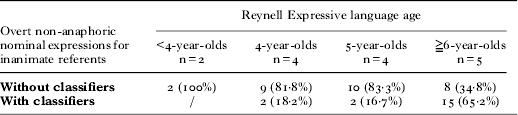
However, we believe that the syntactic/semantic complexity of functional elements should not be the sole factor contributing to the high percentage of bare nouns in the d/hh children's narratives. In the data presented so far, all the nominal expressions referred to animate referents. Nominal expressions for inanimate referents in the narratives were not yet taken into account. If syntactic/semantic complexity is the sole contributing factor, we would expect to see a similarly low percentage of classifier-related expressions for inanimate referents in the d/hh children's narratives. When we look at how inanimate referents were referred to (there are a few inanimate entities in the picture stimuli), a rather unexpected result emerged. Table 12 shows the overt full nominal expressions used by the d/hh children for inanimate referents.
Overt non-anaphoric nominal expressions for inanimate referents by the fifteen d/hh children
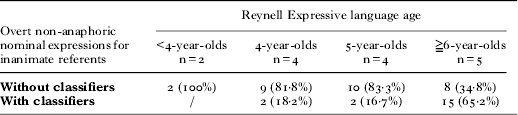
Initially, classifiers were scarcely used by the d/hh children. Nonetheless, there was a sudden rise of classifier use for inanimate referents for those who reached the highest level of spoken language proficiency (up to 65·2%). For the same group of children, however, the percentage of classifiers in overt non-anaphoric nominal expressions for animate referents was only 32·6%. In example (25) below, the d/hh child (Reynell Language Age = 4) used bare nouns for the two animate referents (i.e. ‘bird’ and ‘goat’), but an appropriate classifier for the inanimate referent (i.e. ‘rope’).
(25) zeok3zai2 bong2 tiu4 sing2 bei1 joeng4.
Bird tie CL rope give goat
‘The bird ties the rope and gives it to the goat.’
(a d/hh child, Reynell Expressive Language Age 4;00–4;11)
This suggests that, as their spoken language proficiency improved, the d/hh children preferred to adopt a more structurally complex nominal expression for inanimate referents while continuing to cling to bare nouns for animate referents. Apparently, syntactic/semantic complexities associated with functional elements alone cannot explain this animate–inanimate asymmetry.
Another possible factor is the linguistic transfer from written Chinese, which is based on Mandarin. One crucial difference between Cantonese and Mandarin with respect to the semantic properties of nominal expressions lies in the interpretation of bare nouns. In Mandarin, bare nouns can be definite in subject and object position, and be indefinite in object position. In contrast, in Cantonese bare nouns can normally not be interpreted as definite. Constant exposure to written Mandarin since kindergarten in formal education could have possibly led the d/hh children into thinking that bare nouns in spoken Cantonese also work the same way, resulting in the frequent use of bare NPs in their spoken Cantonese narratives. In fact, previous studies on discourse referencing in Mandarin indeed reported a high percentage of bare nouns in both adults’ and children's data (Hickmann, Reference Hickmann2003; Hickmann & Liang, Reference Hickmann and Liang1990). While the possibility of linguistic transfer from written Mandarin does exist, this factor alone cannot satisfactorily explain the (in)animacy asymmetry of bare nouns observed in the d/hh's children data, because bare NPs in Mandarin function in more or less the same way for both animate and inanimate referents. Nor can Mandarin influence explain the use of bare nouns for introducing new referents in the d/hh children's data, as this is not a grammatical option in Mandarin.
The third possible factor is the transfer from HKSL. In HKSL, bare nouns can be definite or indefinite in both preverbal and postverbal positions (Tang & Sze, Reference Tang, Sze, Richard, Quinto and Cormier2002). Hence, the high percentage of bare nouns in the d/hh children's Cantonese narratives may be partly attributable to the transfer from HKSL. However, like Mandarin, bare nouns in HKSL can be used for both inanimate and animate referents. Hence, the transfer from HKSL cannot explain the animate–inanimate asymmetry in the use of classifiers discussed above. In fact, in a preliminary study that analyzes the signing production of exactly the same two narratives by four native signers of HKSL, we observe that although bare nouns can be used in both definite and indefinite context, noun phrases with pointing determiners are also frequently used. Among the 134 tokens of overt nominal expressions in the adult signing narratives, nearly 50% (67 tokens) involve a pointing determiner plus a lexical noun, and only 34·3% (46 tokens) are bare nouns. In both the maintenance and reintroduction contexts, nominal expressions with determiners (20 tokens for maintenance; 34 tokens for reintroduction) outnumber the use of bare nouns (13 tokens for maintenance; 17 tokens for reintroduction). If we assume that such distributions reflect the type of sign language input received by the d/hh children, the latter would have produced more demonstratives and fewer bare nouns. The only feature in the discourse referencing strategy by deaf adults that possibly resembles the d/hh children's Cantonese narratives is the low percentage of pronouns (15·7%).
Note further that, although the possibility of linguistic transfer from HKSL exists, we do not think the syntactic knowledge of HKSL has exerted a significant influence on the acquisition of Cantonese nominal expressions in these d/hh children, as far as the syntactic structures are concerned. In Cantonese, the syntactic order of a nominal expression is [DEM – NUM – CL – ADJ – N], which is fairly rigid. In HKSL, determiners can be either prenominal or postnominal, and adjectives and number tend to be postnominal. In all of the Cantonese nominal expressions produced by the d/hh children, however, we did not find any instance in which the word order resembles that of HKSL. In fact, all the d/hh children, including those of the lowest spoken language proficiency level, followed a correct syntactic order of Cantonese in their production of nominal expressions. This strongly suggests that they have acquired knowledge of the syntactic structure of Cantonese, just as they manifested such knowledge when using it to refer to the inanimate referents.
The fourth possible factor is the d/hh children's awareness that common nouns can occasionally be used with a proper name interpretation, especially for persons. This strategy can be employed in narratives for animal characters, which are personified as humans in this way, and the resulting ‘proper name’ is syntactically bare. As we have seen earlier, this strategy was sometimes used by the hearing adults, and quite often by the hearing children in this study. This may help explain why the d/hh children used more classifiers for inanimate referents than animate ones as their spoken language proficiency improved. We may therefore hypothesize that the use of bare nouns is either (a) developmental for some d/hh children demonstrating limited structural knowledge of Cantonese, just as typical children's initial acquisition of Cantonese nominal expressions, or (b) discourse-related, especially when they are restricted by their limited knowledge of mapping the structurally adequate nominal expressions onto appropriate discourse referents. Under condition (b), they resorted to using bare, common nouns as proper names in Cantonese to avoid using more complex nominal expressions in their narrative production. In other words, these d/hh children might be using bare nouns as if they were proper names as an avoidance strategy, which is quite likely, especially in language production.
Would it be possible that the overuse of bare nouns results from the d/hh children's attempt to compensate their less intelligent speech by using nominals with more lexical content to replace null forms and pronouns? While this possibility cannot be ruled out entirely, we contend that it cannot explain the following facts. First, the d/hh children of the highest Cantonese proficiency actually have fairly clear speech, yet bare nouns still predominate in their narratives. Second, this view can only account for the use of bare nouns in maintenance contexts where null forms or pronouns are appropriate, and have nothing to say about the introduction and reintroduction contexts. Third, if this view holds, we would expect to see frequent use of bare nouns in a maintenance context to replace null forms and pronouns, but this is not the case.
CONCLUSION
In this paper, we have investigated the development of discourse-referencing skills in Cantonese of fifteen d/hh children by comparing their elicited narratives with those of hearing children and hearing adults. Our findings reveal that the d/hh children produced fewer existential constructions, pronouns, demonstratives, and classifier-related constructions but more bare nouns across all discourse contexts. Nonetheless, they demonstrated pragmatic sensitivity towards the use of existential constructions, null forms, and pronouns in appropriate contexts. As their language age increased, the d/hh children also developed a wider range of functional elements in the nominal expressions, and show improved competency in using null forms unambiguously. The use of nominal expressions and referencing strategies by the d/hh children actually bears resemblance to the younger hearing children, particularly those under the age of four. Note further that the d/hh children's errors related to classifiers and misuse of pronouns/null forms in ambiguous contexts are also found in the productions of the hearing children. Taking all these findings together, we contend that the d/hh children are likely to be having delayed rather than deviant development in their acquisition of discourse referencing skills. Regarding the predominant use of bare nouns in d/hh children's Cantonese narratives, we have proposed several contributing factors, namely, the syntactic/semantic complexities associated with functional elements, and linguistic transfer from written Mandarin and HKSL, as well as the awareness of the optional use of bare nouns for a proper name interpretation in Cantonese. We believe that all these factors play some role in the frequent use of bare nouns in d/hh children but none can be counted as the sole contributing factor given the evidence we have so far. Further research is certainly warranted in order to find out the relative weight of each of these factors.
This study is limited in several ways. One major limitation is the small sample size for the d/hh children. As d/hh children are well known for the diverse variations in their linguistic attainments, future research with a larger sample size is definitely needed in order to find out the extent to which the current findings can reflect the development of discourse referencing in Cantonese of the d/hh children at large in Hong Kong. Due to the small sample size, the tokens of existential markers, pronouns, and demonstratives are just too few for us to make generalizations on their acquisition patterns. Another limitation is that there were no readily available assessment tools for us to measure the d/hh children's signing ability for gauging the possible degree of transfer from sign language in their spoken language performance. The validity of the comparisons can also be strengthened if we could obtain the Reynell Expressive Language scores of the hearing children for comparison, rather than assuming that their discourse referencing performance is age-appropriate. This study has generated some questions that cannot yet be answered satisfactorily. For example, what causes the animacy effect in the use of classifiers in the data of d/hh children? Why are pronouns and demonstratives more difficult than classifiers for the d/hh children to acquire? These questions, if answered in the future, would undoubtedly shed more light on the development of discourse referencing by d/hh children.
Appendix I: the Cantonese instructions given to the children
(a) First the researcher sat down with the child, and said: ‘I am going to let you look at two stories. After that I want you to tell the two stories to the Big Sister who is now standing outside. You need to provide as many details as possible.’
—陣間 我 會 俾 你 睇 兩個 故事,
jat1zan6gaan1 ngo5 wui5 bei2 nei5 tai2 loeng5go3 gu3si
你 睇 完 之 後,
nei5 tai2 jyun4 zi1 hau5
我 想 你 講 個故事 俾 出面 嘅 姐姐
ngo5 soeng2 nei5 gong2 go3gu3si6 bei2 coet1min6 ge3 ze4ze1
聽。 你 要 有 幾多 講 幾多 喎。
ting1 nei5 jiu3 jau5 gei2do1 gong2 gei2do1 wo3
(b) The researcher then presented the first picture sequence to the child. The researcher asked the child to name the referents (e.g. BUNNY, GOAT, BIRD, FENCE, FIRST-AID-BOX). If the child did not know the names, the researcher taught the child, making sure that the latter knew the forms well before the story-telling task began. The Cantonese instruction used by the researcher was: ‘Let's find out what are in the pictures first. What is this?’
我哋 睇下 呢度 有啲 乜嘢 先,
ngo5dei6 tai2haa5 nei1dou6 jau5di1 mat1je5 sin1
呢樣 咩 嚟架?
nei1joeng6 me1 lai4gaa3?
(c) The researcher also needed to make sure that the child understood that the pictures formed a story by saying: ‘These few pictures make up a coherent story.’
呢 幾幅 圖畫 係 講緊 一個 故仔。
nei1 gei2fuk1 tou4waa2 hai6 gong2gan2 jat1go3 gu2zai2
(d) When the child was ready, the second researcher, who was blindfolded, entered the room. The first researcher then said: ‘This Big Sister has not seen this story before. Now you try to tell her the story. You need to provide as many details as possible.’
姐姐 無 睇過 個故事 喎,
ze4ze1 mou5 tai2gwo3 go3gu3si6 wo3
你 試下 講番 個故事 俾 姐姐 聽,
nei5 si3haa5 gong2faan1 go3gu3si6 bei2 ze4ze1 ting1
你 要 有 幾多 講 幾多 喎。
nei5 jiu3 jau5 gei2do1 gong2 gei2do1 wo3
(e) The blindfolded researcher intervened as little as possible. She might have simple responses such as head nods. If the child had difficulties in telling the story, the second researcher might repeat the last utterance by the child and ask general questions such as: ‘What happens next?’ (跟住呢? gan1zyu6 ne1). The same procedure is repeated for the second story.
Appendix II: samples of narratives by the hearing and d/hh children in this study
1. Hearing child, below four (chronological age)
第一, 白兔 就 跑 跑 跑…,
dai6jat1 bak6tou3 zau6 paau2 paau2 paau2
first rabbit then run run run
‘First, Rabbit runs and runs.’
跟住, 就 走 走 走… 走 去 石頭 嗰度。
gan1zyu6 zau6 zau2 zau2 zau2 zau2 heoi3 sek6tau4 go2dou6
Then then run run run run towards rock there
‘Then, (it) runs and runs. (It) runs towards the rock.’
跟住 到 第二 就, 跑 跑 跑…,
gan1zyu6 dou3 dai6ji6 zau6 paau2 paau2 paau2
Then to number two then run run run
‘Then, for picture number two, (it) runs and runs.’
又 走 去 條繩 嗰度, 綁住 佢
jau6 zau2 heoi3 tiu4sing2 go2dou6 bong2zyu6 keoi5
in-addition walk towards rope there, tie pronoun
隻手。
zek3sau2
hand
‘After that, (it) walks towards the rope, then (it) ties its hand.’
跟住 第三 就 又 跑 跑 跑 跑…
gan1zyu6 dai6saam1 zau6 jau6 paau2 paau2 paau2 paau2
then number three then in-addition run run run run
‘Then, for picture number three, (it) runs and runs again.’
又 見到 隻羊,
jau6 gin3dou2 zek3joeng4
in-addition, see goat
‘After that, (it) sees a goat.’
第四 又 跑 跑 跑… 跑 咗,
dai6sei3 jau6 paau2 paau2 paau2 paau2 zo2
Number four, in-addition, run run run run ASP-marker
‘Number four, (it) runs and runs. (It) runs away.’
跑 咗 又 睇到 隻羊 嗰度。
paau2 zo2 jau6 tai2dou2 zek3joeng4 hai2dou6
run ASP-marker in-addition see goat there
‘(It) runs away, then (it) sees the goat there.’
第五, 又 睇到 隻羊 嗰度, 就
dai6ng5 jau6 tai2dou2 zek3joeng4 hai2dou6 zau6
Number five in-addition see goat there then
綁住 佢 隻手。
bong2zyu6 keoi2 zek3sau2
tie pronoun hand
‘Number five, then (it) sees the goat there, and (it) ties its hand.’
2. Deaf/hard-of-hearing child, below four (Reynell language age)
白兔 跑, 白兔 跑, 羊羊 追, 白兔 跑。
bak6tou3 paau2 bak6tou3 paau2 joeng4joeng4 zeoi1 bak6tou3 paau2
rabbit run rabbit run goat chase rabbit run
‘Rabbit runs. Rabbit runs. Goat chases. Rabbit runs.’
鴨 放。 羊, 白兔, 跑, 跳。
aap3 fong3 joeng4 bak6tou3 paau2 tiu3
duck put-down goat rabbit run jump
‘Duck puts down (the rope). Goat and Rabbit run and jump.’
鴨 xxx。 白兔 救命 aa3。 白兔, 白兔
aap3 xxx bak6tou3 gau3ming6 aa3 bak6tou3, bak6tou3
duck rabbit help-me SFP rabbit rabbit
救命 aa3。
gau2ming6 aa3
help-me SFP
‘Duck xxx. Rabbit (says) ‘help me’. Rabbit (says) ‘help me.’
鴨 幫, 羊 幫 拉。 白兔 好。
aap3 bong1 joeng4 bong1 laai1 bak6tou3 hou2
duck help goat help pull rabbit good
‘Duck helps Goat to pull. Rabbit is good.’
3. Hearing child, 4;00–4;11 (chronological age)
頭先 有 隻 白兔, 佢, 佢 地吓 咁
tau4sin1 jau5 zek3 bak6tou3 keoi5 keoi5 dei6haa2 gam2
just-now have CL rabbit it it ground like-this
跑,
paau2
run
‘Just now there is a rabbit. It runs on the ground.’
差啲 見到 個 羊 企 側邊
caa1di1 gin3dou2 go3 joeng4 kei5 zak1bin1
almost see CL goat stand aside
‘Almost (it) sees the goat that is standing at the river side.’
然之後 有 一 個 白兔, 有 個 雀仔
jin4zi1hau6 jau5 jat1 go3 bak6tou3, jau5 go3 zoek3zai2
After-that have one CL rabbit, have CL bird
嗌 佢 過嚟,
ngaai1 keoi5 gwo3 lai4
ask pronoun come
‘After that, a rabbit, a bird asks it to come over.’
然之後 跌落 水, 嗰 個 羊 la1 佢
Jin4zi1hau6 dit3lok6 seoi2, go2 go3 joeng4 la1 keoi5
After-that fall into water that CL goat pull it
上 嚟。
seong5 lai4
up come
‘After that (rabbit) falls into water. The goat pulls it up.’
4 Deaf/hard-of-hearing child, 4;00–4;11 (Reynell language age)
兔仔 跳起, 攞 石頭 dam2 咗 隻, 走
tou3zai2 tiu3hei2 lo2 sek6tau4 dam2 zo2 zek3, zau2
rabbit jump up take stone throw ASP CL. leave
喇, 走。
laa3, zau2
SFP leave
‘Rabbit jumps up. (It) picks a stone and throws it. (It) leaves.’
跟住 羊 嗰度, 跟住 兔仔 跳 落 水
gan1zyu6 joeng4 hai2dou6 gan1zyu6 tou3zai2 tiu3 lok6 seoi2
then goat here, then rabbit jump down water
度。 跳 喇。
dou6 tiu3 laa1
there jump SFP
‘Then Goat is here. Then Rabbit jumps into water. (It) jumps.’
跟住 玩 水。 玩 完 水 之後,
gan1zyu6 waan2 seoi2 waan2 jyun4 seoi2 zi1hau6
then play water play finish water after-that
‘Then (it) plays (in the) water. After playing in the water…’
羊 幫 佢 攞 繩 lei4 包住 佢
joeng6 bong1 keoi5 lo2 sing2 lei4 baau1zyu6 keoi5
goat help it get rope SFP wrap it
上 返 lei4 lo1。 講 完 喇。
soeng2 faan1 lei4 lo1 gong2 jyun4 laa1
up back SFP say finish SFP
‘Goat helps it get the rope. (Goat) ties it (with the rope) and (pulls) it up. This is the end.’