1 Introduction
Over twenty years ago, Joan C. Beal (Reference Beal and Britton1996: 379) called for ‘a kind of “Dobson” for the eighteenth century’ in reference to Eric J. Dobson's encyclopaedic two-volume English Pronunciation 1500–1700 (1,082 pages). Beal identified the need for ‘a comprehensive survey’ of the many works on pronunciation published in the heyday of the British elocution movement – including pronouncing dictionaries – which, if taken together, would afford ‘a complete picture of the true extent of variation in eighteenth-century pronunciation’ (Reference Beal and Britton1996: 379). Her own monograph English Pronunciation in the Eighteenth Century: Thomas Spence's Grand Repository of the English Language (Reference Jones1775), published in 1999, remains one of the most exhaustive works on pronouncing dictionaries, and yet she considers that her own studies here ‘barely scratch the surface in terms of the wealth of phonological evidence available in eighteenth-century pronouncing dictionaries’ (Reference Beal1999: 184). Around the same time, Michael K. C. MacMahon made a similar appeal in his lengthy chapter on phonology in The Cambridge History of the English Language (Reference MacMahon and Romaine1998: 373–535), having taken the same journey through a range of obscure pronouncing dictionaries, rhetorical grammars and orthoepist works (Reference MacMahon and Romaine1998: 433). In the 1990s and 2000s, the corpus revolution certainly revolutionised the study of Late Modern English (LModE, broadly understood as 1700–1900) in the fields of syntax, morphology, pragmatics and language ideology, and yet historical phonology continued to be underrepresented, with several notable exceptions in works by Mugglestone (Reference Mugglestone1995/2003), MacMahon (Reference MacMahon and Romaine1998), Beal (Reference Beal1999), Lass (Reference Lass and Lass1999) and Jones (Reference Jones2006). The urgent need for a computerised corpus or database of phonological evidence providing an account of the pronunciation of the whole lexicon was raised again by Beal in various publications (e.g. Reference Beal2004, Reference Beal and Cowie2009, Reference Beal, Markus, Iyeiri, Heuberger and Chamson2012a, Reference Beal2012b; Beal & Sen Reference Beal, Sen, Davidse, Gentens, Kimps and Vandelanotte2014), and the construction of such a resource finally materialised in 2015 with the Eighteenth-Century English Phonology Database (ECEP). This is a new searchable electronic database which aims to facilitate research on the social, regional and lexical distribution of phonological variants in eighteenth-century English as documented in contemporary pronouncing dictionaries (see ECEP 2015; Yáñez-Bouza et al. Reference Yañez-Bouza, Beal, Sen and Wallis2018). Its design, taking John C. Wells’ (Reference Wells1982) standard lexical sets for vowels as a reference point, with additional consonant sets, is also of use for comparative studies with present-day varieties of English and nineteenth-century English, thereby widening the window for the study of (historical) phonology.
The volume to which this article contributes presents a collection of case studies which share a focus on historical phonology and the use of historical direct evidence, including data from the ECEP database. Here we introduce ECEP in the context of the study of eighteenth-century phonology.
2 Historical corpora and eighteenth-century pronouncing dictionaries
Developments in the field of corpus linguistics and digital humanities have led to studies which offer new insights into the history of English at the levels of morphology, syntax, pragmatics, stylistics, register/genre, lexicon and historical sociolinguistics in general, including (new) theoretical approaches. With regard to the LModE period, for instance, a solid body of research has demonstrated the value of historical normative grammars as evidence of variation and change, one of the main foci being the re-evaluation of language myths that had resulted in a certain hostility towards eighteenth- and nineteenth-century grammars and grammarians (see the literature review in Yáñez-Bouza Reference Yáñez-Bouza2016a). While this upswing in research has contributed greatly to LModE coming to be regarded as an ‘exciting and innovative field’, it is also the case that LModE phonology has been relatively ‘sidelined’ (Beal Reference Beal, Markus, Iyeiri, Heuberger and Chamson2012a: 13), and Beal's words continue to resonate today, in that ‘where interest is shown in the eighteenth century, phonology is neglected, and where interest is shown in the history of English phonology, the eighteenth century is neglected’ (Reference Beal1999: 13).Footnote 2 A brief review of recent handbooks and edited volumes on corpus linguistics and English historical linguistics is testimony to this: many include no chapter on (historical) phonology (Rayson et al. Reference Rayson, Hoffmann and Leech2011; Hernández-Campoy & Conde-Silvestre Reference Hernández-Campoy and Conde-Silvestre2012; Andersen & Bech Reference Andersen and Bech2013; López-Couso et al. Reference López-Couso, Méndez-Naya, Núñez-Pertejo and Palacios-Martínez2016; Nevalainen et al. Reference Suhr, Nevalainen and Taavitsainen2019), some include one or two (O'Keefe & McCarthy Reference O'Keeffe and McCarthy2009; Biber & Reppen Reference Biber and Reppen2015; Kytö & Pahta Reference Kytö and Pahta2016), and only occasionally are there more (Lüdeling & Kytö Reference Lüdeling and Kytö2008; Nevalainen & Traugott Reference Nevalainen and Traugott2012); when such studies are present, they tend to use spoken corpora of recent English. We might recall Wichmann's (Reference Wichmann2008: 194) observations in this respect: ‘Given the fact that interest in spoken corpora seems a relatively recent development of corpus linguistics as a whole, it is remarkable that we already have access to a diachronic spoken corpus, by means of which it will be possible to trace changes in speech over a period of 25 to 30 years’ – that is, in the late twentieth century with the Diachronic Corpus of Present-day Spoken English, which contains material from the London–Lund Corpus (late 1960s – early 1980s) and the British component of the International Corpus of English (early 1990s). See also Timmis’ (Reference Timmis2017) comparative study of speech-based material from Victorian London in the 1850s and Bolton in the 1930s. While it is fair to acknowledge that the first sound recordings date from the last quarter of the nineteenth century (Mair Reference Mair2016: 146), other speech-informed resources (such as pronouncing dictionaries) could have been considered for the investigation of historical phonology beyond the now extensively researched materials drawn from speech-based/speech-like written texts, such as sermons, trials, plays and private letters.
This is not to say that historical phonology has been totally neglected. Alongside landmark monographs such as Beal (Reference Beal1999) and Jones (Reference Jones2006), both of which focus on eighteenth- and nineteenth-century pronouncing dictionaries, we find monographs on phonology such as Jones (Reference Jones1989, Reference Jones1995) and Mugglestone (Reference Mugglestone1995/2003), and two substantial chapters in The Cambridge History of the English Language for the period 1476–1776 (Lass Reference Lass and Lass1999) and after 1776 (MacMahon Reference MacMahon and Romaine1998). There has been something of a ‘phonological turn’ since the early 2010s running in parallel with the compilation of the ECEP database, with thematic journal issues such as Beal & Sturiale (Reference Beal and Sturiale2012) and Beal & Iamartino (Reference Beal and Iamartino2016); reference book chapters like Hickey (Reference Hickey, van Ostade and van der Wurff2009), Beal (Reference Beal2012b), Jones (Reference Jones2012) and Mugglestone's (Reference Mugglestone, Brinton and Bergs2017) work on ‘Received Pronunciation’; doctoral theses such as Trapateau (Reference Trapateau2015), based on a fully computerised edition of a historical pronouncing dictionary;Footnote 3 volumes covering historical phonology in general, like The Oxford Handbook of Historical Phonology (Honeybone & Salmons Reference Honeybone and Salmons2015); the Edinburgh Symposium on Historical Phonology series (Reference Honeybone and Salmons2015–); and the online journal Papers in Historical Phonology (Reference Beal and Iamartino2016–, http://journals.ed.ac.uk/pihph).
The reasons for the general trend to overlook historical phonology derive to a great extent from statements made by historical linguists who brushed aside the relevance of the eighteenth and nineteenth centuries in terms of the status of present-day English. For instance, claims have been made that the LModE period was ‘too close’ to the present day (Jones Reference Jones1989: 279), that there have been no ‘sweeping systematic changes’ comparable to those in earlier periods in the history of English (Strang Reference Strang1970: 78), and that the LModE period ‘superficially … might appear to contain little of phonetic and phonological interest’ compared to early English (MacMahon Reference MacMahon and Romaine1998: 373).Footnote 4 One of the reasons that has perhaps most discouraged scholars is the continued lack of searchable digital sources comparable to those available in other disciplines (cf. Claridge Reference Claridge2008: 247). Despite the fact that the Georgian period witnessed the proliferation of treatises on elocution and orthoepy – five times as many in the years 1760–1800 as prior to 1760 (Mugglestone Reference Mugglestone2003: 3) – we still need to rely on printed material which, as written evidence, is open to the reader's interpretation and typically contains a mixture of direct and indirect evidence. The ECEP database aims to redress this absence of research material.
As noted above in relation to normative grammars, the perception of the eighteenth century as normative and prescriptive has also had an influence, leading to a certain hostility towards the linguistic evidence that pronouncing dictionaries can offer, especially in light of the warnings of some scholars about the qualitative value of orthoepists’ descriptions (notably in Dobson Reference Dobson1957: I.311; MacMahon Reference MacMahon and Romaine1998: 376–7). Such remarks have now been substantially dismissed; for instance, Beal's in-depth survey of late eighteenth-century pronouncing dictionaries has shown that these sources ‘provide us with descriptions of sounds which build on, and are as good as, those of seventeenth-century orthoepists’ (cf. Dobson's claim), and that ‘[t]hese descriptions reassure us that the authors are “good” phoneticians and supplement the phonemic (inventory and incidence) information provided in the notation systems and the dictionary entries themselves’ (Beal Reference Beal1999: 56, pp. 47–58).
If normative grammars have now gained recognition as sources of valuable evidence for the study of the history of English, pronouncing dictionaries should be no different. This requires a change in perspective and an appreciation of the wealth of information conveyed in the dictionaries: despite their more-or-less descriptive or prescriptive nature, and their more-or-less nuanced pre-phonetic transcriptions, they stand as a record of the pronunciation of the time. For example, John Walker, one of the most popular elocutionists in the period, has been described as ‘an acute observer [who] was able to describe the nature of sounds in a way that is reasonably clear even to the twentieth-century reader’ (Beal Reference Beal1999: 55), and MacMahon (Reference MacMahon and Romaine1998: 381) concedes that ‘[i]ndeed, there are several striking similarities between the type of phonetic/phonological analysis undertaken by various [orthoepists], particularly during the second half of the eighteenth century, and certain twentieth-century procedures for phonemic analysis’. The richness of the direct evidence found in such descriptions is of interest to phonologists, dialectologists and language variationists, in that the eighteenth century is a key period of transition, laying the ground for the ‘Received Pronunciation’ which developed in the following centuries (Beal Reference Beal, Kytö and Smitterberg2020), and thus deserves to be fully explored. From the linguistic perspective, these sources contain rich and reliable evidence of diachronic change, lexical influences and phonological patterns conditioned by rhythmic stress, competing loanword integration patterns and word frequency, all of which can help us in tracing how the segmental and suprasegmental phonology of English develops in terms of both structure and lexical incidence. Likewise, as vehicles of the codification of a standard pronunciation in the heyday of the British elocution movement, pronouncing dictionaries provide insights into diatopic variation and the socio-political significance of linguistic variants in the eighteenth century; although they did not always succeed in achieving a standard form, they were ‘in a number of ways, to be of fundamental importance in furthering these notions of “proper” speech’ (Mugglestone Reference Mugglestone2003: 30).
The value of using pronouncing dictionaries in the study of historical phonology is now beyond dispute, yet researchers have been somewhat reticent to investigate them because of the idiosyncratic notation systems employed by eighteenth-century orthoepists and elocutionists, which make it difficult to search and interpret phonological evidence, as various scholars have previously acknowledged (Beal & Sen Reference Beal, Sen, Davidse, Gentens, Kimps and Vandelanotte2014: 34–8; Trapateau Reference Trapateau2017: 2–4). We might recall the words of Roger Lass in his survey of historical phonology from the late fifteenth to the late eighteenth century:
Unfortunately phoneticians before the later nineteenth century did not use modern phonetic theory or metalanguage; they are a rich but problematical source, requiring detailed and sophisticated interpretation, supported by historical, theoretical and comparative argument. Though their testimony is of inestimable value, they can be ambiguous, mistaken, or plain incomprehensible. Still, the best are superb observers; and the scholarship devoted to them since the late 1860s first revolutionized and then became the implicit basis of much of the conventional wisdom about the history of English phonology. (Lass Reference Lass and Lass1999: 58)
The difficulty lies not only in the diversity of systems employed by orthoepists in order to convey their recommended pronunciations and describe usage, which indeed are often idiosyncratic and uneven from one source to another, but also in the need to navigate through the prefatory material in the dictionaries (also uneven in terms of explicit detail) in order to establish the correspondence between sounds and combinations of letters, fonts, superscripted numbers and diacritics (see section 3 below). By wholly discounting such testimonies of spoken language, though, we do no justice to the history of English. With a view to overcoming this long-standing obstacle, and thereby encouraging the study of eighteenth-century pronouncing dictionaries, we have constructed the Eighteenth-Century English Phonology Database (ECEP) as a new searchable electronic resource which allows for systematic collations of different kinds of direct evidence collected from eleven pronouncing dictionaries, from phonological patterns to geographical and chronological spread, and also including contemporary commentary. The breadth in quantity and quality of the phonological data provided in ECEP (c. 17,600 transcriptions of 1,600 different lexical items; see section 3 below) will facilitate comparative studies whereby scholars may posit new or enhanced accounts of historical sound changes, including dating of the different stages of phonological variation and change. In response to what Beal called for, the ECEP database aims to ‘bring phonology into the mainstream of LModE studies and back into the mainstream of English historical linguistics’, and the data therein ‘have the potential to inform studies of variation and change in contemporary English, and to provide evidence for the input from eighteenth-century British varieties to the pronunciation of extraterritorial Englishes’ (Beal Reference Beal, Markus, Iyeiri, Heuberger and Chamson2012a: 27).
The potential of ECEP to inform our exploration of phonetic and phonological changes has been shown in a number of pilot studies carried out both during and after the database compilation process, as well as in parallel research drawing comparisons between various sources documented in the database itself. For instance, data drawn directly from ECEP have been used to investigate the pronunciation of ‘wh’ as /ʍ/~/w/~/h/ in the lexical set whale (Beal & Sen Reference Beal, Sen, Davidse, Gentens, Kimps and Vandelanotte2014Footnote 5), the reflexes in eighteenth-century English of Middle English long vowels undergoing the Great Vowel Shift in the lexical sets face, fleece, goose, goat, mouth, price (Yáñez-Bouza Reference Yáñez-Bouza2016b), and variability resulting from historical mergers in the lexical sets choice and face (Beal Reference Beal, Kytö and Smitterberg2020). Other studies carried out while ECEP was being compiled include the ‘North–South divide’ in the absence or presence of the phoneme /ʌ/ in the strut lexical set (Beal Reference Beal2012d), and variation between short /ɒ/ and long /ɔː/ in the lexical set cloth (Beal & Condorelli Reference Beal and Condorelli2014). In addition, a large number of other linguistic features have been explored based on comparisons of evidence observed in the pronouncing dictionaries transcribed in ECEP, such as the lengthening of Middle English and later /a/ in various environments, the foot–strut split, vowel reduction in the pronunciation of unstressed vowels, happy-tensing, phonological change in consonants such as th-fronting, the weakening and loss of rhoticity, yod-dropping, h-dropping and the velar nasal in -ing /n ~ ŋ/ (see in particular Beal Reference Beal and Britton1996; Reference Beal1999: 96–180; Reference Beal2004: 133–66; Reference Beal2012c: 70–2).
The following section provides a summary of the design, annotation and contents of the ECEP database, further details of which are provided in Yáñez-Bouza et al. (Reference Yañez-Bouza, Beal, Sen and Wallis2018).
3 Eighteenth-Century English Phonology Database (ECEP)
The ECEP database is freely available via the Humanities Research Institute webfarm at the University of Sheffield (www.dhi.ac.uk/projects/ecep/). The online interface displays two main layouts Browse and Search, and data can be downloaded in csv file format. The design of the application allows for individual and combined searches, and lexical items can be searched in the entire dataset as well as in individual works. For instance, a simple query for the lexical set foot /ʊ/ identifies the occurrence of variant sounds in words such as bullet /ʊ, ʌ, uː/ or cook /ʊ, u, u:/, while a search for lexical sets representative of reflexes of Middle English long vowels affected by the Great Vowel Shift reveals instances in which authors have not yet adopted the preferred variant (e.g. house and loud in the lexical set mouth as /ɔu, ɒʊ, ɔʊ/) and instances in which diphthongisation has not occurred yet (e.g. lexical set face /eɪ/ as /e:/ in the eleven dictionaries) (see Yáñez-Bouza Reference Yáñez-Bouza2016b).
The current version of ECEP draws data from eleven British pronouncing dictionaries printed between 1757, the year of the publication of the first pronouncing dictionary of English in the sense that every word is transcribed, and the last years of the eighteenth century. These are James Buchanan's Linguae Britannicae Vera Pronuntiatio (Reference Buchanan1757), William Johnston's A Pronouncing and Spelling Dictionary (Reference Johnston1764), William Kenrick's A New Dictionary of the English Language (Reference Kenrick1773), William Perry's The Royal Standard English Dictionary (Reference Perry1775), Thomas Spence's The Grand Repository of the English Language (Reference Spence1775), Thomas Sheridan's A General Dictionary of the English Language (Reference Sheridan1780), John Burn's A Pronouncing Dictionary of the English Language (2Reference Scott1786), William Scott's A New Spelling, Pronouncing and Explanatory Dictionary of the English Language (Reference Scott1786), John Walker's A Critical Pronouncing Dictionary (Reference Walker1791) and two editions of Stephen Jones’ Sheridan Improved. A General Pronouncing and Explanatory Dictionary of the English Language (2Reference Jones1797, 3Reference Jones1798). We have made use of the earliest available editions, and in the case of Jones’ work we have included two editions on the grounds that it documents significant changes through which Jones distances himself from Sheridan (Jones Reference Jones1798: preface). Taken together, these sources provide diachronic evidence across the second half of the eighteenth century and diatopic evidence from authors of varying geographical provenance – three authors from the London area (Kenrick, Jones, Walker), one author of uncertain origin but who is known to have lived and worked in the southeastern county of Kent (Johnston), one northern author from Newcastle (Spence), four Scotsmen (Buchanan, Perry, Burn, Scott) and one Irishman (Sheridan) who worked in London for some thirty years before publishing his dictionary.
Our principal method of compilation has been to interpret the idiosyncratic notation systems of the dictionaries and to convert them into Unicode IPA transcriptions, based on the descriptions provided by the authors in the dictionary entries and in the prefatory material to their works. ECEP thus reflects the inventory of categorically distinct sounds in the way that the eighteenth-century elocutionists document them, avoiding second-guessing issues of a phonetic nature.Footnote 6 As Dobson (Reference Dobson1957: II.588) suggested, ‘it is only with phonemes that the historian of pronunciation can safely deal’, and the survey of the transcription systems employed during the eighteenth century confirms that phonetic descriptions are scarcer and difficult to judge. As an example: ‘[w]hether the strut vowel really was pronounced more like schwa in the eighteenth century, or whether authors simply described and transcribed schwa as “short u” because they had no other symbol for it, we have no way of knowing’ (Beal Reference Beal2012d: 16).
Table 1 reflects the puzzle that one encounters in deciphering the notation systems in the selected pronouncing dictionaries for three IPA sounds: the short vowel /ʌ/,Footnote 7 the long vowel /iː/ and the diphthong /ai/. Most eighteenth-century dictionaries use diacritic marks to indicate the quality or the quantity of sounds, but different diacritics are used, and even when diacritic marks are identical the meaning often differs. Buchanan (Reference Buchanan1757) and Johnston (Reference Johnston1764) use breves to indicate short vowels and macrons to indicate long vowels, as in the short and long sound of <o> in rŏt, gŏt and glōbe, prōse, respectively (Buchanan Reference Buchanan1757: 9). In addition, in cases where there is little correspondence between spelling and pronunciation both authors use a semi-phonetic respelling of the word, as in [enuff] and enúff for enough (Buchanan Reference Buchanan1757: xiii; Johnston Reference Johnston1764: s.v. enough). Johnston's (Reference Johnston1764) system also uses italic font type and black-letter font type. Kenrick (Reference Kenrick1773) introduced the convention of superscripted numbers ‘to provide a clear guide to pronunciation with minimal disruption to orthography’, inspired by Sheridan (Reference Sheridan1761) (Beal Reference Beal and Cowie2009: 163). Perry (Reference Perry1775) complicates things further with the combination of superscripted numbers for vowel sounds, commas and cedillas for consonants, italics for silent letters and indistinct vowels, and grave/acute accent for accented syllables. Spence (Reference Spence1775) devised his own alphabet and is the first to present a ‘phonetic’ system of transcription in the sense of aiming at an ideal one-to-one correspondence between orthography and sound. Burn (Reference Burn1786) and Scott (Reference Scott1786) employed a numerical system, while Sheridan (Reference Sheridan1780) and Walker (Reference Walker1791) are diacritic in essence, following the model set out by Kenrick.Footnote 8
Sample of idiosyncratic notation systems for the IPA sounds /ʌ/, /iː/, /ai/

Let us take Sheridan (Reference Sheridan1780) as an illustrative example, looking at the notations in table 1 and the dictionary entry in figure 1. In the rhetorical grammar which prefaces his dictionary, he lays out the description of the ‘scheme of the vowels’, which are marked by ‘figures’, i.e. numbers, and are referred to as ‘First, Second, and Third sounds’ (Reference Sheridan1780: 4). The notation < u1> represents the vowel in but and gun and is described as ‘short u’ (Reference Sheridan1780: 4, 14), and the notation < y1> represents the sound in the last syllable of lovely and happy, described as ‘the short sound of e3 in beer’ (Reference Sheridan1780: 4, 5). Based on the description given by Sheridan in the prefatory material, the interpretation of the pronunciation of the example word money in ECEP is IPA /ʌ/ in the first syllable and /i/ in the second syllable, for the lexical sets strut and happ y_b respectively.
Dictionary entry for money in Sheridan (Reference Sheridan1780)

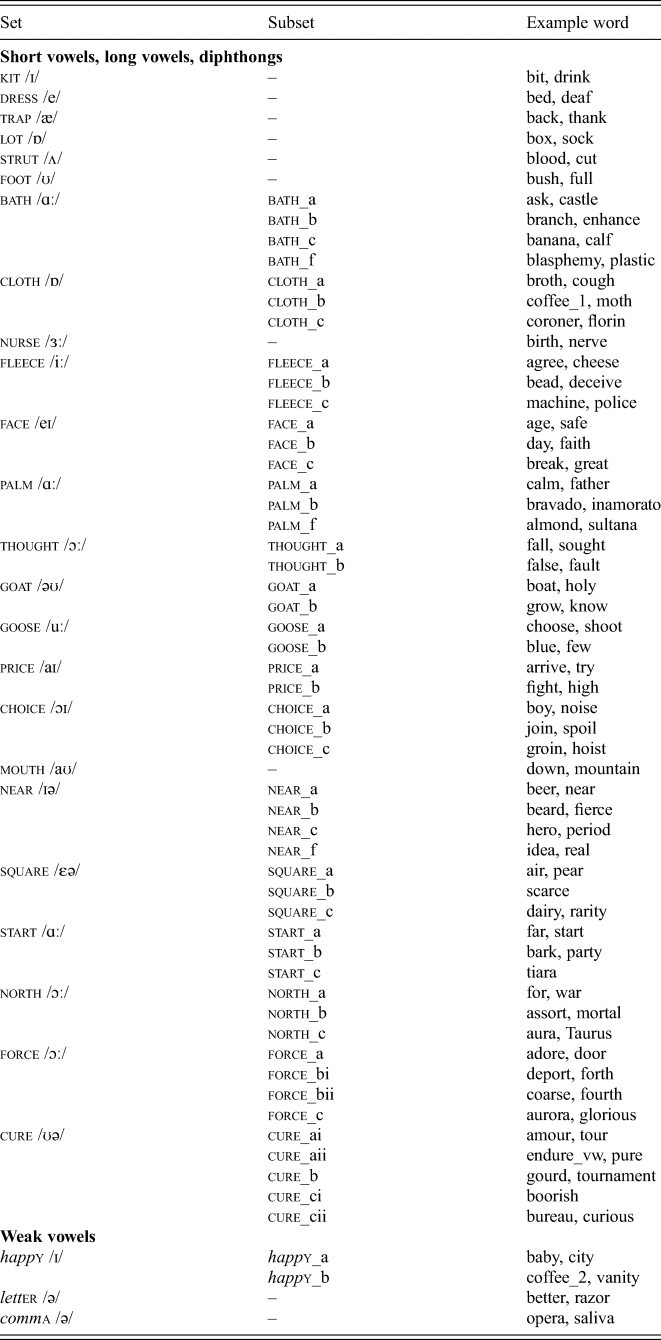
As noted above, pronouncing dictionaries are an ideal source for the study of phonological changes because they provide evidence for the entire lexicon. Nonetheless, in order to keep the project to a workable size and to obtain a balanced dataset across the sources, we drew up a list of words of interest, taking Wells’ Accents of English as a reference point, in particular his list of standard lexical sets for the vowel system in varieties of present-day English (Reference Wells1982: 119–20, 127–68).Footnote 9 The use of Wells’ lexical (sub)sets and their associated example words is standard practice in studies of present-day phonological variation and change and has also been used extensively in historical phonology research. We have therefore retained the subsets in the structure of ECEP in order to determine whether major distinctions between accent systems in present-day English have precursors in the variation attested across our eighteenth-century data sources. Likewise, including the full range of Wells’ example words allows for the detection of differences in lexical distribution between the primary sources, and also between these and the contemporary accents described by Wells (see, for instance, Trapateau's (Reference Trapateau2017) observations on the origin of distinctive pronunciation features in present-day American English and British English varieties with regard to the force–north merger or the pronunciation of the unstressed ending -ile). In addition, given that Wells’ lexical sets are designed only to investigate vowel systems, and that in the study of LModE phonology some consonantal changes are also of interest, we have constructed additional consonantal sets and extracted relevant data in the same way as for Wells’ vowel sets. Thus, the ECEP database provides Unicode IPA transcriptions for the relevant segment of each word given as an example of its vowel or consonant standard lexical set and subset, as documented in the selected eighteenth-century pronouncing dictionaries.
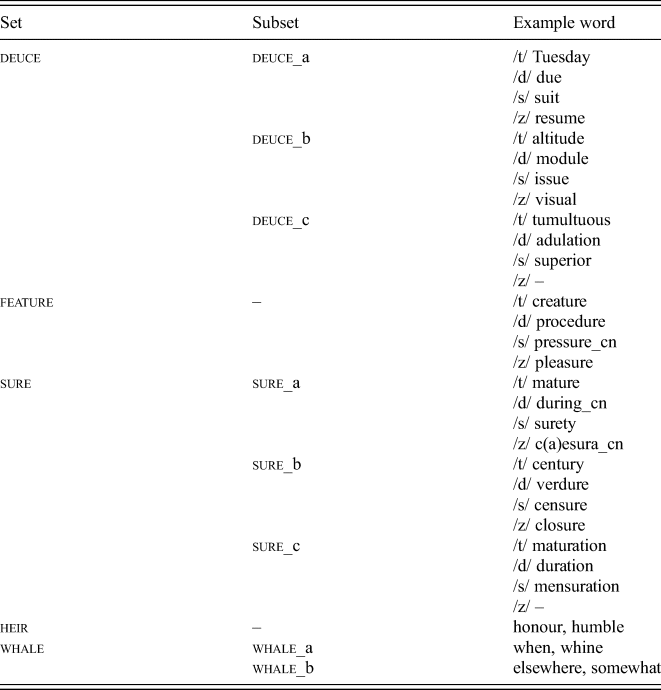
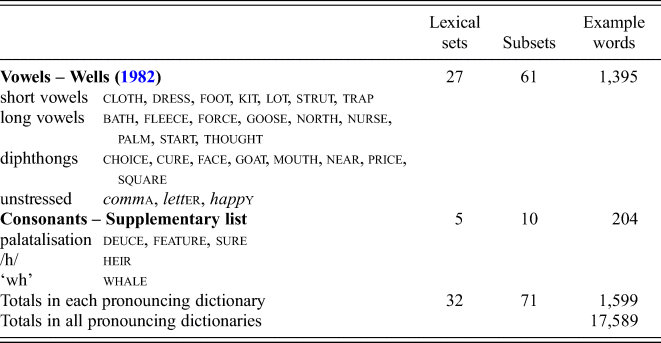
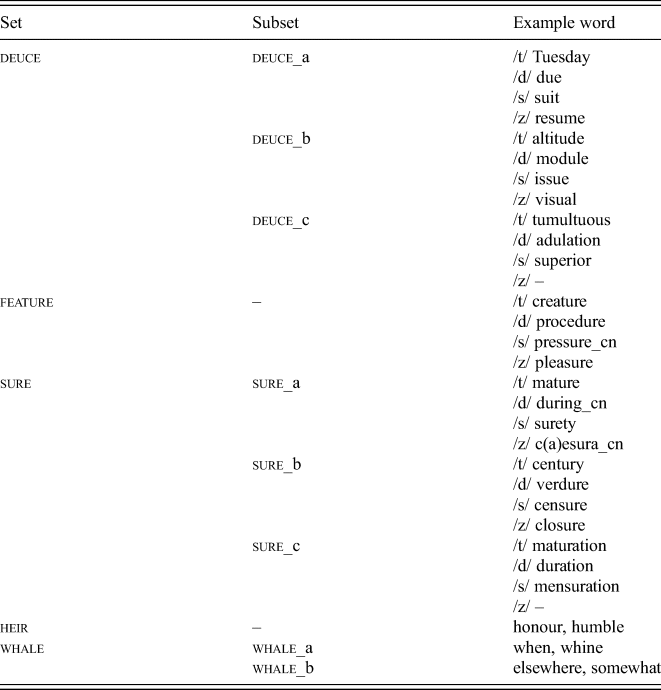
Table 2 presents an overview of the categorisation of the phonological data in ECEP and the distribution of the items transcribed, with further details provided in Appendix tables A1 and A2. As far as the vowel data are concerned, Wells’ list contains twenty-four lexical sets for stressed vowels (classified as short vowels, long vowels and diphthongs according to their pronunciation in RP) and three sets for unstressed vowels, distributed across sixty-one subsets. As can be seen in the table, of the 1,737 example words in Wells, the ECEP database documents transcriptions for some 1,395 of these. The difference here lies in the necessary exclusion of example words due to various methodological principles, such as example words that were introduced into the English language after 1800, proper names, country names or cliticised spellings (for details see Yáñez-Bouza et al. Reference Yañez-Bouza, Beal, Sen and Wallis2018: 208–9). The added supplementary material for the study of the consonant system includes five sets, ten subsets and 204 example words: the sets deuce, feature and sure address the process of palatalisation, dealing with stress patterns (subsets _a for stressed syllable, _b for post-stress syllable, _c for pre-stress syllable) and the pre-/j/ phoneme (/t, d, s, z/ in each set); the set heir relates to the presence or absence of word-initial /h/; and the set whale is concerned with the pronunciation of ‘wh’ /ʍ ~ w ~ h/. For instance, the inclusion of the three lexical sets deuce, feature and sure in ECEP allows Beal et al. (Reference Beal, Kytö and Smitterberg2020) to shed new light on the processes of palatalisation and yod-dropping by identifying interaction of phonological (stress, rhoticity, phoneme) and extra-phonological (chronology, geography, stigmatisation) motivations for these developments. Overall, ECEP contains phonological evidence of eighteenth-century English for 1,599 example words in each dictionary and a total of 17,589 individual lexical items.
Phonological data in ECEP

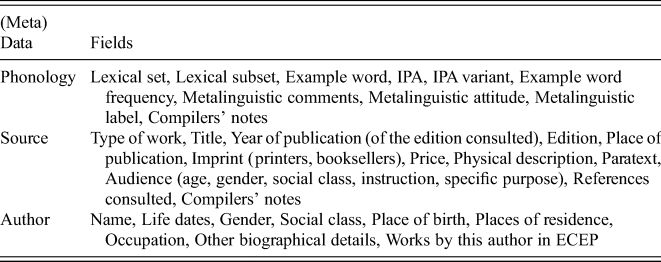
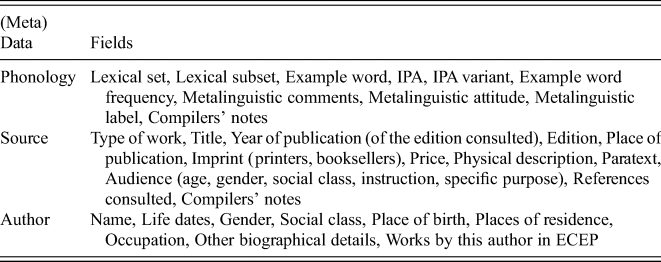
The compilation of ECEP aims to offer a more comprehensive dataset for evidence of variation and change and hence goes beyond the linguistic phonological annotation based on lexical sets. Its design lays out the data in thirty different fields across three main categories: phonology, source (dictionary) and author, as listed in table 3.Footnote 10
Design of the ECEP database
Most dictionary entries provide a single pronunciation for the lexical item in question; when variation is noted by the authors the variant sounds are also documented in the field ‘IPA variant’; for instance, Perry's variation between /h/ and silent /h/ in the example words herb and humble (lexical set heir). Having authorial metalinguistic discourse concerning variation and/or change is fundamental in avoiding phonetic misinterpretations of historical data, as seen in Trapateau's (Reference Trapateau2017) study of vowel reduction in the pronunciation of unstressed endings. In the selected sources, orthoepists sometimes show sensitivity to contrasts in meaning, so that for Perry the word whist (whale_a set) was pronounced /w/ for the meaning ‘game of cards’ but /ʍ/ for the meaning ‘be silent’. Authors were also aware of variants regarding stress patterns, and thus in the dictionaries by Scott (Reference Scott1786) and Burn (Reference Burn1786) the entries for conjure (cure_aii set) note different pronunciations for the stress on the first versus the second syllable, as in /juːr/ and /jʌr/. Style and register are also an important issue in this period, as noted by Walker (Reference Walker1791) in the example word front (strut set): ‘Mr. Sheridan marks this word in the second manner only [/ɒ/]; but I am much mistaken if custom does not almost universally adopt the first [/ʌ/]. If the second is ever used it seems to be in poetry, and that of the most solemn kind.’ When it comes to variation in terms of normative attitudes towards ‘proper’ and ‘improper’ pronunciation, the author who offers the greatest number of critical comments amongst our sources is Walker (Reference Walker1791), most often with regard to pronunciations considered ‘vulgar’ in contrast to the educated speech in London (see also Trapateau Reference Trapateau2016); for example, he states that sausage (cloth_b set) is pronounced /ɔː/ by ‘correct’ speakers but /æ/ by ‘vulgar’ speakers. Likewise, provincial pronunciations were severely criticised as ‘marks of disgrace’ (Sheridan Reference Sheridan1761: 29–30), an illustrative example here being the Irishisms stigmatised in Walker's entries for door and floor (force_a set), which are ‘universally pronounced by the English as if written dore and flore [/oːr/]; but in Ireland they preserve the regular sound of oo [/uːr/]’. It should be noted that while ECEP records evidence of variation between the ‘received’ speech of London and of the equivalent in provincial centres such as Edinburgh and Newcastle, it is not intended to be a fully documented database of dialectal pronunciation.
4 Final words
This article has introduced the context for the compilation of the ECEP database and has described its design and contents. We hope that the availability of ECEP and its future developments will help to turn scholars’ attention to the field of historical phonology so that it will no longer be the ‘poor relation’ in the family of LModE studies (Beal Reference Beal, Markus, Iyeiri, Heuberger and Chamson2012a: 27), and that it will meet the demands of the growing research community in LModE generally. From the methodological perspective, ECEP also aims to promote the use of databases as research resources in English historical linguistics, in parallel to or alongside large text corpora (see the Eighteenth-Century English Grammars Database and, for earlier English, NerthusV3: Online Lexical Database of Old English (Martín Arista et al. Reference Martín Arista, Fernández, Palacios, Ojanguren López and Narbona2016)).
Appendix
Wells’ (Reference Wells1982: 127–68) lexical sets in ECEP (sorted as in Wells)

Consonant lexical sets in ECEP