To some extent, domestic politics determines the fate of any member state presidency of the European Union (EU). Nonetheless, domestic politics is until now little studied and under-theorized in research on EU presidencies. Contributions on EU presidencies primarily address external factors,Footnote 1 whereas the domestic politics of EU presidencies has not been studied systematically.
More generally, developments in EU political arenas cannot be fully understood without reference to domestic party politics. The domestic politics approach to the study of European integration focuses on the impact of domestic politics – including the processes of domestic preference formation – on EU policy-making. In outlining this approach, Bulmer suggests that the role of political organizations such as political parties, interest groups and parliaments should be examined.Footnote 2 In short, theories and analyses of European integration in general and of EU presidencies more specifically, and which are concerned with deeply political processes, should take domestic structures into account. Domestic structures can be expected to impose constraints on the freedom of action of governments and their leaders, and therefore on EU presidencies.
This article aims to start filling a gap in contemporary research on EU presidencies. In particular, the article will stress and examine the role played by domestic factors in the development and fate of EU presidencies. In the words of Quaglia and Moxon-Browne: ‘However skilful a Presidency may be in managing its role, it has little control over the domestic context in which it operates’.Footnote 3 This alerts us to the interplay between government and opposition and the inherent conflict between them and the party-political battles that break out as a consequence. This is, as we will see, one of the critical roles played by political parties during the periods of EU presidencies. What is the level of conflict between the government and the opposition in EU presidencies? The question is central to this article and it is addressed through an in-depth analysis of one single case, Sweden, through a comparative examination of the role that domestic politics played in the Swedish EU presidencies of 2001 and 2009.
EU presidencies are rarely studied systematically in a comparative perspective. The two presidencies allow for a structured, focused comparison.Footnote 4 We adopt a comparative approach designed to identify and explain variation across time, and to generate hypotheses and to contribute to theory-building for future research. Thus, this is a ‘hypothesis-generating’ comparative case study.Footnote 5
In terms of material, ten formal interviews were conducted with people occupying key roles in EU policy-making: top-level officials as well as other civil servants, including special advisers, and politicians. Most interviews were conducted in early 2010. In addition, the case study draws on informal conversations, documents, parliamentary records, media reports and commentaries.
The article proceeds in three steps. First, we discuss conflict/consensus in politics in general and in Sweden in particular, as well as in EU politics and for presidencies. Second, we present the case study of the level of domestic conflict during the two Swedish EU presidencies, focusing on government–opposition dynamics in 2001 and 2009. In the conclusion, finally, we summarize our findings and expand on hypotheses and the broader implications of the key findings for future research.
CONFLICT AND CONSENSUS
Conflict is a defining characteristic of politics, where values and interests are at stake. Nonetheless, there is often a desire to arrive at consensus in politics. This is particularly so where foreign policy is concerned. As a rule, political parties tend to conform to norms of national consensus at times of crises and of external threats to the nation: that is, to rally around issues of national or ‘homeland’ security. Such situations are said to call for party-political unity in the name of the national interest. In the USA, this is called the bipartisan approach to foreign policy. The major political parties are expected to reach agreement on a ‘party truce’. More generally, a party truce can be defined as a situation where government and opposition refrain from all party-political battles.
As a matter of fact, it could be in the self-interest of the opposition to avoid political conflicts with the government; to fight can be seen as irresponsible in the eyes of the voters. At the same time, however, citizens can be suspicious of consensus among the political elite, which can be seen as collusion. Consensus may entail a weakening of democracy in that the public debate and transparency and the principle of ministerial accountability are weakened.Footnote 6
The extent of conflict or consensus is conditioned by the history, institutions and constitutions of a particular country; by the historically and socially shaped political culture. In some countries politics is more conflictual, in others more consensual.Footnote 7 Sweden is often described as a consensus democracy where a strong norm of consensus has traditionally characterized political decision-making. As Arter notes, there has been ‘substantial support in the political science literature for the perception of the Scandinavian states as consensual democracies’.Footnote 8 Arter further notes that ‘the “bloc character” of Swedish parliamentary politics has become more pronounced in recent years’.Footnote 9
FORGING CONSENSUS OVER EUROPEAN AFFAIRS
The level of conflict can be expected to be lower in foreign policy than in domestic policy. At the same time, it is critical to note that the increasing internationalization of politics in general has affected the conditions for politics more broadly.Footnote 10 Political decision-making today takes place through cooperation and negotiation with other states to a much greater extent than in the past. To achieve the strongest possible negotiating mandate, the government has an interest in gaining broad national support for the positions taken internationally. This is the context of EU decision-making, where negotiations are practically permanently under way.
In the EU, member state governments need to ‘speak with one voice’ in order to formulate a common national position into a coherent whole and for policy to be effective. This seems to have been more pronounced in smaller member states based on the logic that national consensus and policy consistency increase bargaining power in EU institutions.Footnote 11 The call for national consensus is accentuated by the responsibility of holding the presidency of the EU. During the EU presidency period, the government of the member state holding the presidency is expected to be an impartial mediator.Footnote 12 The government in question wants to maximize its room for manoeuvre and therefore seeks domestic peace in order to concentrate on the presidency. Consequently, it is in the government's self-interest to turn the presidency into a national concern. In this situation the political opposition faces a dilemma. On the one hand, it is expected to demonstrate national responsibility and to back the government vis-à-vis the EU and other member states. On the other hand, there is a certain pressure on any political party, not least from within the party itself, to come forward with its own policies and priorities. Whereas the government may use the presidency to emphasize its competence – and to convert the presidency into domestic or electoral gains – the challenge for the opposition is to act as an active critic of the government while at the same time being loyal for the sake of national interests. In short, it can be difficult for the political opposition to mount an effective opposition to the government during EU presidencies. The responsibilities connected with holding the presidency reinforce the argument for national unity or ‘party truce’.
Examples of Domestic Conflict During Presidencies
Even if the general pattern from Sweden and other EU countries is that the government at least seeks to put conflicts on hold during the presidency period, it is also the case that the level of political conflict is high in connection with EU presidencies. To illustrate we will highlight domestic conflict levels in two presidencies preceding the Swedish one. One case is the Slovenian EU presidency in the first half of 2008. In view of the presidency, on 17 May 2007 the majority of parliamentary parties signed an agreement informally known as the ‘agreement on “non-attacking” the government in the period of holding the EU presidency’.Footnote 13 However, this agreement did not hold in the context of the impending presidential election in the autumn of 2007 and the parliamentary elections shortly after the presidency period.
An even better case is that of the Czech EU presidency in the first half of 2009. The Czech Republic is known for zero tolerance as regards the relationship between the (main) parties in opposition and government, with very high levels of tension between the parties, which was also demonstrated during the preparations for the presidency programme. In the presidency period a vote of no confidence from the Social Democrats towards the centre-right government resulted in a crisis in the government and its collapse. As a report on the presidency states: ‘The fact that the Government lost the confidence of parliament suggests an interesting observation. The democratic opposition, i.e. the Social Democrats, sacrificed the credibility and reputation of the Czech Republic in the EU for short-term, domestic political gain…The fall of the Government caused the political death of the Presidency.’Footnote 14
The Czech government crisis was an example that Swedish Prime Minister Fredrik Reinfeldt highlighted when he urged the opposition to agree to national consensus in view of the Swedish presidency, which followed directly from that of the Czech Republic. It is against this background that we now turn to the Swedish case.
THE LEVEL OF DOMESTIC CONFLICT DURING SWEDEN'S EU PRESIDENCIES
When Sweden held the EU presidency in 2001 the level of domestic conflict was very low, in line with the agreement of a ‘party truce’ between the government and the opposition, which the opposition parties complied with.Footnote 15 Looking back, former Prime Minister Göran Persson wrote in his memoirs:
The opposition gathered around the efforts to make the Swedish presidency as good as possible. Thanks to that attitude Sweden could make a genuine effort and anchor our programme well in advance. All Swedish party leaders were involved in the process and so were every party's representative in European affairs…During the six months when Sweden had responsibility for the presidency I was not challenged in domestic politics once. I could therefore make a wholehearted bid and during these six months I almost exclusively devoted myself to my presidency.Footnote 16
In 2009, this was cited by Persson's successor, Fredrik Reinfeldt, who had been Sweden's prime minister since October 2006. The question was whether the previous experience of domestic peace would repeat itself, if there would also be consensus in domestic politics during Sweden's EU presidency in the second half of 2009.
Government and Opposition Dynamics Before the 2001 and 2009 Presidencies
Ahead of the 2001 presidency there were considerable efforts made by the government to reach a broad agreement with the opposition. Even though there were disagreements concerning the priorities to be made, there was a distinct striving for a general agreement. Hegeland and Johansson write: ‘In line with the fact that the presidency to a large extent is being regarded as a foreign policy task, the government aimed for a broad anchoring of the policies they aimed to promote.’Footnote 17 The non-socialist opposition parties had certain aspects of the government's agenda that they wanted to modify. The moderates wanted to lift the presidency's commitment on World Trade Organization (WTO) negotiations and the liberals stressed institutional issues as well as immigration and asylum. The parties to the left of the political spectrum, the Greens and the Left (ex-communist), cooperated with the government on domestic politics but could not cooperate on EU affairs as they were staunchly Eurosceptic. The two parties agreed on making environment a top priority, but wanted a different agenda to the government's. The Greens raised issues of consumer protection and food safety while the Left Party planned a strategy against European Monetary Union (EMU). The Left's campaign was criticized by the Social Democrats and never gained any great attention.Footnote 18
On several occasions Prime Minister Persson urged the opposition to be loyal and responsible. During 2000, the opposition party leaders were invited three times for round table discussions at the Prime Minister's Office. A special reference group was formed in parliament with representatives from all parties with the aim of enhancing deliberation and disseminating information ahead of and during the presidency.
In the run-up to Sweden's EU presidency in 2009, Prime Minister Reinfeldt appealed for consensus and called for a party truce during the presidency. In doing so, he drew attention to the party truce that had been agreed during the former Swedish EU presidency and also to the negative consequences that the party-political battles in the Czech Republic had for its presidency immediately prior to the Swedish one.
When the prime minister presented the presidency programme in parliament on 23 June 2009 he stressed the importance of gathering the nation behind the presidency: ‘To lead the EU is not just a task for the government, but for the whole of Sweden.’ This strongly echoed how Göran Persson reasoned ahead of the 2001 presidency; he urged the opposition to show responsibility and to back the government.
For quite some time it was unclear how the opposition would respond to the call for a party truce. Whereas the approach taken by the Social Democrats and the non-socialist parties to the EU and European integration had been broadly similar, their policies began to diverge strongly after the European Court of Justice issued its ruling in the LavalFootnote 19 case in December 2007.Footnote 20 The Laval ruling intensified tensions in the EU over balancing workers' ability to move across borders with labour and trade union rights, and in Sweden over the system of collective wage bargaining. The issue was highly politicized, and remained contentious during and beyond the 2009 European elections.
On 14 May 2008, the same day that the leaders of the political parties in parliament were to meet at the Prime Minister's Office to discuss the EU presidency, the Social Democratic Party launched its own alternative proposal for the presidency programme, emphasizing three ‘S’s – Sustainability, Security and Solidarity.Footnote 21 This related to the 2001 presidency, when the Social Democratic government had three ‘E’s as its priority areas: Enlargement, Employment and Environment. The Social Democrats criticized the government for being unclear in regard to its priorities and were generally critical of the government's programme, indicating a higher level of conflict. Of all the policy issues it was most notably the conflicts surrounding the aftermath of the Laval verdict that threatened to linger if there were no agreement between the major parties. The leader of the Left Party, Lars Ohly, and one of the spokespersons of the Green Party, Peter Eriksson, also stressed that they were not prepared to keep a low profile on EU issues during the entire presidency period. Eriksson emphasized that a party truce was not favourable for democracy and reminded the government about the impending European election campaign and of the parliamentary election campaign in 2010, which would be started shortly after the Swedish presidency period.
For his part, the prime minister criticized the opposition for its lack of support and said that its approach was radically different from that of the non-socialist opposition in 2001. He argued that a party truce was necessary in order to make the Swedish presidency of the EU a success. He also claimed that the party truce should include domestic politics and that these debates should be put aside and returned to in 2010, after the presidency. According to the prime minister, all the EU presidencies he had studied had a sort of party truce.
To galvanize opposition support for the EU presidency, Prime Minister Fredrik Reinfeldt invited the leaders of all the political parties represented in the Riksdag to meetings at his office. Meetings were held on 14 May 2008 and 5 May 2009. Before the May 2009 meeting, the prime minister publicly urged domestic peace during the presidency. Furthermore, he referred to the Czech Republic, where a government crisis occurred during the presidency period in the first half of 2009, and to the party truce during the 2001 Swedish EU presidency. To his great satisfaction, during the meeting the opposition agreed in principle to a party truce. As he understood it, there was now agreement on a party truce, if that meant a shared responsibility for how Sweden would handle the presidency and that the parties would avoid unnecessary squabbles. At the same time, however, the opposition acknowledged that Reinfeldt's own Moderate Party as well as the Social Democrats would have party conferences during the presidency period and that the government was to present a proposal for the state budget; these were all highly political events.
Although the government and the opposition agreed – however half-heartedly on the part of the opposition – to play down the domestic political differences, they did not agree on whether to call it a ‘party truce’. The leader of the opposition Social Democrats, Mona Sahlin, did not want to call it a ‘party truce’ and emphasized that the political debate would not cease. Insofar as the opposition actually agreed to a ‘party truce’, this was a consensus of convenience, not conviction; disagreements and policy differences remained.
Despite the broad agreement – at least in principle – over a party truce during the presidency, the prime minister was nonetheless put under pressure by the opposition when he presented the presidency programme in parliament on 23 June 2009.Footnote 22 The main disagreements between the opposition and the government in the run-up to the presidency concerned the directive on the posting of workers – and labour market regulation more generally – and the level of ambition to combat climate change.
From the conflicts surrounding the preparations for the presidency, we will now address the actual presidencies to sketch out the general patterns of conflict as well as analysing the areas in which the conflicts between the government and the opposition emerged.
The Level of Conflict During the 2009 Presidency
In order to estimate the levels of conflict in the domestic arena during the two presidencies we use quantitative data (only available for 2009)Footnote 23 from the European Affairs Committee (EAC) in the Swedish Parliament and qualitative assessments of the issues politicized during the two presidencies.
The EAC constitutes the central arena of the Swedish parliamentary system for control of the government's actions in the council. There was a major reorganization of the way EU affairs are handled in parliament between 2001 and 2009 in that the specialized committees was given a much larger role to play in scrutinizing the legislative proposals, while the role of the EAC was reduced to controlling the strategies and policy positions of the government when proposals reached the council for decision.
During the presidency in 2009 the EAC held 24 meetings and dissenting views are recorded for some 50 different items on its agenda. The three opposition parties held concurrent dissenting views in 20 of these cases. The most dissent was recorded for the formation of the Council for Agriculture, followed by the General Affairs and External Relations Council and the Council for Economic and Financial Affairs. Most of the dissenting views were recorded for policies such as intervention prices for butter or fisheries policies. However, a number concerned the key priorities of the Swedish presidency, such as the Stockholm Programme and the preparations ahead of the climate change conference in Copenhagen. The fact that the government lacked bipartisan support for its conduct of the presidency in the EAC can be taken as a first indication that the level of conflict was higher in 2009 than in 2001. Most of the concurrent disagreement from the opposition was related to the Council for Agriculture and the Council for Transport, Telecommunications and Energy, with five and four simultaneous dissenting views respectively.
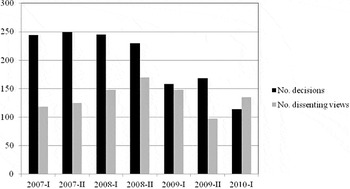
In order to estimate the relative level of conflict in the EAC during the presidency we use data from 2007 to the first half of 2010 for the number of decisions and the number of dissenting views. As the dissenting views of the three opposition parties are recorded individually, a maximum level of conflict – that is, a situation where the three opposition parties disagrees with the government on every decision – would entail a 3:1 ratio.
Figure 1 clearly shows that the number of dissenting views during the six-month presidency is lower than in the three preceding six-month terms, both in absolute numbers and also as a share of the number of decisions. This supports a notion that the opposition showed restraint in recording dissenting views during the autumn of 2009. An interesting observation of a more general nature is that the number of dissenting views as a proportion of the number of decisions rose steadily from spring 2007 until spring 2009, dipping during the presidency and soaring afterwards.
Number of Decisions and Dissenting Views in the EAC, 2007–10

The degree of opposition cohesion also increased during the period and peaked in spring 2009 with concurrent dissenting views on nearly 20 per cent of the items on the agenda; it dipped during the presidency and increased to almost 30 per cent during the first half of 2010. It is also interesting, although not surprising, that the Social Democrats were pivotal if there was to be a cohesive opposition. During the presidency the Social Democrats recorded 21 dissenting views and were in 20 cases joined by both the Green Party and the Left Party. Thus, according to the quantitative data the level of political conflict in the EAC was lower during the presidency, which supports the notion of a self-restrained opposition.
However, we will argue below that the issues that were selected for political conflict break the expectation of a party truce since they concerned, inter alia, issues that were central to the strategy of the government for the presidency period. The conduct of domestic politics during the period adds weight to this assessment.
Contentious Issues in 2001 and 2009
Ahead of the 2001 presidency, there were some areas where the opposition had priorities that did not match the government's. Apart from the Eurosceptic flank (Greens and Left parties), who wanted to have a different agenda, though, there was strong support among the opposition for the government's agenda (see above). As far as the three Es (Environment, Employment and Enlargment) were concerned, there was no major disagreement among the parties. The general consensus was particularly strong concerning enlargement, where several of the leading opposition parties firmly supported the government's pro-enlargement policy.
Ahead of the presidency in 2009 the opposition primarily politicized labour market policies, but this was not a major issue during the autumn of 2009. Rather, the domestic debate on European affairs focused mainly on climate change negotiations and the Stockholm Programme (see below), and some debate was also generated around the concept of Social Europe in the context of the Europe 2020 strategy. These were issues that were politicized outside the walls of parliament primarily by the media.
Climate Change. The negotiations leading to the Kyoto Protocol took place at around the time of the first Swedish presidency. Environment was a priority then, with support from all political parties. There is no evidence of conflicts surrounding this issue in 2001.Footnote 24
The strategy of the presidency ahead and during the climate change negotiations in Copenhagen came to be the most contested of the presidency-related issues in 2009. Already beforehand and on the very first day of the presidency, the opposition criticized the government for lowering its ambitions and expectations for the climate change conference through its domestic policies and as the EU president. The position of the Green Party and the Left Party on this issue could be foreseen, but that the Social Democrats did not support the government's efforts was more unexpected as this must be seen as a prima facie issue where the presidency would benefit from domestic peace.
One of the leaders of the Green Party wrote in an op-ed halfway through the presidency that the prime minister ‘has not exhibited the kind of leadership on the climate issue which is required by the presidency of the EU…Ahead of the climate summit in Copenhagen, the Swedish position has been weak and marred by misjudgements and contradictory positions.’Footnote 25 The Social Democrats stressed the unwillingness and ineptitude of Reinfeldt to raise the bid of the EU,Footnote 26 while the Left Party called on the minister for the environment to stop being cowardly and to take a lead.Footnote 27
Taken together, the opposition claimed that the government failed to exercise an effective leadership role in the climate change negotiations. They said that the ambitions of the government were too low: one failed to cajole the other member states to accept a larger share of the burden and one failed to act as a bridge between North and South. Predictably, the government strongly disagreed with these assessments and argued that its strategy indeed was aimed at – and appropriate for – producing an EU position which was as comprehensive as possible.Footnote 28
Justice and Home Affairs. The other policy area that was to become politicized during the 2009 presidency was cooperation in justice and home affairs matters. In 2001 there were some minor issues of conflict ahead of the presidency in this area as the Liberal Party (in opposition at the time) urged the government to raise issues of migration and asylum during the presidency. However, these tensions never materialized into conflicts during the presidency. In 2009, it fell to the Swedish presidency to finalize negotiations over a new five-year programme which was to set out ambitions and aims in this field, the so-called Stockholm Programme. The government was criticized in this area both for its conduct during the presidency and for the content of the policies adopted. The Social Democratic spokesman on legal affairs wrote, for example, that the efforts of the minister for justice, Beatrice Ask, ‘must be seen as a major failure’,Footnote 29 and a party truce concerning these issues was not on the agenda for the Social Democrats.Footnote 30
In terms of the content of the Stockholm Programme, the opposition parties were critical of different aspects of this package. The Social Democrats along with the Green Party and the Left Party opposed the provisions on asylum, and the Left Party also opposed the positions on labour migration. Other areas where the opposition actively dissented from the government concerned exchange of information and the legal rights of the individual. Taken together, this amounted to a lack of comprehensive support for the government during the presidency in yet another prioritized policy area. The government, just as in the case of climate change, agreed with neither the policy positions of the opposition nor the critical reviews of its achievements.
General Evaluations
After both presidency periods, the opposition paid tribute to the government for its handling of the period as leader of the EU. The positive outcomes regarding the enlargement process received most attention and credit in 2001. One area where the government faced criticism was concerning the debate about the future of the EU. After the Nice Treaty in 2000, the European Council agreed to return to constitutional and institutional reform. The Swedish presidency took few bold initiatives regarding the future architecture of the EU; the governing party and its leader had positioned themselves as something of a defender of a status quo with strong support for intergovernmentalism. Parts of the opposition criticized the government for not being bold enough.
Towards the end of the 2009 presidency both the government and the opposition were keen to promote their respective reviews of its execution. The opposition was in the end willing to concede that the presidency was well run from an administrative point of view but the praise generally ended there. The foreign policy spokesman of the Social Democrats wrote in December 2009: ‘When the evaluation [of the presidency] is to be done, it is central to look for concrete results in the areas prioritized by [the PM] Fredrik Reinfeldt himself, the financial crisis, climate and unemployment. Few, if any, Swedish initiatives can be found in these areas and the concrete results have not materialized.’Footnote 31
Criticisms regarding the lack of progress on these issues were repeated when parliament debated the presidency in February 2010. In this debate the labour market regulations entered the discourse once again, but for the purposes of this article the political conflicts ex post does not affect the analysis. The government, on the other hand, was content with its presidency, claiming to have ‘delivered good results in all prioritized areas’.Footnote 32
Domestic Politics
Not only are the political battles surrounding EU affairs important in the context of domestic peace during a presidency, but so too are purely domestic political conflicts, which may distract resources and focus from the tasks of the presidency. The domestic political pressure increased during the presidency: the effects of the economic crisis and the presentation of the budget of the government during the autumn triggered political debates concerning employment and taxation; the government's handling of the originally Swedish GM-owned car-maker SAAB was also a source of political tensions between the blocs. Moreover, a quite fierce debate surfaced during the autumn regarding certain aspects of the social security system. This debate can only be labelled as an open political confrontation; the government was forced into a defensive position. This was also a political conflict where the relative absence of the prime minister due to his presidency commitments was most notable, leaving portfolio ministers to fight the battle. There was consequently no party truce concerning domestic politics during the presidency, and the conflicts were both manifest and rather intense. It is possible, though, that the conflicts were of lower intensity than would have otherwise been the case, as we cannot know how domestic politics during the autumn of 2009 would have developed in the absence of a presidency.
We conclude that during the 2009 presidency there was no political conflict in the great majority of EU-related issues. However, the opposition did not support the positions of the government in certain issues that were central for the presidency. Moreover, the intensity of the criticism increased during the autumn. Finally, conflicts concerning domestic politics did emerge and the opposition did not refrain from criticizing the government. In the last month of the presidency, the relative absence of the prime minister in the domestic debate became a liability for the government.
SOME TENTATIVE DETERMINANTS OF LEVEL OF POLITICAL CONFLICT
As has been shown above, the level of political conflict was higher during the Swedish EU presidency in 2009 than in 2001, and below we set out four tentative and general explanations that can add to our understanding of domestic political conflict during EU presidencies. These explanations have been induced through comparisons between the two Swedish EU presidencies, where we have tried to identify structural or institutional differences between the two terms.
Political Timing. The electoral calendar was different in 2001 compared to 2009: the former presidency period had no elections 12 months either before or afterwards. By contrast, the elections to the European Parliament in 2009 were held only weeks before the inception of the 2009 presidency. Even though political parties consider European elections as less important than national elections, they can be seen as a dress rehearsal for the next general election. In such a context central actors are less likely to agree on a bipartisan approach or to seek a consensual approach. A scenario where parties that had just fought an election campaign against each other were to collude and form a unified front for a presidency would risk alienating party members and voters at large.
Further, the time to the next general election was shorter in 2009 and would have added to the level of conflict during the presidency. It was less than nine months between the end of the presidency and the general election, and it was integral to the re-election plan of the government that a successful presidency would be a valuable asset. On the other hand, this situation also created disincentives for the opposition to maintain a party truce as the attraction and logic of criticizing the government both on policy and process increased as the elections approached.
Degree of Political Competition. Swedish politics has often been characterized by consensus, but the degree of political conflict varies over time. The ideological polarization of the party system has varied, as has the political competition for office. Since the formation of the four-party alliance of the centre-right during the 2002–6 parliament – which in turn more or less forced the Social Democrats to form a similar alliance with the Left and the Green parties later on – the competition for office has increased significantly. The Swedish political system took on the characteristics of a two-party system, with low ideological competition but with intense competition over office – an observation that can add to our understanding of why conflict during the EU presidency in 2009 was higher than in 2001.
First, the value of signalling internal cohesion for the two blocs can be assumed to be high. Second, the domestic political potential for the government as a consequence of a successful presidency was huge both in 2009 and in 2001. The increased political competition did, however, present the opposition with a different set of incentives in 2009 as it had strong strategic reasons to remain critical of the government and try to argue that it lacked the competence for the job, in domestic as well as European affairs. If we are correct that the ideological competition was indeed lower in 2009, political parties can be expected to seek other types of conflicts, which we argue can be a partial explanation for the higher degree of conflict during the more recent presidency.
The Parliamentary Base of the Government. The most important structural difference between the 2001 and 2009 Swedish presidencies was that the latter was conducted under a majority government, whereas the former was carried out by a minority government. This meant, in parliamentary terms, that during the 2009 presidency the government did not need to seek the active or passive support of the opposition as long as its own backbenchers remained loyal. Therefore, coordination between the government and its parliamentary base became important to create and maintain support for policy positions and the conduct of the presidency. In contrast to 2001, the support and loyalty of the opposition was thus not strictly needed in 2009 for the implementation of the presidency. This may well have contributed to the higher level of political conflict during 2009, as breaches in a party truce would not bring any major parliamentary consequences for the government.
The European Dimension in Domestic Politics. The concept of European integration has been divisive and contested in Swedish society since the reorientation towards Europe in the early 1990s. It has also caused deep conflicts within political parties and increased polarization between parties positive and sceptic about the EU. However, during the last few years there has been a slow but rather dramatic shift in the conflict dynamics surrounding the EU dimension of Swedish domestic politics. The polarization between parties has decreased with regard to EU membership, and the splits within parties are gradually closing. At the same time, as EU membership has become ever more accepted, political conflicts over EU policies have become increasingly visible. This is particularly the case for decisions affecting the labour market. The changes in the Swedish party system should be seen and understood in the light of the shifts in Swedish public opinion, which since 2001 is increasingly positive to membership of the Union.Footnote 33
We argue that this changed domestic situation constitutes an important difference for the presidency in 2009 compared to 2001. First, a more consensual context regarding Swedish EU membership should have made certain aspects of the presidency easier for the government as it did not need to participate in debates with opposition parties or in the media regarding the fundamentals of EU membership. Second, the growing acceptance of membership has led to an increased use of opposition strategies within the existing political system. This, taken together with the parliamentary situation, can lead to increased conflict over policy, even though a presidency is in progress. Put differently, loyal opposition to the policies pursued by the government is not seen as opposition to the existing political system but as a normal part of the democratic system.
These four explanations can be generalized to testable hypotheses for further research on the domestic levels of conflict during EU presidencies.
CONCLUSIONS AND FURTHER RESEARCH
Our main results can be summarized as follows. There are strong incentives for governments when facing a six-month EU presidency period to seek domestic political peace, as it strengthens its room to manoeuvre. As there is a push towards the norm of the presidency as ‘honest broker’, the government may be forced to steer away from national interests in bargaining situations. Therefore, the acceptance of the role the government plays by its main challengers domestically is essential for avoiding domestic dissent. Second, the incumbent government will seek to show its own ability in governing during the period. The opposition, on the other hand, is squeezed between the traditional role of opposition and that of a responsible and credible alternative to the government. Therefore, incentives are mixed for the opposition.
Our results show that there were a number of conditions that made the levels of conflict higher during the Swedish EU presidency of 2009 than in 2001. Even though these results are based on a comparative study within a case, we believe there are a couple of analytical dimensions that could be transformed into hypotheses that could guide further research primarily on the role of domestic politics on EU presidencies, but could perhaps also shed some light on the government and opposition dynamics in relation to EU politics more broadly. In conjunction with our four main explanations to the varying degree of political conflict during EU presidencies we present four hypotheses that could be advanced in the comparative study of EU presidencies.
Hypothesis 1: The closer in time to next general election, the higher the degree of political conflict.
The timing of general elections does, of course, affect party politics, and the level of political conflict rises as elections approach. When comparing the cases of 2001 and 2009 we find that political timing is likely to explain part of the variation. The government will be increasingly tempted to score domestic political points from the presidency as elections approach. The opposition will, by the same logic, be increasingly tempted to seek political conflict in order to discredit the efforts of the government as elections are approaching.
Hypothesis 2: The greater the parliamentary base of the government, the higher the degree of political conflict.
We found that the need to get broad support for its EU policies was radically more important for the minority government in 2001 than for the majority government in 2009. This would mean that the strength of the parliamentary base determines the need for broader consensus and thereby the willingness on the part of the government to invest in finding broader support.
Hypothesis 3: The more competition over office, the higher the degree of political conflict.
The extent to which a presidency can be used in domestic politics as a means to increase support for the incumbent government, notably demonstrating the skills to handle office, combined with the extent to which the opposition is also trying to compete over office, will determine the level of conflict. The office-holder will try to use the period to demonstrate their capacity to lead and steer, and will have incentives to focus political competition around this issue. The opposition will – rather than competing over policy – try to oppose the government's leadership skills and its ability to govern efficiently.
Hypothesis 4: The more that European issues follow a domestic political logic (and not a European or foreign policy logic), the higher the degree of political conflict.
Foreign policy differs from domestic policy in democratic input and in its execution. European affairs tend to sit somewhere between these domestic and foreign policy logics. However, when holding the presidency, the executive can argue that it is in the interests of the state to show bipartisanship and to leave the handling of the presidency to the executive, and therefore a foreign policy logic should be prevalent. One would hold different expectations regarding the degree of political conflict, depending on the extent to which European affairs follow a domestic or foreign policy logic.
We argue that a key difference between the 2001 and 2009 presidencies is that conflicts over European affairs in the Swedish context have increasingly come to resemble domestic politics and to reproduce domestic conflicts. Climate change, issues of privacy and integrity, labour market regulations and the appropriate response to the economic crises are all issues that cannot sensibly be discussed in a purely domestic context. Consequently, the European arena has, at least in Sweden, become more integrated into domestic politics. As we stressed above, the presidency is a special instance of European affairs where the case for de-politicization is more akin to foreign policy than ‘normal’ European affairs, let alone domestic politics.
We believe that these four hypotheses can be tested in settings that differ substantially from the Swedish case and think the systematic study of comparative EU presidencies can be helped by the hypotheses derived. However, it is possible that when comparing different member states there will be another set of explanations that can account for variation in levels of conflict.