Introduction
In order to correctly decide whether an engineering change request imposed on an engineering entity, namely product part, assembly, design or manufacturing task, can be approved or implemented in the engineering development process, it is critical to predict the change propagation effects on the process (Jarratt et al., Reference Jarratt, Eckert, Caldwell and Clarkson2011). This issue is more complex when several or more changes simultaneously occur in different stages of the development process (Li et al., Reference Li, Zhao and Tong2017). In the literature, several models and methods have been proposed to predict change propagations in the local (Clarkson et al., Reference Clarkson, Simons and Eckert2004; Lee et al., Reference Lee, Ong and Khoo2004; Cheng and Chu, Reference Cheng and Chu2012; Koh et al., Reference Koh, Caldwell and Clarkson2012; Morkos et al., Reference Morkos, Shankar and Summers2012; Yang and Duan, Reference Yang and Duan2012; Hamraz et al., Reference Hamraz, Caldwell and Clarkson2013b; Wynn et al., Reference Wynn, Caldwell and Clarkson2014) and global (Chua and Hossain, Reference Chua and Hossain2012; Li et al., Reference Li, Zhao and Shao2012, Reference Li, Zhao and Ma2016; Li and Zhao, Reference Li and Zhao2014) perspectives. These models and methods are useful to facilitate design managers to adopt appropriate measures to handle one or more changes in the engineering development process.
Considering that engineering development is composed of several stages, such as requirement analysis, function design, structure design, embodiment design, and manufacturing (Pahl et al., Reference Pahl, Weitz, Feldhusen and Grote2007), design experts and managers need to know whether the multistage propagation process is controllable and can complete within the limited time and budget constraints according to their change decisions, so a dynamic model describing change durations, numbers of changes, etc., at different product development times is indispensable in addition to predicting change impacts on engineering entities. However, although the change prediction methods (Clarkson et al., Reference Clarkson, Simons and Eckert2004; Lee et al., Reference Lee, Ong and Khoo2004; Cheng and Chu, Reference Cheng and Chu2012; Chua and Hossain, Reference Chua and Hossain2012; Koh et al., Reference Koh, Caldwell and Clarkson2012; Li et al., Reference Li, Zhao and Shao2012, Reference Li, Zhao and Ma2016; Morkos et al., Reference Morkos, Shankar and Summers2012; Yang and Duan, Reference Yang and Duan2012; Hamraz et al., Reference Hamraz, Caldwell and Clarkson2013b; Li and Zhao, Reference Li and Zhao2014; Wynn et al., Reference Wynn, Caldwell and Clarkson2014) can help designers select the most economic or riskless change propagation paths, to the author's knowledge, no change propagation dynamic model has been proposed to predict the evolution trends of propagation characteristics such as the number of changes, the entity infection rate (the number of changed entities with respect to the total ones), and change costs with respect to product development time although change propagation dynamics have been observed in the literature (Pahl et al., Reference Pahl, Weitz, Feldhusen and Grote2007). These problems are important because of the observed phenomenon that when multistage engineering changes propagate in the development process, they may cause change ripples, blossoms, or avalanches (Eckert et al., Reference Eckert, Clarkson and Zanker2004) due to the interwoven dependencies between engineering entities, and thus engineering development processes and product quality may be affected to different degrees.
The dynamics of engineering change propagations across multiple product development stages usually are difficult to be predicted manually by designers or product managers because many engineering entities and different engineering dependencies are involved. Furthermore, different product development divisions may have conflicting goals when implementing changes propagated into their domains. Therefore, the following three sub-problems need to be solved in order to build a uniform change propagation dynamic model. First, engineering entities in different development stages, such as product parts, assemblies, and tasks, and their relationships must be represented in a uniform way, the relationships include dependencies between engineering entities within one stage and across different ones. Second, based on this engineering model granularity, in what kinds of ways propagation dynamics can be modeled by taking different change propagation strategies and different propagation parameters into consideration? Third, how the dynamic model can be solved in order to obtain propagation evolution trends in the whole product development cycle? These three problems will be discussed in detail in this paper based on the literature review of related research works.
Literature review
Change propagation analysis
Analysis of change propagations can be used to conclude propagation characteristics in order to catch the important points for efficient modeling and scheduling of changes (Clarkson et al., Reference Clarkson, Simons and Eckert2004). Literature review on change propagation process, change-related product complexity, architecture, and the degree of innovation of change, change supporting tools and chronological literature categorization to structure engineering change management can be found in Jarratt et al. (Reference Jarratt, Eckert, Caldwell and Clarkson2011) and Hamraz et al. (Reference Hamraz, Caldwell and Clarkson2013a). According to the analysis made in a new helicopter development process to meet multi-role requirements of many diverse customers (Clarkson et al., Reference Clarkson, Simons and Eckert2004), change flow did occur in the process, resulting in changes propagation up to four steps, while statistically 5–50% of changes were not expected. Change requests usually peak during the manufacturing and service phases, for example, more than 90% of changes can occur during the above two stages and 62% of the changes occurring in the service stage can be related to decisions made in the detail design phase in the life cycle of aeroengine, while more than 80% of changes can take place in the installation and service stages of the life cycle of the drilling equipment (Vianelo and Kristensen, Reference Vianelo and Kristensen2012). These statistics illustrate that multidomain or multistage change propagation management is necessary by taking upstream and downstream entity relationships into consideration in order to reduce changes in the later life cycle of complex products.
In terms of the change propagation analysis model, Lee et al. adopted an analytic network process approach to measuring design change impacts in modular products, while specific change propagation process was not touched upon (Lee et al., Reference Lee, Seol, Sung, Hong and Park2010). By unifying the previous research on change propagation in a comprehensive paradigm (Giffin et al., Reference Giffin, De Weck, Bounova, Keller, Eckert and Clarkson2009; Siddiqi et al., Reference Siddiqi, Nounova, De Weck, Keller and Robinson2011), Pasqual and De Weck introduced a multilayer change propagation network model consisting of three layers or domains of product development that contribute to change propagations, namely product, change, and social layers (Pasqual and De Weck, Reference Pasqual and De Weck2012). Ahmad et al. introduced a cross-domain method to decompose a design into layers of requirements, functions, components, and the detail design process, and identify possible change propagation linkages based on the analysis of links and hyperlinks between items in the same and different domains (Ahmad et al., Reference Ahmad, Wynn and Clarkson2013). Hamraz et al. introduced a multidomain matrix model by combining the concept of the function–behavior–structure model with the change prediction method to analyze change propagations in different domains (Hamraz et al., Reference Hamraz, Caldwell and Clarkson2012). The above change propagation analyses show that changes can propagate different numbers of steps across different domains with unexpected impacts on products or processes which maybe beyond designers’ conjecture, this makes it necessary to construct a comprehensive and detailed engineering entity dependency network to model propagations. While DSM-based change propagation models are compact to represent multidomain engineering entities and computationally efficient to calculate the spread of change probabilities, they are lacking logic representations between entities, and the change propagation sequences cannot be explicitly expressed in the model. Thus, a digraph model combining logic, dependency, and mapping relationships between engineering entities is adopted to describe multistage change propagations in this paper.
Dynamic change propagation models
Considering propagation dynamic models describing evolution trends of propagation characteristics such as change durations and number of changes with respect to the product development time are highly relevant with the calculations of propagation impacts and entity recovery rate of changing state to the state of waiting for changes, so propagation dynamic models can be built based on the change propagation prediction methods from which the above information can be inferred (Clarkson et al., Reference Clarkson, Simons and Eckert2004; Lee et al., Reference Lee, Ong and Khoo2004; Cheng and Chu, Reference Cheng and Chu2012; Chua and Hossain, Reference Chua and Hossain2012; Koh et al., Reference Koh, Caldwell and Clarkson2012; Li et al., Reference Li, Zhao and Shao2012, Reference Li, Zhao and Ma2016; Morkos et al., Reference Morkos, Shankar and Summers2012; Yang and Duan, Reference Yang and Duan2012; Hamraz et al., Reference Hamraz, Caldwell and Clarkson2013b; Li and Zhao, Reference Li and Zhao2014; Wynn et al., Reference Wynn, Caldwell and Clarkson2014). Recently, Long and Ferguson studied the dynamic change probabilities in engineering changes of long-lived systems by building on change propagation techniques, network theory and excess, but the change propagation dynamics within a limited time interval was not given (Long and Ferguson, Reference Long and Ferguson2020). In terms of propagation phenomena in the engineering and social fields, there are some similarities shared by engineering change propagations and infectious disease transmission. For example, both engineering change propagations and disease transmission proceed in a discrete way; there are outbreaks in the propagation or transmission processes if poor management strategies or methods are adopted; both need appropriate predictions, containments, or deployments of resources in order to keep the process in a controllable state; both phenomena can be modeled using graph theory, etc. Considering their enormous influences on the engineering development and social stability, many references can be found in the literature focusing on the change propagation prediction and analysis (Clarkson et al., Reference Clarkson, Simons and Eckert2004; Eckert et al., Reference Eckert, Clarkson and Zanker2004; Lee et al., Reference Lee, Ong and Khoo2004, Reference Lee, Seol, Sung, Hong and Park2010; Pahl et al., Reference Pahl, Weitz, Feldhusen and Grote2007; Giffin et al., Reference Giffin, De Weck, Bounova, Keller, Eckert and Clarkson2009; Siddiqi et al., Reference Siddiqi, Nounova, De Weck, Keller and Robinson2011; Cheng and Chu, Reference Cheng and Chu2012; Chua and Hossain, Reference Chua and Hossain2012; Hamraz et al., Reference Hamraz, Caldwell and Clarkson2012; Koh et al., Reference Koh, Caldwell and Clarkson2012; Li et al., Reference Li, Zhao and Shao2012, Reference Li, Zhao and Ma2016; Morkos et al., Reference Morkos, Shankar and Summers2012; Pasqual and De Weck, Reference Pasqual and De Weck2012; Vianelo and Kristensen, Reference Vianelo and Kristensen2012; Yang and Duan, Reference Yang and Duan2012; Ahmad et al., Reference Ahmad, Wynn and Clarkson2013; Hamraz et al., Reference Hamraz, Caldwell and Clarkson2013a, Reference Hamraz, Caldwell and Clarkson2013b; Li and Zhao, Reference Li and Zhao2014; Wynn et al., Reference Wynn, Caldwell and Clarkson2014; Long and Ferguson, Reference Long and Ferguson2020), dynamical modeling of epidemic outbreaks (Wang et al., Reference Wang, Chen and Fu2018). However, they also have some significant differences:
-
• First, in the compartmentalization of individual objects in both cases, engineering objects can be divided into two groups, namely affected and susceptible, while human objects can be divided into two, three, or more groups according to different diseases, for instance, SIS (Susceptible, Infected, Susceptible), SIR (Susceptible, Infected, Removed), SEIR (Susceptible, Exposed, Infected, Removed), etc. (Anderson and May, Reference Anderson and May1992). In the engineering domain, there are not absolutely removed or immune objects who are not subject to any changes although changed entities may avoid being changed again or the component does not have enough margin (Eckert et al., Reference Eckert, Isaksson and Earl2019) or it was designed robustly enough to afford some changes (Taguchi et al., Reference Taguchi, Chowdhury and Wu2004) in the change propagation process. This also implies that an affected engineering entity may also receive other changes during its change implementation phase, and thus, counting the number of affected entities or changes may not be the only quota to represent the status or severity of engineering change propagations in the development process.
-
• Second, comparing with the random disease transmission among individual objects, engineering change propagation is characterized with niche or local change spread due to the constraints of dependencies between engineering entities, which is also usually the control objective of change management, then it is inappropriate to model propagation or transmission paths in engineering change propagations the same as random disease transmission because changes do not propagate between two irrelevant engineering entities directly, so it is necessary to find appropriate and dependent paths for engineering change propagations, while it is not required in random disease transmissions.
-
• Third, random disease transmissions fit well with the actual facts only when the population of humans or some other biotic population is greater than 400,000 (Anderson and May, Reference Anderson and May1992), while the number of engineering entities is usually less than this value considering the model granularity is adopted in this paper. Therefore, the deterministic change propagation instead of random transfer of engineering entity states is used to build the dynamics model.
-
• Fourth, change propagations may be characterized with different patterns in different development phases, for example, in the design stage, an entity propagating a change to another one may also receive a change from it after the change is resolved by the entity, however, this kind of mutual propagations rarely happen in the manufacturing stage (Nelson and Schnieder, Reference Nelson and Schnieder2000). Although epidemic outbreaks may follow a precise hierarchical dynamic pattern (Barthelemy et al., Reference Barthelemy, Barrat, Pasto-Satorras and Vespignani2005), no significant transmission features can be identified in different time periods of the whole epidemics.
-
• Finally, different strategies or methods can be adopted to handle change propagations (Li et al., Reference Li, Zhao and Tong2017) and infectious disease transmission (Anderson and May, Reference Anderson and May1992). To stop the spread of disease, the most useful methods are keeping social distance and vaccination, while for multistage change propagations, different propagation strategies such as sequential and concurrent strategies can be used to obtain the most efficient solutions to changes (Li et al., Reference Li, Zhao and Tong2017).
Process simulations for solving dynamic models
When propagation dynamic models are built, appropriate analytical or simulation-based methods need to be found to solve them. Different from the epidemic spreading dynamic models which were built on the indirect networks (Wang et al., Reference Wang, Chen and Fu2018), engineering change models given in this paper is constructed on the direct networks. This model combines logic, numerical, and topological information into a comprehensive representation of product development processes, which makes it indispensable to be solved using simulation-based methods because it is impossible to obtain the analytic solutions. Actually, discrete-event simulation-based methods have been widely adopted in the design process management (Zeigler et al., Reference Zeigler, Muzy and Kofman2018). Karniel and Reich demonstrated that the logic differences between process models required the simulation-based decision-making to select correct concurrent process models according to the specific process attributes (Karniel and Reich, Reference Karniel and Reich2009). To investigate the implications of granularity on the outcomes of process models, the simulation-based method was adopted to compare the results and explore ways to account for the differences by modeling the product development process as design structure matrices (DSMs) at different granularity levels (Maier et al., Reference Maier, Eckert and Clarkson2019). Suzuki et al. presented a simulation-based process modeling tool to identify the fragility of product-based design processes and the tolerance of function-based design processes to overload situations (Suzuki et al., Reference Suzuki, Yahyaei, Jin, Koyama and Kang2012). Avci and Selim proposed a simulation-based optimization framework to determine supplier flexibility and safety stock levels that yield the best performance in terms of holding cost and premium freight for supply chain management in product development processes (Avci and Selim, Reference Avci and Selim2017). Wynn et al. presented a discrete-event simulation model to investigate priority policies in design and developed a Monte Carlo based change propagation simulation algorithm to predict resource requirements and schedule the risk of a change process characterized by concurrency, multiple sources of changes and iterations during redesign (Wynn et al., Reference Wynn, Caldwell and Clarkson2014). Kang and Hong developed a simulation-based method to evaluate the acceleration effect of dynamic sequencing of design processes according to the availability of resources in a multiproject environment (Kang and Hong, Reference Kang and Hong2009). Li et al. adopted simulation-based methods to evaluate the global effects of parallel and serial change propagations in the complex engineering design, and a simulation-optimization framework was built to find the optimal change propagation path (Li et al., Reference Li, Zhao and Shao2012, Reference Li, Zhao and Ma2016; Li and Zhao, Reference Li and Zhao2014). This paper extends the above simulation and optimization methods by simulating the state transitions of engineering entities, sequential and concurrent control strategies for change propagations across multiple product development stages, and propagation dynamic characteristics such as distributions of change durations, the number of changes, and the number of affected entities are obtained by statistical analysis of simulation results derived from one or several simultaneous change requests.
The research work in this paper
Based on the above literature analysis, it can be shown that (1) in terms of change propagation analysis, although much work has been done to analyze change types, change distributions across the life cycle of products, etc. (Eckert et al., Reference Eckert, Clarkson and Zanker2004; Vianelo and Kristensen, Reference Vianelo and Kristensen2012; Hamraz et al., Reference Hamraz, Caldwell and Clarkson2013a), no conclusion has been drawn that what kind of strategy can be adopted to find an appropriate solution to one or several simultaneous change requests which propagate along complicated interwoven dependencies between engineering entities; (2) many change prediction methods have been presented based on the change risks (Clarkson et al., Reference Clarkson, Simons and Eckert2004; Koh et al., Reference Koh, Caldwell and Clarkson2012; Wynn et al., Reference Wynn, Caldwell and Clarkson2014), change complexity (Cheng and Chu, Reference Cheng and Chu2012; Morkos et al., Reference Morkos, Shankar and Summers2012; Hamraz et al., Reference Hamraz, Caldwell and Clarkson2013b), change costs (Lee et al., Reference Lee, Ong and Khoo2004; Chua and Hossain, Reference Chua and Hossain2012; Li et al., Reference Li, Zhao and Shao2012, Reference Li, Zhao and Ma2016; Morkos et al., Reference Morkos, Shankar and Summers2012; Yang and Duan, Reference Yang and Duan2012; Li and Zhao, Reference Li and Zhao2014), etc., these models can more or less be used to avoid high-risk or expensive changes and help designers select optimal solutions to change requirements, however, a synthetical change dynamic model is needed to facilitate designers or implementers handling engineering changes in the following aspects: (1) To predict whether change propagations can converge to a stable solution, which can help designers or implementers avoid uncontrollable change avalanches. (2) To present a global view of change propagation dynamics and comprehensively evaluate the effects (durations, costs) of their selections of change plans on the whole product development process. The dynamic model can output not only change duration and entity infection rate for every moment but also the overall change effects on the process. (3) To evaluate whether the change plans can be carried out with the constraints of limited resources, time, and budget, so that product managers can prepare and allocate resources to the imminent development activities according to change propagation paths. (4) Determine an appropriate strategy, namely concurrent strategy, sequential strategy, or hybrid strategy consisting of partial concurrent and partial sequential phases, to implement change plans in the most cost-effective or time-saving way.
In this paper, a change propagation dynamic model is proposed to analyze the change propagation dynamics in the multistage engineering development process by taking the differences between change propagations and infectious disease transmission into consideration. These differences make it difficult to solve the dynamic model analytically, and thus, a simulation-based approach is applied to the multistage change propagations in order to factor the threshold value of impact below which changes do not create any changes, initial change effect, coupling of multiple change propagations, number of initiated changes, etc., in the change propagation dynamic analysis. The structure of the paper is organized as follows: Section “The SA-based mathematical model” introduces an (susceptible engineering entities, affected engineering entities) SA-based mathematical dynamic model based on the graph representation of change entities and assumptions of change propagations, Section “The simulation-based solving algorithms” gives the simulation algorithms for concurrent and sequential, random and optimized change propagation schemes based on the previous work in which the GA-based optimal change evolution paths across functional, structural, and manufacturing domains were found (Li et al., Reference Li, Zhao and Tong2017). The analysis of propagation dynamic characteristics and factors are presented in the section “System implementation and case study,” and Section “Discussions” concludes the paper.
The SA-based mathematical model
Model development
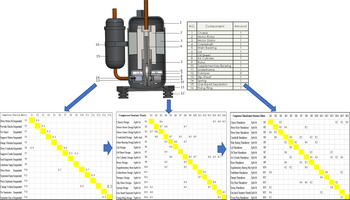
To build the mathematical model for change propagation dynamics, the first step is to obtain multistage product development models. Accompanying the incremental product development process, the multistage process model can be built by dividing the process into functional design, structural design, and manufacturing process (Li et al., Reference Li, Zhao and Tong2017). In the research work, an air-conditioner was selected to validate the mathematical change propagation model, and the three-stage models were obtained by referring to product models in the market, interviewing with product development senior experts, and site visits to product manufacturing workshops. The model is constructed by simplifying the integration and assembling of multiple components to sub-assemblies and finally to the complete product, and each node and edge in the graph model representing a single component and a dependency between two components actually include the efforts for integration and assembling of components in addition to development of themselves. This model certainly merits further extensions of more hierarchical and nonhierarchical relationships between engineering entities to overcome this simplication of the product development process. Figure 1 shows the three-stage compressor models, which are parts of the whole air-conditioner model.
Compressor model and its functional structural and manufacturing process dependency matrices (the numbers in the matrix cells are change impacts between two related entities, the leftmost column of each matrix shows entities in each stage) (Li et al., Reference Li, Zhao and Tong2017).

In terms of the mathematical model for change propagation dynamics, it was built by referring the relevant literature and analyzing the change propagation data in the air-conditioner development process. As it has been observed and reported in Eckert et al. (Reference Eckert, Clarkson and Zanker2004), change ripples, blossoms, and avalanches in terms of change numbers can occur in the product development process, these phenomena reflect different propagation dynamics caused by different initial or emergent changes. Furthermore, according to the statistical analysis of change propagation data in the air-conditioner development process in Haier™, changes increase rapidly with the evolutionary product development process, while change requests leading to bursts of large numbers of changes usually terminate due to their pretty long resolving time and high costs, and this merits modeling change propagation characteristics including not only the number of changes but also change durations for every moment, so that more factual constraints can be reflected in the dynamics model.
The mathematical model was developed based on the change propagation model presented in Li et al. (Reference Li, Zhao and Shao2012), in which two-state compartmentalization of engineering entities (Susceptible Engineering Entity Set, Affected Engineering Entity Set) are added to model the events that engineering entities are affected by change propagations and engineering entities wait for being affected by changes. This model can describe the intricate and nontrivial change iterations among engineering entities which may be missed in the coarse product development models. While manufacturing entities are usually changed once to reduce product development costs, they are also subject to change iterations considering a lumped manufacturing process model taking part as a basic element may incorporate a sequence of manufacturing or assembling operations. This model certainly merits further expansions by adding more process details.
The model
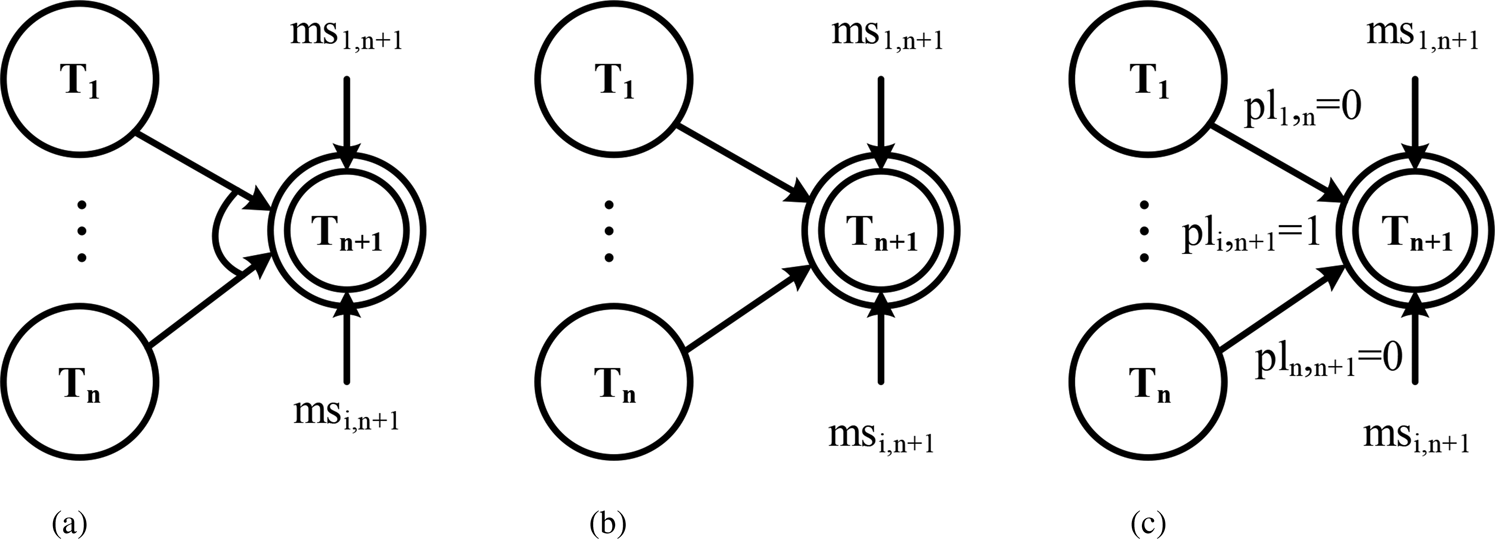
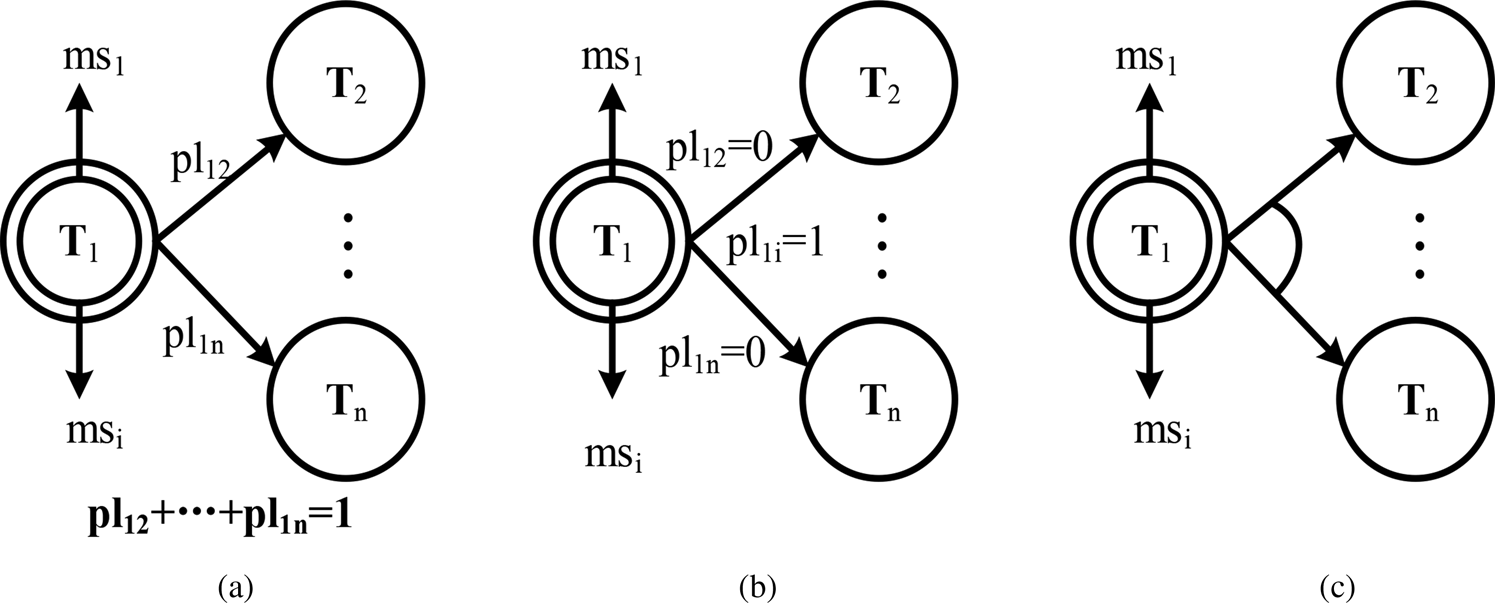
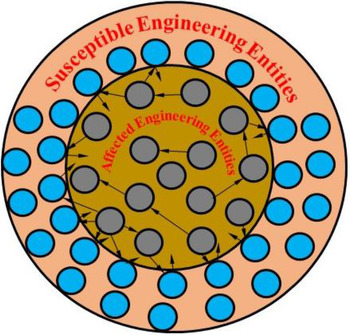
In order to incorporate different change propagation paths, three input and output logic models are adopted to represent the entity dependency and mapping relationships, the input logic models shown in Figure 2 means that more than one entities transfer design information to the dependent one, while the output logic models shown in Figure 3 represent that one entity may transmit its change results to more than one downstream entities. Detailed information about these junctions can be found in Li et al. (Reference Li, Zhao and Shao2012). Based on the network model consisting of a number of entity nodes and dependency edges as well as embedded input and output logics, an SA (susceptible engineering entities–affected engineering entities) model (Fig. 4) is presented in this paper to describe the change propagations. In this model, engineering entities such as design and manufacturing tasks, parts, and assemblies are divided into two compartments, namely susceptible engineering entities and affected engineering entities. Changes can only propagate through dependencies or mapping relationships between entities, which leads to that the random transmission of changes does not occur in change propagations. Change propagations can happen not only from affected entities to susceptible entities but also from affected entities to affected entities, and thus, counting the number of changes and calculating total change durations are two necessary measures to model change propagation dynamics.


where ρ(t) is the rate of affected entities with respect to the total ones at time t, namely the density of affected entities at time t; μ i is the rate of change on entity i being resolved with respect to time; T(t) is the total time required to resolve all changes at time t; NI(t) is the number of affected entities at time t; PI i(t) is the total impact entity i receives at time t; T i is the total time to implement the development of entity i; NODi is the number of output dependencies from entity i; NIDi is the number of input dependencies to entity i; I i(t) is the variable indicating whether entity i can propagate changes to its downstream dependent entities at time t; PI ji(t) is the change impact propagated from entity j at time t, this value keeps invariant during when the change is being resolved; PL ji(t) is the change likelihood propagated from entity j to entity i at time t; PL jiu means the largest proportion of the change result that can be transferred from entity T i to the direct downstream entity T j; PL jil means the smallest proportion of the change result that can be transferred from entity T i to the direct downstream entity T j; k(t) is the change iteration number at time t; PI tvi is the threshold value of change impact deciding whether the influenced entity i can affect other dependent ones; PI ji0 is the largest proportion of the entity that needs to be redone when the preceding entity transfers the change to the downstream one with the maximal propagation probability.
Dependency input logics combined with mapping relationships: (a) “join-And”, (b) “join-Or”, and (c) “join-Xor” (Li et al., Reference Li, Zhao and Shao2012).

Dependency output logics combined with mapping relationships: (a) “split-Or”, (b) “split-Xor”, and (c) “split-And” (Li et al., Reference Li, Zhao and Shao2012).

An SA model for engineering change propagations.

Based on the above descriptions, the mathematical dynamic models are as follows: Eqs (1) and (2) describe the rate of change of affected entities density with respect to time and the rate of change of total time required to resolve all changes. Considering the ordinary differential Eq. (2) is integrable, it can be restated as Eq. (3). In this model, μ i, namely the rate of change on entity i being resolved with respect to time representing capabilities of human resources, product development teams, design tools, etc., and PI tvi, the threshold value of change impact deciding whether the influenced entity i can transmit changes to other dependent ones, are kept as constant during the change resolving process, this may differ with the engineering development practice since the learning curve effect may function as designers or engineers iterate their development processes. This is remedied by introducing the learning effect in the calculating of propagation impacts on entities, as shown in Eq. (6). For the detail of Eqs (5) and (6), refer to Li et al. (Reference Li, Zhao and Shao2012).
The simulation-based solving algorithms
The mathematical model usually cannot be solved analytically due to complicated interwoven dependencies between entities and input and output logics. Therefore, how many entities are and will be affected and how long in total it will take to complete all the changes can be determined by simulations of the change propagation process. In the network model, generally breadth-first and depth-first transverse methods can be adopted to simulate the change propagation process. When a change occurs on an entity, it may transmit its effect to its neighbors simultaneously, and thus, breadth-first graph transverse algorithm can simulate this phenomenon more accurately. Since a multistage change propagation model including functional structural and manufacturing phases is adopted to explore change propagation dynamics, two kinds of change propagation patterns will be simulated in this paper to compare their dynamic characteristics. The first pattern is mutual propagations between entities in each internal domain, namely engineering changes can propagate from any two interdependent entities no matter whether they are affected by other changes or not. In the intra-stage engineering change management, only one-way change propagations are allowed.
To evaluate change propagation dynamics in the multistage engineering development process, two strategies are adopted to compare their effects on change management, namely concurrent and sequential change propagation strategies. For the concurrent change propagation strategy, changes can propagate in the inter- and intra-development stages simultaneously, while for the sequential change propagation strategy, changes can not be propagated from the upstream stage to the downstream one before all the changes in the upstream stage complete, but simultaneous change propagations can still occur within each product development stage. In the sequential change propagation scheme, each entity will aggregate impacts incurred in the change propagation process before it transmits its effects to downstream entities, and the sequence for all change propagations between intra-stage entities abides by the first-order change propagation sequence in the upstream stage.
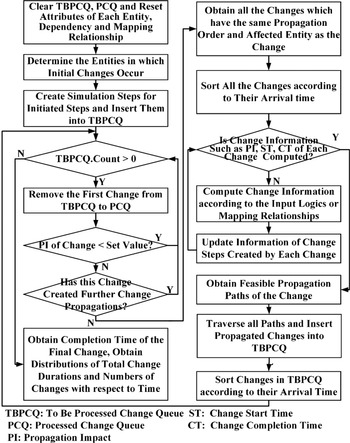
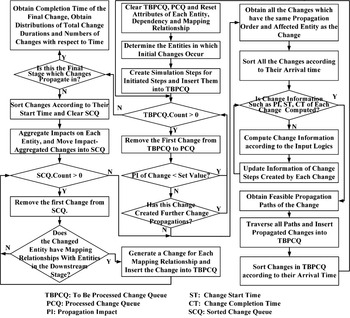
To meet the above change propagation and statistical requirements, simulation algorithms are developed for multistage change propagations, as shown in Figures 5–8. The main flowcharts for concurrent and sequential change propagation schemes are shown in Figures 5 and 6. Figure 5 is adapted from the simulation algorithm in Li et al. (Reference Li, Zhao and Tong2017) by adding the calculations of the total change durations and the numbers of changes with respect to time in the final step. This figure is also used to compare with the sequential change propagation simulation algorithm shown in Figure 6. The sequential algorithm constrains change propagations within one stage before the completion of propagations in it, in which all the change impacts are aggregated if they are exerted on the same entity, and then changes are sorted before they are moved from the PCQ (Processed Change Queue) to the SCQ (Sorted Change Queue). In the change propagation process within one stage, changes will not propagate along the mapping relationships between entities in different stages while they are permissible with the concurrent strategy. When the change propagation finish in an upstream stage, all new changes will be generated based on the entity mapping relationships across different stages and sorted according to their creation time, then changes will continue propagating in the mapped downstream stage. It should be pointed out that when changes propagate along mapping relationships between entities in different stages, the threshold value for propagations emanating from each affected entity does not apply.
Main flowchart for concurrent simulation of change propagations [adapted from Li et al. (Reference Li, Zhao and Tong2017)].

Main flowchart for sequential simulation of change propagations across different stages.

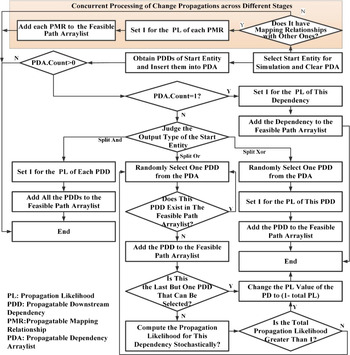
The algorithm for randomly obtaining feasible concurrent and sequential change propagation paths [adapted from Li et al. (Reference Li, Zhao and Shao2012)].

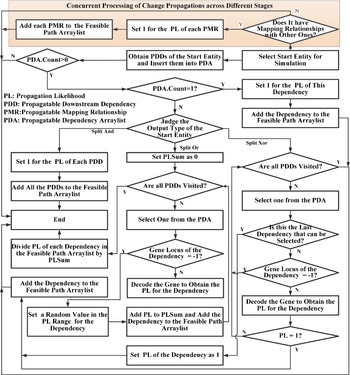
The GA decoding algorithm for obtaining feasible concurrent and sequential propagation paths [adapted from Li and Zhao (Reference Li and Zhao2014)].

In addition to the change control strategies shown in the concurrent and sequential propagation simulation algorithms, input and output logic relationships between entities, namely “Join-And,” “Join-Or,” “Join-Xor” and “Split-Or,” “Split-Xor,” “Split-And,” and quantitative dependency relationships such as propagation likelihood, propagation impact, and propagation duration are introduced in the change propagation network model. These constraints are embodied in the algorithms for obtaining feasible change propagation paths, as shown in Figures 7 and 8 [adapted from Li et al. (Reference Li, Zhao and Shao2012) and Li and Zhao (Reference Li and Zhao2014), respectively]. These flowcharts are also used to compare the effects of random and optimal selection of change propagation paths on the change propagation durations. Figure 7 shows the algorithm for random selections of change propagation paths, this algorithm is adapted from Li et al. (Reference Li, Zhao and Shao2012) by adding concurrent processing of mapping dependencies and identifying propagatable change paths, which represents dependencies satisfying sequential change propagation rules in the functional, structural, or manufacturing stage. Figure 8 shows the optimal selections of change propagation paths in the concurrent and sequential change propagation paths across different stages, in which the three steps in the light-orange shaded rectangle are used to handle concurrent change propagations between adjacent mapping stages.
System implementation and case study
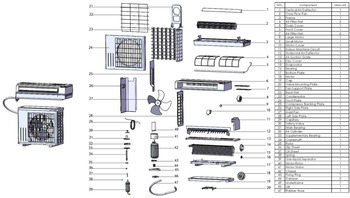
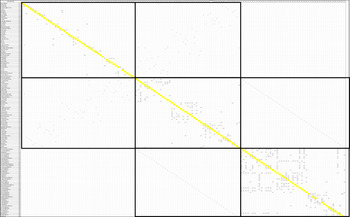
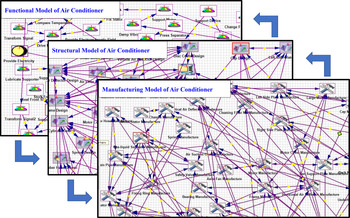
The dynamic model and the above algorithms are implemented in the simulation-based change scheduling system (Li and Zhao, Reference Li and Zhao2014; Li et al., Reference Li, Zhao and Tong2017). A three-stage air-conditioner development model including functional design, structural design, and manufacturing stage is presented, as shown in Figures 9–11. Air-conditioner is a kind of seasonal product which has a quite short lead time in the summer. This makes it necessary that producers must deliver their products as soon as possible when customers put up forward their requirements. These requirements may correspond to changes of entities in the function domain, structure domain, or manufacturing domain. So how much percentage of the changes should be assigned to each of the affected entities so that the change duration to completely resolve the change requirement is the shortest? What kind of change propagation dynamics will characterize the concurrent and sequential multistage change propagation process? How does the threshold value of change impact for each entity, initial change effect, number of initiated changes, and coupling of multiple change propagations affect propagation dynamics? To answer the above questions, single and multiple initiated changes are imported into the air-conditioner development process, simulation results are given in this section to demonstrate the change propagation dynamics. In terms of model validation, considering that it is not realistic that a change can be implemented in different strategies and with different initial ratios in a firm, the data for an initial change propagation case implemented in sequential change propagation strategy are collected to validate the change propagation model, which will be described in the section “The single initiated change case”.
An air-conditioner model [adapted from Li et al. (Reference Li, Zhao and Tong2017)].

United development structure matrix model for representing multistage change impacts in the air-conditioner development process [adapted from Li et al. (Reference Li, Zhao and Tong2017)].

Computer models representing three stages of the air-conditioner development process [adapted from Li et al. (Reference Li, Zhao and Tong2017)].

The single initiated change case
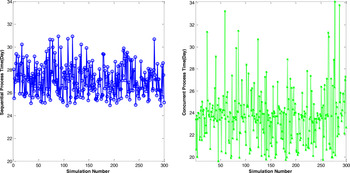
A customer requirement, namely “decrease the temperature inside the cabinet more quickly,” is submitted to the air-conditioner development team. This requirement can be satisfied by the function “Compare Temperature” and the function “Transform Signal” independently or simultaneously. But their change will incur different change effects to the downstream structural design and manufacturing entities. Figures 12 and 13 show 300 times of random simulations of the total change propagation durations in the sequential and concurrent ways, respectively. An initial change effect for the customer requirement, 0.6, is set for the initiated change, which means that 60% of customer requirement is changed. According to these two figures, the average durations for sequential and concurrent change propagations are 27.1 and 23.7 days, respectively, but the standard deviations are 1.34 and 2.4 days, which means that the sequential multistage change propagations are generally longer than concurrent propagations, but concurrent change propagations have a higher fluctuation range than the sequential strategy. This indicates that in the change triggered product redevelopment process, concurrent strategy may have a shorter product development cycle than the serial strategy since upstream and downstream concurrence is the most effective way to reduce product development lead time. However, if the change propagation paths are not correctly scheduled, that is a change propagation path involves many communications between affected entities, finding a shorter solution to the change requirement with the concurrent strategy may not be achieved, which makes it necessary to adopt the optimization method to find the best change solution. It should be pointed out that it took the firm almost 31days to complete this change request according to statistical data analysis, the duration deviation between the simulation data and the real data was caused by that more than 2 days was spent on selecting the supplier to manufacture the changed design concept since usually not only one original equipment manufacturers (OEMs) were contacted in order to maintain competitions among suppliers. This can verify that the change propagation model tallies with the actual situation.
Monte Carlo simulations of single initiated sequential (blue, left) and concurrent (green, right) multistage change propagation durations.

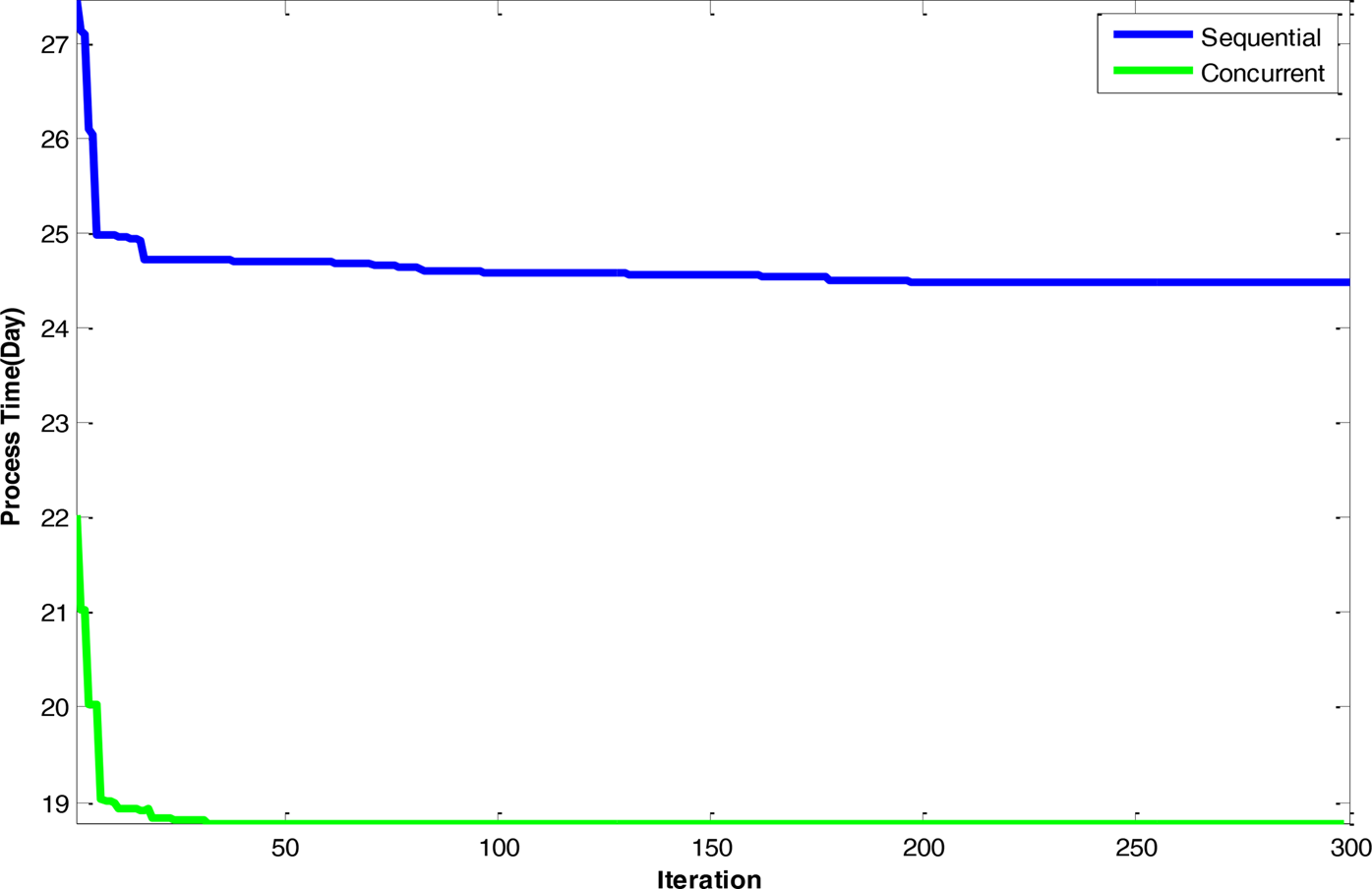
Optimization process for single initiated sequential (green, left ordinate) and concurrent (blue, right ordinate) multistage change propagations.

Figure 13 shows the design optimization processes for sequential and concurrent change propagations. The steady GA is adopted to optimize the change propagation process (DeJong, Reference DeJong2006), and the GA parameters including GA population, crossover rate, mutation rate, replacement rate, and evolution generations are 300, 0.9, 0.001, 0.25, and 200, respectively. After 300 generations of iterative optimization, the optimal change propagation solutions are found. As demonstrated in Figure 13, concurrent change propagations do have an advantage of shortening product development cycle for this single initiated change request considering that the shortest change durations for the sequential and concurrent strategies are 24.48 and 18.76 days, respectively.
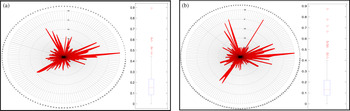
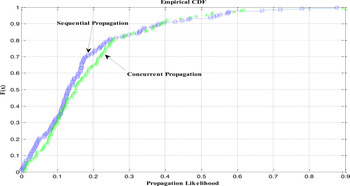
Figure 14 shows the distribution of involved “split-Or” change propagation likelihoods for the sequential and concurrent change propagation strategies. It can be illustrated that, first, concurrent change propagations involve more than 16% optional change transmission paths, which may need more product development resources to accomplish change requests, and it can be deduced that, in the concurrent propagation process, the optimization algorithm is trying to resolve change effects in a shorter time by allocating them to more engineering entities; second, in this concurrent change propagation case, six more optional change paths have statistically extreme propagation likelihoods (bigger than the upper bound) than the sequential strategy that can shorten the total propagation durations, and thus change effects can be allocated to entities linked to the above propagation paths with the largest proportion of them; third, the median, lower quartile, upper quartile values, and CDFs (Fig. 15) for both propagation strategies are almost same, which indicates concurrencies of upstream and downstream development activities are the main reason that leads to a shorter product re-development cycle. Therefore, in the following analysis, propagation likelihoods will not be displayed in different simulation cases.
The optimal propagation likelihood values for involved “split-Or” dependencies in the sequential (a) and concurrent (b) change propagation processes.

Cumulative density distribution of propagation likelihoods for sequential and concurrent propagations.

To find the influences of the initial change effect and the threshold value on change propagation dynamics, the same change propagation paths and propagation likelihoods found in the above optimal solutions for sequential and concurrent change propagations with the initial change effect of 0.6 and threshold value of 0.01 are adopted. In order to decrease the influence of the initial change effect on change propagation paths and propagation likelihoods as far as possible, less than 10% variations of initial change effect, namely an initial change effect interval 0.56–0.64, are conducted on the change propagation simulations. But for the threshold value, bigger variations are used since propagation dynamic characteristic variables, such as resolving durations and infection rates, are not sensitive to it in this study.
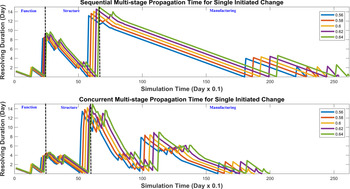
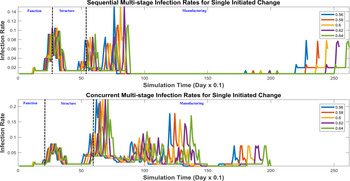
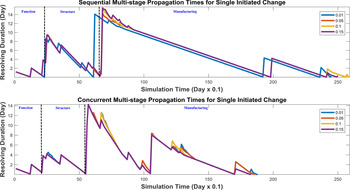
Figure 16 shows propagation dynamics of single initiated change propagations with different initial change effects. As illustrated in Eckert et al. (Reference Eckert, Clarkson and Zanker2004), changes propagate with ripples and blossoms. Considering 60% of the customer requirement is changed in this case, change blossoms are observed in both sequential and concurrent change propagation processes. Generally, change propagation processes have three phases of change ripples and blossoms, namely functional design, structural design, and manufacturing stages as included in this case study, and usually manufacturing stage accounts for the most part of change propagation process and has more change blossoms or ripples. Change ripples usually occur during the early phase of each stage, and the critical path, namely for this case, “Receive User Commands” – “Compare Temperature” – “Indoor Machine Circuit Design” – “Indoor Machine Circuit Manufacture” – “Small Motor Manufacture” – “Large Motor Manufacture” mainly determines three stages of the whole change propagation process. Since changes propagate in a serial way across different stages in the sequential change propagation process, small ripples can be observed in the early phase of structural and manufacturing change process, while bigger blossoms can be observed during the structural and manufacturing change propagation processes in the concurrent change propagation process. This can be explained that changes in the upstream propagations are instantly mapped to the downstream entities, and later changes usually need much more effort to satisfy upstream change requirements. In terms of entity infection rates, as illustrated in Figure 17, sequential change propagations have lower values than concurrent change propagations, although generally both have relatively low rates in the most part of the change propagation process, which does show that usually locally adjacent engineering entities are affected by changes, and changes outbreaks more concentratedly in the concurrent change propagation process than in the sequential one since the total concurrent change propagation duration is shorter.
Change resolving durations at different sequential and concurrent multistage propagation times for single initiated change with different initial change effects.

Entity infection rates at different sequential and concurrent multistage propagation times for single initiated change with different initial change effects.

According to Figures 16 and 17, dynamic patterns for both change durations and infection rates do not change with the increase or decrease of initial change effect, but the total change duration and change durations for every moment vary almost linearly with changes of initial change effect. This is consistent with the linear Eqs (1) and (2), which include the linear equation describing the calculation of propagation impact as well as the linear change resolving rate in Eq. (2). For the infection rate, local infection rate peaks appear between the second day and the fourth day, and between about the sixth day and the eighth day, and the ninth day and the fourteenth day in the concurrent change propagation process, while in the sequential change propagation process, infection rate peaks occur concentratedly between the second day and the ninth day. This is due to that the propagation cutoffs in the sequential change propagation process can restrain infection peaks within one stage, and thus, change propagation can be managed in a controllable and ordered way.
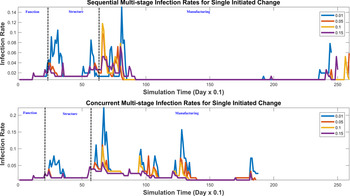
Figures 18 and 19 show change resolving durations and infection rates at different sequential and concurrent multistage propagations with different threshold values for propagations. It can be concluded that change of threshold values does not affect change resolving durations especially for concurrent change propagations. However, the change propagation ripples and blossoms for infection rate are significantly affected by the value. When the value reaches 0.15, no more than 8% and 6% of total engineering entities will be infected in the respective sequential and concurrent change propagation processes. Therefore, if the excess for each affected entity can be preset with enough values, which means that the threshold value can be bigger in this research, its change effects can be restrained within a very limited range, and this is consistent with what was found in Long and Ferguson (Reference Long and Ferguson2020). Furthermore, big threshold value can reduce change ripples and blossoms, as illustrated in Figure 18, and emergent changes can decrease in the change propagation process.
Change resolving durations at different sequential multistage propagation times for single initiated change with different threshold values for propagations.

Entity infection rates at different sequential and concurrent multistage propagation times for single initiated change with different threshold values for propagations.

The multiple initiated changes case
To further demonstrate the change propagation model, two–four initiated changes to the function design including “Transform Signal,” “Support Motor,” “Support Crankshaft,” and “Dissipate Heat by Pipe” are imported into the air-conditioner development process to satisfy different customer requirements. Due to the space constraint, the figures showing optimization processes are not included. Sequential and concurrent change propagation simulations are both adopted to compare their different change propagation dynamics (Barthelemy et al., Reference Barthelemy, Barrat, Pasto-Satorras and Vespignani2005; Karniel and Reich, Reference Karniel and Reich2009; Suzuki et al., Reference Suzuki, Yahyaei, Jin, Koyama and Kang2012; Maier et al., Reference Maier, Eckert and Clarkson2019). In the simulations, the initial change effect for initiated changes and the threshold value for propagations are assigned with 0.6 and 0.01, respectively.
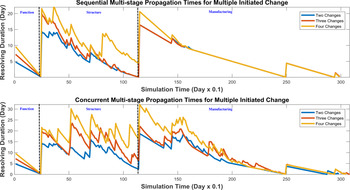
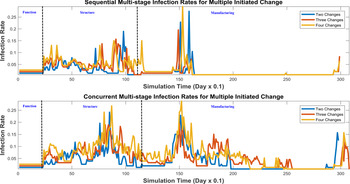
As far as the change duration for every moment is concerned (Figs. 20, 21), no significant variations of propagation patterns can be seen in the sequential change propagation process, for example, change blossoms and ripples almost occur at the same points of time in the process unless durations for every moment are different. But for the concurrent change propagation process, small ripples are added into the propagation process with the increasing of initiated changes although general propagation patterns do not change significantly. With insertions of small change ripples, the total durations of concurrent change propagations are lengthened when initiated changes increase. This shows a remarkable difference with the sequential change propagation process, which further asserts that frequent communications between upstream and downstream development stages caused by couplings of multiple changes propagations may impede the change resolving process.
Change resolving durations at different sequential and concurrent multistage propagation times for multiple initiated changes.

Entity infection rate at different sequential and concurrent multistage propagation times for multiple initiated changes.

In terms of infection rates, first, while the top infection rates are almost same throughout the sequential and concurrent change propagation processes for multiple initiated changes, the concurrent change propagation process has more change ripples than the sequential propagation process. This result is consistent with the single initiated change propagation processes, which further demonstrates that concurrent propagation strategy usually involves more human resources no matter it can shorten the process or not; second, generally more initiated changes, bigger infection rates are, but the sequential propagation strategy can still have infection rate cutoffs in the process, which demonstrates its robustness in handling multiple initiated changes; third, sequential propagation strategy can significantly reduce the number of changes generated in the propagation process except the initiated ones especially when the product development process has many interwoven dependencies, this indicates that one engineering entity may be affected by other changes in the same stage or different ones through mapping or dependency relationships.
Discussion
According to the above diagrams, it can be seen that the initial change effects can lengthen or shorten the whole change propagation durations if it becomes bigger or smaller, and a general proportionate relationship between them can be obtained as indicated by Eq. (6). While even the threshold value for change propagations is assigned with 0.15 (as large as 15 times of the first threshold value), no significant effect on the total change durations can be seen. This indicates that change propagations are mainly determined by dependent relationships between engineering entities, this, on the one hand, indicates that the threshold value needs to become bigger to shorten change propagations, on the other hand, it may also suggest that the latter changes which can be intercepted by this value in the whole change propagation process do not account for big portions of the total durations, or they have a high level of concurrency due to the parallel spread of changes in the later change propagation process.
Concurrent change propagation strategy can lead to high and long-time entity infection rates during the whole change propagation process. As analyzed in the above section, this is caused by allocating changes to more engineering entities to shorten the process. This certainly increases the difficulty of change management since more resources may be involved and rostered in the concurrent change propagation process. While in the sequential change propagation process, high infection rates usually occur in the early stages, which requires less resources to implement change requests. In addition, high infection rates peaks and high resolving durations peaks usually occur around several entities that are directly influenced by changes, for example, in the sequential change propagation process, “rotor design” is a critical engineering entity that invokes high infection rates and high resolving durations, this also signifies that control of these engineering entities is critical to the success of change development process since they may generate many changes in a short time.
As shown in Figures 20 and 21, an increase of initiated changes does not significantly lengthen the total change process duration. This indicates that these initiated changes may share the same change propagation paths, and the increase of change effects on the involved engineering entities may not cause much more workloads on product experts since a solution to one change request may also satisfy other requests too. For example, in the sequential change propagation process of two initiated changes, the “Bottom Plate Design” task receives change impacts occupying 13% of the original solving duration, while in the change propagation process of three initiated changes, it only receives change impacts occupying 14% of the original solving duration, which does not make a significant increase. However, compared to single initiated change propagation cases, multiple changes can bring frequent change ripples and blossoms to the engineering development process, so that change avalanches may happen if several changes compete for a single design margin or change multipliers make it difficult to find convergent solutions.
In terms of shortcomings of the dynamics model, there are several points that merit further explorations. First, the multistage change propagation model needs to be refined. Due to limited access to the product manufacturing process and nondisclosure agreement of commerce secrets, the structural and manufacturing development processes are presented as lumped change engineering entities instead of detailed steps consisting of concrete development actions or operations. This may lead to a mismatch between the dynamic propagation characteristics obtained by simulations and the actual propagation characteristics, change propagation models including hierarchical and multidimensional information need to be developed to further validate the results. Second, in the interview with product managers and design experts, backtracking due to exhausted margins or high costs and short lead time occasionally occurs in the development process, the propagation simulation algorithms need to be further refined to include the backtracking mechanism instead of only forward propagations and change iterations. Third, different change implementation actions or operations need to be taken into consideration in order to obtain more operational and actionable change concepts.
Conclusion and future work
To precisely predict change propagation dynamics, such as change durations and entity infection rates for every moment, are important for designers or managers to determine whether a change request can be approved or not, and how the change propagation process should be scheduled in order to implement the most time- and cost-saving solution to the request. The following contributions of the paper can be concluded in order to address the above questions.
-
• First, based on the compartmentalizing of engineering entities into susceptible engineering entities and affected engineering entities, a change propagation dynamic model is proposed to describe change propagations in the complex network model by taking dependency and mapping relationships, split- and join-logics, and quantitative change propagation constraints into consideration.
-
• Second, based on the prior research work, simulation algorithms for sequential and concurrent multistage change propagations are presented to obtain numerical solutions to the change propagation dynamic model considering the difficulty of finding analytical ones. Random and optimal selections of change propagation paths are given to simulate different change propagations paths.
-
• Third, single and multiple initiated changes are imported into the air-conditioner development process to testify the change propagation dynamic model. Change propagation ripples and blossoms of change resolving durations for every moment are observed in the process, and it can be concluded that the small number of changes can be handled in the concurrent strategy, while the sequential strategy has the advantage to handle more changes.
It should be pointed out that, in the above research work, there are still some factors that need further analyses. For example, the change resolving rate is assumed as a linear function of resolving time, this may be not consistent with the product development practice especially when a product development team is responsible for implementing the change request because the behavior of a team is different from the behavior of single person. In the simulations of change propagations in the manufacturing domain, more fine control constraints instead of the same propagation rules as adopted in other domains, need to be implemented. Furthermore, more product development cases need to be explored in order to obtain more universally feasible and quantifiable measures for choosing sequential or concurrent change resolving strategy.
Acknowledgments
The research work is funded by the National Natural Science Foundation of China (Grant Numbers 51775488 and 52175219), the Fundamental Research Funds for Central Universities (Grant Number: 2232019A3-11), and Shanghai Economic and Information Committee Innovation Fund for Artificial Intelligence (Grant Number 2019-RGZN-01077).
Yuliang Li is currently a professor at the Institute of Artificial Intelligence, Donghua University, Shanghai. He got his Ph.D degree from Huazhong University of Science & Engineering in 2004. His research interests include Design Change Management, Intelligent Design, and Product Conceptual Design, etc. He has authored more than 30 Journal Papers in these fields.
Wei Zhao is a lecturer at Zhejiang University of Finance & Economics. Her research interests include change propagation prediction, text mining, etc.
Wenqi Zhang is a mechanical engineer of Institute of Aerospace System Engineering Shanghai, his research interests include Overall design of space vehicles, space robotics, intelligent design, etc.
Meng Chen is the research fellow of Institute of Aerospace System Engineering Shanghai, his research fields include intelligent design, space robotics, intelligence mechanism, dynamic simulation and control.