Introduction
There are compelling reasons to investigate medical students’ perceptions of psychiatry. In Ireland it is the third largest specialty in the country in terms of the number of junior doctors and consultants but few medical graduates consider a career in the area (Department of Health and Children, 2008). Finucane & O'Dowd (Reference Finucane and O'Dowd2004) showed that only 4% of interns in Ireland considered a career in psychiatry, which is similar to findings in a review by Brockington (Reference Brockington2002) in the United Kingdom showing a low level of interest in a career in psychiatry in the range of 2.9–4.2% (Brockington, Reference Brockington2002; Finucane & O'Dowd, Reference Finucane and O'Dowd2004). Difficulty in recruiting psychiatrists appears to be an international phenomenon (Sierles & Taylor, Reference Sierles and Taylor1995; Kumar etal. Reference Kumar, Robinson and Lau2004; Hadlaczky etal. Reference Hadlaczky, Stefenson and Wasserman2012). While limited attempts have been made to tackle shortages through increasing the number of medical students and medical schools, the situation has not improved (Maidment etal. Reference Maidment, Livingston, Katona, Whitaker and Katona2003). There has been a longstanding recruitment issues in Ireland. Last year the lack of junior doctors in the Republic of Ireland across all specialities led to the Minister for Health introducing emergency legislation to set up a new category of Medical Registration, the Supervision Division of the Register in order to facilitate the entry of non-EU doctors to work in Ireland.
Specialties such as medicine and surgery have traditionally enjoyed high recruitment rates, while specialties like psychiatry tend to be viewed negatively with concerns about ‘scientific rigor, therapeutic efficacy and the appropriate role of psychiatrists’ (Nielsen & Eaton, Reference Nielsen and Eaton1981). Similarly, Wigney & Parker (Reference Wigney and Parker2007) also reported that perceptions of being unscientific and not proper medicine led to a lack of interest in pursuing a career in psychiatry, along with a number of other themes such as a stressful work environment and lack of resources. Poor funding in mental health and little access to resources make recruitment challenging, particularly in the current financial climate. In an analysis of all applications for specialty training posts in England in 2008, surgery and radiology had the highest number of applicants per vacancy while paediatrics and psychiatry had the lowest (Fazel & Ebmeier, Reference Fazel and Ebmeier2009). The Royal College of Psychiatrists coordinates national recruitment to core psychiatry training. Jacques reported that only 61% of the core training posts available in psychiatry in the United Kingdom for 2011 had been filled at the first stage of recruitment. One possibility considered for this low rate was because psychiatry shared more than half of its applicant pool with general practice and core medical training (Jaques, Reference Jaques2011).
Influences in relation to choice of career have been shown to begin even before medical school (Goldacre etal. Reference Goldacre, Turner and Lambert2004). Requirements for entry to medicine tend to favour those with biological sciences rather than humanities (Brockington, Reference Brockington2002). In the United States, one study found that students who tend to choose psychiatry had often majored in the humanities or social sciences (Nemetz & Weiner, Reference Nemetz and Weiner1965). This may indicate that requirements for medicine make specialisation in psychiatry less likely. A recent Danish study investigated the attitudes of medical students in rating the attractiveness of psychiatry as a career option and assessed the impact of these attitudes on experience of psychiatry (Holm-Petersen etal. Reference Holm-Petersen, Vinge, Hansen and Gyrd-Hansen2007). They found that as many as 42% of responders rejected psychiatry as a career choice even before entering medical school.
It has been suggested that a positive attitude to psychiatry is linked to the likelihood of becoming a psychiatrist (Sloan etal. Reference Sloan, Browne, Meagher, Lane, Larkin, Casey, Walsh and O'Callaghan1996; Maidment etal. Reference Maidment, Livingston, Katona, Whitaker and Katona2003). The psychiatry attachment is considered to be an important influence on attitudes to psychiatry and indeed recruitment (Sierles etal. Reference Sierles, Dinwiddie, Patroi, Atre-Vaidya, Schrift and Woodard2003). It has been frequently observed that medical students begin their psychiatric attachments with less than favourable views about psychiatry (Nielsen & Eaton, Reference Nielsen and Eaton1981; Wilkinson etal. Reference Wilkinson, Greer and Toone1983; Feifel etal. Reference Feifel, Moutier and Swerdlow1999; Malhi etal. Reference Malhi, Parker, Parker, Carr, Kirkby, Yellowlees, Boyce and Tonge2003; Baboolal & Hutchinson, Reference Baboolal and Hutchinson2007; Holm-Petersen etal. Reference Holm-Petersen, Vinge, Hansen and Gyrd-Hansen2007; Compton etal. Reference Compton, Frank, Elon and Carrera2008). While many studies highlight an improvement in attitude to psychiatry following a clinical attachment in psychiatry (Burra etal. Reference Burra, Kalin, Leichner, Waldron, Handforth, Jarrett and Amara1982; Shelley & Webb, Reference Shelley and Webb1986; Sloan etal. Reference Sloan, Browne, Meagher, Lane, Larkin, Casey, Walsh and O'Callaghan1996; Al-Ansari & Alsadadi, Reference Al-Ansari and Alsadadi2002; McParland etal. Reference McParland, Noble, Livingston and McManus2003; Glynn etal. Reference Glynn, Reilly, Avalos, Mannion and Carney2006; Xavier & Almeida, Reference Xavier and Almeida2010), there are a small number of studies that indicate no significant change in attitudes post-attachment (Galletly etal. Reference Galletly, Schrader, Chesterman and Tsourtos1995; Kuhnigk etal. Reference Kuhnigk, Strebel, Schilauske and Jueptner2007; Fischel etal. Reference Fischel, Manna, Krivoy, Lewis and Weizman2008). A number of studies have looked at attitudes of medical students to psychiatry in an Irish context (Shelley & Webb, Reference Shelley and Webb1986; Sloan etal. Reference Sloan, Browne, Meagher, Lane, Larkin, Casey, Walsh and O'Callaghan1996; Glynn etal. Reference Glynn, Reilly, Avalos, Mannion and Carney2006; O'Connor etal. Reference O'Connor, O'Loughlin, Somers, Wilson, Pillay, Brennan, Clarke, Guerandel, Casey, Malone and Lane2012). All have found improvements in attitude to psychiatry on completion of training. Although improvement in attitude during attachment may increase intention to pursue psychiatry as a career (Wilkinson etal. Reference Wilkinson, Greer and Toone1983; Shelley & Webb, Reference Shelley and Webb1986; Sloan etal. Reference Sloan, Browne, Meagher, Lane, Larkin, Casey, Walsh and O'Callaghan1996; McParland etal. Reference McParland, Noble, Livingston and McManus2003; Cutler etal. Reference Cutler, Alspector, Harding, Wright and Graham2006; Holm-Petersen etal. Reference Holm-Petersen, Vinge, Hansen and Gyrd-Hansen2007; Xavier & Almeida, Reference Xavier and Almeida2010), student preferences can be poor predictors of eventual career choice (Mowbray etal. Reference Mowbray, Davies and Biddle1990).
There is recognition that doctors’ attitudes, values and behaviours are shaped by both the formal curriculum and the ‘hidden curriculum’, the broad social and cultural milieu in which medical education takes place. Medical students’ attitudes are likely to be influenced by exposure to unprofessional comments experienced during medical school. Holmes etal. (Reference Holmes, Tumiel-Berhalter, Zayas and Watkins2008) found that medical students perceived a high level of non-constructive criticism relating to a number of specialties including psychiatry during medical training. Medical professionals have been found to regard psychiatric patients as difficult and unrewarding to treat and attitudes can become less favourable as time passes (Sivakumar etal. Reference Sivakumar, Wilkinson, Toone and Greer1986; Buchanan & Bhugra, Reference Buchanan and Bhugra1992). It is not unsurprising that medical students may approach the psychiatry with unhelpful or stigmatised attitudes. Professionalism is thought to be learnt in a latent, implicit and experiential manner, therefore tackling attitudes by examining both the professional curriculum and cultural context may be helpful (Hafferty, Reference Hafferty1998; Bernard etal. Reference Bernard, Malone, Kman, Caterino and Khandelwal2011).
Particular subgroups of students may have more favourable attitudes to psychiatry, even before their clinical attachment (Maidment etal. Reference Maidment, Livingston, Katona, Whitaker and Katona2003). Quality of life aspects of career choice have been shown to be more important for graduate entrants to medical school as well as those who choose psychiatry (Aasland etal. Reference Aasland, Rovik and Wiers-Jenssen2008; Goldacre etal. Reference Goldacre, Davidson and Lambert2008; Van Der Horst etal. Reference Van Der Horst, Siegrist, Orlow and Giger2010). The introduction of graduate entry programmes (GEPs) for those pursuing a career in medicine has been presented as a potential solution with the implication being that the selection of students from a broader and more diverse background will increase interest in some of the subspecialties (Geffen, Reference Geffen1991; Sefton, Reference Sefton1995; Prideaux etal. Reference Prideaux, Teubner, Sefton, Field, Gordon and Price2000; Searle, Reference Searle2004). Goldacre's 2007 study examined whether graduate and non-graduate entrants had different long-term career preferences at one year and three year post-qualification (Goldacre etal. Reference Goldacre, Davidson and Lambert2007). They found a significant difference in men when it came to graduates and non-graduates choosing general practice (33% of male graduate entrants and 21% of male non-graduates). Surgery and paediatrics were less popular choices for graduate entrants. No difference, however, was found in the number of graduates and non-graduates choosing psychiatry. The study concluded that increasing graduate entry to medical school may increase the percentage of doctors who want to become general practitioners but would make little difference to the percentage seeking careers in different branches of practice. Interestingly, O'Connor etal. (Reference O'Connor, O'Loughlin, Somers, Wilson, Pillay, Brennan, Clarke, Guerandel, Casey, Malone and Lane2012) recently posed the question ‘Would you like to be a psychiatrist?’ to medical students in an Irish context. They observed that those already holding a degree were actually less likely to express an interest in psychiatry as a career (O'Connor etal. Reference O'Connor, O'Loughlin, Somers, Wilson, Pillay, Brennan, Clarke, Guerandel, Casey, Malone and Lane2012).
The authors are unaware of any studies that have specifically compared graduate and non-graduate entry medical student attitudes to psychiatry in Ireland. Therefore, in this study we tested the following hypotheses: (i) exposure to a clinical psychiatry attachment is associated with a positive change in attitudes to psychiatry in both graduate entry and non-graduate entry students, (ii) graduate entry students exhibit a more positive attitude to psychiatry compared to non-graduates and (iii) graduate entry students are more interested in a career in psychiatry than non-graduates.
Methods
The target population of this study was 247 students who completed their psychiatry attachment at the Royal College of Surgeons in Ireland Medical School, Dublin (RCSI). The GEP commenced in 2006 and the first cohort of students graduated in 2010. The year being examined was the first year to include students from GEP and students completing the traditional cycle. Data collection commenced in September 2008 and continued throughout the academic year.
The psychiatric attachment consisted of an orientation programme comprising introductory lectures, followed by a 6-week clinical attachment. The teaching delivered was varied and intensive, using a variety of teaching methods including case-based learning, small group tutorials facilitating problem-based learning and opportunities for the development of clinical skills, and special teaching modules. Further learning opportunities were provided via the RCSI Virtual Learning Environment (Moodle). Students were expected to spend most of their time on the wards or clinics where they were attached and attended fixed teaching sessions including ward rounds, tutorials and seminars.
All students in the target population were invited to participate in the study electronically on Moodle. The information about the study was also made available on Moodle prior to their attachment. Consent was also obtained from all students at the time of study completion, both before and after attachment. Ethics approval was obtained from the RCSI Research Ethics Committee. The RCSI Student Union was contacted regarding the study and permission to proceed was obtained.
Prior to their attachment, students were given a questionnaire booklet that contained a consent form, a form designed to gather demographic information, two structured questionnaires and an information sheet. Each student also entered three specialty choices at the pre-attachment and post-attachment stage. A mixed mode of data collection was used to maximise response rates whereby questionnaires could be completed at an introductory lecture, online or prior to the start of the attachment on the first day. The students were then given a second questionnaire booklet with the same set of instruments on the last day of the attachment.
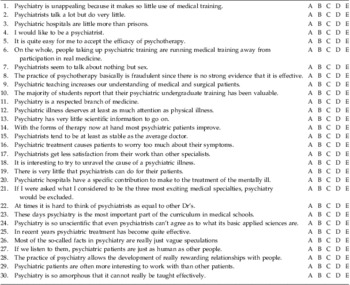
The first questionnaire used was the Attitudes to Psychiatry 30-item questionnaire (ATP-30) (Burra etal. Reference Burra, Kalin, Leichner, Waldron, Handforth, Jarrett and Amara1982). It was designed and validated by Burra and colleagues on Canadian medical students in 1982. Prior to 1980s, most research into attitudes to psychiatry used non-validated questionnaires. Burra's ATP-30 allowed for a more standardised approach to examining attitudes which permitted ease of international comparison (Kuhnigk etal. Reference Kuhnigk, Strebel, Schilauske and Jueptner2007). After examination of the literature, it was found that the ATP-30 was the most useful instrument to examine attitudes to psychiatry given that it had already been validated with a medical student population and has been used in numerous other studies. This questionnaire produces a global score between 30 and 150. Those completing the 30-item questionnaire rate their answers on a five-point Likert scale (see Appendix A). A score of 90 is considered neutral. Higher scores indicate more favourable attitudes towards psychiatry.
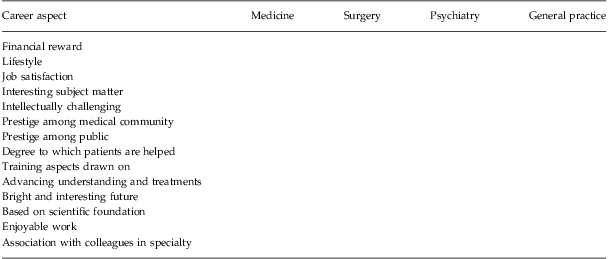
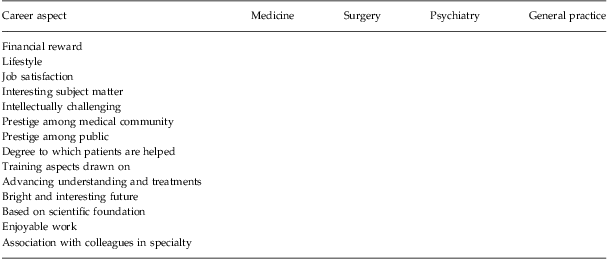
The second questionnaire, the Ratings of Attractiveness of Career Aspects (Feifel etal. Reference Feifel, Moutier and Swerdlow1999) was adapted by the authors. While the original questionnaire looked at the attractiveness of four specialties, namely internal medicine, surgery, psychiatry and paediatrics at the start of medical training, the present study included general practice rather than paediatrics as similar cohorts of students may be attracted to both psychiatry and general practice. One other adaptation was made by omitting the word internal from internal medicine to make it more appropriate to an Irish setting. The 14 factors as outlined in Feifel's study were then rated on a five-point Likert scale (see Appendix B).
All student responses were anonymised and coded. The scales were compared with repeated measures ANOVA. Tukey's method was used for post hoc comparisons. Single items were compared with matched-pair t-tests using the Bonferroni method to adjust for multiple comparisons. Choice of specialty was analysed with Pearson's χ 2-test.
Results
Out of 247 students, 165 graduate and non-graduate students (67%) completed the pre-attachment ATP-30 items questionnaire and 162 completed the Ratings of Attractiveness of Career Aspects questionnaire (66%). At the post-attachment stage 117 students completed the ATP-30 items questionnaire (47%) and 112 completed the post-attachment Ratings of Attractiveness of Career Aspects questionnaire (45%). This was due to five students answering the first questionnaire only at the post-attachment stage. From the population of 247 students, 60 students were in the GEP and 187 entered medicine via the traditional route. In total, 82% (49 students) in the GEP completed the pre-attachment survey and 58% (35 students) of GEP completed the second survey. Of those in the study had a primary degree and they have been examined separately. Out of 118 females and 129 males, 90 females (76%) and 75 males (58%) took part in the pre-attachment stage of the study. At the pre-attachment stage, 61 females (52%) and 56 males (43%) completed the second questionnaire pack (four males and one female answered only the ATP-30 at the post-attachment stage).
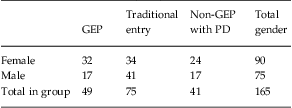
With regard to educational background, three groups were identified (Table 1). They include the traditional entry students (without a primary degree), those who entered via the GEP and those students who entered via the traditional route but have a primary degree. The gender breakdown has been described in Table 2. The age range of the students was from 20 to 34 years. The mean age was 24.5 and the median was 24. All but four students were under 30 years of age. The age range of the students was from 20 to 34 years. The mean age was 24.5 and the median was 24. All but four students were under 30 years of age.
Number of students in each group participating in the study

GEP, graduate entry programme; PD, primary degree; ATP, attitudes to psychiatry; RACA, ratings of attractiveness of career aspect.
Traditional entry (not GEP and not a holder of PD).
Gender breakdown
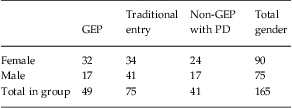
GEP, graduate entry programme; PD, primary degree.
Traditional entry (not GEP and not a holder of PD).
The ATP-30 scale reliability analysis was obtained using a Cronbach's α score. This estimates the reliability of a psychometric scale and was high pre- and post-attachment at 0.873 and 0.912, respectively. Factor analysis did not identify any dominant subscales.
Hypothesis 1 : Exposure to a psychiatry attachment is associated with a positive change in attitudes towards psychiatry in both graduate entry and non-graduate entry students.
We found a significant difference between pre-attachment and post-attachment scores. Comparing all students at pre- and post-attachment gave a mean score before attachment of 108.5 (s.d. ± 11.4) and post-attachment of 112.3 (s.d. ± 14.8) [F (1,116) = 8.056, p = 0.005] indicating that the cohort of students who completed the questionnaire had a positive view of psychiatry prior to their attachment and this significantly improved post-attachment, which was consistent with the first hypothesis that clinical attachment in psychiatry is associated with a positive improvement in attitude to the specialty.
Hypothesis 2 : Graduate entry students exhibit a more positive attitude to psychiatry compared to non-graduate entry students
While the study found that there was a significant difference between pre- and post-attachment students (in a positive direction), the results also indicated that on average, attitudes were similar across gender, age, primary degree, GEP and non-graduate entry non-primary degree, indicating no difference between non-graduate and graduate entry students. Therefore the data did not support the second hypothesis that graduate entry students exhibit a more positive attitude compared to non-graduates. A subsequent analysis was performed using age as a continuous covariate (which looks at whether there is a linear relationship across ages) and again no difference between study groups was found.
Paired sample t-tests were used to examine attitude changes on each of the 30 attitude questions using a Bonferroni adjustment to adjust for the large number of comparisons. At item level, only three questions appeared to differ significantly between pre- and post-attachment after adjustment (Table 3).
Paired t-test items that differed significantly

Item 7 = Psychiatrists seem to talk about nothing but sex.
Item 10 = The majority of students report that their psychiatric undergraduate training has been valuable. (reverse coded).
Item 21 = If I were asked what I considered to be the three most exciting medical specialties, psychiatry would be excluded.
s.d. in parentheses.
Scores from one to five where one is strongly agree and five is strongly disagree.
Hypothesis 3 : Graduate entry students are more interested in a career in psychiatry than non-graduate entry students.
For the Ratings of Attractiveness of Career Aspects questionnaire, the scale reliability analysis indicated the scale is internally consistent (pre-attachment: Cronbach's α score – 0.822; post-attachment: Cronbach's α score – 0.860). As with the ATP-30 item questionnaire, the Rating of Career Aspects questionnaire also showed a significant difference pre- and post-attachment scores for psychiatry. The lower the score, the more attractive the specialty (moving closer to a score of 1, which equals very attractive). As can be observed from the scores (Table 4), psychiatry was the least attractive specialty, both before and after attachment, although the post-attachment score was the same as general practice. Psychiatry made the greatest gain overall and both psychiatry and general practice demonstrated improvements in scores. Medicine remained the most popular of the four specialties and surgery had a significant decrease in attractiveness as a career choice.
Career aspects questionnaire scores for different specialties

The lower the score, the more attractive the specialty (a score of 1 = very attractive).
s.d. in parentheses.
*Significant difference for surgery at p = 0.005.
Again, in terms of the demographics, there were no significant changes on average for psychiatry in terms of the GEP or indeed gender, age, ethnicity, holding a primary degree or non-graduate entry non-primary degree. There were also no significant changes for medicine or surgery. These results do not support the third hypothesis that GEP students are more interested in a career in psychiatry either before or after their clinical attachment. It is worth noting that for general practice, however, the Ratings of Attractiveness of Career Aspects questionnaire found significant differences for two areas, age [F(1,110) = 4.502, p = 0.036] and those holding a primary degree [F(1,110) = 4.173, p = 0.044]. Older medical students and those holding a primary degree on average rated general practice more favourably.
In terms of the responses to the various items on the Ratings of Attractiveness of Career Aspects questionnaire, Lifestyle was the only item with a significant change for psychiatry. The result improved from an already attractive score of 2.24 to 1.67 (p < 0.001) indicating it was significantly more attractive. Scores for the item prestige among medical community for general practice also significantly improved with a score of 3.03 before attachment to 2.68 post-attachment (p < 0.001). The items interesting subject matter and intellectually challenging dropped significantly for surgery after a psychiatric attachment [with the first item changing from 1.66 to 1.99 (p = 0.001) and from 1.72 to 1.103 (p < 0.001)]. There were no significant changes for medicine itself.
Due to the number of specialties chosen, for statistical purposes other subjects were grouped together as ‘other’. When looking at all choices together, there was a significant difference between pre-attachment and post-attachment choices ( $$--><$>\chi _{2}^{2} \,{\rm{ = }}\,{\rm{16}}{\rm{.422}}$$$
, p < 0.001) using Pearson's χ 2-test, with a decrease in undecided and an increase in the other specialty choice. No significant changes were found in the first and second choice of specialty. The third choice was significant in that there was a decrease in the undecided numbers but also a slight significant increase in the number of students choosing psychiatry as a third option (p = 0.005).
Discussion
Our study took place in the first medical school in Ireland to have a stream of graduate entry medical students, offering the opportunity to examine whether attitudes to psychiatry and career preferences were different depending on route of entry to medicine. We found that while there was a positive improvement in attitudes towards psychiatry on completion of the rotation, there was no difference in attitudes to psychiatry between graduate and non-graduate entry students. Similarly, there was no difference in the attractiveness of a career in psychiatry when comparing graduate and non-graduate entry students.
The response rate for completion of the pre-attachment questionnaire was 67% and post-attachment response was 47% (ATP-30 item questionnaire) and 45% (Career Aspects questionnaire). Our response rate is not unlike other studies, also examining medical students’ attitudes (Zimny & Sata, Reference Zimny and Sata1986; Feifel etal. Reference Feifel, Moutier and Swerdlow1999; Glynn etal. Reference Glynn, Reilly, Avalos, Mannion and Carney2006). Response rates in these studies varied from 52% to 61% and 69%. The study reporting 69% noting that this reflected the attendance of medical students on the day of the study (Glynn etal. Reference Glynn, Reilly, Avalos, Mannion and Carney2006). Similarly, our response rate reflects attendance at lectures but may also be related to survey fatigue and the possibility of concerns about confidentiality. Van Horn's study in 2009 reported the results of a meta-analysis of survey response rates in published research in counselling and clinical psychology over a period of 20 years (Van Horn etal. Reference Van Horn, Green and Martinussen2009). This study found that 308 survey administrations had an average-weighted response rate of 49.6%.
The first hypothesis tested whether exposure to a clinical psychiatry attachment was associated with a positive change in attitudes to psychiatry. Overall, students who completed the questionnaire had a positive view of psychiatry prior to their attachment and this significantly improved post-attachment consistent with the first study hypothesis that a clinical attachment in psychiatry is associated with a positive improvement in attitude to the specialty. Weismann's survey of medical students who matched into first-year positions in psychiatry in the United States (Weissman etal. Reference Weissman, Haynes, Killian and Robinowitz1994) found that nearly two-thirds of psychiatric trainees rated their psychiatric attachment experience as the most important medical school influence. Lampe etal. (Reference Van Der Horst, Siegrist, Orlow and Giger2010) observed that ‘the quality of the teaching, enthusiasm of the clinical teachers, the holistic approach and scientific basis of psychiatry were cited by students as factors influencing attitudes’. Although a number of studies revealed no significant change in attitudes post-attachment, reassuringly our study and a number of other Irish studies have found positive attitudes to psychiatry pre- and post-attachment (Sloan etal. Reference Sloan, Browne, Meagher, Lane, Larkin, Casey, Walsh and O'Callaghan1996; Glynn etal. Reference Glynn, Reilly, Avalos, Mannion and Carney2006; O'Connor etal. Reference O'Connor, O'Loughlin, Somers, Wilson, Pillay, Brennan, Clarke, Guerandel, Casey, Malone and Lane2012). Other studies using the ATP-30 have found similarly significant attitudinal change in a positive direction pre- and post-attachment, including a recent Dutch study by Den Held etal. published in 2011 using an adapted form of the ATP-30. They found the mean ATP-30 score to be 106.1 (s.d. 10.9) pre-attachment and 111.6 (s.d. 11.6) post-attachment (p < 0.001; Den Held etal. Reference Den Held, Hegge, van Schaik and van Balkom2011). As most students who rotate through a psychiatry attachment do not choose psychiatry as a career, it is essential that their experiences in the attachment are positive and they are provided with an opportunity to not only express appropriate attitudes but also to internalise them (Walton & Gelder, Reference Walton and Gelder1999).
Our second study hypothesis was that graduate entry students exhibit a more positive attitude to psychiatry compared to undergraduates. We found no difference between graduate entry students and those entering medicine via the traditional route. It has been postulated that this may be the case because they are older and have had more life experience. However, given that the mean age was 24.5, the age group may not be sufficiently old enough to adequately test this hypothesis. O'Connor etal. (Reference O'Connor, O'Loughlin, Somers, Wilson, Pillay, Brennan, Clarke, Guerandel, Casey, Malone and Lane2012) also found no association between age and attitude to psychiatry.
With regard to the third hypothesis that graduate entry students are more interested in a career in psychiatry than non-graduates, again no difference was found. This is an important finding as the introduction to Ireland of formalised GEPs have been anecdotally considered a possible opportunity for increasing recruitment in psychiatry. It has been suggested that graduate entry would be more mature and self-directed in their career selection (Geffen, Reference Geffen1991). A number of studies have reported a trend for mature entrants to medicine choosing general practice (Lambert etal. Reference Lambert, Goldacre, Davidson and Parkhouse2001; Goldacre etal. Reference Goldacre, Davidson and Lambert2007; Calkins & Wakeford, Reference Calkins and Wakeford1984). As demonstrated in our study, however, this may not necessarily be the case, which is in keeping with findings of no statistical difference in the number of graduates and non-graduates choosing psychiatry (Goldacre etal. Reference Goldacre, Davidson and Lambert2007).
While there was no difference between graduate and non-graduate entrants in terms of choosing a career in psychiatry in our study, overall interest was at a high level with 14% of those expressing an interest prior to clinical attachment and 20% post-attachment. In the cohort, Lifestyle factors showed a significant improvement from an already attractive score for psychiatry. This is likely to reflect the better work-life balance traditionally associated with psychiatry. A recent publication by Goldacre etal. (Reference Goldacre, Fazel, Smith and Lambert2013) noted a fall in the number of women choosing psychiatry as a career over the last 10 years. They highlighted the possible implications of the European Working Time Directive on recruitment in psychiatry if other specialties become potential competitors (Goldacre etal. Reference Goldacre, Fazel, Smith and Lambert2013).
Following the attachment, medical students rated prestige among medical community significantly better for general practice. This may be because psychiatry attachments offer an opportunity for medical students to observe the various aspects of general practice work in the community, which often includes a significant component of psychiatry, increasing its attractiveness. The surprising significant drop in interesting subject matter and intellectually challenging items for surgery after a psychiatric attachment may be related to psychiatric content appearing more interesting following exposure.
Studies indicating a positive change in attitude post-attachment usually demonstrate increased interest in psychiatry as a career (Al-Ansari & Alsadadi, Reference Al-Ansari and Alsadadi2002; McParland etal. Reference McParland, Noble, Livingston and McManus2003; Glynn etal. Reference Glynn, Reilly, Avalos, Mannion and Carney2006; Holm-Petersen etal. Reference Holm-Petersen, Vinge, Hansen and Gyrd-Hansen2007; Kuhnigk etal. Reference Kuhnigk, Strebel, Schilauske and Jueptner2007). McParland etal. (Reference McParland, Noble, Livingston and McManus2003) reported that improvement in attitudes during attachment was associated with an increased intention to pursue psychiatry as a career. However, while there was a definite improvement in attitudes to psychiatry in our study, a concomitant rise in interest in pursuing psychiatry as a first choice career was not found. Mowbray etal. (Reference Mowbray, Davies and Biddle1990) have reported that student preference can be a poor predictor of eventual career choice. Follow-up studies are required to determine whether career intention expressed in this study correlates with subsequent future career choice.
Psychiatry and general practice ranked lower than medicine and surgery in overall ratings on the Career Attractiveness Scale. This was consistent with others studies which reveal a general reluctance towards a career in psychiatry (Nielsen & Eaton, Reference Nielsen and Eaton1981; Feifel etal. Reference Feifel, Moutier and Swerdlow1999; Malhi etal. Reference Malhi, Parker, Parker, Carr, Kirkby, Yellowlees, Boyce and Tonge2003). Intern rotations in specialties like psychiatry, paediatrics and general practice have recently been introduced to Ireland. It may be that postgraduate experience before final decision regarding career choice is important for recruitment to psychiatry because exposure to the specialty in medical school is limited. However, assuming that new intern positions will attract new graduates to psychiatry is risky. Despite the introduction of the Foundation Programme in the United Kingdom in 2005, which enabled newly qualified doctors to rotate through psychiatry, the Royal College of Psychiatrists continues to report falling numbers of graduates applying for psychiatry posts (Jaques, Reference Jaques2011). Low recruitment may impact on the quality of those choosing psychiatry as a career (Davies, Reference Davies2013).
Clearly, any experience in psychiatry needs to be of the ‘right kind’ in order to attract new entrants and address possibly stigmatised views (Lambert etal. Reference Lambert, Turner, Fazel and Goldacre2006). This might mean working in a supported and positive environment with adequate exposure to a variety of presentations as well as being provided with opportunities to experience the subspecialties and out patients. This would undoubtedly apply to any experiences in postgraduate training.
Unlike other findings, our study did not result in an increase in psychiatry as a first or indeed second choice of specialty despite a significant improvement in attitude post-attachment in psychiatry. Psychiatry and other specialties may benefit from looking at strategies to deal with unconstructive criticism from other branches of medicine (Holmes etal. Reference Holmes, Tumiel-Berhalter, Zayas and Watkins2008). A starting point could be the evaluation of professionalism during training. If psychiatry is to increase recruitment to the specialty, it will need to address stigmatising attitudes within the medical profession as well as provide experiences that encourage recruitment to the specialty.
In relation to limitations, questionnaires are relatively inexpensive and easy to administer but suffer from a number of methodological weaknesses including susceptibility to bias and other confounding factors. Respondents may have found it hard to answer truthfully or normalise behaviour because they felt observed in that apart from online completion, a lecturer was present in the room (the Hawthorne effect). Some of the improvements found in attitudes may well be transient. Sivakumar etal. (Reference Sivakumar, Wilkinson, Toone and Greer1986) noted that significantly positive changes in attitude were not maintained at the end of the first postgraduate year. The stability of any positive attitude change would therefore need to be assessed longitudinally in an Irish setting. Lastly, we did not investigate whether rotations in other specialties produce similar effects on levels of career attractiveness in those specialties.
Acknowledgements
The authors would like to thank Mr Mike Stevenson, Senior Lecturer in Medical Statistics, Queen's University Belfast for his initial advice on statistical tests and Ms Patricia Patton in the Irish College of General Practitioners library. We would also like to thank the students for their participation in the study.
Declaration of Interest
None.
Ethical Approval
Obtained from RCSI.
Attitudes to Psychiatry questionnaire (Burra et al. Reference Burra, Kalin, Leichner, Waldron, Handforth, Jarrett and Amara1982)

Ratings of Attractiveness of Career Aspects (Feifel et al. Reference Feifel, Moutier and Swerdlow1999)