One key cognitive mechanism that has been posited to play an important role in second language (L2) development is learner attention, which reflects the focus of cognitive operations and mechanisms on particular aspects of the learner’s environment (e.g., input, their own output). Indeed, at least three theoretical L2 models claim that attention is necessary for L2 development (Leow, Reference Leow and Leow2015; Robinson, Reference Robinson, Doughty and Long2003; Schmidt, Reference Schmidt1990, Reference Schmidt1993) and at least one claims that attention is both necessary and sufficient (Tomlin & Villa, Reference Tomlin and Villa1994). Additionally, work within the instructed L2 acquisition literature has relied upon the premise that instructional interventions that direct learner attention to target forms promote L2 development (Doughty, Reference Doughty, Doughty and Long2003). Empirical research has addressed both the theoretical role of attention (e.g., Gass, Svetics, & Lemelin, Reference Gass, Svetics and Lemelin2003; Leow, Reference Leow2000) and the effectiveness of instructional interventions that aim to manipulate attention (e.g., Lee, Reference Lee2007; Park, Reference Park2005; VanPatten & Cadierno, Reference VanPatten and Cadierno1993), and findings have largely supported the claim that attention has a positive effect on L2 development. However, this work largely provides indirect evidence regarding the role of attention as assessing attention directly has been either methodologically difficult or beyond the scope of the study.
Recent research on L2 development has employed eye-tracking as a more direct measure of attention, with the premise being that what participants look at is what they are paying attention to, at least overtly (Rayner, Reference Rayner1998). Emerging eye-tracking results generally suggest that attention to L2 forms is related to awareness and development (e.g., Godfroid et al., Reference Godfroid, Boers and Housen2013) and that, more specifically, textually enhanced L2 input may lead to increased attention to target forms but does not necessarily lead to development (Choi, Reference Choi2017; Indrarathne & Kormos, Reference Indrarathne and Kormos2016; Loewen & Inceoglu, Reference Loewen and Inceoglu2016; Simard & Foucambert, Reference Simard, Foucambert, Bergsleithner, Frota and Yoshioka2013; Winke, Reference Winke2013). With the present study, we extend previous research and consider (a) how two different types of attentional manipulations, which aim to tap external and internal attentional mechanisms (Chun et al., Reference Chun, Golomb and Turk-Browne2011) affect overt attentional allocation to a relatively novel L2 morphosyntactic form and (b) whether there is a relationship between attentional allocation due to these manipulations and development of the L2 morphosyntactic form.
BACKGROUND
THEORETICAL MODELS OF ATTENTION IN SECOND LANGUAGE
At least four prominent perspectives have posited a role for attention in L2 development. Schmidt’s seminal Noticing Hypothesis (1990, 1993, and elsewhere) claimed that both attention to and awareness of specific aspects of L2 input are both necessary for input to serve as intake for the developing linguistic system. Tomlin and Villa (Reference Tomlin and Villa1994) claimed that attention was sufficient for L2 learning and that awareness was not necessary based on a model of attention from cognitive science with three levels of attention, that is, alertness, orientation, and detection, that do not entail awareness. As a way of reconciling these perspectives, Robinson (Reference Robinson, Doughty and Long2003) posited that detection, a construct from Tomlin and Villa’s model, can lead to noticing (as described by Schmidt) that then leads to L2 development in long-term memory. More recently, Leow (Reference Leow and Leow2015) proposed a model that highlights attention as a crucial cognitive resource in the L2 learning process, but only at the initial, input-processing stage of learning. The model states that attended input must be processed in working memory for it to reach further stages of the model, where establishing associations with prior knowledge and restructuring are expected to occur.
Empirical research relevant to these models has examined the role of attention by (a) experimentally focusing attention on L2 forms (Gass et al., Reference Gass, Svetics and Lemelin2003), (b) operationalizing levels of attention from Tomlin and Villa’s (1994) model (Leow, Reference Leow1998), or (c) collecting think-aloud protocols (i.e., concurrent verbal reports provided while participants complete a task) to categorize learners’ levels of awareness (Leow, Reference Leow2000). Findings from this work suggest a positive role for attention on L2 development. Ultimately though, such findings are methodologically constrained because more direct measures of attentional allocation were not available.
INSTRUCTED SECOND LANGUAGE ACQUISITION AND ATTENTION
Additional indirect evidence for the role of attention may be gleaned from studies that have examined the efficacy of L2 instructional interventions that involve the manipulation of learner attention toward L2 forms (Doughty, Reference Doughty, Doughty and Long2003). Two such instructional interventions that have been examined with pretest, instructional intervention, posttest designs are (a) input enhancement (IE; Sharwood Smith, Reference Sharwood Smith1993), where the salience of L2 target forms provided to learners is enhanced, for example, through a change to the font in the visual modality (e.g., bolding, underlining), and (b) structured input (SI) practice, an element of the Processing Instruction paradigm (VanPatten, Reference VanPatten and Sanz2005), where the L2 target form is presented so that learners must process the form for meaning to respond to practice items. The positive effects of both interventions on L2 development can be interpreted as indirect evidence for a role of attention in L2 (e.g., see Fernandez, Reference Fernandez2008; Morgan-Short & Bowden, 2006; VanPatten & Oikkenon, Reference VanPatten and Oikkenon1996 for positive effects of SI practice, and Alanen, Reference Alanen and Schmidt1995; Lee, Reference Lee2007 for positive effects of IE). Note, however, that IE studies have generally shown mixed results (Han, Park, & Combs, Reference Han, Park and Combs2008; Leow & Martin, Reference Leow, Martin, Gass, Spinner and Beheney2017), with several studies producing null effects for IE (e.g., Park, Reference Park2005).
Interestingly, recent IE research, reviewed in the following text, has begun to use eye-tracking as a measure of overt attention to better understand how attention may lead to L2 development when learners are provided with enhanced input (Indrarathne & Kormos, Reference Indrarathne and Kormos2016; Loewen & Inceoglu, Reference Loewen and Inceoglu2016; Simard & Foucambert, Reference Simard, Foucambert, Bergsleithner, Frota and Yoshioka2013; Winke, Reference Winke2013).
ATTENTION IN SECOND LANGUAGE AS REVEALED BY EYE-TRACKING
In recent years, research on L2 development has more directly investigated the role of attention by using eye-tracking (e.g., Godfroid et al., Reference Godfroid, Boers and Housen2013; Loewen & Inceoglu, Reference Loewen and Inceoglu2016). This method may be particularly well suited as a direct measure of attention given “the eye-mind link,” which is the idea that an individual’s eye movements reflect their overt attentional focus (Rayner, Reference Rayner1998). These studies have typically examined the following eye-tracking measures as a way to assess attentional allocation: (a) first fixation duration—the amount of time spent fixating a word the first time it is encountered, (b) gaze duration—the amount of time spent fixating a word until leaving it for the first time, which includes first fixation duration, (c) second-pass time (also referred to as rereading time)—the amount of time spent fixating a word after having left it for the first time, that is, all fixations after those measured by gaze duration, and (d) total time—the total amount of time spent fixating a word, which is the sum of gaze duration and second-pass time. First fixation duration and gaze duration are measures of earlier and possibly automatic cognitive processes (e.g., lexical access and word identification), whereas total time and second-pass time are thought to index later, more controlled cognitive processes (e.g., syntactic and semantic integration; Clifton, Staub, & Rayner, Reference Clifton, Staub, Rayner, Van Gompel, Fisher, Murray and Hill2007). In addition, more global measures of attentional allocation have been considered in recent work such as the total number of fixations on a word and its overall skipping rate. Research on eye-tracking from psychology suggests that one should examine multiple eye-tracking measures to obtain a holistic picture of eye movements reflecting both early and later processes (see Rayner, Reference Rayner1998, Reference Rayner2009 for reviews).
Following research that has examined relationships between attention, awareness, and development (e.g., Godfroid et al., Reference Godfroid, Boers and Housen2013), recent eye-tracking studies have examined how IE might affect attentional allocation and L2 development for rule-based morphosyntactic forms (Indrarathne & Kormos, Reference Indrarathne and Kormos2016; Loewen & Inceoglu, Reference Loewen and Inceoglu2016; Simard & Foucambert, Reference Simard, Foucambert, Bergsleithner, Frota and Yoshioka2013; Winke, Reference Winke2013, and see Choi, Reference Choi2017 for IE and vocabulary development). The results of the studies examining morphosyntactic forms have been somewhat mixed: IE seems to lead to greater attentional allocation to target forms in some studies, as measured by increased total time (Winke, Reference Winke2013) and second-pass time (Simard & Foucambert, Reference Simard, Foucambert, Bergsleithner, Frota and Yoshioka2013; Winke, Reference Winke2013), but not in others (Indrarathne & Kormos, Reference Indrarathne and Kormos2016; Loewen & Inceoglu, Reference Loewen and Inceoglu2016). Somewhat surprisingly, only one study has revealed evidence for a relationship between increased attentional allocation, measured by total time, and increased L2 development (Indrarathne & Kormos, Reference Indrarathne and Kormos2016), as would be predicted by L2 theoretical perspectives of attention. Thus, the question of whether increased attention leads to L2 development of grammar remains open for investigation and might be further addressed by considering additional instructional interventions, such as SI, and different accounts of attention, such as those offered by the field of cognitive science.
MODELS OF ATTENTION FROM COGNITIVE SCIENCE
Although the L2 acquisition field has previously conceptualized attention based on multiple mechanisms, for example, alertness, orientation, and detection (Tomlin & Villa, Reference Tomlin and Villa1994), it has not fully considered some more recent accounts of attention from cognitive psychology. A review of work on attention (Chun et al., Reference Chun, Golomb and Turk-Browne2011) suggests that attention may not be one unitary system comprised of multiple mechanisms but rather may be understood as multiple attentional systems including: an external attentional system, which is affected by modality-specific exogenous (i.e., external) cues, and an internal attentional system, which is affected by endogenously (i.e., internally) generated information. Effects on the external attentional system, for example, are observed when the saliency of visual stimuli is manipulated (e.g., Corbetta & Shulman, Reference Corbetta and Shulman2002; Egeth & Yantis, Reference Egeth and Yantis1997), and effects on the internal attentional system are found when the demands of a task that elicits responses to stimuli are manipulated (e.g., Braver, Reynolds, & Donaldson, Reference Braver, Reynolds and Donaldson2003; Leber, Reference Leber2010). Empirical evidence for the distinction between these systems comes from a double dissociation in the literature where manipulations of attention through exogenous cues affect the external but not the internal attentional system and manipulations through endogenous cues affect the internal but not the external attentional system (e.g., Lavie, Hirst, de Fockert, & Viding, Reference Lavie, Hirst, de Fockert and Viding2004). Therefore, while these systems may interact and communicate, there is evidence for separability (Chun et al., Reference Chun, Golomb and Turk-Browne2011).
The distinction between external and internal attention and the effects of different types of manipulations on attention may provide a relevant and interesting contribution to theories about attention in L2 development. For example, it could be the case that engagement of the external attentional system leads to L2 development, whereas the engagement of the internal attentional system may not. Or, it could be that the internal attentional system is more likely to be affected by individual differences in cognition, such as working memory. Or, the rate of development may play out differently with increased attention in one system as compared to the other. Although it is beyond the scope of the current article to propose and test new theoretical possibilities, by examining the effects of external and internal attentional manipulations, we take a first step in providing insight into how these types of manipulations, which may reflect engagement of the corresponding attentional systems, impact overt attentional allocation and resulting L2 development.
Fortuitously, the two instructional interventions reviewed in the preceding text appear to align with external and internal manipulations of attention, with IE being an external manipulation and SI practice being an internal manipulation. Empirical research in cognitive science has investigated the effects of external manipulations of attention through various types of tasks, including paradigms that have examined attentional capture in visual search tasks (see Egeth & Yantis, Reference Egeth and Yantis1997 for a review). In these paradigms, participants view an array of characters or objects that have a consistent format except for the target object, which may be displayed in a different color, for example. The different format of the target object, which is external to the participant, is more likely to capture their attention than distractor objects. We view IE as a parallel paradigm, in that an array of words is presented with a consistent format except for one word that is presented in a different color with the purpose of capturing attention. By contrast, paradigms that examine the effects of internal attentional manipulations employ tasks that provide advance information in the form of a cue, such as an arrow to indicate where an upcoming stimulus will appear (see Corbetta & Schulman, 2002 for a review). In our view, SI practice follows a parallel approach by presenting participants with two images that serve as the advance information that cues participants to pay attention to the linguistic target form. Thus, IE and SI paradigms may be leveraged by L2 researchers to probe how external and internal attentional manipulations affect attentional allocation and L2 development.
MOTIVATION AND RESEARCH QUESTIONS
To further explore the role of attentional allocation in L2 grammatical development, the present study follows recent research in employing eye-tracking as a measure of overt attentional allocation (e.g., Godfroid et al., Reference Godfroid, Boers and Housen2013). The study specifically examines how external and internal manipulations of attention may be involved in L2 morphosyntactic development. Such manipulations of attention are implemented using IE and SI instructional interventions, and thus the study also provides more nuanced evidence regarding how these particular interventions affect attentional allocation. Due to inherent differences between the attentional manipulations, and the desire to independently examine the role of each on L2 development, the research questions that follow are presented as two parallel sets, one pertaining to each type of manipulation, and the methods and results for each manipulation are reported as separate experiments.
EXPERIMENT 1 RESEARCH QUESTIONS
RQ1: Does an external manipulation of attention (IE) cause greater attention to be paid to a novel linguistic target form?
RQ2: Does an external manipulation of attention (IE) bring about learning of a novel linguistic target form?
RQ3: Is there a relationship between the amount of attention to and learning of a novel linguistic target form as a result of an external manipulation of attention (IE)?
EXPERIMENT 2 RESEARCH QUESTIONS
RQ1: Does an internal manipulation of attention (SI) cause greater attention to be paid to a novel linguistic target form?
RQ2: Does an internal manipulation of attention (SI) bring about learning of a novel linguistic target form?
RQ3: Is there a relationship between the amount of attention to and learning of a novel linguistic target form as a result of an internal manipulation of attention (SI)?
EXPERIMENT 1
METHOD
Two groups of participants completed Experiment 1: an experimental group and a control group. Both groups completed two blocks of trials that consisted of picture-sentence matching activities. The first block of trials served as a baseline measure of attentional allocation (phase 1). The second block of trials (phase 2) differed by group: Participants in the experimental group read and responded to sentences containing Spanish direct object pronouns under an external attentional manipulation where textual IE was employed. Participants in the control group read the same sentences as the participants in the experimental group but did not receive the attentional manipulation. Eye movements were recorded during both phases. Developmental gains on the target form were assessed with pre-, post-, and delayed interpretation tests. In the following text, we describe each element of the study’s design in further detail.Footnote 1
Participants
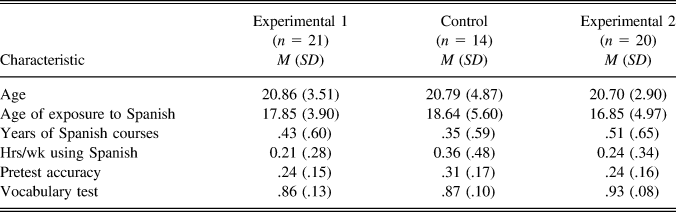
Sixty-one novice L2 learners of Spanish were recruited from first-semester, university-level Spanish courses for participation in the study and were pseudorandomly assigned to the experimental group for Experiment 1 (n = 23), to the experimental group for Experiment 2 (n = 21, discussed in the following text), or to the control group (n = 17) that was used for comparisons within each experiment. All participants had normal to corrected-to-normal vision. To minimize effects of previous exposure to the target form, participants were recruited before they had been exposed to the target form in their class and were scheduled for participation only if they had studied Spanish or any other Romance language for one year or less. At the end of the study, participants were asked if they had ever encountered or studied the form and would have been excluded from the final analysis if they indicated any previous exposure. However, no participants reported having encountered or studied the form previously. Participants were also excluded from the final analysis if they demonstrated more than 60% accuracy (following various Processing Instruction studies, for example, Sanz & Morgan-Short, Reference Sanz and Morgan-Short2004) on target items on a pretest (experimental: n = 1; control: n = 3). One additional participant was excluded from the final analysis due to poor quality eye-tracking data with more than 20% of trials where no eye movements were recorded. For Experiment 1, the final experimental group consisted of 21 participants (9 female) and the final control group consisted of 14 participants (10 female). Independent samples t-tests did not detect group differences based on pretest scores (t(33) = 1.395, p = .17, d = .43), amount of previous Spanish study (t(33) = .397, p = .69, d =.13), age of first exposure to Spanish (t(33) = .502, p = .62, d = .16), hours spent using Spanish per week outside of class (t(33) = 1.12, p = .27, d = .39), or a Spanish vocabulary test (t(33) = .270, p = .78 , d = .08) that assessed their knowledge of the verbs used in the experiment (Table 1).
Participant characteristics for experimental and control groups

Target Form
During the experiment participants were exposed to a construction in Spanish about which they had not yet received instruction in their current class: direct object pronouns, for example, lo (“him”) in Lo besa María (“Maria kisses him”). Because participants had not yet been exposed to the construction in their current class and were excluded based on the criteria described previously, we consider that the construction was novel for the set of participants included in the final analysis, although some previous exposure may have occurred that was not reported.
Following previous research (e.g., VanPatten & Cadierno, Reference VanPatten and Cadierno1993), we presented learners with only the third-person singular forms—lo (“him”) and la (“her”). Spanish direct object pronouns were chosen as the target form as they present a processing problem for learners when they are embedded in an utterance that also employs a null subject: In an utterance like La besa el chico (“The boy kisses her.”), if learners employ the First Noun Principle, that is, a processing strategy whereby learners interpret the first noun or pronoun they encounter in an utterance as the subject (VanPatten, Reference VanPatten and Sanz2005 and elsewhere), they will incorrectly interpret the pronoun as the agent rather than the theme.
Stimuli
The stimuli consisted of 160 unique sentences and a series of corresponding photos that depicted the sentences. Each sentence relayed information about an action that an agent performed on a theme, where the theme theta role was conveyed by the direct object clitic pronoun. The agent and theme roles expressed in the sentences were always third-person singular and animate. Sentences also provided an introductory phrase with time information and a final phrase referring to the place where the action occurred (see examples 1 and 2 in the following text). Sentences were formed using (a) 40 verbs, which had already been taught in the participants’ Spanish class, (b) masculine or feminine direct object pronouns, and (c) phrases such as “at eight in the morning” or “in the living room” to indicate when and where the actions occurred, respectively.
(1) Por la mañana a las ocho, la besa en su sala.
“At eight in the morning, he kisses her in their living room.”
(2) Por la tarde a las tres, lo besa en su cocina.
“At three in the afternoon, she kisses him in their kitchen.”
From the full set of sentences, 150 sentences were distributed between the experimental tasks (30 for phase 1 and 30 phase 2) and the linguistic assessment tasks (30 for the pretest, 30 for the posttest, and 30 for the delayed posttest). Within each task, each verb appeared no more than once, and masculine and feminine direct object pronouns occurred with equal frequency. The words that appeared immediately to the left of the direct object pronoun were matched for length, always consisting of four characters (i.e., tres or ocho). All sentences were presented in 18-point Times New Roman font on one line, centered on a computer monitor.
Presentation of Stimuli
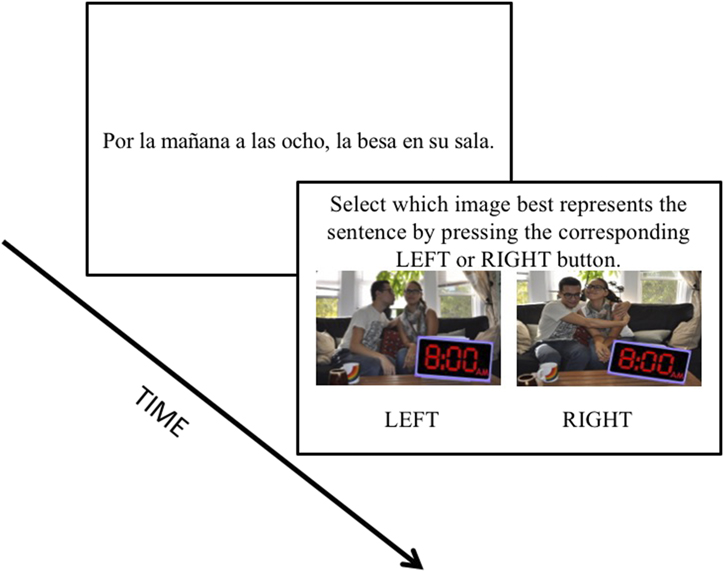
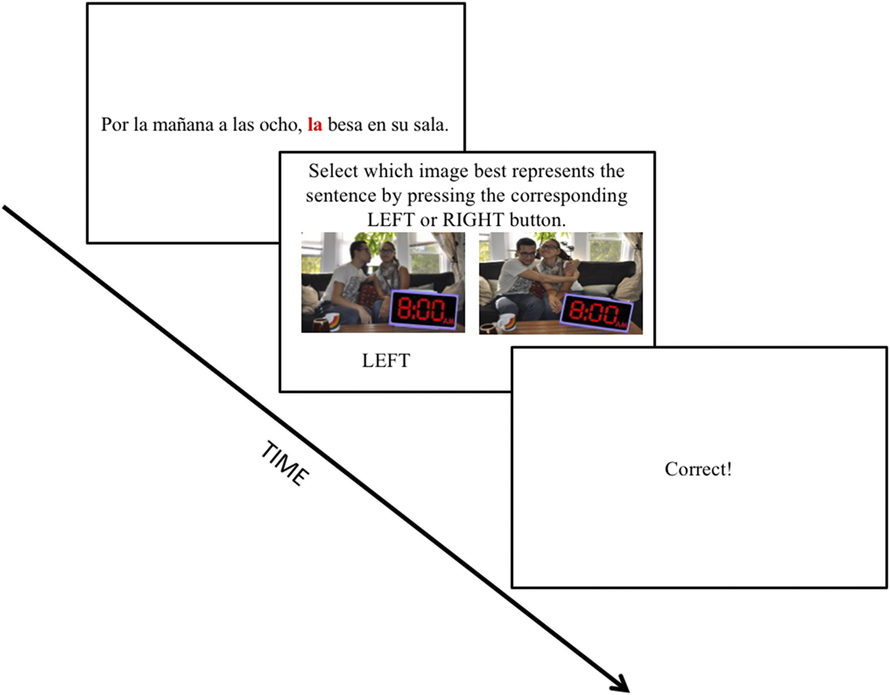
Phase 1 obtained a baseline measure of how participants allocated their attention to the target form prior to any manipulation. This phase was completed by both groups and consisted of 30 trials made up of the sentences and pictures described previously, each of which included two slides (Figure 1). The first slide of each trial presented a sentence with a direct object pronoun. The second slide presented two images along with directions to choose the image that represented the sentence. One image was a correct depiction of the sentence and one was a distractor image. Distractor images were scenes that differed from the sentences based on time, place, or the action depicted. Importantly, the images did not differ based on thematic role assignment. The location of the distractor image (i.e., left or right side of the slide) was counterbalanced and pseudorandomized.
Example of an individual trial in phase 1 (Experiments 1 and 2).

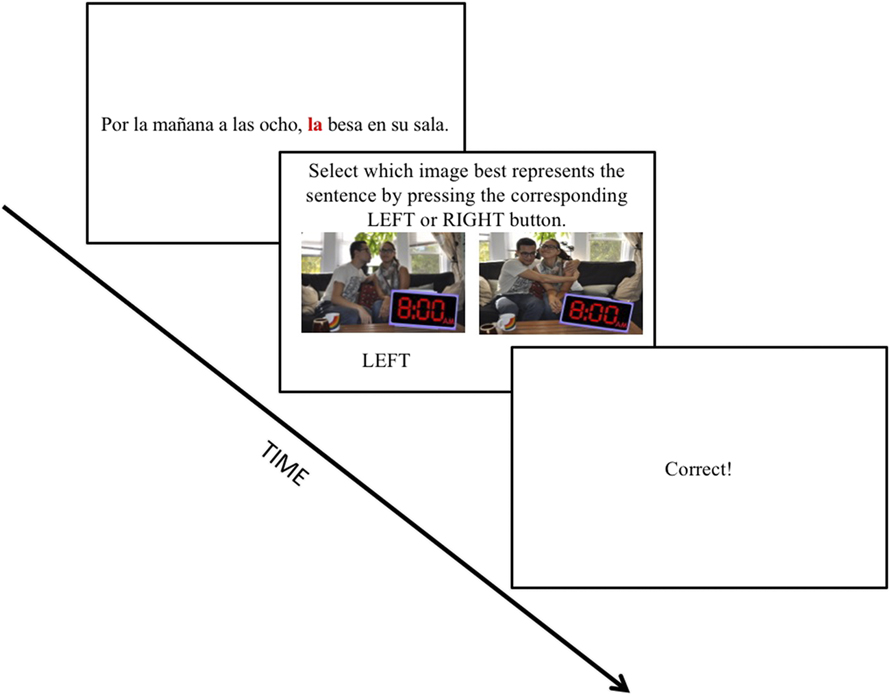
Next, to examine the effects of our external manipulation of attention, all participants completed phase 2 of the experiment, which differed by group. The experimental group completed 30 novel trials in which we employed IE as an external manipulation of attention to the target form (Figure 2). The trials were presented in the same manner as those in phase 1 except that the direct object pronoun in each sentence was displayed in red font rather than in black.
Example of an individual trial in phase 2 for Experiment 1 (external manipulation of attention with IE), with the target form presented in red font.
The control group completed the same 30 novel trials as the experimental group in phase 2, but without the external manipulation of attention. Thus, this phase 2 control condition was designed to ensure that any effects found in our experimental group were not solely due to additional exposure to the target form. In phase 2, all participants (experimental and control groups) received written feedback in the form of a message such as “Correct!” or “Incorrect!” depending on the accuracy of their response to each sentence. Note that the feedback was not relevant to the target form but rather to whether learners understood the time, place, or action depicted.
ASSESSMENT OF LINGUISTIC DEVELOPMENT
L2 development of Spanish direct object pronouns was assessed by an interpretation task (following VanPatten & Cadierno, Reference VanPatten and Cadierno1993) that measured participants’ ability to correctly interpret the target form. This test consisted of a picture-sentence matching task with 10 critical items in which participants read a novel sentence, saw two images that differed only regarding the direct object, and decided which image best represented the sentence. Thus, to respond correctly, participants needed to interpret the theme theta role expressed by the direct object pronoun. Twenty similarly formatted distractor items were also included where the difference between the two images was not related to the theme theta role but rather depicted differences in information related to the time, the action, or the place. This assessment was very similar in nature to the tasks completed during the training phase of the experiment, but feedback was never provided during assessment. Three versions of the assessment were created, and the distractor and critical items were counterbalanced across these versions, which were administered with a Latin square design over the pre-, post-, and delayed assessments so that each participant was exposed to all versions. For scoring of the interpretation task, participants received one point for each correct answer and no points for incorrect responses. Reliability was measured by Chronbach’s alpha for each version of the interpretation task (pretest: .72, immediate posttest: .87, and delayed posttest: .89) and reflected medium-to-high instrument reliability (Plonsky & Derrick, Reference Plonsky and Derrick2016). Accuracy was averaged over items for each participant on the pretest, immediate posttest, and delayed posttest.
Lastly, participants completed a postexposure debriefing questionnaire that assessed their explicit knowledge of rules related to the target form. This questionnaire consisted of seven questions that started out asking about what they thought the purpose of the experiment was more generally, and gradually became more specific, asking questions about their noticing and rule knowledge of the target form.
PROCEDURE
Data collection for each participant took place over two sessions on separate days in a campus laboratory. Participants were contacted by phone and a language background questionnaire was administered, and those who met criteria for inclusion were scheduled for their first session. They were also e-mailed a list of the 40 verbs used in the experiment and asked to review them before their first session. The procedure for session one, which lasted approximately an hour per participant, was as follows: After providing informed consent, participants completed the receptive, multiple-choice vocabulary test of the verbs used in the experiment, which required participants to choose the English translation equivalent of Spanish verbs. Next, participants completed the following components of the experiment in this order: (a) the pretest interpretation task, (b) phase 1, (c) phase 2, and (d) the immediate posttest. Two weeks later, participants returned to the lab for session two, which lasted approximately 30 minutes and included (a) the delayed posttest interpretation task and (b) a debriefing questionnaire.
Participants’ eye movements were recorded with an Eye-Link II head-mounted eye-tracker with a monocular sampling rate of 500 Hz, tracking the right eye while they completed phase 1 and phase 2 of the experiment. Before the experiment began, each participant, seated approximately 80 centimeters in front of a computer monitor, completed a nine-point visual calibration. For each trial, a fixation point appeared approximately 0.5 inches to the left of where the sentence would subsequently appear on the screen to ensure the participant was looking at the correct area of the screen when the sentence was displayed. Each sentence was presented for as long as the participant needed, and they were instructed to advance when ready. Responses were made by pressing one of two buttons on a game controller. Participants received monetary compensation for their participation.
DATA PROCESSING AND ANALYSIS
To analyze the eye-movement data, we processed the data as follows: First, we defined each word as a separate region and gathered eye-movement data at the word level (see Figure 3). We hypothesized that any effects of the attentional manipulation may be apparent on the direct object pronoun (region 7), as the novel target form. We also hypothesized that effects of the attentional manipulation may be apparent over both the direct object pronoun and the verb (regions 7 and 8 combined) for two reasons: (a) the thematic role relationship must be established between the pronoun and the verb, and (b) the pronoun is a short word, and thus participants may have overshot the word and processed it with the preceding word (Rayner, Reference Rayner1998). Thus, we conducted all analyses on region 7 and on the combined regions 7 and 8.
Regions of interest for eye-movement data.

To prepare the eye-movement data for analysis, we removed fixations of less than 50 ms and greater than 800 ms in duration (Keating, Reference Keating, Jegerski and VanPatten2014). We then extracted the following measuresFootnote 2 for each trial in the critical regions: gaze duration,Footnote 3 second-pass time, total time, and fixation rate. Data from the duration measures (i.e., gaze duration, second-pass time, and total time) were summed for each participant over the trials for phase 1 and phase 2 separately and are reported in seconds. Fixation rate is the percentage of trials in each phase where the participant made at least one fixation on the critical region.
To answer RQ1, group mean differences (phase 2 minus phase 1) and 95% confidence intervals (CIs) around the mean differences were calculated for each eye-tracking measure. Cummings and Finch (2005) and Plonsky (Reference Plonsky and Plonsky2015) argue that within-group difference scores with 95% CIs that do not overlap zero can be interpreted as reliable, that is, statistically significant. Thus, if the mean difference for any eye-tracking measure was more than zero and its 95% CIs did not overlap zero, we interpret the result as a reliable increase in attention. We also calculated Cohen’s d as a measure of the magnitude of any increase, and we interpret these effects sizes according to Plonsky and Oswald’s (2014) field-specific recommendations for within-group comparisons, with .60 indicating a small effect, 1.00 indicating a medium effect, and 1.40 indicating a large effect.
To answer RQ2, group mean differences (immediate posttest minus pretest and delayed posttest minus pretest for experimental and control) and the 95% CIs around these means were calculated. If a mean difference was more than zero and its 95% CIs did not overlap zero, we interpret the result as a statistically significant gain in L2 development (Cummings & Finch, 2005; Plonsky, Reference Plonsky and Plonsky2015) and report it along with Cohen’s d. To further understand the nature of any L2 development evidenced, mean accuracy scores at each assessment are also considered and are interpreted as reliably below or above chance if the 95% CIs for the mean did not overlap with 50% chance level.
Next, to answer RQ3, accuracy scores on the delayed posttest and the change in eye-tracking measures obtained during phase 2 as compared to phase 1 were submitted to multiple regression analyses. Models were run using the lm() function in R (R Core Team, 2016). The model included scores on the delayed posttest as the dependent variable. In our view, these scores represent stable L2 development as the time that elapsed between the instructional intervention and the delayed posttest should have led to consolidation of information acquired during the experiment. The model included the change (indicated by ∆) from phase 1 to phase 2 in gaze duration (∆GD) and second-pass time (∆SPT) as the predictor variables (see example 3). These two eye-tracking measures were included in the model as they have been examined in previous research on attention and L2 development (e.g., Winke, Reference Winke2013), and they are thought to represent qualitatively different cognitive processes (Clifton et al., Reference Clifton, Staub, Rayner, Van Gompel, Fisher, Murray and Hill2007).Footnote 4 Finally, the model included group as a predictor variable to determine whether any significant findings were specific to the experimental group. Alpha was set at .05 for this analysis.
(3) lm(formula = Delayed post ∼ group + ∆GD + ∆SPT + group * ∆GD + group * ∆SPT)
RESULTS
RQ1: Changes in attentional allocation
Experimental Group
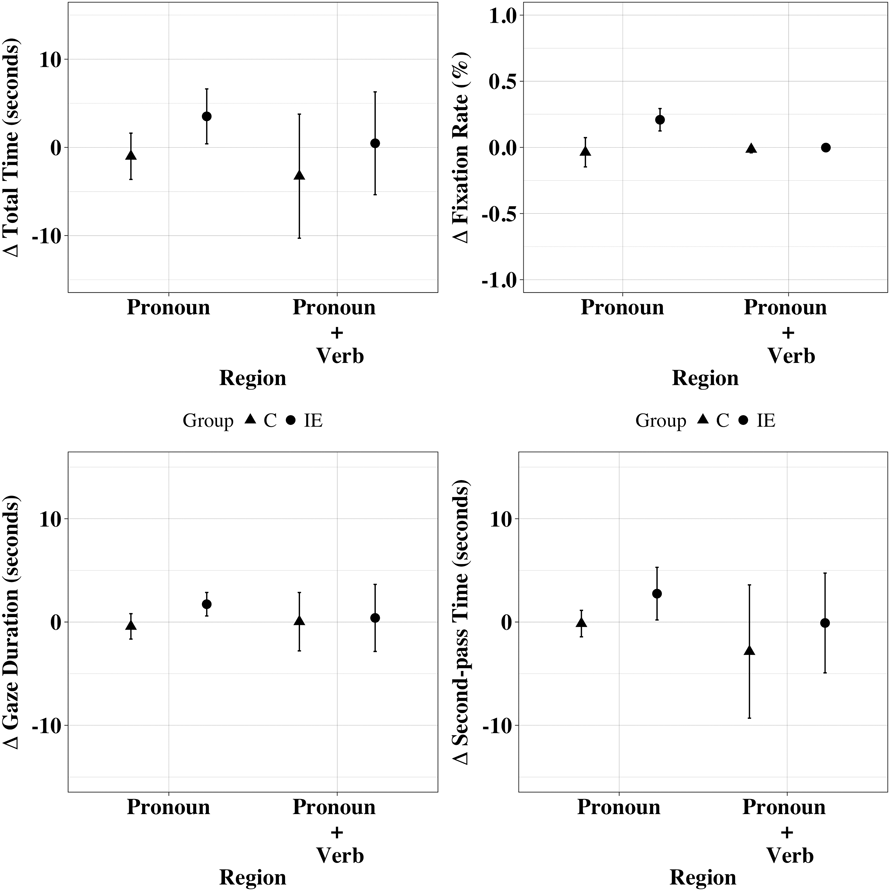
To determine whether the external attentional manipulation affected participants’ attentional allocation to the direct object pronoun, we examined the mean differences between the eye-tracking measures, that is, gaze duration, second-pass time, total time, and fixation count, recorded during phase 1 and phase 2 (see Figure 4 for mean differences for each eye-tracking measure, and Online Supplementary Materials Table SM1 for full descriptive data). Results revealed that gaze duration (mean difference = 1.7 seconds, 95% CI [.6, 2.9], d = .69), second-pass time (mean difference = 2.7 seconds, 95% CI [.2, 5.3], d = .49), total time (mean difference = 3.5, 95% CI [.4, 6.6], d = .51), and fixation rate (mean difference = 21%, 95% CI [12%, 29%], d = 1.12) all reliably increased on the pronoun. This is evidenced by 95% CIs around the mean difference that did not overlap zero along with a Cohen’s d value that indicates small to medium effect sizes. No changes were evidenced for the pronoun and verb (P+V) region.
Mean differences between phase 1 and phase 2 for eye-tracking measures for the experimental (IE) and control (C) groups on the Pronoun and Pronoun + Verb regions of interest for Experiment 1 (external manipulation of attention). Error bars represent the 95% CI around the mean difference scores.

Control Group
To confirm that the effects in the experimental group were not likely due to additional exposure to the form rather than to the attentional manipulation, we examined mean differences in eye-movement data between phase 1 and phase 2 for the control group. No reliable changes were found for the control group for either region of interest, as all the 95% CIs around the mean difference values overlapped zero and the effect sizes were negligible (see Figure 4 and Online Supplementary Materials Table SM1). Thus, effects of additional exposure to the form were not detected for the eye-movement data, suggesting that additional exposure does not account for the changes evidenced in the experimental group.
RQ2: Gains in L2 development
Experimental Group
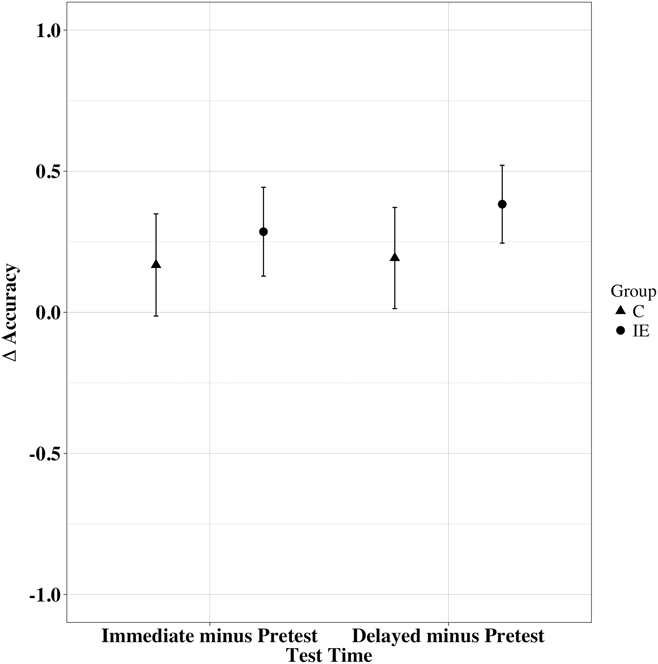
Mean differences from pretest to posttest and delayed posttest were examined to ascertain whether the external attentional manipulation led to improved interpretation of Spanish direct object pronouns (see Online Supplementary Materials Table SM2 for full descriptive data and Figure 5 for mean differences between tests). Reliable, small to medium-sized accuracy increases were evidenced from pretest to posttest (increase from 24% accuracy to 52%; mean difference = .29, 95% CI [.13, .44], d = .82) and from pretest to delayed posttest (increase to 62% accuracy; mean difference = .38, 95% CI [.25, .52], d = 1.26). Note that these increases in accuracy represent a change from below chance performance on the pretest (upper 95% CI < .50) to performance that did not differ from chance on the posttests (95% CIs overlapped or were equal to .50).
Mean differences in interpretation accuracy scores from pretest to immediate and delayed posttests for Experiment 1 (external manipulation of attention) for the experimental (IE) and control (C) groups. Error bars represent the 95% CI around the mean difference scores.

Control Group
To examine the possibility that the experimental group’s development resulted merely from additional exposure to the target form, we examined the accuracy data from the control group (see Online Supplementary Materials Table SM2 and Figure 5). A reliable, medium accuracy increase was evidenced from pretest to delayed posttest (increase from 31% accuracy to 50%; mean difference = .10, 95% CI [.01, .37], d = 1.16), but not from pretest to posttest (48% accuracy). Thus, additional exposure to the form led to some development, although accuracy never reached above chance levels (95% CIs overlapped or were equal to .50). These findings suggest that the change in development in the experimental group may have been partially due to exposure to the form, although the attentional manipulation seems to have led to earlier and greater gains in development.
RQ3: Assessing the relationship between attention and learning
Experimental Group
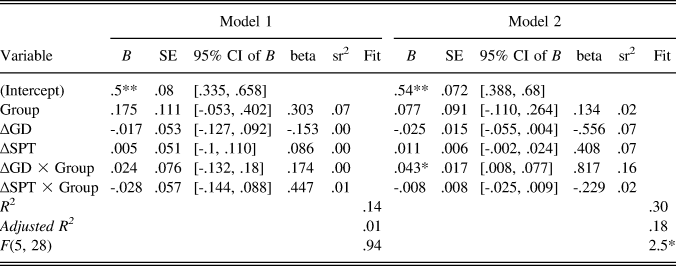
As a means of exploring the relationship between attention and learning, data from the pronoun alone (Model 1) and the P+V region (Model 2) were submitted to separate multiple regression analyses with ∆GD, ∆SPT, and group as predictor variables and scores on the delayed posttestFootnote 5 as the dependent variable. Although Model 1 did not yield any significant results (ps > .05 for the model and for the predictor variables; see Table 2), Model 2 accounted for 30% of the variance on the delayed posttest with a significant interaction between group and ∆GD (p < .05, sr 2= 16%) meaning that the relationship between ∆GD and delayed posttest scores differed for the experimental and control groups. As the control group was set as the comparison group in the model, we can interpret the coefficient (B) values from the model regarding the control group. Thus, ∆GD was negatively associated with accuracy, such that every additional 1 ms in ∆GD was associated with a decrease in accuracy of .025. For the experimental group, an additional calculation is necessary to obtain the coefficient from the significant group by ∆GD interaction: ∆GD coefficient (-.025) + group (1) * ∆GD coefficient (.043) = .018, which indicates that every additional 1 ms in ∆GD is associated with an increase in accuracy of .018 for the experimental group. In other words, for the control group for every additional second of ∆GD, a 25% decrease in accuracy was predicted by the model, and for the experimental group, for every additional second of ∆GD, an 18% increase in accuracy was predicted.
Regression results for Experiment 1

Note: * indicates p < .05; ** indicates p < .01. A significant b-weight indicates the beta-weight and semi-partial correlation are also significant; b represents unstandardized regression weights; SE represents the standard error of the unstandardized regression weights; beta indicates the beta-weights or standardized regression weights; sr 2 represents the semipartial correlation squared. The experimental (external attentional manipulation) and control groups are included in the model (n = 35).
DISCUSSION: EXPERIMENT 1
Here we summarize the findings from Experiment 1 and discuss their relevance to previous research. Regarding RQ1, results indicated that an external manipulation of attention, that is, IE, led to increases in duration and frequency of attention to a novel linguistic target form. These results are generally consistent with previous research that found that attention can be manipulated by IE (Simard & Foucambert, Reference Simard, Foucambert, Bergsleithner, Frota and Yoshioka2013; Winke, Reference Winke2013). IE in the current study led to increases on the Spanish direct object pronoun for more global measures including the total time fixating on a target form, consistent with Winke (Reference Winke2013), and the overall fixation rate. IE also led to increases on the pronoun for second-pass time, consistent with Simard & Foucambert (Reference Simard, Foucambert, Bergsleithner, Frota and Yoshioka2013) and Winke (Reference Winke2013), as well as for gaze duration. The results, however, are not consistent with Indrarathne and Kormos (Reference Indrarathne and Kormos2016) and Loewen and Inceoglu (Reference Loewen and Inceoglu2016) who did not show effects of IE on attentional allocation.
Regarding RQ2, the current study’s results converge with the mixed results of previous research on the effectiveness of IE for L2 development. On the one hand, some L2 development seemed to occur, as evidenced by significant gains from pretest to posttests, consistent with studies that have found an effect of IE (e.g., Alanen, Reference Alanen and Schmidt1995; Lee, Reference Lee2007). On the other hand, the fact that learners did not significantly differ from chance levels of accuracy with the novel L2 target form supports studies that have not found an effect for IE (e.g., Park, Reference Park2005).
Pertaining to RQ3, the results indicated that, for the experimental group, the amount of additional attention paid to the combined pronoun and verb target region predicted increased accuracy. These results are generally consistent with Indrarathne and Kormos (Reference Indrarathne and Kormos2016) in that, for their IE conditions, they found significant relationships between total time and L2 development. Our results suggest more specifically that L2 development under external attentional manipulations may have been affected by the earlier stage of attentional allocation, that is, gaze duration, which would be included in the total time measured in Indrarathne and Kormos (Reference Indrarathne and Kormos2016). However, our findings contrast with those of Loewen and Inceoglu (Reference Loewen and Inceoglu2016) and Winke (Reference Winke2013) in that those studies did not find evidence for a direct relationship between attention, as measured by eye movements, and L2 development. This contrast may be due to differences in the type of enhancement, the target form, or the eye-tracking measures included in our regression model, among other factors.
In summary, the results from Experiment 1 reveal that attentional allocation to a novel L2 form was in fact impacted by the external manipulation of attention and that although development occurred, it did not result in targetlike interpretation of the novel form. Lastly, we found a relationship between the attention allocated due to the external manipulation of attention and development (from below chance to at chance performance) of the novel L2 form.
EXPERIMENT 2
Experiment 2 was designed in parallel to Experiment 1, but rather than exploring the effects of an external manipulation of attention on L2 development, Experiment 2 examined the effects of an internal manipulation, which was based on SI practice (described in the following text) and compared to the control condition from Experiment 1. The assessment of linguistic development, the procedure and the analyses for Experiment 2 were identical to Experiment 1, and their descriptions are not repeated here.
METHOD
Participants
Twenty-one participants were pseudorandomly assigned to the experimental group in Experiment 2. All had normal or corrected-to-normal vision. One participant was removed from the experimental group for scoring more than 60% accuracy on a pretest. Thus, the final experimental group consisted of 20 participants (14 female). The control group (as described for Experiment 1) consisted of 14 participants. Independent samples t-tests did not detect group differences based on pretest scores (t(32) = 1.27, p = .24, d = .42), amount of previous Spanish study (t(32) = .775, p = .44 , d = .25), age of first exposure to Spanish (t(32) = 1.00, p = .32, d = .33), hours spent using Spanish per week outside of class (t(32) = .856, p = .40, d = .29), or a Spanish vocabulary test (t(32) = 1.91, p = .06 , d = .67) that assessed their knowledge of the verbs used in the experiment (see Table 1).
Target Form and Stimuli
The target form, sentences, and pictures were identical to those used in Experiment 1.
Presentation of Stimuli
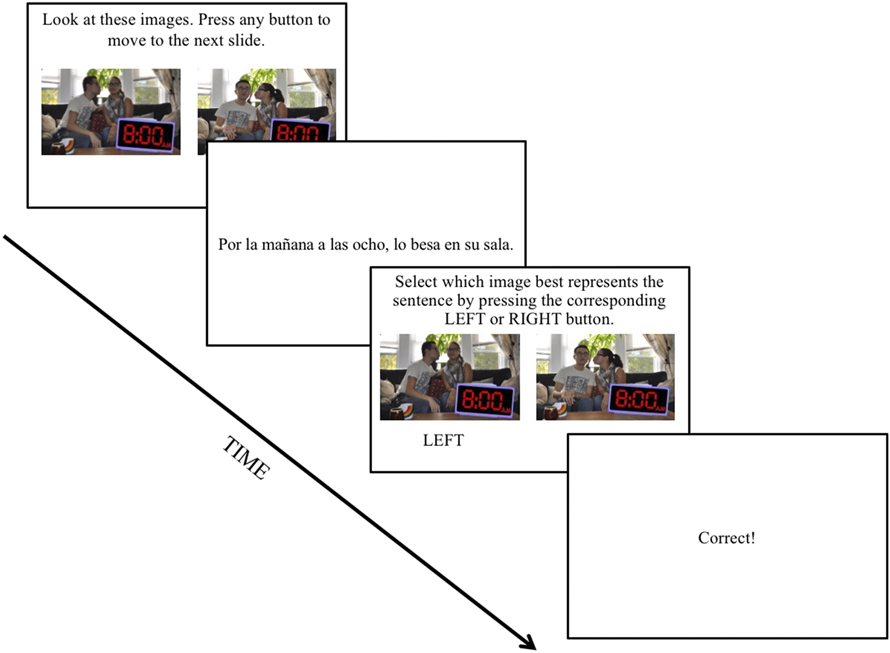
Parallel to Experiment 1, the presentation of the stimuli for Experiment 2 consisted of two phases: phase 1 (identical to that of Experiment 1) and phase 2 (same sentences, different presentation as compared to Experiment 1). The trials in phase 2 differed for the experimental condition in that they were designed to internally direct attention to the target form through SI practice (Figure 6). In this condition, prior to the sentence slide, participants were presented with a slide that provided advance information, specifically, two images with directions to look at them. The same two images were presented again after the sentence slide with instructions to choose which image best represented the sentence. Crucially, all pairs of images in this condition differed from the sentence based only on which actor realized the theme theta role of the verb. For example, participants saw an image of a boy kissing a girl and an image of girl kissing a boy as the first slide in the trial. Thus, the contrast between these two images should serve as advance information to internally direct learner attention to the direct object pronoun in the sentence on the upcoming slide. In other words, the direct object pronoun encoded the information necessary to decide which image best represented the sentence and, thus, respond correctly.
Example of an individual trial in phase 2 for Experiment 2 (internal manipulation of attention with SI practice), with a preliminary slide that includes two images distinguished only by agent-patient relationship.

RESULTS
RQ1: Changes in attentional allocation.
Experimental Group
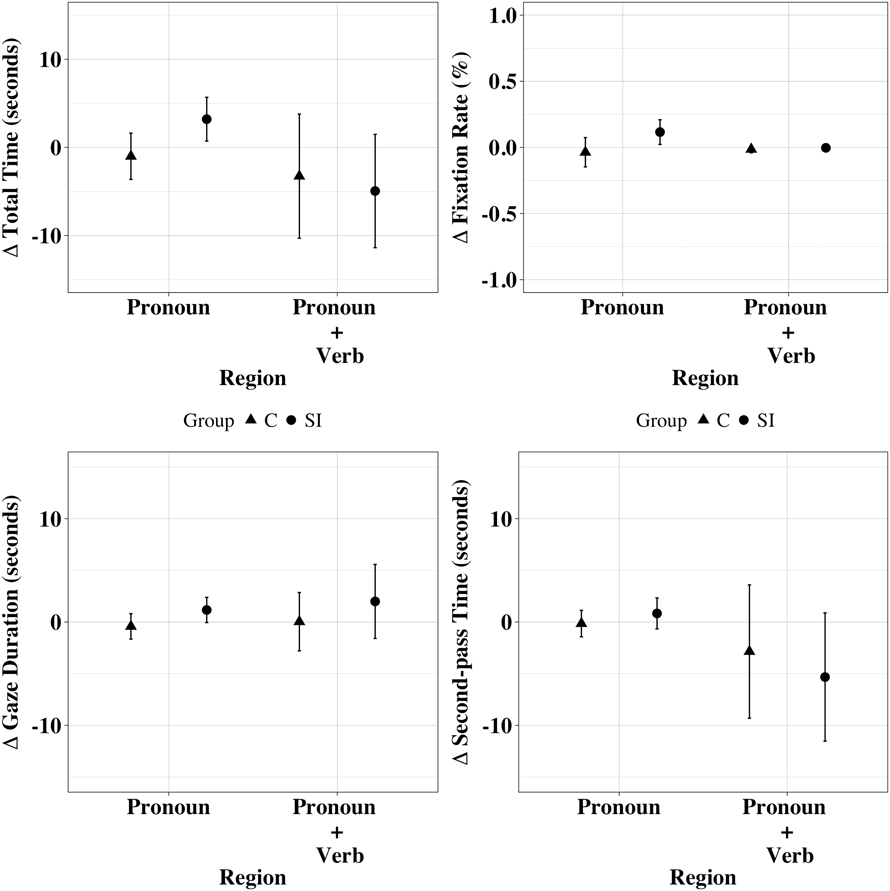
To determine whether the internal attentional manipulation impacted participant attentional allocation to the direct object pronoun, we examined the mean difference between the eye-tracking measures recorded during phase 1 and phase 2, that is, gaze duration, second-pass time, total time, and fixation rate (see Figure 7 for mean differences for each eye-tracking measure, and Online Supplementary Materials Table SM3 for full descriptive data). Two small but reliable changes were evidenced on the pronoun: an increase in fixation rate (mean difference = 12%, 95% CI [2%, 21%], d = .53) and an increase in total time (mean difference = 3.2 seconds, 95% CI [.721, 5.6], d = .60). No changes were evidenced for the pronoun and verb (P+V) region.
Mean differences between phase 1 and phase 2 for eye-tracking measures for the experimental (SI) and control (C) groups on the Pronoun and Pronoun + Verb regions of interest for Experiment 2 (internal manipulation of attention). Error bars represent the 95% CI around the mean difference scores.

Control Group
As reported in Experiment 1, the control group did not evidence any reliable changes in eye-tracking measures, suggesting that changes in the experimental group were not due to additional exposure to the form but rather to the internal manipulation of attention (control group data is repeated in Figure 7 and Online Supplementary Materials Table SM3 for comparability).
RQ2: Gains in L2 development
Experimental Group
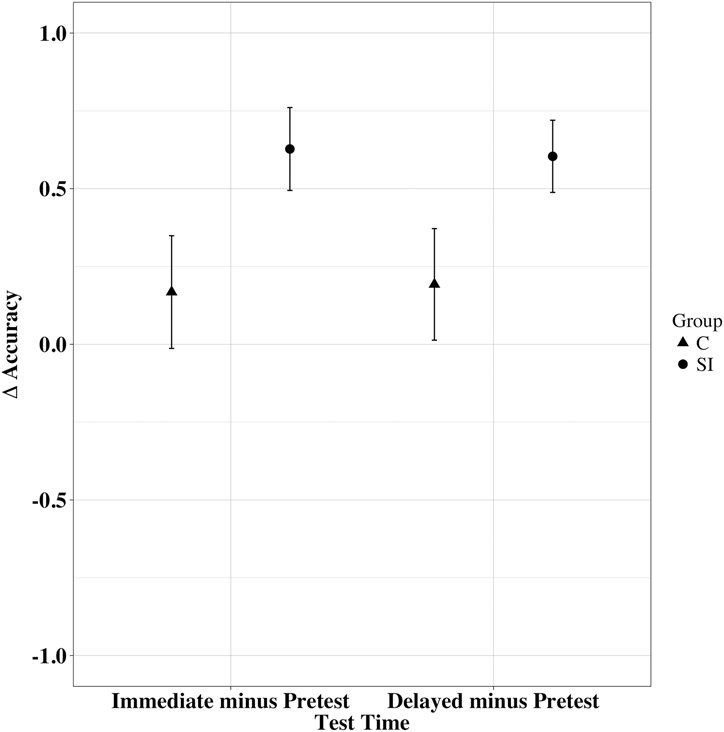
CIs (95%) on the mean differences from pretest to posttest and delayed posttest were examined to ascertain whether the internal attentional manipulation led to improved interpretation of the target form (see Online Supplementary Materials Table SM2 for full descriptive data and Figure 8 for mean differences between tests). Reliable, large accuracy increases were evidenced from pretest to posttest (increase from 24% accuracy to 87%; mean difference = .63, 95% CI [0.49, 0.76], d = 1.93) and from pretest to delayed posttest (increase to 85% accuracy; mean difference = .60, 95% CI [0.49, 0.72], d = 2.09). Note that these increases in accuracy represent a change from below chance performance on the pretest (upper 95% CI < .50) to above chance performance (95% CIs > .50).
Mean differences in interpretation accuracy scores from pretest to immediate and delayed posttests for Experiment 2 (internal manipulation of attention) for the experimental (SI) and control (C) groups. Error bars represent the 95% CI around the mean difference scores.

Control Group
As reported in Experiment 1, the control group only evidenced a medium, reliable change from below chance-level accuracy to accuracy that did not differ from chance, which suggests that the experimental group’s large, reliable increase and above-chance performance cannot be fully attributed to additional exposure to the target form alone, but was also caused by the internal manipulation of attention (see Online Supplementary Materials Table SM2 and repeated control data in Figure 8).
RQ3: Assessing the relationship between attention and learning
Experimental Group
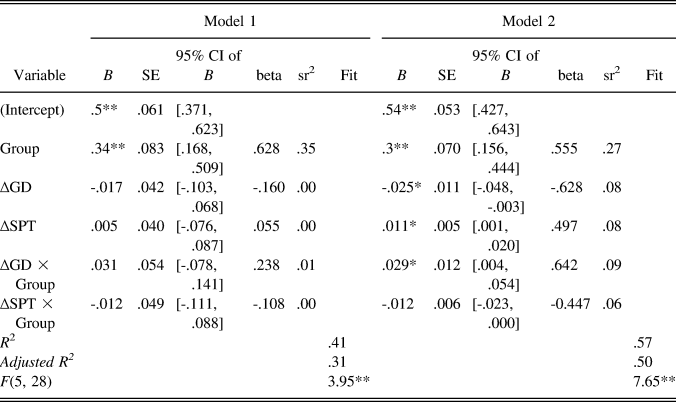
To explore the relationship between attention and learning, data from the pronoun alone (Model 1) and the P+V region (Model 2) were submitted to separate multiple regression analyses with ∆GD, ∆SPT, and group as predictor variables and scores on the delayed posttest as the dependent variable (see Table 3). Results from Model 1 accounted for 41% of the variance in posttest scores with group as a significant predictor (p < .01, sr 2 = 35%), which indicates that being in the SI group is a significant predictor of delayed posttest scores, but no additional significant results were evidenced (ps > .05 for the model and for the predictor variables). Model 2, by contrast, accounted for 57% of the variance in responses on the delayed posttest, with group (p < .01, sr 2 = 27%), ∆SPT (p < .05, sr 2 = 8%), and ∆GD (p < .05, sr 2 = 8%) being significant predictors of delayed posttest scores and a significant interaction between ∆GD and group (p < .05, sr 2 = 9%).
Regression results for Experiment 2

Note: * indicates p < .05; ** indicates p < .01. A significant b-weight indicates the beta-weight and semipartial correlation are also significant; b represents unstandardized regression weights; SE represents the standard error of the unstandardized regression weights; beta indicates the beta-weights or standardized regression weights; sr 2 represents the semipartial correlation squared. The experimental (internal attentional manipulation) and control groups are included in the model (n = 34).
For Model 2, the significant positive coefficient for group indicated that being in the experimental group was associated with an average delayed posttest score that was 30 points greater than that of the control group. As in Experiment 1, the significant negative coefficient for ∆GD indicated that for the control group, each 1 ms increase in ∆GD is associated with a decrease of .025 in accuracy scores. Additionally, the significant positive coefficient for second-pass time, indicated that for the control group, each 1 ms increase in ∆SPT is associated with .011 increase in accuracy. The significant interaction of group × ∆GD indicated that the relationship between accuracy and attention differed for the experimental and control groups. For the experimental group, the coefficient was calculated as follows: ∆GD coefficient (-.025) + group (1) * ∆GD interaction coefficient (.029) = .004, which indicates that every additional 1 ms in ∆GD is associated with .004 increase in accuracy for the experimental group. In sum, for the control group, each additional second spent in gaze duration on the target form was associated with a 25% decrease in accuracy and each additional second in second-pass time was associated with an 11% increase in accuracy for the control group, whereas for the SI group, each additional second spent fixating the target was associated with a 4% increase in accuracy.
DISCUSSION: EXPERIMENT 2
Regarding RQ1, the results from Experiment 2 indicate that the internal manipulation of attention, that is, SI, directed learners’ attention to novel linguistic target forms as small increases in the duration and frequency of fixations were evidenced. Whereas previous research has shown that SI practice results in learning (e.g., VanPatten & Oikkenon, Reference VanPatten and Oikkenon1996) that can occur rather quickly (e.g., Fernandez, Reference Fernandez2008), the current results provide unique insight into how learners’ cognitive processes (i.e., attentional allocation) are affected by SI practice.
Pertaining to RQ2, the results indicate that participants learned a substantial amount under this attentional manipulation. Mean differences in accuracy scores on the interpretation task reflected large accuracy increases of about 60% from pretest to posttest. These significant increases show that by internally directing learners’ attention to the target form, they exhibited highly accurate L2 development of this form in a relatively short amount of time without the provision of any explicit information and were able to retain the learning gain.
Regarding RQ3, the results from Experiment 2 show that the additional attention, in gaze duration, that learners in the experimental group paid to the pronoun and verb in reading predicts a small increase in their scores on the delayed posttest. Thus, these results link L2 development with attentional allocation, as measured by eye-tracking, and therefore provide novel evidence that attention to grammatical target forms brought about by an internal manipulation of attention, as instantiated by SI, may be related to learning of those forms in a limited way.
The relationship between L2 grammatical development and internal manipulations of attention has not been specifically addressed by previous research. Generally, though, results from the current study are consistent (a) with Indrarathne and Kormos (Reference Indrarathne and Kormos2016), which found that, for learners who received IE (an external attentional manipulation), total fixation time (which includes gaze duration) was related to L2 grammatical development, and (b) with research conducted by Godfroid and colleagues (e.g., Godfroid et al., Reference Godfroid, Boers and Housen2013 among others), which did not provide attentional manipulations but found relationships between attention as measured by gaze duration and total time, awareness, and subsequent learning of L2 vocabulary items and at least one grammatical form.
General Discussion
Taken together, the findings from Experiments 1 and 2 showed that external and internal manipulations of attention to a novel L2 target form affect how learners allocate their overt attention to that form and bring about L2 development, albeit in different ways and to differing levels of accuracy. Furthermore, L2 development was accounted for, in part, by the attention directed to the target form by both external and internal manipulations, but to differing magnitudes of effect. In the following text, we consider each of these findings as informed by both experiments.
First, for attentional allocation, results provide novel findings regarding SI and confirm some previous research on IE (Simard & Foucambert, Reference Simard, Foucambert, Bergsleithner, Frota and Yoshioka2013; Winke, Reference Winke2013, but cf. Indrarathne & Kormos, Reference Indrarathne and Kormos2016 and Loewen & Inceoglu, Reference Loewen and Inceoglu2016), serving as online evidence that both IE and SI can manipulate overt learner attention to L2 forms. Thus, given the eye-mind link, we provide evidence that through overt attention IE can arguably affect both early and possibly automatic and late controlled cognitive processes (Clifton et al., Reference Clifton, Staub, Rayner, Van Gompel, Fisher, Murray and Hill2007), whereas, regarding SI, we only have evidence of its effect more globally.
Second, regarding L2 development, the findings are generally consistent with previous research on IE (Han et al., Reference Han, Park and Combs2008; Leow & Martin, Reference Leow, Martin, Gass, Spinner and Beheney2017) and SI (e.g., VanPatten & Oikkenon, Reference VanPatten and Oikkenon1996). For IE, the current results were mixed because gains were evidenced, but the gain was from below chance performance on the pretest to chance performance on the delayed posttests. Thus, participants did not seem to successfully learn to interpret the target form. For SI, significant gains were also evidenced with participants obtaining below chance levels on the pretest and above chance levels on the posttests, which suggests that learners were largely interpreting the target form correctly after the internal attentional manipulation. Additionally, group means suggest that all groups of learners appeared to initially adhere to the First Noun Principle, consistent with VanPatten’s (2005 and elsewhere) Input Processing Model, based on pretest scores that were significantly below chance, which indicates that learners were consistently interpreting the pronoun as the subject, rather than the object, of the sentence. Whereas the IE group (and the control group at the delayed test) seemed to abandon a consistent interpretation of the pronoun as the subject, only the SI group seemed to abandon this strategy and to make form-meaning connections between the target form and its thematic role, as evidenced by highly accurate performance on the posttests.
Finally, the results inform our general understanding of the role of attention in SLA by evidencing a relationship between attention and L2 development. The relationship between external and, to a lesser extent, internal manipulations of attention and L2 development was found specifically for gaze duration, which has been associated with early cognitive processes (Clifton et al., Reference Clifton, Staub, Rayner, Van Gompel, Fisher, Murray and Hill2007). Thus, increased gaze duration time may be the attentional correlate that reflects first-pass processing of form-meaning connections as brought about by our instructional interventions. Interestingly, attending to the pronoun was not associated with L2 development, but rather development was associated with the amount of time initially attending to both the pronoun and the adjacent verb before leaving the combined region, suggesting that early overt attention to the thematic relationships between the pronoun and the verb may have been important in leading to gains on the posttest.
Note, however, that the effects of attention on development do not appear to be of similar magnitude across manipulations. Although the current study was not designed to directly compare the external and internal manipulations of attention, we note that each additional second of gaze duration led to an 18% increase in accuracy for the external manipulation, whereas, each additional second of gaze duration led to only a 4% increase in accuracy for the internal manipulation. This finding might be somewhat unexpected theoretically: The internal manipulation led to a linguistic gain of 60 percentage points, whereas the external manipulation led to a linguistic gain of 38 points. Given the theoretical links between attention and development, one might expect that attention would play a larger role for the group that experienced the large gains in development. Contrary to this prediction, the role of attention seemed to be small for these learners.
Why might it be that overt attention exhibited a weak relationship with accuracy under our internal manipulation of attention? Here we discuss one theoretical and two statistical explanations, although there certainly are additional possible explanations. The small effect may have been caused by the characteristics of the internal manipulation. That is, the advance information provided to participants may have freed up attentional resources and allowed for the facilitation of processing of the form-meaning connection (referred to as modulation by Chun et al., Reference Chun, Golomb and Turk-Browne2011), as learners may not have needed to employ attentional resources to select the meaning from “competing stimuli,” that is, the full semantics of the sentence, to map onto the form. In other words, the advance information in the form of images may have more readily activated semantic features in the learners’ developing linguistic system, such as theta roles. Such activation in combination with even a small increase in attention to the target form in the input may have facilitated a rapid creation of successful form-meaning mappings, thus potentially reducing the need for a more substantial increase in attention to the form over the course of phase 2 (i.e., the SI practice).
Regarding possible statistical reasons for the weak relationship between attention and L2 development for the internal manipulation (SI group), learners’ scores on the delayed post-test were relatively high (75% of scores more than 80% accuracy) with a relatively small standard deviation (see Online Supplementary Materials). These constraints on the SI group’s accuracy data may have affected the ability to detect a relationship between development and attention in our models. A second factor that may have impeded the detection of a stronger relationship, is that the effect of attention may have varied over the course of phase 2, potentially playing a more significant role at the beginning of the phase and diminishing in effect as learners began successfully making form-meaning connections. To explore this possibility, we ran two post hoc regression models, with one model containing eye-tracking data from the first half of trials from each phase and the other containing data from the second half of trials from each phase. Thus, we hoped to gain some insight as to whether the relationship differed over the course of phase 2, which would have impacted the results from RQ3 for the SI group. Results revealed no interpretable effect for eye-tracking measures during the first or second halves of trials, which suggests that the relationship between attention and development evidenced for RQ3, although weak, did not change drastically over the course of the experiment.
An interesting point made by one reviewer is that the significant group × ∆GD interaction for Experiment 2 may have largely been driven by the performance of the control group and that gaze duration minimally affected linguistic development in the SI group. Upon examination of the full pattern of results, it is evident that the two experimental groups, as compared to the control group, exhibited a different pattern of associations between attention and development for gaze duration: namely, both experimental groups showed positive relationships whereas the control group showed a negative relationship. Additionally, after running post hoc regression models with each group’s data separately, which confirmed the coefficient values for each group but did not find independent statistically significant relationships (control: ps > .08; IE: ps > .06; SI: ps > .4), we believe that the significant interactions reported in our results reflect the fact that attentional manipulations, particularly an external manipulation, change the relationship between attention and development above and beyond mere exposure to the target form as in the control group.Footnote 6
Taken together, the findings from both experiments seem to indicate that although attention to the target form may be manipulated by external and internal manipulations, without effective processing and subsequent creation of form-meaning connections, learners may not fully abandon the first-noun processing strategy to correctly interpret the pronoun as the object, as evidenced by posttest scores that were not above chance for the external attentional manipulation and the control group. Regarding models of L2 development that highlight a role for attention in learning, these findings corroborate claims from Leow (Reference Leow and Leow2015) and Robinson (Reference Robinson, Doughty and Long2003) that attention to form serves as a gateway for further processing that, in turn, improves the likelihood that these forms will enter the learner’s developing interlanguage system. For example, the results for the group that received IE, align with Leow’s (2015) model, insofar as although this group attended to the target form, participants did not show strong learning effects, which may have been due to a lack of depth of processing, given that the manipulation did not require that learners process the form for meaning (as we postulated in the preliminary report of this study in Issa, Morgan-Short, Villegas, & Raney, Reference Issa, Morgan-Short, Villegas and Raney2015). Note, however, that within this group, attention to the target form predicted increased accuracy. This finding could also be interpreted in light of a depth of processing account, such that learners within the group who attended to the target form for longer may have employed deeper processing during phase 2, resulting in increased L2 development.
Although eye-movement data is not a direct measure of external and internal attentional mechanisms, but rather a reflection of overt attentional allocation due to the manipulations employed here, we consider this study to be a first step in potentially leveraging research in cognitive psychology about external and internal attention (Chun et al., Reference Chun, Golomb and Turk-Browne2011) to further refine theoretical models of attention in L2 development. To the extent that our manipulations engage external and internal attention, a speculative interpretation of the eye-tracking effects may suggest that external attention, which is also described by Chun et al. as “perceptual attention,” is readily engaged by salient visual characteristics of the L2 input, as evidenced by increases in overt attention in the IE group for all eye-tracking measures. However, although such engagement may lead to initial stages of learning, for example, input processing in Leow’s (2015) model, it may not necessarily lead to further processing, for example, intake processing in Leow’s model, that would ultimately create accurate form-meaning connections. Regarding the internal attention that may have been engaged by our internal manipulation, we speculate that these mechanisms may have been more effective in leading learners to process the attended form to establish form-meaning connections through rehearsal or modulation of information in their working memory (Chun et al., Reference Chun, Golomb and Turk-Browne2011; Leow, Reference Leow and Leow2015; Robinson, Reference Robinson, Doughty and Long2003), which may have led to the robust learning gains in the SI group. The deployment of these internal attentional mechanisms may not require overt attentional allocation, as evidenced by only one of the four eye-tracking measures being affected by this manipulation and the weak relationship between attention and development of form. However, if later stages of processing in working memory are in any way dependent on internal attention, then internal attention, as differentiated from external attention, should be accommodated into models of attention in L2 development. Future research that continues to be informed by current perspectives about attention in cognitive psychology may provide a means for further exploration of whether and when external and internal attention play independent roles in L2 development.
LIMITATIONS AND FUTURE DIRECTIONS
As with any research endeavor, the present study is not without limitations. First, we acknowledge that the 60% accuracy cutoff value on the pretest, typical of Processing Instruction research (e.g., Sanz & Morgan-Short, Reference Sanz and Morgan-Short2004 and elsewhere), could be lowered in future research. That said, each of our groups performed below chance on the pretest, and no participant reported having studied the form before or during the experiment. Thus, the target form seems to be novel to our sample in general, although some participants may have had very limited knowledge of the target form that they did not recall or report.
Second, the feedback provided to learners in the two experiments differed, such that the IE group’s (Experiment 1) feedback was not related to the target form and is not expected to have played a role in L2 development. However, the feedback provided to the SI group (Experiment 2) was always related to interpretation of the target form. Thus, for the SI group, we are not able to fully disentangle the effects of the internal attentional manipulation (increased attention due to the advance information) from increased attention due to feedback, or from the combination these factors. Future research may want to design conditions that isolate these elements.
A third limitation is that, based on a post hoc power analysis, we have determined that there is a low probability that our regression analysis would detect small effects, thus, there could be more subtle relationships with eye-tracking measures that we were unable to detect. This lack of power may also partially explain the fact that, for RQ1, effects were evidenced on the pronoun and, for RQ3, relationships between attention and development were found on the combined pronoun and verb region. Fourth, we have only considered the relationship between overt attention measured during the attentional manipulations and L2 development for the delayed posttest, which we take as the most valid representation of stable L2 development. Future research may consider the effects of attentional allocation during L2 practice on both immediate and delayed posttests in an a priori manner to understand how and why online processes affect development over time.
Fifth, limited L2 development in Experiment 1 may have been evidenced because learners were only exposed to 30 target forms. Additional exposure under external manipulations of attention may have led to greater attentional effects and/or L2 development. Moreover, increased time before delayed testing may have led to increased development, as the experimental group in Experiment 1 showed a descriptive increase in accuracy between the posttest and the delayed posttest two weeks later. Another potential explanation for the weak learning effect evidenced in Experiment 1 may be related to a lack of transfer-appropriate processing as the measure of L2 development did not reflect the experimental task, whereas it did in Experiment 2. These issues, as well as a deeper examination of how attention to the target form changes over a series of trials, should be addressed in future research following recent L2 eye-tracking research (e.g., Cintrón-Valentín & Ellis, Reference Cintrón-Valentín and Ellis2015; Godfroid et al., Reference Godfroid, Ahn, Choi, Ballard, Cui, Johnston, Lee, Sarkar and Yoon2018; Indrarathne, Ratajczak, & Kormos, Reference Indrarathne, Ratajczak and Kormos2018; Pellicer-Sánchez, Reference Pellicer-Sánchez2016). It might also be fruitful for future research to delve deeper into the experimental tasks and create permutations that more closely align with tasks from cognitive psychology. Additionally, as effects for attention and L2 development were found for SI, it would be interesting to explore whether these effects were particular to the task-essentialness or other elements of SI.
CONCLUSION
In all, the pattern of results from Experiments 1 and 2 provides a nuanced view of the role of different types of attentional manipulations in L2 development in that (a) external and internal attentional manipulations both result in increased attention to linguistic target forms, and (b) both manipulations are positively associated with L2 development through a measure of attention that reflects early cognitive processes, albeit to different degrees of magnitude. Future research and replication are needed to further substantiate the robustness and generalizability of this pattern of findings, which is expected to contribute to our understanding of the theoretical role of learner attention in L2 development and how attentional manipulations may lead to more effective L2 development.
SUPPLEMENTARY MATERIAL
To view supplementary material for this article, please visit https://doi.org/10.1017/S027226311800013X