Implications
When grass silage and maize silage are incubated together but in different ratios in vitro, the associative effects on criteria of fermentation are unlikely to occur. Fermentation values for the individual silages are additive in these mixtures. However, the effect of variation in silage chemical composition remains to be investigated. The effects of feed particle size should be taken into account when comparing results of studies conducted with a Rusitec system. Further research investigating the effect of feed particle size, larger than particles produced by milling feeds with a 4-mm sieve, on degradation rates measured in rumen simulations is needed.
Introduction
The simultaneous use of maize silage and grass silage in ruminant nutrition is common practice in Europe, and intensity of feeding is dependent on environmental and economic aspects. Both forages differ in their contents of non-structural carbohydrates (NSC), generally higher in maize silages, and CP, mostly higher in grass silages. Current feed evaluation systems assume that nutritional values of individual forages are additive and do not consider possible interactions. However, one forage can affect the nutritional value of another forage in the diet (Niderkorn and Baumont, Reference Niderkorn and Baumont2009). The incremental replacement of grass silage by maize silage has been reported to result in linear or quadratic responses of total tract digestibility (Browne et al., Reference Browne, Juniper, Bryant and Beever2005; Juniper et al., Reference Juniper, Browne, Bryant and Beever2008; Vranić et al., Reference Vranić, Knežević, Bošnjak, Leto, Perčulija and Matić2008).
Published studies investigating the effect of a diets’ maize silage to grass silage ratio on ruminal fermentation are limited in number. On the one hand, the adequate availability of fermentable carbohydrates and nitrogen has been intensively discussed to promote microbial fermentation in the rumen (Hoover and Stokes, Reference Hoover and Stokes1991). On the other hand, high starch contents, as present in maize silage, have been shown to possibly lead to a depression in fibre degradation (Grant and Mertens, Reference Grant and Mertens1992). As recently demonstrated by Juniper et al. (Reference Juniper, Browne, Bryant and Beever2008), the inclusion of maize silage in replacement of grass silage in a diet (0, 330, 670 and 1000 g/kg forage) led to an increase in degradation of organic matter (OM) and a decrease in degradation of NDF in the rumen of steers. These observations were accompanied by an increase in feed intake and ruminal passage rate caused by the inclusion of maize silage, whereas the ruminal pH value decreased.
In vitro methods provide the opportunity to standardise the environment of ruminal fermentation, in general at lower costs than in vivo studies (Stern et al., Reference Stern, Bach and Calsamiglia1997). One of the most commonly used in vitro methods is the Hohenheim gas production technique (Menke and Steingass, Reference Menke and Steingass1988), which is reported to detect interactions between forages in the early hours of incubation (Robinson et al., Reference Robinson, Getachew and Cone2009). However, to consider the adaptation of the microbial community to the diet, in vitro continuous culture systems are suitable for measurements on nutrient degradation (Stern et al., Reference Stern, Bach and Calsamiglia1997). To generate homogeneous samples, dry feedstuffs usually are milled before in vitro incubation. The particle size and shape of incubated feedstuffs affect the availability and degradability of nutrients (Michalet-Doreau and Cerneau, Reference Michalet-Doreau and Cerneau1991; Bowman and Firkins, Reference Bowman and Firkins1993). The particle size of incubated feedstuffs has varied widely across continuous culture studies in the literature, but attempts to research the consequences of this variation are rare. Inter-laboratory standardisation of in vitro set-ups is hard to achieve. However, the comparison of results from different laboratories is common practice in scientific publishing.
The first objective of this study was to investigate how the stepwise replacement of maize silage by grass silage affects gas production and nutrient degradation under in vitro conditions. The hypothesis was that one silage, maize silage and grass silage, respectively, might affect the fermentation and nutritional value of the other one when both are incubated together in several ratios. The effects on total tract digestibility were additionally studied with sheep. The second objective was to study to what extent the characteristics of in vitro fermentation change when particle size distribution is varied by fine and coarse milling.
Material and methods
Treatments
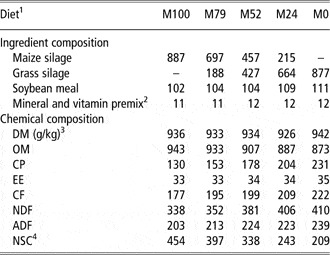
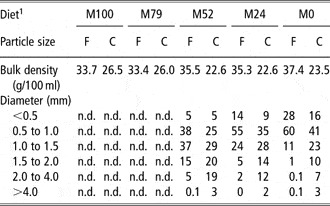
Five diets, equal in their proportion of forages (877 to 887 g/kg), soybean meal (102 to 111 g/kg) and a mineral and vitamin premix (11 to 12 g/kg), but different in their maize silage to grass silage ratio, were used. The maize silage and grass silage (fourth cut) were produced at a dairy cow farm near Halle upon Saale (Germany). The dry matter content was 350 g/kg (maize silage) and 380 g/kg (grass silage), and the pH values were 3.72 and 4.21, respectively. The concentrations of acetic acid, propionic acid, butyric acid and lactic acid were 25.1, 0.6, 0.3, 56.6 g/kg dry matter for maize silage and 6.2, 0.3, 0.3, 92.2 g/kg dry matter for grass silage. NH3-N content was 116 mg/g total N in maize silage and 43 mg/g total N in grass silage. The starch concentration of the maize silage was 323 g/kg dry matter. The maize silage to grass silage ratios were 100 : 0, 79 : 21, 52 : 48, 24 : 76 and 0 : 100 (on dry matter basis) in diets M100, M79, M52, M24 and M0, respectively (Table 1). With the stepwise replacement of maize silage by grass silage, the concentrations of CP and fibre fractions in the diet increased, and the concentrations of OM, especially NSC, decreased. Before the in vitro incubations, the diets were dried at 65°C and ground by a cutting mill (Pulverisette 15, Fritsch GmbH, Idar-Oberstein, Germany). Particle size was varied by using two different milling sieves with either a 1- or 4-mm perforation, and treatments were classified as fine (F) and coarse (C), respectively. F treatments were characterised by a bulk density (g/100 ml) that was, on average, 45% higher than that of C treatments (Table 2). Differences in bulk density rely on differences in particle size distribution. The proportion of particles with a diameter lower than 1 mm was about 88%, 69% and 43% in F treatments and 57%, 44% and 30% in C treatments for diets M0, M24 and M52, respectively. Particle size distribution could not be measured for diets with a high proportion of maize silage (M100, M79) due to a high degree of particle agglomeration, which turned out to impair the suitability of the method of determination.
Composition of experimental diets (g/kg DM)

DM = dry matter; OM = organic matter; EE = ether extract; CF = Crude fibre; NSC = non-structural carbohydrates.
1Maize silage to grass silage ratio of 100 : 0 (M100), 79 : 21 (M79), 52 : 48 (M52), 24 : 76 (M24) and 0 : 100 (M0)
2Ingredient/g: 180 mg Ca, 100 mg Na, 52 mg P, 20 mg Mg, 0.32 mg Zn, 0.064 mg Mn, 0.002 mg Se, 0.001 mg I, 0.001 mg Co, 24 IU vitamin A, 2.4 IU vitamin D3, 0.024 mg vitamin E.
3Oven-dried at 65°C as used for in vitro incubation.
4NSC = 1000 − NDF − CP − EE − ash (Van Soest et al., Reference Van Soest, Robertson and Lewis1991).
Bulk density of diets and classification of feed particles according to their diameter (%)

F = fine; C = coarse; n.d. = non detectable because of agglomerated particles in maize silage.
1Maize silage to grass silage ratio of 100 : 0 (M100), 79 : 21 (M79), 52 : 48 (M52), 24 : 76 (M24) and 0 : 100 (M0).
Experimental procedures
Total tract digestibility
For additional characterisation of diets before the in vitro assays, digestibility of crude nutrients was measured with four wether sheep per diet by a standard procedure (Gesellschaft für Ernährungsphysiologie, GfE, 1991) with methodological details as described by Boguhn et al. (Reference Boguhn, Kluth, Steinhöfel, Peterhänsel and Rodehutscord2003). In brief, the daily rations were offered in two meals per day. The period of adaptation to the diet was at least 14 days. Feed intake ranged between 722 and 828 g dry matter for diets M0 and M100, respectively, and was adapted to the estimated maintenance metabolisable energy (ME) requirement. Wethers with a mean body weight of 67.1 kg were housed in single cages and were equipped with bags during collection of faeces for a period of 6 consecutive days. The bags were emptied once daily and a representative sample of faeces was stored at −20°C.
Gas production test
The intention was to describe the kinetics of gas production especially in the first hours of incubation as an indication of the extent of fermentation over time. Gas production was measured using the apparatus as described by Menke et al. (Reference Menke, Raab, Salewski, Steingass, Fritz and Schneider1979) and following the official method (25.1, Verband Deutscher Landwirtschaftlicher Untersuchungs- und Forschungsanstalten, VDLUFA, 2006). At least eight replicates per treatment, distributed across four independent incubation periods, were used. Approximately 200 mg of the diets were weighed in glass syringes (150 ml). Rumen liquid was taken from three ruminally fistulated sheep (breed Schwarzköpfiges Fleischschaf) before the morning feeding, filtered through two layers of linen cloth and mixed. Animals had been fed grass hay for ad libitum intake, 250 g of a concentrate mix and 10 g of a mineral and vitamin mix daily. Rumen liquid and buffer medium (method 25.1, VDLUFA, 2006) were mixed at a ratio of 1 : 2 and dosed at a volume of 30 ml to each syringe. Gas production was recorded manually 1, 2, 3, 4, 5, 7, 9, 11, 13, 15, 17, 21, 25, 29, 33, 39, 45, 57, 69, 81 and 93 h after the incubation had been started. Venting was done four times in each incubation period at all syringes including the blanks. The correction factors for hay and concentrate as the two standard feedstuffs were not considered.
Rumen simulation
Degradation of crude nutrients and detergent fibre fractions was measured using a semi-continuous rumen simulation technique (Rusitec; Czerkawski and Breckenridge, Reference Czerkawski and Breckenridge1977). Treatments were tested at four (F) and three (C) replications, respectively, and distributed to seven incubation periods, each lasted for 13 days. Five ruminally fistulated sheep, fed as described above, were used for obtaining liquid and solid samples of rumen content on the first day of incubation, immediately before the morning feeding. The whole procedure of sampling inocula, loading and running the Rusitec system, equipped with six fermenters having a capacity of 800 ml each, was carried out as described by Boguhn et al. (Reference Boguhn, Kluth and Rodehutscord2006). Diets were weighed into nylon bags (pore size = 100 μm) at an amount of 15 g per bag. Incubation started with two nylon bags per fermenter, one contained experimental feed and the other was filled with solid samples of rumen content (∼60 g). The latter was replaced by a second feed bag 24 h later. The buffer solution, following McDougall (Reference McDougall1948), contained 0.7 mmol NH4+/l from 15NH4Cl (11.5% 15N abundance) and was infused continuously at an average flow rate of 546 (s.d. = 29) ml/day. The amount of effluents, captured in cooled bottles (4°C), was measured daily. After 48 h of incubation, each bag was replaced by a new one, washed in 50 ml of buffer solution and squeezed moderately. The liquid was filled back into the respective fermenter. After 7 days of incubation, feed residues were collected for 6 consecutive days. In addition, 320 ml of daily effluents were centrifuged two times for 5 min at 2.000 × g and 4 °C to separate the feed particles that were washed out from the bags. After removing the supernatant with a pipette, the residuum was rinsed on a pre-weighed folded filter (MN 615 • ø 150 mm, Macherey-Nagel GmbH & Co. KG, Düren, Germany). Bags and filters were dried at 65 °C for 24 h and weighed at room temperature after 24 h. Feed residues from the bags were pooled per fermenter and stored at room temperature until subsequent analyses. Thereafter, liquid effluents, free from feed particles, were centrifuged at 27.000 × g (15 min, 4°C), and 40 ml of the supernatant were sampled daily, pooled per fermenter and stored at −20°C for analysis of NH3-N and short-chain fatty acids (SCFA). Microbes, associated with solids, were isolated from feed residues on the last day of incubation according to the method described by Carro and Miller (Reference Carro and Miller2002). The microbes were separated from the remaining fluid and further treated as described by Boguhn et al. (Reference Boguhn, Kluth and Rodehutscord2006).
Analytical procedures
Bulk density of feed samples was measured by using a grain tester with a calibrated 250 ml cylinder (Louis Schopper, Leipzig, Germany) in three replicates per diet. Particle size distribution was detected by using a photo-optical particle analyser (HAVER-CPA 4, Haver & Boecker OHG, Oelde, Germany). The photo-optical method was used because sieving methods are less suitable for measuring feed samples that contain particles of elongated shapes, as in the case of grass silage. In brief, particles from 5 g of the experimental diets were individualised by an oscillating trough and dosed to fall down in front of a light source. The particles’ silhouettes were detected by a charge-coupled device camera, which was connected to a control and output unit. The diameter of the feed particles was calculated by the area of a circle, equating the area of the particles’ silhouettes.
Crude nutrients were analysed following official methods (VDLUFA, 2006). Samples of feed, feed residues and freeze-dried faeces were ground to pass through a sieve of 1-mm pore size and analysed for dry matter and crude ash (method 3.1), CP (method 4.1.1), ether extract (EE, method 5.1.1) and crude fibre (CF, method 6.1.1). These samples, with the exception of faeces, were also analysed for contents of NDF, assayed with a thermally stable amylase, and ADF, both without residual ash (methods 6.5.1 and 6.5.2). Starch content in maize silage was determined via the polarimetric approach (method 7.2.1). NH3-N was measured by steam distillation with sodium hydroxide (VAPODEST 4 titramatic, Gerhardt GmbH & Co. KG, Bonn, Germany) followed by end-point titration (titration unit S154, Schott, Hofheim, Germany). Concentrations of SCFA were analysed in pooled samples of each replicate, using a gas chromatograph (GC 14B, Shimadzu, Japan) equipped with a flame ionisation detector, and samples were treated with formic acid containing 4% of 2-methyl-valeric acid according to Geissler et al. (Reference Geissler, Hoffmann and Hickel1976). Feedstuffs, feed residues and solid-associated microbes were analysed for N and 15N in triplicate per sample using an elemental analyser (EuroEA, HEKAtech GmbH, Wegberg, Germany) combined with an isotope ratio mass spectrometer (Delta V advantage, Thermo Fisher Scientific, Bremen, Germany).
Calculations
Total tract digestibility of nutrients was calculated on the basis of quantitative data for feed intake and faeces and the analysed concentrations of crude nutrients as described by Boguhn et al. (Reference Boguhn, Kluth, Steinhöfel, Peterhänsel and Rodehutscord2003). ME was calculated on the basis of digestible nutrients according to GfE (2001).
Gas production data were corrected for blank values (mean value of 3 syringes per incubation period, only rumen liquid-medium mixture) at each time of measurement. Considering the aspect that gas production primarily originates from OM fermentation and because diets differed in their OM content, the gas production data were standardised by expression per g of OM. To describe the course of cumulative gas production, the following modified Gompertz function according to Beuvink and Kogut (Reference Beuvink and Kogut1993) was fitted to the data:

with y = cumulative gas production at time t (ml/g OM); b = capacity of gas production (ml/g OM); μr = gas production rate of rapidly fermentable components (per h); Dr = fractional decay constants for μr; μs = gas production rate of slowly fermentable components (per h); Ds = fractional decay constants for μs; t = time after incubation started (h).
Model parameters were estimated for each syringe by using the software GraphPad Prism 5.01 for Windows (GraphPad Software Inc., La Jolla, San Diego, CA, USA). The rate of gas production was calculated by the first derivative of equation (1), and its maximal value (GPmax, ml/h) was reached at the point of inflection.
The extent of degradation of crude nutrients and detergent fibre fractions was calculated as the difference between the daily input and output of the respective nutrient in relation to its daily input. The amounts of NSC in feed and feed residues were calculated according to Van Soest et al. (Reference Van Soest, Robertson and Lewis1991). The daily amounts of N and OM in feed residues were corrected for the contribution of solid-associated microbes. Respective calculations, based on measurements of N and 15N, followed Boguhn et al. (Reference Boguhn, Kluth and Rodehutscord2006). CP from microbes was calculated as microbial N × 6.25.
Statistics
Data were statistically analysed using the MIXED procedure of the software package SAS for Windows (version 9.1.3, SAS Institute, Cary, NC, USA). Analysis of variance (ANOVA) was performed for the two fixed effects of diet and particle size and their interaction. Incubation period was factored as a random effect into the statistical analysis. Variances were evaluated according to the method of Kenward and Roger (Reference Kenward and Roger1997) for calculation of the degrees of freedom in mixed linear models. If significant interactions (P < 0.05) between the fixed effects were observed, the least square means of treatments F and C within a diet were additionally compared by t-test. Furthermore, the effect of replacing maize silage by grass silage was examined for linear and quadratic effects using the CONTRAST statement of SAS.
Results
Total tract digestibility in wether sheep
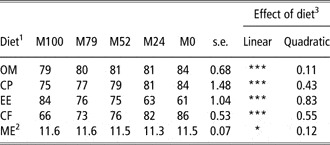
Diets were characterised by a linear increase in digestibility of OM, CP and CF with increasing proportion of grass silage (P < 0.001, Table 3). In contrast, the digestibility of EE decreased linearly with an increasing proportion of grass silage (P < 0.001). The content of ME was similar among all diets, with a mean value of 11.5 MJ/kg dry matter. Nevertheless, there was a slight linear decrease with increasing proportion of grass silage in the diet. No significant quadratic effects in response to changes in diet composition were observed for nutrient digestibility and ME content.
Total tract digestibility of nutrients (%) in wether sheep and ME (MJ/kg DM) of experimental diets (means and pooled s.e.)

ME = metabolisable energy; DM = dry matter; OM = organic matter; EE = ether extract; CF = Crude fibre.
1Maize silage to grass silage ratio of 100 : 0 (M100), 79 : 21 (M79), 52 : 48 (M52), 24 : 76 (M24) and 0 : 100 (M0).
2Calculated on the basis of digestible nutrients according to GfE (2001).
3Linear and quadratic effects in response to changes in maize silage to grass silage ratio.
*P < 0.05; ***P < 0.001.
Gas production
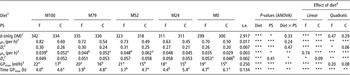
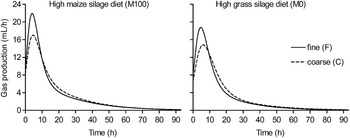
The modified Gompertz function was adjusted to the gas production data with a high goodness of fit (R 2 ⩾ 0.99). The capacity of gas production (b) decreased linearly with increasing proportions of grass silage in the diet for both particle size treatments (Table 4). Values averaged 338, 333, 321, 311 and 300 ml/g OM for diets M100, M79, M52, M24 and M0, respectively. Values were, on average, higher in F treatments than in C treatments (P = 0.03). Although differences between the two particle sizes became nominally lower with higher proportions of grass silage, no significant interaction was detected (P = 0.33). The gas production rate of rapidly fermentable components (μr) and its fractional decay constant (Dr) were affected by diet and significantly higher at particle size F than at C across all diets. Interactions of diet and particle size were found for the gas production rate of slowly fermentable substrate (μs). Although μs was higher at particle size C than F for diets M52, M79 and M100, it was not significantly affected by particle size in diets M24 and M0. Maximal gas production rate (GPmax), on average, was highest for M100 (19 ml/h) and lowest for M24 and M0 (17 ml/h). GPmax was higher in F treatments than in C treatments for all diets. The point of GPmax was reached after approximately 4.3 h for diets M100, M79 and M52, but was detected 0.6 and 1.1 h later for diets M24 and M0, respectively. For all diets, the occurrence of GPmax was significantly later in C treatments compared with F treatments, at least 0.6 h for diet M100, and at most 1.4 h for diet M0. These differences between F and C treatments might explain the observed interactions for GPmax and its time of occurrence. In Figure 1, the development of gas production rates within 93 h of incubation is shown for these two diets. A delay of gas production in C treatments compared with F treatments is obvious for both diets. As shown in Table 4, significant quadratic effects were detected for the parameters μr, Dr,, μs and Ds, as well as for the time of occurrence of GPmax. In contrast, the capacity of gas production (b) and GPmax only showed a significant linear response.
Estimated parameters of the modified Gompertz function (equation (1)) and maximal gas production rates (means and pooled s.e.)

PS = particle size; F = fine; C = coarse.
1Maize silage to grass silage ratio of 100:0 (M100), 79:21 (M79), 52:48 (M52), 24:76 (M24) and 0:100 (M0).
2Abbreviations according to equation (1).
3Maximal gas production rate.
4Linear and quadratic effects in response to changes in maize silage to grass silage ratio.
*P < 0.05; **P < 0.01; ***P < 0.001.
a,bIn case of significant interaction: different superscripts indicate significant differences between particle sizes F and C within diets (t-test, P < 0.05).
Development of gas production rates from 1 g organic matter of diet M100 and diet M0 at particle sizes F and C during 93 h of incubation.

Rumen simulation
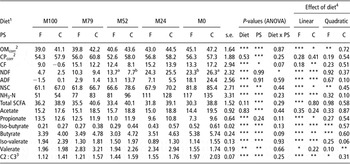
Degradation of OM, CF, NDF and ADF during 48 h of incubation in the Rusitec system was significantly affected by diet (Table 5). The stepwise replacement of maize silage by grass silage from diet M100 to diet M0 led to a linear increase in degradation of OM from about 0.40 to 0.46. This was accompanied by a linear increase in degradation of fibre fractions and NSC with increasing proportion of grass silage in the diet. Apparently unaffected by the diet, CP was degraded to an extent of 0.57. The degradation of OM was, on average, 2 percentage points higher in C treatments than in F treatments. This observation seems to result from the significantly higher degradation of the CP and NSC fractions in C treatments compared with F treatments, with 0.58 v. 0.55 and 0.74 v. 0.68, respectively. The effect of milling on degradation of fibre fractions was less clear. Coarse milling seemed to have a negative effect compared with fine milling at high maize silage proportions, whereas the opposite seems to be the case at high grass silage proportions. The trend for an interaction for CF degradation was also supported by the linear effect determined for C treatment but not for F treatment.
Degradation of crude nutrients, detergent fibre fractions and non-structural carbohydrates during 48-h incubation in the Rusitec (%), daily outflow of NH3-N (mg/day) and SCFA (mmol/day) measured in the effluents (means and pooled s.e.)

PS = particle size; F = fine; C = coarse; CF = Crude fibre; NSC = non-structural carbohydrates; SCFA = short-chain fatty acids.
1Maize silage to grass silage ratio of 100:0 (M100), 79:21 (M79), 52:48 (M52), 24:76 (M24) and 0:100 (M0).
2Corrected for contribution of solid-associated microbes.
3Acetate-to-propionate ratio.
4Linear and quadratic effects in response to changes in maize silage to grass silage ratio.
*P < 0.05; **P < 0.01; ***P < 0.001.
a,bIn case of significant interaction: different superscripts indicate significant differences between particle sizes F and C within diets (t-test, P < 0.05).
Higher proportions of grass silage in the diet resulted in a linearly increasing amount of NH3-N in the daily effluents from Rusitec, with, on average, 52 mg/day for M100 and 126 mg/day for M0 (Table 5). The daily outflow of NH3-N was higher in C treatments than in F treatments, with a minimum difference of about 3 mg and a difference of maximally 18 mg for M100 and M0, respectively. No main effect of diet on the amount of SCFA was detected by ANOVA (P = 0.11). Nevertheless, the test for linear effects showed a decrease in SCFA production with increasing proportion of grass silage within F treatments (Table 5). The daily outflow of the individual SCFA was significantly affected by diet, with the exception of acetate. With a higher proportion of grass silage in the diet, the daily amounts of iso-butyrate and butyrate increased, and those of propionate and iso-valerate decreased linearly. The response in iso-butyrate and butyrate also showed a quadratic effect, but only within the F treatments. Compared with F treatments, C treatments had a higher production of total and individual SCFA, except for propionate. Consequently, the acetate-to-propionate ratio was significantly affected by maize silage to grass silage ratio and particle size. Molar proportions of acetate, iso-butyrate and butyrate increased from diet M100 to diet M0, whereas the proportion of propionate and iso-valerate decreased (data not shown). Compared to fine milled diets, C treatments had an increasing effect on the molar proportions of acetate, iso-butyrate and butyrate but led to reductions in the proportion of propionate.
Discussion
Effect of maize silage to grass silage ratio
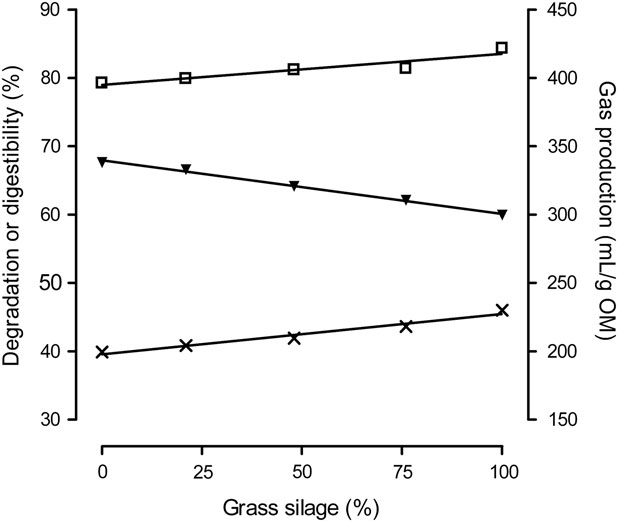
It was hypothesised that maize silage and grass silage might affect each other in their characteristics of fermentation when both are incubated together in vitro at several ratios. In general, this hypothesis could not be confirmed. Although some quadratic effects on parameters of the estimated functions were detected, the combination of maize silage and grass silage (M79, M52 and M24) showed no associative effect on the capacity of gas production (Figure 2). The differences between diet M100 and diet M0 are in agreement with the results of García-Rodriguez et al. (Reference García-Rodriguez, Mandaluniz, Flores and Oregui2005), who found a mean difference of 24% in the cumulative gas production between maize silages and grass silages after 96 h of incubation. Some associative effects of forage mixtures, compared with single feedstuff incubation, were reported by Robinson et al. (Reference Robinson, Getachew and Cone2009), but only for the first 8 h of incubation. This could be confirmed by the present results when performing some calculations with the estimated parameters (equation (1)). During the first 4 h of incubation, cumulative gas production was the highest for both F and C treatments of diet M52, but after 8 h the ranking of diets was equal to the capacity of gas production and did not change anymore (quadratic effect at 2 h: P < 0.001, 4 h: P = 0.01 and 8 h: P = 0.32). Consequently, the presence of associative effects depends on the duration of incubation.
Linear responses of organic matter (OM) digestibility in wether sheep (□; y = 0.045x + 78.98; R 2 = 0.68), OM degradation in the Rusitec (×; y = 0.059x + 39.56; R 2 = 0.33) and capacity of gas production (▾; y = −0.394x + 339.8; R 2 = 0.70) to the replacement of maize silage by grass silage in the forage portion of the diet.
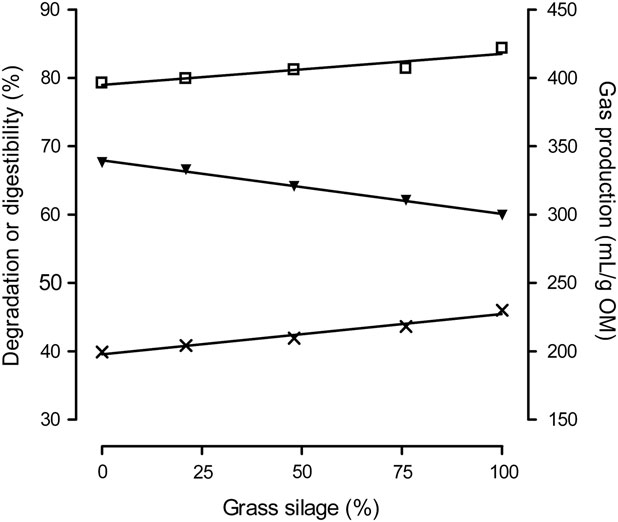
Increasing the proportion of grass silage in the diet resulted in an increase in degradation of OM (Figure 2). However, the amount of apparently degraded carbohydrates (NDF + NSC, without consideration of microbial carbohydrates) was higher in high maize silage diets than in high grass silage diets (4.2 v. 3.8 g in diets M100 and M0, respectively). This was confirmed by the measured amounts of total SCFA, which averaged 37, 38, 36, 35 and 34 mmol/day for diets M100, M79, M52, M24 and M0, respectively. These results are in agreement with the quantitative gas production data, and in vitro gas production arises to a greater extent from NSC fermentation than CP fermentation (Menke and Steingass, Reference Menke and Steingass1988). The amount of degraded CP increased with increasing proportion of grass silage (1.0 v. 1.8 g in diets M100 and M0, respectively), which contributed to the degradability of OM in the Rusitec. However, the degradability of CP was not affected by diet, probably because the solubility of CP in grass silage and maize silage is similar (Givens and Rulquin, Reference Givens and Rulquin2004). In addition, differences in the availability of N sources between diets were indicated by changes in iso-acid production (Griswold et al., Reference Griswold, Apgar, Bouton and Firkins2003).
Differences in fibre degradation between diets, incubated in the Rusitec system, were in accordance with the acetate-to-propionate ratio, increasing from high maize silage to high grass silage diets. However, the general level of fibre degradation was very low and close to zero for ADF for diet M100. Microbial enzyme activity and not the fibre itself limits the rate of fibre degradation (Wallace et al., Reference Wallace, Wallace, McKain, Nsereko and Hartnell2001). High dietary contents of NSC, such as maize starch, are often associated with a decrease in ruminal pH value and consequently a reduction in cellulolytic activity, but this effect is marginal when the pH value does not fall below 6.2 (Huhtanen et al., Reference Huhtanen, Ahvenjärvi, Weisbjerg and Nørgaard2006). In vitro conditions allow the pH value to be maintained at a constant level, which in this study was around 6.6 immediately before daily feeding. A negative effect of maize starch addition on the potential extent of NDF digestion (Grant and Mertens, Reference Grant and Mertens1992) and lag time of fibre digestion (Mertens and Loften, Reference Mertens and Loften1980) was observed, although the pH was maintained at 6.8 in vitro. In conclusion, the presence of starch might have had a negative effect on microbial fibrolytic activity in the present Rusitec study. However, the increase in fibre degradation with inclusion of grass silage in the diet is in accordance with the digestible CF determined in wether sheep (Table 3), indicating a higher content of fermentable fibre from grass silage. Linear responses in the total tract digestibility (Table 3 and Figure 2) of nutrients are also reported by Browne et al. (Reference Browne, Juniper, Bryant and Beever2005) and Juniper et al. (Reference Juniper, Browne, Bryant and Beever2008) when the ratio of maize silage to grass silage was changed. However, the occurrence of associative effects is dependent on the quality of grass silage (Vranić et al., Reference Vranić, Knežević, Bošnjak, Leto, Perčulija and Matić2008). The quality of grass silage can greatly vary between single batches and the digestibility of OM is positively related (P < 0.001) to CP concentration (Yan and Agnew, Reference Yan and Agnew2004). Contrary results from studies concerning maize silage to grass silage ratio may arise because of the high variations in the chemical composition of silages. Therefore, the results of this study do not allow for conclusions on these types of diet per se. The content of CP and fibre fractions in forages, as well as their ruminal fermentation characteristics, especially seems to play an important role in the occurrence of associative effects (Niderkorn and Baumont, Reference Niderkorn and Baumont2009).
Effect of particle size
Our second objective was to identify the effect of milling on the characteristics of fermentation in vitro. The use of milling sieves with either a 1- or 4-mm perforation showed apparently contrary results between the two in vitro methods used. Gas production was higher in F treatments than in C treatments, but fermentation benefited in the Rusitec system when diets were milled at 4 mm than at 1 mm perforation.
Particle size distribution differs between feedstuffs also when the same sieve is used (Michalet-Doreau and Cerneau, Reference Michalet-Doreau and Cerneau1991; Bossen et al., Reference Bossen, Mertens and Weisbjerg2008). Owing to the agglomeration of fine particles in high maize silage diets (M100 and M79), particle size distribution could not be measured by photo-optical particle analysis in this study. As shown by Bossen et al. (Reference Bossen, Mertens and Weisbjerg2008), who used a sieve shaker particle separator system, the mean particle size was higher when maize silage and grass silage were milled at 4-mm than at 1-mm perforation. The mean particle size was similar between both silages, which is also in accordance with the measurements in bulk density of this study. In routine use of the gas production test, feedstuffs are milled at 1-mm perforation (Menke and Steingass, Reference Menke and Steingass1988). As expected, C treatments showed a decreasing effect on cumulative gas production and gas production rate during the early stages of fermentation compared with F treatments (Menke and Steingass, Reference Menke and Steingass1988). Nutrient degradation was not measured in the present gas production study. However, other batch culture studies showed that the degradation of NDF can be reduced by an increase in the mean particle size, with this effect being dependent on the kind of incubated forage (Robles et al., Reference Robles, Belyea, Martz and Weiss1980; Bossen et al. Reference Bossen, Mertens and Weisbjerg2008). Furthermore, differences in the rate of NDF degradation are much higher between different forages than within the different batches of the same forage (Robles et al., Reference Robles, Belyea, Martz and Weiss1980).
As known from in situ studies, particle losses through the pores of nylon bags increase with the fineness of milling (Michalet-Doreau and Cerneau, Reference Michalet-Doreau and Cerneau1991). Surprisingly, the disappearance of OM and CP was higher at the coarse milled treatments in this Rusitec study. The increased degradation of OM was accompanied by an increase in the production of total SCFA and in the acetate-to-propionate ratio, indicating an increase in fibrolytic activity. However, the effect of the particle size on fibre degradation was inconsistent in this study. The large feed particles generated because of mechanical crushing rather originated from the stem fraction than from the leaf fraction (Kennedy and Doyle, Reference Kennedy and Doyle1993). Rodríguez-Prado et al. (Reference Rodríguez-Prado, Calsamiglia and Ferret2004) used dual-flow continuous culture fermenters and varied the particle size of the stem fraction from alfalfa hay in the diet. According to the present study, no significant differences in the degradation of NDF were found. An increased production of acetate, as well as a higher acetate-to-propionate ratio at a large particle size (⩾3 mm) compared with a small particle size (⩽1 mm), was also described by Rodríguez-Prado et al. (Reference Rodríguez-Prado, Calsamiglia and Ferret2004). It can be assumed that large particles benefit cellulolytic micro-organisms, which is the reason why the acetate proportion was increased in this study. Zhang et al. (Reference Zhang, Gao and Meng2007) evaluated the contribution of various ruminal microbial groups (bacteria, protozoa, fungi) to the fermentation of cell walls extracted from corn stover with two different particle sizes, coarse and fine. Gas production and degradability after 72 h was always higher for fine milled samples in the presence of bacteria (alone and in mixtures with fungi or protozoa), but was higher for coarse ground samples in the presence of fungi alone. Akin (Reference Akin1993) suggested that increased particle size may benefit the penetration of particles by fungi and consequently the degradation of fibre by respective bacteria. In accordance with the results of Bowman and Firkins (Reference Bowman and Firkins1993), interactions between forage source and feed particle size were rare in this study. Some interactions were found for the parameters of gas production; however, particle size did not affect the general conclusions on the effect of diet at all. Interactions found for the Rusitec study concerning fibre degradation and SCFA production and the kind of effect in response to replacing maize silage by grass silage seemed to be dependent on feed particle size for a few of these in vitro characteristics.
Conclusions
A stepwise replacement of maize silage by grass silage induces an increase in degradability of fibre and OM in a rumen simulation. The associative effects of both forages were marginal for the used feed evaluation methods. However, results might be dependent on the chemical composition of the used silages.
Milling silage-based diets at the 4-mm sieve size seem to benefit fermentation processes in the Rusitec system, compared with fine milling at the 1-mm sieve size. A negative effect of coarse milling on fermentation in the Hohenheim gas production test was confirmed. All these observations underline the importance of using standardised milling sieves in feed evaluation methods. The effect of the particle size should be investigated further to make it easier to compare studies using rumen simulations.
Acknowledgements
This study was funded by the Deutsche Forschungsgemeinschaft (DFG; Grant no. BO 2960/1-1). The authors would like to acknowledge the IFF Research Institute in Braunschweig-Thune for measurements of feed particle size and thank Denise Völker from the Georg-August-Universität Göttingen for SCFA analysis. Furthermore, the authors would like to thank the co-workers of the Animal Nutrition group at Martin-Luther-Universität Halle-Wittenberg for assistance with experiments and analyses and Robert Christopherson from the University of Alberta for helpful suggestions on the manuscript.