Introduction
“[A]dvanced industrial states are facing similar problems and are tending to solve them in similar ways” (Bennett Reference Bennett1991, 218). This, in a nutshell, is policy convergence. Alas, we need not go far to see this simple rationale shattered – to some, for instance, the European Union (EU) appears as a system of differentiated integration (cf. Leruth and Lord Reference Leruth and Lord2015); others ask, more sharply, “how much distrustful divergence the European Union can contain without degenerating into ineffectiveness and fragmentation” (Hayward and Wurzel Reference Hayward and Wurzel2012, 1). Against this backdrop, we analyse how the concept of policy convergence, understood here as an increase in policy similarity over time (cf. Kerr Reference Kerr1983; Drezner Reference Drezner2001; Holzinger et al. Reference Holzinger, Jörgens and Knill2008b), can be framed and productively used within a contested empirical context: policies supporting electricity from renewable energy sources (RES)Footnote 1 in the EU.
Surprisingly, the convergence literature is rather dispersed: there is a long trail of political science literature, including empirical studies on convergence of environmental policies (e.g. Fernández Reference Fernández1994; Howlett Reference Howlett2000; Holzinger et al. Reference Holzinger, Knill and Arts2008a) as well as specific case studies on RES policy convergence (e.g. Jacobs Reference Jacobs2012; Kitzing et al. Reference Kitzing, Mitchell and Mothorst2012). Rather independently, economists have thoroughly investigated (both theoretically and empirically) the general mechanisms of economic (growth) convergence (for overviews see Rodriguez and Rodrik Reference Rodriguez and Rodrik2001; Islam Reference Islam2003), and its relationship with environmental pollution convergence (e.g. Brock and Taylor Reference Brock and Taylor2010). Moreover, a handful of econometric studies assess international convergence along various environmental indicators (e.g. Camarero et al. Reference Camarero, Castillo, Picazo-Tadeo and Tamarit2013; Pettersson et al. Reference Pettersson, Maddison, Acar and Söderholm2014). However, as Plümper and Schneider (Reference Plümper and Schneider2009) observe, there exists a gap between theoretical and empirical work on convergence because compared with the many theoretically proposed drivers of convergence, the empirical evidence is rather weak. This implies a problem for the conceptual research on convergence in that it does not sufficiently explain under what conditions and to what extent convergence processes actually unfold.
The article contributes to closing this gap by extending previous conceptualisations (e.g. Bennett Reference Bennett1991; Holzinger and Knill Reference Holzinger and Knill2005; Holzinger et al. Reference Holzinger, Jörgens and Knill2008b) through a systematic differentiation that includes both economic and political science reasoning on convergence issues. Specifically, the article distinguishes four dimensions (object, benchmark, drivers and directed process) of policy convergence, which help clarify why and in what form convergence might occur (or not). First, acknowledging that the object of convergence may refer to, amongst others, policy instruments or policy outcomes leads to the insight that convergence of the former not necessarily implies convergence of the latter. Second, the benchmark of convergence measurement may either be absolute or be conditional on some other characteristic (e.g. with respect to geographical variables) so as to take overall heterogeneity between countries into account. Third, the drivers of policy convergence include both economic and political processes, and these complement each other: economic convergence explains why states are facing the same problems, whereas political drivers account for why states actually may use the same (or closely related) solutions to address these problems. On their own, however, neither economic nor political drivers can sufficiently explain policy convergence. Fourth, convergence should be understood as a directed process that does not necessarily lead towards a single final state. In contrast, convergence processes may lead to different final states.
Thus, the main contribution of this article consists of conceptual consolidation, thereby also setting the stage for more accurate future empirical research: the framework should prevent researchers from confusing evidence for convergence with respect to a specific dimension over a certain period with sustained convergence over all dimensions. In order to illustrate the conceptual propositions, we turn to the empirical case of RES in the EU, a very dynamic field with rapid technological development and continuous policy evolution over almost three decades now.
The average share of electricity consumption in the EU met by RES has almost doubled from 14% in 2004 to 27% in 2014.Footnote 2 Worldwide, in 2014, RES experienced their fastest expansion rate, accounting for almost half of overall additions in electricity-generation capacity (IEA 2015a). In other words, RES are leaving their former status as niche technologies, thereby fundamentally transforming electricity systems (e.g. Edenhofer et al. Reference Edenhofer, Hirth, Knopf, Pahle, Schmid and Ueckerdt2013). With increasing RES penetration, the main impetus of RES policies shifts from rapid capacity addition to market and system integration as well as to the cost-effectiveness of RES deployment (e.g. Miller et al. Reference Miller, Bird, Cochran, Milligan, Bazilian and Denny2013). In consequence, national RES policies are regularly updated, often on yearly basis.
At the same time, RES policies in the EU have been scolded as too fragmented and in need of “Europeanisation” (e.g. Tagliapietra Reference Tagliapietra2014). Critics advocate coordinated RES support at the EU level as a means for a more efficient geographical allocation of RES installations (e.g. Teyssen Reference Teyssen2013; Unteutsch and Lindenberger Reference Unteutsch and Lindenberger2014). However, these calls for Europeanisation of RES policies neglect both normative trade-offs and politico-economic restrictions. From a normative economic perspective, centralisation also has its downsides: in particular, the “laboratory federalism” argument (Oates Reference Oates1972, Reference Oates1999) points to the advantages of decentralised experimentation (see also Gawel et al. Reference Gawel, Strunz and Lehmann2014; Tews Reference Tews2015). Moreover, Member States do not only dismiss any suggestion to concede sovereignty over energy and climate policy but they are also hesitant to coordinate their RES support schemes (Klinge Jacobsen et al. Reference Klinge Jacobsen, Pade, Schröder and Kitzing2014).Footnote 3 Specifically, RES are often used as a vehicle for regional development and job creation and/or as a way to reduce regional and local environmental impacts, outcomes that could not be guaranteed in case of an integrated EU approach. Thus, bottom-up processes may better conform to both politico-economic restrictions and normative trade-offs than coercive top-down harmonisation (Strunz et al. Reference Strunz, Gawel and Lehmann2014, Reference Strunz, Gawel and Lehmann2015).
In consequence, the development of RES in the EU provides a particularly relevant empirical case for policy convergence research. Indeed, it illustrates the main challenge posed by the multifaceted character of convergence: depending on the specific object of analysis and the benchmark used, the analysis does or does not find convergence. The article provides some evidence for a temporary convergence around feed-in tariffs as support instrument (i.e. RES producers receive a fixed remuneration for each kilowatt hour of electricity), conditional convergence of RES shares and divergence of public R&D subsidies for RES at the national level.
The rest of this article is organised as follows: in the next section, we explicate four dimensions of policy convergence. Subsequently, we illustrate the conceptual framework via empirical evidence for economic convergence and RES policy convergence in the EU. Finally, we discuss and summarise our findings.
What is policy convergence? An interdisciplinary recapitulation in four dimensions
Most commonly, policy convergence is understood as the “increase of policy similarity over time” (Holzinger et al. Reference Holzinger, Jörgens and Knill2008b, 24), although a variety of alternative (although similar) definitions could be brought forward. In the following sections, we systemise the multifaceted concept of policy convergence via differentiating four dimensions. Within this framework, we draw on both economic and political theories of convergence. In order to contextualise an otherwise abstract discussion, we revert to the case of RES policies for empirical examples.
The object of policy convergence
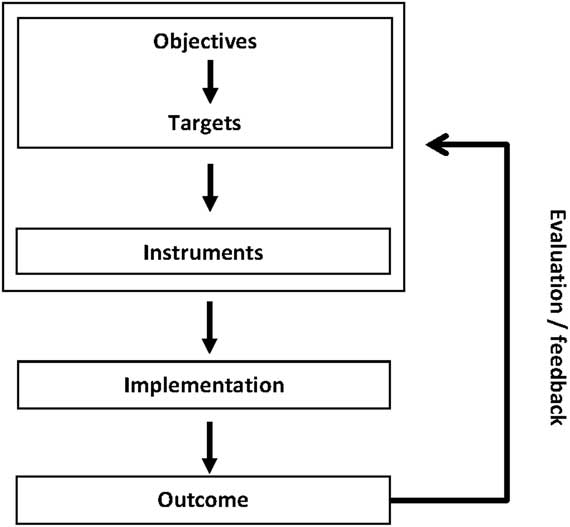
The objects of policy convergence may be distinguished along the specific stages of the policy process. Figure 1 provides a stylised overview of the development and implementation of public policies. Needless to say, it is not meant to be a comprehensive and an entirely realistic representation of politics.Footnote 4
Stylised overview of the different stages of the policy process.
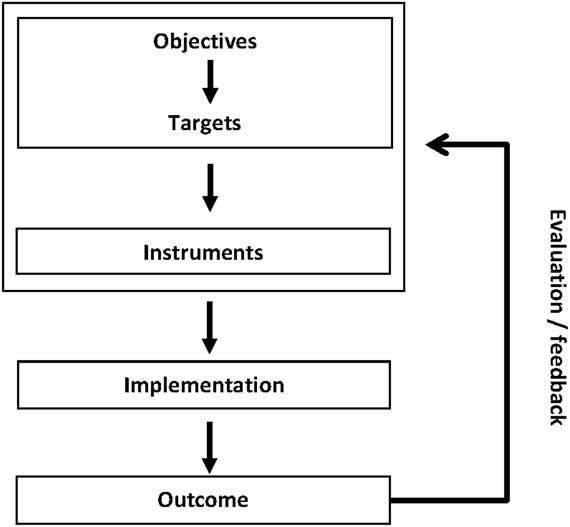
Compared with rather general notions of convergence such as “the tendency of policies to grow more alike, in the form of increasing similarity in structures, processes, and performances” [Kerr Reference Kerr1983, 3, cited in Drezner (Reference Drezner2001, 53)], we obtain more specific concepts of policy convergence objects when focussing on particular stages of the above scheme. Similarly, Bennett (Reference Bennett1991) argues that policy convergence may relate to the dimensions of objectives, content, instruments, outcomes and style of policies. The following discussion demonstrates that the question on which dimension to focus on is closely related to normative questions on why convergence might be desirable in the first place.
First, objectives guide the long-term trajectory of policies. For instance, one might explore whether all EU Member States adhere to the main objective of the EU Roadmap 2050 towards a decarbonisation of European energy provision. Alternatively, one might investigate policy targets, which typically represent quantified values that shall be attained in a certain period of time, in order to acknowledge distributional aspects (i.e. fair burden sharing).
Second, convergence of policy instruments is of particular interest from the normative perspective of (narrow) economic efficiency. Subsidising RES deployment in the EU will be least costly – in terms of minimising RES generation costs only – if the geographical allocation of RES facilities closely follows natural conditions. Such a deployment pattern, in turn, could be achieved via a harmonised scheme of RES support instruments in the EU (Unteutsch and Lindenberger Reference Unteutsch and Lindenberger2014). Thus, a range of benefits, including economies of scale in RES production, might be realised. However, instrument alignment per se is not sufficient for cost-effectiveness, it also requires convergence of support levels. Certainly, accounting for country-specific benefits of RES questions the economic desirability of converging instruments/support levels in the first place (cf. Söderholm Reference Söderholm2008a).
Third, policy convergence may refer to outcomes. Yet, the policy outcomes may be more due to other factors rather than being intended policy effects. For instance, RES shares (e.g. out of total electricity consumption) are affected by the cost of these technologies relative to the price of conventional energy sources. The latter, in turn, is influenced by a number of exogenous variables, such as the world market prices for coal and natural gas. Thus, outcome convergence appears as a weak proxy for policy convergence, as it may be primarily driven by strong global factors. Then again, one interesting question is whether policy manages to “even out” differences in natural conditions, so that convergence in observed outcomes is obtained despite structural differences (cf. Overbye Reference Overbye1994).
In conclusion, it is important to acknowledge that policy convergence of a particular object (cf. Figure 1: objectives-targets-instruments-outcomes) may not align with convergence in terms of another object – in fact, convergence of policy instruments may actually be directly responsible for diverging outcomes. To see this, consider the case of Sweden and Norway who merged their quota schemes (i.e. utilities are required to certify a certain amount of RES via tradable certificates), by establishing a common market for RES certificates in 2012. The aim of such a common market is not to achieve identical RES shares. In fact, the scheme should “promote increased wind power in Norway rather than Sweden” due to Norwegian comparative advantages (Söderholm Reference Söderholm2008b, 2061). In the same vein, the calls for a uniform quota scheme in the EU actually tend to promote diverging RES shares across the EU following optimal geographical allocation of RES installations: wind farms along North European shores, photovoltaic (PV) energy in Southern Europe and, conversely, less RES production in Central Europe’s centres of population and industrial production.
In sum, the first conceptual specification concerns the object of policy convergence (cf. Bennett Reference Bennett1991). In particular, one might refer to the following:
∙ policy objectives/targets (e.g. RES objectives/targets),
∙ policy instruments (e.g. RES policies),
∙ policy outcomes (e.g. RES shares).
The following proposition captures the relevance of choosing the object of convergence in a nutshell: Convergence of policy instruments does not necessarily imply convergence of outcomes (and vice versa).
The benchmark of policy convergence
The second conceptual specification concerns the benchmark of policy convergence (cf. Baumol Reference Baumol1986; Holzinger et al. Reference Holzinger, Jörgens and Knill2008b), and in this case it is useful to distinguish between the following:
∙ absolute convergence implicitly assumes that all countries attain the same outcomes, for example, in terms of the steady-state level of RES generation shares, and
∙ conditional convergence acknowledges key differences among countries, for example, regarding economic wealth and geographical potential, in turn implying that countries may converge but towards different steady-state levels.
The notion of conditional convergence may be particularly helpful to improve the concept of outcome convergence. As noted above, a sole focus on observed outcomes may not relate much to policy convergence. However, correcting for, for instance, Member States’ GDP could take exogenous economic factors sufficiently into account. Furthermore, correcting for Member States’ RES potential would enable relating conditional outcome convergence to the normative rationale of minimising RES generation costs. Thus, introducing conditional convergence measures might, in principle, solve some of the problems related to outcome convergence.
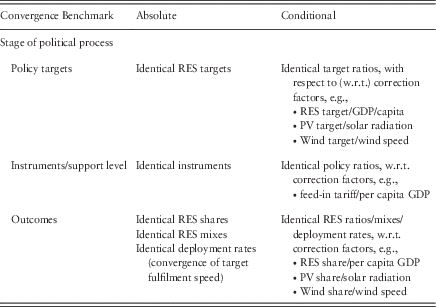
The crucial difference, then, lies in when we can argue to have convergence. We might say that conditional convergence is some weak version of policy convergence. For instance, in the case of RES policy instrument convergence in terms of support levels, absolute convergence is only achieved when support levels are equalised. In contrast, conditional convergence may describe a situation where countries are moving in the same direction (e.g. where not some countries are decreasing the support while others are increasing it), and there exist systematic and legitimate reasons for why we may never see completely equalised support levels. In short, the conceptual proposition regarding the benchmark of convergence reads as follows: Not only absolute but also conditional convergence may serve as a benchmark of convergence analysis. Table 1 provides an overview of the specifications introduced so far.
Specifying “convergence” for the case of renewable energy sources (RES) policies in Europe
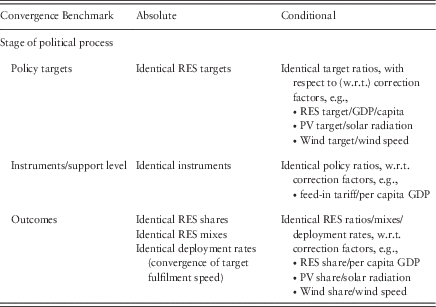
Note: GDP=gross domestic product; PV=photovoltaic.
The drivers of policy convergence
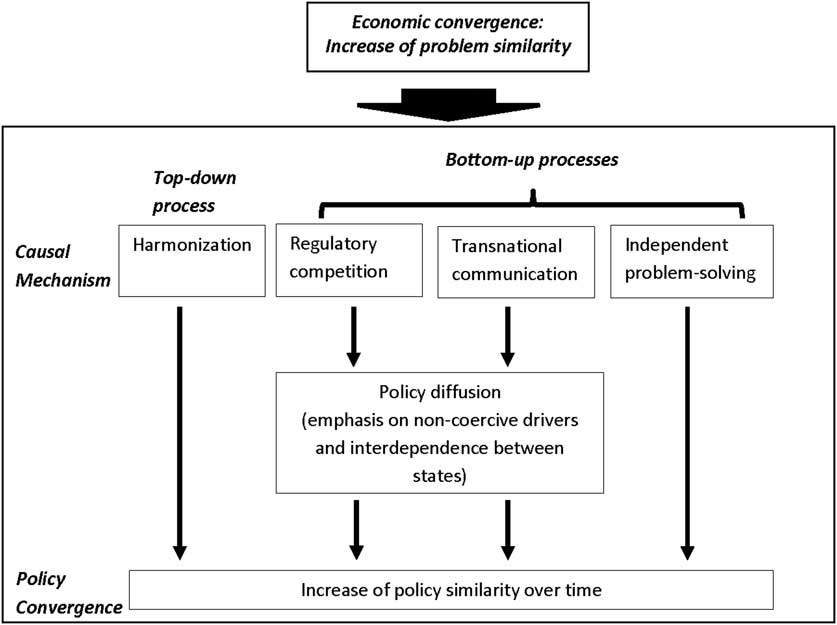
A third conceptual issue relates to the drivers of policy convergence, which in turn can be distinguished into economic and political drivers. In Figure 2, the economic drivers roughly correspond to the box at the top, whereas the political drivers correspond to the large box, which includes both bottom-up and top-down mechanisms. In the following, we first address the complementarity of economic and political drivers, before sketching possible subdifferentiations among the political drivers.
Causal mechanisms of convergence, based on and adapted from Holzinger et al. (Reference Holzinger, Jörgens and Knill2008b, 24).
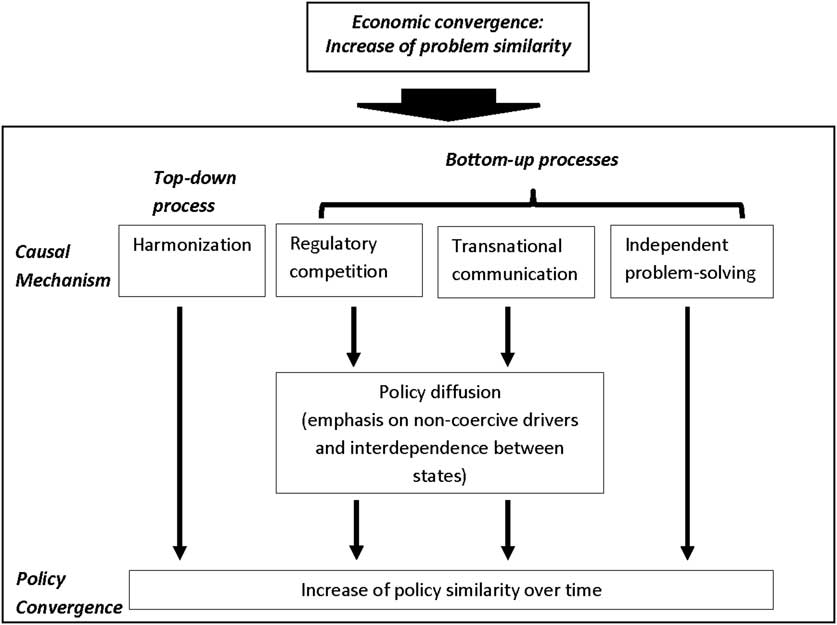
Let us start with the economic drivers of convergence. The introductory quote of Bennett (Reference Bennett1991) points at an important precondition for policy convergence – namely that states are facing similar problems. In principle, such an alignment of issues-to-be-addressed by policy intervention can come about through different channels, such as economic contexts, natural conditions, common institutional frameworks and ideological backgrounds. Nevertheless, the sobering experience of Europe’s “monetary disunion” (Streeck and Elsässer Reference Streeck and Elsässer2016) hints to a particularly strong link between economic and policy convergence. Although a common monetary policy binds the Euro group together, the lack of (i) a sufficiently homogeneous area in terms of economic fundamentals and of (ii) a fiscal stabilisation mechanism has almost teared the Euro apart (thereby also supporting the theory of optimum currency areas, see Mundell Reference Mundell1961; Fingleton et al. Reference Fingleton, Garretsen and Martin2015). In other words, policy convergence without economic convergence may often not be sustainable. What, then, is the rationale for expecting different countries to converge economically?
The modern economic theory of growth dates back to Solow (Reference Solow1956). It conceptualises growth as extension of capital stocks (where capital includes all forms of productive assets, from machinery to know-how). If countries exhibit similar characteristics, such as the level of technological progress, the Solow model predicts convergence of capital stocks (per capita) among these countries. In case the fundamental economic characteristics differ, convergence is not absolute but conditional, reflecting these differences. Yet, declining marginal productivity of capital may erode differences over time: poor economies should grow faster than rich economies because investments in the former yield higher marginal returns. Eventually, all countries would converge to the same steady-state level of capital (Baumol Reference Baumol1986). This is the so-called “catching-up” hypothesis – traditionally supposed to hold within an interdependent world of trade (Ohlin Reference Ohlin1933; Samuelson Reference Samuelson1948). Furthermore, a globalisation-driven competitive pressure on economies may induce convergence of regulatory approaches. Although Hall and Soskice (Reference Hall and Soskice2001) pointed to persistent “Varieties of Capitalism”, coordinated market economies have in recent years implemented more extensive deregulation than liberal market economics (Ther Reference Ther2014; Pierre Reference Pierre2015) – possibly pointing towards a convergence of approaches.
Yet, there is also a long-standing controversy over the “catching-up” hypothesis, particularly regarding the influence of international trade: for instance, it has been shown that opening up poorer countries to trade may stop growth convergence processes and even cause divergence (Bajona and Kehoe Reference Bajona and Kehoe2010). In addition, the catching-up hypothesis is empirically disputed (see Rodriguez and Rodrik Reference Rodriguez and Rodrik2001 as well as Islam Reference Islam2003 for extensive overviews) and even staunch supporters of globalisation concede that “catch-up will be a long, difficult grind” (The Economist 2014).
The economic literature on growth and convergence has been connected to environmental policies via the concept of the so-called Environmental Kuznets Curve (EKC, cf. Grossman and Krueger Reference Grossman and Krueger1995). The EKC suggests an inverted U-shaped relationship between gross domestic product (GDP) and environmental pollution: with raising wealth, pollution at first increases but then decreases. Brock and Taylor (Reference Brock and Taylor2010) argue that the EKC is a necessary “by-product” of economic convergence within the Solow model. Yet, as to the specific mechanisms that might give rise to such patterns, a range of candidates has been discussed. One prominent mechanism relates to the increasing demand for high environmental quality with rising income levels. Thus, economic convergence would directly translate into convergence of demand for generally stricter environmental policies. For instance, demand for clean energy provision increases as poorer countries catch up economically; due to higher marginal productivity of capital, poorer countries can raise their RES shares (e.g. in terms of PVs, wind power) faster than early adopters, with all countries eventually converging. Conversely, without economic convergence, there could be little reason to expect countries to align their energy and environmental policies and to attain similar outcomes in terms of, for instance, RES shares.
Let us now turn to the political drivers of policy convergence. Theories of economic convergence are “apolitical” in the sense that they build on economic variables (e.g. technological progress, capital accumulation, etc.) that may explain demand for specific polices; yet they are silent on the workings of the “political market” where policy supply needs to meet this demand (cf. Keohane et al. Reference Keohane, Revesz and Stavins1998). Policy convergence implies that demand is met in similar ways. In other words, problem convergence is a necessary but not a sufficient condition for policy convergence:Footnote 5 in principle, countries might promote rather different solutions to essentially identical problems. Thus, a comprehensive framework of convergence needs to identify the specific mechanisms that lead states to adopt similar policy solutions.
These political drivers may be differentiated into top-down and bottom-up drivers. Within the latter, one may further distinguish policy diffusion (in the narrower senseFootnote 6 ), relying on interaction between countries, and independent policy formulation without interaction. As Figure 2 demonstrates, the literature on policy convergence mostly highlights different forms of interdependence between states, possibly combined with elements of top-down steering. Bennett (Reference Bennett1991) proposed four different drivers of convergence: emulation, elite networking, penetration by external actors, and harmonisation. Subsequently, the literature focussed on specific variations of Bennet’s first two mechanisms under the label “policy diffusion” (e.g. Busch and Jörgens Reference Busch and Jörgens2005; Tews Reference Tews2005; Maggetti and Gilardi Reference Maggetti and Gilardi2016). In particular, the nonhierarchical character of diffusion has been emphasised: “Diffusion is the spreading of innovations due to communication instead of hierarchy or collective decision making within international institutions” (Tews Reference Tews2005, 65).
Thus, diffusion should be differentiated from coercive imposition and harmonisation as other possible mechanisms that may establish homogeneous policies. Diffusion proceeds horizontally rather than vertically and is “driven by information flows” (Busch and Jörgens Reference Busch and Jörgens2005, 865) within processes of emulation and learning. Coming back to Figure 2, policy diffusion marks the result of interdependent problemsolving: neither are policies implemented because of pressure from above nor are they conceived by solitary policymakers. Empirically, diffusion has been identified as a crucial driver of economic policy reform (Pitlik Reference Pitlik2007). The bottom-up drivers of policy convergence were further investigated by Holzinger and Knill (Reference Holzinger and Knill2005) and Holzinger et al. (Reference Holzinger, Jörgens and Knill2008b) who focussed on three bottom-up mechanisms of convergence – transnational communication, regulatory competition and independent problemsolving.
In the case of European RES policies, such bottom-up processes may be especially relevant. The main reason here is the relative weakness of supranational EU institutions with regard to energy policy. Although the Lisbon treaty for the first time stipulates an active role for the EU in conducting energy policy, Member States have retained their sovereignty over the general course of their energy policies [Article 194(2) of the Treaty on the Functioning of the EU (2012)]. The EU commission, on the other hand, tries to shape Member States’ policies even if its direct regulatory power is limited. The common EU climate and energy target architecture for 2020 and 2030 constitutes an indirect way of top-down influence – a common framework that creates a similar problem context (i.e. “how to increase the share of RES?”) for all Member States without prescribing the use of specific instruments. In addition, the Commission is increasingly active in using the internal market directives and the guidelines for environmental state aid to steer Member States’ energy policies in the preferred direction (e.g. in the form of tender schemes that use competitive bidding procedures to determine the level of RES support, or fixed premium schemes that offer RES producers a mark-up on top of the spot-market price). Eventually, the “EU impact on the national energy mix is predominantly indirect, yet powerful” (Callies and Hey Reference Callies and Hey2013, 88).
Furthermore, the EU’s multilevel system with its complex architecture of partly differentiated, partly overlapping and often contested allocation of responsibilities allows for hybrid processes. For example, the so-called Open Method of Coordination, whereby the EU Commission influences national policies by agenda-setting and framing discussions among Member States (cf. Borrás and Jacobsson Reference Borrás and Jacobsson2004; Ania and Wagener Reference Ania and Wagener2014), represents one potentially important driver of convergence. Therefore, although national decisions may formally be taken voluntarily, they may respond to pressures arising from, for instance, EU guidelines and intergovernmental discussions. Thus, Member States may cooperate, compete, or communicate with each other or emulate one another or combine all of these activities.
In conclusion, theories of economic and political convergence processes complement each other: the former help explain why states are facing similar problems, the latter provide rationales as to why states choose or should choose the same policies to solve a given problem. We may summarise this argument in the following conceptual proposition: On their own, neither economic nor political drivers can sufficiently account for policy convergence.
The directed process of policy convergence
Finally, a fourth conceptual dimension of convergence results from its conjunction of both process and final state. Specific definitions may accentuate these characteristics to different degrees. Consider, for instance, the following hypothetical situation: some EU Member States move from wide diversity towards more similarity, although still far from homogeneity. If we emphasise proximity to final states, we would rather not refer to this situation as convergence. However, if we focus on the process of increasing similarity, we would speak of a case of convergence – even if the process is far from finished. In a similar vein, Plümper and Schneider (Reference Plümper and Schneider2009) introduce a distinction between complete and incomplete convergence.
Against this background, the process dimension is a crucial conceptual element of convergence, not least because it directly opens the analytical framework for investigating the mechanisms that may lead to convergence. Furthermore, as Bennett remarked: “Policy convergence should also be conceptualized in dynamic terms. The relevant theoretical dimension is time rather than space. Otherwise the concept becomes a synonym for similarity” (Reference Bennett1991, 230). At the same time, final states are important as a benchmark against which to measure the progress of increasing similarity. In the particular context of RES policies, the final states are moving targets (e.g. support level or RES share/per capita GDP) that evolve with technological and political development: unless we refer to the EU’s long-term aim of full decarbonisation, essentially implying 100% RES, it does not seem sensible to consider specific support levels or RES shares as “final” in any literal way. In brief, we suggest the following conceptual proposition: Convergence processes may notwithstanding lead to different final states.
Methods and Data
The general point of this article that convergence is multifaceted has to be translated into a structured conceptual framework that can inform empirical research. To this end, the preceding section differentiated four dimensions of policy convergence (object, benchmark, driver and directed process) and condensed the discussion into one proposition for each dimension:
1. Object: convergence of policy instruments does not necessarily imply convergence of outcomes (and vice versa).
2. Benchmark: not only absolute but also conditional convergence may serve as a benchmark of convergence analysis.
3. Drivers: on their own, neither economic nor political drivers can sufficiently account for policy convergence.
4. Process: convergence processes may notwithstanding lead to different final states.
Note that the article’s main objective is of conceptual nature, and therefore it empirically illustrates the relevance of the conceptual propositions; it does not aim at full-fledged, comprehensive statistical analyses itself. Rather, the propositions provide building blocks for future more in-depth empirical assessments.
Methodologically, the multiple dimensions of convergence imply that there exists no uniform measure that fits for all dimensions. More specifically, under some circumstances, it may be useful to conceive convergence as a negative relationship between some initial level and growth rate – suggesting that countries with lower initial levels catch up with the forerunners. For instance, this notion (often referred to as β-convergence, see Heichel et al. Reference Heichel, Pape and Sommerer2005) seems appropriate when policies/outcomes (e.g. emission levels) can be expressed as a continuous quantifiable variable. In contrast, the choice between policy instruments is a discrete choice, which implies that instrument convergence may not be representable in statistical terms. Then again, statistical measures such as absolute and conditional convergence may be relevant for specific policy design issues, such as tax levels, public expenses, etc. All this leads to our main argument that, depending on the specific object of analysis and the benchmark used, the same empirical area may give rise to opposing assessments. As a case in point, we now refer to some empirical evidence for RES policy convergence in the EU – temporary convergence around feed-in tariffs as support instrument, conditional convergence of RES shares, but divergence of public R&D subsidies for RES at the national level.
Specifically, we rely on three different sets of data. First, we present data on the use of support instruments for RES. Information on the type of support instruments that are currently used is available at www.res-legal.eu, a database initiated by the European Commission. Moreover, information on support instruments that were used in the past was gathered from Kitzing et al. (Reference Kitzing, Mitchell and Mothorst2012). Second, we present data on current RES shares and RES growth rates within the EU Member States. This assessment is based on the notion of convergence as catching-up and relates the initial level of RES shares to the respective growth rates. The data are available at Eurostat, the statistical office of the EU (http://ec.europa.eu/eurostat). Third, we present empirical evidence on policy convergence in terms of public subsidies to R&D in the RES field. The data used are derived from the International Energy Agency’s (2015b) Energy Technology RD&D Statistics database. Unfortunately, this data set is limited to 14 different EU countries. The empirical assessment builds on the calculation of so-called R&D-based knowledge stocks. Specifically, we start from the premise that previous public R&D expenditures in a country add to an R&D-based knowledge stock, that is, comprising the cumulative expenditures (e.g. Ek and Söderholm Reference Ek and Söderholm2010, Grafström et al. Reference Grafström, Söderholm, Lehmann, Strunz and Gawel2017). We assume that the R&D expenditures only add to this stock after some years have lapsed, as it takes time for investments in R&D to generate new useful knowledge. Moreover, it is also assumed that the stock depreciates in that the effects of previous public R&D expenses gradually become outdated (e.g. Griliches Reference Griliches1995). We here assume a time lag of two years, and a depreciation rate of 10%. The latter choice suggests a fairly high rate of depreciation of R&D-based knowledge, but this is reflected in the relatively rapid development of renewable-energy technology during the last few decades (see Johnstone et al. Reference Johnstone, Haščič and Popp2010; Edenhofer et al. Reference Edenhofer, Hirth, Knopf, Pahle, Schmid and Ueckerdt2013; IEA 2015b). The above permits a test of the convergence hypothesis that countries with low initial R&D-based knowledge states will experience higher growth rates in this stock over time (and vice versa).
In the following, we empirically corroborate the four conceptual propositions, addressing each in turn.
Assessing the case for RES policy convergence in the EU
Convergence of policy instruments does not necessarily imply convergence of outcomes (and vice versa)
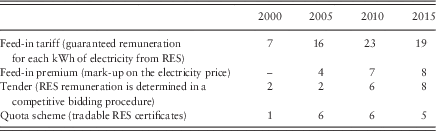
The early history of RES support instruments, from 1970 to 2000, is summarised by Knill et al. (Reference Knill, Sommerer and Holzinger2008, 115ff.) as the “emergence of two dominant approaches” – first “subsidies or tax reductions” and second “legal obligations for energy users to purchase a certain amount of renewable energy”. Yet, in hindsight, the latter cannot be reasonably called a dominant approach. Although quota schemes have been a long-time favourite of the EU Commission, there is no long-term trend towards a more widespread implementation of such schemes. In fact, in 2000, out of the nine RES-obligation schemes cited by Knill et al. (Reference Knill, Sommerer and Holzinger2008, 118), only one involved tradable certificates, and, although the number rose to six in 2005, it has been stagnating or even declining since then (cf. Table 2).
Number of European Union Member States that have implemented major renewable energy sources (RES) support instruments, 2000–20157 Footnote
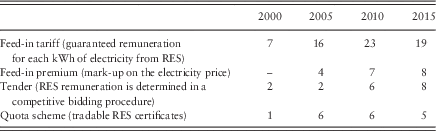
Source: Kitzing et al. (Reference Kitzing, Mitchell and Mothorst2012) for years 2000–2010, database www.RES-legal.eu for 2015.
Major support instruments for RES have been available in all EU Member States since 2007. In particular, feed-in tariffs have emerged as the most popular support instrument (see Kitzing et al. Reference Kitzing, Mitchell and Mothorst2012 for more details on the period 2000–2010). Yet, Table 2 also shows that pure feed-in tariffs might have passed a peak around 2010 and that they are increasingly complemented or replaced by feed-in premiums and tenders. Given that often feed-in tariffs enabled the rapid increases of RES deployment in the first place, should we not expect first convergence towards this instrument and then towards specific regulatory details? Why would regulators shift away from a successful policy instrument?
The short answer is that feed-in tariffs have been falling victim to their own success. Feed-in tariffs foster niche technologies, and with RES growing out of their niche policy priorities change too. Specifically, feed-in tariffs Footnote have been empirically shown to facilitate technological innovation for solar energy but they are less effective for more mature technologies such as wind that are close to compete with fossil energies (e.g. Johnstone et al. Reference Johnstone, Haščič and Popp2010). Furthermore, the crucial success factor of feed-in tariffs, the mitigation of income risk for potential investors, also drives up the overall costs of RES deployment. With technologies maturing and concerns of cost-effectiveness increasing, RES support is entering a “critical policy transition period”, so as to integrate RES into electricity markets (Miller et al. Reference Miller, Bird, Cochran, Milligan, Bazilian and Denny2013).
In addition, EU energy policy puts partly explicit, partly implicit pressure on Member States to move away from feed-in tariffs. The Commission’s argument here reads: once common rules for the generation, transmission and distribution of electricity are implemented all over the EU, substantial cross-border interactions will be prevalent, rendering country-specific support schemes incompatible. In order to minimise market distortions and inefficiencies, country-specific RES support should oblige RES producers to directly sell electricity in the market, promoting the overall market integration of RES and increasing cross-border electricity trading. Recent developments indicate that the Commission successfully frames national discussions on RES policies along these lines (cf. Tews Reference Tews2015). In consequence, one might say that during the first stage of RES support, policy instruments converged around feed-in tariffs but that the market integration of RES calls for different approaches.
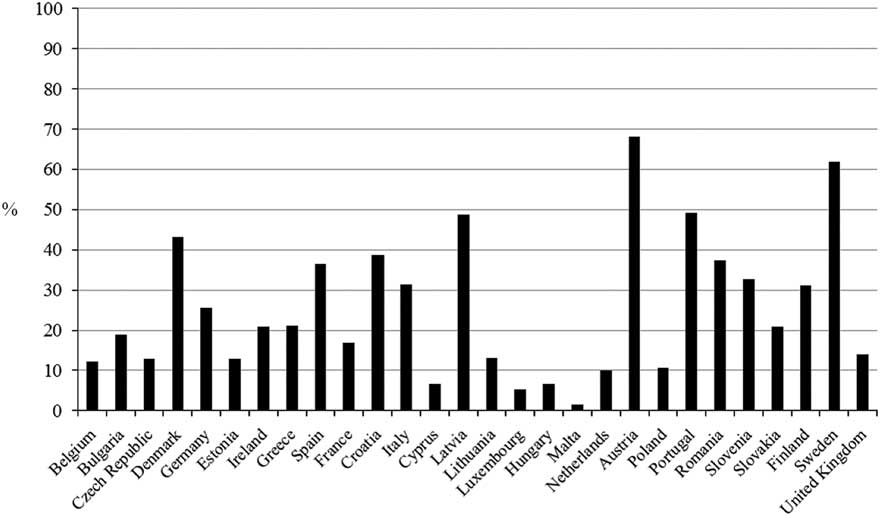
In comparison with the (temporary) convergence of RES instruments, the diversity of RES shares at electricity consumption in the EU is striking (Figure 3). One possible explanation for this diversity refers to heterogeneity in ideological orientation. Member States’ ambitions to decarbonise their energy systems are diverse, and RES still inhabit a technological niche in some markets. More importantly, however, geographical conditions seem to determine the sizes of the RES shares. Consider Austria and Sweden, which exhibit the highest shares of RES in gross electricity consumption in the EU: both rely heavily on hydropower – traditionally so, rather than triggered by recent and current RES deployment policies. By comparison, the densely populated Netherlands only covers a fraction of its electricity consumption with RES. In addition, the EU’s aim of finalising the internal energy market with fully harmonised RES policies, not necessarily implies convergence of RES shares. As outlined above, policy instrument convergence may lead to diverging RES shares with geographically predisposed countries exhibiting higher shares than the rest (e.g. solar in Southern Europe, wind at the shores).
Shares of electricity generated from renewable energy sources in gross electricity consumption for European Union-27 Member States in 2013.
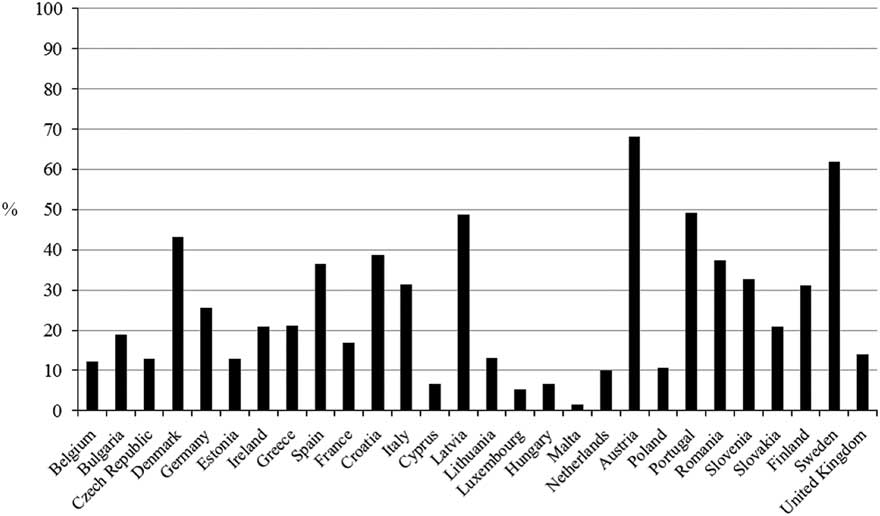
Hence, although RES support instruments (temporarily) converged around feed-in tariffs, this did not result in absolute convergence of outcomes, and there is no reason to expect the latter any time soon. In the following, it will also become clear that – even when restricting the analysis to the object “RES policies” – both divergence and convergence may obtain, because different sets of policies need not align.
Not only absolute but also conditional convergence may serve as a benchmark of convergence analysis
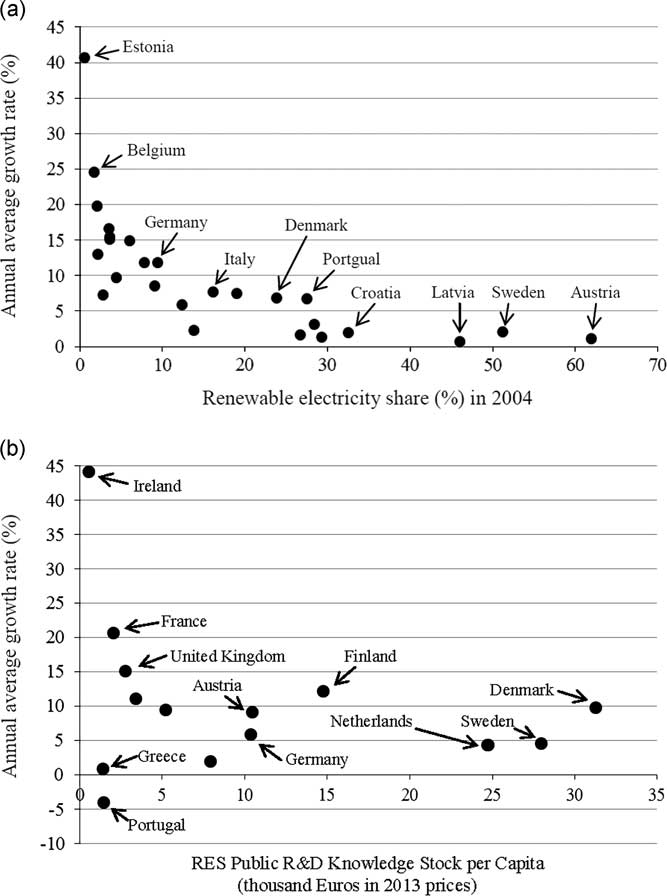
The diversity in RES shares notwithstanding, there might be conditional convergence. In order to account for the country-specific history of geography-induced renewables deployment, a look at the growth rates of RES shares seems useful. As Figure 4a shows, the growth rates of RES shares in gross electricity are generally significantly higher for the Member States with low initial levels than for the ones with high initial levels (a very similar pattern emerges in the case of RES shares at overall energy consumption, including heat and transport). This empirical pattern therefore seems to support the catching-up hypothesis.
(a) Shares of electricity generated from renewable energy sources (RES) in gross electricity consumption [European Union (EU)-27, excluding Cyprus] over the time period 2004–2013: annual average growth rates versus the initial level in 2004. (b) Per capita knowledge stock based on public subsidies to renewable energy R&D: annual average growth rates in 14 EU countries over the period 2004–2013 versus the initial level in 2004.
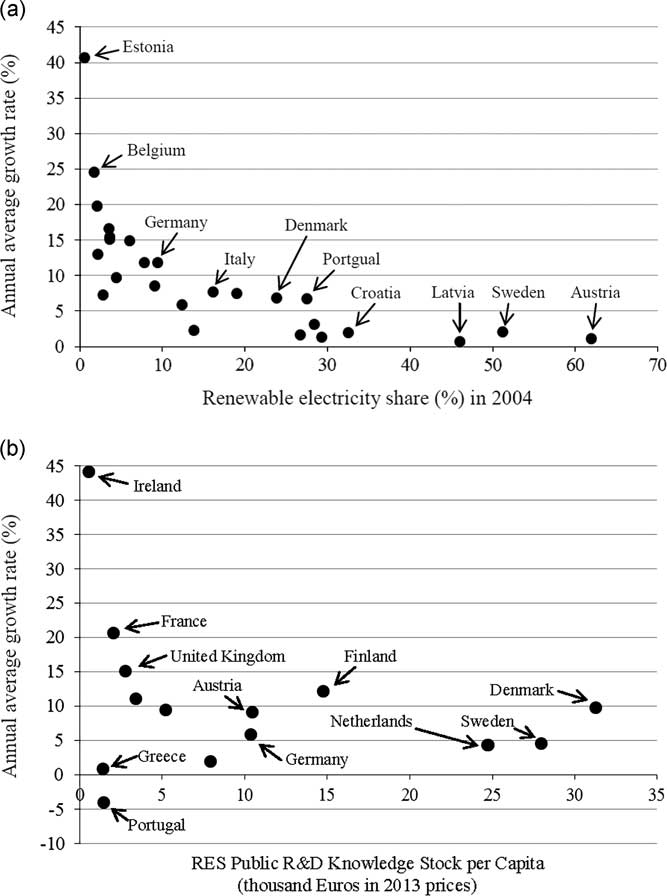
However, Figure 4b provides a corresponding test of policy convergence in the case of public subsidies (i.e. government expenditures) for renewable energy R&D, here operationalised in terms of an R&D-based knowledge stock with time lags and a depreciation rate attached to the stock. These results show little direct support for the catching-up hypotheses, as there is no clear negative correlation between the initial (beginning-of-period) knowledge stock and the growth rate in the knowledge stock over the time period. However, although there are a few indications of absolute convergence, there may be convergence after having controlled for other factors such as GDP per capita, energy import dependence, etc. In an empirical study focussing solely on the drivers behind public R&D support in the EU (Grafström et al. Reference Grafström, Söderholm, Lehmann, Strunz and Gawel2017), we use more elaborate econometric analyses over a more extended time period (1990–2013).Footnote 8 The results provide robust evidence for the presence of public R&D expenditure divergence across EU countries. In other words, countries with initially low R&D-based knowledge stocks have experienced lower growth rates in these stocks compared with countries that have already accumulated a lot of R&D-based knowledge in the RES field.
What might bring these different patterns between RES shares and public R&D RES support about? In contrast to the case of RES shares, there are no mandatory targets regarding R&D expenses for the EU Member States, and divergence may be related to the public good characteristics of public R&D. Some countries could thus be free-riding on the others’ development efforts through knowledge spillovers. This is not possible to the same extent in the case of RES shares because of the presence of mandatory country-specific targets. Moreover, countries that choose to invest in R&D may experience increasing returns on their R&D investment, and investments may also be further spurred by vested interests and industrial policy motives.Footnote 9
In conclusion, the ambiguous empirical results attest to the complexity of the policy convergence issue.
On their own, neither economic nor political drivers can sufficiently account for policy convergence
To start with, what is the empirical evidence for economic convergence (measured in real per capita income) in the EU? In short, there is meager evidence for overall convergence but there is evidence of convergence within several subgroups – that is, clusters of Member States growing at the same rate (Borsi and Metiu Reference Borsi and Metiu2015). A clear separation between old EU Member States and new Member States in Eastern Europe appears: although the latter have exhibited higher growth rates, catching-up has not yet been sufficient in order to smooth out differences across Member States (Borsi and Metiu Reference Borsi and Metiu2015). This can also be seen from recent GDP per capita statistics for the EU-28: at the upper end (omitting Luxembourg), the Netherlands stay at 31% above the EU-28 average (year 2013, EurostatFootnote 10 ). At the lower end, Bulgaria is listed with a GDP per capita of 55% below the average. In sum, one might speak of clustered, slow and nonmonotonic processes of economic convergence in the EU.
It can be noted that the Member States’ catching-up in terms of RES shares (Figure 4a) appears similar to this economic catching-up: both catching-up processes occur slowly and have reduced but not yet eliminated substantial differences between the Member States. In other words, both processes display conditional convergence. As laid out above, economic theory could explain this congruency via, for instance, a causal relationship from economic growth over changes in peoples’ preferences towards more environmental-friendly electricity provision. Yet, this tells us little about why similar policies should be used to address this demand.
We, therefore, turn to the political explanations for the spread of specific policy instruments to increase RES deployment within the EU. The literature here places a clear emphasis on policy diffusion: “The international spread of feed-in tariffs and quotas was driven neither by mechanisms of harmonization nor imposition. Rather, the analysis […] points to an important role of diffusion mechanisms during the instruments’ spread” (Busch and Jörgens Reference Busch and Jörgens2005, 876). As outlined above, at the end of the 2000s, support schemes for RES in the EU converged towards feed-in tariffs. To better understand the specific mechanisms behind this convergence/diffusion process, the detailed case study of RES policy convergence in Spain, France and Germany, conducted by Jacobs (Reference Jacobs2012), is helpful. Building on Holzinger et al.’s (Reference Holzinger, Jörgens and Knill2008b) framework, Jacobs identifies the three mechanisms of transnational communication, regulatory competition and independent problemsolving as main political drivers of convergence towards feed-in tariffs (and their regulatory details).
First, transnational communication aligned approaches towards RES deployment in Spain, France and Germany; in particular, it was “decisive for the spread of certain feed-in tariff design options” (Jacobs Reference Jacobs2012, 134). Second, regulatory competition arises from Member States’ objective to stay competitive in terms of attracting investment. Here, Jacobs (Reference Jacobs2012) finds some evidence for convergence of PV feed-in tariffs due to competition between EU Member States. Interestingly, this contradicts the main results of Holzinger et al.’s (Reference Holzinger, Knill and Arts2008a) empirical analysis that regulatory competition has only had negligible explanatory power for environmental policy convergence in the EU. Third, common problem-solving pressure may lead states to independently adopt very similar solutions. For instance, rapidly cumulating remunerations for PV installations was a problem both in Germany and in Spain during the late 2000s. As a solution, “flexible tariff degression was developed independently in Germany and Spain” (Jacobs Reference Jacobs2012, 227). A related case study suggests that these different convergence mechanisms possibly follow a chronological pattern: Carley et al. (Reference Carley, Nicholson-Crotty and Miller2016) evaluated the diffusion of renewable portfolio standards in the United States, demonstrating that processes of interstate emulation explain the states’ decisions on policy adoption and design, whereas internal influences determine subsequent changes to these policies.
Against this background, does not a purely political account sufficiently explain RES policy convergence in the EU? The problem with such an approach is its blindness to economic factors that may disrupt convergence processes. From Jacobs’s study, one might get the impression that full alignment of feed-in tariffs was imminent – not only was there a general tendency towards feed-in tariffs at the end of the 2000s, but also did very specific regulatory details converge. Nonetheless, financial and economic crisis squeezed Member States’ budgets and lowered priority of RES support on the overall policy agendas. In Spain, this pressure resulted in a drastic dismantling of the RES support scheme in 2013. In Germany, the economic repercussions of the financial crisis were not as severe. Thus, the policy agendas in both countries diverged, and the RES policy convergence process tended to halt.
Meanwhile, as outlined above, Germany and other countries are beginning to switch away from pure feed-in tariffs. This development is in line with the EU Commission’s push towards cost-effective RES support, and, more generally, stems from the growing economic impact of RES. In sum, therefore, a narrow look at the mechanisms of policy diffusion at work in the 2000s would give rise to a completely misleading picture of the way RES policies would be taking in the 2010s – the main reason being the importance of economic drivers in establishing problem similarity as condition for sustained convergence of policies.
Convergence processes may notwithstanding lead to different final states
Somewhat paradoxically, the very reason the EU Commission pushes for tender schemes, the market integration of RES, also raises doubts as to whether any RES instrument will serve as a convergence line. In short, the best way to integrate RES into energy markets remains unclear, as well as the final state of RES support in a world with very high RES shares (e.g. Kopp et al. Reference Kopp, Eßer-Frey and Engelhorn2012): will there be no more support at all? Alternatively, will “energy-only” markets transform to remunerate production capacities rather than electricity, thereby fusing RES support with technology-neutral capacity payments?
Eventually, different forms of market integration might be observed, depending on geographical and other country-specific conditions. The heterogeneity of Member States in terms of both RES potential and preferences for sustainable energy provision may imply that, after all, there will not be only one but several final states: for example, we might see several subsets of Member States with similar policies transforming their energy systems at similar speed, corresponding to their respective regulatory models (cf. Ćetković and Buzogány Reference Ćetković and Buzogány2016). Furthermore, there may be historic, institutional and cultural path dependencies that make absolute convergence of RES support polices highly unlikely. The framework of institutional economics (North Reference North1990) may be particularly helpful to carve out the institutional inertia that may inhibit policy convergence. This concerns environmental policy in general (Fernández 1994) and energy transition pathways more specifically (Laird and Stefes Reference Laird and Stefes2009; Kern Reference Kern2011). Such institutional path dependencies also challenge the quest for adaptive efficiency through RES policy reform efforts (Gawel et al. Reference Gawel, Strunz and Lehmann2017).
The gist of the preceding discussion is that convergence processes notwithstanding, final states may not be identical. RES policies may converge towards different final states, or they may converge with regard to their basic structure but still diverge in content (Vasseur Reference Vasseur2014). That is, on the surface, we might perceive similarity, where substantial divergence prevails. Therefore, even if all Member States pursue roughly similar energy transition pathways and even if there is broader economic convergence, this may not bring about absolute convergence of RES instruments and RES shares.
Conclusion
Policy convergence is a multifaceted concept. The main argument of this study is that distinguishing four dimensions of convergence helps clarify why and in what form policy convergence might occur. In doing so, the study aims to guide prospective empirical research. First, convergence analyses may refer to different objects, and there may well be convergence for one particular object but not for another. Most notably, convergence of policy instruments does not necessarily imply convergence of outcomes. Second, the benchmark of convergence analysis may be absolute or conditional on some other characteristics to account for heterogeneity: differences in, for example, economic performance or geographical conditions can then be framed as conditional convergence. Third, a comprehensive explanation of successful policy convergence needs to account for both economic and political drivers. Economic convergence may explain similarity of problems rather than similarity of policy solutions. Converging policies, in turn, do not solve the same problems if there is no economic convergence. In other words, economic and political drivers of convergence complement each other. Fourth, convergence processes may notwithstanding lead to different final states. That is, convergence should be understood as an inherently dynamic concept, not to be confused with static similarity – because of heterogeneities and institutional path dependencies, there may exist more than one final state.
The case of RES support policies in the EU illustrates these conceptual propositions very well. First, although there is evidence for (temporary) convergence of RES instruments, RES shares exhibit no absolute convergence – in fact, calls for harmonisation of RES support in the EU (arguably the most ‘convergence’ there might be) have the explicit objective of generating diverging outcomes (i.e. RES shares), so as to optimise allocation of production capacities following heterogeneous RES potential. Second, there is conditional convergence of RES shares, possibly reflecting this heterogeneity in RES potential. Interestingly, however, there is no evidence for convergence of public R&D expenses, but rather divergence. Hence, in short, whether an analysis of RES policies in the EU finds convergence heavily depends on the object and the benchmark of analysis. Third, the importance of considering both economic and political drivers of convergence becomes apparent from the evolution of RES policies in the EU. Around 2010, absolute convergence towards feed-in tariffs seemed all but imminent when analytically focussing on political processes of diffusion and emulation. Since then, however, feed-in tariffs have begun to decline from their pinnacle, which can be attributed to changing economic drivers. Finally, RES policies may well converge towards different rather than a single final state.
In conclusion, this study hopes to inspire further empirical research efforts. Acknowledging the multiple dimensions of convergence, particularly the economic conditions of policy convergence, may help further close the gap between theoretical and empirical literature with many proposed drivers of convergence but less actual empirical evidence (cf. Plümper and Schneider Reference Plümper and Schneider2009). Although a number of empirical case studies link divergence to institutional factors (e.g. Laird and Stefes Reference Laird and Stefes2009; Kern Reference Kern2011), the importance of economic factors in explaining disruption of convergence processes and diverging pathways seems to deserve far more attention than it has hitherto attracted. Regarding our example of RES policies, their prospective evolution in the post-niche era seems predestined for further convergence/divergence research.
Acknowledgement
This study was supported by the German Helmholtz Association under Grant HA-303.
Supplementary materials
Supplementary material
To view supplementary material for this article, please visit https://doi.org/10.1017/S0143814X17000034