Introduction
The anurans are a well-known group of amphibians. Anurans are found globally, with a total of 6723 species described to date (Frost, Reference Frost2017). The greatest anuran richness is found in the Neotropical region (Duellman & Trueb, Reference Duellman and Trueb1994; IUCN, 2016). Despite the importance of amphibians for biodiversity, relatively little is known about their helminth fauna (Pérez-Ponce de León et al., Reference Perez-Ponce de León, García-Prieto and Razo-Mendivil2002; Anjos, Reference Anjos2011; Campião et al., Reference Campião, Morais, Dias, Aguiar, Toledo, Tavares and Silva2014). Aho (Reference Aho, Esch, Bush and Aho1990) emphasized the importance of knowledge of the helminth community of amphibian parasites, due to the shortage of such studies in this group of vertebrates. Since then, studies with an ecological focus were developed for communities of parasites in anurans (McAlpine, Reference McAlpine1997; Bolek & Coggins, Reference Bolek and Coggins2003; Luque et al., Reference Luque, Martins and Tavares2005; Hamann et al., Reference Hamann, Kehr and González2006b, Reference Hamann, Kehr and González2013b, Reference Hamann, Kehr and González2014; Schaefer et al., Reference Schaefer, Hamann, Kehr, González and Duré2006; Campião et al., Reference Campião, Silva and Ferreira2009; Santos & Amato, Reference Santos and Amato2010; Santos et al., Reference Santos, Amato and Borges-Martins2013; Toledo et al., Reference Toledo, Aguiar, Silva and Anjos2013, Reference Toledo, Morais, Silva and Anjos2015). However, most studies remain limited to surveys and describing the taxonomy of the species.
The composition and structure of the helminth community depends on many factors, including life-history features of the host and parasites (Brooks et al., Reference Brooks, León-Rpgagnon, McLennan and Zelmer2006), diet, body size, sex, infection site, geographic distribution, behaviour and host species (Muzzall et al., Reference Muzzall, Gillilland, Summer and Mehne2001; Bolek & Coggins, Reference Bolek and Coggins2003; Poulin & Morand, Reference Poulin and Morand2004; Zelmer & Arai, Reference Zelmer and Arai2004; Hamann et al., Reference Hamann, Kehr and González2006b; Campião et al., Reference Campião, Silva and Ferreira2009).
The parasite infracommunities of sympatric host populations represent component communities accumulated from a pool of species available in the environment (Valtonen et al., Reference Valtonen, Pulkkinen, Poulin and Julkunen2001). Also, parasite sharing along evolutionary time is facilitated between host populations that have short phylogenetic and geographical distances (Poulin & Morand, Reference Poulin and Morand1999). Given that communities of frog parasites exhibit a generalist character (Aho, Reference Aho, Esch, Bush and Aho1990), it is expected that populations of congeneric anurans from the same locality will share taxa of the helminths, because they are exposed to similar ecological and phylogenetic conditions.
Searching the literature, we found few studies comparing the helminth communities in anurans with different biological and behavioural characteristics but from the same location (e.g. Hamann et al., Reference Hamann, Kehr and González2013a). Evaluating the interspecific variation of body size and habitat occupancy between sympatric species of anurans is likely to enhance our understanding of how these factors influence the structure and composition of helminth parasite communities and how they are distributed in the environment.
This study aimed to: (1) evaluate the parasite composition of 13 anuran species; (2) describe the richness and diversity of helminths at the component and infracommunity levels; and (3) analyse the relationship between helminths and anuran characteristics.
Materials and methods
Collection and examination of frogs
Anurans were sampled from an Atlantic rainforest remnant on private property in the municipality of São Luiz do Paraitinga (23°13′23″S, 45°18′38″W), located in the Serra do Mar of São Paulo State, Brazil.
Amphibians (n = 168 specimens), comprising representatives of five families [Brachycephalidae: Ischnocnema guentheri (n = 4); Bufonidae: Rhinella icterica (n = 18), R. ornata (n = 2); Hylidae: Dendropsophus anceps (n = 1), Hypsiboas albopunctatus (n = 36), Hypsiboas faber (n = 11), Hypsiboas lundii (n = 2), Hypsiboas polytaenius (n = 27); Leptodactylidae: Leptodactylus fuscus (n = 2), Leptodactylus labyrinthicus (n = 1), Leptodactylus latrans (n = 36), Physalaemus cuvieri (n = 17); and Odontophrynidae: Proceratophrys boiei (n = 11)], were collected between February 2009 and February 2010. Hosts were sampled under licence by active searching during their activity period and by pitfall traps installed within the forest, and were deposited in the Museu de Zoologia da Universidade Estadual de Campinas ‘Adão José Cardoso’, São Paulo State, Brazil. Anurans were transported live to the laboratory and then euthanized with sodium thiopental solution. The snout–vent length (SVL) and body weight of each specimen were recorded. During necropsy, hosts were sexed, and their gastrointestinal tract, lungs, liver, kidneys, urinary bladder, gall bladder and coelomic cavity were surveyed for parasites.
Helminths were fixed in alcohol–formaldehyde–acetic acid (AFA) and preserved in 70% ethyl alcohol. For species identification, monogeneans, trematodes and cestodes were stained with hydrochloric carmine and cleared with creosote. Nematodes were cleared with Amman's lactophenol and examined as temporary mounts. For parasite identification, morphometric data and photomicrographs of helminths were obtained using a computerized LAS V3 image analysis system (Leica Application Suite, Leica Microsystems, Wetzlar, Germany) coupled to a DM 5000B microscope with interferential phase contrast (Leica Microsystems). The voucher species were deposited at the Coleção Helmintológica do Instituto de Biociênciasde Botucatu (CHIBB), Department of Parasitology, at the Universidade Estadual Paulista (UNESP), São Paulo State, Brazil.
Statistical analysis
Prevalence, intensity and abundance of infection were calculated for helminths following Bush et al. (Reference Bush, Lafferty, Lotz and Shostak1997). All values are expressed as the mean ± standard error (SE). Measurements of community richness and diversity included the species richness (= total number of helminth species), Shannon index (H′), and evenness (J′) as H′/H′ maximum (Zar, Reference Zar2010). The Brillouin index (BH) and evenness (E) were used to compare helminth infracommunities among amphibian species. The diversity indices were used with decimal logarithms (log10). Mean helminth species richness is the sum of helminth species per individual host, divided by the total sample size. The Kruskal–Wallis test was used to compare diversity and richness of helminths between hosts. A posteriori multiple pairwise comparisons using Dunn's procedure were calculated. The Berger–Parker index of dominance (d) was used to determine the most dominant species (Magurran, Reference Magurran2004). Spearman's rank test (r s) was used to assess the relationship between the host body size and parasitological descriptors. Sorensen's coefficient similarity index was used to determine the qualitative similarity between component communities.
Statistical analyses were performed using BioEstat 5.0 (Ayres et al., Reference Ayres, Ayres Júnior, Ayres and Santos2007) and MultiVariate Statistical Package (MVSP 3.1; Kovach, Reference Kovach1999).
Results
Helminth community characteristics
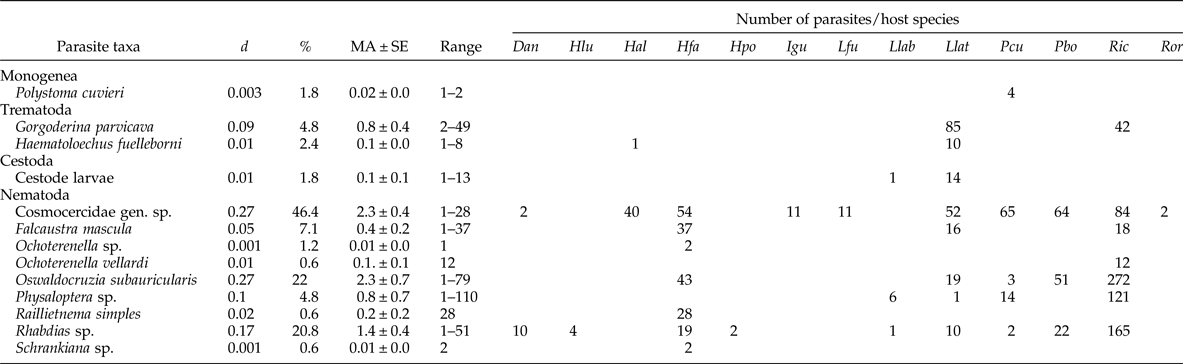
Of the 168 hosts analysed, 105 (62.5%) were parasitized by at least one helminth species. In total, 1422 helminths from 13 taxa were recovered from hosts of five anuran families (table 1), with a mean abundance of 8.5 ± 1.4 and a mean intensity of infection of 13.5 ± 2.0. Helminth diversity (H ′) and evenness (J ′) were 0.799 and 0.717, respectively. The mean helminth richness was 1.84 ± 0.1 (max. = 6) species per infected host. Mean helminth value of diversity (HB) and evenness (E) were 0.11 ± 0.01 and 0.33 ± 0.04, respectively.
Helminths recorded in the 13 host species collected in an Atlantic rainforest remnant, São Paulo State, Brazil. Dominance (d), prevalence (%), mean abundance (MA) ± standard deviation (SE), range and number of parasites/host species are presented. Dan, D. anceps; Hlu, H. lundii; Hal, H. albopunctatus; Hfa, H. faber; Hpo, H. polytaenius; Igu, I. guentheri; Lfu, L. fuscus; Llab, L. labyrinthicus; Llat, L. latrans; Pcu, P. cuvieri; Pbo, P. boiei; Ric, R. icterica; Ror, R. ornata.

Oswaldocruzia subauricularis (Molineidae) and Cosmocercidae gen. sp. were the most abundant taxa (d = 0.27). Cosmocercidae gen. sp. and Rhabdias sp. (Rhabdiasidae) were the helminth taxa that infected the greatest number of host species (10 and 9, respectively). The nematodes Ochoterenella sp., Raillietnema simples and Schrankiana sp. were found only in H. faber. Ochoterenella vellardi was found only in R. icterica. The monogenean Polystoma cuvieri was found only in Physalaemus cuvieri (table 1).
Parasitic infection related to size of host
The total lengths of hosts ranged from 24.14 to 141.60 (64.6 ± 30.7) mm, and their weights ranged from 0.6 to 300.0 (39.9 ± 55.8) g. The parasitological descriptors were significantly correlated with the host body size (P < 0.05) (table 2).
Spearman correlation (r s) between parasitological descriptors and the body size of anuran hosts collected in an Atlantic rainforest remnant, São Paulo State, Brazil. H. albo, H. albopunctatus; H. fabe, H. faber; I. guen, I. guentheri; L. latr, L. latrans; P. cuvi, P. cuvieri; P. boie, P. boiei; R. icte, R. icterica; L, length; W, weight.

*P < 0.05.
The host body size of some host species also showed a significant correlation with abundance and parasitic richness (L. latrans – abundance/length: r s = 0.435, n = 23, P = 0.04; R. icterica – abundance/length: r s = 0.674, n = 18, P = 0.002; abundance/weight: r s = 0.54, n = 18, P = 0.020; richness/length: r s = 0.49, n = 18, P = 0.04) (table 2).
Comparison of infection among the hosts
The parasite composition for each host species is shown in table 1. The highest intensity of parasites was found in the toad R. icterica (n = 714). Leptodactylus latrans was the host exhibiting the highest helminth richness (n = 8) followed by H. faber and R. icterica (n = 7). The diversity of the helminths tended to be greatest in H. faber followed by L. latrans and R. icterica (H′ = 0.711, 0.708, 0.689, respectively). The dominant taxa corresponded to Cosmocercidae gen. sp. for most of the hosts (53.8%), followed by Rhabdias sp.
Mean species richness of the helminths showed significant differences between host species (H = 78.03; df = 10; P < 0.0001). These data showed that the infracommunity species richness was higher in R. icterica than in the other host species, and that the mean richness in H. polytaenius was lower than in the other host species (P < 0.05) (table 3). Mean species diversity of the helminths between the hosts was also different (H = 44.27; df = 10; P < 0.0001). The Dunn's data show that, in R. icterica and H. faber, the mean helminth diversity was significantly higher than in the other hosts (P < 0.05) (table 3).
Ecological indices of parasite communities from species of anuran hosts collected in an Atlantic rainforest remnant, São Paulo State, Brazil. Dan = D. anceps; Hlu = H. lundii; Hal = H. albopunctatus; Hfa, H. faber; Hpo, H. polytaenius; Igu, I. guentheri; Lfu, L. fuscus; Llab, L. labyrinthicus; Llat, L. latrans; Pcu, P. cuvieri; Pbo, P. boiei; Ric, R. icterica; Ror, R. ornata.

R, Rhabdias sp.; C, Cosmocercidae gen. sp.; P, Physaloptera sp.; G, G. parvicava; O, O. Subauricularis.
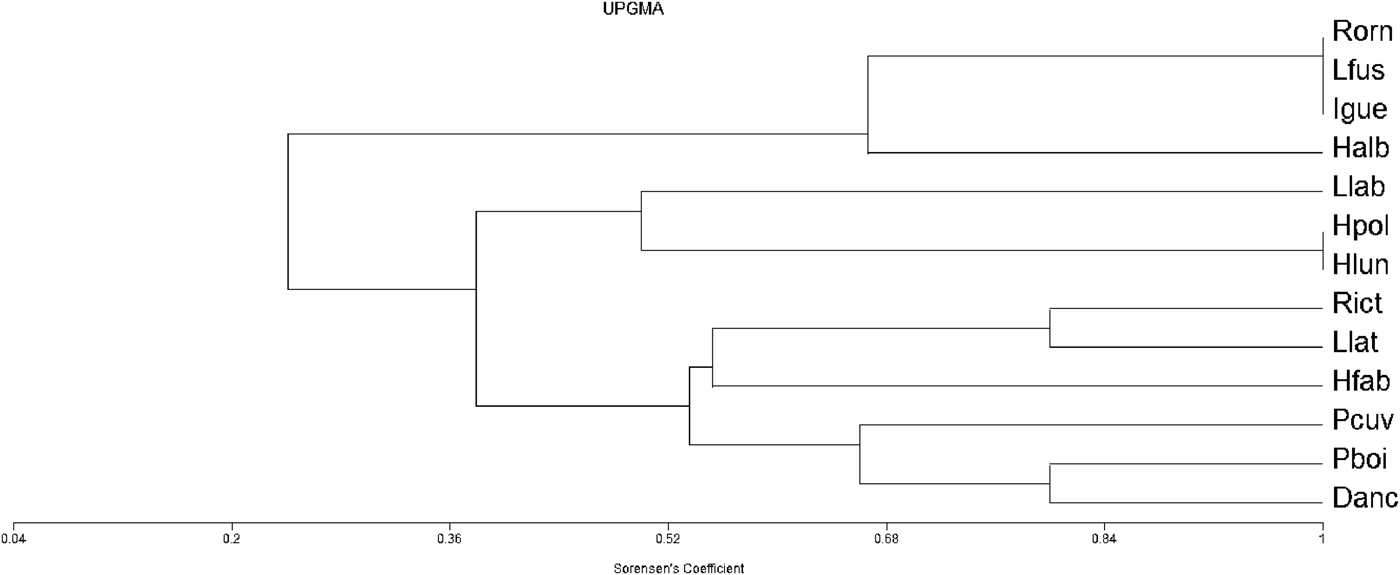
In a cluster analysis, the H. lundii and H. polytaenius, and L. fuscus, I. guentheri and R. ornata, groups had the highest similarity (1.00), followed by R. icterica and L. latrans, and P. boiei and D. anceps (8.0) (fig. 1).
Clustering of the similarity among 13 anuran species based on the Sorensen distance of their helminth community. Danc, D. anceps; Hlun, H. lundii; Halb, H. albopunctatus; Hfab, H. faber; Hpol, H. polytaenius; Igue, I. guentheri; Lfus, L. fuscus; Llab, L. labyrinthicus; Llat, L. latrans; Pcuv, P. cuvieri; Pboi, P. boiei; Rict, R. icterica; Rorn, R. ornata.

Discussion
Most taxa of helminths found here exhibit a direct life cycle (Anderson, Reference Anderson2000); for example, O. subauricularis and Rhabdias sp., which were the helminth taxa that infected the greatest diversity of host species, demonstrate a simple and direct mode of transmission (oral ingestion or active penetration of infective larvae through the skin) (Anderson, Reference Anderson2000) and low specificity.
Cosmocercidae gen. sp. nematodes are intestinal parasites of amphibians (Vicente et al., Reference Vicente, Rodrigues, Gomes and Pinto1990). Due to the great similarity of congeneric females and the absence of males in various samples, identification to the species level was not possible.
The role of host specificity was variable in these communities. Many helminth species were generalists, infecting more than one host species. The generalist helminths found in this study, such as Oswaldocruzia and Rhabdias, have also been reported to parasitize R. icterica (Pinhão et al., Reference Pinhão, Wunderlich, Anjos and Silva2009), Rhinella major (Hamann & González, Reference Hamann and González2015), Leptodactylus podicipinus (Campião et al., Reference Campião, Silva and Ferreira2009) and P. cuvieri (Toledo et al., Reference Toledo, Aguiar, Silva and Anjos2013) from other localities in the Neotropical region. These data support the idea that sympatric hosts, even those of different species and genera, might share some helminth taxa since they are exposed to similar environmental conditions (Aho, Reference Aho, Esch, Bush and Aho1990; Krasnov et al., Reference Krasnov, Mouillot, Shenbrot, Khokhlova and Poulin2011).
However, specialist parasite species such as Po. cuvieri, Ra. simples and Schrankiana sp. are important within infracommunities of their hosts. Polystoma cuvieri is a monogenean found in Physalaemus cuvieri. Vaucher (Reference Vaucher1990) described Po. cuvieri in the urinary bladder of P. cuvieri from Paraguay. This parasite was registered by Santos & Amato (Reference Santos and Amato2012), parasitizing P. cuvieri in the region of Santa Catarina, Brazil. Thus, the present study is the second record of this monogenean parasitizing Ph. cuvieri in Brazil. Raillietnema simples, found parasitizing H. faber, has this anuran species as its only recorded host. Helminths of the genus Schrankiana were found only in H. faber. Species of the genus Schrankiana have a direct life cycle. This parasite has only been found parasitizing anuran species in the family Leptodactylidae (Campião et al., Reference Campião, Morais, Dias, Aguiar, Toledo, Tavares and Silva2014; González & Hamann, Reference González and Hamann2014). This is the first record of Schrankiana sp. infecting H. faber in South America.
Regarding the amphibian body size, studies had suggested that this feature has influence on species richness and abundance of parasitic helminths (Muzzall, Reference Muzzall1991; McAlpine, Reference McAlpine1997; Bolek & Coggins, Reference Bolek and Coggins2000; Yoder & Coggins, Reference Yoder and Coggins2007; Ibrahim, Reference Ibrahim2008; Hamann et al., Reference Hamann, Kehr and González2012, Reference Hamann, Kehr and González2013b; Toledo et al., Reference Toledo, Morais, Silva and Anjos2015). In the present study, the size of the amphibian individuals was a determining factor in the parasite species richness and abundance (i.e. hosts with larger bodies harbour more parasites than the small-bodied hosts). This can be explained by the higher ingestion and more diverse diet of larger anurans, as well as the larger surface area available for colonization by parasites.
Leptodactylus latrans, R. icterica and H. faber were the anuran species that had the highest species richness and abundance of parasitism at the level of helminth infracommunity. The anatomy, ecology, diet (Yoder & Coggins, Reference Yoder and Coggins2007) and host size (Muzzall, Reference Muzzall1991; McAlpine, Reference McAlpine1997) appear to be important for the structure of the helminth community. The larger host body size can offer more space and diversity of microhabitats, supporting a greater richness of parasites (Poulin & Morand, Reference Poulin and Morand2004). Also, larger hosts have a higher contact area, increasing the opportunity for penetration by parasite larvae (McAlpine, Reference McAlpine1997; Poulin & Morand, Reference Poulin and Morand2004). Leptodactylus latrans, R. icterica, and H. faber are considered to be large, exhibit a reproductive and ecological complexity, and have a greater exploitation of habitats. Thus, these species are expected to host a greater diversity of helminths.
Anurans with terrestrial behaviour are infected predominantly with species of nematodes (Barton, Reference Barton1999; Bolek & Coggins, Reference Bolek and Coggins2000, Reference Bolek and Coggins2003; Iannacone, Reference Iannacone2003; Luque et al., Reference Luque, Martins and Tavares2005), while aquatic anurans harbour greater amounts of trematodes (McAlpine, Reference McAlpine1997; Bolek & Coggins, Reference Bolek and Coggins2001, Reference Bolek and Coggins2003; Muzzall et al., Reference Muzzall, Gillilland, Summer and Mehne2001; Paredes-Calderón et al., Reference Paredes-Calderón, León-Regagnon and Gárcia-Prieto2004; Hamann et al., Reference Hamann, González and Kehr2006a, Reference Hamann, Kehr and Gonzálezb; Schaefer et al., Reference Schaefer, Hamann, Kehr, González and Duré2006). The host species with arboreal (H. albopunctatus and H. polytaenius) and cryptozoic habit (I. guentheri and P. boiei) were infected mainly by nematodes. Leptodactylus latrans, a host having terrestrial behaviour and a high association with the aquatic environment, compared to the other hosts in this study, showed the highest infection by trematodes. Hosts that have greater contact with the water accommodate a greater abundance of individual parasites and more parasite species (Aho, Reference Aho, Esch, Bush and Aho1990; Bush et al., Reference Bush, Aho and Kennedy1990), emphasizing the importance of ecological determinants in the composition of parasite communities.
Hosts may have more similar parasite communities when they show a phylogenetically direct relationship (Lima et al., Reference Lima, Giacomini, Takemoto, Agostinho and Bini2012). However, our results did not show this similarity among the hosts in this community of anurans. Infection with parasites may be more related to other biological or behavioural characteristics of the host species than to the phylogenetic groups in which they are included. According to Aho (Reference Aho, Esch, Bush and Aho1990), hosts from the same location (i.e. when exposed to similar ecological conditions), even those belonging to different species and genera, might share some helminth taxa.
In conclusion, this anuran community showed great variety in its helminth fauna, including characteristic helminth species of terrestrial and aquatic habitats. Based on our findings, we propose that the morphological and behavioural characteristics of the host influence the structure of parasite communities in sympatric species of anurans.
Acknowledgements
The authors are grateful to colleagues from the Laboratório de Parasitologia de Animais Silvestres (LAPAS) – UNESP, for help with the fieldwork.
Financial support
G.M.T. thanks the Conselho Nacional de Desenvolvimento Científico e Tecnológico (CNPq) for an MSc scholarship (130585/2011-4). L.A.A. thanks the Fundação de Amparo à Pesquisa do Estado de São Paulo (FAPESP) for a postdoctoral grant (2008/50417-7). R.J.S. is grateful to FAPESP for financial support (2008/58180-6) and CNPq (307808/2014-9) and CNPq-PROTAX (440496/2015-2) / FAPESP 2016/50377-1.
Conflict of interest
None.
Ethical standards
Pitfall traps were installed under licence from the Instituto Brasileiro do Meio Ambiente – IBAMA (collection permit IBAMA/SISBIO No. 18240-1/2009).