Implications
No references were found in the literature regarding either the profitability of genetic improvement programs using artificial insemination (AI) in dairy sheep or the factors affecting it. The methodology and outcomes described in this paper should prove useful to all those planning such a program in developing and developed countries.
Introduction
Sheep production in the European Union (EU) countries is at a crossroads. Low lamb and mutton prices attained during the past decade have reduced the numbers of breeding sheep and restructuring of the livestock sector has occurred. However, numbers of milking ewes have remained relatively stable (Anon, 2008) due to the higher profitability of sheep milk production compared with meat production (deRancourt et al., Reference deRancourt, Fois, Lavin, Tchakérian and Vallerand2006).
Milk sheep breeding is an important sector of animal production in the Mediterranean and Middle East countries (Morand-Fehr and Boyazoglu, Reference Morand-Fehr and Boyazoglu1999; Boyazoglu and Morand-Fehr, Reference Boyazoglu and Morand-Fehr2001) and is currently under development in North America and Oceania (Lindsay and Skerritt, Reference Lindsay and Skerritt2003; Thomas, Reference Thomas2004).
In Greece, sheep milk production is a sizeable industry, with annual production ranging from 650 000 to 700 000 tons (Eurostat, 2004; deRancourt et al., Reference deRancourt, Fois, Lavin, Tchakérian and Vallerand2006; Zygogiannis, Reference Zygogiannis2006), representing about 35% of all milk produced in the country. With about 6.3 million dairy ewes in 2007 (Anon, 2008), Greece has the second largest national dairy flock in the EU, but average annual production per ewe remains relatively low, at around 100 to 120 kg.
Traditionally, these sheep were and are kept mostly on marginal land. About 78% of sheep population are kept in ‘less-favoured’ areas (Anon, 2008), under a system described as ‘sedentary extensive’ (deRancourt et al., Reference deRancourt, Fois, Lavin, Tchakérian and Vallerand2006). A ‘semi-intensive’ system, also described by the same authors, is currently being developed, not only in the plains but also in hilly areas. Higher-producing ewes are a prerequisite for such improved systems and various local (Chios, Frizarta and Karagouniko) and imported (e.g. Lacaune) breeds and their crosses are raised for this purpose.
Of the indigenous breeds, Chios is the most productive. It is an intensively reared breed with a naturally long breeding season (May to February). Most flocks are zero-grazed. Official records from purebred flocks show a mean prolificacy of 1.87 lambs and an average 200-day milk yield of 302 kg, after an initial 6-week suckling period; the top 15% of ewes produce more than 450 kg saleable milk per lactation (Chios Sheep Breeders Cooperative ‘Macedonia’, 2004) and a genetic improvement program has recently been introduced to exploit this genetic potential.
AI is the most efficient way to promote genetic improvement in feed-producing animals and sheep are no exception. Using AI makes sire reference schemes easier to implement with more accurate genetic evaluation of test sires and more extensive use of semen from superior proven sires (Nicholas, Reference Nicholas1996; Lewis and Simm, Reference Lewis and Simm2000; Kuehn et al., Reference Kuehn, Lewis and Notter2007). In sheep, the relatively low pregnancy rates of frozen-thawed compared with fresh semen (Windsor et al., Reference Windsor, Szell, Buschbeck, Edward, Milton and Buckrell1994; Salamon and Maxwell, Reference Salamon and Maxwell1995) limits its use, while laparoscopic insemination, despite yielding excellent results, is considered too cumbersome and invasive for mass application (Donovan et al., Reference Donovan, Hanrahan, Kummen, Duffy and Boland2004). On the other hand, a solid industry infrastructure is required when applying large-scale breeding schemes using fresh ram semen (Lindsay and Skerritt, Reference Lindsay and Skerritt2003) because of its short shelf life and the natural limitation on the number of semen doses that can be collected, evaluated and processed per time unit (Gordon, Reference Gordon1997).
For these reasons, with the exception of France where more than 410 000 inseminations with fresh semen are performed annually in both nucleus and commercial flocks of the Lacaune breed alone (Barillet et al., Reference Barillet, Marie, Jacquin, Lagriffoul and Astruc2001), AI is not widely applied to dairy sheep. Estimated AI rates in several (other than Lacaune) European selection schemes of milk sheep breeds, range from 30% to 51%, but due to the rather small nucleus size of these breeds, the number of annual inseminations range from 7800 to just 35 500 (Smulders et al., Reference Smulders, Serrano, Perez-Guzman, Jimenez, Uribe and Jurado2007). These schemes are assumed to be profitable, but specific data are lacking. Business issues are critical for the success of breeding programs (Garrick, Reference Garrick2005), but few studies are present in the literature (Abbott, Reference Abbott1994; Hygate, Reference Hygate2002), all dealing with the least profitable sector (wool) of the sheep industry. This is a very important issue though, in the era of diminishing public funding, especially for small-scale sheep breeding programs. The Chios selection scheme, with a current nucleus size of about 16 900 ewes, falls well within this category.
Currently, AI is not commercially available and consequently is not used in Chios breeding flocks; genetic improvement is mainly achieved by the sale of breeding rams (Gelasakis et al., Reference Gelasakis, Valergakis, Arsenos, Basdagianni, Sinapis and Banos2008). Using AI is, however, a key factor in the success of genetic improvement programs for sheep milk production (Fatet et al., Reference Fatet, Leboeuf, Freret, Druart, Bodin, Caillât, David, Palhière, Boué and Lagriffoul2008), and the Greek sheep industry will have to adopt it provided there is efficient selection of superior rams. The Chios scheme identifies such animals, but farmers must recognize the economic and managerial constraints of using AI.
This investigation evaluates the farm-level economic benefits of a genetic improvement scheme using AI with fresh ram semen in dairy sheep of the Chios breed in Greece.
Material and methods
A simulation study was carried out using data pertinent to the Chios dairy sheep and based on farmer’s responses to a survey on 67 farms of the ‘Macedonia’ Cooperative of Chios Sheep Breeders, in Northern and Central Greece. The survey questionnaire sought information and data regarding flock size, farm facilities, nutrition, management practices and major health problems.
Model components
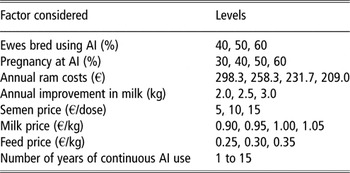
Factors considered in the model included the percentage of ewes in the flock to be bred using AI, pregnancy rate, annual costs of keeping natural service rams that would be saved when using AI, expected improvement in milk production when using AI sires, semen, feed and milk price and number of years of AI program application (Table 1).
Factors considered in the simulation study

AI = artificial insemination.
The proportion of flock that would receive AI was similar to that proposed by Smulders et al. (Reference Smulders, Serrano, Perez-Guzman, Jimenez, Uribe and Jurado2007) and that of the early Lacaune breeding program (Barillet et al., Reference Barillet, Marie, Jacquin, Lagriffoul and Astruc2001). Levels of pregnancy rate to AI were based on the available literature regarding fresh semen (Evans and Maxwell, Reference Evans and Maxwell1987; Perret and Castres, Reference Perret and Castres2001; Donovan et al., Reference Donovan, Hanrahan, Kummen, Duffy and Boland2004; Arranz et al., Reference Arranz, Freret, Fidelle, Fatet, Druart, Beckers, Sulon, Sousa, Bodin, David, Lagriffoul, Beltran de Heredia, Sasieta, Arrese, Maeztu Sardina, Lana Soto and Lasarte2008; Fatet et al., Reference Fatet, Leboeuf, Freret, Druart, Bodin, Caillât, David, Palhière, Boué and Lagriffoul2008). Annual cost of keeping a natural service ram was calculated using the formula A–(B–C)/3, where A was the cost of keeping an ‘active’ ram for 1 year (270€), B was the cost of rearing a young ram (160€) and C was the price received when the ram is culled or sold (four levels, mean values 75, 195, 275 and 343€, respectively); natural service rams are kept for an average of 3 years in Chios flocks (Gelasakis et al., Reference Gelasakis, Valergakis, Arsenos, Basdagianni, Sinapis and Banos2008; Valergakis et al., Reference Valergakis, Gelasakis, Arsenos, Basdagianni and Banos2009). Keeping two less rams per flock was considered when the highest levels of flock proportion bred by AI and pregnancy rate were combined (0.5 × 0.6, 0.6 × 0.5 and 0.6 × 0.6); in all other cases, one less ram per flock was considered. Annual improvement of milk production represented 0.66%, 0.83% and 1.00% of the mean phenotypic milk production of Chios ewes. Semen prices used in the model were assumed to include the insemination fee. The average price of sheep milk in Greece was just over 0.90€/kg in 2007 (Anon, 2008), but higher prices are received currently by larger, modernized farms (more milk of better quality). Concentrate prices (home-mixed or purchased, containing mainly ground corn and soybean meal) were based on 2008 feed prices. In all, 1 kg of concentrates with 0.98 UFL (unités fourragère lait) and 130 g PDI (protéines digestibles dans l’intestin) supports the production of 1.5 kg of milk (Hassoun and Bocquier, Reference Hassoun and Bocquier2007).
Calculation of profitability
The profit from applying a genetic improvement program using AI, based on responses to the questionnaire and combining the model components and related set of assumptions, was calculated using the following equations:

where D = % of ewes bred by AI; E = pregnancy rate and F = % of AI bred flock replacements. Equation
(1)assumes 1.75 live lambs at weaning, a 50 : 50 male–female ratio and a 25% flock replacement rate.

where G = potential annual improvement in milk production (kg/ewe) due to the genetic improvement program and H = actual improvement in milk production (kg/ewe) depending on program application in each flock.
Replacements resulting from AI (F) were considered to express fully the genetic improvement in milk production, while those resulting from natural service rams (sired by proven sires) were considered to express half of it. When F < 1, H was lower than G, as not all replacements were sired by AI rams. When F > 1, H was higher than G, as the daughters of the very best ewes were supposed to be kept as replacements.

where I = year of continuous AI use coefficient and J = improvement in milk production (kg/ewe), adjusted for the year of the program application.
Improvement in milk production would not result from the first year of the program application. Coefficients (I values in equation (3)) used for years 1 through 15 were 0, 0.25, 0.50, 0.75, 1, 2, 3, 4, 5, 6, 7, 8, 9, 10 and 11, respectively. They reflect the gradual replacement with improved ewes and the additive nature of the genetic improvement.

where K = the price of milk (€/kg); L = ram costs saved by using AI, per 100 ewes; M = the price of concentrates (€/kg); N = the price of semen (€/dose) and O = profitability per ewe (€/year).
Both annual and cumulative (over the 15-year period) profitability per ewe was calculated, for the whole model and for some scenarios considered practical under Greek conditions. The latter were (a) semen price fixed at 15€ per dose and (b) semen price fixed at 10€ and 15€ per dose for the first 5 and the following 10 years, respectively, and annual genetic improvement in milk production fixed at 3.0 kg for the whole period.
Statistical analysis
In total, the 4 × 3 × 4 × 3 × 3 × 4 × 3 × 15 factorial arrangement of the variables created 77 760 different scenarios. Analysis of variance was used to estimate the effect of each variable on profitability. All factors were fitted as fixed effects in the analysis model.
Results
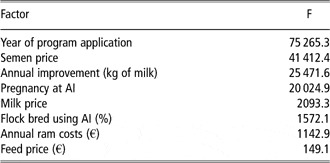
All factors considered in the model had a statistically significant (P < 0.001) effect on profitability. However, this effect varied, as illustrated by the F-statistic in Table 2.
Factors affecting the cost effectiveness of the Chios genetic improvement program using artificial insemination (AI) and corresponding adjusted Wald statistic (F)

Number of years of program application had the greatest effect on profitability. Semen price explained a large part of profitability’s variation as well. Conception rate and annual genetic improvement in milk production had also substantial effects. On the contrary, although significant, the other factors had a considerably smaller effect. Percentage of flock in AI had a relatively small effect on profitability. Annual expenses of natural service rams that would be replaced by AI explained a small part of its variation, as well. Moreover, factors that always seem to catch farmers’ attention and are not directly influenced by them, for example, price of milk and feed, had also a considerably lower effect. The latter’s effect on profitability was particularly small.
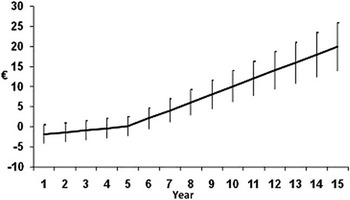
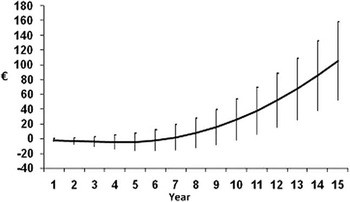
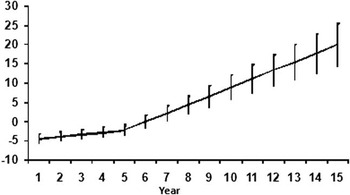
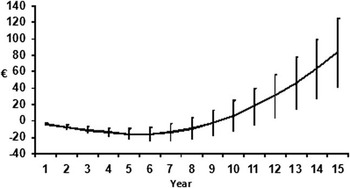
Annual and cumulative profitability (€/ewe) per year of program application (mean ± s.e.) are reported in Figures 1 and 2, respectively. Depending on other factors, 0 to 6 (mean = 4) years were necessary before a positive annual return was achieved (Figure 1). Cumulative profitability, however, became positive after 0 to 10 (mean = 6) years (Figure 2).
Annual profitability (€/ewe) of program application (mean ± s.d.).

Cumulative profitability (€/ewe) of program application (mean ± s.d.).

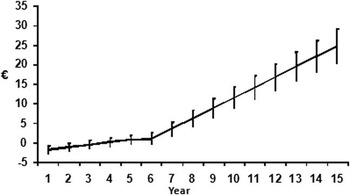
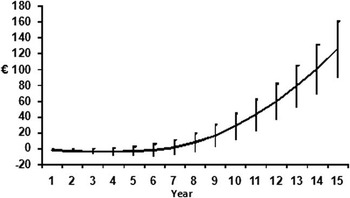
With semen price fixed at 15€ per dose, 5 to 6 (mean = 5) years were necessary to achieve a positive annual return (Figure 3), and it was only after 7 to 11 (mean = 9) years of program application that cumulative profitability became positive (Figure 4). A combination of lower semen prices (10€/dose) for the first 5 years and maximum annual improvement in milk production yielded better results. Time was not the only element in this case; still 2 to 6 (mean = 3) years and 3 to 8 (mean = 6) years were required to achieve positive annual (Figure 5) and cumulative profitability (Figure 6), respectively. However, there were marked differences in maximum cumulative monetary loss between these two scenarios (16.4 v. 3.7€), making the latter far more affordable and emphasizing the significance of both semen price and management practices in the adoption of genetic improvement programs.
Annual profitability (€/ewe) of program application (mean ± s.d.), semen price fixed at 15€ per dose.

Cumulative profitability (€/ewe) of program application (mean ± s.d.), semen price fixed at 15€ per dose.

Annual profitability (€/ewe) of program application (mean ± s.d.), semen price fixed at 10€ and 15€ per dose for the first 5 and the following 10 years, respectively, and annual genetic improvement in milk production fixed at 3.0 kg for the whole period.

Cumulative profitability (€/ewe) of program application (mean ± s.d.), semen price fixed at 10€ and 15€ per dose for the first 5 and the following 10 years, respectively, and annual genetic improvement in milk production fixed at 3.0 kg for the whole period.

Discussion
Using AI is a key factor in the success of genetic improvement programs for sheep milk production (Fatet et al., Reference Fatet, Leboeuf, Freret, Druart, Bodin, Caillât, David, Palhière, Boué and Lagriffoul2008) and the Greek sheep industry will have to adopt it provided there is efficient selection of superior rams. The Chios scheme identifies such animals, but farmers must recognize the economic and managerial constraints of using AI.
As clearly shown in this study, AI is a long-term investment and considerable communication effort will have to be dedicated to this point. Long-term benefits should be emphasized, but short-term motives are necessary to attract farmers’ attention. Semen price, which proved to be the second most significant factor affecting profitability in this study, is most probably the best candidate. Inherently, genetic improvement programs have an unprofitable lag period, during the first years of their implementation. About 26% and 44% of farmers participating in the survey were willing to pay 5€ and more than 5€ per dose, respectively (Gelasakis et al., Reference Gelasakis, Valergakis, Arsenos, Basdagianni, Sinapis and Banos2008). However, these rather low prices would be difficult to achieve. On the basis of the results of this study, about 8 to 10€ per dose is the maximum affordable price for the first 5 years under Greek conditions. Financial loss should not be felt by farmers during this period; this is considered an essential point. Regarding the Chios breed and due to the small number of breeding sheep concerned (∼ 17 000 ewes), only limited public funding or borrowed capital (<300 000€) will be required. Later on, when the increase in milk production becomes obvious, a price of 15€ per dose, necessary for the profitability of the program at the ‘AI Station’ level, will not be a burden to the farmers.
Smulders et al. (Reference Smulders, Serrano, Perez-Guzman, Jimenez, Uribe and Jurado2007) reported relative genetic progress values between 0.3% and 3.1% (mean 1.4%, median 1.0%) for similar schemes in other European milk sheep breeds. Considering the relatively low productivity of most of these breeds, a conservative approach (0.66%, 0.83% and 1.00% of the mean phenotypic milk production) was adopted in this study. Difficulties arising during the first years of the program had to be anticipated. However, an improvement of 3.0 kg of milk per ewe per year (1.0% of the mean phenotypic milk production) is considered totally feasible. The Lacaune program, with a much larger breeding sheep population, achieved an annual genetic gain of about 6.0 l/year between 1980 and 1994 (2.4% of the mean) when phenotypic milk production was about 150 and 250 l, respectively (Barillet et al., Reference Barillet, Marie, Jacquin, Lagriffoul and Astruc2001). Farmers should still be encouraged to continue careful recording of parentage and milk production. Farmers’ contribution to this issue can never be overemphasized. Under such conditions, an annual improvement of more than 1.0% would be achieved and further enhance the profitability of the program.
Although experienced technicians using fresh ram semen can achieve pregnancy rates of more than 80% in well-managed flocks, this is not expected to be very common, at least during the first years of the program. Pregnancy rates are influenced by a multitude of environmental factors (Arranz et al., Reference Arranz, Freret, Fidelle, Fatet, Druart, Beckers, Sulon, Sousa, Bodin, David, Lagriffoul, Beltran de Heredia, Sasieta, Arrese, Maeztu Sardina, Lana Soto and Lasarte2008; David et al., Reference David, Robert-Granié, Manfredi, Lagriffoul and Bodin2008a and Reference David, Leymarie, Lagriffoul, Manfredi, Robert-Granié and Bodin2008b) and for practical and demonstration reasons, a conservative approach (30% to 60%) was chosen in this study. Improved management recommendations specific for the Chios breed have already been developed and applied (Valergakis et al., Reference Valergakis, Arsenos, Basdagianni and Banos2008; Gelasakis et al., Reference Gelasakis, Arsenos, Valergakis and Fortomaris2009) and higher end pregnancy rates can be an added bonus in the future.
A conservative approach regarding savings in ram expenses, a factor interrelated with pregnancy rate, was adopted as well. It is anticipated that farmers will be reluctant to substantially decrease the number of their rams at least until AI results are clear. The small effect of this factor on profitability could certainly be increased in the future when a much smaller number of natural service rams will be kept on farms.
According to Smulders et al. (Reference Smulders, Serrano, Perez-Guzman, Jimenez, Uribe and Jurado2007), applying AI to 50% of the flock is adequate for achieving the largest genetic gains in Manchega sheep. The Chios breed is more prolific than the Manchega breed, though this means that either < 50% AI application rate is adequate or more rapid genetic progress is feasible with a 50% application. In any case, profitability would be improved. However, this factor explained a small part of the variation in profitability in this study. The latter was also true for milk and (especially) feed prices. Interestingly, true or perceived, low milk and high feed prices are the most frequently used arguments when farmers are reluctant to adopt a new technology. The effective communication of the minor effect of these two factors on profitability is a major prerequisite for the success of the program. Admittedly, this is not going to be an easy task. On the other hand, perspectives regarding milk prices are optimistic and efforts in reducing feed costs have an overall positive effect of farm profitability.
Three elements were deliberately excluded from the model in the present study: (a) effect of synchronization programs on prolificacy, (b) synchronization costs and (c) a possible overall delay in flock lambing date due to low pregnancy rates to AI. The Chios breed is naturally prolific and the effect of hormone treatments applied is minimal. Estrous synchronization is already applied in about 21% of the flocks. Its cost in Greece is presently 2.5€ per ewe. In about 67% of farms, hand-mating ewes expressing natural estrous is used; this is a labor-intensive method and synchronization protocols could have a significant labor and cost-saving effect. Moreover, ‘ram effect’ is practiced in 62% of the flocks (Gelasakis et al., Reference Gelasakis, Valergakis, Arsenos, Basdagianni, Sinapis and Banos2008) and protocols combining it with AI are already under research (Fatet et al., Reference Fatet, Leboeuf, Freret, Druart, Bodin, Caillât, David, Palhière, Boué and Lagriffoul2008). On the other hand, a possible delay in flock lambing date due to low pregnancy rates can be easily addressed by advancing the breeding period by 1or 2 weeks.
In the immediate future, Chios sheep breeders must take the following steps: (a) create a ‘Genetic Center’ where genetically superior ram lambs can be gathered and reared under optimal conditions, (b) create an ‘AI Station’ where semen from progeny tested and proven rams will be collected, (c) develop the necessary infrastructure (transportation, training and equipment) to apply AI in their flocks, (d) develop an efficient marketing system for semen and natural service rams not only among themselves but also for sheep farmers willing to upgrade their non-Chios flocks and (e) improve management in their flocks (nutrition, housing and record keeping), which will result in more accurate genetic selection. The integration of these efforts (buildings, equipment and personnel) with existing activities (pedigree and milk production recording) can keep fixed and variable costs to a minimum, thus supporting the profitability of both individual farms and the cooperative as a whole.
Conclusion
Under prevailing Greek conditions, a genetic improvement program of milk production for the Chios breed of dairy sheep using AI can certainly be profitable. In implementing such a program, efforts should be concentrated on (a) securing funding for the unprofitable initial period of approximately 5 years and (b) successfully communicating the relative effect of each factor on profitability. Chios sheep breeders will benefit from the permanent effects of the program; increased milk production and higher prices for superior breeding animals sold domestically and perhaps abroad, will substantially improve the profitability of their farms.
Acknowledgement
The authors thank the Chios Sheep Breeders’ Cooperative ‘Macedonia’ for collaboration during data collection.