Nearly 375 years after its initial performance in Rome, Giulio Rospigliosi and Stefano Landi's Il Sant'Alessio was reintroduced to European opera audiences in a 2007 production performed at the Théâtre de Caen.Footnote 1 Directed by William Christie and Benjamin Lazar, this twenty-first-century production of a seventeenth-century opera paid careful attention to detail. Among its features were a period orchestra (Les Arts Florissants); historically informed costumes; sets that embraced seventeenth-century challenges to stagecraft (presented by scene changes, stage machines and the chiaroscuro of a stage lit by candlelight); and an all-male cast that replicated as nearly as possible the vocal ranges and dramatic gestures that are believed to have been employed at the opera's 1634 performance. Despite the production's successful negotiation of issues related to period musical and dramatic performance, the modern-day production of Il Sant'Alessio fell short in one regard: it misread the opera's comic scenes as scenes of buffoonery and recast the young and comically naive pages of Rospigliosi's libretto as overgrown clowns, if not outright oafs.Footnote 2 Such a misconception not only is common in the work of modern-day directors and performers, but also reflects a lack of understanding among scholars of early opera, whose interpretation of early operatic comedy is largely dependent upon Enlightenment aesthetics that were anachronistic in the literary and theatrical world of the seventeenth century.
It may seem counterintuitive to find that significant departures in literary and theatrical interpretations of comedy took place during the early modern period – a time when the varied political, economic and institutional models with which comedy had historically interacted were beginning to develop along a similar, global path. And yet the move in the late eighteenth century away from the comic breadth of the commedia dell'arte towards sentimental drama paralleled Enlightenment social and philosophical trends that increasingly emphasized manners and decorum, believed to be good sense made visible. Comic characters, scenes and entanglements that had in the sixteenth and seventeenth centuries played an essential role in helping audiences of mixed-genre works make sense of the world around them would in the eighteenth century be shifted to the drama's periphery, where they were treated as departures from reason, if not purely ridiculous elements of plot. The result was an Enlightenment narrowing of the understanding of comedy which focused its comic analyses on studies of behaviour that reinforced social norms or on the systematic classification of comic character types and scenarios.Footnote 3
By contrast, seventeenth-century authors on comedy took great pride in demonstrating their knowledge of the comic writings of antiquity, as well as the serious writings of classical Greek and Roman authors on drama, rhetoric and oratory.Footnote 4 As recipients of the fruits of the literary and interpretative endeavours of Renaissance humanists, poets and librettists embraced comedy as an imitation of life that encompassed personalities drawn from disparate traditions ranging from classical mythology to stock characters like the courtesan, the parasite, the captain full of braggadocio and everything in between. The result was a fairly comprehensive yet nuanced view of comedy and its dramatic subtleties – one that considered the laughable and ridiculous elements of comedy alongside matters of artistic originality such as comedy's rhetorical tendency, ability to reflect current events and capacity to promote one or more particular viewpoints, at times simultaneously.Footnote 5
This article reconsiders the role played by comedy in early seventeenth-century opera, using the combined lenses of literary theory, seventeenth-century theatre history and sociocultural context. The focus of its study is the aforementioned Il Sant'Alessio by Rospigliosi (1600–69) and Landi (bap. 1587, d. 1639), written for the Barberini family and first performed in Rome in 1632.Footnote 6 Two years later, Rospigliosi and Landi returned to the opera and revised it, paying close attention to its comic elements. In so doing they created a work whose comedy successfully projected the Barberini family's religious and political agenda while ensuring that there would be some levity in an otherwise heavy-hitting religious drama. This study begins by briefly framing Rospigliosi and Landi's Il Sant'Alessio within the historical frameworks of the Thirty Years War and 1630s Rome, before turning to a short summary of the original legend of St Alexis. The legend's continued popularity well into the seventeenth century and the conditions that allowed for its inclusion of comedy are, at least in part, explained by the nature of the saint's vita, the genre upon which Il Sant'Alessio was based. Finally, a close reading of Rospigliosi and Landi's comic scenes for the 1634 version of Il Sant'Alessio explores the interrelationship between the comic and the sacred in religious drama and demonstrates how Il Sant'Alessio's comedy was used to promote a more widespread acceptance of key religious ideals.
Setting the stage: Il Sant'Alessio, comedy and 1630s Rome
For the subject matter of his first opera written for the Barberini papal court, Rospigliosi turned to the life of St Alexis. Dating from the fifth century, the legend of St Alexis tells the story of the son of a Roman patrician who took to heart the prescription found in the Gospel of St Matthew (xix. 29): ‘And every one that hath forsaken houses, or brethren, or sisters, or father, or mother, or wife, or children, or lands for my name's sake shall receive an hundredfold, and shall inherit everlasting life.’Footnote 7 Accordingly, St Alexis forsook his birthright and instead chose the humble life of a pauper living amid a world of wealth and luxury, fasting and praying for the day in which he would be allowed to ascend to heaven and receive his eternal reward.
The selection of the legend of St Alexis as the subject for the Barberini family's first foray into opera is significant when viewed through the political lens of the 1630s. At the time of Il Sant'Alessio's conception, Europe was embroiled in the ongoing struggle between the Catholic rulers and the Protestant princes of Germany. Ostensibly a war over religion and the possession of ecclesiastical lands, the Thirty Years War posed a complicated political reality for Maffeo Barberini (Pope Urban VIII, r. 1623–44), whose support of the Catholic cause required careful navigation of the power struggle between the Holy Roman Emperor, the Bourbons of France and the Spanish Habsburgs. As the head of the Catholic Church, the pope and his cardinal nipote, Francesco, sought diplomatic ways of promoting Catholicism throughout Europe without relinquishing the juridical power of the papacy.Footnote 8 Separating the politics of the war from the papal agenda, Urban VIII and Francesco accomplished this feat by favouring ambiguous positions within the war effort, pursuing building projects and land acquisitions that would strengthen the church's material resources and advancing the desire to conserve the Catholic religion within Rome and propagate it abroad.Footnote 9 At the same time, the Barberini consciously began to integrate the political with the cultural, undertaking an ambitious programme of artistic patronage that actively promoted the legitimacy and moral virtue of the papacy while ensuring that the European world continued to view Rome as a symbol of faith, the centre of Catholicism and a temporal power in its own right.Footnote 10 One noteworthy result of this patronage was the Barberini's exploration of the still relatively new art form of opera as a powerful artistic, religious and propagandistic tool. Among the works written during this period was Rospigliosi's Il Sant'Alessio, with music by the composer Landi. Commissioned at a major turning point in the Thirty Years War, dedicated to the Holy Roman Emperor's visiting ambassador Hans Ulrich von Eggenberg and featuring a saint with strong historical connections to Rome, Il Sant'Alessio stands out as a particularly palpable artistic endorsement of Urban VIII's religious and political programme.
As a retelling of the life of a palaeo-Christian saint who was recognized in the seventeenth century as the ‘Confessor of Roman Patricians’, Rospigliosi's Il Sant'Alessio brought together aspects of Rome's – and with it the church's – historical past with its more conflicted present. The saint's sacrifice and humility, presented amid the splendour and luxury of the seventeenth-century papal court, paralleled the challenges facing the Barberini as they pursued their dream of restoring the papacy to its pre-Reformation power and status. The use of music and drama as a means of rehearsing and promoting the teachings of Catholicism through the appropriation of hagiographic legend and scripture drew upon the medieval traditions of dramatizations of saints’ vitae and sacred drama. At the same time, the opera's interpolation of established literary and religious tradition with modern approaches to music, poetry and drama was directly in keeping with the activities of members of Rome's intellectual establishment and Urban VIII's desire to make Rome a centre for the arts and learning.Footnote 11 The opera's focus on Rome (as the setting for the drama and the place where Religion emerges victorious, inviting all to follow a path of virtue) highlighted the city as a time-honoured symbol of Catholicism. And the employment of the still relatively unestablished genre of opera as the means of presenting St Alexis's story underscored the papal court's role in continuing the advancement of Italian culture and art. Notwithstanding these various frameworks for understanding and interpreting Il Sant'Alessio, the opera might be viewed as simply another narration of St Alexis's life, one that fully participated in a centuries-long history of hagiographic adaptations. As such, the success or failure of Rospigliosi and Landi's Il Sant'Alessio largely depended on the way in which its creators reinterpreted the past for the contemporary papal court.
From its very first operatic manifestation, Il Sant'Alessio unexpectedly utilized comedy to achieve these ends. Rospigliosi's modest inclusion of Martio, a comic pageboy who innocently teases Sant'Alessio in Act 1, reflected the type of comedy that, as early as the Middle Ages, had been employed by the church in religious drama as a means of imparting Christian views to a community of believers.Footnote 12 However, the amplification of comic scenes in Rospigliosi and Landi's revised and expanded form of Il Sant'Alessio for the 1634 visit of Alexander Charles, Prince of Poland, was highly unusual in the context of serious religious drama and unheard of in the operas of the period. The increased attention to comedy in the revised version pushed the limits of sixteenth- and early seventeenth-century theological and moral views, countering the opinion of some religious reformers that immoderate comedy and laughter were an impure indulgence that should be strictly separated from the sacred. Instead, Rospigliosi and Landi's comic scenes of witty banter provide a pleasant respite from the unfolding powerful religious drama that may well have been inspired by the type of recreational play that Aristotle referred to in his ethical writings as eutrapelia.Footnote 13 Standing in contrast to the steadfast resolve of the opera's virtuous protagonist, Il Sant'Alessio's pages personify youthfulness in their passionate embrace of life, predisposition for indiscriminate gratification and inability to perceive immorality or cruelty in others (not having witnessed many instances of wickedness in their own short lives).Footnote 14 The comic scenes in which they mock the saint and the Devil are sensibly constructed so as to balance realistically and decorously the story of the saint's martyrdom in a manner befitting the dramma spirituale.Footnote 15
Drawing as it did from the established writings of Aristotle, Il Sant'Alessio's brand of comedy reflected the scholarly and literary activities of the Roman intelligentsia within the Barberini circle. Philosophers and theologians at the Barberini court would have been familiar with Aristotle's writings, as well as with those of Sts Augustine and Thomas Aquinas, both of whom applied the Aristotelian notion of eutrapelia to Christianity, advocating a relaxation of the mind from work with playful words and deeds, and noting the suitability of such play for a wise and virtuous man.Footnote 16 Similarly, poets familiar with emerging genres such as tragicomedy may have interpreted the strategic placement and nature of Il Sant'Alessio's comic elements as a conscious manipulation of comedy to lessen the sadness created by St Alexis's self-imposed martyrdom, and instead inspire delight in the opera's viewers – a goal not dissimilar to the Horation platitude that poetry should instruct as well as delight.Footnote 17
Il Sant'Alessio's sources: a medieval saint's life in seventeenth-century Rome
Based on an eleventh-century rendering of a fifth-century Byzantine legend, Rospigliosi's libretto for Il Sant'Alessio relates the story of an ancient Roman martyr who left the comforts of his wealthy family home in order to devote himself more fully to a life of poverty, prayerful worship and penance.Footnote 18 Although hagiographic scholarship suggests that much of this legend is apocryphal – most likely a conflation of the stories of St John Calabite and the man of God Mar Riscia of Edessa – it had by the seventeenth century been generally accepted as Catholic history and widely proliferated throughout Christendom.Footnote 19
The narrative from which Rospigliosi's plot is drawn is divided into two parts, beginning in Rome with Alexis's parents, who, unable to have children, pray for an heir. Their prayers are answered and they are granted a son for whom they arrange a marriage to the daughter of the imperial family. Having dedicated himself wholly to God during his youth, Alexis flees the bonds of an earthly marriage and secretly journeys to the Syrian city of Edessa. There, he gives away his remaining money and turns to a life of devout prayer and supplication. For 17 years, Alexis lives in Edessa as a pauper, begging for alms on the stairs of the church. One day, the likeness of the Blessed Virgin Mary appears to the sacristan of Edessa, requesting that Alexis be welcomed into the church. Upon learning of this miraculous event, Alexis fears that the new-found recognition will threaten his chosen life of renunciation and decides to flee once more. While at sea, a terrible storm arises that blows Alexis's ship ashore near Rome, not far from his father's house. Greatly changed in appearance, Alexis returns home, where he goes unrecognized by his family and friends.
The second half of the legend takes place back in Rome, where for 17 years Alexis remains in his father's household, living as a beggar under the stairs and silently enduring the insults and abuses of the household servants. One morning, a celestial voice is heard at a nearby church instructing those in attendance to seek out the man of God at the house of Euphemian. Upon their arrival, the heads of church and state learn of the nameless beggar who, having devoted his entire life to prayerful contemplation, has just died. On the beggar's body is found a letter that reveals Alexis's true identity and narrates the events of his life. The legend ends with the lamentation of Alexis's family and the saint's burial in a tomb.Footnote 20
Like many stories of the saints, the source material for Rospigliosi's libretto is striking in its lack of historical perspective and its reliance on a framework of interchangeable narrative elements that invite adaptation. What began as a simple story of one man's decision to live an ascetic life gradually evolved over the centuries into an epic story encompassing 34 years and spanning two countries. At the centre of the story lay several key narrative elements: Alexis offers himself to God despite his parent's opposition; he voluntarily renounces all worldly goods; he spends his final years living under the stairs of his parents’ house; and his death, heralded celestially, is marked by his family's recognition not only of his identity, but also of his great sanctity.Footnote 21 In the centuries leading up to Rospigliosi and Landi's retelling of Alexis's story, this well-defined core of saintly lore was repeatedly embellished with episodes taking place during Alexis's time abroad, appearances of disembodied or celestial voices, appearances of the Blessed Virgin Mary and attempts made by the Devil to tempt him.Footnote 22 Notably, each new variant appears to have emphasized either the saint's interactions with religious and/or celestial figures or the reactions of those who encountered the saint, rather than any psychological or physical action undertaken by him. This may well have to do with the fact that St Alexis's sainthood lies not in his martyrdom, miracle-working or life of service, but rather in the exemplary model of faith and austerity that his dedication to prayerful contemplation epitomized.Footnote 23 His legend, when compared with that of so many other celebrated saints, is rather bland. The nature of his story invites, if not requires, its narrators to take liberties in inventing new episodes and anecdotes in their retelling in order to engage and inspire audiences of their time. Moreover, the invented details in each tale of Alexis's life renegotiate the particulars of the relationship between the theological institution of the Catholic Church and its followers. Footnote 24
When traced over time, the modifications made to the legend of St Alexis provided a precedent by means of which Rospigliosi could transform a centuries-old religious narrative into an operatic vehicle for conscious propaganda – a means to promote specific religious perspectives and temper public perception.Footnote 25 As a sacred history dating back to the Byzantine era, the story of St Alexis had by the seventeenth century survived a long history of reinterpretation and translation. Its varied manifestations throughout the medieval, Renaissance and early Baroque periods, and its continued popularity regardless of whether the church was undergoing a period of rapid expansion, conflict and division or of internal reform, demonstrates a certain malleability within the story that lends itself well to religious and political manipulation. It was just this type of adaptability that enabled Rospigliosi to turn to the legend and use it to present a powerful allegory of early Baroque Rome. The direct connection between the continued popularity of St Alexis's legend and its established history within the Catholic religion from its earliest days through to the development of its current post-Tridentine identity paralleled the continuity of the Catholic faith despite the many challenges it faced during Urban VIII's reign.Footnote 26 The legend's emphasis on Rome as the locale of the saint's birth, a place of return where even the impoverished and unrecognizable Alexis might seek refuge and find welcome after 17 years abroad, and the site of Alexis's ultimate reception by Religion and ascension into heaven resonated well with the spirit of religious romanitas promoted by the Barberini. Finally, the message of steadfastness of faith, especially in times of external threat, would not have been lost on the opera's earliest court audiences, which included foreign delegates, high-ranking prelates, members of the Barberini intellectual circle and prominent papal supporters.
Rospigliosi's adaptations: two versions of Il Sant'Alessio
Although it is believed to have been commissioned for the 1631 carnival season, the earliest confirmed performances of Il Sant'Alessio did not occur until February of the following year, when several performances were given in honour of Hans Ulrich Fürst von Eggenberg, the visiting emissary from the imperial court in Austria.Footnote 27 The opera's dramatic content, as presented on this occasion, encompassed only the second half of the legend of St Alexis – the half that takes place in Rome. Early in Act 1, the saint's father, Eufemiano, recounts the missing first half of the legend, mourning the loss of his son so many years before. At the time of his narrative, Eufemiano is unaware that Sant'Alessio has already returned home and is currently living under the family's stairs. As the opera's action unfolds, Sant'Alessio's still-grieving wife and mother prepare to set out in search of him, leading the Devil to tempt Sant'Alessio to turn away from his life of religious contemplation and reveal his true identity to his suffering family. When Sant'Alessio learns of his imminent demise and of the great reward that he will receive in heaven, he chooses not to reveal himself and welcomes death. As Sant'Alessio departs his worldly life, a voice from heaven announces the death of a holy man, and Sant'Alessio's family discovers the saint's body under the stairs with a letter revealing his true identity. The opera ends as the angels admonish the family for mourning one who has been welcomed into heaven and it is revealed that Sant'Alessio's life of sacrifice and blessed death has increased the glory of Rome.
In adapting the literary legend of St Alexis for the operatic stage, Rospigliosi's early libretto draws upon a number of dramatic elements that were commonly found in parallel theatre traditions. Its dramatization of the triumph of virtue over worldly temptation was analogous to themes found in the Italian rappresentazione sacra, while its use of drama as a means of imparting Catholic doctrine and Christian values bore more than a passing resemblance to Jesuit drama, tragedia sacra (renamed tragicomedia by Alessandro Donati in his Ars poetica of 1631), and the Spanish comedia de santos.Footnote 28 As vehicles for transmitting the redefined dogmas of the Council of Trent, these theatrical traditions mediated between the church in Rome, its vernacular forms as understood and followed by communities outside Rome (such as those in Eggenberg's Austria) and the perceptions of its followers. Similarly, Rospigliosi's Il Sant'Alessio accomplished the Barberini desire to convey the church's religious and moral beliefs while reaffirming Rome's position as the centre of Catholicism.
Somewhat unsurprisingly, given his education and training, Rospigliosi's first endeavour to write a libretto in the service of the papacy erred more towards the literary and intellectual side of these traditions than to the visual and spectacular, leaving little creative space in which Landi and the opera's set designer, Pietro da Cortona, might work. The first known version of his libretto for Il Sant'Alessio presents very few opportunities for the types of elaborate scenery, costumes, stage machinery and theatrical embellishment that were generally associated with Baroque theatre. What is more, Rospigliosi kept comedy in his early libretto to a minimum, utilizing a single pageboy to provide brief moments of comic respite from the religious drama.Footnote 29 Though the judicious positioning of these dramatic elements was probably intended to emphasize the libretto's focus on the sacrifices of St Alexis and the Catholic teachings implicit in them, the moments of spectacle that Rospigliosi did include did not go unnoticed; at least one spectator in attendance in 1632 noted with delight how the final tableau of Paradise was ‘so resplendent and luminous that one could hardly look at it’.Footnote 30
Perhaps it was a growing awareness of the necessity for an opera to delight as well as to instruct and move the sensibilities of its viewers that prompted Rospigliosi to return to his Il Sant'Alessio in 1634 and revise it for that year's carnival celebrations.Footnote 31 Performed in honour of the visit of Alexander Charles Wasa, brother to the king of Poland, the 1634 version of Il Sant'Alessio retained the same basic plot as the 1632 version, but featured a rewritten prologue in which a victorious Rome, accompanied by a chorus of slaves, announced that St Alexis's story would be presented in honour of the prince's visit.Footnote 32 Additionally, the revised version included five new scenes (several of which utilized elaborate stage machinery designed by Francesco Guitti) and further developed the role played by comedy within the saint's narrative. Of especial interest are the addition of a second young page, Curtio; the division of pre-existing comic lines between the two pages; and the invention of two wholly comic scenes: Curtio's introduction to the ballo at the end of the first act and Martio's conversation with the Devil late in Act 2 (see Table 1).
| Description of events in 1632 version | 1632 scene | Revised and/or added scenes for 1634 |
|---|---|---|
| Rome tells of the glories of her citizens both in combat and religious devotion; outstanding among them is Sant'Alessio. | prologue | Added reference to visiting dignitary Prince Alexander Charles of Poland; chorus of slaves added. |
| ACT 1 | ACT 1 | |
| Eufemiano relates ‘background’ of Sant'Alessio's departure to Adrasto. | scene i | |
| Sant'Alessio prays to escape suffering of this world. | scene ii | |
| Sant'Alessio endures Martio's teasing. | scene iii | Curtio added; Martio and Curtio sing duet, then begin to tease Sant'Alessio. |
| Devil devises plan amid ballet of demons. | scene iv | |
| Mother and Wife lament loss of Sant'Alessio; Nurse tries to console them; they pray for Sant'Alessio; Martio present. | scene v[/a] | Curtio added to scene. |
| Members of Eufemiano's household discuss unpredictability of world, then pray for divine mercy. | scene v[/b] | |
| ** | Added scene: Curtio provides introduction to a dance of peasants at Eufemiano's country estate. (1634 version reads: ‘Scena aggiunta. Per introduzione di un ballo’.) | |
| ACT 2 | ACT 2 | |
| ** | Added scene: Eufemiano reflects on return of Adrasto and mourns loss of Sant'Alessio. (Becomes Act 2, scene i.) | |
| Devil initiates plan. | scene i | (Becomes Act 2, scene ii.) |
| Wife (dressed as pilgrim) wants to look for Sant'Alessio; she is observed by Nurse. | scene ii | (Becomes Act 2, scene iii.) |
| Nurse tells Mother, who first tries to stop Wife, then decides to join search; Sant'Alessio deters them; Martio present. | scene iii | Curtio added to scene. (Becomes Act 2, scene iv.) |
| Sant'Alessio contemplates revealing himself. | scene iv | (Becomes Act 2, scene v.) |
| Disguised as hermit, Devil tempts Sant'Alessio. | scene v | (Becomes Act 2, scene vi.) |
| Sant'Alessio told of his approaching death and of heavenly reward by an Angel. | scene vi | (Becomes Act 2, scene vii.) |
| ** | Added scene: Martio mistakes Devil for a hermit; Devil turns into bear and runs off. (Becomes Act 2, scene viii.) | |
| ** | Added scene and character : at Sant'Alessio's death, Religion invites all to follow the path of virtue. (Becomes Act 2, scene ix.) | |
| Eufemiano laments to Adrasto, they learn of ‘voice’ in church. Roman chorus celebrates joy of newly ‘consoled’ Rome. | scene vii | (Becomes Act 2, scene x.) |
| ACT 3 | ACT 3 | |
| Having failed in his task, Devil returns to hell. | scene i | Demon chorus added. |
| Adrasto learns of Sant'Alessio's death from Eufemiano's servant; they proceed to room where Sant'Alessio's body lies. | scene ii | |
| Family laments Sant'Alessio's death; Sant'Alessio's letter is read; Martio present. | scene iii | Curtio added to scene. |
| Ascension of Sant'Alessio's soul to heaven; Choirs of Angels tell family not to grieve; Virtues celebrate Sant'Alessio's heavenly glory with ballet. | scene iv | Original scene divided into two: Angels escort Sant'Alessio's soul to heaven and tell family not to grieve. |
| ** | Religion reconsecrates an ancient Roman temple to Sant'Alessio; the Choirs of Angels continue their song while the Virtues dance in celebration. (Becomes Act 3, scene v.) |
Note: A detailed comparison of the characters present in each scene can be found in Silke Leopold, Stefano Landi: Beiträge zur Biographie: Untersuchungen zur weltlichen und geistlichen Vokalmusik (Hamburg: Karl Dieter Wagner, 1976), 284–5.
Appearing as they do in a storia sacra, Rospigliosi's 1634 comic additions and alterations are of particular interest.Footnote 33 Their focus on a type of secular comedy stemming from the literal wordplay, comic disguise and conversational misunderstanding that were central to popular written comedies and improvised commedia dell'arte was in keeping with the existing traditions of Jesuit drama, tragicomedy and comedia de santos.Footnote 34 Take, for example, two of the three scenes that feature Martio and Curtio, pages in Eufemiano's household. In Acts 1 and 2 of the 1634 version, the pages directly engage the physical manifestations of good and evil, first as they laugh at Sant'Alessio's chosen lifestyle (Act 1, scene iii) and later when Martio mistakes the Devil for a lost hermit and begins to tease him (Act 2, scene viii).Footnote 35 In both of these cases, the pages encounter characters who dramatically personify extreme religious ideologies, yet never demonstrate fully human characteristics, sentiments or qualities. Rather, Sant'Alessio and the Devil exist in the opera as pure representations of doctrinal beliefs – beliefs that need to be tempered in order to achieve their dramatic purpose. Ironically, it is Martio's and Curtio's unapologetic expression of their humanity, manifested in their comically unsophisticated conversational skills, that engages these doctrinal beliefs and ultimately mitigates them for public consumption.
As comic foils to that which is deemed holy, moral and upright (as well as to that deemed unholy, immoral and malevolent), the characters of Martio and Curtio represent an interrelationship between the comic and the sacred in religious drama that can be traced back at least as far as the Middle Ages.Footnote 36 Their representation of the foibles of humanity stands in stark contrast to the abstract philosophical truths embodied in the characters of Sant'Alessio and the Devil, and serves as a reminder that human life does not exist as a series of religious absolutes, but rather is a finite, conditioned thing, deeply rooted in the tangibles of this world. Unlike their dramatic counterparts, Martio and Curtio are intentionally comic characters who function as a ‘kind of icon of the human actuality […] example[s] of the contingent, imperfect, earthbound creatures that in truth we all really are’.Footnote 37 Their comic humanity acts as an imago veritatis, making the pages the perfect guides to help Il Sant'Alessio's seventeenth-century spectators navigate between the religious dichotomies of good versus evil, spiritual versus worldly, soul versus body, sacrifice versus pleasure and spiritual contemplation versus worldly action that are represented by Sant'Alessio and the Devil.Footnote 38 In so doing, Martio and Curtio's comedy becomes a vehicle of instruction – a centuries-old method of presenting moral lessons intended to be absorbed by its audience.
If Il Sant'Alessio's comedy is considered within the context of its literary and dramatic predecessors, the pages’ distinction as the only characters to interact directly with the personifications of both the path to heavenly salvation (i.e. Sant'Alessio) and the path to eternal damnation (i.e. the Devil) establishes them as being central to the interpretation of the opera's overarching message. Their musical exchanges with Sant'Alessio and the Devil, while essential to providing light-hearted comic relief, also become a focal point for exploring the dichotomies of good/evil and contemplation/action that are intrinsic to the Catholic religion. As such, the pages’ amusing challenges to the basic tenets of Catholicism become key elements of the opera's religious propaganda. In what follows, the musical and dramatic representations of Sant'Alessio, the pages and the Devil will be examined, with special attention given to the musical manifestation of comedy in the Act 1, scene iii interactions between the pages and the saint and the Act 2, scene viii exchange between Martio and the Devil.
Rereading comedy in Il Sant'Alessio
Before undertaking a close reading of the comic scenes in Il Sant'Alessio, brief consideration should be given to the musical language employed by Landi when setting Rospigliosi's text. At the time of Il Sant'Alessio's conception, musical theorists and composers continued to engage in the exploration – initially undertaken nearly 50 years earlier in Florence among members of Giovanni de Bardi's camerata – of ways to make manifest the expressive and dramatic possibilities of music. Terminology such as stile rappresentativo (a dramatic or emotional approach to representing text musically) remained in vogue, as did the employment of musical shifts between flat, natural and sharp systems as a means of marking dramatic, emotional or expressive moments. In Rome, the music theorist and classicist Giovanni Battista Doni published several treatises examining the use of mode and genera, as well as ornamentation and other expressive devices, in the music dramas of the day.Footnote 39 When referring to the dramatic capabilities of music, Doni highlighted in particular an ‘expressive’ style of composition in which the mutations of mode, genera and rhythm are employed to ‘express the affects well’ and ‘move [the listener] to laughter, weeping, anger, etc.’ when fitting a speech to a lively action.Footnote 40 Prefaces to early seventeenth-century song collections and operatic scores made note of such a theatrical style, as is evidenced by the prefatory notices published with Landi's score for Il Sant'Alessio in 1634.Footnote 41 Each of these sources offers particularly helpful insights into the way in which seventeenth-century composers, theorists and listeners conceptualized the relationship between words and music.
In keeping with the theoretical approaches of the period, the musical discussion that follows focuses on the conjunctions between dramatic poetry, melodic setting and tonal practices (particularly the modal shifts that in the late sixteenth and early seventeenth centuries were reserved for highly dramatic, emotional or expressive moments). Such an analysis corresponds to the way in which early seventeenth-century theorists, composers and listeners conceived of musical drama as an extension of both contemporary and ancient musical practices in which the tonal structure of the music merged with the narrative logic presented by the poetic text in order to express its dramatic meaning more accurately. A particularly good example of the dramatic interplay between music and text can be found in the first act of Il Sant'Alessio, when the saint and the religious ideals that he manifests are introduced, challenged and ultimately reinforced.
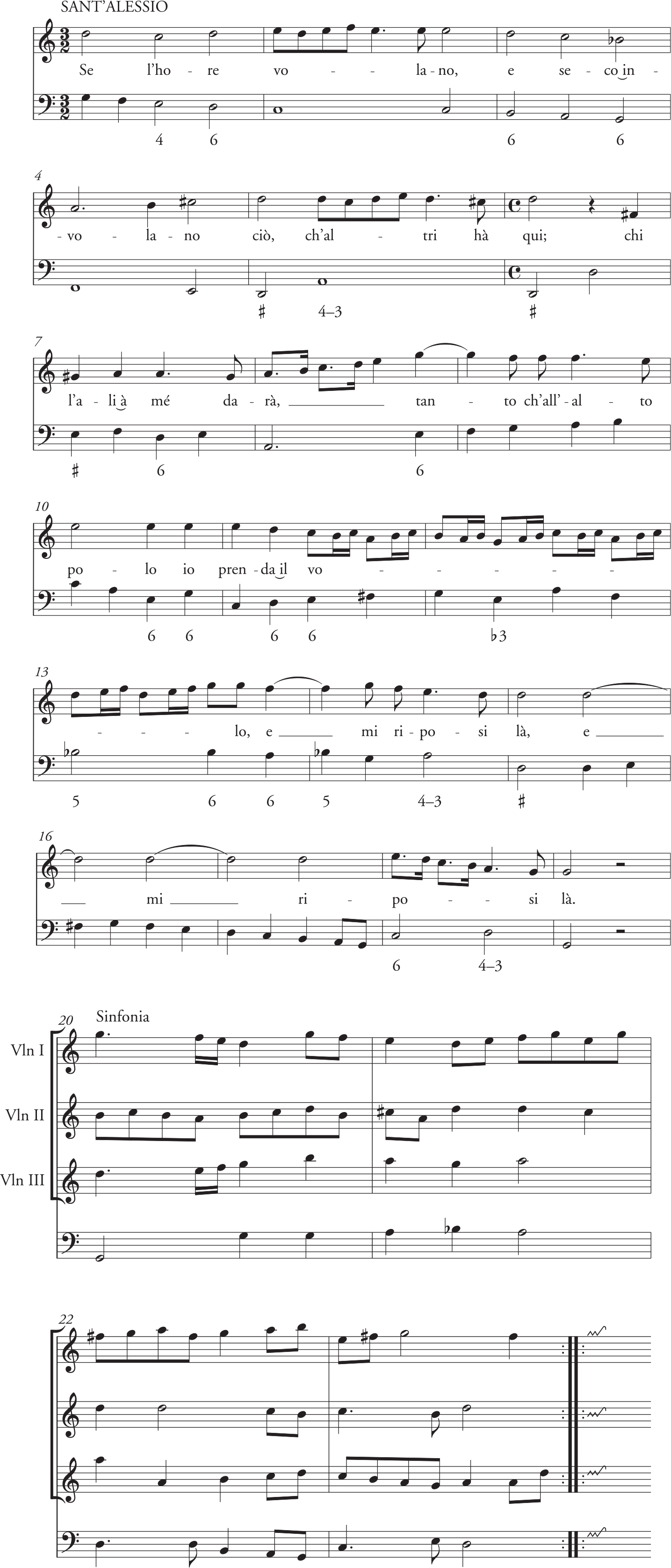
Act 1, scene ii opens as Sant'Alessio appears alone onstage, bemoans the sins of the flesh that have come to dominate the earthly world, then turns to God in prayer. Taking the form of a strophic arietta for solo voice, his expressive prayer (‘Se l'hore volano’; see Example 1) is the only instance in which the contemplative saint appears to carry out an action – even one as reflective as prayer. Its highly organized music stands in marked contrast to the cantar recitando that he employs throughout the rest of the opera, yet observes many of the same expressive tendencies that the saint later demonstrates.
Il Sant'Alessio, Act 1, scene ii, Sant'Alessio's arietta: ‘Se l'hore volano’. This excerpt and all others presented below are drawn from the facsimile edition: Landi, Il Sant'Alessio: Dramma musicale, ed. Morelli (see n. 2).

| 1 | Se l'hore volano, e seco involanociò, ch'altri hà qui;chi l'ali à mé darà, tanto ch'all'alto poloio prenda il volo, e mi riposi là. | If the hours flyand with them stealthat which others possess here on earth;who will give me wings, so that to the lofty poleI may take flightand there repose? |
| 2 | Nel mondo istabile, altro durabile, ch'il duol non è;chi l'ali à mé darà, […] | In this unstable world, nothing is lastingsave grief;who will give me wings, […] |
| 3 | Quei rai, che splendonqui l'alme offendono, nè serban fè;chi l'ali à mé darà, […] | Those rays that shinehere offend the spiritnor do they keep faith;who will give me wings, […] |
Forced in this moment to exist amid the instability, sinful pleasure and grief of humanity, Sant'Alessio can do no more than hope and pray for the day on which he is permitted to enter fully into the kingdom of heaven. His petition for help in escaping the drudgery of life on earth to achieve the eternal glory of heaven is marked by an abrupt metric shift and a D major cadence that musically grounds the ‘qui’ of ‘here on earth’ before lyrically and tonally departing for the spiritual realm. As he attempts to liberate himself from the bonds of this world through the musical expression of his most cherished desire, the saint commences an ascending melismatic passage that represents an extended vocal flight as it briefly surmounts the limitations of the earthly realm and pauses momentarily on a high g″ before being arrested by the basso continuo and gently guided back down to the earthly realm. Here, Sant'Alessio's musical setting abruptly changes from one of elaborate word-painting to one bounded by the rules of harmony. Rather than allowing Sant'Alessio truly to ‘repose’ at the ‘lofty pole’ to which he ascended with additional word-painting and, notably, the arrival of a new tonal centre to bring his verse to a close, Landi's musical descent back to D undermines the notion of the saint's physical escape from the earthly realm. The repeated musical material of the second and third strophes further detracts from Sant'Alessio's persuasive power through its continual reminder of the saint's worldly limitations.
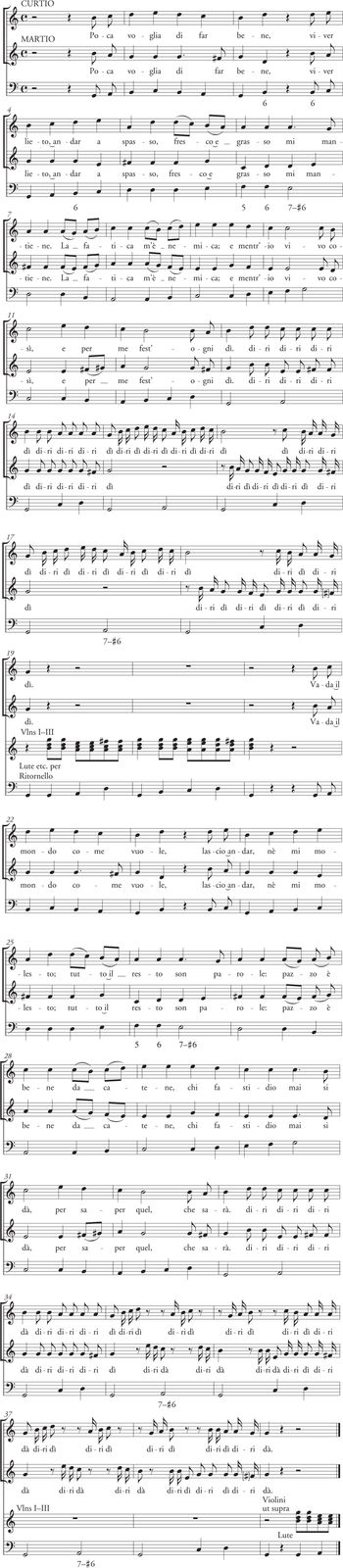
A human character who has not yet gained admittance to the heavenly realm, Sant'Alessio is caught between the spiritual and the earthly world. His saintly predilection to identify completely with the Catholic ideals of sacrifice, humility and faith blinds him to the true nature of his humanity and leads to his feeling trapped by his own human finitude. In this manner, Rospigliosi's Sant'Alessio operates in much the same way as antiquity's tragic hero. The fundamental norms of his existence in a world that does not conform to his spiritual desires causes him great anguish, and his inability to depart from the human world is revealed in his lack of power over his music. Yet, despite its dependence on absolutes, the saint's brand of humanity is indeed exemplary – a fact that is underscored just moments later, when his prayerful arietta is musically and dramatically juxtaposed with the worldly desires of the opera's comic pages, who enter singing a lively canzonetta promoting the same earthly pleasures that Sant'Alessio has, only moments earlier, decried (see Example 2).Footnote 42
Il Sant'Alessio, Act 1, scene iii, Martio and Curtio: ‘Poca voglia di far bene’.

| 1 | Poca voglia di far bene, viver lieto, andar a spasso, fresco e grassomi mantiene. La faticam’è nemica;e mentr'io vivo così, e per me fest'ogni dì.diri diri diri dì. | It doesn't take much to do well [for oneself], living happily, hanging around, keeps mefresh and fat. Hard workis my enemy;and so long as I can live like this, every day is a holiday for me.diri diri diri dì. |
| 2 | Vada il mondo come vuole, lascio andar, nè mi molesto;tutto il restoson parole:pazzo è beneda catene, chi fastidio mai si dà, per saper quel, che sarà.diri diri diri dìdiri diri diri dà. | Let the world go how it wants, I let it go, it doesn't bother me;all elseis just talk:and he is truly a madmanfit to lock upwhoever troubles himselfto know what the future will be.diri diri diri dìdiri diri diri dà. |
Charming in its ingenuousness, the pages’ stated principle of pleasure is presented as a simple, syllabic, strophic song. Its straightforward rhythmic profile, whimsical refrain of nonsense syllables (‘diri diri diri … ’) and layering of voices in each verse give the song a dance-like feel that invites the incorporation of movement or stage antics.Footnote 43 Unlike Sant'Alessio, Martio and Curtio exist solely within the human realm. They are emblems of human naivety whose subsistence on earth is marked as much by their chosen lives of action as by their determination to live for the moment with little regard for the future or its consequences. Thus Martio and Curtio's arietta demonstrates their ability to acknowledge, experience and appreciate the beauties and fleeting pleasures of this world. While neither amoral nor anti-religious per se, their exhilarating quest for happiness represents that aspect of humanity that refuses to be governed by fear of failure. For, as the pages so aptly state, surely it must be madness to reject the comforts and contentment of this world on blind faith alone.Footnote 44
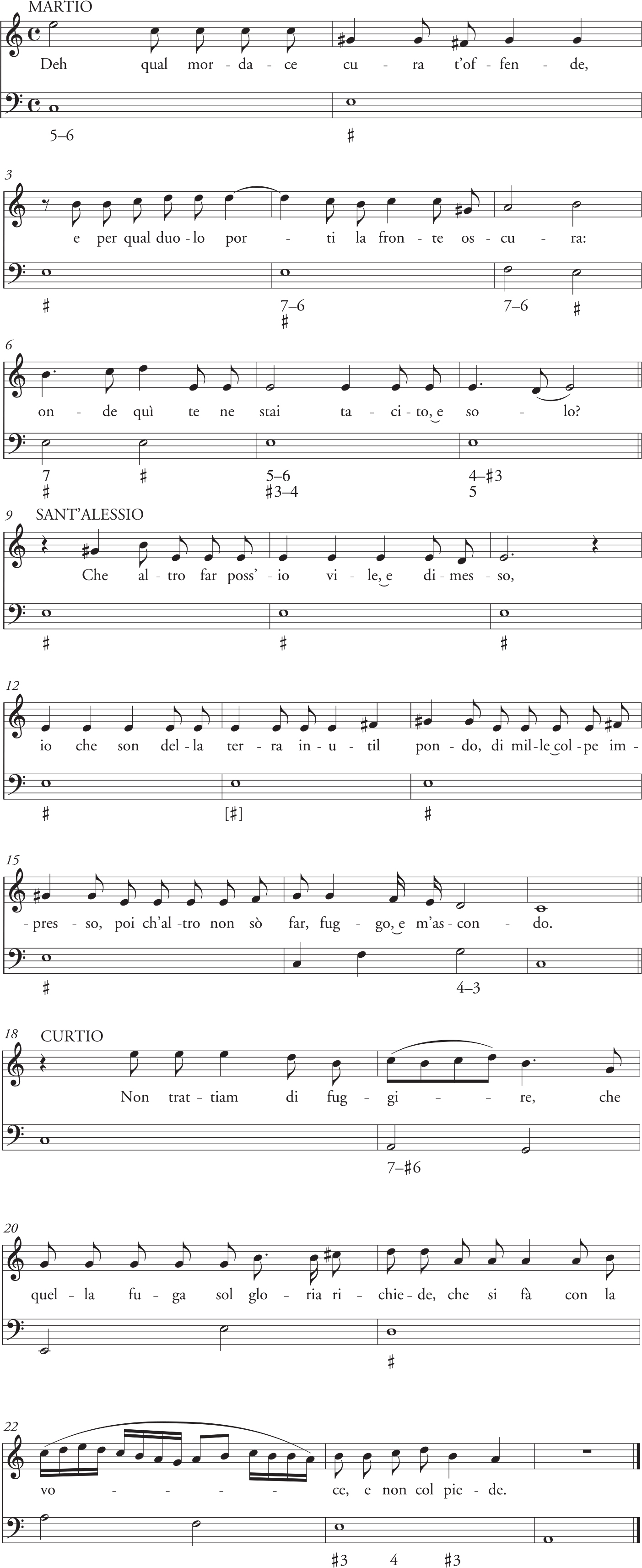
Appearing directly after Sant'Alessio's arietta, ‘Poca voglia di far bene’ is positioned at the point in the opera where the opening material intended to provide background on the unperformed half of the St Alexis story ultimately gives way to the launching of the opera's actual plot. The dramatic import ascribed to the comic pages is marked by this prominent placement, as well as by the fact that the arietta holds the musical distinction of being the second of the only two designated ariettas in the entire score (the first being Sant'Alessio's ‘Se l'hore volano’, discussed above). Afforded dramatic and musical rights similar to those bestowed upon Sant'Alessio, the pages have now set the stage for a scene of fun, in which Martio and Curtio discover Sant'Alessio alone and decide to have some entertainment at his expense. Their dialogue opens as Martio mocks the saint's religious absolutism with an overwrought musical imitation of the beggar's grief, the cause of which, Sant'Alessio patiently explains, stems from the base nature of humanity (see Example 3).
Il Sant'Alessio, Act 1, scene iii: Alessio explains humanity's baseness.

| MARTIO | Deh qual mordace curat'offende, e per qual duoloporti la fronte oscura:onde quì te ne stai tacito, e solo? | Tell me, what gnawing worryupsets you, and by what sorrowis your brow darkened:so that you remain here silent and alone? |
| SANT'ALESSIO | Che altro far poss'io vile, e dimesso, io che son della terra inutil pondo, di mille colpe impresso, poi ch'altro non sò far, fuggo, e m'ascondo. | What else can I do, cowardly and humble, I, who am a useless burden to the earth, oppressed by a thousand sins, since I do not know what else to do, I flee and hide myself. |
| CURTIO | Non trattiam di fuggire, che quella fuga sol gloria richiede, che si fà con la voce, e non col piede. | Let's not talk of fleeing, for the only flights that glory requiresare made with the voice, and not with the feet. |
Landi's musical setting of this exchange is significant in his manipulation of the characters’ tonal language, which allows for a dramatic scene in which the lofty tenets of Catholicism can be challenged and even subverted under the disguise of comic wordplay. Opening his question with an exaggerated ‘Tell me’ (‘Deh’) on C major (the tonal area of the preceding recitative), Martio quickly slips away from tonal and melodic stability as he musically illustrates the ‘gnawing worry’ (‘mordace cura’) that supposedly afflicts Sant'Alessio with a descending leap of a diminished fourth from c″ to g# ′ before abruptly shifting from C major to an unexpected E major sonority (‘t'offende’). As his musical line is propelled into the durus region, Martio brings his calculated gesture of mockery to a close by asking why Sant'Alessio chooses to remain silent and alone. Sant'Alessio's response (‘Che altro far poss'io vile’) ignores Martio's teasing and replies not with the expected A resolution, but rather with an extension of the tonal region introduced by the page's discourteous question. Sant'Alessio's seeming misunderstanding is apparent both in the prolongation of this somewhat extreme tonal area and in the disjunct cantar recitando of his response. The flight contained in the saint's concluding remark, ‘since I do not know what else to do, I flee and hide myself’ (‘poi ch'altro non sò far, fuggo, e m'ascondo’), begins in Martio's E major tonality, but is marked musically by a sudden and unexpected return to the arguably safer tonal region of C major (‘fuggo, e m'ascondo’). Incapable of fully comprehending the significance of Sant'Alessio's response, the pages now misinterpret his words and seize upon the saint's return to the tonal normality of C major to respond literally to the saint's figurative meaning. Their literal response is highlighted when Curtio abruptly shifts his manner of taunting from the tonal to the melodic as he assumes his preferred role as singer (‘la voce’). He is quite aware of his onstage audience, and his response to Sant'Alessio is an unexpected and somewhat contrived vocalization that provides an all-too-literal alternative to Sant'Alessio's earlier spiritual and tonal flight.
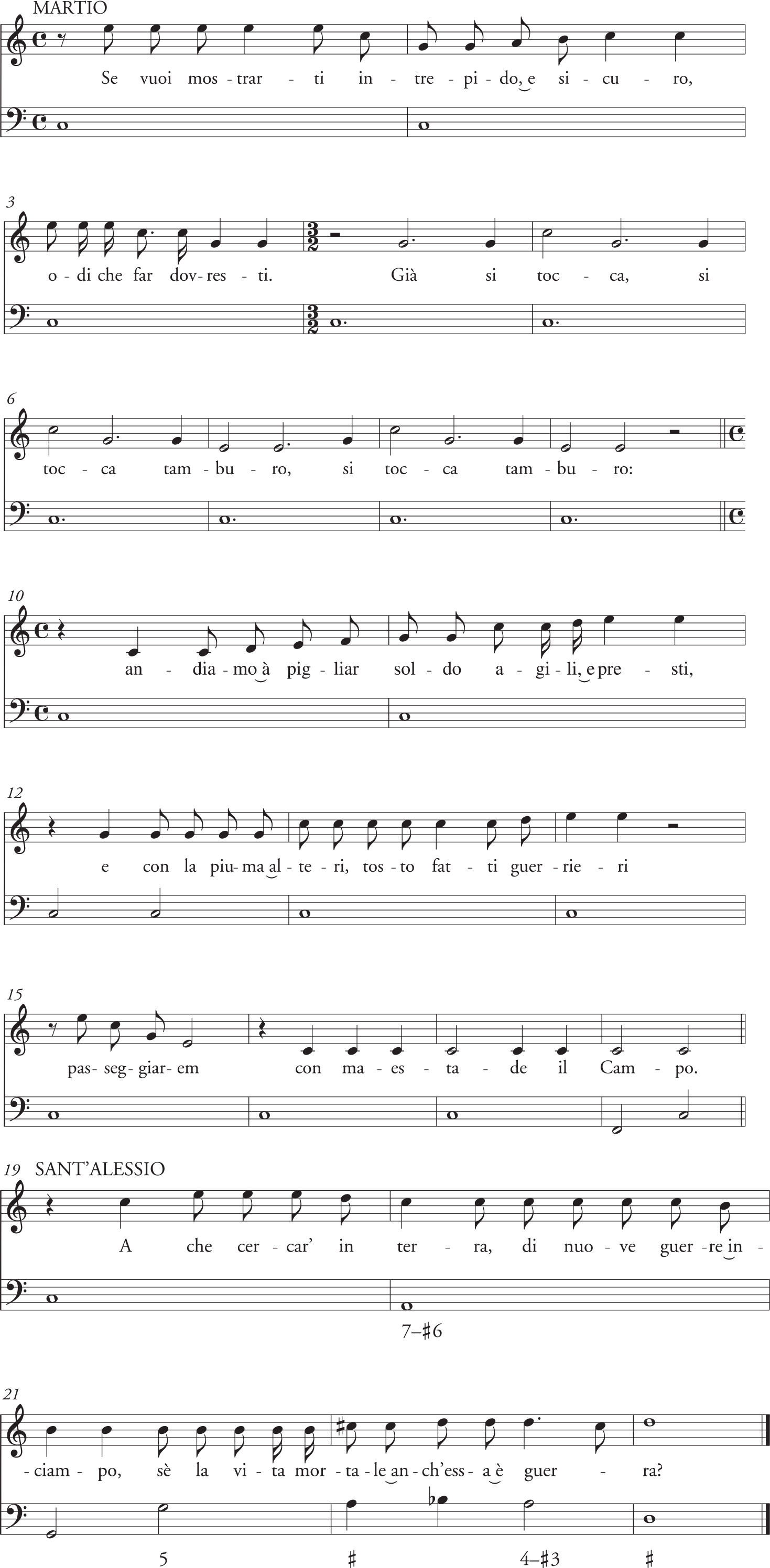
Here the pages’ comic inability, or possibly simple reluctance, to comprehend the intended meaning of Sant'Alessio's words can be interpreted as being symbolic of the human difficulty of reconciling the religious ideals embodied by the saint with the worldly concerns of society. Sant'Alessio's perfect adherence to Catholic teaching and subsequent deviation from accepted human norms makes him the target of Martio and Curtio's fundamentally unsympathetic laughter, and they deem him to be mad. Their desire to save this contemplative madman by persuading him to pursue some course of action (symbolic of Sant'Alessio's rejoining society) leads Martio to begin aurally accosting the saint with musical images drawn from everyday life. However, the reference to the beating drums (‘Già si tocca tamburo’) and bugle-call motif that accompany the page's suggestion that Sant'Alessio live a life of action as a soldier does little to change the saint's resolve, and Martio's heightened form of expression is replaced by stile recitativo (beginning on ‘e con la piuma alteri’; see Example 4). This simplification of the page's vocal activity contrasts sharply with Sant'Alessio's lyrical line, which gradually moves to a more harmonically complex cantar recitando representative of his deliberate rejection of the page's suggestions.
Il Sant’ Alessio, Act 1, scene iii: stylistic mutations

| MARTIO | Se vuoi mostrarti intrepido, e sicuro, odi che far dovresti. Già si tocca tamburo:andiamo à pigliar soldo agili, e presti, e con la piuma alteri, tosto fatti guerrieripasseggiarem con maestade il Campo. | If you want to appear intrepid and secure, listen to what you ought to do. They are already beating the drum, let's nimbly go earn some quick money, and, proud of our plumed hats, as soon as we're made soldiers, we'll majestically parade the field. |
| SANT'ALESSIO | A che cercar’ in terra, di nuove guerre inciampo, sè la vita mortale anch'essa è guerra? | Why seek on earththe horrors of new wars, when mortal life is itself warfare? |
Trapped in the void between the two worlds, Sant'Alessio is incapable of rising musically above what has now, by virtue of the musical and dramatic opposition of two distinct rhetorical styles, become a comic scene.Footnote 45 His role as a contemplative rather than an active protagonist prevents Sant'Alessio from being able to explain his philosophies convincingly to the pages or to understand the cause of their ridicule. Instead, he decides literally to wait them out, remaining steadfast in his religious resolve until Martio and Curtio finally give up on the beggar and, in disgust, order him away.
Rospigliosi's literary delineation and Landi's musical setting of the scene create an operatic moment with far-reaching implications. The pages’ comic attempts at understanding Sant'Alessio's views and their active mockery of the saint's seeming passivity represent a collision of the spiritual and worldly realms that elucidates the contradictions between Catholic teaching and the realities of human existence. Sant'Alessio, the personification of the church's teachings, reveals to the pages an understanding of the interconnected concepts of eternal life and heavenly reward. Meanwhile, the pages’ inability to understand the true significance of Sant'Alessio's words provides a comic element through which the ideologies presented by Sant'Alessio and, accordingly, the religious premisses underlying the opera's drama can be examined. The pages’ philosophy of living in the moment, while alluring, contrasts greatly with the ascetic practices of Sant'Alessio, and the dramatic pairing and contrasting of these characters, like the earlier pairing of their ariettas, compels the audience to compare them. From within the framework of comedy, the viewer is implicitly invited to reflect upon and evaluate the ideals that are being represented onstage. The presence of the comic in this scene mitigates the dramatic extremes presented by the three characters, amply illustrating the double risk that humans face both of succumbing to the temptations of this world and of becoming imprisoned by too strict an adherence to religious doctrine.
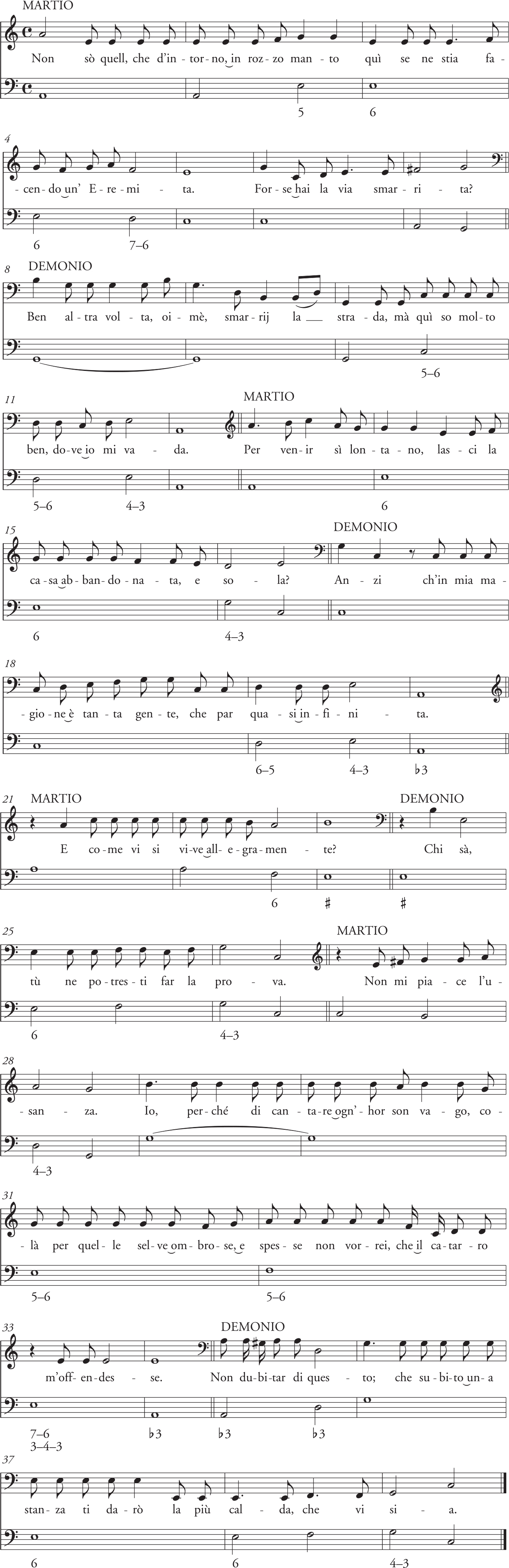
But what of the dangers that lie in rejecting religion outright? Does the pages’ mockery of Sant'Alessio automatically align these devilish young nobles with the other half of the religious dichotomy: evil and hell? Rospigliosi and Landi explore this possibility in Act 2, scene viii. Here, the viewer finds the Devil, who just moments earlier was interrupted in the middle of his temptation of Sant'Alessio by the sudden arrival of a heavenly Angel. In this scene, the Devil, who is dressed as a hermit (the same disguise in which he had earlier approached the saint), is making his way through the woods bragging aloud about his intended victory when he unexpectedly encounters Martio. The page, falling for the Devil's disguise, decides to tease him as he had earlier teased Sant'Alessio,Footnote 46 only this time it is the Devil, and not the page, who wins the verbal sparring (see Example 5).
Il Sant'Alessio, beginning of Act 2, scene viii: Martio's encounter with the Devil (excerpt).

| MARTIO | Non sò quell, che d'intorno, in rozzo mantoquì se ne stia facendo un'Eremita. Forse hai la via smarrita? | I don't know what this hermit in his coarse mantleis up to hereabouts. Have you perhaps lost your way? |
| DEMONIO | Ben altra volta, oimè, smarrij la strada, mà quì so molto ben, dove io mi vada. | There was another time, alas, when I lost the way, but here I know well where I am going. |
| MARTIO | Per venir sì lontano, lasci la casa abbandonata, e sola? | But, to come such a distance, did you leave your house abandoned and unoccupied? |
| DEMONIO | Anzi ch'in mia magione è tanta gente, che par quasi infinita. | On the contrary: in my abode there are so many peoplethat they seem numberless. |
| MARTIO | E come vi si vive allegramente? | And do you all live happily? |
| DEMONIO | Chi sà, tù ne potresti far la prova. | Who can say? You might like to try it. |
| MARTIO | Non mi piace l'usanza. Io, perché di cantare ogn'hor son vago, colà per quelle selve ombrose, e spessenon vorrei, che il catarro m'offendesse. | I don't like that way of life. I, who enjoy singing each hour that I wander, wouldn't like to catch a coldthere in those dense, dark woods. |
| DEMONIO | Non dubitar di questo;che subito una stanzati darò la più calda, che vi sia.[scene continues] | There is no fear of that;I will instantly give youthe hottest room there is. |
The comic relief of this scene, like that of the pages’ earlier encounter with Sant'Alessio, lies in the mixing of rhetorical levels that leads to a humorous depiction of misunderstanding. The dialogue opens harmlessly enough – Martio, believing the hermit to be lost, innocently offers his assistance (‘Forse hai la via smarrita?’). His lyrical line, a light, narrowly voiced soprano, is sharply juxtaposed with the Devil's wide-ranging basso profondo as he responds to each of the Devil's taunts with a C (major) tonality that highlights his naivety. As the dialogue unfolds, the Devil cleverly manipulates his words and music, deftly singing the words containing double or nuanced meanings with cadences that emphasize his low vocal range (‘io mi vada’, ‘infinita’ and ‘prova’). In each of these cases Martio quite misses the Devil's meaning, and responds to his provocative innuendos with a straightforward insouciance indicative of the fact that he has no idea with whom he is conversing.
As the two engage in increasingly witty repartee, Martio appears to consider seriously the Devil's offer of lodging, a detail of plot that cannot help but remind the spectator of the scene just moments before, when Sant'Alessio narrowly avoided yielding to the Devil's temptation.Footnote 47 Martio's fear of catching a cold (‘e spesse non vorrei, che il catarro m'offendesse’), however, leads the page to refuse the offer, inspiring the Devil's tongue-in-cheek reference to hell's temperature accompanied by a sudden leap an octave downward (‘ti darò la più calda, che vi sia’). At this moment, the Devil's earthly disguise wears thin as his lyrical line reaches all the way into the bottom part of his range, where it comfortably pauses over a short dotted rhythm on E before he catches himself slipping back into the infernal regions and rapidly pulls his lyrical line earthward (on the word ‘sia’). This near unmasking happens at two other significant moments in the scene – during the Devil's preceding monologue, where he refers to the dangers that the saint's soul will face at the moment just before death (‘Dunque non resti scemo d'arte, ò di forza il mio disegno audace, però che un'alma infino al punto estremo ai perigli soggiace’; ‘Then let not my daring design fall short in cunning or force, for a soul, up to its very last moment, remains exposed to danger’), and later, when he prepares to depart from the page, citing urgent business as his excuse (‘lasciami, che mi preme altra faccenda’; ‘leave me, for I have other pressing business’).
While the humour remains obvious throughout the dialogue, the Devil manages to maintain something of a respectful distance from the pageboy both musically and dramatically, suggesting that, given his religious associations, he is still a character to be taken seriously. This changes later in the scene, however, when he willingly engages in a rather slapstick scenario with the page over the contents of his flask. Martio's enquiry about the contents of the Devil's container is met with a half-hearted warning offered by the Devil in G major (‘Lasciala star, che ti farà mal gioco’; ‘Leave it alone, or it'll hurt you’) – one that the page ignores as he reaches for the flask and burns himself. Assuming the Devil's new tonal area, Martio responds with a cry, bewailing his newly burned hands with a series of durus-tinged shouts of ‘hoimè’ and ‘misero mè’ (‘Alas, pitiful me!’). Yet the page, failing to learn his lesson, still believes the Devil to be human and tries to punish him in turn – an action that angers the Devil as he ominously warns the page to leave him alone and prepares to depart. (This is the final moment of musical unmasking mentioned above.) Once again, the page fails to catch on, lunging for the Devil, who, having grown tired of the game, metamorphosizes into a bear as the scene comes to a close.Footnote 48
Like the earlier scene between the pages and Sant'Alessio, this scene between Martio and the Devil employs comedy to temper a religious extreme. Whereas previously the pages’ philosophy of pleasure in life appeared be in direct opposition to the religious doctrine represented in the character of Sant'Alessio, the spectators now learn that the page's search for, recognition of and participation in personal pleasure is not the true antithesis of religion. Nowhere in their characterization – musical or otherwise – does either Martio or Curtio ever claim agnosticism or faith; rather, their state of bliss independent of religious consideration is representative of the awkward innocence of the human state: while they are vulnerable to the Catholic sins of pleasure, wealth and power, there is still the very real possibility of redemption. Quite the reverse is true of the Devil, whose very existence poses a serious threat to men's souls, and for whom redemption is no longer possible.
When viewed alongside each other, the pages’ scenes with Sant'Alessio and the Devil share a number of comic elements commonly associated with commedia dell'arte: recognizable figures of authority are freely challenged by the lowest-ranking characters onstage; mistaken identity and/or anonymity are the cause of comic encounters; wit and clever manipulation of language becomes the preferred mode of communication; and the natural order (as represented by the representation of religious binaries) is, generally speaking, overturned. While the comedy that results surely gives cause for playful laughter, it also holds important implications for the overall interpretation of the drama at hand. Acting in true Bakhtinian form, the comedy of these scenes is one of renewal. It serves to liberate and purify the opera's drama, freeing it from the threat of repression by blind obedience to abstract religious principles and gifting its viewers with a state of ambivalence that enables them to weigh the balance between the conflicting forces represented onstage. The potential for fear inspired by the underlying meaning in the Devil's words is counteracted by the desire to laugh at Martio's naivety, while the archetype of Sant'Alessio's dogged pursuit of Catholic beliefs is diffused by the comic misunderstanding and subsequent derision of the pages. Thus the interactions between the pages, Sant'Alessio and the Devil acknowledge the difficulty that lay in attempting to follow too closely in Sant'Alessio's footsteps and raise the possibility that neither of the religious ideologies presented is ideal. Instead, the spectator's experience is ‘liberate[d] from fanaticism and pedantry, from fear and intimidation, from didacticism, naïveté, and illusion, from the single meaning, the single level’ and is restored to ‘ambivalent wholeness’.Footnote 49 A middle ground between the two extremes is established. Through laughter, the spectator understands that the key to redemption lies in the balancing act between the ideals of religious doctrine and the endless quagmire of daily life.
Where the worldly and the sacred collide: Il Sant'Alessio's comedy then and now
In her book Operas for the Papal Court, Margaret Murata noted that throughout his entire career as a librettist, Rospigliosi never offered any ‘striking views on theology or dogma, dramatic theory, or any new religious imagery’, but instead relied upon conventional vehicles to ‘keep open the channels between the multifarious aims of the Church and real human behavior’.Footnote 50 The revised version of Il Sant'Alessio is an example of just such a conventional vehicle: it integrated dramatic devices culled from successful religious genres of the period; its position as one of the Barberini family's entertainments during the 1634 carnival season marked it as a symbolic presentation of the Barberini family's power and position; its setting of the life of a well-known religious hero reinforced the importance that religion played in the everyday life of Rome; its focus on the Roman half of the St Alexis legend highlighted the legend's romanitas; and its clever manipulation of comedy – borrowed no doubt from that of the secular spoken and improvised stages throughout Italy – represented a means of access into the church that had been readily available to laymen since the Middle Ages. What was original about Rospigliosi's revised 1634 libretto, however, was the creation of a new comic rubric for the operatic stage. By treating the comic element as a mitigating force, Rospigliosi effectively subverted the two over-idealized extremes of the religious spectrum. At the same time, he was able to assert the need for all humans to maintain, at the very least, the morality, compassion and spirit of hopefulness that was so strongly advocated by Catholic doctrine. Rospigliosi's underlying message proposes that there are no absolutes in life, only opportunities to reach suitable compromises – a message that was nothing short of timely, given the religious, political and intellectual climate in Rome.
Written as the tide was turning against Catholic forces in the Thirty Years War, revised at a time of political and moral impasse that required negotiation between Catholic and Protestant factions, and dedicated in each of its versions to representatives and ambassadors of the war's major players, Rospigliosi's Il Sant'Alessio is an example of conscious propaganda. Add to these political contexts for the opera the fact that the 1634 revisions occurred shortly after Galileo's trial and subsequent abjuration for doctrine-threatening publications, and Il Sant'Alessio's emphasis on mediating between seemingly irreconcilable extremes begins to move beyond mere propaganda; it starts to resemble the papacy's need to navigate contradictory political, ideological and intellectual principles in its quest to unite Christendom and encourage followers to remain steadfast during one of the most embattled periods of the Catholic Church.Footnote 51 It is, perhaps, the fine line that Urban VIII continually trod when negotiating between the spiritual and temporal worlds that he inhabited which so closely aligned his papacy with the drama of Il Sant'Alessio.
As a product of a precise political moment in history, the version of St Alexis's life that is retold in the drama of Il Sant'Alessio remains inseparable from the historical context for which it was written. The nature of the opera's comedy, however, transcends the precincts of history, appealing to the innocence, curiosity and at times inelegant humanity present in audience members of all periods. By fully integrating the comic moments of Il Sant'Alessio within the fabric of the opera, Rospigliosi and Landi demonstrate an appreciation of the multifaceted nature of comedy which had embraced many of its literary and theatrical manifestations since antiquity. Their resulting brand of comedy has the potential to translate meaningfully to audiences even well into the twenty-first century. Unfortunately, the true dramatic potential of Rospigliosi and Landi's comedy is largely misinterpreted today; the youthful innocence and delightful wordplay inherent in the source material is largely distrusted, and Martio's and Curtio's scenes are instead recast as opportunities for general clowning, bad singing and clumsy acting. Were we instead to consider the literary and dramatic sources of the sixteenth and early seventeenth centuries as closely as we consider the musical sources, we might discover that comic scenes such as those found in Il Sant'Alessio oblige us to reconsider our tendency to relegate early modern comedy to the operatic sidelines. When viewed through truly interdisciplinary lenses, the comedy of Il Sant'Alessio, like that found in other operas of the period, proves to be far more than a peripheral element of plot.