




No CrossRef data available.
Article contents
THE JAKALTEK MAYA BLOWGUN IN MYTHOLOGICAL AND HISTORICAL CONTEXT
Published online by Cambridge University Press: 04 March 2004
Abstract
Blowguns (or blow-guns) have been depicted on pre-Columbian pottery, mentioned in Maya myths, and are still used to hunt small game and birds in many parts of the Americas. This paper surveys the history of the blowgun in Mesoamerica and documents the manufacture and use of the blowgun in Jacaltenango, Guatemala, where it is used to hunt birds.
Information
- Type
- Research Article
- Information
- Copyright
- © 2003 Cambridge University Press
The Jakaltek Maya blowgun first caught my attention when I worked as a Peace Corps volunteer in Jacaltenango, Guatemala, from 1976 to 1980. I researched the blowgun more fully in Jacaltenango in the summers of 1986 and 2002. After seeing blowguns depicted on pre-Columbian Mesoamerican pottery, I realized that the blowgun needed to be studied more closely to understand its importance in Maya culture.
Blowguns (long, hollow, wooden pipe-like tubes) are used in many parts of the world, including the Americas. Because of the similarities found in ammunition, construction, and hunting techniques, an ongoing debate persists as to whether the blowgun was invented independently or spread through diffusion. Although blowguns were used for hunting and as weapons in the past by Native Americans (Alegre 1841; Oviedo y Baños 1941 [1824]; Simon 1882–1892; Vargas Machuca 1892; Veytia 1836), today they are primarily used to hunt birds and small animals among the Maya. Blowguns were also known in Medieval Egypt and Europe (Blackmore 1971). They are still used in Ceylon, Japan, Melanesia (Endicott 1969), Southeast Asia (Kuchikura 1988), and southern India (Hornell 1924). For an excellent and comprehensive geographical survey of blowgun use, see Stephen Jett (1970, 1991).
Today blowguns are rarely used in Mesoamerica, having been replaced by slingshots and firearms. To protect small game, particularly the quetzal bird (the Guatemalan national bird), legislation was passed in the 1930s outlawing the use of the blowgun in Guatemala. Although this law was hard to enforce in rural areas such as Jacaltenango, it was one of the reasons for the decline of blowgun use in Guatemala (Shook 1946).
THE BLOWGUN IN MAYA MYTHOLOGY
Most Mesoamerican hunters use the blowgun to hunt birds, using unfired clay pellets, seeds, or darts for ammunition. Whereas non-poisonous darts are used today by Native Americans of the U.S. Southeast to hunt birds and small animals, South American hunters usually employ poisoned darts, enabling them to shoot a variety of larger game (Bianchi 1976). The darts used as ammunition in the Old World were very similar to those of the Americas. Although most South American blowguns use poisoned darts for ammunition, the Indians of the Río Jurva and the Colorados sometimes use pellets (Nordenskiold 1979; Sprinzin 1928). Sigvald Linné (1939, 1942) and Carroll Riley (1954) state that clay pellets were the exclusive ammunition in Mesoamerica and that only birds and lizards were shot with the blowgun. Not everyone agrees with this conclusion, however. Charles Wisdom documented that the Ch'orti' Maya of Guatemala used small darts for ammunition (Wisdom 1940). If darts were used during pre-Columbian times, however, they probably would have decomposed, leaving little trace in an archaeological site.
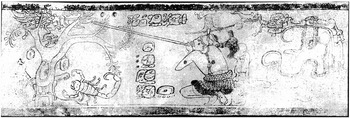
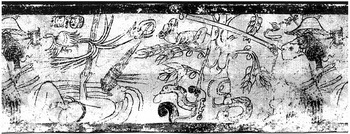
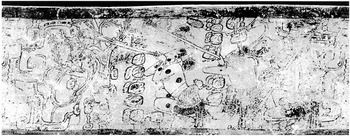
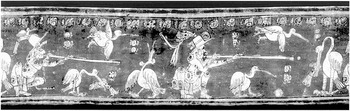
The clay-pellet blowgun appears in many Mesoamerican myths and is featured on more than 25 Maya pre-Columbian ceramic vases that illustrate some of the myths (Figures 1, 2, 3, and 4 Kerr 2000). For instance, the clay-pellet blowgun frequently appears in the hands of Hun Ah Pu and X Balan Ke, the trickster brothers of the Popol Vuh, the sacred book of the ancient K'iche' Maya of Guatemala (Edmonson 1971; Robicsek and Hales 1981).

This roll-out photograph of a polychrome Maya vase probably features Hun Ah Pu in the Underworld using a blowgun to shoot Vucub Caquix. Notice the sight on the blowgun (Kerr 2000; Robicsek and Hales 1981, 1982). Collection of the Museum of Fine Arts, Boston. Photo K1126, courtesy Justin Kerr.

This roll-out photograph of a polychrome Maya vase probably features Hun Ah Pu and X Balan Ke in the underworld (Kerr 2000; Robicsek and Hales 1981). Photo K1345, courtesy Justin Kerr.

The blowgun hunters on this Maya vase are shooting Itzam Ye (Kerr 2000). Photo K4546, courtesy Justin Kerr.

The blowgun hunters on this Maya vase are probably hunting birds in the underworld. Notice the sight (Kerr 2000). Collection of the Museum of Fine Arts, Houston. Photo K4151, courtesy Justin Kerr.
In the Popol Vuh, the brothers use the blowgun to hunt birds, to injure an arrogant creature, and to overcome their brothers. The brothers' magical blowguns also protect them in the underworld, where they sleep in them when they need protection in the evil House of Bats (Edmonson 1971). In one myth, Hun Ah Pu and X Balan Ke used only puffs of breath for ammunition (Edmonson 1971). Breath is an old symbol of spirit and life, a spark of divine energy. The South American Barasana shaman blows the spirits, blows spells and pathological agents to kill and sucks to remove pathogenic agents from the body (Hugh-Jones 1979).
For the Classic Maya, Ahpu was another name for the sun and meant “he with the blowgun.” In fact, the youthful sun on Earth carried the blowgun in many recorded myths. For the Q'eqchi' Maya, the sun was a hunter and closely associated with the blowgun. In one Q'eqchi' and Mopan myth, three boys (future celestial bodies) hunt birds with their blowguns. They give the meat to an old woman who cares for them, but she gives it to her monstrous lover and tricks the boys into thinking that they have eaten the birds. The boys eventually learn the truth and kill the old woman and her lover (Thompson 1970).
In another Mopan and Q'eqchi' myth, the future sun converts himself into a hummingbird. He is shot with a blowgun by the old father of a beautiful young maiden (the future moon). She takes the hummingbird to her room. He revives that night and persuades her to flee with him. Before the couple leaves, the sun fills the old man's blowgun with ground chili, and when the old man draws in a breath to blow the pellet at them, he nearly chokes to death. In one version of this myth, as the old man writhes in pain he causes the first earthquake. In another variation, his choking is the beginning of whooping cough in the world. The old man eventually strikes the sun with a pellet, and the sun lets go of the moon. The moon falls, and to this day she is still trying to overtake her lover, the sun (Thompson 1970).
The Kaqchikel Maya tell that the moon's father had a magic blowgun that could bring back anyone at whom it was aiming. Before the sun and moon tried to escape from the moon's father, the sun put lime, chili, and soot in the blowgun, which incapacitated the father when he took a breath (Thompson 1970).
The blowguns mentioned in the Maya Book of Chilam Balam of Chumayel are connected with strife, purse snatching, robbery with violence, and debts (Roys 1967).
Blowguns also appear in Mexican myths. The Zapotec of Mitla tell of an orphan boy and his sister (who later became the sun and the moon, respectively) who live with a childless woman who is married to a lazy old man. Each day, the boy hunted birds and hares with his blowgun. He takes the meat to the woman, who gives it all to the old man, leaving the boy and his sister hungry. Later in this story, the children escape by filling a blowgun with chili. Their pursuer is temporarily incapacitated as he draws in his breath to shoot the orphans as they flee (Thompson 1970).
As one can see from these myths, the blowgun played an important role in pre-Columbian Mesoamerica. The penetration of the pellet conquered and transformed the bird or small animal from a live, earthly creature into sustenance. The flesh became nourishment for the body, while the skin or feathers nourished the spirit.
The Blowgun in Mesoamerica
Blowguns survived into the twentieth century in many parts of Central America (Riley 1952, 1954). The nineteenth-century Costa Rican Tiribis blowgun was 2 to 2.5 m long and was made by punching and burning the pith out of the heart of a palm (?Bactris spp.) trunk that was nearly 5 cm in diameter. The sight consisted of two glass beads placed 1.3 cm apart on top of the blowgun. The finished blowgun was covered with resin or pitch. The clay pellets were carried in a net with two bone implements; one to drive out a pellet stuck in the blowgun and the other for trimming the pellets to the proper size and shape (Gabb 1875). In Mesoamerica, blowguns can be documented back to the fifth century. A clay vessel fragment from Teotihuacan, Mexico, depicts a man hunting birds with a blowgun. Also from Teotihuacan are 42 spherical clay pellets (Driver and Massey 1957; Linné 1934, 1939). Clay pellets have also been found at other archaeological sites. Forty-three clay pellets (average size, 1.5 cm) were found at Las Colinas and Zoquipan (Linné 1942), and at Calpulalpan, clay pellets occurred in numbers that were large in relation to other artifacts (Linné 1942). Bertha Dutton and Hulda Hobbs (1943) found pellets in the ruins of Tajumulco, Guatemala, a site approximately 20 km north of Porvenir. The blowgun was still used in Tajumulco in 1943, so the pellets, made of fired clay, were easily identified. They said that tubular bone was once used to shape the pellets, but by then empty metal cartridges were being used. Colonial writers were told that the Chichimecs (Mexico) invented the pellet blowgun and that they used the blowgun for hunting (Alegre 1841; Veytia 1836).
At the time of the Conquest, the Aztecs raised birds not only for their beauty. They also enjoyed hunting birds with blowguns. In fact, Montezuma enjoyed hunting with a blowgun and was a good shot (Gutiérrez de Santa Clara 1925; Torquemada 1943). Montezuma sent a dozen blowguns with gold ammunition to Charles V through Cortés (López de Gómara 1964 [1552]), but the ship was captured by a French pirate (MacNutt 1908). Although Cortés and López de Gómara report that a dozen blowguns were sent, Bernal Díaz (1963) mentions only three blowguns and their pellet molds, decorated with pearls and precious stones. Whatever the number, it is obvious that these blowguns were very elaborate—fit for a king. According to Cortés, the blowguns “were decorated with very excellent paintings in perfect hues, in which there were figures of many different kinds of birds, animals, flowers, and diverse other objects, and the mouthpieces and extremities were bordered with gold, a span deep, as was also the middle, all beautifully worked” (MacNutt 1908:254–255). Montezuma also gave Cortés a gold net bag to hold the gold pellets (MacNutt 1908).
The use of the blowgun during the sixteenth century in the Valley of Mexico was visually documented through an illustration on a map of a man using a blowgun to hunt (Linné 1937). Fray Bernardo de Sahagún, colonial author of the thirteen-volume Florentine Codex, mentioned that the rulers living in Mexico enjoyed hunting birds with a pellet blowgun (Sahagún 1979 [1569]). Sahagún included an illustration and description of a blowgun; he tells us that the blowgun is called Tlacalhauzquauitl in Nahuatl and that “it is slender, reed like … hollow (the hole) going clear through. It serves as a throwing device, as a blow gun, a device for hunting, for killing” (Sahagún 1963 [1569]).
Of the Colonial Maya, Friar Diego de Landa wrote that “a certain soft brass, which, when founded with a light mixture of gold yielded them … chisels which they used in making the idols and boring out the blowpipes … they used the blowpipe a great deal, and shoot well with it” (Landa 1978 [1566]).
Many different groups of twentieth-century Mesoamericans still use the blowgun. The Honduran Jicaque blowgun is made from a dry 2 to 2.5 m branch of the mogotillo tree (Saurauia englesingii Standl., Actinidiaceae). The dry pith is first drilled out by twisting a sharp-pronged green vine called rabo de iguana, or iguana tail (Mimosaceae hondurana Britton, Fabaceae) through the length of the branch, then the hole is enlarged by twisting a larger herb (Equisetum giganteum L., Equisitaceae) through the entire length of the branch. A hole is carved with a knife into a large snail shell that matches the bore of the blowgun. The ammunition is prepared by rolling small bits of clay in the palms of the hands until the pellets are the correct size to pass through a gauge hole in a shell. In addition to sizing the pellets, the shell smoothes their surface. The dry pellets are then fired in the coals of a fire (Von Hagen 1943).
The Mam Maya of western Guatemala use the blowgun to hunt birds, rabbits, squirrels, and other small game. Their blowguns are made of white pine (Pinus spp., Pinaceae) or cypress (Cupressus spp., Cupressaceae). They are 1.48 m to 1.72 m long, consisting of two carefully hollowed halves glued and nailed together with a tapered mouthpiece (Shook 1946).
In Concepción Tutuapa, Department of San Marcos, Guatemala, blowguns are made from the trunks of two small trees with soft hearts, moquillo (translates from Spanish to “little mucus,” which is a good way to describe the look of the core) found in the Porvenir forest and ixkepatze. A straight branchless trunk with a diameter of 3 to 4 cm was used. Some blowgun makers allowed the pole to dry for several days before removing the heart, while others buried the pole in mud or water so that the pith would rot away. A gun sight (a red bean set in a lump of wild beeswax that encircles the barrel and forms a lump below the sight) was placed 20 cm from the muzzle end. The barrel, after it was dry and the bore cleaned out, was treated on the exterior with beef tallow to keep it from splitting. This blowgun was twice as expensive as the split and glued type and lasted longer. The latter eventually split at the seams, causing loss of air pressure (Shook 1946).
Most Mesoamerican blowguns are 1.3 cm caliber. Edwin Shook (1946) collected unfired clay pellets and a small bamboo tool for wearing down and polishing the pellets. An empty caliber cartridge was even better, because the pellets that were close to the diameter of the barrel worked the best. The pellet bag in Figure 5 that was collected in 1927 for the Middle American Research Institute at Tulane University includes a gun cartridge for shaving the pellets. The pellets averaged 2.3 g unfinished and 1.74 g finished. Formerly, tubular bone could have been used to shape the pellets (Dutton and Hobbs 1943).

Unfired clay blowgun pellets, a looped bag for carrying them, and an empty gun cartridge to shave the pellets were collected by LaFarge and Byers in 1927. Courtesy Middle American Research Institute, Tulane University, New Orleans. Photo by Carol Ventura, 1987.
The Q'eqchi' immigrants of Belize, who used the blowgun in Alta Vera Paz, Guatemala, introduced the blowgun for shooting birds at San Antonio in Belize (Thompson 1930). Thompson wrote that the blowguns used by the Maya of the Toledo District in Belize ranged from 1.19 to 1.72 m long. They were constructed from wood known as komoltse. A section of the wood was chosen and placed under water in the river and left there until the soft inner core rotted away. A wad of chicle gum obtained from Manilkara achras (P. Miller) Fosberg (Sapotaceae) served as a sight. The ammunition was usually a small pellet of baked clay, which was placed in the blowgun with a piece of hollowed bone, although hard seeds were sometimes used instead of clay pellets. Thompson (1930) thought that the blowgun was useless for shooting anything except small birds.
The Blowgun in Jacaltenango, Guatemala
The Jakalteks have lived in the foothills of the Cuchumatan Mountains in northwestern Guatemala since pre-Columbian times, occupying an area centered on the town of Jacaltenango. Built on a bedrock plateau overlooking Mexico, Jacaltenango is 1,437 m above sea level and has 26 surrounding villages located at both higher and lower elevations. Its advantageous ecological position allows for a wide variety of highland and lowland products. The town of Jacaltenango is a governmental, religious, and market center, and in 1994 it had a municipal population of 26,896, of whom 8,785 lived in the city center (Funcede 1996).
Victor Montejo, a Jakaltek anthropologist, said that the town's modern name, Jacaltenango, is from the Nahuatl word xacalli tenam go (lit., “place of the huts surrounded by stones”). In Jakaltek, a member of the Kanjobalan branch of Mayan languages, the town is still referred to as Xajlaj, or “place of the big white rock slabs.” Jakaltek is called Popti' by the Academia de las Lenguas Mayas de Guatemala and the Guatemalan Congress. When I learned to speak Jakaltek in 1977 in Jacaltenango, I was told that the language was known as jab' xub'al in Jakaltek. Jakaltek is also spelled Jacaltec and Jacaltek.
For many years, this area was both physically and culturally the most remote from Spanish, and later European, centers in the country. The 72-km trip from Huehuetenango, the departmental capital, was a rugged two-day walk through Chiantla, Todos Santos, San Martin, and Concepción. Since 1974, when an unpaved road was built from the Pan-American Highway to Jacaltenango, it has been a five-hour bus ride from Huehuetenango to Jacaltenango. Electricity was brought into town in 1979.
Because of its relative isolation, many traditions survived in Jacaltenango. Two anthropologists, Oliver La Farge II and Douglas Byers (1931:8), lived in Jacaltenango for four months in 1927, primarily to investigate the
survival of old beliefs and customs that may help us in understanding the ancient culture…. They are not merely descendants of the Mayas, they are also live Indians…. They present a picture of fairly primitive people whose background is highly civilized, subjected strongly to the influence of a foreign culture, and out of these factors evolving a type pattern peculiarly their own.
La Farge and Byers also documented much of the Jakaltek lifestyle and material culture. Since that time, however, Catholic missionaries have moved into town, and in the 1940s one of the priests tried to purge traditional Mayan religious practices, which forced surviving traditions into hiding.
La Farge and Byers collected a looped bag with several clay blowgun pellets and a cartridge used for shaping them (Figure 5), and they photographed a Jakaltek using a blowgun (Figure 6). The name for blowgun in Spanish is cerbatana; in Jakaltek, it is ub'al (Méndez Cruz 1997). The words for blowgun in other Mayan languages are tz'on (Classic Maya), pubché (Quekchi and Kaqchikel), pujbché (Poqomchi'), aj (Poqomam), jub (K'iche'), u'bab (Uspanteko), and jub (Ixil) (Stoll 1958).

This Jakaltek man demonstrated the use of the blowgun to LaFarge and Byers in 1927. Photographed by LaFarge and Byers in 1927. Courtesy Middle American Research Institute, Tulane University, New Orleans.
In Jacaltenango, La Farge and Byers (1931:64) wrote:
The blow-guns are hollow tubes of some light wood which grows in the Cold Country around San Miguel and Santa Eu lalia, where there are people specializing in making them. The gun is usually about 50 cm longer than the individual who uses it. The longest was 1.92 m long (a little over 6 feet). On one side of the gun is placed a lump of beeswax which serves as a sight. Pellets of clay are used for bullets, spa-up:al. They are rolled into approximate size in the hands and carried dried in a small pouch. The ones for immediate use are worked down to the exact size between pieces of bark or by rotating them in the mouth of a brass rifle shell, kaski'ya (Spanish). The shots that have been thus prepared are carried in a small pocket on the outside of the pouch, ready at hand. According to statements made to us, a rabbit can be brought down with this weapon at a distance of 50 yards [45.4 m].
Based on my research, the blowgun in Jacaltenango is now shorter and less popular than it was in 1927. In 1986, it was used only for hunting birds and did not play a role in local myths. Although the birds were hunted for sport, they were collected, cleaned, cooked, and eaten. Although many people had a blowgun at home, most had not used it in years.
José Ros Silvestre, a Jakaltek, learned how to use and make blowguns twenty years earlier from a friend. In 1986, he was one of two blowgun makers in Jacaltenango. Most Jakalteks preferred to use a slingshot to shoot birds and small game because the slingshot is smaller and easier to transport and the ammunition does not have to be made carefully to a specific size. With a slingshot, a stone or other material of any shape can be used as ammunition. The blowgun does have advantages, though, as it is more accurate and more powerful than a slingshot. The blowgun is also quieter than a slingshot; it does not scare the prey, allowing for a second shot.
According to José Ros Silvestre, the best blowgun is long and relatively heavy for better stability (for good aim). Two types of wood were used in the manufacture of blowguns: light and dark (which is more resistant to insects).
It took José seven days, from start to finish, to make a blowgun for me. The wood, ol ch'am (Saurauia spp., Actinidiaceae) could not have branches (Figure 7), because the knots would disorient the gelatinous-looking core (Figure 8). The inner diameter of the core is about the same (1.3–1.4 cm) on a thick or thin piece of wood. It is best to use the wood right after it has been cut, because it is difficult to remove the core after the wood has dried.

The tip of the branch, which was too thin, was cut off the debarked thicker portion. Photo by Carol Ventura, 1986.

The core of the branch is very soft and gelatinous looking. Photo by Carol Ventura, 1986.
The leaves were removed from a trunk with a diameter of 4 to 4.5 cm, and every 10 minutes it was rotated over a fire for about two hours until the bark was carbonized. The fire treatment softened the core and insured that the wood would not crack later.
The bark was removed with a machete (Figure 9). A thin wire was then stuck through the core (Figure 10) and pulled out, creating a 5-mm hole. Two days later, the hole was enlarged to 9 mm with a thicker wire. Before wire was available, José said, a hard stick was probably used to start the hole.

After the wood has been roasted, the bark is completely removed with a machete. Photo by Carol Ventura, 1986.

A wire is pushed through and pulled out of the soft core to make a hole. Photo by Carol Ventura, 1986.
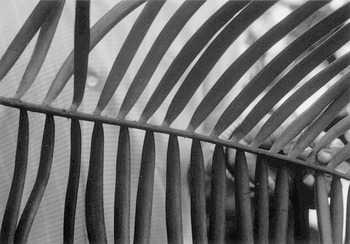
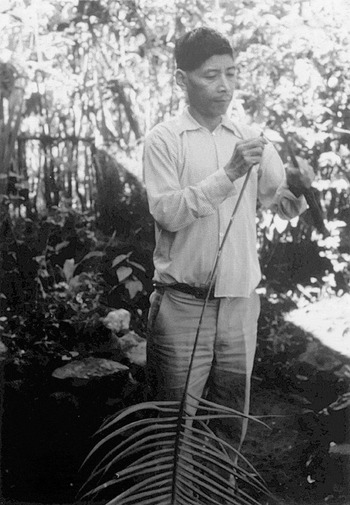
Leaves were removed with a machete from 12 Cycas circiinalis L. (Cycadaceae)—smotx b'alam in Jakaltek, which translates to “jaguar's ribs” (Figures 11 and 12). Each thorny stalk was gently pushed and pulled through the future blowgun. The particles were blown out each time the stalk was removed (Figure 13). This procedure was repeated for four days until a 12 mm hole was formed and all of the core had been removed.

The thorny stalks from 12 Cycadaceae are used to enlarge the barrel hole. Photo by Carol Ventura, 1986.

The leaves are carefully removed from the Cycadaceae. Care is taken to leave the thorns intact, and the thick end of the stalk is broken off. Photo by Carol Ventura, 1986.

The loosened particles inside the blowgun are blown out each time the stalk is removed. Photo by Carol Ventura, 1986.
A wire with sisal (Agave spp., Agavaceae) cord wrapped around one end was used to smooth the inside of the blowgun (Figure 14.) The final inner smoothing was done for about one hour with a piece of fine sandpaper wrapped around the sisal-tipped wire.

José Ros Silvestre wraps a wire with sisal. It will be pushed and pulled inside the blowgun over and over until the bore is smooth. Photo by Carol Ventura, 1986.
To see whether the channel had been enlarged enough, a clay pellet—bodoque in Spanish—was inserted and blown through the barrel. If the pellet got stuck, it was backed out of the blowgun by hitting the mouthpiece of the blowgun on the floor. The high spots were then removed. When the inner barrel was finished, the outside of the barrel was smoothed with sandpaper (Figure 15).

The outside of the blowgun is smoothed with sandpaper. Photo by Carol Ventura, 1986.
The inside barrel of the blowgun should curve slightly upward at the muzzle end. Because my blowgun was too curved, it was gently straightened by placing it in the upper “V” section of a house post and bent against the curve for about two hours. Once the blowgun had been straightened, a depression around the mouthpiece was cut with a machete (Figure 16), then a sight was made by putting a red bean of the Erythina macrophylla—ukun in Jakaltek—on the blowgun with beeswax, ixkab' (Méndez Cruz 1997). The sight was put on top of the heavier end that slightly curved upward. On a long blowgun, the sight was placed two hand spans (40 cm) from the muzzle end of the blowgun; on a shorter one, it was placed one hand span and three fingers (26 cm) from the end. The blowgun that José made for me was 1.29 m long, with a sight placed 30 cm from the end. Yellow or black clay was sometimes added in a lump under the sight when the diameter of the blowgun was too thin to add weight for more stability and a better aim.

A depression around the mouthpiece is cut with a machete. Photo by Carol Ventura, 1986.
The ammunition consisted of spherical dry seeds or pellets made from local river clay. The clay was dug up and used without processing because it was free of debris. A small bit was pinched off a lump of clay and rolled between the palms of the hands (Figure 17). The pellets were slightly larger than needed to allow for shrinkage and refinement. The pellets were set aside to dry and then stored in a small sisal looped shoulder bag that had a piece of umbrella shaft attached to it with a sisal string. (José used the umbrella shaft, a hollow metal tube 4 cm long, because he did not have a bullet cartridge.) As a pellet was needed, it was pushed onto the top of the umbrella shaft and rolled (Figure 18). The shaft shaved off excess clay and made the pellet smooth, shiny, and round.

Clay is rolled between the palms of the hand to make pellets that are slightly larger than needed, because the pellets will shrink as they dry and then be scraped. Photo by Carol Ventura, 1986.

As a pellet is needed, it is removed from the storage pouch and shaved smooth with a tubular tool. Photo by Carol Ventura, 1986.
José then inserted the shaved pellet between his lips (Figure 19), brought the blowgun to his mouth, steadied it with his hands, sighted on the head of the target, and fired with an explosive-like blow (Figure 20). All Jakaltek blowgun hunters whom I observed refined and loaded their ammunition and placed their hands on the blowgun in the same manner, with the right hand clasped around the blowgun, against the mouth, and the left hand next to it with the fingers upward. The same grasp is used in other parts of the world (Sprinzin 1928; Vellard 1965).

The pellet is placed between the hunter's lips before the blowgun is brought to his mouth. Photo by Carol Ventura, 1986.

Like the Hero Twins before him, he brings the blowgun to his mouth, steadies it with his hands, sights it on the head of a bird or the eye of a small animal, and then fires it with a powerful blow. Photo by Carol Ventura, 1986.
For good luck, some of the victims' blood is smeared on the sight. A blowgun with a bloodstained sight is good, because it demonstrates that the blowgun has killed a lot of birds. When a Jakaltek examines a friend's blowgun, this is the first thing that is noticed.
José prefers to hunt in October because birds are plentiful then. He cleaned the barrel with a piece of dry corn husk and sisal string. Then, because few birds were around in July when I visited, we shot clay pellets at a tin can.
CONCLUSION
The blowgun, an ingenious invention, is found in many parts of the world. Constructed from simple tools, the blowgun and its ammunition have evolved in a variety of ways to meet local needs. This practical and sometimes magical tool played an important role in the mythological past. Even though it was outlawed in Guatemala in the 1930s, the blowgun has continued into the present in remote places such as Jacaltenango.
RESUMEN
La cerbatana aparece representada en la cerámica pre-Colombina, y también se menciona en la mitología Maya. Este instrumento aun se usa para cazar pájaros en muchas partes de las Américas. En esta publicación sehace una reseña histórica del uso de la cerbatana en Mesoamerica y en particular su construcción y uso en Jacaltenango, Guatemala.
ACKNOWLEDGMENTS
I thank the many wonderful Jakaltek people who enthusiastically shared their knowledge. I am also grateful to Felix G. Coe for sharing his botanical expertise and for his numerous helpful comments on drafts of the manuscript.
References
REFERENCES
Alegre, Francisco Javier
1841
Historia de la Compañia de Jesus en Nueva España,
vol. 1
(from an eighteenth-century manuscript).
J.M. Lara,
Mexico.
Bianchi, César
1976
Armas.
Centro de Documentación, Investigación, y
Publicaciones, SUCUA, Morona Santiago,
Ecuador.
Blackmore, Howard L.
1971
Hunting Weapons.
Walker and Company,
New York.
Díaz, Bernal
1963
The Conquest of New Spain
(from a sixteenth-century manuscript).
J.M. Cohen, translator.
Penguin Books,
London.
Driver, Harold E., and
William C. Massey
1957
Comparative Studies of North American Indians.
Transactions of the American Philosophical Society
47(pt. 2):165–456.Google Scholar
Dutton, Bertha P., and
Hulda R. Hobbs
1943
Excavations at Tajumulco, Guatemala.
University of New Mexico Press,
Albuquerque.
Endicott, Kirk
1969
Negrito Blowpipe Construction on the Lebir River, Kelantan.
Federation Museums Journal
14:1–36.Google Scholar
Edmonson, Munro S.
1971
The Book of Counsel: The Popol Vuh of the Quiche Maya of Guatemala.
Middle American Research Institute, Tulane University,
New Orleans.
Funcede
1996
Municipalidad de Jacaltenango.
Guatemala.
Gabb, William M.
1875
On the Indian Tribes and Languages of Costa Rica.
Proceedings of the American Philosophical Society
14:483–602.Google Scholar
Gutiérrez de Santa Clara, Pedro
1925
Historia de las guerras civiles del Peru (1544–1548) y de otros
sucesos de las Indias.
Colección de Libros y Documentos Referentes a la Historia de
América, vol. 20.
Librería General de Victoriano Suárez,
Madrid.
Hornell, James
1924
South Indian Blow-Guns, Boomerangs, and Crossbows.
Journal of the Royal Anthropological Institute of Great Britain and
Ireland
54:316–346.Google Scholar
Hugh-Jones, Stephen
1979
The Palm and the Pleiades.
Cambridge University Press,
Cambridge.
Jett, Stephen C.
1970
The Development and Distribution of the Blowgun.
Annals of the Association of American Geographers
60:662–688.Google Scholar
Jett, Stephen C.
1991
Further Information on the Geography of the Blowgun.
Abstracts in Anthropology
81(1):89–102.Google Scholar
Kerr, Justin
2000
Iconography Blowgun a Weapon.
Available at:
http://kawil.saiph.com:9500/dataspark/maya.
Kuchikura, Yukio
1988
Efficiency and Focus of Blowpipe Hunting among Semaq Beri
Hunter-Gatherers of Peninsular Malaysia.
Human Ecology
16(3):271–303.Google Scholar
La Farge, Oliver, II, and
Douglas Byers
1931
The Year Bearers People.
Tulane University,
New Orleans.
Landa, Diego de
1978 [1566]
Yucatan before and after the Conquest.
Dover Publications,
New York.
Linné, Sigvald
1934
Archaeological Researches at Teotihuacan, Mexico.
Victor Pettersons Bokindustriaktiebolag,
Stockholm.
Linné, Sigvald
1937
Hunting and Fishing in the Valley of Mexico on the Middle of the
16th Century.
Ethnos
2(2):56–64.Google Scholar
Linné, Sigvald
1942
Mexican Highland Cultures.
Ethnographic Museum of Sweden,
Stockholm.
López de Gómara, Francisco
1964 [1552]
Cortés: The Life of the Conqueror by his Secretary.
University of California Press,
Berkeley.
MacNutt, Francis Augustus
(translator, and editor)
1908
Fernando Cortes: His Five Letters of Relation to the Emperor
Charles V, vols. 1 and 2
(from a sixteenth-century manuscript).
Arthur H. Clark Company,
Cleveland.
Méndez Cruz, Antonio Feliciano
1997
Diccionario Popti'.
Editorial Nuestra América,
Guatemala.
Nordenskiold, Erland
1979
The Ethnography of South America Seen from Mojos in Bolivia.
AMS Press,
New York.
Oviedo y Baños, José de
1941 [1824]
Historia de la Conquista y Población de la Provincia de
Venezuela.
Paul Adams,
New York.
Riley, Carroll L.
1952
The Blowgun in the New World.
Southwestern Journal of Anthropology
8:297–319.Google Scholar
Riley, Carroll L.
1954
Early Accounts of the South and Central American Blowgun. In
University of Colorado Studies Series in Anthropology, vol. 4, pp.
78–89.
University of Colorado,
Boulder.
Robicsek, Francis, and
Donald M. Hales
1981
The Maya Book of the Dead.
University of Virginia Art Museum,
Charlottesville.
Robicsek, Francis, and
Donald M. Hales
1982
Maya Ceramic Vases from the Classic Period.
University of Virginia Art Museum,
Charlottesville.
Roys, Ralph
1967
The Book of Chilam Balam of Chumayel.
University of Oklahoma Press,
Norman.
Sahagún, Bernardo de
1963 [1569]
General History of the Things of New Spain, or The Florentine Codex,
Book 11.
School of American Research,
Santa Fe, NM.
Sahagún, Bernardo de
1979 [1569]
General History of the Things of New Spain, or The Florentine Codex,
Book 8.
School of American Research,
Santa Fe, NM.
Shook, Edwin M.
1946
Blowguns in Guatemala.
Notes of Middle American Archaeology and Ethnology, vol. 3,
no. 67.
AMS Press,
New York
Simon, Pedro
1882–1892
Noticias historiales de las conquistas de tierrafirme, vol. 1.
M. Rivas,
Bogotá.
Sprinzin, N.
1928
The Blowgun in America, Indonesia, and Oceania.
International Congress of Americanists
23:699–704.Google Scholar
Stoll, Otto
1958
Etnografía de Guatemala.
Ministry of Education,
Guatemala City.
Thompson, J. Eric
1930
Ethnology of the Maya of Southern and Central British Honduras.
Field Museum of Natural History Publication 274, Vol. 18, No.
2.
Chicago.
Thompson, J. Eric
1970
Maya History and Religion.
University of Oklahoma Press,
Norman.
Torquemada, Juan de
1943
Monarquia Indiana, vols. 1 and 3
(from a sixteenth-century manuscript).
Editorial Salvador Chavez Hayhoe,
Mexico City.
Vargas Machuca, D. Bernardo de
1892
Milicia y Descripcón de las Indias, vol. 2.
Librería de Victoriano Suarez,
Madrid.
Veytia, D. Mariano
1836
Historia Antigua de Méjico, vols. 2 and 3.
Juan Ojeda,
Mexico.
Vellard, J.
1965
Histoire du Curare.
Editions Gallimard,
Paris.
Von Hagen, V. Wolfgang
1943
The Jicaque (Torrupan) Indians of Honduras.
Indian Notes and Monographs No. 53.
Museum of the American Indian,
New York.
Wisdom, Charles
1940
The Chorti Indians of Guatemala.
University of Chicago Press,
Chicago.
This roll-out photograph of a polychrome Maya vase probably features Hun Ah Pu in the Underworld using a blowgun to shoot Vucub Caquix. Notice the sight on the blowgun (Kerr 2000; Robicsek and Hales 1981, 1982). Collection of the Museum of Fine Arts, Boston. Photo K1126, courtesy Justin Kerr.
This roll-out photograph of a polychrome Maya vase probably features Hun Ah Pu and X Balan Ke in the underworld (Kerr 2000; Robicsek and Hales 1981). Photo K1345, courtesy Justin Kerr.
The blowgun hunters on this Maya vase are shooting Itzam Ye (Kerr 2000). Photo K4546, courtesy Justin Kerr.
The blowgun hunters on this Maya vase are probably hunting birds in the underworld. Notice the sight (Kerr 2000). Collection of the Museum of Fine Arts, Houston. Photo K4151, courtesy Justin Kerr.
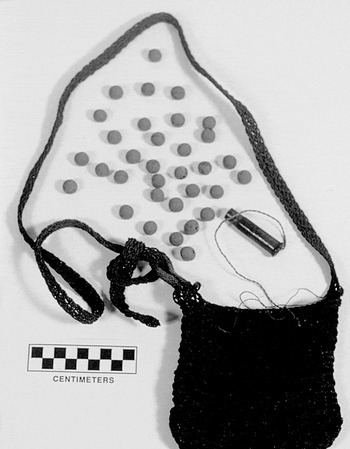
Unfired clay blowgun pellets, a looped bag for carrying them, and an empty gun cartridge to shave the pellets were collected by LaFarge and Byers in 1927. Courtesy Middle American Research Institute, Tulane University, New Orleans. Photo by Carol Ventura, 1987.
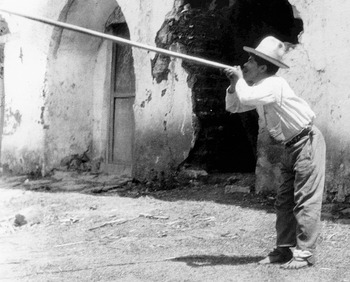
This Jakaltek man demonstrated the use of the blowgun to LaFarge and Byers in 1927. Photographed by LaFarge and Byers in 1927. Courtesy Middle American Research Institute, Tulane University, New Orleans.
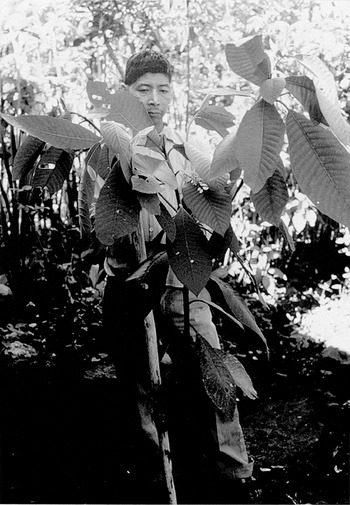
The tip of the branch, which was too thin, was cut off the debarked thicker portion. Photo by Carol Ventura, 1986.
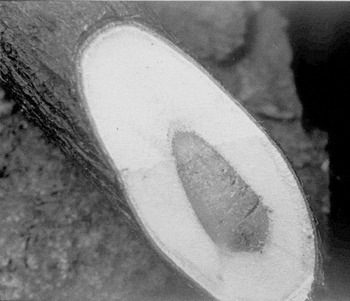
The core of the branch is very soft and gelatinous looking. Photo by Carol Ventura, 1986.
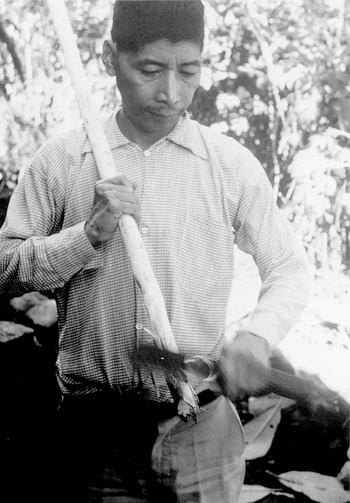
After the wood has been roasted, the bark is completely removed with a machete. Photo by Carol Ventura, 1986.
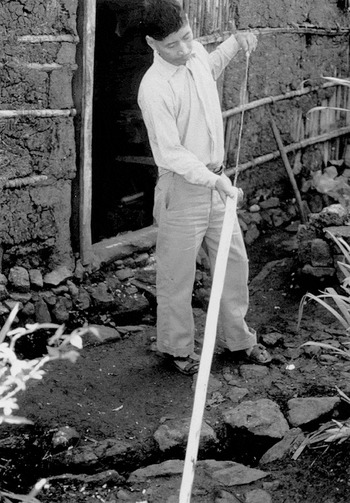
A wire is pushed through and pulled out of the soft core to make a hole. Photo by Carol Ventura, 1986.
The thorny stalks from 12 Cycadaceae are used to enlarge the barrel hole. Photo by Carol Ventura, 1986.
The leaves are carefully removed from the Cycadaceae. Care is taken to leave the thorns intact, and the thick end of the stalk is broken off. Photo by Carol Ventura, 1986.
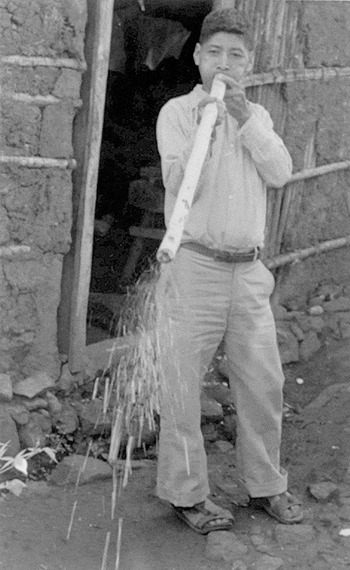
The loosened particles inside the blowgun are blown out each time the stalk is removed. Photo by Carol Ventura, 1986.
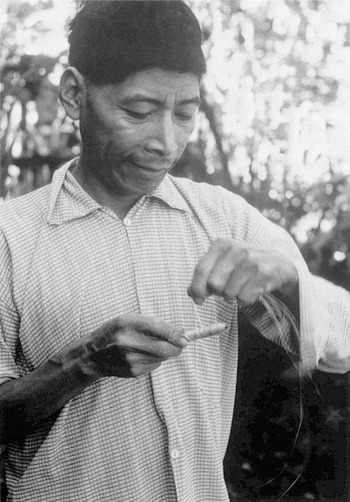
José Ros Silvestre wraps a wire with sisal. It will be pushed and pulled inside the blowgun over and over until the bore is smooth. Photo by Carol Ventura, 1986.
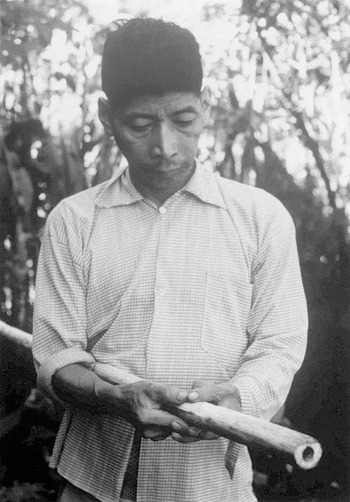
The outside of the blowgun is smoothed with sandpaper. Photo by Carol Ventura, 1986.
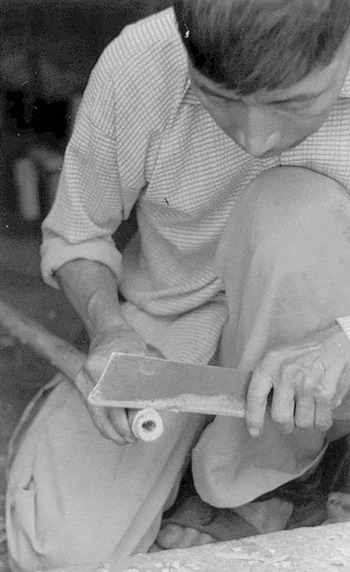
A depression around the mouthpiece is cut with a machete. Photo by Carol Ventura, 1986.
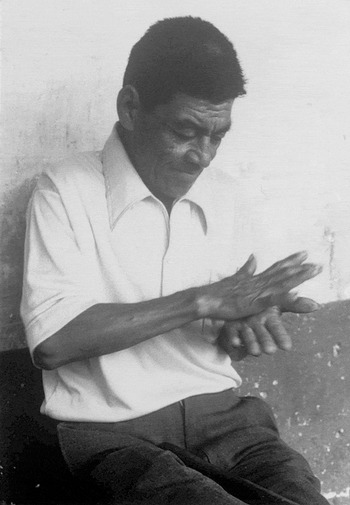
Clay is rolled between the palms of the hand to make pellets that are slightly larger than needed, because the pellets will shrink as they dry and then be scraped. Photo by Carol Ventura, 1986.
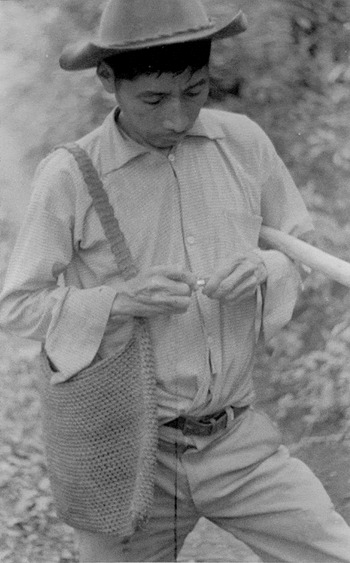
As a pellet is needed, it is removed from the storage pouch and shaved smooth with a tubular tool. Photo by Carol Ventura, 1986.
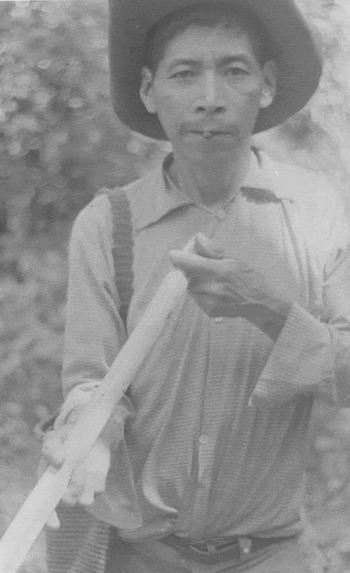
The pellet is placed between the hunter's lips before the blowgun is brought to his mouth. Photo by Carol Ventura, 1986.
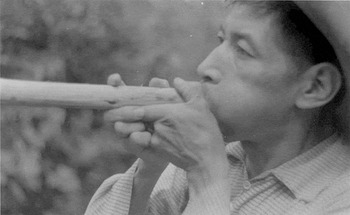
Like the Hero Twins before him, he brings the blowgun to his mouth, steadies it with his hands, sights it on the head of a bird or the eye of a small animal, and then fires it with a powerful blow. Photo by Carol Ventura, 1986.
 You have
Access
- 7
- Cited by