1 Introducing multimodal quot(ativ)es
This paper, a spin-off from a larger-scale research project, advances a novel perspective on recent introducers to quotations in interactive communicative settings, with the (current reporting) speaker and addressee(s) co-present: be like, quote, quote unquote, and the air-quotes are all ‘newcomers’ to the quotative system in English; they are constrained in usage to face-to-face contexts, and they foreground through animating the quote, resorting to the various modalities available in such situations: verbal, vocal, and gestural.
Methodologically, the study is intended as a complementary alternative to the still hegemonic quantitative research paradigm on the ‘innovative’ quotatives, their global spread and (often contradictory) patterns of local sociolinguistic adaptations; that is, I will not engage in a discussion of or contribute to (mainstream) variationist investigations in the vein of Buchstaller (Reference Buchstaller2011), Durham et al. (Reference Durham, Haddican, Zweig, Johnson, Baker, Cockeram, Danks and Tyler2012), or Rodríguez (Reference Rodríguez Louro2013), just to name three most recent articles on (the glocalization of) be like. In contrast, my objective is informed by and compatible with Third-Wave sociolinguistics conceptions such as Eckert (Reference Eckert2012: 87), emphasizing the necessity of accounting for social meaning in the context of styles with an explicit focus on individual speakers (even their idiosyncrasies); or Johnstone (forthcoming), acknowledging sociolinguistic authenticity in terms of individual variation and social meaning: ‘[r]ather than looking at a representative subset of a large set of data’, such investigations are instantiations of the ‘linguistics of particularity’, based on ‘a single instance of a single thing’; instead, these discourse-analytical studies in fact look at communicative situations ‘in which talk is mediated or performed’ and ‘in which the issue of what it means to say something one way or another is more complex’ (Johnstone, forthcoming: 2).
Following this rationale, I will outline a comparative and integrative approach to direct speech reports that draws on recent conversation-analytical methodology and multimodal interaction analysis (see, e.g., Yu, Reference Yu2013), arguing that the particular quotative selected indicates its own characteristic modality ‘signature’: be like, quote, quote unquote, and the air-quotes are seen to differ from each other and from their traditional competitor, neutral and versatile say. As discourse-specific alternatives to the functionally defined (say) variable (see Buchstaller, Reference Buchstaller2006: 5), these quotatives are all lexicalized to highlight the sensory-perceptual categories of the visual, auditory, and kinetic modes, in which linguistic signs encode information and are represented in the medium of (verbal and vocal) speech and gesture respectively. It is precisely this essentially multimodal character that not only assigns the quotatives their unique function within the quotative system but may also serve as a(nother) valid argument against the prevailing bias that they are unwelcome, meaningless, and ruining the language. Taking a closer look at some critical properties of speech reports in interactive communicative settings, this paper at the same time attempts to (partially) balance out the (almost exclusive) bias toward the written mode in the research on quotation, which perpetuates the ‘bad’ reputation of be like disclosed in D'Arcy's (Reference D'Arcy2007) study on the ideological lore surrounding this most prominent ‘new’ quotative; note that quote (unquote) and the air-quotes have so far been completely ignored in linguistic research. For each quotative under scrutiny, I will offer one comparatively dense sample analysis in terms of their functional specifics and discourse effects, which have so far remained underresearched. Given the early stage of the project and in light of my central argument, as well as in compliance with the methodological orientation, I will, however, not venture any generalizations.
Conceptually, my proposal is rooted in cognitive semanticist Leonard Talmy's (Reference Talmy, Geerarts and Cuyckens2007, and forthcoming)Footnote 1 model of The Attention System in Language, according to which attention proves a major, if not the determinant, factor in motivating selectional preferences for one out of several linguistic alternatives, privileging one quotative over its competitors. In section 2, I will briefly outline the gist of this approach, without detailing its precise analytical tools. Section 3 will then present some initial findings and provide an illustration for each quotative at hand.
2 Quotatives as triggers to concomitants of quotations
Quoting itself, as a complex meta-linguistic act, essentially involves a two-layered structure:
• A specialized meta-linguistic item, now commonly referred to as a quotative; while verbal quotatives index an adjacent verbal sequence as a quotation, the air-quotes are concurrent or at least overlapping with the beginning of a quote;
• A linguistic representation of a previous speech event, the quotation itself, which may or may not be a verbatim report of what another or the current speaker has said in a prior context.Footnote 2
In direct face-to-face interactions, an(y) act of (reported) speaking necessarily features all the multimodal dimensions of communication – verbal, vocal, and gestural modes of expression; and, typically, quoters will functionalize the resources the acoustic and visual channels provide for. They systematically recruit non-verbal cues to convey affective messages, which are especially pervasive in interactive exchanges. Consequently, a full-fledged multimodal analysis ‘closely examines all levels of linguistic expression (including verbal expressions and prosodic cues) and of co-ordinated embodied actions (such as gaze, gesture, and body posture)’ (Yu, Reference Yu2013: 4).
In light of these basic characteristics, I will argue that the quotatives selected for scrutiny invite a consistent and sensible analysis that is to resort to the fundamental cognitive principle of attention, mediated through an extant system accounting for and subserving language-specific demands. The Attention System of Language details a repertoire of devices that foreground or background, in different degrees and multiple modes, components conceptually co-present in a referent situation (see Talmy, Reference Talmy2007 and forthcoming). And one such meta-linguistic mechanism is specifically designed to capture the asymmetric effects that motivate speakers' selective preference of one quotative over its competitors: say, be like, quote (unquote) as well as the air-quote gesture, ‘dedicated causal triggers’, are specifically conventionalized ‘to direct a hearer in selecting out the target entity intended by the speaker and in setting that target's attentional weighting’ (Talmy, forthcoming), i.e., the quotation. And these interactive quotatives' ‘multimodal signature’ selectively activates vocal and kinesic concomitant aspects of the original speech event a quoter intends to convey aside from quoting. Such a cognitive process of concomitance activation increases the salience of a quotation's para- and extra-linguisticFootnote 3 characteristics: as an ensuing effect, I propose, the quotatives differentially highlight the verbal, vocal, and gestural modes of communication. Manifesting a responsiveness to their ‘home’ modality, the verbal triggers be like and quote (unquote) – in contrast to modality-neutral and all-purpose say – foreground characteristics of (casual) speech vs. (formal) writing. And speakers typically overlay the subsequent quote with distinctive styles of vocal delivery; at the same time, these quotatives, again discriminately, resort to facial, manual, and bodily gestures. To this set of verbal quotatives, I argue, the air-quotes sensibly assimilate – gestural triggers acting as equivalents of (the figural elements of) quotation marks in writing.
3 Attentional profiles and modality effects of selected quotatives
In light of this conceptual sketch, quotatives' (alleged) semantic specifics may, in fact, quite generally be re-analyzed as differences in their Attentional Profiles (cf. Lampert, Reference Lampert2011 and in press), which will then account for various effects, critically including modality specifics. And in view of their styles of delivery, the interactive quotatives may apparently be located along a continuum of perceptual distinctness, with say representing its low end and be like the most expressive representative: while English say appears innocent of any modality and, accordingly, is unlikely to invite either expressive vocal and gestural ‘coloring’, be like criterially directs attention to the original speaker's para- and extralinguistic style of delivery, which in turn is taken to be indicative of their current affective state; and quote (unquote), as well as the air-quotes, highlights the quote's exact formal representation suggestive of formal writing.
In section 3.1, I report on some initial findings from a case study on multimodal be like, complemented, in section 3.2, by a brief comparative look at samples featuring quote and quote unquote; and, in section 3.3, I will add some notes on the air-quotes.
3.1 Be like – re-performing a(n imagined) speech event
The case study on be like may serve as a demonstration of both the proposed attention-differential approach and be like's sensitivity to and reliance on multimodality.Footnote 4
The scenario under scrutiny,Footnote 5 reprinted below as (1) through (10), is an excerpt from the press conference on the occasion of the women's semifinal at the US Tennis Open, September 13, 2009. Featuring instances of both say and be like, it allows for a comparison, and it conforms to the (original and current) speaker's heightened emotionality: Serena Williams, then number one tennis player, was foot-faulted by a linesperson (referred to as she in the transcript) on a match-point that eventually caused her defeat; Serena also matches the sociolinguistic stereotype associated with quotative like (cf. D'Arcy, Reference D'Arcy2007): a female below thirty, even invoking a kind of Valley Girl persona that, by the trait of air-headedness, is readily associated with sport professionals. Though, as an African American, she does not represent be like's prototype by ethnicity, Serena has been a heavy user of quotative like for quite a time in especially high frequencies; and the report of her outburst on court comes close to verbatim re-performing her own previous utterances, both vocally and gesturally.Footnote 6 The sequences analyzed,Footnote 7 with the (single underlined) quotatives and the (double underlined) quotes, have been numbered for convenience of reference:
(1) Cuz I think she said I w'd kill you,
(2) bu' I w's like, What?
(3) I w's like, Wait a minute.
(4) But th-then I had misheard.
(5) She'd never said that.
(6) So that was just something –
(7) I w's like – [y'know]
(8) I w's like, Whoa-oa.
(9) Cuz I w's like, Wait a minute.
(10) Let's let's let's let's not – cuz I'm not that way.
(1) reproduces the alleged utterance on court of the lineswoman, who reported to the chair umpire that Serena had uttered a death threat against her. In fact the spelled-out form would read Cuz I think she said [I had said/was like] I would kill you, an emotionally loaded situation that features an ellipsis typical of spontaneous speech.
In line with the concomitant multimodal analysis, the quote introduced with say does not feature any pronounced (facial and no manual) gestures, which characterizes the attentional profile of say. Consequently, it might indeed be open to debate whether to assume a concomitant for say – unless a speaker's refraining from expressing a stance toward the quote(e) would qualify as such: indexing the default case of communicating verbally, with most attention on the reported event's content, say conforms to the attentional bias of foregrounding a morpheme's referential meaning over any other characteristics, like aspects of form or attributes of prosody. However, its attentional profile co-entails that the reported sequence's exact formal and lexical composition is less salient, and still less, probably, its style of delivery. Accordingly, say would be specifically lexicalized to disregard, e.g., attentionally background, attitudinal and affective concomitants as well as those that relate to the specific selection of morphemes in their particular sequence, even if these aspects are of course inherent properties of the original speech event.
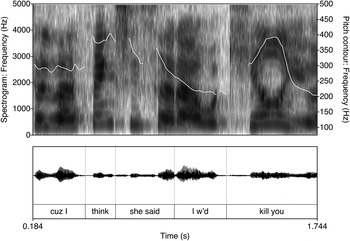
The vocal analysis of the quote (Figure 1) reveals a pitch contour between 298 and 204 Hz (as against Serena's average below 190 Hz), with interim peaks on think and kill at 402 and 392 Hz respectively; these frequencies appear well-motivated and conform to the semantics of think (hedging Serena's surprise or disbelief) and of kill – both emotion-related and emotion-laden lexical items. This high rise is then followed by a considerable (emotional) fall returning to 204 Hz on you.
Serena's frequencies of cuz I think she said I w'd kill you

Though be like would in fact qualify as a reasonable alternative in the context of a ‘death threat’, and Serena's vocal and gestural parameters for these exact items testify to her heightened emotionality, her preference of say over be like appears perfectly sensible: the hedge I think communicates her non-commitment toward reproducing the lineswoman's utterance verbatim, and the third-person perspective (she said) precludes access to the original speaker's ‘true’ emotional state, reporting the speech event matter-of-fact. The three modal dimensions reveal an intricate pattern of interaction: the verbal semantics is consonant with the style of vocal delivery for I think and I would kill you, while Serena's non-gesturing coincides with the neutral report indicated by say (please check link at 0:21–23).
In contrast, Serena uses be like consistently for her own speech reports, conforming to its usage profile of speaker involvement: quotative like instructs the hearer of the quotes – (2) What?, (8) Whoa-oa, and (3)/(9) Wait a minute – to understand them as re-enactments of her own previous utterances on the court; typically, the vocal and gestural patterns of such re-experience diverge from both the original and current speaker's neutral para- and extralinguistic habitus. Diverting some hearer attention from the quotes' referents, quotative like highlights Serena's style of delivery and her affective state that can be inferred from that style, e.g. ‘I don't believe it’, ‘you don't mean that’ for What? and Whoa-oa. Be like, then, iconically communicates concomitant aspects of the original speech event, vocallyFootnote 8 and gesturally re-enacting the emotional experience in a ‘like’ way, which the current speaker finds it significant to convey.
The gestural analysisFootnote 9 again substantially supports quotative like's attentional profile, in part independent from the verbal layer: parallel to the vocal dimension, Serena continues, but speeds up, her backward movement on (2); she tilts her body and head further to the right and reaches a climax on What?, which is accompanied by a perceivable nod of her head – a beat gesture to emphasize her surprise. This affective state is mirrored on her face: the knitting of her eyebrows, the narrowing of her eyes, and nose-wrinkling progress, the tension in her forehead increases – all communicating her utter disbelief; at the same time, pulling up the left corner of her mouth and distorting its normal shape, her facial expression iconically indicates her surprise and/or shock, clearly deviating from its normal appearance (please check link at 0:23–24).
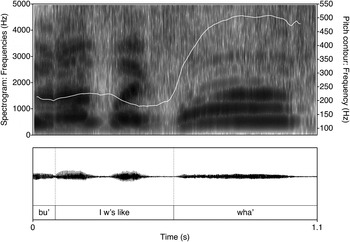
Remaining with the two most common and revealing parameters, pitch height and duration, the reporting clause in (2) continues this level pitch (with like between 208 and 180 Hz), while it stages an extremely high rise up to about 508 Hz on What? (as against Serena's unemotional delivery below 190 Hz), at the same time slowing down the tempo and dwelling on a considerably drawn-out high intensity low back vowel (.042s); see Figure 2.
Serena's frequencies of I w's like, What?

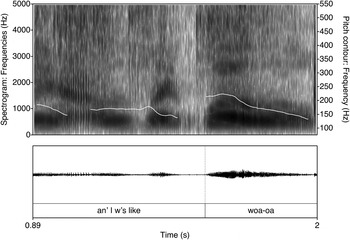
Disregarding the false start (7), I briefly comment on (8): The tension in Serena's face returns and remains until the end of Whoa-oa, re-enacting the original scene on court (and again indexed by be like); the iconic gesture is, however, clearly reduced in size and intensity (please check link at 0:30–31). And in accordance with the gestural layer, the acoustic analysis now reveals discernibly attenuated parameters, repeating the same basic pattern as (2): her vocal dynamics continue the previous level pitch in the reporting clause between 170 and 178 Hz on like, with a moderate, steady rise and slowing-down of tempo, ending on a drawn-out vowel in Whoa-oa (see Figure 3). After a short pause of .19s, the pitch contour, not exceeding 223 Hz (less than half of What?), accompanies a more speedy delivery (with less change in voice quality parameters) but (still) a distinctly perceivable rise on Whoa-oa and two less drawn-out consecutive diphthongs (together about .038s) – all suggesting that this second re-living of the situation on court is moderated in terms of affect; however, it is still an emotional re-experience, sensibly motivating the choice of be like.
Serena's frequencies of an' I w's like, Whoa-oa

To conclude: while the multimodal analysis confirms the suggestion about a distinct style of (vocal) delivery in be-like quotes, the vocal and gestural examination interestingly also reveals some clues about a partial independenceFootnote 10 of the three constitutive dimensions of any event of (reported) speaking, i.e. the verbal, vocal, and gestural modes of communication, apart from, or additional to, confirming the general assumption of their critical interdependence. Significantly, the repetition pattern of the verbal layer is not exactly reflected in the prosodic parameters, and of note is certainly the discriminating interaction between the gestures and the vocal and the verbal modes: first, beat gestures concur with higher pitch and/or dramatic fall, emphasizing the respective lexical items, while the attenuated repetition lacks them; correspondingly, the highest pitch on What? is accompanied by both a beat and an iconic gesture. Second, the analysis reveals an obvious relationship between the verbal mode and iconic gestures, with all reported utterances introduced by quotative like featuring iconic gestures: the decrease in pitch and gestural intensity supports the idea of her attenuated emotional involvement as Serena relives the scene a second and third time, nevertheless underscoring be like's affective import.
Correlating the verbal, vocal, and gestural analyses, then, may well corroborate the claim that quotative like has become lexicalized to involve a (re-)performance of a previous (actual or imagined) speech event; at the same time, such perspective reveals its sensitivity to multimodal(ity) concomitants of this speech event and makes it likewise susceptible to an analysis in terms of attention effects. In the service of communicating attitudinal and affective ‘messages’, the current speaker will typically fall back on concomitants of interactive face-to-face communication, with acoustic/prosodic and visual/mimic characteristics being both inherent but associated, backgrounded meaning components of say and quote (unquote).
3.2 Quote (unquote) – a focus on reference and representation
Following this more detailed multimodal account of be like, I will now only briefly illustrate two more dedicated lexical items: quote and its ‘expanded’ variant quote unquote, each giving rise to specific contextual implications (see Lampert, Reference Lampert2011 and in press).
To contextualize the attentional particulars of quote,Footnote 11 again with a comparative glance at co-occurrent say, an excerpt from Barack Obama's Remarks on the Post-9/11 GI Bill at George Mason University, Fairfax, Virginia, on August 3, 2009, serves as an example. The President refers to Roosevelt's veteran policy, and the immediate context features indirect speech reports, introduced with told and said, which I disregard, and the (underlined) quotatives at issue, indexing verbatim quotes:
(11) In 1943, [Roosevelt] told the nation that the veterans of World War II would be treated differently. He said that they must not be demobilized, and I quote, “to a place on a bread line” – demobilized “to a place on a bread line or on a corner selling apples.” Instead, Roosevelt said, “The American people will insist on fulfilling this American obligation to the men and women in the Armed Forces who are winning this war for us.”
Like in (1), say serves as a ‘reference frame’ for the envisaged comparison: it directs attention to the referential content of (a) previous linguistic event(s) and is likely to co-entail the speaker's commitment to the content's veridicality. Say introduces a literal quotation of Roosevelt, as indicated by the quotes in the official transcript, whose unequivocalness as a verbatim report is contextually reinforced through its precursor, the dedicated trigger quote selecting out the relevant sense of say (see below).
Though likewise constrained to interactive settings, quote, contrasting with quotative like, highlights concomitants of a quote's representational characteristics – the exact formal and lexical composition of a literal quotation – while, at the same time, backgrounding the original speaker's affective state and style of delivery. As (11) suggests, quote and say considerably overlap in function, ‘suppressing’ the quote's para- and extralinguistic characteristics as against the significance of its referential content. The co-occurrence of the two quotatives again supports the argument about say's underdeterminedness: speakers ‘only’ commit themselves to the referential truthfulness of their report, leaving it open whether they adhere to the original speech event's lexical and formal composition, while quote highlights the verbatimness of a quotation likely to appeal to, if not presuppose, written notes. In the present case of an official presidential address, which gains permanency through video-recording and a transcript,Footnote 12 the context of academia is readily invoked, with its air of legalistic caution that the current speaker considers relevant, or rather is institutionally coerced into observing. Restricted to interactive contexts, quote ‘translates’ conventionalized figural elements, the quotation marks, into the verbal ‘code’; unlike the written medium, which is unequivocal in delimiting a quote's exact scope, quote, in its native spoken setting, only more or less precisely indicates the beginning (but not the end) of the verbatim quotation.
Given the transience of speech and, typically, the relative shortness of the quotations, the strictness with which the criterion of verbatimness is met will be more flexible in spoken contexts, which are largely constrained by the particulars of the production and reception circumstances. And while (11) would certainly tend toward the written end on a conceived spoken-written continuum, a precise delimitation of the quote to a place on a bread line proves less relevant when judged against a (formal) printed text, not least, probably, due to its familiarity.
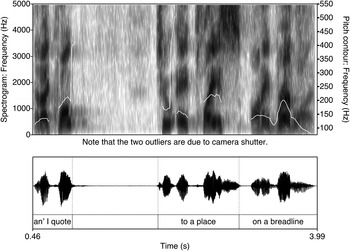
The quote also features a distinctive vocal overlay, though the precise acoustic parameters would never reach the perceptual extremes of quotative like – quite in contrast: backgrounding speakers' affective states in favor of the quotation's exact lexical composition,Footnote 13 Obama indeed accompanies the entire sequence with both beat and iconic gestures, though moderate in range and expressiveness (please check the link at 5:46–48). His well-known pointing (in this case right) index finger on and I quote passes over into a circle on to a place on a breadline, when the fingertip connects to the thumb, resembling the okay sign (which might lend its meaning to the item ‘I quote Roosevelt, and he was right’). The acoustic analysis likewise shows attenuated values, typical of a parenthetical overlay which continues the level-pitch contour of the reporting clause between 124 and 134 Hz; in line with the observations in (1), the open-class items peak at 212 Hz (quote), 220 Hz (place), and 202 Hz (bread-), while the closed-class items remain below 165 Hz, and the tone unit and I quote is followed by a clearly perceivable, substantial leading pause (1.05s); cf. Figure 4.
Obama's frequencies of an' I quote, to a place on a breadline

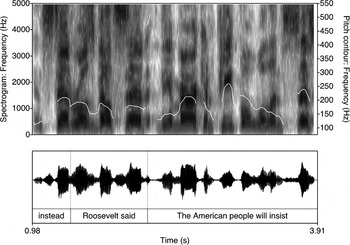
Expectedly, on account of the attentional analysis promoted, the reporting clause Roosevelt said is characterized by even more attenuated parameters: starting from 123 Hz at instead and ending at 178 Hz at said and a hardly perceivable pause of .11s, it lacks any distinctive prosodic and gestural style of delivery, with Obama's hands remaining below the desk. This pattern would indeed invoke an iconically motivated speculation in line with the concomitance analysis: quoting verbatim typically co-entails an attitudinal stance toward the quote(e), giving rise to an additional cognitive effect; in the present case, Obama pays tribute to and, hence, supports his own point, ‘borrowing’ the air of a prominent voice. And this effect is likewise detectable on the para- and extralinguistic level – the current speaker ‘withdraws’ from center stage, leaving it to the original speaker, Roosevelt. The quote again features the ‘beaten’ okay sign on The American people will insist (please check the link at 5:56–58), with higher frequencies (212, 258, 215, and 236 Hz respectively) to underline the correctness of Roosevelt's statement (see Figure 5).
Obama's frequencies of instead Roosevelt said, The American people will insist (the outlier is again due to camera shutter)

Analogous in function to scare quotes, whose home domain is written language, quote unquote again ‘transgresses’ the spoken-written divide and accommodates a multimodal attentional analysis. According to and following Lawler (Lawler, Reference Lawler2013), whose personal website offers the only sensible information so far on this quotative, ‘spoken English can also avail itself of that convention. It can provide “quotes” by saying quote.’Footnote 14 Sharing quote's ambiguity, the second constituent unquote in advance announces, hence fails to delimit, the end of a quotation, which is likewise irrelevant, as the quoted sequence appeals to ‘the listener's short-term memory’ and typically consists of ‘only one word or phrase – one phonological unit in any case’. Such constraint on scope and complexity proves sensible if not mandatory in spontaneous spoken settings. Consequently, the second constituent is ‘simply dropped in many cases’, leaving the two quotatives indiscriminate.
Though Lawler maintains that quote (unquote) is regularly accompanied by ‘an “ironic” intonation on the item that is to be “quoted”’, communicating a speaker's distance toward a quotation's referential content, such a claim proves untenable at least for the present case. While (12) certainly confirms the colloquiality argument, any ironic or even sarcastic overtone is missing; rather, Obama conveys a note of friendly understanding, supported by the immediately following How's that working out, Mrs. Bush? (Laughter.).
(12) It was second nature to [Bush] – the continuation of a proud family tradition that he and Mrs. Bush clearly passed on to their children and grandchildren. And one which he's carried on throughout his quote, unquote “retirement.”
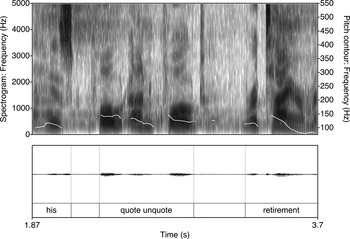
An inspection of Obama's para- and extralinguistic parametersFootnote 15 reveals vocal and gestural styles of delivery that recede into the background as additional, but not mandatory, cues, as the quotative unmistakably indicates the quotation. His right hand – fingers relaxed and loosely spread – continues the previous gesturing pattern, while a small beat gesture with the index finger accompanies quote unquote (please check link at 6:48–49). The vocal layer likewise displays the attenuated parameters characteristic of parenthetical overlay, with both a short leading pause (.25s) and a trailing pause (.33s) after the tone unit quote unquote; the level pitch between 116 and 145 Hz shows moderate peaks at quote unquote (145 and 134/137 Hz), which may also subserve the function of signaling the intended non-literal reading, while the frequencies of retirement range from 139 to 84 Hz, cf. Figure 6.
Obama's frequencies of his quote unquote, retirement

On account of these observations, quote (unquote) proves another intriguing indicator of multimodality, calling for closer scrutiny in terms of the comparative attentional analysis, which appears apt to motivate its selection over be like and probably also over say.
3.3 Air-quotes – just a playful, and/or unwelcome, addendum?
Again for want of any specialist linguistics account, the provisional remarks to follow certainly fail to do justice to the multifacetedness of the manual gestures visualizing punctuation marks in spoken settings (see also Yu, Reference Yu2013): air-quotes mimic scare quotes in print, again adapting a convention native to the visual mode of written language to face-to-face contexts. The virtual quotation marks are ‘drawn’ in the air when speaking to embrace the quote – typically only a single word – or they overlap with the initial part of a very short phrase.
The air-quoted sequence is regularly announced by a leading pause and typically features an overlay structure similar to quote (unquote); now the speaker's style of delivery, however, readily accommodates the expression of (strong) attitudinal connotations like irony, satire, or sarcasm. Air-quotes especially serve the socio-psychological and/or communicative purpose of allowing speakers who are, as Lawler observes, not willing to ‘take responsibility for the correctness of any description to distance themselves from the respective quotes, thus effectively saying that the [speaker] believes something like the reverse of the description’; and ‘a single handed quote is an equivalent, though less dramatic variation’.
Concomitant activation, I argue, again proves a viable explanatory construct for air-quotes. The gesture foregrounds distinctive properties of punctuation marks – native to the written modality – to signal the exact selection and sequence of the original wording. The air-quotes are under the constraints of the production circumstances characteristic of the visual-manual channel, indexing their home domain's visual-graphic mode, i.e. the manual gesture would typically not imitate the inclusion pattern of the written convention but rather realize the simultaneity model of quote (unquote) accompanied by an initial prosodic overlay.
With a substantial empirical study being mandatory, air-quotes appear to invoke a (strong) sense of ‘intermodality’ (a term intended as an analog to intertextuality): first, they establish a trans-modality relation between the air-borne transient quotes and their permanent printed representational counterpart; second, they would set up a (regular?) connection with their native setting, the acoustic medium, overlaying a distinct vocal delivery in the speaker's realization of the quoted sequence. In light of this complex cross-modality interrelation, air-quotes reveal themselves as a true multimodal phenomenon, critically both presupposing and integrating all mediums available to communication – signed, printed, and spoken.
John McCain's exampleFootnote 16 features two instances of air-quotes. The first (underlined) occurrence of health is accompanied by the two-hand air-quotes (please check link at 0:40), while the second gesture stages a(n attenuated) one-hand air-quote and is additionally introduced with quote (please check link at 0:50), in fact supporting the argument of multimodal integration.
(13) [Senator Obama]'s health for the mother. … That's the extreme pro-abortion position, quote, “health.”
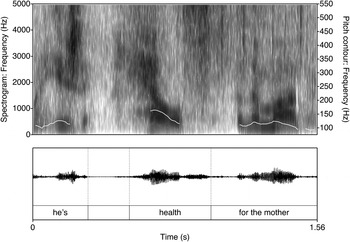
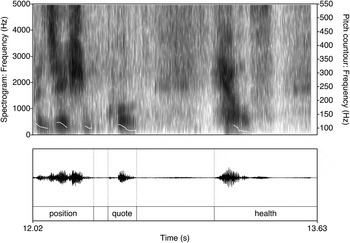
Attentionally, the air-quotes target the concomitant of a ‘displaced’ gestural modality encontextualized in a (formal) speech, which quite naturally lends itself to the cognitive effect of alienation, giving rise to irony or sarcasm. Such attitude becomes immediately salient in the first occurrence of health, while it appears to be attenuated in the secondFootnote 17 token; and the vocal analysis confirms this difference: the air-quoted health peaks at 164/115 Hz (see Figure 7) as against 110/85 Hz of the repetition (cf. Figure 8), introduced by quote (109/91 Hz) with both a short leading and trailing pause (.19s and .15s respectively). The second occurrence of health features a very short leading pause of .13s, which is sensible, given the double-indication of its status as a quote, and a considerable trailing pause of .43s. In this context, legalistic caution suggests itself as a more plausible motive, due to the uncompromising (alleged) extremist position of equating abortion and health, which is supported by the additional introducer, quote, and which coincides with the less dramatic single-hand gesture to avoid (or at least reduce) the insinuation of sarcasm. Both quotes, though discriminately, feature a lengthening of the stressed vowel in health, .15s in the first as against .09s in the second case.
McCain's frequencies of the air-quoted health

McCain's frequencies of quote, health

4 Review and preview: quotatives in competition – quotatives in unison
The initial findings seem indeed to support the idea of assuming attention as a theoretical and explanatory construct: Differentially highlighting multimodal concomitants of the quote available to interactive communicative settings and accommodating constraints as well as options of the linguistic modality's production and reception circumstances, the interactive quotatives, including perhaps, quite sensibly, the air-quotes, variably respond to contextual factors. Motivated by the principle of iconicity, they indicate their own characteristic ‘situatedness’ as modality-sensitive conceptual alternatives, accounting for speakers' selectional preferences.
Quotatives' attentional profiles would then specify the degree of salience that an addressee is expected to accredit to concomitant aspects of a quote, involving a partial withdrawal of attention from the reported speech event's direct referring function (except probably for say) in a process of reference attenuation. At the same time, they differentially direct some ‘more-than-normal’ attention to particularities of quotations in a process of concomitant activation, including intrinsic and non-cancelable attributes of the respective speech reports – all less attended to when say is selected.
As essentially multimodal items, interactive quotatives recruit the three modes spoken language avails itself of, and they would demand that these mediums be taken seriously into account for their analysis. In fact, the provisional findings appear to have (again) corroborated the claim that the ‘new’ quotatives are anything but meaningless fancy items, (over-)used without any constraints: a multimodal analysis along the lines presented appears suitable to ‘disprove’ such a stereotype and disclose the language ideology on the para- and extra-linguistic levels, which has, for the verbal level, been challenged by D'Arcy's (Reference D'Arcy2007) study on be like.
The air-quotes arguably share the basic properties of their lexical competitors, ‘departing’ only insofar as the gesture itself more readily acquires the connotative overtones, which may perhaps be due to the modality-clash between the expected implementation of vocal means in direct verbal interactions and the ‘displaced’ manual-visual representation of an ultimately written symbol.
 MARTINA LAMPERT is a lecturer/Privatdozentin at the Department of English and Linguistics, Johannes Gutenberg University, Mainz, Germany. As a cognitive semanticist, her research has focused on attention phenomena in language, more specifically the new quotatives in English and the study of parenthetical constructions. Two recent book-length publications are Attention and Recombinance: A Cognitive-Semantic Investigation into Morphological Compositionality in English (2009) and (co-authored with Günther Lampert) ‘… the ball seemed to keep rolling …’: Linking up Cognitive Systems in Language: Attention and Force Dynamics (2013). Email: mlampert@uni-mainz.de