Introduction
Head and neck skin cancers present commonly to the otolaryngology, plastic surgery and dermatology services. The mainstay of clinical practice is surgical excision. Mohs micrographic surgery attempts to achieve clear margins of excision by examining histological specimens simultaneously. However, this process is not widely available, is time-consuming and, where advanced reconstruction is required, may not be cost-effective.Reference Bialy, Whalen, Veledar, Lafreniere, Spiro and Chartier1 Therefore, when calculating excision margins, most surgeons rely on practice guidelines.Reference Haigh, DiFronzo and McCready2–Reference Telfer, Colver and Bowers4 These guidelines exist to give the best chance of complete excision, given the size of the lesion.
This study was undertaken to objectively assess the accuracy, influencing factors and reproducibility of margins drawn for the excision of superficial facial skin lesions commonly encountered in clinical practice.
Materials and methods
Within the setting of a specialist course in facial plastic surgery (North Cheshire Hospitals National Health Service Trust, 2005), 24 clinicians were questioned on how they marked skin lesions for excision. They were then asked to draw margins of 3, 4, 5, 8 and 10 mm around life-sized skin lesion pictures, using a standard surgical marker pen (CB 3150 nib; Cory Bros Ltd, Shenley, UK; line thickness 0.8 mm). Participants were instructed that the outer edge of the drawn line would be where the incision was placed. Drawings were performed both unaided and using a microscope (Figure 1). The images used (Figure 1a to f) were chosen in order to demonstrate actual pathologies and difficult sites (Figure 1c to e). Participants were also asked to draw circles of 3, 5 and 8 mm diameter on white paper.
Images used for margin drawing exercises.

Each participant was given one attempt for each margin. Quadrants were then drawn for each lesion and margins measured at four points with vernier callipers graduated to 0.05 mm (callipers graduated to 0.05 mm may produce an error of 1 per cent when measuring a 5 mm margin). Similar measurements were taken for the circles drawn on paper.
Results and analysis
When asked what visual aids they would use to mark lesions before excision, 21 participants said they would mark the lesions using only the naked eye. One participant reported using a microscope every time, and three reported using loupes. No participant reported use of a ruler or other measuring device in their regular practice.
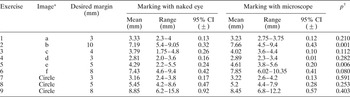
The excision margins drawn by participants are shown in Table I. The difference between margins, using the different methods for each participant, were analysed using Student's t-test.
Exercises and results

* See Figure 1. †Comparing means (significance at <0.05). CI = confidence interval
When comparing results for individual exercises, significant differences (p < 0.05) were seen for exercises two (10 mm margin) and five (5 mm margin, difficult site). In exercises one and four, participants were asked to mark a 3 mm margin; however, in the difficult site (Figure 1d), the mean marking was 2.81 mm, compared with 3.33 mm in the nondifficult site (p < 0.05). In exercise two, in which a 10 mm margin was required, the mean marking was 7.19 mm with the naked eye and 7.66 mm with the microscope. None of the participants achieved the desired margin in exercise two.
In exercises seven, eight and nine, there were no significant differences observed between methods of marking. The mean margins achieved were all greater than required.
Discussion
In our study, when smaller margins (i.e. 3 mm or less; exercises one and seven) were necessary the vast majority of participants overestimated the margin. Thus, in cases of basal cell carcinoma less than 2 mm, participants would have had an 85 per cent chance of histological clearance.Reference Breuninger and Dietz5, Reference Wolf and Zitelli6
Where large margins (8 mm and 10 mm) were required to achieve clearance (e.g. in cases of primary morphoeic basal cell carcinoma), participants tended to underestimate the margin by up to 28 per cent. Higher incomplete excision rates have been demonstrated for this type of lesion.
The use of visual adjuncts (i.e. loupes and microscopes) did not confer any benefit in judging physical measurement (p > 0.05 for exercises seven to nine). However, such aids are of benefit in demonstrating areas of field change, thus giving a better chance of excision.Reference Wettstein, Kalbermatten, Rieger, Farhadi, Harr and Pierer7
When participants engaged in exercises in which no decision-influencing factors were present, such as drawing plain circles or drawing on large areas of skin with no areas of aesthetic concern, then satisfactory margins were achieved, with even a tendency to overestimate. This result is in keeping with that of a previous study, which found overestimation in all groups asked to mark 2, 5 and 10 mm margins on paper and on the back of a wrist.Reference Lalla, Brown and Griffiths8
When participants were asked to mark margins for excision in areas of aesthetic concern, then certain errors were noted. In exercise five, the lesion was adjacent to the orbital cosmetic subunit, and poor reconstruction here would have resulted in poor function (i.e. entropion of the lower lid). Thus, most participants sacrificed satisfactory margins and potentially under-excised the tissue required. This phenomenon was also noted in exercise six, in which the lesion was on the lower aspect of the left nose and potential reconstruction options thus risked ‘notching’ the ala. This result is supported by comparing the results of exercises one and four and exercises six and nine, for which mean excision margins were also significantly different.
• Surgical excision margins exist to give the best chance of pathological clearance
• This study clearly demonstrates the caution used by surgeons when excising facial lesions
• Fixed scale rules should be used when marking skin cancers for excision
Rates for incomplete excision of various skin lesions (regarding peripheral margins) have been reported to range from 5.3 to 25.4 per cent (for cases requiring 4–5 mm margins).Reference Griffiths, Suvarna and Stone9–Reference Talbot and Hitchcock11 In these retrospective series, there was a higher chance of incomplete excision in cosmetically sensitive areas (i.e. medial canthus and nose, and for larger morpheic lesions).
In high risk areas where adequate resection may be difficult to judge and where the use of predetermined margins may cause aesthetic or functional impairment, then the use of Mohs surgery should be considered.Reference Rowe, Carroll and Day12 If this is not available, and incomplete excision is associated with worse prognosis (e.g. in the case of squamous cell carcinoma), then it is advisable to delay repair until histological confirmation of clearance is received.
Conclusion
We conclude that surgeons marking facial lesions for excision should use a measurement of scale, in order to eliminate the inherent tendency to underestimate the margin required for large excisions and for cosmetically sensitive areas.
Acknowledgements
We would like to thank all the participants in this study who attended the Warrington Facial Plastics course 2005.