Syncope, defined as a sudden brief loss of consciousness and of postural tone with rapid and spontaneous recovery, is relatively common in the paediatric age. Approximately 15% of children experience an episode of syncope before adolescence.Reference Sapin1 About 20% of boys and 50% of girls interviewed in a college survey remembered having had at least one episode.Reference Murdoch2 While it is generally a benign condition, rarely it can hide an important cardiac, neurological, or metabolic condition. Neuromediated syncope, recently renamed as neurocardiogenic syncope, is undoubtedly the most frequent in children, representing 61–80% of cases according to different studies.Reference Steinberg and Knilans3
Cardiac causes of syncope in children are less common (10–15%), but paediatricians must be aware of life-threatening conditions such as long QT syndrome, Brugada syndrome, cardiomyopathy, and ventricular arrhythmia that can lead to sudden death.Reference Massin, Malekzadeh-Milani and Benatar4 Other causes of syncope in the paediatric age group are neurological – migraine headache, seizure disorder, transient ischaemic attack, and acute vestibular syndrome – psychiatric – depression, conversion reaction, and panic attacks – and systemic/metabolic diseases – drug side effects, electrolyte abnormalities, and endocrinopathy.Reference Johnsrude5
There is no international agreement on the diagnosis of syncope. Moreover, Italian guidelinesReference Raucci, Longhi and Calmieri6 suggest collecting an extremely detailed history with particular attention to warning signs such as syncope in response to loud noise, fright or extreme emotion, syncope during exercise or while supine, family history of sudden death in young persons less than 30 years of age and syncope with an “odd” history. The first approach to a child with syncope must include a detailed history, a physical examination, and an electrocardiogram. Further investigations could be suggested only if indicated and must be decided case by case.Reference Steinberg and Knilans3
While the head-up tilt test appears to be a useful tool in the diagnosis of syncope in adults,Reference Kenny, Ingram, Bayliss and Sutton7 its use in the paediatric age is still debated.Reference Cohen, Lewis and Berger8, Reference Ritter, Tani, Etheridge, Williams, Craig and Minich9 Electroencephalogram, echocardiography, 24-hour Holter monitoring and blood tests are indicated only in specific cases based on presentation.Reference Soergel, Kirschstein and Busch10
The aim of this study was to evaluate the usefulness of head-up tilt test and ambulatory blood pressure monitoring in children with episodes of syncope.
Materials and methods
One hundred and forty-six consecutive children and adolescents (82 male and 64 female) with a mean age of 11.7 plus or minus 7.1 years, (ranged 5.1–17.9 years) a mean weight of 45.9 plus or minus 21.2 kilograms, and a mean height of 145.7 plus or minus 35 centimetres referred to our centre for a clinical history of multiple syncopal episodes were included in the study. All patients and/or parents underwent a careful historical review of the episodes to better characterise the conditions that preceded it in terms of environment or physical conditions, such as longtime standing, crowded or hot environments, fever status and/or dehydration, etc.
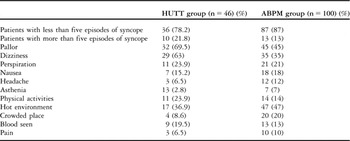
The patients were assigned to either head-up tilt test or ambulatory blood pressure monitoring according to age and the features of the episodes: the younger and less cooperative were considered not able to undergo head-up tilt test. Older patients with typical features of neurocardiogenic syncope were studied with ambulatory blood pressure monitoring. The different signs and symptoms of syncope in the patients are summarised in Table 1.
Signs and symptoms and situations of syncope in the two groups.

HUTT = head-up tilt test; ABPM = ambulatory blood pressure monitoring
The table showed signs and symptoms and situations of the syncope episodes in the patients considered. The patients are divided according to the evaluation with head-up tilt test and ABPM. Number of patients and percentage are shown
All patients underwent a clinical examination, a 12-lead electrocardiogram, as well as systolic and diastolic blood pressure measurement, at rest and in the seated position, using a calibrated sphygmomanometer. None of the patients was taking any medication at the time of the study and did not have any other medical condition that could influence the result of the evaluation.
Other causes than neurocardiogenic syncope were excluded on the basis of careful history, neurological, and metabolic evaluation.
All parents gave their informed consent to the study. The protocol was approved by the Hospital Research Ethics Board.
Head-up tilt test
Forty-six children (19 male and 27 female), with a mean age of 13.0 plus or minus 2.7 years, ranged 7.7–17.8 years, mean weight 50.3 plus or minus 21.5 kilograms and mean height of 157.2 plus or minus 35.7 centimetres underwent head-up tilt test. All tests were performed in the morning after a restful night and in a fasting condition in a room with a temperature of 23°C, under soft light and without external stimuli. A peripheral intravenous catheter was inserted for use in a possible emergency, electrocardiogram monitoring was continuous and heart rate and blood pressure were recorded.
The tilt table (Gardhen balance, Casalnuovo Napoli) was positioned at 80 degrees of inclinations for a period of maximum 30 minutes until symptoms, vasodepressor response, cardioinibitory response, or both (mixed response) occurred. This protocol, previously used in another study,Reference Giordano, Turchetta, Crosio, Nigro, Di Giacinto and Calzolari11 was used because it was an aggressive protocol that provides high specificity avoiding the use of pharmacological stimulus (isosorbide dinitrate).Reference Benditt12 Whenever symptoms of pre-syncope or syncope developed before 30 minutes, or hypotension – systolic blood pressure less than 60 millimetres of mercury – bradycardia – heart rate less than 40 beats per minute – or both occurred, the patient was turned back to the supine position immediately, the test was terminated and was considered positive.
Ambulatory 24-hour blood pressure monitoring
Ambulatory blood pressure monitoring was performed in 100 patients (41 male, 59 female) with a mean age of 11.4 plus or minus 3.6 years, range 5.1--17.9 years, mean weight 43.8 plus or minus 30.7 kilograms and mean height 147.5 plus or minus 32.3 centimetres. A Spacelab Ambulatory Blood Pressure recorder model 90207-30 (Redmond, Washington, United States of America) was used. It recorded blood pressure every 15 minutes during the day (7:00 am–11:00 pm) and every 30 minutes during the night (11:00 pm–7:00 am). The patients kept a diary of their activities or symptoms while awake and during the sleep period. The mean 24-hour, mean daytime and mean nighttime systolic and diastolic blood pressures were recorded and compared with reference values for age, sex and height.Reference Soergel, Kirschstein and Busch10 Hypotensive status was assumed when mean blood pressure values (24-hour, daytime, and nighttime) were less than the 50th centile.Reference Soergel, Kirschstein and Busch10
Ambulatory blood pressure monitoring and head-up tilt test
On account of an uncertain history of the syncopal episodes, both ambulatory blood pressure monitoring and head-up tilt test were performed in 12 of 146 patients (8.2%).
Statistical analysis
All values are expressed as mean plus or minus standard deviations. For a comparison of head-up tilt test and ambulatory blood pressure monitoring results a t-test for independent sample was used. The SPSS 12.0 software for Windows was used for all statistical analysis. Values were considered significant with a p-value less than 0.05. Sensitivity was expressed as a percentage of the patients with a positive test divided for all patients with syncope that underwent the test.
Results
No difference in anthropometric parameters and sex distribution between the two groups (head-up tilt test and ambulatory blood pressure monitoring) was found. As expected, age was statistically lower in ambulatory blood pressure monitoring patients (p-value less than 0.05), because of the difficulty in execution of head-up tilt test in the younger patients.
Head-up tilt test
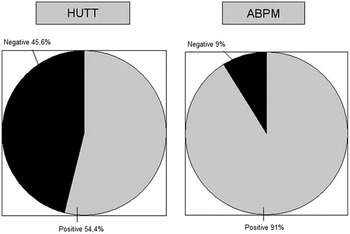
General physical examination was normal in all 46 patients, as well as electrocardiogram at rest. The head-up tilt test was positive in 25 patients (54.4%) and negative in 21 patients (45.6%; Fig 1).
Percentage of positive and negative response in the two groups.

In the 25 patients with a positive tilt test, three patterns of response to tilting were observed; 10 patients (40%) had a mixed cardio-inhibitory and vasodepressor response, 12 patients (48%) had a predominantly vasodepressor response, and three patients (12%) had cardio-inhibitory response.
Ambulatory blood pressure monitoring
General physical examination and electrocardiogram at rest were normal in the totality of the patients. However, 91 patients (91%) examined in this group demonstrated hypotension, mean blood pressure values lower than 50th percentile (Fig 1).
Ambulatory blood pressure monitoring and head-up tilt test
In the small group of 12 patients, five patients had hypotension during ambulatory blood pressure monitoring and a positive response during the head-up tilt test (four vasodepressor and one mixed), five had hypotension with a negative head-up tilt test, and two were negative for both.
At first, all patients were given advice to increase fluid and salt intake, avoid long periods of standing, especially in hot and crowded places. If these simple measures were insufficient, according to the numbers of episodes experienced by the patients, a pharmacological treatment was prescribed, usually with midodrine.
In total, three patients in the head-up tilt test group and five patients (5%) in the ambulatory blood pressure monitoring group required pharmacological therapy.
After an average follow-up period of 10 plus or minus 2 months, 40 out of 46 patients (86.9%) in the head-up tilt test group were symptom free, two patients (4.3%) had one syncopal episode and four patients (8.7%) had pre-syncope only. There was no difference between the tilt-positive and the tilt-negative patients. In the ambulatory blood pressure monitoring group, 90 patients out of 100 (90%) were symptoms free, four (4%) experienced one syncopal episode, and six (6%) patients had pre-syncope only.
Discussion
Many studies have shown the utility of the head-up tilt test in the diagnosis of paediatric syncope, but it is still debated which protocol must be used.Reference Steinberg and Knilans3, Reference Benditt12 Some authors have stated that this non-invasive test was diagnostic for syncope in the paediatric population.Reference Raucci, Longhi and Calmieri6, Reference Cohen, Lewis and Berger8 Other authors have underlined the great number of false-positive results.Reference Benditt12, Reference Steinberg and Knilans13 In our study, the head-up tilt test has shown positive results only in about half of the patients examined for syncope.
In the paediatric population, it has to be considered that it is the psychological aspect that is more important than in adults and that can modify the results of a provoking examination like the head-up tilt test.Reference Benditt14
To the best of our knowledge, there are no studies in the paediatric population showing the usefulness of ambulatory blood pressure monitoring in the evaluation and diagnosis of a hypotensive status that can easily lead to syncope. The reason is that ambulatory blood pressure monitoring is not specific for the diagnosis of syncope.
Our data on a population of 146 children and adolescents studied for syncopal episodes showed that ambulatory blood pressure monitoring can diagnose the underlying hypotensive condition that leads to neurocardiogenic syncope. In this study, ambulatory blood pressure monitoring became very helpful in diagnosing hypotension in 91% of patients examined in comparison with only 54.4% in the head-up tilt test. In the small group of patients with both tests 10 of 12 patients had hypotension but only 5 of 10 patients had a positive tilt test.
From the data obtained in this clinical study we can suggest that the head-up tilt test has low sensitivity for children because it provoked syncope in only half of the symptomatic patients. However, it was very specific when it was positive when there was documentation by electrocardiogram, blood pressure, and clinical monitoring.
Conversely, ambulatory blood pressure monitoring cannot be considered a specific tool for the evaluation of syncope, since it documents all hypotensive episodes, not just those during episodes of neurocardiogenic syncope. Ambulatory blood pressure monitoring is not invasive and can be prescribed at any age, even in babies. In contrast, the head-up tilt test needs a very cooperative patient and therefore is not applicable before the age of 8–10 years.
The limitation of the study is that this is not a cross-over study. This could reduce the significance of the results also if the differences obtained between the two different tests are clear.
Considering the reproducibility of the ambulatory blood pressure monitoring and the difficulties of the head-up tilt test, especially in younger patients, and based on the data obtained in our study, we suggest the use of the head-up tilt test only in selected patients for a differential diagnosis of syncope of unknown origin, never as a first step or when the history is typical for a neurocardiogenic aetiology of the syncope. The tilt test should be performed only when the history is unclear or there are no witnesses of the episodes. Additional test, such as electroencephalogram, echocardiogram or Holter monitoring, are necessary when the history at first, but also the tilt test or ambulatory blood pressure monitoring do not give clear results.
When neurocardiogenic syncope is suspected according to the clinical presentation, we prescribe ambulatory blood pressure monitoring as a first test to underline hypotension and the head-up tilt test as a next step if simple adjustments, such as increased water and salt intake and awareness of symptoms that prelude syncope, are not effective. If the episodes persist, the head-up tilt test is indicated and drug therapy should be considered.
In conclusion, our data confirm that the head-up tilt test is more difficult to perform in the diagnosis of neurocardiogenic syncope in the paediatric population than ambulatory blood pressure monitoring, but both are non-invasive, and aid in the diagnosis and management of patients with neurocardiogenic syncope.
Acknowledgement
We are grateful to F.M. Galioto, MD, for his critical support.