Introduction
For many years, psychologists have understood that the pattern of symptoms associated with one diagnosis of psychopathology can co-occur, a phenomenon known as comorbidity (Ingram Reference Ingram2009). Identifying and researching co-existing disorders has been highly relevant in clinical practice because it informs treatment and highlights added risk factors (Drake and Wallach Reference Drake and Wallach2000; Gilbert, Adamson and Deering Reference Gilbert, Adamson and Deering2014). Given the significant contribution the construct of comorbidity has made to the treatment of psychopathology, one would presume that understanding the impact of co-existing positive traits would equally benefit clinicians in enhancing wellbeing. To date, limited attention has been given to the co-occurrence of multiple positive strengths (Furlong et al. Reference Furlong, You, Renshaw, O'Malley and Rebelez2013; Jones, You and Furlong Reference Jones, You and Furlong2013; You et al. Reference You, Dowdy, Furlong, Renshaw, Smith and O'Malley2013). The current study extends upon this preliminary research by assessing the combination of specific positive psychological traits in relation to their association with depression in a sample of retirees. The importance of examining positive traits within this age demographic is further emphasised by the increasing number of individuals over the age of 65 (Australian Bureau of Statistics 2011) and the societal and economical costs associated with sub-optimal living in retirement (Ranzijn Reference Ranzijn2002).
To date, research has identified various positive traits as contributing to enhanced life outcomes and life satisfaction (Fredrickson and Losada Reference Fredrickson and Losada2005; Killen and Macaskill Reference Killen and Macaskill2015; Seligman Reference Seligman, Snyder and Lopez2005). Specifically, there appears to be a relation between people reporting higher levels of positive psychological traits (e.g. an optimistic outlook was associated with higher levels of happiness) and living longer and healthier lives (Kato et al. Reference Kato, Zweig, Barzilai and Atzmon2012). Similarly, it has been found that higher levels of depression are negatively associated with lower levels of resilience and successful ageing (Jeste et al. Reference Jeste, Savla, Thomson, Vahia, Glorioso, Martin and Depp2013). Overall, a positive view of life is associated with superior health outcomes (Scheier and Carver Reference Scheier and Carver1992).
Considering human needs via a positive psychology lens also appears to benefit clinical practice by facilitating individuals’ psychological functioning through strength-based interventions (Vahia et al. Reference Vahia, Chattillion, Kavirajan and Depp2011). Similar to psychopathology, positive psychology initially focused on identifying and defining individual characteristics such as optimism (Scheier and Carver Reference Scheier and Carver1985), hope (Snyder et al. Reference Snyder, Harris, Anderson, Holleran, Irving, Sigmon and Harney1991) and gratitude (McCullough, Emmons and Tsang Reference McCullough, Emmons and Tsang2002) in relation to resilience and psychological wellbeing (Tugade and Fredrickson Reference Tugade and Fredrickson2004). Through this process, researchers found that many individual characteristics, such as hope and self-efficacy (Snyder et al. Reference Snyder, Harris, Anderson, Holleran, Irving, Sigmon and Harney1991), were related to each other. The present study sought to build on previous research by more closely examining the co-occurrence of multiple positive traits.
The covitality construct
Various bodies of research have suggested that overall wellness is not just the sum of individual health indicators. A person's health is made up of diet, exercise, genetics, stress levels and so on, but the robustness of their wellness comes from the synergistic interaction of these health elements. Drawing on this perspective, Weiss, King and Enns (Reference Weiss, King and Enns2002), for example, examined the heritability of subjective wellbeing in chimpanzees to determine if there was a correlation with personality trait dominance. They found support for this hypothesis with genetic correlations paralleling the explanation of comorbidity between anxiety/neuroticism and depression. As comorbidity was deemed inappropriate to explain the co-occurrence of positive constructs, these authors suggested the term ‘covitality’ be used to describe the integrative upward spiralling effects associated with positive traits. The results from this study were generalised to human beings given that chimpanzees share more than 98 per cent of human DNA and past research has identified similarities in subjective wellbeing and personality between the two species (King and Figueredo Reference King and Figueredo1997; Perry et al. Reference Perry, Yang, Marques-Bonet, Murphy, Fitzgerald, Lee and Redon2008). Other areas of research have also suggested that developmental outcomes are most strongly associated with and predicted by the combination of factors. Within work places and organisations, the term ‘psychological capital’ has been used to describe the value added by positive psychology constructs to increased worker success and satisfaction (e.g. Avey, Luthans and Youssef Reference Avey, Luthans and Youssef2010). In the youth developmental realm, there is a strong relation between the number of internal and external resources (e.g. 40 Developmental Assets – Scales Reference Scales1999) in an adolescents’ life and indicators of wellness such as higher grade point average (Shoshani and Slone Reference Shoshani and Slone2013) and high levels of subjective wellbeing (Guhn et al. Reference Guhn, Schonert-Reichl, Gadermann, Marriott, Pedrini, Hymel and Hertzman2012).
To date, several studies have examined covitality within a positive psychology context. Jones, You and Furlong (Reference Jones, You and Furlong2013) assessed the co-occurrence of multiple positive psychological traits (gratitude, hope, optimism, self-efficacy, life satisfaction and happiness) in college students, in order to determine if there was evidence for a higher-order factor, and if such a factor was associated with psychological wellbeing. Using a two-stage confirmatory factor analysis, support was found for a measurement model that included the higher-order covitality latent trait. In addition, a structural equation model identified a positive relation between covitality and a dual-factor wellbeing model; thus, supporting the hypothesis that a combination of positive psychological strengths was associated with greater psychological wellbeing than were its constituent elements. In subsequent research, evidence for a measurement model that includes a higher-order covitality latent trait has been found for elementary (Furlong et al. Reference Furlong, You, Renshaw, O'Malley and Rebelez2013) and secondary (You et al. Reference You, Dowdy, Furlong, Renshaw, Smith and O'Malley2013) school children. In addition, in these studies higher covitality scores were associated with (a) greater prosocial behaviour and positive school bonding (Furlong et al. Reference Furlong, You, Renshaw, O'Malley and Rebelez2013) and (b) higher levels of subjective wellbeing, lower emotional-behavioural problems and higher grade point average (You et al. Reference You, Dowdy, Furlong, Renshaw, Smith and O'Malley2013). This research, therefore, highlights that interventions aimed at increasing a combination of positive psychological constructs might be more beneficial than focusing on individual positive traits. Although Furlong and his associates have developed scales for measuring covitality in children and adolescents, with a college-aged version (18–26 years) in the pipeline, there are no scales to measure covitality in older adults (see Furlong Reference Furlong2016). In the current study, a number of positive psychological constructs are used to gauge whether a combination of these constructs are related to lower levels of depression in older adults. These constructs reflect those used in the college-aged version (e.g. self-efficacy, optimism, grit and gratitude) and are identified as strengths of the heart as classified in Peterson and Seligman’s (Reference Peterson and Seligman2004) character strengths and virtues.
Classification of character strengths and virtues
To further qualify positive psychological functioning, Peterson and Seligman's (Reference Peterson and Seligman2004) developed the Character Strengths and Virtues Handbook (CSV). This handbook outlines individual character strengths and virtues and was intended to parallel the Diagnostic and Statistical Manual of Mental Disorders (DSM). In the CSV, character strengths relate to positive traits found in thoughts, behaviours and feelings (Park, Peterson and Seligman Reference Park, Peterson and Seligman2004). In order to identify and measure these positive traits, Park, Peterson and Seligman (Reference Park, Peterson and Seligman2004) developed the Values in Action (VIA) Classification of Strengths. Consisting of 24 character strengths, the VIA was developed around six virtues: wisdom and knowledge, courage, humanity, justice, temperance and transcendence. Several character strengths have been identified within these virtues, including hope (Snyder, Cheavens and Sympson Reference Snyder, Cheavens and Sympson1997), self-efficacy (Bandura Reference Bandura1977), gratitude (McCullough, Emmons and Tsang Reference McCullough, Emmons and Tsang2002) and optimism (Scheier and Carver Reference Scheier and Carver1985). For example, the virtue wisdom and knowledge can be achieved through creativity, curiosity, love of learning, open-mindedness and perspective (Peterson and Seligman's Reference Peterson and Seligman2004). Additionally, these strengths have been identified as either strengths of the heart (i.e. emotional and interpersonal) or strengths of the head (i.e. intellectual and self-oriented). This classification system has recently been proposed within the positive psychology field and further categorises positive strengths as being self-orientated or other-orientation, thus, encompassing all strength aspects (Park and Peterson Reference Park and Peterson2010). Therefore, the human strengths examined in the current review, optimism, hope, grit, gratitude and self-efficacy, are all classified as strengths of the heart.
Ageing
What is it about ageing that makes it a time in life that being positive can be an advantage? Erikson's (Reference Erikson1950) Psychosocial Theory of Personality Development suggests that humans all go through a series of stages from birth to old age and within those stages have to resolve a crisis or conflict. In relation to older adults, these stages would be generativity versus stagnation (40–65 years) and ego identity versus despair (65 years and older). The former reflects a time for career making and family raising while the latter is a time when a person reflects on their life's achievements. If either are not successful then the adult gets in a rut (stagnates) or falls into despair due to a general sense of meaninglessness. However, inner feelings of happiness and life satisfaction can help overcome these crises (Srivastava and Das Reference Srivastava and Das2103). In contrast, the personality trait theory of ageing suggests that five major personality factors (neuroticism, extraversion, openness to experience, agreeableness and conscientiousness) are stable over time (Costa and McCrae Reference Costa, McCrae and Sonderegger1992) but psychological aspects such as goals, beliefs, values and coping styles are subject to change (Ruth and Coleman Reference Ruth, Coleman, Birren and Schaie1996). More recently, Srivastava and Das (2013) have suggested that personality traits such as self-efficacy are associated with a rewarding ageing process. Overall, it can be suggested that positive psychological constructs like self-efficacy and life satisfaction can be helpful in a successful transition to older age.
Retirees and positive psychological constructs
Given that only a few studies have assessed the combination effects of positive psychological constructs within the field of positive psychology, and to date with younger-aged samples, research with older adults is required to assess their effects, if any, in other populations. Specifically, it would be beneficial to understand how combined positive psychological strengths may be associated with wellbeing in older populations, such as retirees. The following section examines each of the positive psychology constructs chosen for inclusion in the current study. As stated above, these variables were chosen as they are well-researched positive psychological constructs that demonstrate positive associations with subjective wellbeing and life satisfaction in retirement.
Self-efficacy
The concept of self-efficacy refers to an individual's expectations that they have the capacity to exert influence over a situation by performing in a specific way (Bandura Reference Bandura1977). While self-efficacy was initially defined as task- or domain-specific, a generalised belief of self-efficacy has more recently been conceptualised. General self-efficacy refers to an overall sense of individual mastery and competence (Schwarzer and Jerusalem Reference Schwarzer, Jerusalem, Weinman, Wright and Johnston1995). Kostka and Jachimowicz (Reference Kostka and Jachimowicz2010) found that having a high level of general self-efficacy increased quality of life in adults 65 years and older, while specific self-efficacy predicted less psychological distress and loneliness in adults aged 65–86 (Fry and Debats Reference Fry and Debats2002). Furthermore, older men (aged 70–79) who had high self-efficacy beliefs over their daily activities were found to have enhanced cognitive functioning (i.e. memory) and were better able to maintain cognitive performance over time (Seeman, Rodin and Albert Reference Seeman, Rodin and Albert1993; Seeman et al. Reference Seeman, McAvay, Merrill, Albert and Rodin1996). Self-efficacy is an important positive psychological construct as it contributes to a person's sense of competence and control and, as stated above, relates to a successful experience of ageing.
Hope
Within positive psychology, hope is considered a goal-directed thinking process that involves two components, agencies and pathways. Agencies relate to one's determination that a goal can be achieved, while pathways signify the belief that strategies can be created to reach that goal (Snyder et al. Reference Snyder, Harris, Anderson, Holleran, Irving, Sigmon and Harney1991). In later stages of life, greater challenges emerge with the loss of autonomy, often due to physical deterioration. As a result, hope may decrease as one enters old age (Bergin and Walsh Reference Bergin and Walsh2005). However, hope may be maintained if pathways are modified to accommodate for new gains (e.g. acquired knowledge) and losses (e.g. physical limitations). Research has found that hope-based interventions in older adults assist in reducing anxiety and depression and enhance social functioning (Bergin and Walsh Reference Bergin and Walsh2005; Cheavens and Gum Reference Cheavens, Gum and Snyder2000). Other studies assessing hope in old age have found a relation with greater adjustment to chronic illness, including handicap and severe injury (Snyder, Rand and Sigmon Reference Snyder, Rand, Sigmon, Snyder and Lopez2002). Hope also appears to assist older adults when responding to bereavement, with a positive relation identified between hope and effective grief resolution (Herth Reference Herth1990). As these studies have demonstrated, hope provides a number of benefits to wellbeing, particularly when dealing with challenging situations in old age.
Optimism
Optimism relates to the general expectation that one will experience positive outcomes in life (Scheier and Carver Reference Scheier and Carver1985). In a longitudinal study assessing 941 Dutch men and women (aged 65–85 years), Giltay et al. (Reference Giltay, Geleijnse, Zitman, Hoekstra and Schouten2004) found that those who reported higher levels of optimism had a lower risk of mortality, particularly related to cardiovascular risks. Low optimism has also been related to higher depressive symptoms in patients who were being treated for ischaemic heart disease (Shnek et al. Reference Shnek, Irvine, Stewart and Abbey2001). Overall, optimism appears to increase health-protective behaviours (e.g. healthier eating and physical activity) in individuals (Giltay et al. (Reference Giltay, Geleijnse, Zitman, Buijsse and Kromhout2007) and resilience when faced with an illness (Vahia et al. Reference Vahia, Chattillion, Kavirajan and Depp2011). Thus, optimism has the characteristics of an important positive psychological construct because it contributes to wellbeing through one's belief in positive outcomes and appears to be particularly useful when faced with illness in retirement.
Gratitude
Gratitude is primarily regarded as a positive recognition of a benefit received (Emmons and Mishra Reference Emmons, Mishra, Sheldon, Kashdan and Steger2011) and is one of the more commonly experienced positive emotions (Baumgardner and Crothers Reference Baumgardner and Crothers2009). This positive strength is considered a useful coping strategy in times of stress (Nelson Reference Nelson2009) and provides some protection over developing psychiatric disorders (Bono and McCullough Reference Bono and McCullough2006). Being high on the gratitude trait also appears to enhance social relationships through acknowledging the support provided by another person. Society often benefits from people being grateful as someone who receives an act of kindness and expresses gratitude can motivate others to continue this behaviour (Bono and McCullough Reference Bono and McCullough2006). Preliminary research has also found that wellbeing can be enhanced through employing gratitude-focused activities (Emmons and McCullough Reference Emmons and McCullough2003; Killen and Macaskill Reference Killen and Macaskill2015; Watkins, Uhder and Pichinevskiy Reference Watkins, Uhder and Pichinevskiy2015; Watkins et al. Reference Watkins, Woodward, Stone and Kolts2003). As this research highlights, gratitude is beneficial to general wellbeing (for the individual and society), thus, an important positive psychological construct.
Grit
Grit relates to perseverance and passion for long-term goals (Duckworth et al. Reference Duckworth, Peterson, Matthews and Kelly2007). While research on grit is limited, findings from several studies have found that this positive trait is associated with better educational achievement. For example, Duckworth et al. (Reference Duckworth, Peterson, Matthews and Kelly2007) found that university students with high levels of grit were more likely to achieve higher cumulative grade point averages compared to those students with lower grit levels. Duckworth et al. (Reference Duckworth, Peterson, Matthews and Kelly2007) also found that grittier adults were more likely to obtain higher education levels and had fewer career changes than less-gritty adults. Additionally, grit has been negatively related to negative emotions such as fear, sadness, anger, guilt and contempt (Singh and Jha Reference Singh and Jha2008). When assessing grit across the lifespan, research indicated that grit was higher in older people than younger individuals. Thus, while grit is considered a stable trait, it may increase over the lifespan (Duckworth et al. Reference Duckworth, Peterson, Matthews and Kelly2007). Overall, these studies highlight that when aiming for difficult goals, a sustained and focused approach is important and will assist with successful outcomes.
Depression in older adults
As highlighted in the previous discussion, each of these individual positive constructs is related to subjective wellbeing, and people who are low in these traits are subject to negative affects such as depression. Depression is considered a worldwide illness that is increasingly affecting people across all societies (Nunstedt et al. Reference Nunstedt, Nilsson, Skarsater and Kylen2012). In the older population, this disorder is a common source of emotional disruption, particularly in adults over 85 years old (Blazer, Hughes and George Reference Blazer, Hughes and George1987; Meller, Fichter and Schroppel Reference Meller, Fichter and Schroppel1996). This is not surprising given that many factors contribute to psychological distress in retirement, such as decline in physical mobility and loss of employment, family and friends (Alpass and Neville Reference Alpass and Neville2003).
Despite the significant impact and occurrence of depression in later life, depressive symptoms are frequently under-diagnosed or misdiagnosed. This is often due to older adults describing their symptoms in terms of loneliness as opposed to depression. Despite research highlighting a link between loneliness and depression, many people continue to see loneliness as a normal part of ageing and therefore not an indicator of depression. This can be further aggravated by the fact that older adults often have reduced and limited social support compared to other age groups (Barg et al. Reference Barg, Huss-Ashmore, Wittink, Murray, Bogner and Gallo2006). Given the significant impact of depression in older adults and the risks associated with misdiagnosis, it is important that research identifies how retirees can achieve life satisfaction and wellbeing. This is particularly important given the specific developmental and physical challenges that arise in later life (Blazer Reference Blazer2003). Additionally, depression in older life tends to increase physical and functional dependency, which results in greater medical and support costs (Proctor et al. Reference Proctor, Hasche, Morrow-Howell, Shumway and Snell2008). Thus, from a societal and economical perspective, it is important to understand how best to reduce the impact of depression and increase wellbeing in this population.
Study purpose
In light of the ‘negative’ issues stated above that may affect levels of depression, it was deemed important to understand how positive psychological factors may serve as protective factors against the onset of depression and enhance wellbeing in retirees. The present study examined the impact of a number of positive constructs on psychological functioning. As previously stated, we examined the constructs of hope, optimism, self-efficacy, grit and gratitude, and their associations with depressive symptoms. While this combination of constructs is not considered to be the only possible representation reflecting covitality, it does provide an appropriate launching point for further research into this area of psychology, which is still considered to be in its early stages. In addition, this study is cross-sectional, and therefore no inferences can be made about the causal nature of the variables under study.
It is anticipated that the results of this study will provide greater insight into the positive psychological constructs that promote wellbeing in retirement, how these variables and constructs are related to each other, and how strongly these variables, or combination of these variables, are related to depression. It is hypothesised that retirees reporting greater (individual) positivity will have reduced depression and that a combination of positive traits will correlate with even lower levels of depression when compared to individual positive constructs.
Method
Participants
Participants in the current study included 278 retirees who resided in the community (not in nursing homes). Eligibility criteria required the participants to be retired. Retirement was defined as leaving one's career, which was identified by the cessation of work or a reduction in full-time or part-time work (Feldman Reference Feldman1994). Three hundred participants completed the survey, however due to significant missing data, 22 participants were omitted. In relation to gender, 99 males and 179 females were identified in the current study. Four age groups were represented: 50–60 years old (N = 24), 61–70 years old (N = 161), 71–80 years old (N = 78) and over 80 years old (N = 15). Note that the over 80 years old group was removed from the mean difference analyses below due to small numbers. The majority of participants lived independently (98.9%) with only three participants identifying with assisted living. Approximately two-thirds of participants reported a spiritual orientation (identified as either a formal or informal belief that guides one's life; 64.4%) and being in a relationship (66.3%). With regards to retirement funds, most people were either self-funded (41.5%) or self- and Government-funded (45.1%), with fewer people relying solely on a Government fund (13.4%). Most participants had some form of higher education (i.e. greater than high school; N = 201), with 78 participants only completing high school or less than high school.
Measures: positive psychological variables
Self-efficacy
The General Self-Efficacy (GSE; Schwarzer and Jerusalem Reference Schwarzer, Jerusalem, Weinman, Wright and Johnston1995) scale is a ten-item self-report that measures self-efficacy. For example, ‘I can always manage to solve difficult problems if I try hard enough’. Each item was rated on a four-point scale: (1) not at all true, (2) hardly true, (3) moderately true, and (4) exactly true. All items were summed together, with total scores ranging from 10 to 40. The GSE scale has been used across 28 countries (Leganger, Kraft and Røysamb Reference Leganger, Kraft and Røysamb2000; Scholz et al. Reference Scholz, Dona, Sud and Schwarzer2002) and found to have appropriate reliability with Cronbach alpha ranges from 0.75 to 0.94 across a number of different language versions (Luszczynska, Scholz and Schwarzer Reference Luszczynska, Scholz and Schwarzer2005; Rimm and Jerusalem Reference Rimm and Jerusalem1999). For the current study, the Cronbach's alpha was 0.87.
Hope
The Hope Scale was created by Snyder et al. (Reference Snyder, Harris, Anderson, Holleran, Irving, Sigmon and Harney1991) and consists of eight items plus four fillers. From the eight items, four relate to the agency construct (e.g. ‘I energetically pursue my goals’) and four relate to the pathways construct (e.g. ‘Even when others get discouraged, I know I can find a way to solve the problem’). Participants are asked to respond based on an eight-point scale from (1) definitely false to (8) definitely true. In relation to internal consistency of the total scores, Cronbach's alpha ranged from 0.74 to 0.84 (Snyder et al. Reference Snyder, Harris, Anderson, Holleran, Irving, Sigmon and Harney1991). In the current study, Cronbach's alpha was 0.89.
Optimism
Scheier and Carver (Reference Scheier and Carver1985) developed the Life Orientation Test (LOT), which was later updated to the Life Orientation Test – Revised (LOT-R; Scheier, Carver and Bridges Reference Scheier, Carver and Bridges1994). The purpose of this scale is to assess optimism. The LOT-R consists of ten items (three optimism, three pessimism and four filler items). For example, ‘I'm always optimistic about the future’ is an optimism question while ‘I hardly ever expect things to go my way’ is a pessimism question. A five-point scale is used for responses ranging from (0) strongly disagree to (4) strongly agree. The negatively worded questions were reverse-scored and added to the positively worded questions to yield an overall optimism score, with higher scores representing greater optimism. With regards to internal consistency, Cronbach's alpha was previously reported to be 0.78 for the six items (Scheier, Carver and Bridges Reference Scheier, Carver and Bridges1994). This is consistent with the current study's Cronbach's alpha of 0.77.
Gratitude
The Gratitude Questionnaire (GQ-6; McCullough, Emmons and Tsang Reference McCullough, Emmons and Tsang2002) is a six-item self-report that measures individual differences in gratitude. Four facets of gratitude are measured, including intensity, frequency, span and density. Responses were given on a seven-point scale: (1) strongly disagree to (7) strongly agree. Two of the items are negatively worded (e.g. ‘Long amounts of time can go by before I feel grateful to something or someone’) and therefore reverse-scored. Higher scores indicate higher levels of gratitude with total scores ranging from 7 to 42. Previous research indicates an acceptable level of reliability with Cronbach's alpha estimates between 0.76 and 0.84 (McCullough, Emmons and Tsang Reference McCullough, Emmons and Tsang2002). In the current study the Cronbach's alpha was 0.79.
Grit
The Perseverance and Passion for Long-term Goals scale (Duckworth et al. Reference Duckworth, Peterson, Matthews and Kelly2007) is a 12-item self-report that measures grit and perseverance. Six of the items are related to perseverance of effort (e.g. ‘I finish whatever I begin’) and six are related to an individual's ability to employ consistent ideas (e.g. ‘My interests change from year to year’). The six questions related to consistent ideas are reverse-scored. Responses are based on a five-point scale (1 = not at all like me, 2 = a little like me, 3 = somewhat like me, 4 = mostly like me, 5 = very much like me). Research highlights appropriate reliability with Cronbach's alpha being 0.80 (Duckworth et al. Reference Duckworth, Peterson, Matthews and Kelly2007), which is consistent with the current study (Cronbach's alpha = 0.77).
Depression
The Center for Epidemiologic Studies Depression (CES-D) scale is a 20-item self-report that measures current depressive experiences with all questions relating to mood over the past week (Radloff Reference Radloff1977). This measure includes 16 negative items (e.g. ‘I was bothered by things that usually don't bother me’) and four positive items (e.g. ‘I am happy’) that are reverse-scored. Responses are based on a four-point scale. Moderate retest reliability has been documented ranging from 0.45 to 0.70. This moderate level was expected given the current (i.e. responses relate to mood over the past week) nature of the scale. Scores range from 0 to 60, with higher scores representing greater depressive symptoms. With regards to internal consistency, past research has found Cronbach's alpha to be 0.85 (Radloff Reference Radloff1977). In the current study, Cronbach's alpha was 0.90.
Procedure
Participants were recruited via e-mail, phone contact and word of mouth through a number of different services that specifically target the retired population. These included retirement villages, retired services leagues, nursing homes and social groups. Consent was obtained from each participant prior to completion of the survey. Participants who consented to complete questionnaires were directed to the survey online (SurveyMonkey 2002) or, for those who did not have access to a computer or preferred a hard copy, provided with a hard copy of the information sheet and a questionnaire to be returned via a postage-paid envelope to the researchers. A small incentive of a chance to win one of ten US $20 gift cards was offered to those who completed the questionnaire and provided a contact e-mail address. All information was obtained and retained in an anonymous fashion, as no identifiable information was required to be disclosed. Approval was gained from the University Ethics Committee prior to data collection.
Results
Descriptive statistics
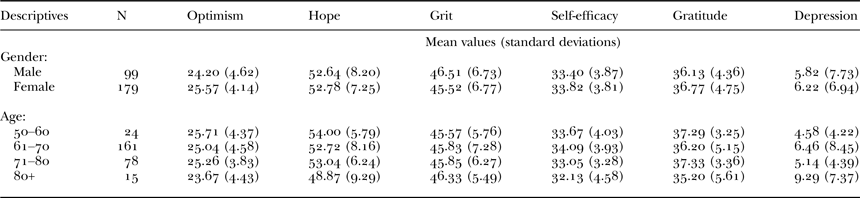
Descriptive statistics have been provided in Table 1. To determine if gender or age could affect the analyses, all variables were compared for significant difference on both variables. Only one significant difference was found in gender on the variables. Females reported significantly more optimism than males, F(1, 275) = 4.36, p = 0.012. The effect size was quite small at 0.016. Further to this, gender and optimism had a significant but very small correlation r(276) = 0.13, p = 0.04. No significant differences were apparent between age groups on all the positive psychological variables. Overall, due to the small effect size, and small correlation, between optimism and gender, and no effects for age, the correlation analyses and the multiple regression analyses that follow were not considered to be affected by gender or age.
Descriptive statistics of participant's optimism, hope, grit, self-efficacy, gratitude and depression scores

Correlation analyses
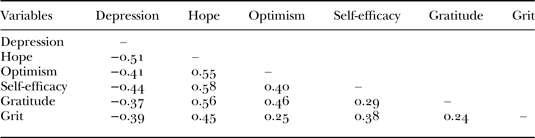
Results of the bivariate correlation analyses for all variables are provided in Table 2. Analyses between the positive constructs identified self-efficacy and hope as having the strongest relation, r(276) = 0.58, p < 0.001. The weakest relation was found between the traits grit and gratitude, r(276) = 0.24, p < 0.001. Whilst all positive constructs were related to each other, they were weak to moderate, indicating that all strengths are separate factors. As expected, all positive measures were negatively correlated with depression: hope, r(276) = −0.51, p < 0.001; optimism, r(276) = −0.41, p < 0.001; and self-efficacy, r(276) = −0.44, p < 0.001. All had moderate negative relations with depression, whilst grit, r(276) = −0.39, p < 0.001, and gratitude, r(276) = −0.37, p < 0.001, had weak negative relations.
Bivariate correlation matrix for the five identified positive psychological constructs and depression

Multiple regression
A standard multiple regression was conducted whereby hope, optimism, gratitude, grit and self-efficacy were defined as independent variables and depression as the dependent variable. A multiple regression analysis was conducted given that no a priori hypothesis had been made to identify the order that each predictor variable should be entered for analysis. G*Power 3 (Faul et al. Reference Faul, Erdfelder, Lang and Buchner2007) highlighted that a sample of 92 was required for this design (setting the a priori effect size to 0.15, p level to 0.05, power to 0.80, with five predictor variables). One outlier was omitted, leaving a sufficient sample size of 278.
Initial analysis of the residual scatterplot and normal probability plot highlighted nonlinearity and heteroscedasticity. As a result, the data were transformed using the square root method (Field Reference Field2009). The critical value of chi squared (20.52) was violated on seven occasions with the maximum Mahalanobis distance being 44.77 (case 69). This case was omitted due to it also being a significant outlier on the residual scatterplot. The other six cases included 38.59 (case 204), 28.22 (case 199), 27.97 (case 129), 27.72 (case 239), 27.02 (case 96) and 25.96 (case 106). None of these outliers were omitted because they were not identified as significant outliers on the residual scatterplot (Field Reference Field2009) and due to the sample size (N = 278) being appropriate (Pallant Reference Pallant2007). Subsequent review of the residual scatterplot and normal probability plot revealed normal distribution, linearity, homeogeneity of variance and independence of residuals. The multicollinearity assumption was met with tolerances above 0.37 and VIF values below 2.69. Perfect correlations were not found between the independent variables, hence, the singularity assumption was met.
Relation between depression and the five identified positive psychological constructs
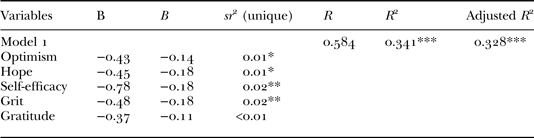
Results of the regression analysis model are presented in Table 3, and highlight that the overall regression was significant, R 2 = 0.34, F(5, 277) = 28.09, p < 0.001. This indicates that the five variables combined explain 34 per cent of the variance in the depression scores. Hope (t = −2.35, p < 0.05), self-efficacy (t = −2.96, p = 0.003), optimism (t = −2.36, p < 0.05) and grit (t = −3.21, p = 0.002) were all significantly associated with lower depression scores. Gratitude (t = −1.75, p > 0.05), however, was not a significant predictor. The unique variance associated with hope was 1 per cent (sr 2 = 0.01), optimism 1 per cent (sr 2 = 0.01), grit 2 per cent (sr 2 = 0.02), self-efficacy 2 per cent (sr 2 = 0.02) and gratitude <1 per cent (sr 2 = 0.007). That is, approximately 7 per cent of the total variance in depression scores can be attributed to the unique variance of the four underlying covitality components, which leaves 27 per cent of the variance being explained by the combined effects of the constructs.
Standard multiple regression of depression and the five identified covitality constructs

Note: sr 2: the squared semi-partial correlations indicate the unique variance predicted by the independent variable.
Significance levels: * p < 0.05, ** p < 0.01, *** p < 0.001.
Discussion
In contrast to previous research which has reported connections between certain negative aspects of old age and depression, the purpose of the current study was to assess the relationships between individual positive psychological constructs and depression in retirees. The co-occurrence of these psychological constructs (expressed as an example of covitality; Jones, You and Furlong Reference Jones, You and Furlong2013) was also considered in terms of predicting lower levels of depression. Given that past literature has often focused on the negative aspects of ageing (Ranzijn Reference Ranzijn2002), it is important that research identifies how individual positive strengths may enhance wellbeing and reduce negative symptoms such as depression.
The examination of gender and age differences produced only one significant difference. Specifically, females were more optimistic than males and there were no other significant differences found for either gender or age. Correlational analyses performed in the current study highlighted no perfect relation between the positive constructs, signifying that each variable was distinct from the others, and all positive constructs were negatively related to depression. Initial analyses highlighted weak to moderate relations when comparing all positive constructs with each other (Hair, Bush and Ortinau Reference Hair, Bush and Ortinau2000). The weakest relation was found between the constructs grit and gratitude (0.24), indicating that in order to be determined and persistent (i.e. grit factors; Duckworth et al. Reference Duckworth, Peterson, Matthews and Kelly2007) one does not require high levels of gratitude.
All constructs had a negative relation with depression; however, hope had the strongest (i.e. moderate) negative relation with depression, with all other constructs (gratitude, self-efficacy, optimism and grit) having weak to moderate negative relations. This indicates that retirees who report higher trait hope also reported fewer depressive symptoms. Due to the correlational nature of the current study, we cannot determine whether hope leads to lower feelings of depression, or whether lower feelings of depression lead to a greater sense of hope. However, the literature generally points to the likelihood that positive psychological constructs are buffers against depression in old age. Nevertheless, this is an area for future longitudinal research exploring the casual nature of these two constructs.
Results from the multiple regression highlighted that grit, self-efficacy, hope and optimism were all significant predictors of lower depression scores, with grit and self-efficacy being the most significant predictors. These results are consistent with past research comparing individual positive constructs and depression. Whilst there is limited literature regarding the positive trait grit, preliminary research has found a negative relation between grit and sadness (Singh and Jha Reference Singh and Jha2008). According to the literature, people who are depressed often have vegetative symptoms such as fatigue and difficulties engaging in activities. Furthermore, their negative thinking makes it difficult for them to engage in problem-solving (Feliciano, Renn and Areán Reference Feliciano, Renn, Areán, Hersen, Turner and Beidel2012). As a result, these factors would impact on a depressed person's ability to persist in and sustain motivation for long-term goals. Grit has also been found to increase with age (Duckworth et al. Reference Duckworth, Peterson, Matthews and Kelly2007); thus, it is not surprising that this positive construct was found to correlate with lower levels of self-reported depression symptoms in this population. Past research also indicates a relation between self-efficacy and depression. In a study by Kraaij, Garnefski and Maes (Reference Kraaij, Garnefski and Maes2010), coping self-efficacy (assessed by the question, ‘Do you believe that you can cope with difficult, stressful or upsetting situations’?) was assessed in people aged 65 and older, and those higher on coping self-efficacy were lower on depression. In particular, participants high on this trait used more task-oriented coping skills as opposed to an emotion- and avoidant-based coping approach.
Interestingly, the assumption that gratitude would predict lower levels of depression was not supported in the current study. This is in contrast to a study conducted by Lambert, Fincham and Stillman (Reference Lambert, Fincham and Stillman2011) that found that gratitude contributed to a decrease in depressive symptoms. However, the study of Lambert, Fincham and Stillman was conducted with undergraduate students; therefore, these results may not easily translate to the retired population. A possible reason for this difference may be due to other strengths, such as capabilities and determination, being more relevant in old age particularly given that loss of autonomy and health deterioration are more likely to be experienced by this age group (Bergin and Walsh Reference Bergin and Walsh2005). A further possible explanation, as indicated by research undertaken with university students by Watkins et al. (Reference Watkins, Scheer, Ovnicek and Kolts2006), is that older adults who feel unable to reciprocate when they feel grateful, due to infirmity or ability, may end up feeling indebted to others. As a result, experiences of gratitude may result in negative feelings and experiences. However, more research specifically focused on older adults is required to further understanding of this finding.
A final major finding of this study is that whilst the four positive personal constructs of hope, self-efficacy, grit and optimism were individually negatively related to depression, their combinatorial negative relation with depression was much stronger. This is consistent with previous research with other age groups that has found that individuals with higher levels of multiple positive psychological constructs report substantially higher levels of subjective wellbeing and lower levels of mental distress (Furlong et al. Reference Furlong, You, Renshaw, O'Malley and Rebelez2013, Reference Furlong, You, Renshaw, Smith and O'Malley2014; Guhn et al. Reference Guhn, Schonert-Reichl, Gadermann, Marriott, Pedrini, Hymel and Hertzman2012; Jones, You and Furlong Reference Jones, You and Furlong2013). This is a promising finding in that it indicates that efforts to enhance multiple positive traits (covitality) in retirees could have positive effects on their mental health.
Study limitations
A number of limitations have been identified in the current study. Firstly, most participants lived independently without assistance. As a result, these participants were more likely to be functioning at a higher level, particularly from a physical and cognitive perspective, and therefore may have reported more positive outcomes. Moreover, only 15 participants were 80 years or older in the current study. Given the prevalence of depression in the oldest-old (i.e. 85 years and over; Blazer, Hughes and George Reference Blazer, Hughes and George1987; Meller, Fichter and Schroppel Reference Meller, Fichter and Schroppel1996), researchers need to assess covitality and depression specific to this age group.
Another limitation relates to the questionnaire being a self-report measure, which can be subject to personal bias and influenced by participants responding in a socially desirable manner (Holtgraves Reference Holtgraves2004). This is particularly relevant given the high number of positive-based questions in the present study. The current study also examined covitality in the context of co-occurring positive strengths rather than assessing which combination contributes most to lower levels of depression. Thus, other positive psychology constructs such as justice, humanity and courage could be included as covitality factors in future studies. Similarly, given that depression was the only negative mental health condition examined, future researchers should consider assessing the relation between other positive traits and mental health disorders such as anxiety and substance use. Finally, as the current study was a cross-sectional research design, causality cannot be determined.
Implications and future directions
This research highlights a number of positive strengths experienced in later life, supporting the more recent idea of ‘successful ageing’. An implication of the current research is that mental health services directed at increasing positive psychological traits, such as self-efficacy, hope, optimism and grit, might benefit retirees. It is important to acknowledge the difficulties inherent in designing an intervention that could improve a range of positive traits. However, research studies such as this one may help uncover the constructs that are more and less receptive to change in certain populations, helping programme designers streamline their interventions towards areas where they feel they can have the most impact. This is particularly important given that research in gerontology (i.e. the study of ageing) and practices and policies in health care have largely focused on limitations rather than potentials (Ranzijn Reference Ranzijn2002; Russell Reference Russell2011). More recent research, taking a positive psychology approach to understanding ageing, highlighted that resilience and a positive outlook enhanced wellbeing in this age group (Vahia et al. Reference Vahia, Chattillion, Kavirajan and Depp2011).
The current study adds to the growing body of research available on the factors that support older adults as they experience retirement. Due to the increasing ageing population, more research needs to be undertaken in this area, so that our understanding develops of how to assist people during later life and enhance optimal living in retirement (Ranzijn Reference Ranzijn2002). It is important to understand further how the synergistic effects of positive personal traits – more recently termed covitality – can assist in successful ageing. Given that the study of the combination effects of positive psychological constructs is still within its infancy, future research assessing older adults from diverse socio-economic groups and with varying mental health conditions would also be beneficial to the field of psychology. Finally, the results of this study suggest that given Furlong and his associates (Furlong Reference Furlong2016) have developed scales for children, adolescents and younger adults, the development of a covitality scale for older adults in retirement is also a worthwhile goal for future research in ageing.