At the Galleria Pesaro in Milan in March 1923, there opened an exhibition of work by the Gruppo dei Pittori del '900. Though relatively small, it was inaugurated by the most illustrious of guests, President of the Council of Ministers, Benito Mussolini. He gave a short address, speaking as ‘an artist among artists’, and explained to his admiring audience that politics, ‘the supreme art, works directly upon the hardest and most difficult of materials, yet the most malleable: man’.Footnote 1 In Italian, Mussolini's favoured artistic material was ‘l'uomo’, which one might translate as ‘humanity’. But one might with equal cogency translate it as ‘the masculine’, for an experiment with masculinity lay close to the heart of the fascist revolution.Footnote 2
During the fascist ventennio, the malleability of the masculine was set over against an unblushing essentialism with regard to the feminine. The attitude of the Duce and his colleagues towards femininity is all too familiar: if woman was charged with a series of roles dictated by biology and male desire, man, by contrast, was charged with the creation of a new Italy, which required the moulding of ‘new men’. Whether these latter were to be brought into being by means of an emphasis on indelibly male characteristics is not something I am proposing to determine here. I have no wish to offer a discourse on the essence of masculinity.Footnote 3 I simply note that the desire to mould as yet hypothetical creatures demanded a quite remarkable proliferation of representations of the masculine. In the first decades of the twentieth century it was not only the masculinism of the Futurists that was speculatively preoccupied with the possibilities inherent in a creature whose energies would be directed only momentarily towards the creation of future generations. As a symbol of these aspirations it is sufficient to recall the occasion in 1906 when Vittorio Emmanuele II, responding to the eulogies of Gabriele D'Annunzio,Footnote 4 gave his permission for the removal of Michelangelo's Prigioni from the Grotta del Buontalenti in Florence's Boboli Gardens to the same city's Galleria dell'Accademia, in order to create the ‘Corridoio dei Prigioni’ – a gallery in which a series of male figures, appearing to want to free themselves from the unworked stone, culminates in the ideal physical glory of the David. I cite the episode merely as a reminder of how the cultural history of the twentieth century shows us repeatedly that, in the course of attempts to realize the ideological objectification of a ‘way of being’ (one whose necessity has been generally recognized, but which has not yet achieved fully coherent form), representations tend towards the more intuitively assimilated media of the visual arts and music, rather than towards verbal propositions which are more easily critiqued, more easily dissolved into chatter. Verbal propositions, furthermore, tend to focus on psychological propositions about what a man ‘is’ or ‘is not’, whereas ideology crystallized through musical and visual media tends rather to focus upon the body and how it moves.
In order to demonstrate the ideological collusion of music and painting with respect to the male body during the ventennio, I must first of all explain why the two arts converged in such an unusually intimate manner during this period. If the nineteenth century plumbed in depth the relationship between music and words, the twentieth, beginning with the rapport between Wassily Kandinsky and Arnold Schoenberg, intuited instead the potential fruitfulness of a relation between music and painting. The convergence was facilitated generically by painting's moves towards abstraction.Footnote 5 Noted below will be the extent to which the relationship was broadly felt in the years before and immediately after the First World War. Nevertheless this constitutes only a background to our investigation, since we must concern ourselves above all with a particular aspect, namely the continuity between abstraction and iconicity that was common both to music and painting with respect to the thematics of the male body in the course of the first decades of the twentieth century. A painter who moved in an explicit manner between these two poles was Enrico Prampolini, who, during the years of the First World War, was specifically preoccupied with the possible convergences between visible form, the human body in movement, and music. As we shall have opportunity to observe, he became a crucial figure in the elaboration of the visual culture of the ventennio. We must then also recall the work of Ernesto Michahelles, alias Thayaht, who explored this continuity in an equally inventive manner as a sculptor, but also speculated on how Luigi Russolo's L'arte dei rumori might furnish the basis for a new radiophonic art, and furthermore anticipated theoretically by more than fifty years the invention of the personal stereo. Finally we must briefly mention Fortunato Depero, who during the years of the First World War complemented his stylized but figurative painting with poetry made up of vocal sounds that only here and there combined to form recognizable words.
As far as the musicians are concerned, the facts are well known. Alfredo Casella, Goffredo Petrassi's mentor and a tireless proponent of the radical possibilities for Italian musical life created by fascist culture, was also a passionate connoisseur and collector of new painting. Coming into contact as a young man with the Parisian avant garde, he envisaged the possibility of a synthesis between the two arts. In a piece written in 1919, he asserted, ‘I firmly believe that the future of musical theatre – since by now the music-word combination is worn out – consists entirely of the union of the sound dimension with plastic visions: forms, colours, gestures etc.’Footnote 6 As far as Casella himself was concerned, that ideal remained elusive, even though his music was employed by Enrico Prampolini in various theatrical experiments. But his sense of a profound affinity between music and painting was transmitted to Petrassi, who in time became an equally passionate collector. The same sense of affinity was then transmitted by Petrassi to his pupil Aldo Clementi in the years following the Second World War (in fact, it fell to Clementi, in his Collage of 1961, to realize Casella's speculative vision).
Yet Petrassi denied with unfaltering consistency any direct link between a painterly vision and his compositions.Footnote 7 I must be concerned here not with direct influences, then, but rather with a cultural ambience in which the exchange of energies between the two arts was generally recognized. Thus I will be seeking to demonstrate how the music of the youthful Petrassi reflects and integrates itself within the multimedia propagation of a typically masculinist culture that characterized the years of the ventennio. In consequence, I shall not concern myself with those artists particularly favoured by Petrassi himself during this period (it should be remembered that, for all that he was an assiduous frequenter of galleries from his youth onwards, Petrassi developed personal friendships with a number of Roman painters only from 1940).
The almost dramaturgical, theatrical layout of Michelangelo's David in the Accademia in Florence (to which I have already drawn attention) may serve as a reminder of the extent to which the idealization of the male nude was granted a very special place in pre-fascist and fascist visual culture. With regard to the specific time span of the ventennio, it is sufficient to recall how the Stadio dei Marmi in Rome, constructed as the ceremonial centre for the sporting activities of the Balilla (the fascist youth organization), was decorated with somewhat kitschy but unambiguous reworkings of classical statues. This fetishism of idealized physiology contrasted strikingly with another approach to the masculine body during the same years, an approach that regarded it as the locus of ideological speculation. Here I must inflict upon you a terminological neologism. If this exchange of energies between painting and music that I have just referred to was able to flower, it is partly because each of these two arts possesses the capacity to form depleted isomorphs. By this I mean a representation whose fruitfulness depends upon its patent incapacity to offer, as it were, a ‘complete’ mimesis of lived experience. The more a representation is culturally accepted as a mimesis that approaches the perception of reality (like video today, for example), the less it is rendered capable of fulfilling this role.
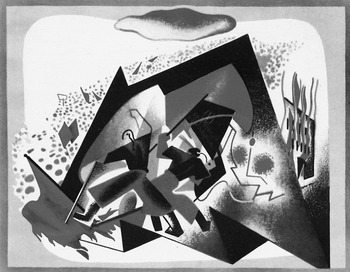
For a visual example, let us turn to the two energetic and gesturing male figures caught in some epic undertaking, reproduced in Figure 1: a panel painted by Prampolini for the extraordinary exhibition mounted in 1932 to celebrate the tenth anniversary of the March on Rome, an event that transformed the interior of the Palazzo delle Esposizioni in Rome into a vast experiment in futurist design. When we encounter bodily representations that, like these, calculatedly deplete those elements that our culture regards as ‘realistic’ traits, we are encouraged towards a mode of perception that may potentially be enriched:
1 by subliminal association of the resultant semi-abstract form with an ever wider network of partially analogous experiences;
2 by the relative freedom of the mind to engage in a free and dynamic play with the formal proposition that results – though an appeal to the disinterest theorized by Kant is not obligatory, given that the perceptual dynamisms produced by this play can themselves involve resonances from a wide range of vital experiences.
Enrico Prampolini, 15 Aprile 1919, mural, Palazzo delle Esposizioni, 1932, lost.

This is why our contemporary cult of realistic representation tends to impoverishment. For those who do not care to experience themselves as empty spaces enlivened by unpredictable echoes, it directs the mind towards the reassuring activity of understanding ‘what it is’ that is being represented, to a task thus fully discharged in recognition. For the resonances brought into play by the image you can see in Figure 1 to begin to operate, the representation of the two men depicted in Prampolini's panel needs to be sufficiently far down the path towards abstraction that the mind may resist closure of this kind – such that it may play among the echoes of a non-specific athleticism, a ballet, or a linear play of forces and colours. It is an interpretative openness in tune with the desire to view the fascist revolution in terms of an existential experiment. As can be seen from the ferocious reaction of the fascist boss of Cremona, Roberto Farinacci, and his anti-modernist allies, such openness is discomfiting to those who draw back when confronted by ambiguity, which means that the debate around modernism remains one of the most interesting (and current) aspects of fascist culture.
But the most potent abstractive force in Prampolini's panel lies in the way in which the dynamic gestures of these two male figures have been halted in mid-execution. Male dynamism, tensed before an immediate future, is freed from the bounds of realism because the temporal dimension has been expunged along with the visual detail. And this permits us to grasp one of the cardinal aspects, in the present context, of the complementarities between music and the visual arts. Music preserves temporal dynamism but sacrifices the sight and feel of the body. The visual arts renounce temporal dynamism, but preserve bodily form. Each medium makes its own sacrifice in order that what remains may constitute the arena for speculative experimentation with as yet unexhausted possibilities. Each contributes in its own way to the discovery of how the homo novus of fascism was to comport himself.
So far, so good. But the use of the iconic process in the evolution of gestural ideology occurs in a distinctive manner. This is because the relation between bodily gesture and mental state continually casts doubt on cause and effect. Gestures can be understood as communicating mental states; but they can equally be understood as inducing them in the gesturing subject. This was a fact emphasized by one of the most interesting precursors of fascist culture, Giovanni Papini.Footnote 8 Depleted gestural isomorphs thereby acquire singular ideological power. Whereas mimetic verisimilitude encourages one to observe ‘from outside’ something that remains irremediably ‘other’, once bodily reality has been reduced to a semi-abstract icon, the latter offers itself up to a pleasurable appropriation on the part of the observer. The depleted isomorph demands that one make it one's own by imaginatively fleshing out its manifest incompletenesses. But in so doing, it offers itself up to the brain's insatiable appetite for seeking out analogies. Each subject has his or her own ‘body-map’: the representation in the brain of the body. This body-map appears coherent to us because it is of necessity a synthetic abstraction from the welter of sensory stimuli presented to the brain. However much it is received intuitively as ‘my body’, this map of the body necessarily possesses the same reductive qualities that we have already noted in the iconic sign, and, like all other icons, is subjected by the brain to a process of comparison. If I have already appropriated depleted isomorphs that suggest how the male body might be (as in the case of the Prampolini panel), and if in comparing my own body-map with those depleted isomorphs similarities are recognized, then there accrues to me the narcissistic pleasure of realizing with my body – in effect, of ‘having become’ – that which was presented to me as an aesthetic-social ideal which I could only strive towards. It should be emphasized that it is only in the case of a partial depletion of the iconic representation of the body that this moment of ideological self-identification becomes possible.Footnote 9 It is perhaps for this reason that the exploration of line as a graphic sign becomes so important in the work of a Picasso, a Klee, or a Cocteau. It is symptomatic of a conviction: that the appropriation of certain bodily gestures allows one to explore ways of ‘being-in-the-world’ in a way not easily accomplished by words.
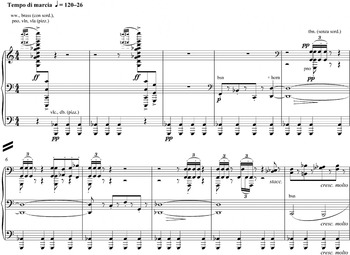
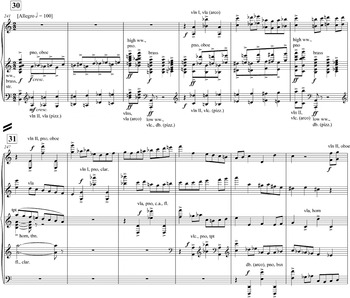
Of course, the musician will be quick to point out that, however problematic for words, that mode of acculturation has been music's province for centuries. Consider Bach's partitas and suites, or Couperin's Ordres. They are lessons in physical deportment: they say, ‘If you want to know who we are, move like this’. It is no accident that Goffredo Petrassi began his public career in 1932 with an orchestral Partita. But that backward look did not suffice. He had to come to terms with the masculinist experiment that surrounded him – and he had at his disposal a stylistic model that lent itself to the task. The ‘neo-classical’ march became a musical topos of great significance during the ventennio. It is hardly surprising that Petrassi should have decided on a march for the finale of his First Concerto for Orchestra of 1933–4, whose first bars are reproduced in Example 1. But this is not a simple glorification of military bearing (as can be found, for example, in a Marche militaire by Schubert). Rather, it presents a musical icon of the cocky young man, the ‘gagliardo’, which formed a fixed point in the representation of masculinity during the ventennio (see Figure 1). The fragmenting energies here can be coordinated only by means of a certain force. The angular, pianissimo gesture of the bassoon (bar 4) does not settle on the downbeat – which is then unhesitatingly asserted by muttering trombones. Everything only begins to fall into place after a first outbreak of violence (Fig. 1 in the score), suddenly disciplined by a menacing pianissimo, with pseudo-fanfares on cor anglais and oboe. These icons are calculatedly irregular: they barely submit to order, continually gesturing to the vitalistic chaos that threatens it.
Goffredo Petrassi, Primo concerto per orchestra, third movement, bars 1–19.

Continued

To grant these observations a more solid semiological basis, we can turn to a concept that Umberto Eco has derived from the writings of the American philosopher Charles Sanders Peirce.Footnote 10 In elaborating his typology of signs, Peirce introduced the concept of an ‘interpretant’. The full range of semiotic functions covered by this concept need not detain us here. But where ambiguous and multivalent signs are concerned, an interpretant is a sign that directs into a more exact focus the multifarious potentials for interpretation manifest in another, more ambiguous sign. Sometimes an interpretant is embedded within a representation. Such, for instance, are the march rhythms and fanfares that loom large in the finale of Petrassi's first orchestral concerto. But more frequently the interpretant originates from another semiological system. The most obvious examples are the titles appended to pictures and musical compositions. Let us return to the Prampolini panel reproduced in Figure 1. Although today it is reproduced with a title that refers to a specific historic event – 15 aprile, 1919 Footnote 11 – there is some doubt whether, in its original context, this panel was supplied with a title. But the title is at best only secondary. The interpretants embedded within the picture bring us to a more focused narrative about what the two men's undertaking might be: observe the colour of their shirts. Plainly these are Mussolini's ‘black shirts’, the shock troops of the fascist revolution. The left-hand figure has his foot upon what one of the few undulating curves in the composition allows us to interpret as a red flag. As soon as we have decoded that, a whole flood of associations and value judgements follows: the potential of the painting as an object of discourse has vastly expanded. But by the same token, our freedom to play with such interpretative and formal potentials as are unleashed by the work's abstract elements has lessened. The eye, guided by a logocentric brain, cannot tear itself away from the foot on the flag.
What we have here, then, is a fundamental rule in the economy of signs. Every interpretant that offers a hand-hold to the obsessive logocentric, bent upon bringing the world together through speech, is paid for by a deficit in associational echoes and potential for formal play. It is a fact intuitively familiar to painters and composers when confronted by the academics who make a living by projecting their creations into the ebb and flow of discourse. A Harrison Birtwistle takes refuge in gnomic monosyllables,Footnote 12 a Franco Donatoni in verbal fireworks. More relevant to our discussion are the tactics deployed by the brilliant but idiosyncratic art theorist and music-lover Carlo Belli. His book Kn, published in 1935, was acclaimed by Kandinsky as ‘the gospel of abstract art’. The book's title derived from the fact that for Belli, an exhibition of abstract works ought not to harbour fanciful titles, but should simply label the paintings k1, k2, etc. all the way up to kn. Plainly, he had a keen sense of the price exacted by an interpretant from the global potentials of a work of art.Footnote 13
But if one shifts one's attention from the play with visual representation and abstraction beloved of Prampolini and Belli to the renewed concert-hall life of early twentieth-century Italy, one encounters a more complex situation. There, I would suggest, the most powerful interpretant is not some evocative title printed in the programme, after the manner of so many works by Respighi, but rather the physical presence in the performing area of a score and a conductor. Since the mid-nineteenth century, the depleted isomorphy implicit in orchestral performance had taken on a distinctive social function. There is a fairly exact historical correspondence between the political praxis of increased, and eventually universal, suffrage, and the rise of the virtuoso conductor. As the scope of democratic suffrage increased, objections to the logical inconsistencies of democracy as a system of governance were submerged beneath sweeping assertions of its self-evident virtues. What could be achieved by concerted action under a single leader was something politics ceased to contemplate, only for the image to re-emerge as idealized symbol in the concert-hall. Essentially anti-democratic, the orchestra exorcized the bad conscience of democracy. In directing hysterical attention to the doings of football squads and their managers, we now expect sport to absolve the same function.Footnote 14
But, of course, the affirmation of the symphonic concert as a component of cultural life under the fascist régime created a quite different situation. The régime, like all products of totalitarian revolutions, insistently called attention to the defects of the democratic system. Orchestra plus conductor no longer functioned as an oppositional symbol, but rather as an icon – a depleted isomorph, if you will – of the political ‘status quo’. It was perhaps the unease deriving from this new semiotic potential that drove Toscanini to pursue his work abroad during the ventennio.
That the iconic relation comes into being is not due simply to the presence of a male figure who dominates and controls everything. The score was an equally potent symbol – a complex set of instructions created (by another lone male) as an image of how one might coordinate the creative energies of a mass of players. In the end, the score has the task of ‘conducting’ the conductor. For the audience at the concert it is thus the symbol of an occult destiny, a destiny that only the ‘maestro’ knows how to read. It is a situation that inscribes itself as one of the central symbols of musical modernism: one that, from Stravinsky and Berg up to Boulez and Berio, produces scores that are obviously unplayable without a conductor.
So we should not be surprised that the emergence of a talent like Goffredo Petrassi, a man of the people who went on to achieve international success with his first orchestral scores, was crowned with the offer of the job of general manager at the Teatro La Fenice in Venice (nor, alas, that a ‘boy wonder’ of similarly working-class stock like ‘Brunetto’, the young Bruno Maderna, should have provoked hysterical reactions in those same years when he appeared on the conductor's podium at the age of twelve). Both cases demonstrated the necessary relation between the individual, intuitive talent so valued by the prophets of the fascist homo novus (Papini or Giuseppe Prezzolini, for example) and the visionary but narcissistically impoverished role of the ‘maestro’, ‘capo’, or ‘Duce’. It is a homosocial relation studied by Luigi Dallapiccola in his first two operas, Volo di notte and Il prigioniero, and by Goffredo Petrassi in the hard-edged clangour of his first contributions to the rite of the concert hall.
Let us return to the finale of Petrassi's First Concerto. Its potential depends on the fact that its mimesis of cocky, swaggering energy was realized by instrumentalists (at that period certainly nearly all men) under the direction of a maestro (and, we should add, of a maestro effectively ‘directed’ by a score created by a young lion of fascist culture …). Here we see the emergence of a telling example of the semiotic triangle theorized by Peirce and further developed by Charles Morris. An ideological meaning (the régime's insistence upon nurturing, but then coordinating, the exuberant energies of young males) is created only because a stylistic signifier (the formal and gestural potentials of Hindemithian ‘neoclassicism’) is brought into focus by an interpretant from another semiological system: that is to say, the depleted isomorphs of the exercise of political and cultural power latent in the conventions of orchestral performance. The efficacy of that semiotic triangle depends entirely upon historical contingencies: without the chronological coincidence of certain stylistic possibilities, of the enlarged importance of the concert hall in Italy, of the régime's faith in masculine youth, the semiotic transaction would not have come into being.
The corner of the triangle I have so far kept under wraps has to do with the stylistic potentials of musical ‘neoclassicism’. The role of historical contingencies in the creation of semiotic potentials is underlined here once again. Notoriously, ‘neoclassical’ is not a satisfactory term. If anything, one should speak of ‘neo-Baroque’, of the recreation of a continuous pulsation that, in its original context, counted out the articulation of an eminently functional and organic harmony. When that idiom's rhythmic and cadential gestures were revived in the twentieth century, it was in a context of diminished harmonic functionality. There were cadences and harmonic resolutions, to be sure, but they served to create moments of closure within a harmonic grisaille whose capacity to create marked tensions and releases was deliberately reduced. The impulse towards such abstention was not perhaps motivated solely by the desire to avoid pastiche. There was also the possibility of creating iconic possibilities that were not present in the original idiom.
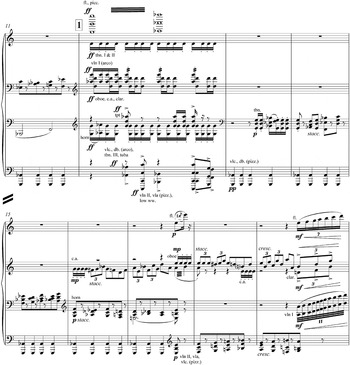
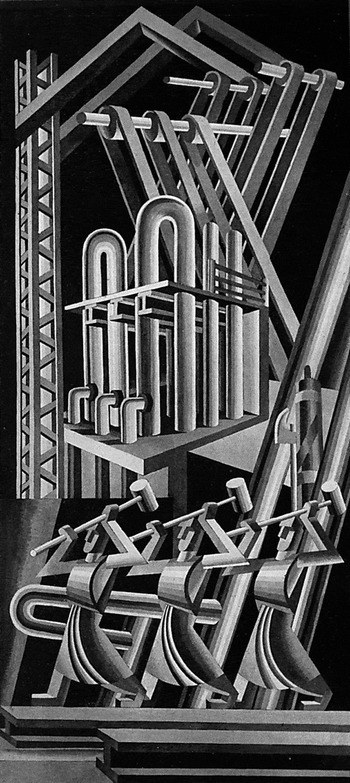
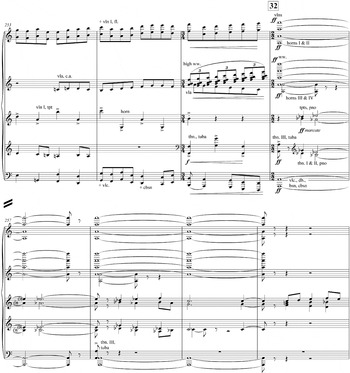
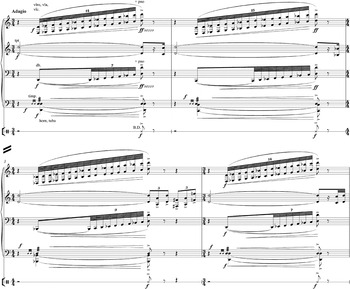
In an era when people were meant to find satisfaction in calm and motivated collaboration with others, happily submitting to the authority of a director (often in a context of industrial production) there arose irresistible opportunities for public art. A visual example, from the Prima Mostra Nazionale di Plastica Murale, staged in Genoa in 1934, can be found reproduced in Figure 2. This design by Fortunato Depero, intended to adorn a Casa del Fascio or local fascist party headquarters, bears a title rich in interpretants: Questa è la guerra che noi preferiamo (This is the War that We Prefer), a punctual quotation from the speech with which Mussolini greeted the creation of the city of Littoria, now Latina. The visible ‘throb’ created by repetitions of male bodies, figurines that represent precisely a depleted isomorph typical of the epoch, reminds us of the rhythmic regularity so dear to the ‘neo-baroque’ idiom of the ventennio. In fact, for an acoustic symbol of collective labour, of the submission to communal work under the aegis of authority, one need look no further than the first movement of Petrassi's First Concerto, an extract from which is shown in Example 2 (see pp. 24–5).
Fortunato Depero, Questa è la guerra che noi preferiamo, design for Prima Mostra Nazionale di Plastica Murale, Genoa, 1934. Lost; reproduced in Gli ambienti della nuova architettura, ed. Fillia (Luigi Colombo) (Turin: UTET, 1935).

Goffredo Petrassi, Primo concerto per orchestra, first movement, bars 241–60.

Continued

Obviously, the busy dynamism of Petrassi's music does not bear a title that can act as an interpretant. The musicologist who wishes to venture into nonverbal culture has necessarily to work in something like the manner of that great exponent of critical theory who answered to the name of Theodor W. Adorno. He or she must call forth an interpretant verbally – solicit the reader's intuitive consent – in order then to proceed to the elaboration of a critical argument based on the interpretant's seductive power. But in the best of Adorno's work, a stylistic characteristic almost always forms the basis of this kind of suggestion. Example 2 is typical of the movement from which it is extracted, a movement striking for the almost total absence of upbeats (except where disfigured by a continual hammering). Every phrase begins on the downbeat. In a social context, upbeats serve to coordinate the acts of individuals who interact with their peers. They ask for assent: one thinks of the minuet, or any other dance movement. The progress of collective energies directed by authority towards a previously defined goal thus has no need for them.
At first glance we seem to have arrived at an image typical of any mass society organized in a totalitarian manner. Similar things could also be found at the same period in the Soviet Union or the Third Reich. But the particularity of Italian culture in the 1930s was the coexistence of this tendency to the glorification of obedience with the cult of the exceptional, innovative male: the cult of men, that is, creating new potentialities in an unceasing subjective revolution. It was a revolution that depended signally on a specific phenomenology of time (and that therefore lent itself to objectification in music). The young lions of fascist modernism had no regard for the cult, dear to nineteenth-century bourgeois culture, of contemplative, ‘passéist’ time, a time in which a network of recollections disposes the perception of the present to a vision resonant with echoes. This is a network set in motion by chains of reactions between memory traces, whose phenomenological dynamism thus involves a continual alternation of emotional condensations and rarefactions, of which ‘expressive’ music, from Schubert to Berg, provides a depleted isomorph particularly seductive for listeners deprived of confidence in the richness of their interior lives.
In ‘activist’ time, by contrast, the past is not contemplated: we trust its presence to furnish us with the experiential traces that permit us to react decisively and intuitively to what is going on outside our heads. If nothing is going on, we will provoke it by means of movement, preferably rapid, since that way the continually changing situation constantly demands new intuitive responses. It is the arena of provocative and reactive gesture: of street fights, of sex, of play with the unknown (whether person or situation), cultivated by those who experience the past as oppressive. Every ‘destiny’ is rebelled against, except the ineluctable one of death. To construct oneself in terms of this reactivity to novelty is to demand inexorable energy and alertness of vision. It is for this reason that, in music as elsewhere, one male Eros was substituted for another. Inchoate male energy found its new apotheosis not in the Wagnerian erotics of the orgasm, but rather in the futurist erotics of the male love-affair with machines. Unlike sexual erotics, ‘man-plus-machine’ can go on and on. Modernism had learnt from Baudelaire the extent to which la chair est triste, precisely because it ends in yielding and exhaustion. Masculine narcissism could thus leave behind the eternal crescendos and diminuendos of carnal eroticism in order to dedicate itself to the seductions of an energy that was mechanical and continuous, an energy that could be turned on and off at a stroke, by an act of will. For Casella and his disciple Petrassi, the result was new formal possibilities, exemplified in the scores of Stravinsky. Blocks of musical material, internally animated by these energies, could be juxtaposed to create the iconic illusion of movement through an abstract musical architecture. Architectonic discipline is hereby applied to the mimesis of fascist male vitality.
And yet, in this new love between man and machine, a stoic fatalism came into play. The non-organic energies of man-plus-machine erotics have a genuine and explicit relation to their nemesis. In Wagnerian eroticism, the dangers of sex – its capacity to kill by means of syphilis (today AIDS) – lie in wait, contingent and hidden. But the dangers of mechanical erotics are plain. Your fate is in your hands. You can kill yourself, if you so wish, in an act of conscious self-annihilation. Such is the ethos evoked by Dallapiccola's Volo di notte (1937–9) and ironized by Petrassi ten years later in Morte dell'aria, where a man attempts flight in the absence of an ecstatic union with a powerful machine, falling to an undignified death. The deliberate and stoical scrutiny of destructive forces was a key constituent of the masculine ethos of the ventennio. One of the young artists displayed in the 1923 exhibition to which I referred at the start was Mario Sironi. His determination to make art out of the modern industrial landscapes of the southeast suburbs of Milan produced a quite distinctive body of work: gaunt, undecorative, and uncompromising. And the same dour stoicism of mental gesture, the same calculated lack of grace, was apparent in the best music of the period. It is an attitude reflected in those moments of parsimonious violence that Petrassi liked to call his ‘moments of rupture’ (lacerazioni). One of these can be found at Fig. 1 in Example 1 (albeit announced and, as a consequence, mitigated by a crescendo). But the classic example, recognized as such by the composer, is provided by the two brutal trumpet chords that interrupt (bar 10) the introduction to Coro di morti (1940–41), a ‘dramatic madrigal’ setting lines from Leopardi's grimly ironic Dialogo di Federico Ruysch e le mummie, in which the physiologist Ruysch, having put together a collection of Egyptian mummies, to his astonishment overhears them singing together in his study, and learns from them what it is like to be dead. As Petrassi commented, the moments of rupture ‘intervene […] like shocks. Like sudden impulses of unexpected reactions’.Footnote 15 They thus formalize the attention to events of unexpected destructiveness that necessarily formed part of the man-plus-machine relation on the brink of the Second World War. But, as Petrassi himself suggested, what counts is the formal discipline imposed by these moments of rupture. We are not dealing here with narration, with the mere illustration of a state of mind. It is a question, rather, of a formal tension between the juxtaposition of blocks of internally animated material that create in the listener the expectation of a calm and sober succession (in effect, a play of temporal proportions) and the unpredictable and fleeting eruption of an autonomous dimension, that of the unbridled energies which are always latently present.
Although both aeroplane and motorbike were intensively developed as extensions and potentiators of the male body during the thirties, it was the aviator that became the main icon of masculine daring in Italy (the iconic apotheosis of man-plus-motorbike had to wait until 1950s America). Those who have studied the armed forces in Italy during the 1930s have noted the extent to which the army and the navy had to fight to attract the attention of the régime, while the air force, thanks to the captaincy of the transatlantic hero Italo Balbo, was installed at the centre of public and official attention.Footnote 16 The air as a new dimension for the male to dominate (and dominate with a flexibility and elegance never before available to him) was an obsession for Marinetti and the Futurists. Aviators and artists became interpretants one of the other: both created from their own instinctive resources a multi-dimensional and abstract grace. An aviator thus became ‘almost’ an artist: like an artist, an explorer of new dimensions. Both directed an audacious and provocative gaze at external reality.
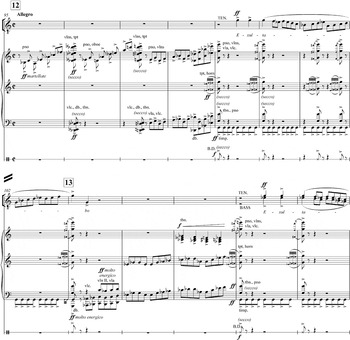
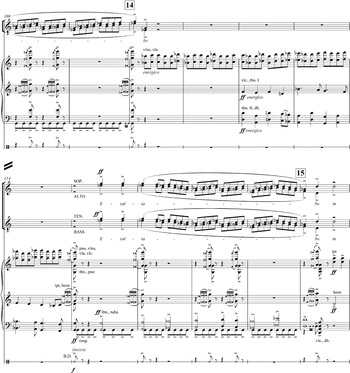
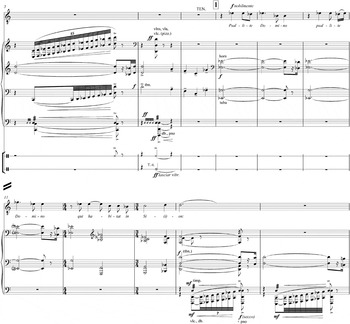
The brotherhood of artist and aviator was consecrated, on the part of the Futurists, by the cult of the various ‘aero-’ arts. Of Marinetti's Aeropoesia and Aeropittura, we need not speak here. But in 1934 he launched his Manifesto futurista dell'aeromusica sintetica, geometrica e curative (Futurist Manifesto of Synthetic, Geometric, and Therapeutic Aeromusic). According to Marinetti, this as yet hypothetical genre was to convey modern Italy's ‘great dynamism: economic, erotic, aviational, mechanical’. If this music was to be ‘curative’, it was ‘not as a distraction from life, a consolation for its sadnesses and a balm for its sufferings, but in order to foster the recuperation of the dynamisms of the human motor’.Footnote 17 As Fiamma Nicolodi has noted, convincing examples of aeromusic are somewhat thin on the ground.Footnote 18 I have already mentioned how Dallapiccola could not resist attempting to explore the new man-plus-plane ethos in his first opera, Volo di notte. But that is a work that treats of the psychology of the relations between dashing young aviators and their relentless, ground-based director, Rivière. There is at the end a magical evocation of the night sky seen from a plane, but not of the corporeal thrill of the relation between an aviator's body and his machine. Nevertheless, that potent combination of mechanical throb and aerial convolution as felt by the body was a natural topos for musical iconicity. When in 1934, the year of Marinetti's Aeromusica manifesto, Petrassi decided to embark on his next major composition, he planned a setting for choir, brass, piano, percussion, and strings of Psalm 9. Naturally, such a text is unlikely to point the creative imagination in the direction of the erotics of flying. And indeed much of Petrassi's setting is devoted to the vigorous, syllabic choral idiom – whether chordal or polyphonic – that befits the rendering of a long text through music: with the exception of Figs. 17–26, in the first part of the work vocal melismas are rare. Yet when in the second part of Salmo IX the psalmist celebrates how the power of the Lord will help him defeat the earthbound enemy, by having him swallowed up in a pit, Petrassi is too much a child of his time not to produce gestures of mechanical pulsation, and stylized vocal lines that swoop and flow. I do not for a moment pretend that the setting in Example 3 (see pp. 26–7) constitutes the sort of graphic mechanical mimesis that Marinetti probably envisaged. But within the stylized neo-Baroque conventions that prevailed in the 1930s, one may at least pause to consider whether Petrassi is not addressing himself to the God of aviators, through whose power earthbound enemies are swallowed up, by the craters created by aerial bombing.Footnote 19
Goffredo Petrassi, Salmo IX (1934–6), Part II, Figs. 12–15.

Continued

It may not have escaped the reader's attention that, with Salmo IX, a new and potent influence had impinged on Petrassi's musical imagination. In 1933, the year before Petrassi began his first major choral work, Casella had conducted in Rome the Italian concert première of Oedipus Rex, which Stravinsky had completed in 1927. It made a profound, and in many ways seminal, impression on Petrassi, and indeed upon the ethos of fascist music-making at large. Here was a demonstration that neoclassicism was capable of taking on the most serious and fundamental issues. It is a mark of the esteem in which Oedipus Rex was held that, to celebrate the tenth anniversary of its première, it was staged at the Florence Maggio Musicale in 1937. In other words, the picture of general neglect and miscomprehension towards the work in the thirties that Stephen Walsh paints in his book on Oedipus Rex might profitably be called into question, at least as far as Italy is concerned.Footnote 20 Petrassi was not one to conceal his debts. Example 4 (see pp. 28–9) shows the opening of the second part of Salmo IX.
Petrassi, Salmo IX, Part II, opening.

Continued

That the brusque seriousness of Stravinsky (his willingness to start and stop motoric processes with the determination of one plotting out a large-scale musical architecture) was intensely congenial to those striving to create the masculinist ethos of 1930s Italy can be shown time and again. Fiamma Nicolodi, in her Musica e musicisti nel ventennio fascista, shows in a table the number of operas and ballets by living foreign composers sanctioned by the splendidly named Minculpop (Ministero della Cultura Popolare) to be performed in state-supported theatres between 1935 and 1945. These being the years of the Pact of Steel, the top place goes, predictably, to Richard Strauss with twenty-four. But the next is Stravinsky with ten. Below him are Falla with four, and Ravel with three. All the others – and the list is extensive – have only one or two.Footnote 21 Strauss's impact upon the stylistic practice of fascist music was arguably minimal. Stravinsky's, on the contrary, was inescapable. That Stravinsky was tough, and that a fascist aesthete had to be tough enough to cope with him, had been clear to Mussolini. Back in 1923, when, as was noted above, the new head of the government was defining himself as an artist among artists, Mussolini had been compelled by his other duties to miss the Italian première of the first part of Le sacre du printemps, conducted by Bernardino Molinari. Afterwards, he wrote to Molinari, ‘I deplore – how I deplore! – having missed the Stravinsky!’.Footnote 22 This was not, it seems, a passing phase. The critic Hans Stuckenschmidt, soon to be silenced by the Nazis, writing in the Berliner Zeitung of 15 January 1934, observed how
Mussolini's Italy is today a refuge of cultural progress. It favours and gives room to youth and is well aware that new forms of artistic expression signify not destruction but construction. The young fascist architects are not so distant from Le Corbusier and the Bauhaus. Futurist poetry and painting are by now officially accepted. And when it comes to music, the Duce himself has intervened in an exchange of contrasting opinions between conservatives and youth, and has declared himself for Stravinsky.Footnote 23
The regard was mutual. Alberto Gasco, in the chapter ‘Stravinsky e il fascismo’ from his Da Cimarosa a Stravinsky of 1939, recorded an interview with Stravinsky immediately after the composer had met Mussolini. According to Gasco, Stravinsky described the encounter as ‘one of the happiest events of my life’. He had met ‘the one man who counts in the whole of today's world’, who was ‘the saviour of Italy […] and of Europe’.Footnote 24
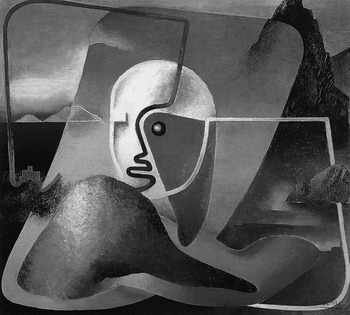
The sense of square-jawed determination to confront the serious things of life, abetted in the case of music by a sober version of Stravinsky's neoclassical mode, was everywhere apparent. The male gaze, denounced with such vigour by feminists in the second half of the twentieth century, remains the indispensable prerequisite for this joy in the tactical manœuvre of the body. This is so much the case that, when we look at the numerous modernist portraits of that untiring protector of radical art under the régime, Marinetti, we find even in the versions closest to abstraction (like Figure 3, for example, a portrait painted by Prampolini in 1933) that the eye remains the focal element of a classic depleted isomorph. This portrait may stand as an iconic summa of all that has been said so far on the topic of the male body. Prampolini depicts a Marinetti, as much a swimmer as a pilot, engaged in elemental eroticism with the fluid media of water or air. The head may be wearing a bathing-cap or an aviator's helmet. The image underlines the semi-mystical import ascribed to the contact between the male body and the more dangerous elements of the natural world. But everything is concentrated on that eye …
Enrico Prampolini, Ritratto di Marinetti poeta del Golfo della Spezia, 1933–4, oil on canvas. 82×73 cm, private collection.

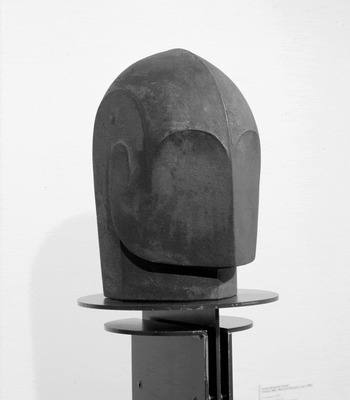
Of course, all this male energy – this mix of spontaneous impulse and meticulously counted rationalism – required direction. This required the creation around the Duce of an iconography that inspired belief in the salubrious necessity of male authority. Out of the massive iconography that surrounded Mussolini, I would like to draw your attention to one creation that played a particularly significant role in articulating the relationship between Mussolini and the artists who identified with his régime. Let us compare Prampolini's portrait to another classic depleted isomorph of the period: a sculpture – or, as the artist termed it, a ‘plastic synthesis’ – entitled Dux by the Anglo-Swiss artist Ernesto Thayaht (1929). It is reproduced in Figure 4. This was an image that enjoyed such success that Thayaht recycled it in his sculpture La prua d'Italia of 1930 and, later, in the medal struck for the Prima Adunata Professionisti ed Artisti in Rome in 1932.Footnote 25 Once again we are dealing with the remodelling of the male head as a helmet, underlining in both cases that the essential thing is to protect the masculine brain, the locus of the production and of the appropriation of all the icons of masculinity with which the homo novus was being constructed.
Thayaht (Ernesto Michahelles), Condottiero (Dux con pietra miliare). Stone and iron, 120×49×30 cm. Museo di arte moderna e contemporanea di Trento e Rovereto.

It is hard to tell whether the Duce appreciated the art of the avant garde with sincere enthusiasm. But it is clear that his sensitivity to the need to look out for the young lions, and his disdain, repeatedly expressed to his biographer Yvonne de Begnac, for Hitler's deplorable incompetence with regard to advanced art, were masterfully exploited by the high-ranking fascist Giuseppe Bottai, Marinetti, and others to protect artistic freedom. In any case, the Duce liked this sculpture. Claudia Salaris relates that, on seeing a photograph of Thayaht's ‘plastic synthesis’, he observed that ‘this is Benito Mussolini as Benito Mussolini likes to think of himself’.Footnote 26 It is fair to ask whether we are dealing here with something more than dictatorial narcissism. An ‘artist’ like Mussolini, who had long prohibited photographs of himself caught in unflattering poses during his orations to the adunate (mass gatherings) in Piazza Venezia, would perhaps have understood intuitively that what was necessary to give psychological substance to the relation between the Duce and those he loved to command was not those eternal idealized portraits that were ubiquitous throughout Italy but, precisely, a depleted isomorph. Depleted, we should note, in terms of the eyes. Young artists could be allowed to grant themselves a cocky and defiant look. But Mussolini already understood instinctively the workings of destiny and thus had no need of the gaze of a Marinetti, fixed on future potentialities.
In February and March 1934 an exhibition of futurist Italian ‘aeropittura’ was mounted at the Hamburg Kunstverein, and then at the Flechtheim Gallery in Berlin. The Berlin exhibition was inaugurated by Marinetti himself, with an honorary banquet organized for him by the poet Gottfried Benn. In a typically shrewd move, Marinetti countered the ‘anti-modernist’ polemics that he knew would flow from the Nazi cultural establishment by placing at the entrance Thayaht's Dux – which, of course, critics had to abstain from rubbishing since the Duce's enthusiasm for it was well known. Nevertheless, attacks from the Rosenberg press upon modernism continued. Hitler followed these up when, at the NSDAP Congress in Nuremberg in September 1934, he denounced modern art as degenerate. Prampolini immediately responded in the futurist review Artecrazia: ‘Now that the great masters of German Expressionism have emigrated elsewhere, and this typically German artistic movement has been banned, upon what does Nazism hope to build up its aesthetic and artistic foundations?’Footnote 27
Mussolini hastened to agree. When discussing the issue with his biographer Yvonne de Begnac, he asserted that:
The culture of fascism has never spoken of degenerate art. Art […] is art and nothing else. If the Germans deny the validity of futurist painting, too bad! We can console ourselves with the Russians, who adore it. A revolution's culture, to show its validity, must invent that which has never been attempted, not knock down that which has established itself, and even won acclaim.Footnote 28
More cuttingly, he added:
The Führer is wrong when he accuses Italian futurism and its most important offspring, Russian futurism, of being Levantine and even non-Aryan. Sometimes the Führer reasons like Mr Lenin, who considered the Bolshevik literary avant garde to be composed of eminent cretins.Footnote 29
He also hastened to the defence of the warrior-aesthete, Marinetti:
Marinetti, whom with his futurism I consider a pillar of the revolution's culture, does not enjoy the sympathy of either Rosenberg or the Führer. He tells me that National Socialism, by the very act of declaring the artistic avant gardes anti-national, abandons any right to call itself revolutionary […]. I have never understood why a man like the Führer should have permitted to be unleashed in his country the battle against expressionism which, according to my friend Oppo, is the most elevated manifestation of German art in this century.Footnote 30
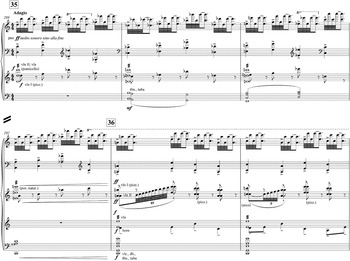
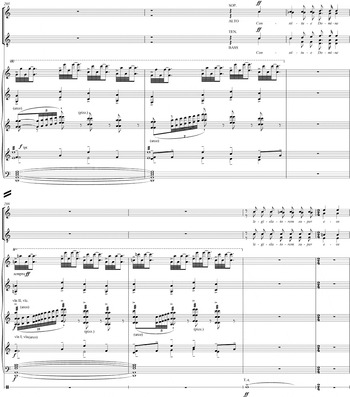
All that in 1934, the year in which Petrassi started work on his Salmo IX, from which we have already seen two extracts. As Petrassi himself tells the story, with his usual frankness, his choice of that particular psalm – singularly aggressive and triumphalistic as it is – was not entirely innocent.Footnote 31 Like Thayaht, Petrassi was moved to propose a ‘plastic synthesis’ of the Duce, so that his selection of this psalm was at least in part motivated by its last verse:
A musical portrait of Mussolini legislator and aesthete raised some rather important aesthetic questions. The absence/presence of the gaze can perhaps be defined as one of the fundamental gestures for the masculinity of the 1930s. But can a male listening be identified with equal confidence? Here, once again, we must turn to the exchange between an ideology of temporal experience and the behaviour of the senses. The male gaze is concerned with tactical comportment, with the body's reaction to an immediate situation. Cultivated listening in a concert hall, by contrast, is concerned with strategy. We are no longer dealing here with a Beethovenian teleology. The world of the fascist ‘neo-baroque’ did not identify with the anxiety of a Brahms, faced with the duty to emulate his great predecessor's isomorphs of sustained purposefulness. If the fascist ‘neo-baroque’ aspired, as Petrassi did in Salmo IX, to respond to the ambitious architectonic of Stravinsky's Oedipus Rex,Footnote 32 it was precisely as a valid alternative to this all too obviously German aesthetic ideal. And to ensure that the juxtaposition of ‘blocks’ is not perceived by the listener merely as a decorous succession, Petrassi has recourse to the formal challenge of the moments of rupture discussed above. Moments of rupture are certainly to be found in Salmo IX. But here, in the final pages, they would have been out of place. As ever, that part of the universe of representations that falls to music is precisely bodily movement. And as one can clearly see in Example 5, this aesthetic legislator strides with measured certainty and implacable step towards his task of remoulding man – ut sciant gentes quoniam homini sunt.
Petrassi, Salmo IX, Part II, Figs. 35–37–1.

Continued