Tracing the boundaries of religion under Western modernity has remained one of the great ongoing quests of social science. At times this grand project of conceptual cartography has appeared settled. For example, it was briefly fashionable to situate religion as that which is opposite to reason. Yet, this version of Whig history has fallen out of favor; recent scholarship suggests that this position erases the role of reason in many religious traditions and overlooks the historical continuities between religion and the Enlightenment in European history (e.g., Taylor Reference Taylor2007; Siedentop Reference Siedentop2014).
Certain intellectual tendencies inherent in Western modernity have greatly complicated endeavors to map the place of religion. The critique of power—and especially of the relationship between power and knowledge found in postmodernism, postcolonialism, and reflexive anthropology—has culminated in a conception of religion which is so entangled in various stories of domination that it has become impossible to conceive of an isolated, essentialized concept of religion (e.g., Asad Reference Asad1993; Masuzawa Reference Masuzawa2005).
Perhaps the most promising, and certainly the most prodigious, path out of this conceptual confusion has been offered by secularization theory. To those who would wonder about the boundaries which separate religion from politics and society in modern, Western countries, secularization theory offered a reprieve. Religion, secularization theorists argued, was declining. The inevitability of religious decline, whether driven by the privatization of belief or the modernization of the economy or the differentiation of authority offered a compelling justification for calling of the quest to draw the conceptual boundaries of religion. Why map a disappearing country?
At some point in the late 20th century it seemed as if religion in the West had been washed away by alternating tides of positivist prognosis and postmodernist critique. Yet, the demise of religion as a core social science concept was short lived. This is not necessarily because the forecasts of secularization have faltered; classic measures of religiosity continue to decline apace in the West. Instead, social scientists have begun to wonder whether there might be some other, unmapped aspects of religion which are not caught up in the process of secularization and whose endurance is of some social consequence.
Do-it-yourself religiosity, implicit religion, civil religion: these are just a few concepts by which contemporary social scientists study stuff which is similar-but-not-too-similar to traditional religion (e.g., Echlin Reference Echlin1995; Angrosino Reference Angrosino2002). The idea that in the secularized West religion—or something conceptually similar—retains some influence over social life is not merely a fantasy retained by the faithful or by social scientists of religion desperate to retain relevance. Recent political events have stirred much public debate over what might constitute a religion under the conditions of contemporary secularized modernity.
Public concerns over the boundaries between religion and politics have not been driven by revival, nor even by the religiously-infused violence of contemporary global terrorism. Instead, intellectuals, politicians, and members of the public have been inspired to revisit the boundaries between these core concepts by a series of social and political dramas including the rise of authoritarian-style leaders, populist movements, xenophobic state policies, and other related developments. If such developments seem to defy many of the premises of typical secular-modern theories, perhaps it is best to think of them as in some sense religious (and, that being the case, perhaps it is time to rethink what is meant by religion)? This, at least, was the motivation for a debate which broke out in American media in late 2018, as writers and public intellectuals in venues from The Atlantic to the New York Times debated a New York magazine article by Andrew Sullivan in which the essayist posited that new social movements (from left to right) are best understood in religious, rather than political, terms (Sullivan Reference Sullivan2018; Wood Reference Wood2018; Jacoby Reference Jacoby2019).
Such dramatic public debates should inspire scholars to revisit the conceptual relationship between politics and religion in modern, Western societies. This is not, again, because such concerns have been historically overlooked; such inquiries have been at the core of religious studies, the sociology of religion and related subfields. Rather, contemporary events across the West should encourage a re-mapping of these most central concepts in the light cast by still-unfolding social drama.
What is sacred in contemporary, secularized countries in the West? Such a question, which might have been absurd 50 years ago and audacious only a decade ago is now relevant and necessary. Developing an answer to this question will not only offer a new look at the boundaries between religion and politics, but also offer a novel perspective on contemporary social and political crises.
In answering that question, this paper does not attempt to articulate or test the conditions under which something might become sacred in a contemporary, secularized country. Instead, this paper seeks to develop concepts and demonstrate the relationships between them. Specifically, this paper seeks to identify and name the varieties of ways in which religion (including traditional religions but also emerging beliefs and quasi-religious movements) can enter public life in an already-secularized society.
This concept development concludes in a theoretical argument: that contemporary processes which have been understood as opposed—religious fundamentalism, new religious movements, ethnic nationalism, and religious pluralism—can be counted as constituent parts of a single process, here called “post-secularization.” This process of post-secularization shares a historical relationship with secularization: the decline of traditional religion is seen as a fissuring process, in which a relatively stable “sacred” is broken down, its scattered parts being repurposed to different ends.
In order to develop these concepts and arrange them into a meaningful theoretical statement, this paper focuses on a single case. There are several competing logics to selecting a case for concept development. One might select a case that is striking or contains certain exaggerated features, for example a society that is prone to intense conflicts at the border between religion and politics. Alternatively, one might select a case that seems especially consequential; in a globalized world, it may be that large and politically influential societies such as the United States might influence other countries.
This paper follows none of those rationales, focusing instead on the small island nation of Iceland. Iceland resembles contemporary post-industrial societies in many ways: its politics, economy, and culture are not dissimilar from the larger collection of Western nations which this paper hopes to better understand. However, Iceland is unique in an important way: the entire society contains fewer than 500,000 people. In this way Iceland can function as an “exceptional-typical” case: it resembles adjacent societies, but its smaller size can allow researchers to observe large-scale social change more easily. Given this more observable scale, Iceland is an ideal case to develop concepts and demonstrate relationships between those concepts.
In order to analyze the case of Iceland and develop concepts, this paper proceeds by offering a general introduction to the case. This is followed by a brief discussion of how the secularization debate applies to the Icelandic case; while certain markers of religious decline are demonstrated, it is also suggested that the theoretical value of secularization theory has been spent, and that new concepts and theoretical frameworks are required to analyze religion in contemporary Western societies. This paper proceeds to document and analyze a variety of forms of post-secularization, including what we call commodified religion, identitarian religion, and elementary religion. Finally, the paper concludes by comparing the ways in which globalization might implicate national-level post-secularization.
ICELAND: AN EXCEPTIONAL-TYPICAL CASE
Contradiction seems as natural to the nation of Iceland as cod or glaciers. The country markets itself as a “land of ice and fire,” a place of snow-peaked volcanoes, a land where steaming geothermal baths bubble mere feet away from the frigid waves of the north Atlantic. Its contradictions are not merely geographic, but civilizational; remote and removed from the continent, Iceland is still faintly European. This is a country founded by infamous warriors, a raiding people. But the Icelandic Vikings had a sensitive side, recording their adventures in alliterative verse. It is a country of ice but also fire, established by ancient pirates, but also by poets.
It is little surprise, then, that Iceland's religious environment should appear as contradictory as its natural environment and its history. Iceland is, by some measures, an intensely religious nation. The country has a state church (“Þjóðkirkjan”), the Evangelical Lutheran Church of Iceland. Compared to many state churches in the West, Iceland's official faith is thriving: the majority of Icelanders baptize their infants in the church, and the majority of Icelanders remain officially registered congregants (e.g., Hagstofa Íslands 2015). Yet, the country is not immune to the trends that have washed over religious life in the late modern West: weekly church attendance has declined over the decades, and even as the majority of Icelanders retain formal ties to the national church, a growing proportion of the population evinces little to no faith in a creator God. Indeed, if one measures religion by belief, Iceland could also be categorized as highly secular country.
These contradictory features make Iceland a compelling case for thinking about religious life in the West. Indeed, Iceland has occasionally been used to test the grand theoretical pronouncements of sociological theory. The historian Pétur Pétursson, for example, has suggested that the history of religion in Iceland offers an almost ideal model for canonical theories of secularization (Reference Pétursson1983).
One might contrast this with the assessment offered by the sociologist William H. Swatos, Jr. His Reference Swatos1984 paper “The Relevance of Religion: Iceland and Secularization Theory” argues that research concerning religion should focus not on objective, institutional forms, but on the interpretations that individuals bring to their actions. Swatos concludes that paper by arguing that by this subjective measure, religion remains relevant in Icelandic society.
In a sense, the opposing claims of Pétursson and Swatos reduce the decades-long secularization debate to a very minor turf war. Not much would seem to be at stake in the religious history of an isolated island nation with only a few hundred thousand human inhabitants.
But the case of Iceland might provide insights disproportionate to its humble size. This is not because the case of Iceland is necessarily representative of some class of cases; its population size, geography, and peripheral political and economic status make it fairly different from even other Nordic states. But neither is Iceland a “negative case”; its economy, government, and infrastructure are not incommensurable with other modernized states.
Rather, the case of Iceland is noteworthy because it confines still-complex processes within a magnified view. What's more, it does so in a society that still takes the form of a modern nation-state. One could borrow from historiographical debates and say that Iceland is an “exceptional typical” case: its scale allows the researcher to unearth “clues” which hold truths that might otherwise be obscured in a larger data set (Peltonen Reference Peltonen2001). For researchers such as Pétursson and Swatos, Iceland is an ideal setting for testing national-level theories of complex social change like the process of secularization precisely because of its “exceptional-typical” qualities. There is, then, more at stake in their argument than might be assumed.
Of course, in the decades since Pétursson and Swatos sparred over religious life in Iceland, the secularization debates have undergone a dramatic shift. Today, social scientists are much less confident that traditional measures of religiosity—church attendance, or faith in a higher power—necessarily capture the most important features of religious life (e.g., Fordahl Reference Fordahl2017). Recent critical, historical studies of secularism have challenged the canonical narrative of secularization, in which the reason and rationality of the modern age gradually displace religion from the public sphere. Scholars of religion increasingly associate secularization with changes in power, identity, and politics, rather than with a process of unilinear, progressive modernization (e.g., Smith Reference Smith2003; Martin Reference Martin2016). These shifts in theory have often been induced by unexpected historical turns, from the global war on terror to the new religious pluralisms caused by rapid migration and the rise of ethno-religious revanchist movements around the world.
There is, then, a need to explore the boundaries between religion and politics in the wake of secularization. An exceptional typical case similar to Iceland is ideal for such an exploration; its size, paired with its status as a modern, post-industrial Western nation-state, mean that clues—about the essence of the concept or its variations—will be more easily located than in a typical case. The discourse analysis which follows—in which public controversies and crisis are mined to understand the varieties of post-secularization—depends upon Iceland's status as a small-but-typical case. In such a case, controversy and public dispute—moments when social actors are prone to interpret or reinterpret categories such as “religion” or “politics”—are highly visible, standing out to the observer where they might have been missed in a larger case. While these moments of controversy cannot be labeled as representative, the Icelandic case shares enough features with other secularized Western states that the concepts gleaned from a discourse analysis may find wider application.
Of course, before assessing the process of post-secularization, it is worth assessing the lingering debate over secularization, rationality, and disenchantment (what might be called the “orthodox” secularization thesis). Such an assessment establishes Iceland as a country experiencing secularization, and a country that, though small, is broadly similar to other Western nations. At the same time, a summary review of secularization in Iceland also demonstrates the intractability of traditional secularization debates.
OLD RELIGION, NO RELIGION, NEW RELIGION: THE INTRACTABILITY OF THE TRADITIONAL SECULARIZATION DEBATE IN ICELAND
There are many variations of secularization theory. However, the theory's disparate strands are held together by the shared assumption that the rise of modernity is inhospitable to traditional religion. One culprit frequently accused of displacing religion is secular reason and rationality. According to this common perspective, the rise of new modes of culture and thought in early modernity—particularly modern science and instrumental rationality—lead to the “disenchantment” of the world.
It would be difficult to locate a better illustration of the disenchantment thesis than medieval Iceland's conversion to Christianity. The island's adoption of monotheism was, if the sagas are to be believed, a bloodless affair. Njals Saga, a medieval story dedicated to the bitter vendettas of 10th and 11th century Iceland, describes the arrival of Christian missionaries from Norway. As the saga tells it, the preachers made their way to the annual meeting of the Alþingi, where their efforts were resisted by the Icelandic Pagans. Before drawing swords, the Christians and the Pagans took their conflict to the assembly's law speaker. The speaker considered the merits of each side for a day, contemplating the debate from under a blanket so as to shield himself from external pressures and distractions. At the end of what was probably a long nap, the speaker declared that Iceland would henceforth be a Christian land.
Iceland's conversion to Christianity offers a prototype of modern secularization. Rather than go to war over belief or resort to spells and miracles, the fate of the island's faith was decided through deliberation and some form of rational calculation (most likely, the costs and benefits of disposing of tradition rather than risk offending the powerful Norwegian king). In the story of Iceland's conversion, change in belief is a fairly dispassionate process. So it was that, according to popular legend, the very same blanketed speaker who decided on the conversion traveled home. There he gathered his Pagan idols and threw them over the edge of a nearby waterfall (the now famous Goðafoss, or “waterfall of the gods”). The stories of Iceland's conversion serve as a fitting metonym for theories of secularization: in a world increasingly governed by scientific reason and populated by rational actors, one can expect that the costs of traditional religion will seem to outweigh the benefits for a growing share of any country's population. As modernity rises, more and more people will make the trek to the metaphorical waterfall, tossing away the gods they once held dear.
Iceland's conversion to Christianity offers a rare instance of massive, life-changing shifts unfolding in a deliberate and anticlimactic manner. Subsequent historical shifts have been less sedulous: as with the rest of the West, the 20th century shook Icelandic society, transforming it from a rural, low-density agrarian society to a highly urbanized paragon of financial capitalism (Ólafsson Reference Ólafsson and Mjøset2011). At the same time, the Icelandic government has transformed from an insubstantial Danish satellite into a rationalized welfare state (Jonsson Reference Jonsson2001).
These shifts, reflective of wider changes in Western Europe, fit neatly into mainstream theories of secularization. Since Max Weber, there has been a tendency to see capitalism as a rationalizing, and ultimately secularizing force (whatever its origins may be). Later, Talcott Parsons would suggest that the rise of the centralized nation-state diminished the necessity of traditional religion, as “functional differentiation” shifted traditionally religious services to other institutions. These perspectives have been concisely and pointedly synthesized by Steve Bruce, who has tested the ways in which individualism, the modern capitalist economy, and the nation-state have displaced, replaced, or obviated traditional religion (Bruce Reference Bruce2011).
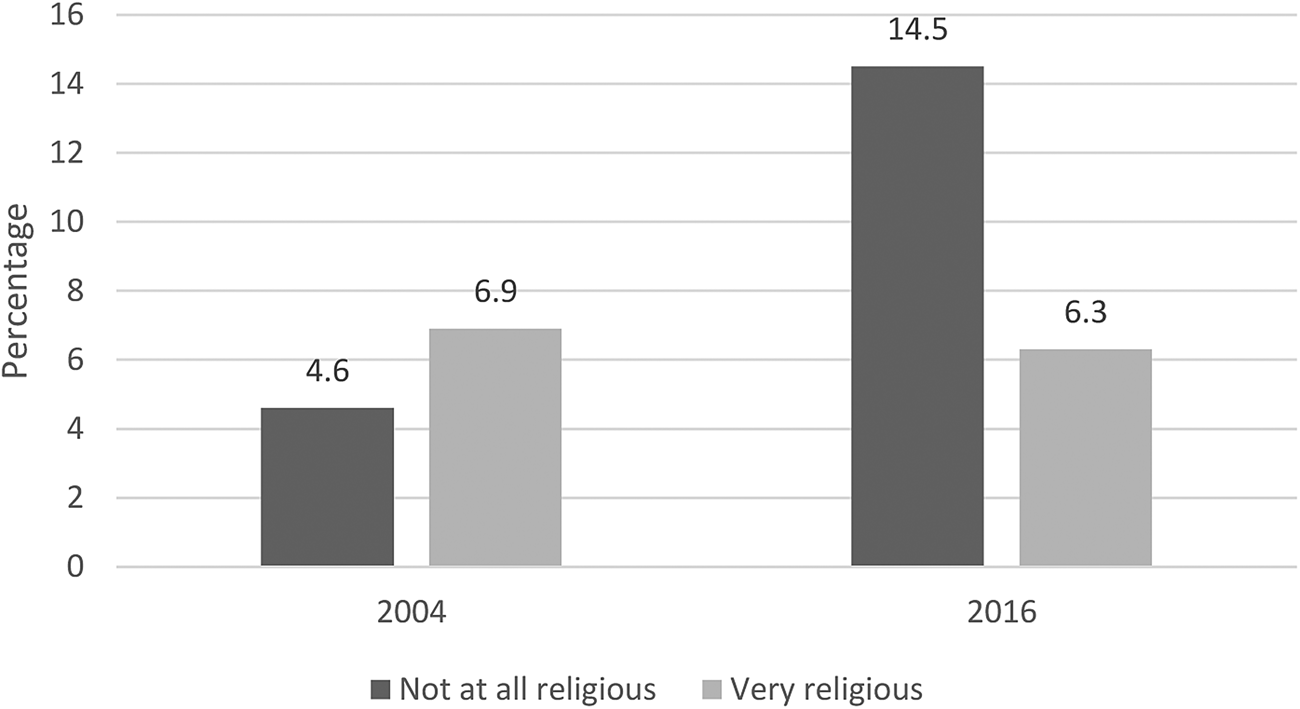
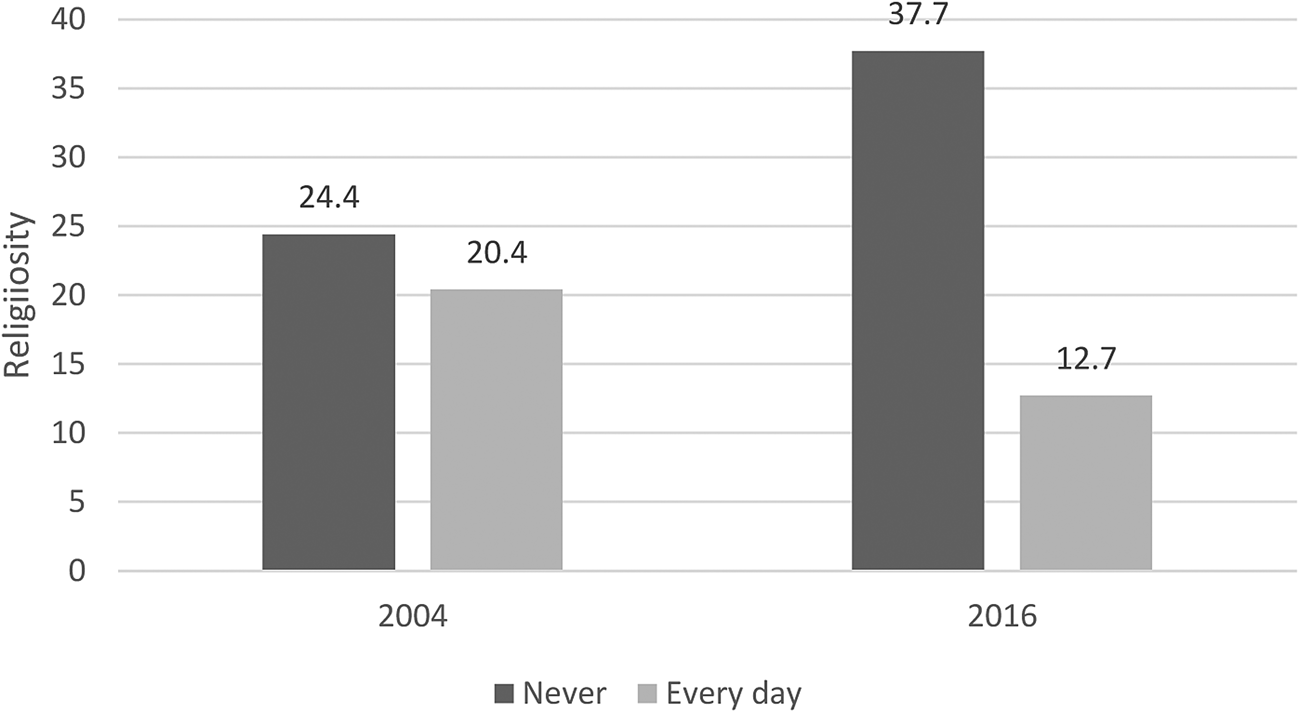
Given that the second half of the 20th century saw Iceland transformed by economic and political development, did the country experience concurrent or subsequent rates of religious decline? Data from the European Social Survey seem to support mainstream secularization theory; from 2004 to 2016, traditional measures of religiosity (regular prayer and self-declared religiosity) declined among Icelandic survey respondents (see Figures 1 and 2). A mere 6.8% of survey respondents declared that they were very religious in 2012, while that same year 11.1% of Icelandic survey respondents defined themselves as “Not at all religious.” The 2016 data saw further rates of secularization: 6.3% of respondents declared that they were very religious, while 14.5 stated that they were “Not at all religious.” Similar to the majority of countries in the West, the advance of political and economic modernization seem to coincide with the decline in traditional religion.
How religious are you?.
Source: European Social Survey, Rounds 2 and 8.

How often do you pray?.
Source: European Social Survey, Rounds 2 and 8.

Yet, some scholars of religion have argued, contra secularization theory, that there is a fundamental need for religion in the human species. While modernity may make traditional religion less plausible, such recent historical shifts cannot smother the innate need for transcendence or the bonds of a sacred community. Advocates of this position suggest that in the modern, secularized West, something like an implicit religion, those social actions and forms of community that are suggestive of religion while existing outside of traditional religious institution, endures (Bailey Reference Bailey1990). Is there any sign of religious life amidst declining church attendance and increasing rates of atheism?
As with every formative debate, the argument between secularization theorists and theorists of implicit religion has often become stuck on issues of measurement. Against the general trend of religious decline, theorists of implicit religion have been limited to case studies and evanescent popular awakenings, as in the widespread but only momentary rise of new age spiritualism. Demonstrating a decline in church attendance has proved easy; capturing the movements of a restive and transparent religious soul, less so.
Yet, a country like Iceland presents at least some likelihood of capturing implicit religion in a measurable form. This is for two reasons. First, because Iceland has a state church, it may be potentially easier to track the endurance of ritual practice amidst typical markers of secularization like declining faith and slowing church attendance. If there is an inherent religious need in most individuals, and if a relatively open state church persists (in spite of falling rates of adherence), it follows that even the non-religious might use the state church as a major source or site for ritualistic needs. This is because, according to the theory of implicit religion, even if someone does not attend church or believe in god, they still require some communal forum for major life events such as birth (as in baptism), coupling (as in marriage), and death (as in church funerals).
The second reason why a country like Iceland might allow for a clearer measure of implicit religion involves the matter of scale. Research on new and/or implicit religion in large, developed countries in the West has demonstrated some lingering religiosity at the individual level, often expressed in spiritualist terms (e.g., Heelas et al. Reference Heelas, Woodhead, Seel, Szerszynski and Tusting2005). At the same time, other studies have drawn attention to the various “new religious movements” which have tended to sprout in the ruins of traditional religion. Yet, as Steve Bruce has argued in his cutting criticisms of implicit religion, there is very little evidence to suggest that the faint pulse of spirituality, whether at the individual level or in the form of new religious movements, presents any evidence of a resurgent or even enduring form of religion. For Bruce, nothing that is as fleeting, fluid, and insubstantial as “spirituality” can be meaningfully compared to traditional religions, which orient social action and often implicate the social order. Theorists of implicit religion might reply that this critique is built on personal taste rather than substantial empirical difference.
Small countries such as Iceland may allow for a clearer assessment of whether spirituality and new religious movements are socially relevant. This is for the simple reason that social change and impact are easier to observe in smaller populations. Does the posited endurance of spirituality manifest itself in any meaningful social action? Do new religious movements have any influence over social life, or are they merely fleeting and inconsequential? Such questions are easier to answer in a small case, where social action and broader social life can be observed from an angle that can capture both small details and the wider canvas of the society.
Are there any indications of implicit religion in Iceland, either in the form of an enduring individual spirituality, a reliance on traditional religion for major life events, or consequential new religious movements? The data from Iceland reveals potentially startling answers to such questions. First, there is evidence that despite declining rates of self-declared religiosity and prayer, Icelanders continue to rely on the state church for major life events. This conclusion is suggested by a seeming paradox: in 2016, the European Social Survey found that almost 15% of Icelanders were “Not at all religious” and that almost 40% of Icelanders never pray (Figures 1 and 2), yet that same year Hagstofa Íslands recorded that more than 70% of Icelanders belonged to the Evangelical Lutheran Church of Iceland.
What does it mean if a population seldom prays and increasingly tends to define themselves as non-religious, but also maintains high levels of affiliation with the state church? This would seem to support at least some components of the theory of implicit religion. Specifically, if individuals describe themselves as members of a church, they are most likely defining their membership based on formal and rational criteria, rather than on the basis of belief or daily practice.
In the context of the Evangelical Lutheran Church of Iceland, formal membership is granted and maintained at baptism. The data suggest that a high number of Icelanders remain affiliated with the Church, more likely as a consequence of their baptism than by virtue of participation in church activities. One could reasonably infer from these data not only that baptism remains an important custom in Icelandic society, but also that the ties established at baptism retain some social importance long after the average Icelander will have stopped displaying the attitudes and habits characteristic of a Christian believer. This inference is supported by the fact that Icelanders continue to baptize their children, even if they do not attend church or engage in regular prayer. From this, one might also infer (though somewhat more tendentiously) the likely relevance of adjacent forms of ritual, including marriage and burial.
But what of the other aspects of the theory of implicit religion? If Icelanders tend to maintain loose and largely extractive relationships with their state church, are there any traces of a more positive (which is to say, socially consequential) form of implicit religion? Data from the three cited panels of the European Social Survey suggest three major conclusions on the state of religion in the country: (1) that a growing number of Icelanders are dropping out of traditional religious practices, (2) that a majority of Icelanders continue to affiliate with the state church, and (3) that an increasing number of Icelanders are affiliating with new or otherwise non-traditional religions.
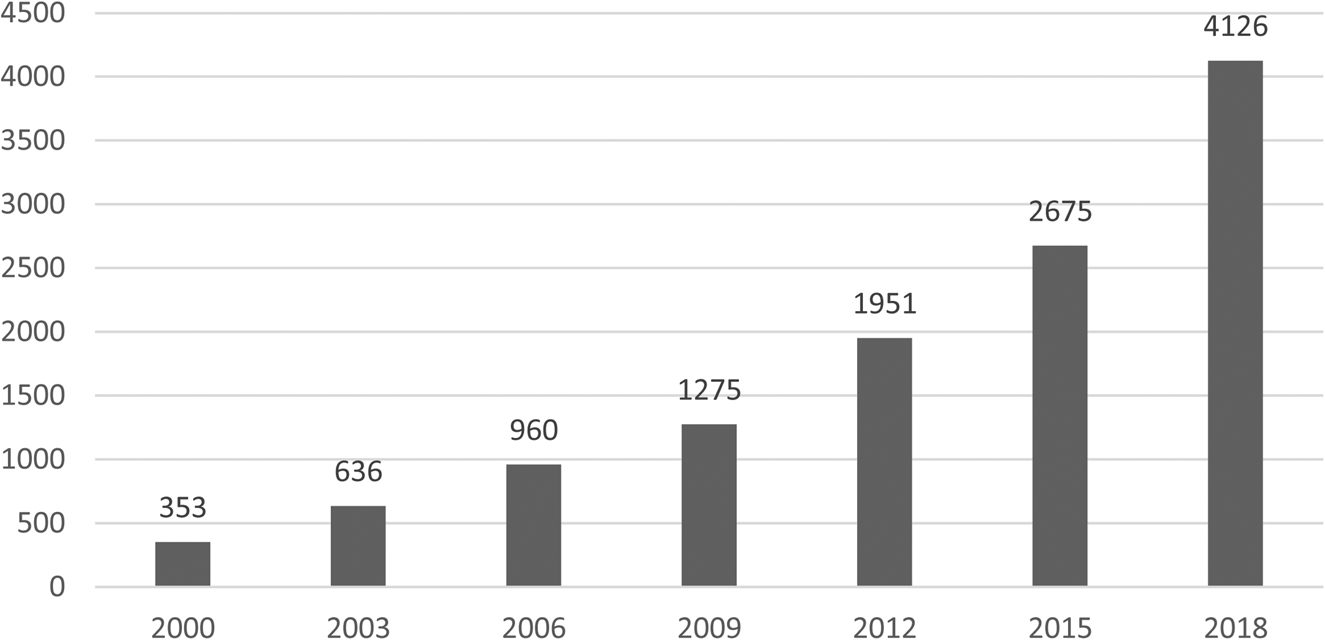
However, the growth of new or non-traditional religious affiliation is only marginally supported by the data. Iceland's national statistics agency, Hagstofa Íslands, offers a comprehensive survey of religious affiliation, including for new religions like the Ásatrúarfélag, Iceland's pagan church.Footnote 1 According to Hagstofa Íslands, Ásatrúarfélagið grew from 280 in 1998 to 3,187 in 2016 (see Figure 3). Is a growth of this scale socially significant? It is difficult to discern a decisive answer to such a question; if it is generally difficult to discern patterns from descriptive statistics, it is nearly impossible to do so at such a small scale.
Growth of Ásatrúarfélagið, in number of registered members.
Source: Hagstofa Íslands.

A fundamental debate between traditional secularization theory and theorists of implicit religion is whether new religious movements reflect a genuine need and desire for religion by individuals (as theorists of implicit religion contend) or whether these organizations are fundamentally insubstantial (as theorists of secularization argue). The descriptive statistics out of Iceland offer no help in resolving this argument. While there does appear to be a growth for some new (or, in the case of Ásatrú, new-nostalgic) religion, this growth is simply too numerically minute to invite confidant interpretation.
Turning from statistical data to assess qualitative indicators of the social impact of new religious movements offers a more promising route forward. If measuring a religion mostly comes down to identifying its social impact (as secularization theorists such as Bruce contend), then there is some evidence to suggest that Ásatrúarfélagið reflects a genuine religiosity.
First, the Ásatrúarfélag has won state recognition as a legitimate religious organization; this is consequential not only for tax purposes, but also because it has allowed the religious organization to take part in public life through participation in government-sponsored events. For example, Michael Strmiska's foundational study of the group discusses a government-sponsored public enactment of the Icelandic Eddas (a set of ancient pagan poems) that is co-sponsored by the Ásatrúarfélag (Strmiska Reference Strmiska2000, 110–11). Additionally, Monika Banaś has described the growth in popularity of Ásatrúarfélagið-led weddings and funerals, a popularity that extends beyond the religion's own congregants (Banaś Reference Banaś, Anczyk and Malita-Krol2017, 54–58). As a final example of the social significance of the Ásatrúarfélag, one might point to the approval and groundbreaking for an official temple; this approval, which requires significant bureaucratic and political support, suggests further influence and impact by the neopagan group.
If one takes the recent experience of the Ásatrúarfélag as representative of new religious movements in Iceland, then the evidence for a thriving implicit religion in the nation is mixed. Statistical evidence does not support claims of a massive growth in new religious movement affiliation (in any case, any growth in this area does not make up for the decline in traditional religious belief and affiliation demonstrated in the European Social Survey). However, qualitative research does suggest that, at least in the case of Ásatrúarfélagið, new religious movements have managed to achieve some degree of social, even public influence.
What does the attempt to measure and track religious decline or religious endurance in Iceland tell us? At a fundamental level, it suggests that while secularization theory and the theory of implicit religion are not incommensurable, they are discordant. This is just to say that both theories seem to measure religion as some mixture of individual beliefs and institutional vitality. Both secularization theorists and theorists of implicit religion argue that a person is religious to the extent that they have some belief system and some organizational adherence. Yet, each theory has starkly opposed views of what might count as a significant measure of either belief or affiliation.
Thus, at a basic level, attempting to compare evidence of secularization against evidence of implicit religion only demonstrates the intractability of the debate, offering demonstrative evidence only for why sociologists of religion are turning away from this debate in greater and greater numbers. But it is worth pointing out that the Icelandic case does suggest one compelling aspect of this debate: that even if it is intractable, both sides have captured some part of the truth.
It would be difficult to ignore the gradual decline of traditional Christianity and traditional Christian religious practice in this small Nordic nation. At the same time, Icelanders rely heavily on the state church for the consecration of major life events. Similarly, an enduring “religious” need—for the sacred or for transcendence or merely for a community of the like-minded—has seen the growth in new religions and nostalgic religions like Ásatrú. What the case of Iceland demonstrates is the need for some alternative paradigms of religious change, which can accommodate both the obvious decline of traditional religion and the apparent endurance of a vaguely religious need or sensibility.
THE VARIETIES OF POST-SECULARIZATION IN SECULAR ICELAND
In social science, as in science generally, a single anomaly can derail a theoretical agenda. The secularization debates have witnessed much struggling over what constitutes an anomaly. Yet, there are more fundamental instances which simply cannot be discussed in the language of reigning theoretical models.
Such is the case with Zuism, an officially recognized religion in Iceland that, according to Hagstofa Íslands, grew from having no members in 2014 to having 3,087 members in 2016. Confronted with these data, a secularization theorist would perhaps reference long-term trends of religious decline, while theorists of implicit religion would declare this to be yet more proof of the endurance of religion in Western modernity. But Zuism's growth presents a more fundamental challenge, requiring the social scientist to reconsider what constitutes religion, as well as the social consequences of traditional categorization like the religious-secular and sacred-profane binaries.
This is because Zuism is a group that has emerged and grown as a means of avoiding taxation. Every year, Icelandic citizens pay a “religious tax,” which the state redistributes to an officially recognized religious organization. When membership in the state church was universal, this may have seemed like the most efficient and lucrative way to tithe the congregation. In contemporary Iceland, the tax has assumed a more social-democratic character; the state now redistributes an individual's tax to the church or religious institution with which they affiliate, and the unaffiliated can have their tax redistributed to the national university system. In this way, the “religious tax” has become part of a larger effort to fund civil society projects.
While Zuism was originally a neo-pagan movement which was vaguely based on the religions of ancient Mesopotamia, its character quickly changed. It was developed by a small group of dedicated Icelanders in the early 21st century, and gained state recognition in 2013. In 2015, a new leadership board reformed and restructured Zuism as a protest movement disguised as a religion. The goal of this new leadership was to receive its share of the religious tax and then redistribute these funds to its congregants (the state functions as an intermediator between church and congregation; it collects funds from congregants, and redistributes the funds to the church. This means that in theory a state-recognized religion could simply redistribute the funds it receives from the tax back to its registered members).
The case of Zuism suggests an instance in which the questions, concepts, and perspectives of the traditional secularization debate simply do not apply. This is not an instance of declining or rising faith, but of movements and symbolic politics. If this seems to be a trivial point demonstrated by a trivial case, it is worth considering two other recent developments in Iceland's religious environment. The first development involves the use of pagan imagery by nascent paramilitary groups, the second is the use of traditional Christianity by mainstream politicians as a framing device in debates over Islam. Each of these cases suggests not just the enduring relevance of religion in politics after secularization, but the increased variety of ways in which religion can come to be entangled with politics through the post-secularization process.
In 2015, a Finnish white supremacist founded the Soldiers of Odin group in Kemi, Finland. As with any new group, the form and purpose of the Soldiers of Odin is often unclear, and confusion about the motives and aspirations of the group have grown along with the group, which has spread rapidly across the West. In its original iteration, the group seems to have been an anti-immigrant paramilitary force. Accounts of the Soldiers of Odin link the group's emergence to the migration crisis, and the Finnish branch of the Soldiers of Odin gained worldwide infamy for their “street patrols,” in which members would march through Finnish streets and confront immigrants (Ekman Reference Ekman2018).
In 2016, an Icelandic chapter of the Soldiers of Odin emerged (see Ritstjórn Reference Ritstjórn2016). However, the group did not undertake any “street patrols,” and its activities seem to have been limited to a private page on a popular social media website. Additionally, while other national chapters of the Soldiers of Odin have focused their attention and rhetoric on a perceived rise in street crimes committed by migrants (and have thus declared themselves to be “defenders” of the people), the initial statement released by the Icelandic chapter focused on its opposition to the proposed construction of mosques for Icelandic Muslims. This suggests that the Icelandic Soldiers of Odin is (or was—given that the group only ever existed online, it is difficult to verify its continued existence) somewhat distinct from both the larger international group and other far-right movements.
However, the Icelandic Soldiers of Odin is of interest here insofar as it reflects a different kind of “religious” revival, in which the sacred imagery and rhetoric of some religion are used for a decidedly non-sacred task. In this case, the sacred compendium of Norse pagan imagery is put to the task of mobilization. The Soldiers of Odin are not engaged in worship, have no explicit theological commitments, and do not evince any sense of the sacred (even by the loose standards of “civil religion”). Instead, the use of the pagan god Odin (and other pagan imagery popular among white supremacists) is a form of mass marketing and “framing,” imbuing the group with a brand and a sense of coherence it might otherwise lack, and advertising a distinctive image to potential recruits (see Dobratz Reference Dobratz2001).
If the use of pagan imagery by the Soldiers of Odin is mere marketing, does that mean it is also inconsequential? In an age of mass consumption, marketing matters; even if a religion is reduced to simplistic imagery for the purpose of advertising, this does not necessarily suggest a weakening of the religion (though it may represent a very real theological weakening). Indeed, to the extent that a religion or religious symbolism becomes marketable, this may increase its relevance in an age of spiritual consumerism (e.g., Kitiarsa Reference Kitiarsa and Turner2010).
The controversies of Zuism and the Soldiers of Odin each demonstrate the fundamental inadequacy of social scientific approaches to religion developed in the secularization debates, which have tended to emphasize the institutional (as in church attendance) and the theological (as in prevalence of theism within a society) over the cultural (both in terms of symbols, but also practices).
However, contemporary Iceland also demonstrates instances in which religion migrates into politics not merely as a prop, but in substantive attempts to recast the social-sacred. The political scientist Eiríkur Bergmann has cataloged the “anti-Muslim turn” of Iceland's center-right political party, the Progressive Party (Bergmann Reference Bergmann2017). Bergmann's analysis of the Progressive Party's recent history suggests that religion may be more than a mere prop in the contemporary politics of this secularizing nation. For example, a proposal to build a mosque for Iceland's small Muslim community was at the center of a 2014 municipal elections. Progressive Party candidate Sveinbjörg Birna Sveinbjörnsdóttir declared that any proposed mosque would violate Iceland's native Christianity (Bergmann Reference Bergmann2017, 116). The candidate's opponents invoked secularism and secularity, declaring that equality and liberty were threatened by Sveinbjörnsdóttir's statements.
This form of dispute is not merely a matter of identity politics, but a clash over the social sacred. Here traditional religion is not the foundation for sacred values, but has become only another realm of temporal dispute. Yet, it is traditional religion—specifically disputes over the accommodation of religious minorities—which reveals the sacred. This is not the sacred of traditional Christianity, but of abstract principles such as “liberty,” “tolerance,” or “the people.”
Each of these cases sees actors doing culture work at the boundaries of politics and religion in the public sphere. Yet, the manner in which this culture work is undertaken, and the ends toward which it is directed, is distinct in each instance. The exceptional typical case of Iceland provides a way of corralling the variations of post-secularization into something like a system. Processes which may elide attention in the larger societies more typical of the late modern West appear in Iceland as manageable, even anecdotal, clues which can be pieced together into a meaningful whole. The cases reviewed are suggestive of a preliminary scale or typology of sacralization in a secularized or secularizing society.
At one end of this typology, traditional religion is a mere prop for political or social movements; if religious symbolism remains generally known, then invoking religious symbols or rhetoric may garner a degree of traditional authority. The use of traditional religion in these cases lacks any deep cultural substance (insofar as any adjacent, generic symbol of Scandinavian identity might have been used in its stead), and may be used out of convenience alone, as appears to be the case for the Soldiers of Odin. This might be called commodified religion and could refer to any case in which the symbols of traditional religion are emptied of their historical meanings and used for the sake of marketing or branding. On a scale or typology of post-secularization processes, the purely instrumental use of religion for the purposes of marketing reflects de-sacralization, the stripping of the sacred.
If commodified religion is a part of post-secularization in which traditional religious symbols are not coterminous with the group which employs them, what about those instances in which traditional religion and its symbols are understood as somehow deeply attached to a non-religious identity, group, or movement? These are, in other words, political or social movements which invoke traditional religion as a component part of a larger, sacred identity. This use of religion has a cultural substance even if it, too, lacks any deep theological roots. Thus, when a political candidate alludes to the supremacy of Iceland's Lutheran Church, they do so not because of that religion's substance (not, in other words because they find its theology or practice more compelling than competitors), but because it serves as a bright marker of identity.
This aspect of post-secularization sees traditional religion as a social fact rather than a social prop; however, here traditional religion is subordinated to some other sacred. This form of post-secularization is sometimes called “religious nationalism,” however a more precise name might be identitarian religion; the case of the “anti-Muslim turn” in Iceland suggests that the transformation of traditional religion into a core component of secular identity needn't be strictly nationalist in orientation (e.g., identitarian religion can also occur in intra-party disputes, used by one political party or faction to distinguish itself from its national-level competitors). Whatever the referent, in identitarian religion, traditional religion aids in the sacralization of some other group aspect.
Along with identitarian religion, in which traditional religion is a marker of a sacred identity, and commodified religion, in which religion and its symbols are used as marketing props, are those forms of post-secularization where group is indistinguishable from symbol. Zuism offers an example of this; unlike the mobilization of religion by identitarian movements, Zuism is self-referential, not a component part of some larger sacred identity project. The principles that animate Zuism—namely that in a secular nation, religious taxation is unjust—are indistinguishable from the group itself. In this elementary religion, the group, its identity, and its symbols are conjoined by its principles, such that no single component can be neatly extracted from the others.
The Icelandic case offers an interesting conclusion about post-secularization: here, the most avowedly non-religious group surveyed, the Zuists, conform most neatly to the classical, Durkheimian vision of religion, in which the social group and its sacred principles are one and the same. In contrast, the use of Christianity in public debates over social belonging and social change demonstrates the emergence of new forms of the social sacred, defined largely in terms of national identity. Common to all three points on the post-secularization spectrum—commodified religion, identitarian religion, and elementary religion—is the decline of traditional transcendent symbols or principles, and the rise of a non-transcendent social-sacred defined by identity or political grievance.
Iceland is an ideal case for locating clues which might clarify a complex process like post-secularization. The size of the country allows for quick assessments of developing dynamics in the religious environment. If the country demonstrates the relatively stagnant debate over traditional secularization theory, it also demonstrates the varieties of post-secularization that emerge in the interaction of religion and politics in a secular age. However, precisely because of its size, the country appears particularly vulnerable to sudden, large-scale change. It is this potential fragility, and the implications of global social change on religion, that we consider next.
POST-SECULARIZATION IN A GLOBAL AGE
The Icelandic case demonstrates how the process of post-secularization can vary in a modern, secularized society. Arranged on a spectrum, post-secularization varies from commodified religion, in which traditional religious symbols are emptied of sacred qualities and used for marketing purposes, to cases of identitarian religion, in which traditional religion supports a new sacred identity, to elementary religion, in which new symbols and group identity mix with emergent sacred principles. Despite these variations, the Icelandic case suggests that post-secularization in an already-secularized environment will inevitably diminish the potency and autonomy of traditional religion.
However, the displacement of traditional religion by emerging forms of post-secularization, often in the form of national-level politics and identity, may overlook one significant refuge and vehicle for traditional religion: globalization. The influence of globalization on religion, politics, and post-secularization might occur in several ways. First, globalization might drive religious pluralism through migration, creating a lively and diverse religious environment in formerly secular settings (e.g., Smith Reference Smith2002; Casanova Reference Casanova and Banchoff2007). Second, globalization might spur identitarian religion, as the rapid movement of people across borders encourages groups to establish firm boundaries of identity and belonging (e.g., Juergensmeyer Reference Juergensmeyer2017). Third, globalization might inspire new forms of fundamentalism, as local populations react to the potentially dislocating effects of global forces (e.g., Barber Reference Barber1996).
These theoretical perspectives on the relationship between globalization and religion suggest another break from the traditional secularization debate. There was a point in the social scientific literature on religion when the topic of global change was primarily discussed in relation to its potential effects on religious growth or decline. On the one hand, scholars associated with the modernization thesis argued that the global spread of political and economic liberalism would bring about the world-wide collapse of religion (e.g., Smith Reference Smith1974). Others suggested that globalization would herald a “de-secularizing” of the world, as civilizations came into increasing contact and conflict (e.g., Berger Reference Berger1999). These arguments have been supplanted, as scholars have turned to questions involving how the rise of global flows and emergence of a global consciousness might influence religion as an identity, as a resource for political contention, and as a collection of sacred ideals.
Scholars who study Icelandic society have demonstrated how globalization has altered the country, primarily through a rapidly globalizing economy and a rise in immigration (e.g., Skaptadóttir and Loftsdóttir Reference Skaptadóttir, Loftsdóttir and Jakobsson2009; Oddsson Reference Oddsson2016). However, the specific relationship between religion and globalization in Iceland remains largely unexamined.
The cases of the Soldiers of Odin and the “anti-Muslim turn” of the Progressive Party both demonstrate how globalization can intersect with post-secularization in the realm of identity. Yet in both cases, religion seems to be mobilized as a reaction against globalization. This is noteworthy, as some theorists of globalization have argued that religion is a primary conduit for global social change. For example, Ulrich Beck devoted his career to arguing that we live in an age of unfolding global risks, which are leading to cosmopolitanization (the process by which the local becomes interdependent with the global). The cosmopolitanization of nations may, in turn, yield a sort of cosmopolitan consciousness, in which individuals can no longer ignore the ways in which their lives are tied up in global social problems (e.g., Beck and Sznaider Reference Beck and Sznaider2006). In a late development, Beck suggested that religion, especially “individualized” religion, would be vital to establishing a normative cosmopolitan consciousness capable of responding to global risks (Beck Reference Beck2010).
The Soldiers of Odin and the “anti-Muslim turn” of the Progressive Party seem to suggest that, at least in the small nation of Iceland, religion is more likely to be used as a resource against the perceived influences of globalization, as national actors use traditional religion as a resource—either an empty symbol for marketing or a buttress for an emerging sacred identity—to articulate frustrations or contrasts in using symbols of historical significance. There is a theoretical logic to this: in smaller social settings, the force of global social change may be more visible or acute, provoking greater opposition. But will religion always serve a reactionary purpose in smaller societies that are responding to global social change?
Here it is worth reflecting once again on the Ásatrúarfélag, Iceland's officially recognized pagan religion. Some of the general traits of Ásatrúarfélagið might seem to make the religion ripe for reactionary movements. First, the Ásatrúarfélag is more connected to national identity than many other new religious movements; historically, membership in the Ásatrúarfélagið has been limited to Icelandic citizens. Relatedly, the Ásatrú belief system is rooted in an attachment to tradition and to Iceland's native landscape. Finally, unlike the “world religions,” Iceland's official pagan church makes no gestures toward universalism; it neither advocates for a universal ethic, nor offers a vision of universal salvation.
These traits would seem to make the Ásatrúarfélagið a meaning system ripe for mobilization against global social change; indeed, the Soldiers of Odin demonstrate how traditional pagan symbols can be emptied of their sacred content yet still retain some power as a marketing tool. In fact, members of the Ásatrúarfélagið have historically opposed the empirical forces of globalization; the founder of the Ásatrúarfélagið, Sveinbjörn Beinteinsson, used pagan ceremony to oppose Iceland's entanglement with global military alliances, while contemporary members have mobilized in opposition to global economic development projects such as aluminum mining. Yet, even as the Ásatrúarfélagið opposes many of the processes of globalization, it offers a distinct form of post-secularization, in which traditional religion and religious symbols are re-consecrated for a new purpose. In this case, that new purpose is the establishment of a cosmopolitan consciousness.
The cosmopolitan consciousness of the Ásatrúarfélagið is demonstrated in several ways. First, while the religion's emphasis on the sacredness of the Icelandic landscape might have been confining, research on the group's membership suggests that many adherents have adopted an outlook closest to pantheism, in which the world itself becomes a sacred object. This intellectual inclination is likely related to opposition among the Ásatrúarfélagið membership to large-scale international development projects such as mining. It is possible to imagine neo-pagan opposition to extractive industries such as mining to be articulated in purely national language (e.g., as a violation of the “mother land”). Yet, the admittedly scant research on these issues suggest that members of the Ásatrúarfélagið see their roles in opposing such projects as part of a larger global struggle on behalf of the earth. Finally, Strmiska's (Reference Strmiska2000) study of the Ásatrúarfélagið suggests that congregants understand the organizational struggles of Iceland's neo-pagan church—struggles which include proselytizing in a secular public sphere and gaining state recognition—as part of a global movement, in which the world's indigenous religions are mobilizing against the adverse effects of modernity.
It might seem that small religions in small nations that are primarily dedicated to the preservation of tradition would be most closed off to cosmopolitan consciousness, and that a traditional religion attached to a fixed place might be ideal fuel for de-sacralization and marketing or identitarian religious politics. Yet, the case of the Ásatrúarfélagið suggests otherwise. This raises an important question: what are the causal mechanisms which lead either to a backlash against the world, in the form of identitarian religion, or a cosmopolitan consciousness? Perhaps more consequentially, is the cosmopolitan consciousness suggested by groups such as the Ásatrúarfélagið a sufficient cultural resource in combatting world risk? These ambitious questions point to yet another line of inquiry which extends the social science of religion beyond the stale agenda of the secularization debates.
CONCLUSION
Researchers who study religion have generally agreed to disagree on the topic of religious decline. For decades, the social scientific study of religion has been dedicated to debating the secularization issue, first in the form of debates between religious economies theory and secularization theorists, then in a debate between secularization theorists and advocates of implicit religion. These debates were fruitful, yielding a bounty of case studies and a wealth of data on the correlations between specific religions and various economic or political contexts.
Ultimately, however, these debates have proven intractable. In this paper, we have used the single case of Iceland to reflect on some sources of that intractability. In essence, secularization theorists and their opponents have simply failed to settle the preliminary question of how to assess the social impact of religion.
Yet, if debates over religious decline have grown stale, compelling and urgent questions about religion and social life continue to emerge. In this paper, we have argued that small nations, such as Iceland, are particularly useful for thinking about such questions in a preliminary manner. This is because small nations, which see the integration of local, national, and global orders, allow social researchers to observe issues as they emerge. Furthermore, the accessibility of data offered by this exceptional typical case allows the social researcher to encounter “clues” about large and complex processes which might be obscured in typical or representative cases.
Here we have used the clues offered by the Icelandic case to pursue two questions. First, what are the varieties of political-religious entanglements in a modern, secular society? Second, how are the local uses of religion and the sacred influenced by global social change? If the case of Iceland has demonstrated the import of these questions, it cannot provide decisive answers. The limits of case studies are well known: it is difficult to generalize from the case, and easy to mistake some particular quirk for something of greater or more general value. These limitations are doubly true for the very small case study. Even so, the clues offered by the Icelandic case provide insights into the process of what we have called post-secularization.
First, we have observed distinct forms of post-secularization which are suggestive of a scale or spectrum. These vary according to the use of traditional religious symbols and meanings, as well as the ways in which these traditional symbols and meanings are coordinated with emerging sacred meanings and symbols. There are instances of commodified religion, in which traditional symbols are emptied of their sacred character not to be replaced but to be used instrumentally. There are instances of identitarian religion, in which traditional religion and its symbols form the scaffolding of a new sacred, formed around principles of party or nation. Then there are instances of elementary religion, in which religious symbol, group identity, and principle are conjoined to the same sacred identity. Notably, the Icelandic case suggests that in an already-secularized society, elementary religion, the process most like Durkheim's description of the genesis of religion, appears to operate on ideas, beliefs, and identities that are not traditionally religious.
Yet, post-secularization does not mean that traditional religion will be inevitably displaced by new or emerging forms of the sacred organized around identity, nation, or other historically secular categories. As the case of the Ásatrúarfélag demonstrates, large-scale processes such as globalization can see traditional religion re-consecrated for a new purpose. In this instance, traditional pagan religion has been used to cultivate a cosmopolitan consciousness, in which the sacred is re-interpreted in ways that link local, traditional beliefs with global risks and challenges.
The case of Iceland provides fertile ground for the sort of clues which are helpful in early social science research. The status, forms, and meanings of a process like post-secularization can be difficult to establish in a representative sample; the contours of an exceptional typical case like Iceland, with its small but modernized and globalized population provide a vital perspective in seeking to understanding a perplexing and much debated concept. However, the same qualities which make Iceland a good case for working through conceptual confusion will also mean that the clues pulled from the case will need further and broader study.