


Introduction
Social anxiety is a pervasive part of everyday life and can be manifested in a variety of forms. It can appear as a reluctance or inability to speak in public, stage-fright, an inability to write or eat in public, excessive blushing, sweating or trembling in public. Socially anxious people are fearful of possible scrutiny and also anxious that they might behave in a manner that is embarrassing, inept, unacceptable, or all of these. Recent epidemiological studies indicate that social phobia is very common (Chapman, Manuzza and Fyer, Reference Chapman, Mannuzza, Fyer, Heimberg, Liebowitz, Hope and Schneier1995). Lifetime prevalence rates based on DSM-IV diagnostic criteria are 4.9% for males and 9.5% for females (Wittchen, Stein and Kessler, Reference Wittchen, Stein and Kessler1999) and suggest that social phobia is more common in women. The age of onset of social phobia is usually between 15 and 20 years (Liebowitz, Gorman, Fyer and Klein, Reference Liebowitz, Gorman, Fyer and Klein1985). Perhaps because many patients see the disorder as part of their personality, they do not seek treatment (Schneier, Johnson, Hornig, Liebowitz and Weissman, Reference Schneier, Johnson, Hornig, Liebowitz and Weissman1992; Wittchen et al., Reference Wittchen, Stein and Kessler1999) or do seek therapeutic help, but at a considerably later age. Social phobia is also associated with high rates of depression (Schneier et al., Reference Schneier, Johnson, Hornig, Liebowitz and Weissman1992) and substance abuse (Kushner, Sher and Beitman, Reference Kushner, Sher and Beitman1990; Rapee, Reference Rapee, Heimberg, Liebowitz, Hope and Schneier1995). Patients with social phobia are exposed to anxiety-provoking social situations daily but often do not experience reduction in anxiety, as learning theory models would predict.
In their model, Clark and Wells (Reference Clark, Wells, Heimberg, Liebowitz, Hope and Schneier1995) suggested several cognitive and behavioural mechanisms that might serve to maintain the disorder. Social phobics' utilization of safety (subtle avoidance) behaviours is one of these maintenance processes. Salkovskis (Reference Salkovskis, Rachman and Maser1988, Reference Salkovskis1991) defined a safety-seeking behaviour as a behaviour that is performed in order to prevent or minimize a feared catastrophe and suggested that such behaviours often explain why the non-occurrence of a feared event fails to change patients' negative beliefs. As Clark and Wells (Reference Clark, Wells, Heimberg, Liebowitz, Hope and Schneier1995) point out, social phobics engage in a wide range of behaviours in social situations that are intended to reduce the risk of social failure and humiliation. Typical examples of safety behaviours include trying to avoid drawing attention of others to self, avoiding eye contact, talking less, and avoiding pauses while talking. Often there are precise links between specific safety behaviours and feared outcomes. For example, those who fear that their hands may shake when they drink, will hold their cups more tightly.
There are, at least, three mechanisms by which safety behaviours maintain distorted thinking in social phobia: (a) exacerbation of symptoms; (b) prevention of disconfirmation; (c) contamination of the social situation (Wells and Clark, Reference Wells, Clark and Davey1997). First, safety behaviours may increase the anxiety symptom in some cases (e.g. gripping the glass tightly to prevent tremor increases likelihood of tremor). Second, safety behaviours prevent social phobics from experiencing an unambiguous disconfirmation of their unrealistic beliefs about feared behaviours (e.g. hand trembling) and their outcomes (e.g. embarrassment, rejections). This is because social phobics attribute the non-occurrence of feared outcomes to the safety behaviours in which they engaged. Third, safety behaviours may become more noticeable than the symptoms they were intended to hide, and more disruptive than the feared catastrophe they were intended to prevent, resulting thus in negative responses from others. For example, social phobics, who speak only a little in social situations for the fear of saying something wrong or sounding funny to other people, may actually give a wrong impression of being disinterested in conversation to others, who may, in turn, show less friendly and less positive response.
The present study focuses on these safety behaviours that are likely to contaminate social situations and increase the likelihood of negative social outcomes. There is already experimental evidence suggesting that socially anxious students who use safety behaviours are liked less than anxious students who do not (Alden and Bieling, Reference Alden and Beiling1998). If the use of safety behaviours actually results in the socially anxious individual looking more anxious and eliciting more negative responses from others, then why do these individuals keep practising them? There are three possible explanations. First, the socially anxious individuals are unaware of their reliance on safety behaviours. However, this explanation is less likely since the cognitive theory clearly suggests that social phobics often attribute the (actual or perceived) non-occurrence of feared outcomes to their use of safety behaviours. Second, individuals are aware of the negative effects of safety behaviours, but lack the ability to engage in less problematic behavioural patterns. Third, socially anxious individuals hold a more positive view of safety behaviours than non-anxious people, and tend to believe that safety behaviours can actually prevent or minimize feared social catastrophes (i.e. negative social evaluation). The main aim of the present study is to examine how socially anxious people themselves view safety behaviours in social situations.
Research has also demonstrated that social phobics apply different standards to the evaluation of their own behaviour and the evaluation of behaviour displayed by other people. In particular, Clark and Arkowitz (Reference Clark and Arkowitz1975) showed that social phobics are accurate in their evaluation of others' behaviour but excessively negative in the evaluation of their own behaviour. Rapee and Lim (Reference Rapee and Lim1992) confirmed these findings. Additionally, in the study by Amir, Foa and Coles (Reference Amir, Foa and Coles1998) participants were presented with ambiguous scenarios and were asked to rank how likely a positive, neutral and negative interpretation would be for each scenario, were it to happen to themselves (self-referent version) and were it to happen to others (other-referent version). Social phobics ranked negative interpretations as more likely only for social scenarios that were self-referent, and ranked positive interpretations as more likely only for social scenarios that were other-referent compared to non-phobics. Therefore, a second aim of the present study is to examine whether interpretation biases about safety behaviours are similarly subject to a double standard.
The present study
The present study explored the ways in which people interpret safety behaviours typically associated with social anxiety (e.g. avoiding eye contact, talking less, sitting alone). High and low socially anxious participants were asked to complete two versions of the Safety Behaviour Interpretation Scale (SBIS – Appendix A). In the “Actor” version of the questionnaire, participants were asked to judge how their own behaviours are interpreted by others (e.g. “What will other people think if you avoid eye contact?”). In the “Observer” version participants were asked how they interpret safety behaviours that they notice in others (e.g. “What do you think about someone who avoids eye contact?”). Participants were presented with eight possible interpretations for each behaviour (e.g. experiencing intense anxiety, being an arrogant person) and were asked to rate how likely each interpretation was for a given symptom. Some of the interpretations could be construed as being extremely negative (e.g. experiencing intense anxiety, having a psychological problem), some others as mildly negative (e.g. being arrogant, experiencing some other emotion like anger, resentment), while others could be viewed as being relatively benign (e.g. being preoccupied).
Competing hypotheses were formulated. If high socially anxious individuals are aware of the negative effects of safety behaviours, then they were expected to more strongly endorse the extremely negative or mildly negative interpretations as compared to low socially anxious individuals. In contrast, if socially anxious individuals believe that such behaviours could prevent negative social outcomes, then they were expected to more strongly endorse the more benign interpretations (e.g. being humble, low-profile person, being preoccupied). Alternate competing hypotheses were also proposed with respect to differences that might emerge between the two versions of the questionnaire. First, it was possible that socially anxious individuals may only apply this interpretation bias to situations in which other people see them exhibiting safety behaviours. In this case, the presence of significant interaction between groups (high social anxiety vs. low social anxiety) and questionnaire version (Actor version vs. Observer version) would have to be observed. No between-version differences were predicted for the low social anxiety group. Alternatively, high socially anxious individuals may apply this bias when others see them engaging in safety behaviours and when they see others using safety behaviours. In this case, what we might expect is a simple main effect of group such that people with high social anxiety more strongly endorse interpretations both in the Actor and Observer versions of the questionnaire as compared to the low socially anxious controls.
The high and low social-evaluative anxiety groups were selected using the Fear of Negative Evaluation scale (FNE; Watson and Friend, Reference Watson and Friend1969). Previous research has indicated that when participants from the normal population are divided into high and low social anxiety groups on the basis of their FNE scores, the effects of experimental manipulations mirror those that are found when social phobics are compared to non-patient controls (for a review see Stopa and Clark, Reference Stopa and Clark2001).
Finally, it should be noted that because of expected comorbidity of depressive and socially anxious symptoms (Schneier et al., Reference Schneier, Johnson, Hornig, Liebowitz and Weissman1992), we measured the level of depressive symptoms in order to control for this variable in analysis. This is important since several studies have shown that depressive symptoms are associated with interpretation biases (e.g. Voncken, Bögels and Peeters, Reference Voncken, Bögels and Peeters2007).
Method
Participants
The participants were students attending the University of Patras, Greece. They were recruited from a larger sample of 135 students who had filled in the Fear of Negative Evaluation scale (FNE; Watson and Friend, Reference Watson and Friend1969). All students were attending a course in psychology and received partial course credits for their participation in the study. The FNE was used to divide individuals into groups of high socially anxious (one standard deviation above the mean on the FNE; n = 25) and low socially anxious (one standard deviation below the mean on the FNE; n = 22). The low social anxiety group consisted of 8 males and 14 females and the high social anxiety group of 3 males and 22 females.
For a better description of the sample, all participants completed the State-Trait Anxiety Inventory (STAI-Trait version; Spielberger, Gorsuch, Lushene, Vagg and Jacobs, Reference Spielberger, Gorsuch, Lushene, Vagg and Jacobs1983) and the Beck Depression Inventory (BDI-II; Beck, Steer and Gorman, Reference Beck, Steer and Brown1996).
Materials and procedure
Questionnaire measures: Fear of Negative Evaluation scale (FNE; Watson and Friend, Reference Watson and Friend1969). The FNE is a 30-item true-false self-report questionnaire that provides a measure of apprehension about others' evaluations, distress over negative evaluation, and the expectation of negative evaluation. Sample items include “I am often afraid that I may look ridiculous and make a fool of myself.” The FNE had high internal consistency (α = 0.94), good test-retest reliability (r = 0.78) and good discriminant validity (p < 0.01) when compared with a measure of social desirability (Crowne-Marlowe Scale; Crowne and Marlowe, Reference Crowne and Marlowe1964) on a sample of undergraduates (Watson and Friend, Reference Watson and Friend1969).
State Trait Anxiety Inventory (STAI; Spielberger et al., Reference Spielberger, Gorsuch, Lushene, Vagg and Jacobs1983). The STAI is a 40-item self-report questionnaire assessing both current (state) and general (trait) anxiety. The STAI is commonly used in research and clinical settings and the internal consistency of the measure among samples of college students is above 0.9 (Spielberger et al., Reference Spielberger, Gorsuch, Lushene, Vagg and Jacobs1983). In the current study only the trait version of the measure was used (the 20 statements that evaluate the participant's general level of anxiety).
Beck Depression Inventory II (BDI II; Beck et al., Reference Beck, Steer and Brown1996). The revised BDI is a 21-item self-report instrument for measuring the severity of depression in adults and adolescents aged 13 years and older during the past 2 weeks. Research has shown that the BDI has good internal consistency, reliability and validity (Beck, Steer and Garbin, Reference Beck, Steer and Garbin1988). The convergent validity with clinical evaluation of depression is 0.64 (Salaberria and Echeburua, Reference Salaberria and Echeburua1998).
Safety Behavior Interpretation Scale (SBIS). The scale was adapted from Roth, Antony and Swinson (Reference Roth, Antony and Swinson2001) for the purposes of this study. In the SBIS, participants were presented with questions about the causal attributions that people make for certain behaviours. For the purposes of the present study, we chose to focus on the types of attributions that are typically made for safety behaviours that are considered to be characteristic of socially anxious individuals in social gatherings (Clark and Wells, Reference Clark, Wells, Heimberg, Liebowitz, Hope and Schneier1995): avoiding eye contact, talking less, avoid talking about oneself, sitting alone and ignoring others, escaping from the situation.
Participants were presented with eight different attributions that could be reasonable explanations for each of the five safety behaviours. Participants were asked to rate the extent to which each attribution was a likely explanation for the behaviour, using a scale of 0 (not at all likely) to 4 (extremely likely). The eight attributions were: 1) being preoccupied; 2) being a humble person; 3) being an arrogant person; 4) experiencing normal levels of anxiety, nervousness or fear; 5) experiencing some other emotion (e.g. anger, resentment; 6) suffering from an intense anxiety problem; 7) suffering from another psychological problem; 8) being, by nature, a person who exhibits the specific behaviour. The attributions were identical for all five safety behaviours except for escaping, where the first attribution was slightly altered to imply that the individuals left the gathering because of a matter of urgency.
First, participants completed the questionnaire according to how they believed that their behaviours are interpreted by others (Actor version). Once participants had written their answers, they opened an additional instruction sheet that told them to go back to the beginning of the questionnaire and give additional ratings according to how they interpret the same behaviours in others (Observer version), without changing anything from their initial ratings.
Finally, socially anxious individuals differ in the safety behaviours that they use in social situations. Therefore, participants in the current study were asked to rate the extent to which they believed they exhibit each of the five safety behaviours when in formal meetings, using a scale of 0 (never) to 4 (always). Their ratings were subsequently combined in a single frequency score.
Procedure
Participants arrived at a laboratory and were a given a questionnaire package by the investigator. This questionnaire package contained the questionnaire measures described above. All study materials were completed in the laboratory and participants were subsequently debriefed.
Results
Participants' characteristics
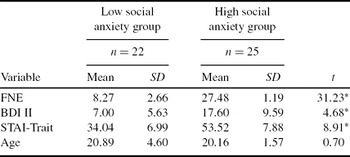
Table 1 shows the mean scores on each measure for each social anxiety group. Independent samples t tests were used to compare groups. FNE and BDI scores failed Levene's test for equality of variance and so t tests assuming unequal variances were employed. Consistent with the selection process, the two groups differed significantly in FNE score. In addition, the high social-anxiety group scored higher than the low social-anxiety group on STAI-T and BDI measures. The two groups did not differ significantly in age or gender composition, χ2 (1) = 3.87, p = .05.
Characteristics of participants in each social anxiety group

*p < .001.
The Safety Behaviour Interpretation Scale: data analysis and findings
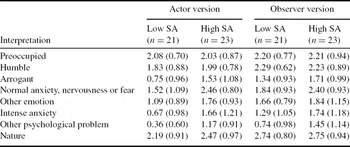
In order to ascertain whether the high and low social anxiety groups differed in the degree to which they endorsed each type of interpretation on the two versions of the SBIS, means were computed for each interpretation across the five safety behaviours (e.g. the ratings for the “intense anxiety” interpretation were summed for all five safety behaviours and then divided by five to compute an average; see Table 2). These “mean interpretations” for each attribution were then used as the dependent variable in a series of group (High Social Anxiety vs. Low Social Anxiety) by questionnaire version (Actor vs. Observer) repeated measures ANOVAs with version as the within group variable.
Group means (and standard deviations) for each interpretation collapsed across five safety behaviours (avoiding eye contact, talking less, avoid talking about myself, sitting alone, escaping from the situation)

SA = Social Anxiety.
For four interpretations, a main effect of SBIS version emerged with no significant interactions. These four main effects were for the following interpretations: 1) being a humble, low-profile person, F(1, 42)Footnote 1 = 9.68, p < .01; 2) being an arrogant person, F(1, 42) = 6.61, p < .05; 3) suffering from another psychological problem, F(1, 42) = 14.51, p < .001; 4) being by nature a person who exhibits the specific behaviour, F(1, 42) = 13.18, p = .001. For all four interpretations, participants endorsed the interpretation more strongly in the Observer version rather than in the Actor version. It should be noted, however, that there was a tendency to make stronger endorsements on the Observer version than on the Actor version of the SBIS for all eight interpretations.
For three interpretations, a main effect of social anxiety group emerged with no significant interactions. These three main effects were for the following interpretations: 1) being an arrogant person, F(1, 42) = 4.87, p < .05; 2) experiencing a normal level of anxiety), F(1, 42) = 8.11, p < .01; 3) suffering from another psychological problem, F(1, 42) = 8.06, p < .01. For these three interpretations, high socially anxious participants endorsed the interpretation more strongly both on the Actor and Observer versions of the questionnaire as compared to the low socially anxious controls. Additionally, high socially anxious individuals, compared to low socially anxious participants, also made significantly stronger endorsements both on the Actor and Observer versions for the “intense anxiety” interpretation, F(1, 42) = 5.00, p < .05.
Most importantly, for two interpretations there were significant interactions between SBIS version and group: 1) experiencing intense anxiety; 2) experiencing some other emotion (e.g. anger, resentment). Follow up t-tests were run for these significant interactions to identify the sources of these interactions.
For the “intense anxiety” interpretation, the significant main effects of group and version were qualified by a significant Group x Version interaction, F(1, 42) = 8.89, p < .01. The two-way interaction remained significant when BDI was entered as a covariate, F(1, 41) = 6.18, p < .05. Comparing within groups, the low social anxiety group more strongly endorsed the “intense anxiety” interpretation on the Observer version of the SIBS than on the Actor version of the SBIS, t(20) = 4.36, p < .001, but the high social anxiety group saw this interpretation as equally likely on both the Actor and Observer version of the SIBS. As for between-group comparisons, the two groups did not differ on the Observer version of the questionnaire, but the high social anxiety group more strongly endorsed the “intense anxiety” in the Actor version than did the low socially anxious participants, t(42) = 2.98, p < .01.
A similar pattern emerged for the “other negative emotion” interpretation, where a main effect of version was qualified by a Group x Version interaction, F(1, 42) = 5.14, p < 0.05. The interaction remained significant with BDI as the covariate, F(1, 41) = 5.34, p < 0.05. Here, the low social anxiety group saw the interpretation as more likely for others than for themselves, t(20) = 3.79, p = .001, and the high social anxiety group saw this interpretation as equally likely for others and for themselves. As for between-group differences, the two groups again did not differ on the Observer version of the questionnaire, but on the Actor version, the high social anxiety group more strongly endorsed the “other negative emotion” interpretation than did the low social anxiety group, t(42) = 2.45, p < .05.
Finally, Clark and Wells (Reference Clark, Wells, Heimberg, Liebowitz, Hope and Schneier1995) clearly hypothesized that high socially anxious people are more likely to use safety behaviours. Consistent with this prediction, an independent samples t-test showed that high socially anxious students were more likely to report engaging in behaviours considered to be safety seeking (single frequency score), t(45) = 2.00, p = .05, compared to low socially anxious individuals.
Discussion
The purpose of this study was to examine how the socially anxious people themselves view safety behaviours in social situations. First, between-version differences emerged, that is, participants often viewed interpretations as differentially likely for others (as measured by the Observer version of the SBIS) than for themselves (as measured by the Actor version of the SIBS). Both high and low socially anxious participants believed that being a humble person, being an arrogant person, suffering from a psychological problem and being by nature a person who exhibits certain behaviours were more likely explanations for safety behaviours exhibited by others than for behaviours that they themselves exhibit. Additionally, the low social anxiety group more strongly endorsed the “intense anxiety” and the “other negative emotion” interpretation on the Observer version as compared to the Actor version of the SIBS. How could we account for this general tendency to make stronger endorsements on the Observer version of the questionnaire? As Roth et al. (Reference Roth, Antony and Swinson2001) correctly suggest, in instances where we do not know much about another's personality or internal experiences (and the instructions of the SBIS implied that), all interpretations about his/her behaviour are perceived as being quite viable. It also indicates that safety behaviours can backfire, i.e. evoke the negative (together with more benign) social judgments the individual was trying to avoid.
Second, between-group differences were found, which indicated that socially anxious participants hold a general interpretation bias regarding safety behaviours. These individuals more strongly endorsed the extreme interpretation (“other psychological problem”) and two mildly negative interpretations (“being arrogant”; “normal anxiety”) both in the Actor and Observer versions of the questionnaire as compared to the low social anxiety group. Furthermore, high socially anxious participants were more likely than low socially anxious individuals to think that others interpreted these behaviours as being indicative of intense anxiety or other negative emotional condition. Taken alone, these results suggest that high socially anxious individuals assume that others judge them using very strict standards. They also indicate that high socially anxious people may hold other people to the same strict standards that they expect others to use to judge them.
Third, interactions between anxiety groups and questionnaire version, which remained significant after controlling for depressive symptoms, indicated the presence of a self-referent interpretation bias. However, this bias was characteristic of low rather than high socially anxious individuals, which was the opposite from what we expected to find. Participants low in social anxiety not only saw the extreme interpretation (“intense anxiety”) as less likely overall as compared to the high social anxiety group, but also viewed this interpretation together with the “other negative emotion” interpretation as far less likely for behaviours exhibited by themselves than for the same behaviours exhibited by others. Taken alone, this pattern of findings appears to suggest that people low in social anxiety may have a “double standard” in their evaluations of specific (safety) behaviours, particularly that they have less stringent rules evaluating their own behaviour, but do not differ significantly from socially anxious people in how they evaluate safety behaviour displayed by others. This self-referent interpretation bias is probably a mechanism working to protect or maintain high levels of self-esteem (Sedikides and Strube, Reference Sedikides and Strube1997). Finally, high socially anxious participants were more likely to report using safety behaviours compared to these in the low social anxiety group.
The results reported so far appear to suggest that socially anxious people are, at least, able to recognize the negative effects of certain safety behaviours. However, the question remains: why do they keep practising them? One possibility is that they lack the ability to engage in more positive responses. Indeed, the skills deficit models (e.g. Curran, Reference Curran1977) suggest that socially anxious individuals either have not had the opportunity to learn the necessary repertoire of behaviours or they are unable to put them into practice.
There is also another possibility. Although socially anxious individuals recognize that the use of safety behaviours increases the likelihood of negative social reactions, they may still prefer practising them because they believe that such behaviours produce less negative social outcomes than the anxiety symptoms they intend to hide. Since this study did not measure interpretations for visible anxiety symptoms, this hypothesis could not be tested and future studies should examine interpretations both for safety behaviours and the anxiety symptoms they intend to conceal. It should be noted, however, that a recent study by Voncken, Alden and Bögels (Reference Voncken, Alden and Bögels2006) failed to find an association between social anxiety and the belief that concealing anxiety (through safety behaviours) will reduce negative social reactions, as it was initially predicted. Social anxiety was only associated with the belief that acknowledgment of anxiety has negative social outcomes specifically for them. More research is needed on this point.
Limitations of the present study
The study reported here has several limitations that need to be addressed in future research. First, the safety behaviours used were not the participants' own idiosyncratic safety behaviours but a standard set of specific safety behaviours that were thought typical of socially anxious individuals in social gatherings. Therefore, it is possible that the behaviours specified were not necessarily functioning as safety behaviours for the participants in this study (i.e. carried out with the intention of preventing a social fear from being realized). Future studies should use more qualitative methods (e.g. semi-structured interviews) to elicit participants' idiosyncratic safety behaviours in response to their social fears. Second, the social scenario described in SBIS concerned meeting unfamiliar people at a social gathering. Although interacting with strangers is one of the most commonly feared social situations (Rapee, Reference Rapee, Heimberg, Liebowitz, Hope and Schneier1995), it is important to investigate interpretations for safety behaviours displayed in other social-anxiety provoking situations. The advantage of the current study over more qualitative research methods is that it standardized the situations and safety behaviours across participants. Third, participants were presented with only a limited number of experimenter-produced interpretations for each safety behaviour and it is important that future studies should directly ask the participants to provide their own interpretations for these behaviours as well as to report how negatively they view the implications of each interpretation for one's self-esteem, public self-image, etc. Fourth, the research was based on analogue population and in order to generalize the findings to social phobia, the study needs replication with clinical groups. Another limitation of the study is that it used a predominantly female sample, and the generalizability of these results to males remains to be established. A final limitation of the present study is its exclusive reliance on self-report.
Summary
Participants high in social anxiety appear to hold a general bias that they were more likely than low socially anxious individuals to think that being arrogant, suffering from a psychological problem or experiencing a normal level of anxiety, nervousness or fear are likely explanations for safety behaviours, regardless of who exhibits them. When participants were asked about safety behaviours that they themselves exhibit, people high in social anxiety were more likely than these low in social anxiety to think that others interpreted these behaviours as being indicative of intense anxiety or another negative emotional condition. Therefore, it appears that socially anxious individuals are, at least, aware of the negative effects of engaging in safety behaviours and that they apply strict judgmental standards both to themselves and to others. On the other hand, low socially anxious participants appear to hold a positive self-referent interpretation bias so that they viewed the intense anxiety or other negative emotional condition interpretation as far less likely for behaviours exhibited by themselves than for the same behaviours exhibited by others.
Appendix A. Sample question from the Safety Behaviour Interpretation Scale (Actor version – adapted from Roth, Antony and Swinson, Reference Roth, Antony and Swinson2001)
You are in a gathering with people you have just met. What will other people think if you AVOID EYE CONTACT? Please rate how likely it is that other people will think you AVOID EYE CONTACT for each of the following reasons using the scale provided below:
0 = not at all likely
1 = slightly likely
2 = moderately likely
3 = very likely
4 = extremely likely
People may think I AVOID EYE CONTACT because I:

• How often do you engage in this behaviour (avoiding eye contact) when you are with people you do not know well?



Comments
No Comments have been published for this article.