Grandmothers, who share on average 25% of their grandchildren’s genes, can increase their inclusive fitness by investing time and resources in their grand-offspring (Hamilton, Reference Hamilton1964). Studies from traditional and historical populations have shown that the presence of grandmothers is associated with improved grandchild survival (Sear & Mace, Reference Sear and Mace2008). Moreover, studies on present-day societies indicate that grandmaternal investment is associated with improved child development and well-being (Sear & Coall, Reference Sear and Coall2011; but see Tanskanen & Danielsbacka, Reference Tanskanen and Danielsbacka2018). There is also evidence of lineage-based differences in grandmaternal effects in both pre-modern and modern populations, where maternal grandmothers have been found to be more beneficial for grandchildren than paternal grandmothers (Sear & Mace, Reference Sear and Mace2008; Sear & Coall, Reference Sear and Coall2011). It has recently come to light that the beneficial effect of grandmothers could be dependent on grandmothers’ lineage and the sex of grandchildren (e.g. Fox et al., Reference Fox, Sear, Beise, Ragsdale, Voland and Knapp2009; Chapman et al., Reference Chapman, Pettay, Lummaa and Lahdenperä2018; Daly & Perry, Reference Daly and Perry2017). This is due to asymmetrical X-chromosome inheritance, causing the degree of genetic relatedness to vary between the grandmother–grandchild pairs based on grandmaternal lineage and sex of grandchildren.
According to X-chromosome relatedness, paternal grandmothers are related to granddaughters (50%) but not to grandsons (0%), while maternal grandmothers are related to both granddaughters and grandsons (25% each) (Euler, Reference Euler, Salmon and Shackelford2011). Based on this variation in genetic relatedness, four hypotheses (H) about the effects of grandmaternal investment on child outcomes were constructed: (H1) paternal grandmothers benefit granddaughters more than grandsons; (H2) maternal grandmothers benefit granddaughters and grandsons equally; (H3) maternal grandmothers benefit grandsons more than paternal grandmothers; (H4) paternal grandmothers benefit granddaughters more than maternal grandmothers.
To date, two studies using data from traditional and historical populations have tested the X-linked grandmother hypothesis. A re-analysis of seven studies detecting grandmaternal impact on child survival in traditional societies found some, although not exhaustive, support for the central role of X-chromosomal relatedness (Fox et al., Reference Fox, Sear, Beise, Ragsdale, Voland and Knapp2009). This study detected that in all studies, grandsons survived better with maternal grandmothers than with paternal grandmothers; in four studies, granddaughters survived better with paternal grandmothers than with maternal grandmothers; and in six studies, paternal grandmothers increased granddaughters’ survival more than grandsons’ survival (ibid.; see Chapman et al., Reference Chapman, Pettay, Lummaa and Lahdenperä2018, for methodological critique). Data from pre-industrial Finland showed that paternal grandmothers improved the survival of granddaughters more than grandsons, and maternal grandmothers improved the survival of grandsons more than granddaughters (Chapman et al., Reference Chapman, Pettay, Lummaa and Lahdenperä2018). However, the Finnish study found no support for the ‘key hypothesis’ that paternal grandmothers improve the survival of granddaughters more than maternal grandmothers (ibid.).
In populations with high childhood mortality, grandmothers may have helped improve grandchild survival, for instance, by preventing deadly injuries in small children (Coall & Hertwig, Reference Coall and Hertwig2010). Although mortality rates in present-day Western societies have decreased remarkably, currently injuries and accidents are the most common cause of morbidity and mortality in early childhood (WHO, 2008), making them an important measure of child outcomes. Prior studies have found that grandparents in contemporary societies can play a significant role in preventing childhood injuries; however, these studies have not considered the role of X-chromosomal relatedness (Tanskanen & Daniesbacka, Reference Tanskanen and Danielsbacka2016; Waynforth, Reference Waynforth2020). Although some studies with data from contemporary societies have tested whether bias in grandmaternal investment is based on X-chromosomal relatedness (e.g. Chrastil et al., Reference Chrastil, Getz, Euler and Starks2006; Rice et al., Reference Rice, Gavrilets and Friberg2010; Tanskanen et al., Reference Tanskanen, Rotkirch and Danielsbacka2011), studies testing whether maternal and paternal grandmothers in contemporary societies have different effects on childhood injuries based on the sex of children are lacking.
This study used data from the Millennium Cohort Study (MCS), which collected information on children born between September 2000 and January 2002 in the UK. In the MCS, parents or parental figures (in most cases biological mothers) answered questions concerning themselves, their family and children in the cohort. The analytic sample used included data gathered when the cohort member children were aged 9 months and 3 years. Only families where the main respondent was the biological mother of the cohort member child and families having information on both grandmaternal childcare and childhood injuries were included. Families where the parents themselves were the main childcarers during work hours were excluded. The final sample included 4445 children. The content of the MCS has been described in detail elsewhere (Hansen, Reference Hansen2014).
The dependent variable measured injuries experienced between 9 months and 3 years. In the MCS, mothers were asked to report whether children in this age group had injuries that resulted in a trip to a doctor, health centre or hospital. A hospital-attended injury for this age group was reported in 36% of the sample. The fact that boys (39%) had more injuries than girls (32%) is not concerning since this study’s aim was to test the relative difference in investment between grandmother types and not to compare the likelihood of injuries between girls and boys. The main independent variable indicated whether maternal or paternal grandmothers were the main sources of childcare arrangement during parental working hours for children in this age group. The main childcare arrangement variable has been used in prior studies as an indicator of heavy grandparental investment (e.g. Tanskanen, Reference Tanskanen2013; Waynforth, Reference Waynforth2020). The main care providers were maternal grandmother (36%) or paternal grandmother (13%). To achieve more robust results, the following variables were controlled for in all the analyses: child’s ethnic background, number of siblings, maternal age and education, family income, paternal presence in the household and housing tenure. Logistic regression was used and the results were illustrated by calculating the predicted probabilities from the regression models.
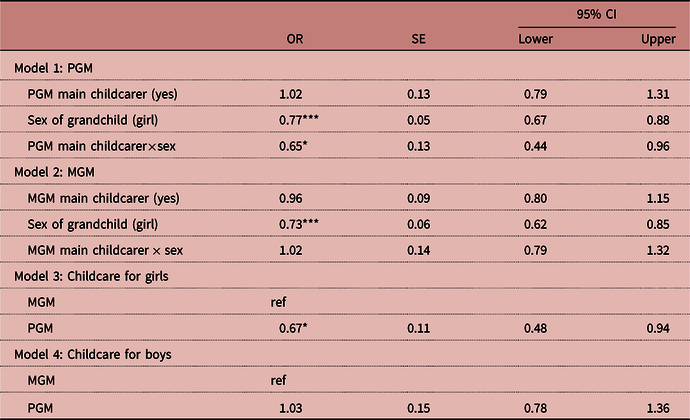
Table 1 shows the results. In Model 1, the investment of paternal grandmothers is associated with a decreased probability of injuries in girls (predicted probabilities calculated from the regression models: PGM main childcarer=24%, PGM not main childcarer=32%) but not in boys (PGM main childcarer=38%, PGM not main childcarer=38%). Based on Model 2, the investment of maternal grandmothers is not associated with an increased or a decreased likelihood of injuries either in girls (MGM main childcarer=31%, MGM not main childcarer=31%) or boys (MGM main childcarer=37%, MGM not main childcarer=38%). Model 3 indicates that the investment of paternal grandmothers is more likely to decrease the risk of injuries in girls than the investment of maternal grandmothers (PGM=24%, MGM=32%). Finally, Model 4 illustrates that the investment of maternal and paternal grandmothers is similarly associated with the probability of injury in boys (PGM=39%, MGM=39%).
Association between grandmaternal investment and injuries of children aged between 9 months and 3 years by sex and lineage

Results from four logistic regression models.
MGM=maternal grandmother; PGM=paternal grandmother.
Models 1 and 2: n=4445; Model 3: n=1048; Model 4: n=1083. Adjusted for child’s ethnic background, number of siblings, maternal age and education, family income, paternal presence in the household and housing tenure.
*p<0.05; **p<0.01; ***p<0.001.
Support was detected for the X-linked grandmother hypothesis predicting that the investment of paternal grandmothers decreases injuries more among granddaughters than grandsons, the investment of paternal grandmothers decreases the injuries of granddaughters more than maternal grandmothers, and the investment of maternal grandmothers is similarly associated with the injuries of granddaughters and grandsons. In contrast to the hypothesis, the investment of maternal grandmothers was equally associated with the risk of injuries in granddaughters and grandsons. Thus, the X-linked grandmother hypothesis received some, although not full, support.
These findings also highlight the importance of studies testing whether theories other than those based on X-chromosomal relatedness can explain the biased grandmaternal effect on child outcomes. Moreover, studies using different grandmaternal investment factors in addition to childcare (e.g. financial or emotional support) and different measures of child outcomes (e.g. subjective well-being or development) are needed. Finally, because the grandmaternal effect may vary according to the age of the grandchild, future studies should concentrate on the outcomes of school-going and adolescent grandchildren.
Funding
The study was supported by the Academy of Finland (grant numbers 317808, 320162, 325857 and 331400).
Conflicts of Interest
The authors have no conflicts of interest to declare.
Ethical Approval
The authors assert that all procedures contributing to this work comply with the ethical standards of the relevant national and institutional committees on human experimentation and with the Helsinki Declaration of 1975, as revised in 2008.