1. Introduction
In his analysis of Sievers‘ Law (Pierce 2006:275–319), Pierce argues that internuclear glide-final clusters were heterosyllabified in Gothic (that is, -C.GV-), rather than tautosyllabified (-.CGV-). Pierce's position con-tradicts that of Barrack (1998) and Kim (2001) among others—indeed, it contradicts that of Sievers himself, at least regarding the palatal glide (1892:22f.)—who maintain that internuclear glide-final clusters were tautosyllabified in Gothic. In what follows, I attempt to refute Pierce's assertion. Pierce bases his analysis on data gathered from the Codex Argenteus (henceforth Arg) and the Codices Ambrosianus A and Ambrosianus B (henceforth, Amb A and Amb B) by Hechtenberg Collitz (1906) and Schulze (1908) as well as on data gathered from the Skeireins and the New Leaf of the Arg by Frey (1989). Finally, he conducts a “spot check” of the manuscripts himself (Pierce 2006:277).
However, these secondary sources do not always present complete or even accurate information on these manuscripts. Hence, even if Pierce accurately presents the data as collated in these sources—which, in fact, Pierce fails to do—the basis for his conclusions is compromised. For example, on p. 288 Pierce incorrectly cites the sum of Hermann's (1923:288) tally of divided internuclear bisegmental glide-final clusters (-VC/GV-) as 339, whereas the actual sum of Hermann's tally is 394. However, Hermann's tally is incomplete in any case because it apparently excludes the Skeireins.
The importance of an accurate count of all divided clusters—whether bi-segmental or multi-segmental—becomes evident in section 3.5, where I show that the number of premature word breaks (so-called errors) in the scribal division of glide-final clusters is significantly greater than the number of such “errors” in clusters not ending in glides. I also show that this discrepancy further corroborates the thesis that glide-final clusters were indeed tautosyllabified, contrary to Pierce's thesis. Moreover, the problem of the inaccurate and incomplete tallies of divided internuclear clusters extends beyond those ending in glides. For example, Frey (1989) fails to mention several forms divided across lines in the Skeireins. Divided words omitted in Frey 1989 are given in 1.Footnote 1
(1)


Because of the unreliability of these various tallies, I have produced an inventory of all divided internuclear consonant clusters in the four Gothic manuscripts mentioned above.Footnote 2 A summary of the totals is included in the Appendix below. Note that the term “divided internuclear (consonant) clusters” refers to divisions either before the clusters (-V/C2-nV-), within the clusters (-VC1-n/C1-nV-), or, in the few rare cases, after the cluster (-VC2-n/V-).
This database in Excel (henceforth, EDB) reveals that the total number of divided bi-segmental glide-final internuclear consonant clus-ters (-VC/GV-) is neither Pierce's 339 nor Hermann's 394, but 409. More importantly, the use of such a tally is misguided in any case because it excludes the many divisions of internuclear glide-final clusters comprising multiple segments and—most significantly, as we see below—many so-called errors in the division of such clusters.Footnote 3
Pierce (2006:281) begins his analysis by averring that the most trustworthy indicator of Gothic syllabification is the orthographic evi-dence provided by the Gothic scribes: word breaks at the end of lines in the manuscripts. Indeed, word breaks in the Gothic manuscripts do appear to conform to basic principles of syllabification such as, for example, the Syllable Preference Laws proposed in Vennemann 1988.
Compare the Head and Coda Laws: Intervocalic singletons go the next line, as in Arg liu/teiÞ, Mt 5:15; hunslasta/da, Mt 5:23. This reflects the preference for empty codas but occupied onsets. Compare the Contact Law: intervocalic clusters comprising consonants of rising or equal strength (that is, evincing declining or equal sonority) are preferably separated by a syllable boundary. This would include, for example, clusters comprising two resonants or a resonant followed by an obstruent or even two oral stops since an unreleased stop is weaker than a following released stop. This reflects the fact that codas of equal or less strength than following onsets are preferred.Footnote 4 Again, Gothic word breaks are consistent with this preference, as in Arg EDB 30 anÞaram/ma, Mt 6:24; EDB 12 frijon/dans, Mt 5:46; EDB 23 mis/sadedins, Mt 6:15.Footnote 5
It is particularly noteworthy that scribal practice is generally consistent with a corollary to the Contact Law. Since the heterosyllabi-fication of oral stops followed by liquids (-P.L-) would be a serious violation of the Contact Law—because consonantal strength drops markedly across such clusters—the scribes regularly divided words before such combinations, (-/PL-), as in Arg EDB 85 sti/kla, Mt 10:42; EDB 133 hug/greiÞ, Jn 6:35 (see Vennemann 1987, who discusses this phenomenon in depth). Indeed, since fricatives are weaker than stops, the related division of -/ÞL- occurs less consistently and, in fact, fails to occur at all in the Skeireins. Instead, one finds four instances of -Þ/L-, as in Skeireins EDB 5, wiÞ/rus (Bennett 1960:52.I.b.3; see Riad 2004:184).
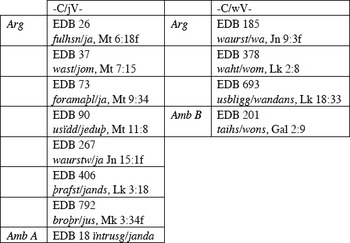
What, then, is one to make of the fact that the Gothic scribes regularly divided internuclear glide-final clusters immediately before the glide, regardless of the preceding sequence of consonants: -C/GV-, -C/jV- and -C/wV-, as shown in table 1? If this practice is taken at face value to reflect the actual syllabification of such clusters, this hetero-syllabification represents one of the most serious possible violations of the Contact Law, especially in the case of -Cj- clusters since /j/ is the weakest consonant on the sonority scale (see Murray & Vennemann 1983:519f.). Therefore, this is the least likely cluster to be hetero-syllabified: **-C.j-. Moreover, Vennemann (1987:190) avers that he knows of no case where a language tautosyllabifies stop-liquid clusters (-.PL-) without also tautosyllabifying glide-final clusters (-.CG-) given that heterosyllabification of the latter would be an even more serious violation than heterosyllabification of the former.
Word division before cluster-final glides in Gothic.

For this reason, in order to account for the scribal practice of breaking words immediately before the glides, Murray & Vennemann (1983:525; compare Frey 1989) conclude that the glides must have occlusivized to fricatives in this position in Gothic. However, Pierce (2006:287) rejects this theory for several reasons, most notably the following two (compare Barrack 1997, Page 1999, Pierce 2002). First, Gothic j alternates with i in biblical names where one would expect a glide rather than a fricative, as exemplified in 2a. Second, sporadic j epenthesis occurs in core vocabulary, as shown in 2b.
(2)
Note that Pierce's argument (p. 282) is inconsistent on this point. He states that he agrees with Murray & Vennemann's heterosyllabification of internuclear glide-final clusters (-C.G-), yet disagrees with their conclusion that the glides had occlusivized to fricatives. Whereas Murray & Vennemann's analysis is coherent—since the putative fricativization of glides renders Gothic scribal practice completely consistent with the Syllable Laws—Pierce's analysis is not: Without such occlusivization of the glides, Murray & Vennemann's argument that Gothic scribal practice is consistent with the Syllable Laws collapses. Yet, this is precisely the weakened position that Pierce adopts.
As noted at the outset of our discussion, the unexpected scribal practice of dividing clusters before the glides sets the stage for the present controversy. Pierce (p. 284; compare Lutz 1986:193) maintains that Gothic scribal practice here is a faithful indicator of syllabification and that the heterosyllabification of internuclear glide-final clusters is simply an anomaly of Gothic. Barrack (1998:chapters 3, 4) and Kim (2001:109), on the contrary, maintain that such clusters were indeed tautosyllabified in Gothic (-.CGV-) and that the scribes divided words before the glides for a different reason: In over 88% of such divisions, there is a morpheme boundary (#) within the divided glide-final clusters, -C/#j- and -C/#w- (see note 8 below). For example, the most productive class of verbs in Gothic (indeed, in Germanic) is the First Class of Weak Verbs consisting of causatives (or iteratives) and denominatives that ter-minate with a j-suffix (from PIE +-éje- and +-ejé, respectively, Kieckers 1960:225–232). Moreover, ja-/jô- and (to a lesser extent) wa-/wô- stem nouns and adjectives are also among the most productive morphological classes in the language.
2. Pierce's Analysis
Pierce (2006) counters this morphologically driven analysis of word breaks across glide-final clusters with the following five observations:
(i) The heterosyllabification of at least the palatal glide in Gothic is corroborated by the Law of Initials, which predicts that no onsets will be permitted word-internally if they are not permitted word-initially. Since no Gothic word begins with a palatal glide-final cluster (**Cj-), it follows that such a tautosyllabified cluster would not be tolerated word-internally. Hence, the scribal division of such clusters word-internally (-C/j-) is consistent with the Law of Initials and reflects Gothic syllabifi-cation (-C.j-; Pierce 2006:289).
(ii) The second observation involves Verschärfung and verb stems with /-ngw-/. The argument that the scribes divided words before the glide because of a putatively ubiquitous morpheme boundary in this position is untenable because not all such sequences evince a morpheme boundary before the glide. There are two reasons for such sequences lacking a morpheme boundary (Pierce, p. 288). First, according to Holtzmann's Law (Verschärfung), stop-glide sequences in Gothic developed from the partial occlusivization of long Proto-Germanic glides, +-jj- > -ddj- and +-ww- > -ggw-, as for example, in PG +ejjV- > Go. ïddja, the suppletive preterite of gangan, ‘go‘; PG +trewwV- > Go. triggw- (compare Feist 1939:288f., 480). Second, there are a few verbs in Gothic whose roots end in /-ngw-/, such as siggwan, that contain no morpheme boundary before the labiovelar glide (compare Feist 1939:419).
(iii) According to Pierce (2006), those Germanists who maintain that internuclear glide-final clusters in Gothic were actually tautosyllabified (-.CGV-) are inconsistent. They maintain this morphologically driven analysis in spite of the scribal practice of dividing such clusters across lines (-C/G-); yet they fail to explain why scribes did not follow the same practice in dividing forms containing sequences of stops (or Þ) followed by liquids. In other words, Pierce counters that if morphology indeed trumps syllabification in dividing internuclear glide-final clusters, why did the scribes not follow the same practice in dividing stops from liquids when the two are separated by a morpheme boundary? Why does -P#L- lead the scribes to produce historical -/P#L- rather than **-P/#L-? The fact that glide-final sequences on the one hand and liquid-final sequences on the other are analyzed by proponents of tautosyllabification using different criteria suggests the inconsistency in that analysis (Pierce 2006:282, 288).
(iv) The assumption that the syllabification of Gothic is faithfully mir-rored in the word breaks reveals a system that generally reflects that of the other early Germanic languages. Word division in the Old English manuscripts also generally corresponds to syllable breaks and “it would therefore be unsurprising if Gothic were to fit this pattern as well” (Pierce 2006:282).
(v) If the scribes normally divided simplex words in accordance with their syllabification rather than their morphological structure but made an exception in the case of glide-final clusters, why did they not occasion-ally err in favor of syllabification in accordance with their normal practice? In other words, why did the scribes not occasionally ignore the morpheme boundary in internuclear glide-final sequences (-C#G-) and divide words in accordance with principles of syllabification based on consonantal strength that they normally followed (-/C#G-, Pierce 2006:288f.)?
3. A Response to Pierce
3.1. The Law of Initials is Unreliable
All five of Pierce's arguments are based on highly dubious premises. Pierce appeals to the Law of Initials to argue that since Gothic does not permit word-initial clusters ending with the palatal glide (**Cj-), one is entitled to conclude that Gothic does not permit such sequences word-internally. However, the Law of Initials is notoriously unreliable when applied to glide-final clusters. For example, the Law of Initials predicts that present-day Standard German will not permit tautosyllabified -V.djV- since no German word can begin with the cluster dj-, as in Diabetes [dia’be:t∊s], Dialekt [dia’l∊kt] (Clark & Thyen 1997:848). Hence the Law of Initials predicts the following syllabifications in Stan-dard German: Idiot [id.jo:t] and Idiom [id.jo:m].
However, such syllabifications run afoul of two very well founded phonological rules: Coda Devoicing and Open-Syllable Vowel Tensing. By dint of the former, all obstruents in codas are devoiced (fortified). This is such a pervasive rule that native German speakers attempting to master other languages have difficulty suppressing it (for example, by pronouncing [g?t] for [g?d] ‘good‘). By dint of Open-Syllable Vowel Tensing, one should expect lax vowels in the initial closed syllables of the two words under discussion. Hence, by dint of these two rules, one should expect counterfactual Idiot **[?t.‘jo:t] and Idiom **[?t.'jo:m] instead of standard [i.'djo:t] and [i.'djo:m] (see Clark & Thyen 1997: 1024).
A similar problem arises in the analysis of Latin sequences exem-plified by the internuclear glide-final cluster in the word sanguis (putatively [sa?gwis]). No Latin word begins or ends with any com-bination of the cluster [?gw]. Thus, the Law of Initials as well as the Law of Finals utterly fails to predict the actual syllabification of such sequences in Latin. Indeed, Pierce himself (p. 289) admits that the Law of Initials fails to predict Pierce's putative heterosyllabification of the labiovelar glide-final sequences (-C.w-) in Gothic. By dint of Pierce's analysis, such sequences were heterosyllabified (-C.w-) in Gothic. Nevertheless, Gothic does indeed permit such word-initial sequences: swistar, twaddje, Þwairhs. Thus, the Law of Initials offers no credible support for Pierce's analysis.Footnote 6
3.2. Very Few Glide-Final Clusters Contain No Morpheme Boundaries
Pierce argues that one cannot attribute the regular scribal practice of dividing words immediately before glides to the presence of morpheme boundaries because there are two sources for such internuclear glide-final clusters that contain no morpheme boundaries, but which, in spite of this, are regularly divided before the glides. Accordingly, Pierce argues that the motivation for division must have been phonological, hence a reflection of syllabification.
The first source for such sequences is Holtzmann's Law, by dint of which the long glides, -jj- and -ww- were partially occlusivized in Gothic to -ddj- and -ggw-, respectively. For example, +twajj- > Go. twaddj- and +triww- > Go triggw-. Since, according to Pierce, no morpheme boun-dary appears immediately before the glide in these sequences, the scribal practice of dividing words immediately before the glide is clear evidence of division induced by syllabification, hence -C.j- and -C.w-. The second source for such sequences is found in verbs whose stems end in /ngw/, such as siggwan. Again, the scribes regularly divided such sequences before the glide, which thereby provides more evidence of the syllabification -C.w-.
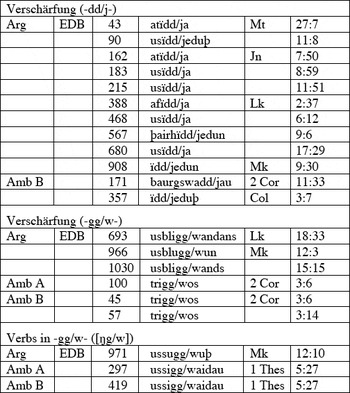
Pierce's argument here rests on a tacit premise. The occurrence of the forms lacking a morpheme boundary, -CG-, was relatively frequent. Therefore, the scribes were not motivated to follow the pattern of the majority, -C#G-, and did not divide words to produce -C/G- on the pattern of ubiquitous -C/#G-. However, in the EDB, there are only 21 forms fitting Pierce's criterion (see 3, and table 2 below).
- (3)
a. Forms in -idd/jV- created in accordance with Holtzmann's Law
b. Forms in -ugg/wV- created in accordance with Holtzmann's Law
c. Verb stems in -gg/w- (that is, -ng/w-)
-C/G- forms displaying either Verschärfung or the verbal ending -ggw-.

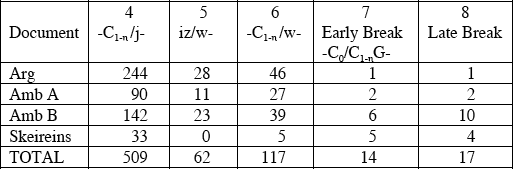
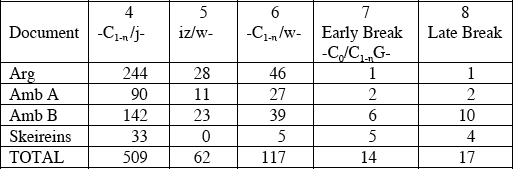
The total number of forms with word division immediately before glides (-C/G-) is 626 (see Appendix, table II, columns 4 + 6). Hence, Pierce's exceptions to sequences of -C#G- constitute a mere 3.3% (21/626) of the total number of pre-glide (-C/G-) word breaks. It is not likely that this meager number would cause the scribes to deviate from their normal practice of dividing words immediately before the glides. Note also that these 21 tokens actually represent only 5 different morphemes (see 4).
- (4)
a. -ïddj- (the suppletive preterite of gangan)
b. -waddj-
c. -bliggw- ∼ -blaiggw-
d. triggw-
e. -siggw- ∼ -suggw-
The fact that none of these forms contains any readily discernable internal morpheme boundaries in a synchronic grammar makes it more plausible that scribes would simply follow their general habit of dividing words before the glides. Nevertheless, all such sequences were probably tautosyllabified in accordance with the Contact Law: -C.C/G-.Footnote 7
3.3. Very Few -/PL- Sequences Contain Morpheme Boundaries
Pierce maintains that those who posit a morpheme boundary as the basis for the scribal practice of dividing before glides, -C/#G-, are inconsistent because they do not explain why the scribes did not follow the same procedure in dividing stop (or Þ) + liquid sequences separated by a mor-pheme boundary, -P/#L-. Instead, they produced historical -/P(#)L-.
Again, Pierce's argument rests on a tacit premise, but—in this case—on a premise that is even more dubious than the one at the basis of the previous argument. Pierce assumes that the occurrence of such sequences containing a pre-liquid morpheme boundary was frequent enough that the scribes would have remained mindful of them and not have been motivated by habit to follow the general pattern presented by the majority of forms containing the sequence -PL- (-or ÞL-) where no morpheme boundary separates the stop (or Þ) from the liquid.
In the entire EDB, there is only one unquestionable example of a word divided before the stop (or Þ) + liquid sequence containing an intervening morpheme boundary: Arg EDB 340 framal/d[#]rozei, Lk 1:18f, the comparative nom.sg.fem. form of framaldrs ‘more advanced in age‘. This form is clearly related to ald ‘time, age‘ in the synchronic grammar of Gothic, and, therefore, exhibits a morpheme boundary im-mediately before the liquid /r/.
There are only two other candidates for such word division, and both are questionable. First, Feist (1939:577) relates the adjective (Amb A EDB 241) wul/Þ[#?]rais ‘of worth, consequence, gen.sg.fem.‘ to the noun wulÞus ‘glory‘. Second, Feist (1939:77) relates the noun (Amb B EDB 274) bai/t[#?]rei ‘bitterness‘ to the verb beitan ‘bite‘. These two forms, wul/Þrais and bai/trei, ostensibly contain morpheme boundaries from a diachronic point of view. Whether they do synchronically is questionable given the semantic divergence from their putative etymolo-gical roots. In any case, there is only one form, framal/d[#]rozei, which can be considered clearly probative of Pierce's argument. However, it is highly unlikely that a single form—or even three such forms—would motivate scribes to deviate from their standard practice of dividing obstruent + liquid clusters before the obstruent, in conformance with the Syllable Contact Law.
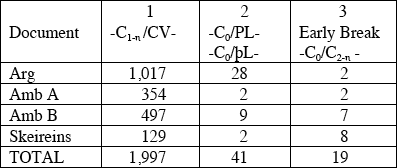
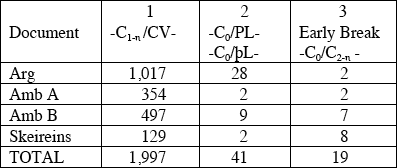
Let us consider these one to possibly three tokens of -/P(#)L- displaying word breaks regardless of morpheme boundaries with the number of tokens of the same structure where there is no intervening morpheme boundary. According to the EDB (table I, column 2 in Appen-dix), this total is 41. It is not unreasonable to assume that the scribes would be more likely to follow the general pattern reflected in the 41 cases than to deviate from that pattern for the one, or possibly three, exceptions.
3.4. The Older Germanic Dialects and Heterosyllabification of -CG-
Pierce argues that heterosyllabification of -CG- clusters is corroborated by the other older Germanic dialects and cites Frey (1989:288) without providing any data to support this conclusion (and neither does Frey, at least for the -CG- clusters). Nevertheless, it is true that the meter of Old Icelandic Stabreim is based on the heterosyllabification of -C.jV- (Murray & Vennemann 1983). However, this heterosyllabification in Old Icelandic Stabreim may be an artifact of the slow, deliberative method of recitation of that genre (Barrack 1998:67–80). In any case, the evidence from the other Germanic dialects lends support to Sievers‘ position, namely, that such sequences were tautosyllabified in Proto-Germanic (see Barrack 1998, chapters 3, 4). Space does not permit a thorough dis-cussion of the issue here.
Nevertheless, one of Pierce's (2006:282) assertions on this subject requires a response:
[W]ord breaks in at least one of the early Germanic languages (Old English) also generally corresponds to syllable breaks, and it would therefore be unsurprising if Gothic were to fit this pattern as well […].
Given the context of this argument, the implication here is that word breaks in Old English also support the heterosyllabification of glide-final clusters, -C.j- and -C.w-. However, this is patently false: word breaks in the Old English manuscripts do not support such a premise at all. In her tally of Wetzel's (1981) compilation of these breaks on microfiche, Lutz (1985:234) examines 30,780 word breaks of the type -VC/CV- of which only 38 comprise -C/w-, viz., -l/w- (n = 7) and -r/w- (n = 31). Note that neither of these poses a serious violation of the Contact Law since both members of the contacts are of near equal strength.
Let me now turn to scribal breaks of the type -C/j-, the most germane to the present discussion as they make up 24.5% (509/2074) of the breaks in internuclear clusters in the EDB.Footnote 8 Lutz finds none to list—and for good reason. By dint of West Germanic Gemination, all such contacts were eliminated by the doubling of the first member of the contact and, in prehistoric Old English, the loss of the palatal glide: PG +-VCajV- > WGmc. +-VCaCajV- > OE -VCaCaV-. For example, PG +sitjan- > WGmc. +sittjan- > OE sittan. The only exception to this historical development is presented by the weak contact -rj- in which /r/ failed to geminate, and there was no loss of the palatal glide, as in nerian (Brunner 1965:144f, 186ff.).
3.5. Putative “Errors” Support Tautosyllabification of -CG-
Finally, Pierce (2006:288) asks:
Had [C + glide clusters at line ends] really been tautosyllabified, one might plausibly expect the Gothic scribes to have tautosyllabified them at least occasionally, especially since there are a handful of demon-strable cases of scribal error in terms of word breaks […].
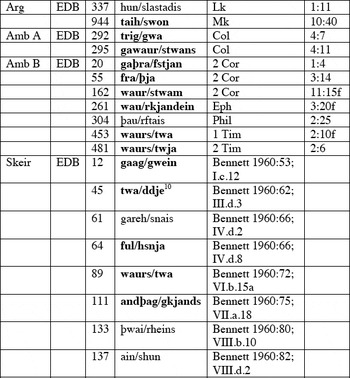
Indeed, there is ample evidence of such “errors.” In fact, most of the “errors” in the four manuscripts in the EDB appear to be precisely of the type Pierce claims should occur if -Cj- were indeed tautosyllabified. Moreover, it is ironic that Pierce cites the form twaddje in his attempt to demonstrate that the scribes divided words before glides even when the morpheme boundary was elsewhere: “Consider forms affected by Holtzmann's Law, such as twaddje ‘of the two‘ (where the word break/syllable boundary occurs before [sic] the j […]” (p. 288). However, Pierce's description of the word break in this word is false because twaddje occurs only once in the EDB and presents the only example of Holtzmann's Law that exhibits a scribal “error:” it is divided before the long stop, twa/ddje Skeireins EDB 45 (Bennett 1960:62; III.d.3).
One must ask: could this “error” be probative of other factors? Consider once again the other divided sequences displaying Holtzmann's Law (see table 2 above):Footnote 9
(5)
None of these forms provide any obvious reason to posit an internal morpheme boundary in a synchronic grammar of Gothic. Hence, it is not surprising that in dividing these forms at the end of lines the scribes fell back on their habit of dividing immediately before the glide where a morpheme boundary occurs in virtually every other such sequence in Gothic, except perhaps for ïz/w- discussed in notes 3 and 8 above.
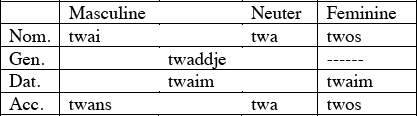
If we now turn to twa/ddje, we find a completely different situation. There is indeed a morpheme boundary before the long stop as revealed in the other occurrences of the morpheme twa- ∼ twai- ∼ two- (see table 3; compare Braune/Heidermanns 2004:127.)
The declension of the cardinal twai ‘two‘.
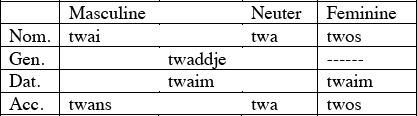
Moreover, there is at least one other occurrence of the allomorph twa-, which, of course, bolsters the positing of a morpheme boundary after twa-, as in twalif ‘twelve‘. Hence, the word break twa/ddje appears to serve as good prima facie evidence of morphological influence on scribal practice. Where no clear morpheme boundary is discernible in the forms resulting from Holtzmann's Law, the scribes fell back on the only well-established pattern: breaking the word before the glide.
Of course, the influence of sonority via the Contact Law may also be a contributing factor in the division of twa/ddje. Moreover, there are other “errors” that provide evidence of the tautosyllabification of glide-final clusters based mainly on such influence. “Errors” of this type—if indeed there are such—would also evince premature word breaks, that is, breaks made earlier than expected in the glide-final sequence; in other words, breaks reflecting tautosyllabified -.CGV-.
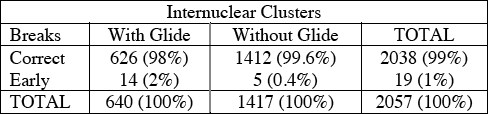
Indeed, if we consider only premature breaks, we find that over 73.7% (14/19) take place in internuclear glide-final clusters (see forms in bold face in table 4). In other words, the proportion of premature breaks
Premature word breaks in the EDB.

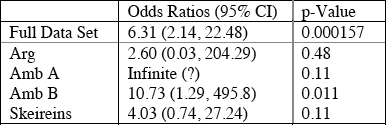
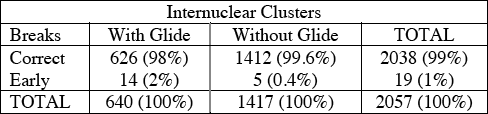
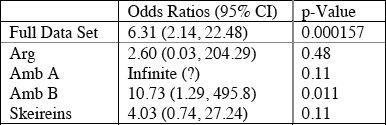
in glide-final clusters is significantly higher than the number of pre-mature breaks in nonglide-final clusters: a chi-square test conducted on the two-by-two contingency table of the data (table 5) reveals that it is highly unlikely that this difference arose by chance (p = 0.00015).Footnote 11 This corroborates the hypothesis that in these instances the scribe was uncon-sciously motivated by considerations of consonantal strength, yet had no established scribal tradition to appeal to and was unsure of precisely where to make the break earlier in the sequence.
Early vs. regular breaks in glide vs. nonglide-final clusters (percentages are column percents).
Three of the remaining five cases of “errors” are also interesting from the point of view of consonantal strength: Whereas Amb B EDB 304 Þau/rftais and Skeireins EDB 133 Þwai/rheins appear to be errors, pure and simple, the other three “errors” also could very well reflect the influence of consonantal strength since all three are divided before one of the strongest fricatives, /s/, and a following weaker consonant: Arg EDB 337 hun/slastadis, Skeireins EDB 61 gareh/snais and EDB 137 ain/shun.
The fundamental weakness of Pierce's analysis stems from his fail-ure to view the scribal practices in their totality—a totality which reveals itself only if one studies the so-called errors. The scribes divided words across consonant clusters in accordance with consonantal strength except where ubiquitous consonant-initial suffixes terminated words. Thus, the scribes followed the Contact Law faithfully, dividing words between consonants except where the strength differential was relatively greater, as in the case of stops (or Þ) followed by liquids (and ignoring the one to possibly three cases where a morpheme boundary was present). In such cases, they usually heeded consonantal strength and divided words before the obstruent. The same tendencies are revealed in 17 of the 19 so-called errors representing premature word breaks. The only significant deviation from the sonority scale is the regular word division before ubi-quitous glide-final clusters, where a morpheme boundary precedes the glide in at least 88.4% of the breaks.Footnote 12
In conclusion, it appears that Sievers‘ (1892:22f.) original assertion that internuclear clusters ending in the palatal glide were tautosyllabified in Germanic has withstood the test of time.
4. A Final Note
It is not possible for historical linguistics to achieve the rigor of the natural sciences since we cannot elicit new data to add to our corpora for purposes of experimentation. However, if we hope to at least approach that ideal, we must pay more attention to what we do have, the primary data and evidence of their inherent characteristics, rather than treating these data as mere raw material to be manipulated into abstract, theoreti-cal constructs.
APPENDIX
Totals of Gothic Word Breaks
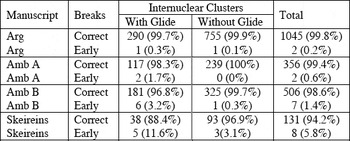
Scribes regularly divided internuclear clusters before the last consonant except in the case of stops and [θ] (Þ) followed by liquids. Such clusters were divided before the obstruent. These regular breaks are tallied in columns 1 and 2 of table I. Any deviations from this practice are noted as “early breaks” (column 3) or “late breaks” (column 8 of table II). In columns 4–7 of table II, I have noted breaks before cluster-final glides as well as deviations from this practice (so-called errors). The occurrence of the morpheme ïz/w- is ubiquitous and is tallied in column 5. Note that column 6 includes the total of column 5. The total number of breaks before glides terminating internuclear clusters (that is, VC1-n/ G V) is the sum of columns 4 and 6. The total number of breaks within or before such clusters is the sum of columns 4, 6, and 7. Breaks after prefixes and the first element of compounds may deviate from the above practices and are not included in the database. On scribal practices in word division, see Schulze 1908:618.
Totals on EDB (columns 1–3).
Totals on EDB (columns 4–8).
Early vs. regular breaks in glide vs. nonglide-final clusters broken out by manuscript; percentages are column percents.

Odds ratios for early break in glide vs. nonglide-final clusters; p-values are from Fisher's Exact Test.