Reading strategies depend on the consistency of the orthographic system, that is, on what the grapheme-phoneme conversion (CPC) rules are like. If a direct correspondence between grapheme-phoneme exists, then a language has a transparent orthography, which means that the alphabetical code is easier to learn. However, Ziegler and Goswami (Reference Ziegler and Goswami2005) in their psycholinguistic grain size theory proposed at least three factors that seem to be crucial to explain the differences between languages: the Grapheme Phoneme Conection GPC relation, the size of the orthographic and phonological representation, and the teaching methods (Ziegler & Goswami, Reference Ziegler and Goswami2005). It is widely known that learning to read, or even reading itself, is easier in absolutely transparent orthographies such as Turkish or Albanian, or in relatively transparent orthographies such as Italian, Greek or Spanish, when compared with opaque orthographies like English, in which the spelling to sound relationship is irregular (Avdyli & Cuetos, Reference Avdyli and Cuetos2012; Öney & Durgunoğlu, Reference Öney and Durgunoğlu1997; Seymour, Aro, & Erskine, Reference Seymour, Aro and Erskine2003). The consistent mapping between graphemes and phonemes facilitates reading in a transparent orthography because a phoneme is always pronounced in the same way, which means a small grain size is more suitable for these types of languages, as is the case for Spanish. However, this assumption is not true in all cases, due to the fact that numerous studies have shown that in spite of the regular rules between Grapheme-Phoneme GP in Spanish, there is a tendency to use larger units than graphemes during reading. Sebastian-Gallés and Parreño (Reference Sebastián-Gallés and Parreño1995) found that six year-old Spanish children made lexicalizations while reading pseudowords. Moreover, nine year-old children made more lexicalizations than adults. The authors argue that lexical reading is present from very early stages of reading (Sebastián-Gallés & Parreño, Reference Sebastián-Gallés and Parreño1995). Similar outcomes have been found in other studies with Spanish speaking children, for instance, Davies, Cuetos, and González-Seijas (Reference Davies, Cuetos and González-Seijas2007) found that both routes of reading were present in children with a mean age of nine years. Length effect was especially shown with longer stimuli. The orthographic neighborhood size and word frequency effects highlighted the strong influence of lexical variables at least for the short and familiar stimuli. The influence of the last two variables may be explained in terms of orthographic or phonological representations. As Spanish language has many long words, to compensate this effect, intermediate groups of graphemes (less than the whole word yet more than a grapheme or a phoneme) are functioning. Along this line, with younger Spanish children, five to ten years old, lexicality, frequency, and length effects were manipulated (Cuetos & Suárez-Coalla, Reference Cuetos and Suárez-Coalla2009). Stronger length effects were found among first graders with a diminishing effect as the children grew older, suggesting these findings that Spanish children seem to start relying mostly on a sublexical route of reading. In contrast, frequency and lexicality effects were seen as they advanced in grade, which highlights that intermediate steps between graphemes and the whole word are being used in Spanish children from very early stages of reading, in spite of the orthographic transparency.
Similar results have also been shown by a number of studies where lexical reading is present from very early stages of reading, although the languages had a relatively regular grapheme-phoneme correspondence (Bates, Burani, D’Amico, & Barca, Reference Bates, Burani, D’Amico and Barca2001; Burani, Marcolini, & Stella, Reference Burani, Marcolini and Stella2002; Defior, Justicia, & Martos, Reference Defior, Justicia and Martos1996; Ehri, Reference Ehri, Gough, Ehri and Treiman1992; Goswami, Gombert, & De Barrera, Reference Goswami, Gombert and De Barrera1998; Öney & Durgunoğlu, Reference Öney and Durgunoğlu1997; Öney & Goldman, Reference Öney and Goldman1984; Orsolini, Fanari, Tosi, De Nigris, & Carrieri, Reference Orsolini, Fanari, Tosi, De Nigris and Carrieri2006).
In a longitudinal study with Italian children, Orsolini and colleagues (2006) found that mastery of the grapheme-phoneme conversion rules is not sufficient for a good and rapid automation of reading; in addition, self- teaching strategies (Share, Reference Share1995) are needed since the beginning of reading. That is, reading strategies, based on usage of larger units than a grapheme, lead to a visual, more automated and lexical reading (Ehri, Reference Ehri2005).
Furthermore, school grade level is another important factor regarding the reading automation process. If learning to read is based on stages of reading instead of item based, then two stages of general reading acquisition can be distinguished: learning to read (1st to 3rd grade) and reading to learn (4th to 6th grade). In the first stage children focus on decoding, whereas in the second stage children concentrate on meaning. Therefore, automaticity in word reading could play a more relevant role in the first stage because children must develop their automaticity with print (Chall, Reference Chall1996). The Spanish system of teaching reading can be perfectly fitted to this explanation, wherein during the first three school grades children are taught systematically and explicitly to read, and after third grade they use reading to access meaning. The abandoning of this explicit teaching of reading may have differential influence on reading.
Until now the automation process was measured through reading accuracy and reading speed measured in reaction times (RTs), and almost all the outcomes from relatively transparent orthographies agree on the idea that larger length effects mean higher RTs, while the opposite occurs with lexicality or increasing frequency and orthographic neighborhood size.
Although the time required to prepare a response (RT) and the different effects related to it were largely reported in a developmental reading study (see, e.g., Barca, Burani, Di Filippo, & Zoccolotti, Reference Barca, Burani, Di Filippo and Zoccolotti2006; Davies,et al., 2007; De Luca, Barca, Burani, & Zoccolotti, Reference De Luca, Barca, Burani and Zoccolotti2008), only a few studies have controlled the time needed to pronounce a word (articulation times: AT) and give a response, which is the total time spent in naming a word. The few existing studies considering articulation times reported lower ATs in regular than irregular words (Gough & Cosky, Reference Gough, Cosky, Castellan, Pisoni and Potts1977; Stanovich & Bauer, Reference Stanovich and Bauer1978), as well as in words that are preceded by semantically related primes in reading (Balota, Boland, & Shields, 1998).
In other study, Gerhand and Barry (Reference Gerhand and Barry1998) measured word pronunciation duration and reaction time, manipulating AoA and word frequency and found a great AoA effect and a very small word frequency effect. They explained these results through an essential difference between the response initiation (RTs) and response duration (ATs). Reaction times are only affected by an input effect, such as word frequency, and AT depends on a phonological output. That is, early acquired words are more “accessible” in terms of their integral phonological forms, which do not need to be assembled, and the AT is shorter than those of latterly acquired words. In the same way, Navarrete, Scaltritti, Mulatti, and Peressotti, (2013) recently found effects of AoA in a delayed picture naming task and concluded that part of the age-of-acquisition effect occurs at the level of phonological processes. In Spanish, Davies, Rodriguez-Ferreiro, Suárez, and Cuetos, (2013), measuring the accuracy, RT and AT (response duration), studied the effects of lexicality, word frequency, and length in letters in reading aloud in a sample of dyslexic children and their typically developing peers. Using similar techniques as in the present study, they found that exactitude, reading latencies and response duration were affected, in both cases, by the lexical (lexicality and word frequency ) and sublexical variables (length in letters). Specifically, word length affected response duration (ATs) similarly in both groups, but frequency effect was smaller for the typically developed children compared to dyslexic readers.
Developmental studies on reading aloud in languages with relatively transparent orthographies, such as Italian or Spanish, have shown that length effect diminishes with increased reading experience (see, e.g., Burani et al., Reference Burani, Marcolini and Stella2002), as well as by the intervention of other lexical variables. These data indicate a transition from a serial grapheme–phoneme mapping to a greater reliance on lexical knowledge. Zoccolotti and colleagues (2005) suggested that lexical reading strategies in Italian are adopted quite early because a substantial reduction of length effect was observed as a function of age between first and second graders. Moreover, in 1st to 8th grade Italian children, length modulates reading performance at early stages of word reading, with a smaller effect at higher grades for high-frequecy words , but in nonword reading the effect of length does not change as a function of grade (Zoccolotti, De Luca, Di Filippo, Judica, & Martelli, Reference Zoccolotti, De Luca, Di Filippo, Judica and Martelli2009). Likewise, the length effect was seen to be the best predictor of RTs even in adult reading (Bates et al., Reference Bates, Burani, D’Amico and Barca2001; Cuetos & Barbón, Reference Cuetos and Barbón2006). Mazzotta, Barca, Marcolini, Stella, and Burani, (2005) studied the effects of word frequency, imageability and age of acquisition in 3rd and 5th grade Italian children in word naming. They found a frequency effect in both grades affecting reading accuracy and reading speed. Nonetheless, Italian children benefit from imageability only with low frequency stimuli. AoA was significant (only over participant analaysis) among 3rd graders but not among 5th graders. These results indicate that lexical (frequency) and lexical-semantic (imageability and AoA) variables influence reading from the beginning of reading in Italian children. Similar results were reported in Spanish children as well, wherein AoA affected reading latency, indicating once more a parallel usage of lexical and sublexical routes of reading (Suárez-Coalla & Cuetos, Reference Suárez-Coalla and Cuetos2012).
Hence, age of acquisition as a lexical-semantic variable was shown to influence reading latency not only in adult reading (Alija & Cuetos, Reference Alija and Cuetos2006; Bates et al., Reference Bates, Burani, D’Amico and Barca2001; Brysbaert & Ghyselinck, Reference Brysbaert and Ghyselinck2006; Brysbaert, Lange, & Van Wijnendaele, Reference Brysbaert, Lange and Van Wijnendaele2000; Cuetos & Barbón, Reference Cuetos and Barbón2006; Gerhand & Barry, Reference Gerhand and Barry1998; Juhasz, Reference Juhasz2005; Morrison & Ellis, Reference Morrison and Ellis1995; Raman, Reference Raman2006), but also in children, although to a lesser extent (Brysbaert, Reference Brysbaert1996; D’Amico, Devescovi, & Bates, 2001; Garlock, Walley, & Metsala, Reference Garlock, Walley and Metsala2001).
In a study with eight nine year-old Dutch children (Brysbaert, Reference Brysbaert1996) in which the children were asked to name 204 three and four-letter Dutch words, independent effects of AoA, word length and word frequency were found. To ensure that the effects of the predictor variables (AoA, frequency and length) can be interpreted independently, Brysbaert found that AoA has a reliable effect on word naming latencies when the variance due to word frequency is controlled for.
The age of acquisition as a lexical-semantic variable not only influences opaque languages wherein a higher rely in lexical reading is given due to the irregular grapheme-phoneme consistency, but it also affects the reading times in a completely regular orthography as is shown in Turkish. Raman (Reference Raman2006), through a word naming task in adult reading (in Turkish), found that RTs in early acquired words were much lower compared to later acquired words. These findings suggest that AoA effects appear to be a property of lexical processing, very similar to the word frequency effect.
All the above mentioned studies, related to visual word recognition through different experimental conditions, report mostly factorial designs that involve the manipulation of two or more variables (e.g., lexicality, length, or frequency) with different levels. In these designs the effects of some factors are measured through an analysis of variance measuring the accuracy and latencies, obtained across items or subjects. Although this approach has been useful in investigating the relationship between variables in word recognition, it has some limitations. The selection of stimuli is not a categorical dimension, which means that it is difficult to reach definitive answers regarding the influence of factors (Plaut, McClelland, Seidenberg, & Patterson, Reference Plaut, McClelland, Seidenberg and Patterson1996); the implicit knowledge of the experimenters regarding lexical variables may introduce interference in the stimuli selection (Forster, Reference Forster2000), and the use of average values instead of raw data can be one of potential limitations (Balota, Cortese, Sergent-Marshall, Spieler, & Yap, Reference Balota, Cortese, Sergent-Marshall, Spieler and Yap2004). In response to these limitations of traditional analysis of variance, regression modeling, such as mixed effects, offers the chance to analyze raw data without counterbalancing and do not require prior averaging. Linear mixed effects combine fixed and random effects to allow the inclusion of all predictor variables that may influence the data in the analyses. In sum, the mixed effects (of fix and random variables) have greater flexibility and sensitivity and allow us to capture individual differences and generalize about wider populations.
According to previous studies, it seems clear that learning to read in transparent scripts is largely based on sublexical reading due to a relatively regular orthography-phonology relationship, but lexical reading appears in early stages of reading. In the present study we aimed to examine the strategies used by two groups (2nd and 4th graders) of Spanish children of typically developed reading ability (TDR), manipulating lexical and sublexical variables. Through this we want to know, at what exact moment the lexical variables have a greater weight, and how this affects reaction times (RTs) and articulation times (ATs). Thus, we may expect a higher length effect in second grade that continues to be present in fourth grade and the presence of lexical variables since second grade, seen in both RTs and ATs.
Method
Participants
Forty-six native Spanish-speaking children of typical developing reading ability, of second and fourth grade took part in this study. Twenty two were of second grade, 12 girls and 10 boys (mean age in months = 94 and SD = 3.25), and twenty four were of fourth grade, 15 girls and 9 boys (mean age in months = 115, SD =3.51). All participants were from the same school and their native language was Spanish.
Materials
A list of 100 words was used, all morphologically simple nouns with a different range of sublexical and lexical variables, such as word length in letters 4–8 (M = 5.64), length in syllables 2–4 (M = 2.33), word frequency 6.57–118.1 (M = 32.14), age of acquisition (AoA) 1.7 – 4.6 (M = 2.9), imageability 3.5–6.5 (M = 5.55), and orthographic neighborhood size (N-size) 0–19 (M = 3.3). The word frequency measure was taken from the adult frequency corpus LEXESP, based upon over 5.5 million words of wide range in Spanish (Sebastián, Martí, Carreiras, & Cuetos, Reference Sebastián, Martí, Carreiras and Cuetos2000), whereas imageability (Valle-Arroyo, Reference Valle-Arroyo1998) and AoA ratings were collected on a 7 point scale, from 20 undergraduate students of the Universidad de Oviedo. Finally, the N-size was gathered from BuscaPalabras (Davis & Perea, Reference Davis and Perea2005).
Procedure
The experiment was carried out at the same school where the children attended classes, in a quiet room and in individually unique sessions. The stimuli were presented on a laptop computer with a white background screen; stimuli in black were presented centrally, with 1000 ms of presentation and preceded by an asterisk. The stimuli were presented in a unique block randomized for each participant, but in order to become familiar with the task they were preceded by 6 practice trials. At the beginning of the test we explained to the children that they had to read the words quickly and accurately. The experimenter told them: “Some words will appear on the computer screen, try to read them aloud as quickly as possible without making mistakes”. To complete the task it took approximately 20 min per participant. Through the software DMDX (Forster & Forster, Reference Forster and Forster2003) the responses were recorded in WAV files, which were later analyzed using CheckVocal (Protopapas, Reference Protopapas2007). This analyzer, using spectrogram techniques, provides us with the precise reaction times (RTs) and articulation times (ATs) resulting from each word. For each given response, the experimenter can indicate, with a single mouse click, whether the spoken response is correct or wrong, or whether there is no response. For the subsequent statistical analysis only the correct responses were taken into account.
All statistical analyses were performed using R statistical programming open code software (R Development Core Team, 2009, version 2.11). Data were analyzed using linear mixed-effects modeling (Baayen, Reference Baayen2008; Baayen, Davidson, & Bates, Reference Baayen, Davidson and Bates2008) after being transformed into log (base 10). The mixed-effects model allowed us to work with gross outcomes instead of averages, which made the analyses more precise and permitted the generalization of the results for a larger population.
Results
T-test analyses were conducted to determine whether the differences were significant between the two groups in RTs and ATs. To avoid overestimation of the data outlier responses (2.5 SD over and under the mean) and incorrect responses were eliminated. From a total of 4600 responses in RTs, 5% of them were outliers, and in ATs 4.02%. Once the data was cleaned up, the descriptive for RTs in 2nd grade were M = 738.04, SD = 111.36 and 4th grade M = 572.30, SD = 54.92, whereas AT¨s were M = 516.60, SD = 65.93 in 2nd grade and M = 438.94, SD = 74.55 for the 4th grade. Significant differences between groups in RTs, t(44) = 6.48, p < .001; Cohen´s d = 1.41 and ATs, t(44) =3.72, p < .001; Cohen´s d = 1.41 were found.
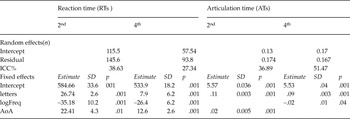
Linear mixed-effects modeling (raw data) was applied to accurately estimate effects of theoretical interest while properly accounting for error variance due to random variation between items or between participants. Thus, random (intercepts) effects of both subjects and items were required in all the reported models. A summary of the model for both cases is presented in table 1.
Effects found in RT´s and AT´s in both grades

ICC interclass correlation coefficient, SD standard deviation, p probability, AoA age of acquisition
logFreq logarithm of word frequency, letters number of letters in words.
In regards to the RTs, the results showed that word length (number of letters), word frequency (logFreq), and AoA were the determining variables for both grades: 2nd and 4th. The final model for the 2nd grade is: RT ∼ 1 + letters + logFreq + AoA (where 584.66 is the constant, the slope for letters 26.74, the slope for logFreq –35.18 and the slope for AoA 22.41), with a constant variance of 115.49 and a standard error of 145.55. In the 4th grade the model is similar: RT ∼ 1 + letters + logFreq + AoA (533.9 is the constant, the slope for letters 7.9, the slope for logFreq –26.4 and the slope for AoA 12.6) with a constant variance of 57.54 and a standard error of 93.80. For the 2nd grade group the model explains 38.63 %, whereas for the 4th grade the model explains 27.34% of the variance in RTs.
On the other hand, the ATs were affected by word length and by lexical variables in both grades, as AoA was significant in 2nd and word frequency in 4th grades. Therefore, 2nd graders had higher articulation times for long and later acquired words, and 4th graders for long and low frequency words. The final model of ATs in 2nd graders is: logAT ∼ 1 + letters + AoA (5.57 is the constant, the slope for letters .11, the slope for AoA .02) with a constant variance of 0.13 and a standard error of 0.174. The model explains the 36.89 % of variance for the 2nd graders. Whereas, for the 4th graders in AT, the model is as follows: logAT ∼ 1 + letters + logFreq (5.53 is the constant, the slope for letters .09, the slope for logfreq .01) with a constant variance of 0.172 and a standard error of 0.167 and it explains the 51, 47% of the variance in ATs.
Discussion
Our study explored the effects of different lexical and sublexical variables (frequency, age of acquisition (AoA), imageability, orthographic neighborhood, and length) on reading strategies used by two groups (2nd and 4th grade) of typically developing Spanish readers. The results showed significant differences between groups in both RTs and ATs. But most importantly, we found effects of the variables length, frequency, and AoA in both groups, which suggests the use of both routes of reading: a sublexical reading evidenced by length effect, and a lexical reading reflected in frequency and AoA effects. These data are consistent with previous results in other transparent orthographies such as: Italian (Bates et al., Reference Bates, Burani, D’Amico and Barca2001; Burani et al., Reference Burani, Marcolini and Stella2002; Burani, Arduino, & Barca, Reference Burani, Arduino and Barca2007; Mazzotta et al., Reference Mazzotta, Barca, Marcolini, Stella and Burani2005; Zoccolotti et al., Reference Zoccolotti, De Luca, Di Filippo, Judica and Martelli2009), Spanish (Cuetos & Barbón, Reference Cuetos and Barbón2006; Cuetos & Suárez-Coalla, Reference Cuetos and Suárez-Coalla2009; Davies, et al., Reference Davies, Rodríguez-Ferreiro, Suárez and Cuetos2013) Turkish (Öney & Durgunoğlu, Reference Öney and Durgunoğlu1997; Öney & Goldman, Reference Öney and Goldman1984; Raman, Baluch,& Besner, 2004) and Albanian (Avdyli & Cuetos, Reference Avdyli and Cuetos2012).
Word length affected the RTs and the ATs in both groups as expected because this variable implies a greater reliance on the GPC rules, which is manifested in higher reading and articulation times in a direct relation to the number of letters in a word. Similar findings were obtained in Italian by Zoccolotti et al. (Reference Zoccolotti, De Luca, Di Filippo, Judica and Martelli2009).
The length effect observed in our study can be interpreted as a greater reliance on the sublexical route of reading because of the number of GP rules to apply to longer words, or because of a smaller perceptual span in beginning compared to proficient readers, as suggested by Rayner (Reference Rayner1986). However, in other studies with similar orthographies to Spanish, such as Italian, the length effect was found to diminish with grade, and in word reading, especially when other lexical variables intervened; but conversely, length effect increased from 6-letter words on or when pseudowords were read (De Luca, et al., Reference De Luca, Barca, Burani and Zoccolotti2008; De Luca, Borrelli, Judica, Spinelli, & Zoccolotti, Reference De Luca, Borrelli, Judica, Spinelli and Zoccolotti2002). In another Italian study (Zoccolotti, De Luca, Judica, & Burani, Reference Zoccolotti, De Luca, Judica and Burani2006), the length effect disappeared when a delayed naming task was used. These data indicate that the locus of the length effect in reading in transparent orthographies for typically developing children relates to visuo-spatial limitations rather than to the phonological coding process.
Although the time taken to articulate a word received less attention in reading research, we have found that longer words not only have greater latencies prior to the pronunciation onset (RTs), but also in a latter measure as the pronunciation of the word (ATs). Thus, typically developing Spanish children need more time to articulate longer words than shorter ones because of the letter by letter assembling, and/or because of the fixation time until pronunciation of the word is completed.
The analysis of the lexical variables, word frequency and age of acquisition, revealed that both variables have substantial effects on the RTs in both groups of children. These results agree with the data found in other transparent languages, that in Spanish the lexical variables are present from very early stages of reading in spite of the highly regular GPC rules (Barca, Burani, & Arduino, Reference Barca, Burani and Arduino2002; Brysbaert & Ghyselinck, Reference Brysbaert and Ghyselinck2006; Brysbaert et al., Reference Brysbaert, Lange and Van Wijnendaele2000; Burani et al., Reference Burani, Arduino and Barca2007; Gerhand & Barry, Reference Gerhand and Barry1998; Juhasz, Reference Juhasz2005; Mazzotta et al, Reference Mazzotta, Barca, Marcolini, Stella and Burani2005; Monaghan & Ellis, Reference Monaghan and Ellis2002; Morrison & Ellis, Reference Morrison and Ellis1995, Reference Morrison and Ellis2000). Thus, word reading by Spanish-speaking children resembles that used in more opaque languages. This means that a shift from sublexical to lexical reading during literacy development occurs early in Spanish children and it persists over time, an effect that was also found in Albanian, which has a very transparent orthography for reading (Avdyli & Cuetos, Reference Avdyli and Cuetos2012).
In ATs these effects were less consistent, the AoA being significant in the second grade and word frequency significant in the fourth. It seems that the lexical and lexical-semantic effects have less importance in the time it takes to pronounce a word once phonology has been accessed and prepared for production. Our results follow the outcomes of Gerhand and Barry (Reference Gerhand and Barry1998) and confirm the Navarrete et al. (Reference Navarrete, Scaltritti, Mulatti and Peressotti2013) hypothesis for second grade children, yet for the fourth grade children we found that frequency is a more determinant variable than AoA. As well, the present findings agree with those obtained by Davies et al. (Reference Davies, Rodríguez-Ferreiro, Suárez and Cuetos2013) wherein the lexical and sublexical variables modulate the response duration times in typical and dyslexic Spanish children, with some exceptions. The frequency effect obtained by Davies et al. (Reference Davies, Rodríguez-Ferreiro, Suárez and Cuetos2013) was smaller in typically developed children while ours is larger as they grow older, probably because the children of both studies belong to different school grades. So, clearly more experiments are necessary to provide a solid response because it is possible that a third variable that includes AoA and frequency, such as word familiarity, orthographic neighborhood, or syllable frequency, could be responsible for the present results.
In conclusion, the reading of typically developing Spanish children depends on a combination of lexical and sublexical strategies, and reading progression does not have specific stages as suggested by some authors (Chall, Reference Chall1996; Ehri, Reference Ehri, Prefetti, Rieben and Fayol1997), for it depends on the characteristics of the stimuli to be read. Therefore, due to the transparency of the Spanish orthography, children start relying heavily on a sublexical process as shown by the length effect and because GPC rules are functioning continuously. Without abandoning the use of GPC, and due to the ease of the alphabetical code, the more familiar and earlier acquired words start to be read lexically even in younger children, as would be explained by the self-teaching hypothesis (Share, Reference Share1995), while less familiar and longer words are more likely to be read sublexically. Response initiation is a good measure of these processes, since the lexical variables influence this stage. Regarding the articulation times, more research is necessary to obtain definitive conclusions.