INTRODUCTION
Disparities in breast cancer survival and treatment for African American and low-income women are well documented, yet poorly understood. As metastatic breast cancer (MBC) care is evolving to a chronic care model, treatment and symptom management equity must also extend to palliative care. The purpose of this study was to explore the unique perspectives that race and socioeconomic status bring to the metastatic breast cancer experience, particularly the management of symptoms, in order to better inform the provision of palliative care for all women with MBC.
Background
Integrating Palliative Care into Metastatic Cancer
Previously, patients diagnosed with cancer were dichotomized into curative or palliative care with clearly defined algorithms of treatment. Now, treatment previously utilized with curative intent is routinely provided until close to death in metastatic cancer for tumor control as well as symptom management. Metastatic breast cancer is perhaps the prototype for this paradigm shift in palliative treatment focus. New chemotherapeutic options, the routine clinical use of the novel therapy, monoclonal antibody trastuzumab, and improved supportive care make treatment efficacy and thus treatment response and survival predications difficult. Providing excellent, equitable integrated palliative care throughout this new treatment trajectory requires sensitivity of racial and economic considerations (Gibson, Reference Gibson2001). These considerations are largely undefined.
Disparities in Breast Cancer Care and Treatment
There are gaps in the literature regarding the influence of race, culture, and economic influence on the end-of-life experience (Crawley, Reference Crawley2005) as well as the influences on earlier stages of the breast cancer treatment trajectory. The influence of race and culture in breast cancer is perplexing. An alarming disparity (35.4 African American vs. 26.4 White) in breast cancer mortality exists between White and African American women in the United States (Jemal et al., Reference Jemal, Murray and Ward2005). This difference cannot be explained only by the stage of disease at the time of clinical presentation (Franzini et al., Reference Franzini, Williams and Franklin1997; Polite & Olopade, Reference Polite and Olopade2005). When treatment equity is present, survival disparities improve (Jemal et al., Reference Jemal, Murray and Ward2005), implying disparity for African American women in treatment or chemotherapy dosage (Griggs et al., Reference Griggs, Sorbero and Stark2003; Bickell et al., Reference Bickell, Wang and Oluwole2006). These treatment disparities may also exist in metastatic breast cancer. Interestingly, despite the evidence that MBC treatment improves survival and quality of life and evidence that African American patients desire aggressive therapy at the end of life (McKinley et al., Reference McKinley, Garret and Evans1996; Borum et al., Reference Borum, Lynn and Zhong2000; Phipps et al., Reference Phipps, True and Harris2003), one analysis of MBC treatment for women from low-income zip codes found 45% of the low-income population had no MBC treatment (McGinnis et al., Reference McGinnis, Menck and Eyre2000). Reasons for nontreatment were not explored. Furthermore, emotional and physical distress is disproportionately higher among African American women receiving breast cancer treatment than White or higher income women (Payne et al., Reference Payne, Medina and Hampton2002). It is not known if these symptom disparities exist in MBC as well.
The extrication of race and income in evaluation of outcomes among women with breast cancer in the United States is virtually impossible (Kwate, Reference Kwate2002). Bradley et al. (Reference Bradley, Given and Roberts2002) attempted to evaluate breast cancer outcomes according to income using census tract categorization instead of race. In this analysis, low socioeconomic status, not race, was associated with worse breast cancer outcomes. However, all attempts to look at low-income status as an independent variable in breast cancer outcome data include a disproportionate number of minority women due to the poverty rates of U.S. African Americans. Without specific categorization of race and income, the independent effect of income can never truly be analyzed. There is no published analysis of breast cancer outcomes in women with metastatic breast cancer delineated according to race and income.
A better understanding of the perspectives of African American women experiencing MBC and exploration of how race and socioeconomic status influence the management of symptoms is crucial if breast cancer care disparities are to be eliminated. The purpose of this study was to better understand the racial and economic considerations that influence the MBC experience and to identify factors that threaten equitable treatment and symptom management for women with MBC.
METHODS
Design
This study employed quantitative survey techniques to describe the demographic and clinical characteristics of the sample, assess symptom and functional levels, and classify participants by race and income. Qualitative grounded theory methods (Miles et al., Reference Miles and Huberman1994; Holloway et al., Reference Holloway and Wheeler1996) were used to explore women's perceived challenges and barriers to achieving optimal symptom management and how these perceptions differed according to race and/or income. The quantitative data collection is ongoing and will be reported separately.
Sample
Forty-seven women with MBC were recruited from academic cancer center clinics and one private oncology office. Participant sampling was purposeful to ensure inclusion of women with known MBC for at least 1 month of both White and African American races (determined by self-report on the clinic intake form using the 2004 Health and Human Services categories and of low- and non-low-income ranges (low income determined by any of the following criteria: reliance on Medicare without supplementary insurance, Medicaid HMO, marital status—single, documentation of previous requests for financial assistance [transportation or medication], or self-pay). Once race and income data were obtained, women were categorized into one of four groups, White low (WL), White non-low (WNL), African America low (AAL), and African American non-low (AANL).
Data Collection Procedures
Once participants provided written informed consent, data regarding diagnosis of metasatic disease, treatments (chemotherapy, hormonal, or observation), and disease severity (number of metastatic sites) were collected by chart review. Participants completed The Symptom Distress Scale (McCorkle et al., Reference McCorkle and Quint-Benoliel1983) and the Functional Assessment of Cancer Therapy—general (FACT-G; Cella et al., Reference Cella, Tulsky and Gray1993) to assess their level of symptoms and quality of life. Semistructured interviews were conducted in a private area of the clinic by four women trained in qualitative interviewing techniques. The interviewer training sessions included an overview of the study objectives, interviewing techniques, interview with a simulated patient, and interview critique. Interview scripts were continually assessed by the principal investigator with interviewer feedback conducted regularly.
To focus the inquiry, the interviewer began with questions about issues related to the symptom experience, self-care strategies, and barriers to symptom management, based on the Symptom Management Model (UCSF; Dodd et al., Reference Dodd, Janson and Facione2001), which purports that symptom management strategies influence interventions, symptom management efficacy, and ultimately patient outcomes. These were followed with questions that focused on how often participants experienced symptoms and how those symptoms were managed during the past few weeks.
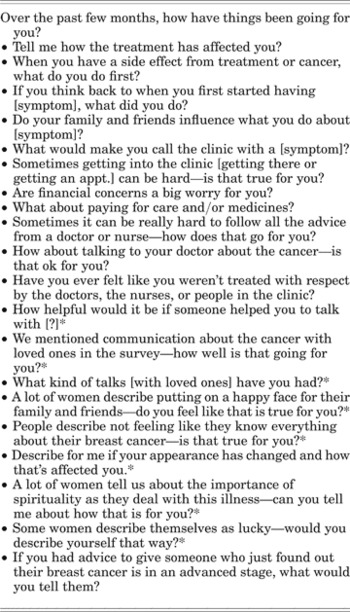
Over the course of the interview, participants' responses were constantly compared and contrasted. For instance, based on our clinical experience and a previous literature review, we postulated that “barriers” expressed by lower income populations would include issues such as child care, distrust, health care access, transportation, specific religiosity, or a sense of fatalism (Berg et al., Reference Berg, Ross and Latourette1977; Cella et al., Reference Cella, Tulsky and Gray1993; Freeman, Reference Freeman1991; Franzini et al., Reference Franzini, Williams and Franklin1997; Hauser et al., Reference Hauser, Kleefield and Brennan1997; Simon & Severson, Reference Simon and Severson1997; Boyer-Chammard et al., Reference Boyer-Chammard, Taylor and Anton-Culver1999; Mandelblatt et al., Reference Mandelblatt, Yabroff and Kerner1999, Reference Mandelblatt, Schechter and Yabroff2004; Yood et al., Reference Yood, Johnson and Blount1999; Crawley et al., Reference Crawley, Payne and Bolden2000; Dignam, Reference Dignam2000; Joslyn & West, Reference Joslyn and West2000; Bach et al., Reference Bach, Schrag and Brawley2002; Krakauer et al., Reference Krakauer, Crenner and Fox2002; Johnson et al., Reference Johnson, Elbert-Avila and Tulsky2005). However, initial interviews with all women yielded little information about barriers to symptom management. Additionally, participants were unsure of the meaning of the term “symptoms” and denied having major difficulties with issues such as transportation, child care, or even prescription coverage costs. Instead, participants shared their experiences regarding the challenges they were facing as well as the strategies they used to cope and manage their overall illness experience. Therefore, consistent with qualitative description using grounded theory techniques of purposive sampling and constant comparison, the focus of the interviews was broadened beyond symptom management to include topics that participants considered relevant to their experiences, such as strengths and challenges in dealing with MBC. Later, after interviewing approximately 25 women and comparing responses from both income groups and both races, we began to infer that the experiences of MBC differed between the four racial and economic classifications. For example, lower income African American women generally reported higher levels of physical distress, more social problems, and less understanding of options for breast cancer treatments and treatment goals than White women or African American women with higher incomes. Therefore, the inquiry for subsequent participants was directed to assess the influence of race and income on physical distress, social problems, and knowledge deficits.
The interview format, including items that were added based on the evolving analysis, are shown in Table 1. Interviews were transcribed verbatim and transferred to Ethnograph (v. 5.0) for open coding and analysis using constant comparative techniques. Codes were then merged into broader categories, such as symptoms, financial concerns, communication issues, and other barriers related to care. Three experts in breast cancer (social services, psychologist, and a breast cancer survivor/community advocate) were involved in reviewing and corroborating categorizations and interpretations.
Interview format

*Questions added based on emerging theoretical relationships.
RESULTS
The four groups, White low, White non-low, African American low, African American non-low, expressed common as well as unique perceptions, strengths, and challenges during metastatic breast cancer. Demographic and clinical characteristics for each group are summarized in Table 2. The quantitative results of all four socioeconomic groups are reported separately (Rosenzweig et al., Reference Rosenzweig, Weihagen and Brufsky2009).
Summary of demographic and clinical characteristics by race and income groups

AANL: African American, high income; W: White, high income; AAL: African American, low income; WL: White, low income.
Experiences Common to All Women with MBC
The majority of women and at least half in each race/income group reported experiencing faith, hope, and progressive loss.
Faith
Faith in God and having a relationship with God were the most common experiences expressed by all women and were unanimously expressed by AAL women, who saw faith as a source of strength. For example, one AAL woman said, “God's hands… . I definitely believe that God is what keeps me going and keeps me strong and what gets me through. He gives me strength to keep on keeping. Without that I wouldn't be able to keep on keeping on. That's very important to me. And to me, I guess that's what love is. God is love to me. And that's what's all good, because even with the bad things that happen and rough times that happen, He keeps me going. I can always know this will pass too. I'll keep on. He always gives me the strength to do it. It's a joy.”
Like the women in the AAL group, most participants described spiritual faith as a way of coping and source of strength to deal with side effects, the uncertainty of illness, or for actual physical healing. As one AANL woman commented, “You have to have faith. And you have to have faith that everything's going to be ok. You have to maintain that and you have to maintain a good spirit. I really firmly believe that.”
Another woman, (WL) expressed a similar reliance on faith: “I have angels watching over me. I think prayer helps a lot. I think faith has a lot to with whether you get well or not. I swear by that. I really do.”
However, to others, references to faith were voiced as a challenge or a disappointment that their prayers for complete breast cancer recovery were not fulfilled, which left their faith shattered, as one woman (AAL) exclaimed, “I became angry with Him [God]. You know, here we go again [said with emphasis]. You know … very angry with him. I had eliminated and excluded everybody from my life … and I'm mad at him, so, you know! I don't have nothing! God, you've failed me, you know [emphatically].”
Hope
Hope was conveyed by some as a wish for “being cured.” Others expressed hope for smaller goals, such as the hope expressed by a woman in the White non-low-income group: “I keep thinking that, you know, in time I want to look for some more active volunteer work, maybe two hours a day. And I just deal, um, I want to be able to stick to that and not be too tired to go or feel that, um, two hours is too much.”
Another AANL women reported “I just take it one day at a time… . Just because you are diagnosed does not mean you are going to die tomorrow. There is always something positive to look forward to … something somewhere in there.”
The women also reported listening for glimmers of hope in the treating physician's manner and conversation. They searched for cues from their physicians regarding the appropriateness of their own optimism, evidenced by the following statements from a woman in the White low income group: “My doctor is very optimistic, which is good. It's almost just, so, like, everything is going to be ok and I'm thinking ‘Are you sure doctor XX?’ He just keeps you going. He's very optimistic.”
Nurses' behaviors were also described as indicators of hope, but through supportive and caring behaviors rather than optimistic speech. One (AANL) woman said, “You gotta have a nurse. That helps with patient's hope. They are that rub on the back or that extra blanket. Or they will say, ‘you better do what you are supposed to do because you need that’—especially with cancer.”
Hope was also conveyed as an expression of inner strength despite the uncertainty, chronicity, and likelihood of death from metastatic breast cancer, as evident in this quote from an AAL woman: “It's just being able to accept it. To accept the fact that I'm needy. I guess how I feel about people is that nothing's too much. Somehow, someway, we all get through that.”
Among AAL women, hope was universally expressed as a “keep on going” mentality despite their awareness, even expectations, that their breast cancer would progress or that they would become more ill.
The following quote is typical of their hope: “And you're coming in, when you see people in the waiting room … and I had to get past all that. You know, and each time you come back you see they look a little thin and they have a little hat, because they're getting chemo … and when you see that you said ‘there goes me.’ So, that's why I dress myself up, you know, I dress myself up to come and to make myself feel better, you know. I said—even though you're going through something you don't have to let yourself go. As women I notice that we dress ourselves up; it helps us to feel better.”
Progressive Loss
Loss in the sense of health, vitality, and essential womanhood was conveyed by the majority of women of all race and income groups. Many women expressed that, although they had accepted their illness and resultant treatments, they did not want to become defined as women with breast cancer. In a sense, the women felt that they were “losing” aspects of their identity, due to the effect on their lives of the cancer. One woman (WL) said, “I guess that's part of the idea of cancer changing you. Physically, emotionally, the whole bit. That's difficult to go from doing what you used to do—now not doing it. It's a hard acceptance to say that your life has gone through these changes. But it's what you're given. It's like it turns you into another person.” Another woman (AANL) expressed, “I'm [her name]. I don't want to be defined as a breast cancer patient… . Long before I had breast cancer, I had another life. I had a career and I'm a mom.”
Others referred to the loss of work and the associated socialization as difficult, one WNL woman reported, “and, um, also um, it's affected my life. I worked for 22 years and I continued to work with the cancer when I was first diagnosed in ’96. But as the bone metastasis and the different treatments, I cannot work at all. And I was doing volunteer work three days a week. That became too much for me; I had additional radiation and chemo. So my life has drastically changed… .So yeah, it's very, very different, and I miss it. It's quite an adjustment.”
On the other hand, AAL women tended to describe their loss in more of a physical context. They described a decrease in independence due to physical limitation, as one AAL woman expressed: “If I have to get groceries or something—I can't lift certain things… . For me to have to ask someone, ‘Can you help me lift this?’ That was hurting, because I was used to doing things myself, so I had to go down the streets crying in the car, crying. And I said, I'll be all right—it's just the hurting thing to have to ask.”
The Unique Experience of AAL Women with Metastatic Breast Cancer
The AAL women reported unique experiences that implied greater physical and social distress and less understanding of illness and treatment goals.
Physical Distress
Almost uniformly, AAL women describe ongoing suffering associated with pain, nausea, or other chronic physical symptoms, “but there's times when I wake up and I really wish I had kept sleeping. You know you hurt so bad, and you ache so bad.” Another AAL woman describes the overwhelming fatigue. “It's a chore just getting myself bathed. And then … sometimes I'm hungry and I'll go and fix myself something that I really want, you know, and then I have to rest before I can eat it, because then I have to settle down all over again. I can't eat when I'm tight or tired… . It's the not being able to … that's what bothers me the most.”
AAL were the only group to describe ineffectual symptom management strategies. Strategies utilized were described as not effective, partially effective, or addressed by the medical staff through suggested interventions and medications but not adhered to by the patient. When symptoms were severe, AAL women report trying a medication or symptom reduction intervention but appeared to not pursue symptom management if the symptoms were not resolved completely and immediately. One AAL woman stated, “My bones ache. Oh my, my bones hurt so bad. Honest to God, the last treatment I had, they were hurting so bad I wanted to chop my legs off. I'm serious; I didn't want to feel anymore… . They gave me pain medicine. Or, I'll go to sleep and hopefully when I wake up it's gone. Sometimes it works and sometimes it doesn't.” Another AAL woman said, “The pain medication scared the hell out of me. Because it's so strong, often times I let myself get sick to the point I'm getting ready to throw up and I'll have to … they tell you don't chew them… . I'll have to chew that pill with something hot to make it work fast, because I'm getting really sick… . I mean, what do you do?” She verbalized a poor understanding of symptom management strategies summarized by “No wonder I think I'm not understanding symptoms.”
When questioned further, women were unable to offer explanations for allowing symptoms to persist in an unresolved state. The AAL women sometimes placed the burden of symptom reduction on themselves: “It's something I have to do. I have to do whatever it takes to help me eat better… . When I can't eat—I can't eat. They recommend all the things that could and should happen. But some things I can't do, like I can't do certain nutritional things… . They've addressed the Megace, but I haven't done it yet so I don't know. I just need to eat more.”
Overall LIAA women did not appear to understand the symptom management strategies prescribed or suggested, felt symptoms were not potentially manageable, and verbalized great distress that did not resolve over time.
Social Distress
Social distress was categorized into (1) financial worries, (2) poor relationships attributed to cancer, and (3) social stigma and worry of community gossip regarding their progressive illness. Financial concerns were commonly expressed in the context of paying for medication, housing, and the inability to financially assist other family members. One AAL woman said, “Your daily living. How are you going to survive? Right. Moneywise, like working, how am I going to do that and they stick you on a whole bunch of medication, how are you going to pay for all of that, even if you do have insurance that will pay so much? … But it's a whole lot overall, it's a biggie.”
Uniquely, low income African American women describe damage in relationships attributed to the cancer that, in turn, caused additional financial worry. No other sociodemographic group expressed these concerns. Ending relationships that were not thought to be supportive resulted in financial worry, forcing women to make choices between their physical and financial health. Talking about her relationship with her husband, one AAL woman said, “It was like I was there by myself … and I would get so mad that I would tell him that I don't want the tumors to come out of hiding. When you're in your home it's your refuge, and then you try to explain, to talk to … and get some comfort from your husband. So that's what led one thing to another and so I said, ‘Lord, I have to live, and I have to fight this and I have to live,’ so I had to make the choice to leave. And that was hard because I needed the income.”
Fear of Gossip/Social Stigmatization
AAL women described having cancer as a stress due to community awareness of their illness. Gossip within the community was feared. AAL women reported that the cultural norm of “being dressed” and “looking good” when one goes into the community as a stress when the fatigue of cancer treatment interfered with self-care abilities. AAL women were afraid that gossip would spread regarding their cancer diagnosis or worsening health if they did not appear to be well dressed and healthy, as exemplified in this quote: “They don't know that I have this. They don't know that when they bury me they're going to find this out, and they're going to tell the whole community.” To avoid gossip, AAL women dressed well and attempted to look healthy. These attempts at appearing healthy presented a converse stress because the AAL women felt that they would not be believed if they did feel very ill or needed financial assistance for transportation or other illness-associated expenses. One woman said, “Several times, um, I missed appointments and I didn't say anything because I was embarrassed, you know? So now I try to make appointments around times that, uh, you know that, uh, I have some money. And then you know when you come into someplace, and you've made yourself look as well as you can and make you feel good too and you tell someone you need money to get home, they look at you like… . People judge you according to the way you look. I have so many people say ‘I heard you were sick.’ And I said, ‘I'm very sick.’ and they say, “Get outta here, girl! You look great!” That's what they give me!”
Uncertainty about Treatment and Treatment Goals
AAL women verbalized lack of knowledge regarding MBC treatment efficacy and treatment goals. AAL women described some frustration in their attempts to find information regarding their health status and treatment goals. At times this resulted in treatment nonadherence. One respondent questioned if this withholding of information was an intentional attempt to keep patients from knowing all the facts and was surprised at her physician's abrupt response to her questioning the need for chemotherapy. She said, “I don't know if they're so used to, like, the normal procedure for this, but you know, some people want to know. I'm like—they don't want you knowing too much at the time. But I like to know what I'm doing. I didn't even know I had bone cancer at the time. They didn't even explain it to me… . And I said, ‘well I don't know if I want to take all this—I'd rather not take chemo—I don't know about it’ [Dr. said] ‘well, okay, wait till you break a bone.’ … I was like—‘who is planning on breaking a bone?’”
DISCUSSION
The aims of this study were to explore the barriers and challenges to optimal symptom management perceived by women with MBC and to examine the influence of race and income on symptom management. Symptom management barriers were not well elicited; instead, the women described the specific strengths and challenges they faced with MBC overall. These findings help us understand the difficulties and group differences patients have dealing with MBC.
Some of the MBC experiences were universal.
The universal themes of progressive loss, faith, and hope are expressed in other studies of coping mechanisms of White and African American patients (Lackey et al., Reference Lackey, Gates and Brown2001; Henderson et al., Reference Henderson, Gore and Davis2003; Born et al., Reference Born, Greiner and Sylvia2004; Johnson et al., Reference Johnson, Elbert-Avila and Tulsky2005) when they are facing serious illness. The illness is manifested or “made real” through progressive loss in physical functioning, role functioning, and future planning. Women coped with these losses through faith in God, organized religion, or individual belief in spiritual connectiveness.
Hope is an important response to serious illness (Ebright & Lyon, Reference Ebright and Lyon2002). Cancer patients verbalize hope as the ability to get through the difficulties of illness and live each day to the fullest. In one study of cancer patients undergoing active treatment, the five themes of hope, finding meaning, affirming relationships, using resources, living in the present, and anticipating survival, were reported (Post-White et al., Reference Post-White, Ceronsky and Kreitzer1996). Most of the women in this study, regardless of race or socioeconomic status, found hopefulness in their illness experience.
The unique aspects of LIAA experience have been confirmed by others. Physical and symptom distress is more severe in African American patients than White patients with cancer (Tammemagi et al., Reference Tammemagi, Neslund-Dudas and Simoff2004). This racial disparity in symptom distress during cancer treatment has not been well explored. It may be due to measurement issues. African Americans may incorporate overall distress, including social and emotional distress, into the measurement of specific physical symptoms (Payne et al., Reference Payne, Medina and Hampton2002). Specifically, distress from undertreated pain may be, in part, from systematic difficulties in having pain treated (Portenoy et al., Reference Portenoy, Ugarte and Fuller2004) or in obtaining opiates (Morrison et al., Reference Morrison, Wallenstein and Natale2000), but it is clearly not the complete explanation.
Social distress, characterized as lack of social support, economic concerns, and fear of community gossip, was uniquely verbalized in the LIAA sample subset. The social distress and feelings of abandonment with the diagnosis of breast cancer were previously reported by African American women (Ashing-Giwa, Reference Ashing-Giwa1999; Moore, Reference Moore2001). There was an interesting difference between African American women with early and metastatic stage breast cancers. African American women with early stage breast cancer describe the need and, in fact, obligation to “bear witness” to their experience and to inform their community of the need for screening and aggressively seeking care for breast abnormalities (Wilmouth & Sanders, Reference Wilmouth and Sanders2001; Gates et al., Reference Gates, Lackey and Brown2001; Henderson et al., Reference Henderson, Gore and Davis2003; Y. Durham, 2006, pers. comm.). The women of this metastatic breast cancer sample do not want to discuss their cancer or cancer experience with community women for fear of gossip or stigmatization. The ongoing illness and treatment of African American women with MBC made reaching out to the community very difficult, thus increasing the social isolation of the AAL women with MBC.
Physician communication is perceived as less supportive, informative, and collobarative among African American patients than among White patients (Gordon et al., Reference Gordon, Street and Sharf2006). Among breast cancer patients, African American women ask few questions about treatments, treatment options, or expected side effects (Lackey et al., Reference Lackey, Gates and Brown2001). African Americans appear to depend solely on their physicians for information whereas White patients view their patient–physician relationships more collaboratively, receiving information from nonphysician sources and utilizing their physician for discussion (Hauser et al., Reference Hauser, Kleefield and Brennan1997). This discordance regarding information seeking has been attributed to minority women's lack of confidence toward participation in a discussion with a physician (Gray et al., Reference Gray, Goel and Fitch2002).
There are limitations to this study and analysis. First, the delineation of patients by federal poverty standards does not adequately reflect the difficulties of living at the low end of the “non-low-income” levels. The non-low-income groups theoretically include income levels very close to the low-income levels and patients who are relatively affluent. Clearly, the issues and concerns are different across the wide spectrum of income. A second limitation is the concern that African American poverty is more profound and deep rooted than White poverty, limiting available social and financial assistance for African American patients. These limitations are not addressed in this analysis. Lastly, the heterogeneity (minimal bone metastasis to widespread visceral disease) of the metastatic breast cancer experience is not considered in this analysis.
There are important clinical implications to these findings. Targeting education, adherence strategies, and cancer-related distress screening in order to limit cancer-related symptom distress and increase knowledge regarding palliative treatment goals is a possible interventional strategy based on the results of this study.
CONCLUSION
In the late 1980s, Harold Freeman, one the country's foremost experts in cancer disparity, wrote that poverty, not race alone, was more determinant for cancer-related disparity: “We conclude however that economic status, irrespective of race, prevails as a more powerful surrogate of human condition and circumstances.” (Freeman, Reference Freeman1991). Our study supports this assertion. It does begin to illuminate the important perceptions that the combined influences of race and economic status bring to the MBC experience. The unique perspectives that the addition of income delineation brings to this study is an important characterization of the MBC experience. Although very limited, these data point to different MBC experiences not only for race (African American and White women) but from race and economic dyads. What is very clear from these discussions is that the unique combination of being low income and African American places a subgroup of women with MBC at risk for greater social and symptom distress. In addition LIAA women do not understand the goals or palliative intent of MBC treatment. These findings are concerning, and more inquiry is required to establish the etiology of this distress and knowledge disparity.
Pursuing discussions of this type raises concerns about promoting stereotypes and assuming homogeneity of experience merely by an assignment to a particular race or income group. (Krakauer et al., Reference Krakauer, Crenner and Fox2002). It was our intention to elicit the unique perceptions that shape the progressive illness and end-of-life experience in metastatic breast cancer in order to better inform patient care. Continuous exploration of the unique strengths and challenges brought to the illness experience through racial and economic delineation will ultimately increase understanding and reduce suffering.