The classical gold standard, the first truly international monetary system based on fixed exchange rates, emerged during the second half of the nineteenth century and lasted into the second decade of the twentieth century.Footnote 1 Scholars have long noted its importance in facilitating both trade and overseas investment during the first era of globalization, 1870–1913.Footnote 2 At its peak, more than 35 countries and colonies used gold to back domestic currency issues, accounting for roughly 70 percent of the world's trade and 67 percent of its gross domestic product (GDP).Footnote 3
The classical gold standard continues to attract attention from scholars seeking to understand the durability of monetary institutions as well as the operation of fixed exchange-rate regimes.Footnote 4 In a seminal paper, Michael Bordo and Finn Kydland (Reference Bordo and Kydland1995) established that joining the gold standard affects policymaking. Being on the gold standard tied the hands of the monetary and fiscal authorities of a country by committing them to a rule, which served as a credible commitment mechanism and solving the classic time-inconsistency problem (Kydland and Prescott Reference Kydland and Prescott1977).
Bordo and Hugh Rockoff (Reference Bordo and Rockoff1996, p. 390) argued that the gold standard represented a “good housekeeping seal of approval,” allowing “peripheral” countries to borrow at lower interest rates as a result of committing to policies that signaled “financial rectitude.” Drawing on a quasi capital-asset pricing model, they used annual interest rates of long-term sovereign bonds from nine countries to explore the determinants of sovereign risk (also called “political risk” or “default risk”), which they defined as the differential between gold or sterling-denominated bonds in a country and the risk-free rate of borrowing (in this period, the British consol). Their research, as well as a subsequent study by Maurice Obstfeld and Alan Taylor (Reference Obstfeld and Taylor2003), which utilized data from a larger number of countries, found that country or sovereign risk was approximately 30–40 basis points lower for countries adhering to gold. Other research suggests that long-term borrowing costs were not significantly lower when countries adopted gold. Niall Ferguson and Moritz Schularick (Reference Ferguson and Schularick2006) find that the gold standard effect disappears once the sample of sovereign borrowers is expanded to include the universe of debtors on the London market. In particular, they highlight the role of being part of an empire in reducing sovereign spreads. Using a sample of 55,000 sovereign bond returns, Ron Alquist and Benjamin Chabot (Reference Alquist and Chabot2011) find no association between gold standard adherence and lower borrowing rates.Footnote 5
Many economists and historians of international finance consider the classical gold standard to be history's most credible hard peg, in part because core-country governments credibly committed to maintain its existence and monetary authorities faced little political pressure to pursue countercyclical economic policies (Eichengreen Reference Eichengreen and Flandreau1997). Testing whether the gold standard was perceived by investors as credible requires data on the currency premium, which, unlike county risk, has been largely neglected in studies on the classical gold standard.Footnote 6 The currency-risk premium measures the compensation that an investor receives for expected movements in the exchange rate (Domowitz, Glen, and Madhavan Reference Domowitz, Glen and Madhavan1998) and is particularly relevant for two reasons. First, its measurement allows one to assess directly whether investors perceived the gold standard as a credible fixed exchange rate regime. If financial markets do not consider a peg to be perfectly credible, then the currency risk premium will remain positive (Schmuckler and Serven Reference Schmuckler and Serven2002). Investors who priced in persistent and sizable currency risk premia during the gold standard era would hence be signaling that they believe countries would not maintain their pegs. Second, and more generally, advocates of hard pegs argue that their adoption will reduce currency risk premia, and if perfectly credible, may even eliminate them altogether. This would imply lower borrowing costs for emerging market countries, a feature that would perhaps make the adoption of hard pegs more desirable.Footnote 7
Using a large, new data set of monthly and weekly short-term interest rates from the period 1870–1913 for 21 economies, we measure currency risk, which we define as the interest-rate differential between a borrower's open market rate and the short-term, domestic U.K. trade bill.Footnote 8 Our results suggest that joining the gold club did not eliminate currency risk for emerging market borrowers. We find that short-term interest rate differentials persisted long after adoption. Five years after a typical emerging market economy joined the gold standard—the currency-risk premium averaged 220 basis points. Our findings build on earlier scholarship that has noted that the gold standard may have operated differently on the periphery.Footnote 9
Even when controlling for country-specific factors that may also explain the variation in currency risk premia, such as wars, market liquidity, colonial status, and debt default, we find no evidence that gold standard adoption eliminated currency-risk permia on the periphery. The average currency risk premium for an emerging market economy remained more than 220 basis points years after its adoption. The existence and persistence of large currency risk premia for these borrowers suggest that financial markets believed that these hard pegs were not credible and devaluations would occur in the future. Our calculations suggested that investors expected exchange rates for emerging market borrowers to fall by 28 percent over any 90-day period.
MEASURING CURRENCY RISK
Bordo and Kydland (Reference Bordo and Kydland1995) provide an interpretation of the role of the gold standard as it relates to this literature on rules for policymakers. They argue that being on the gold standard tied the hands of the fiscal and monetary authorities of a country. Indeed, a monetary rule like a fixed exchange rate could serve as a credible commitment mechanism for solving the classic time-inconsistency problem (Kydland and Prescott Reference Kydland and Prescott1977). The existence of an enforcement mechanism, such as a credible threat to deny the government access to borrowing in the future, means that a socially optimal, but time inconsistent policies can be supported as an equilibrium outcome. This can occur when a policy plan that is determined to be optimal and to hold indefinitely into the future is subsequently revised. For example, suppose that a government sells debt to finance a war. From an ex ante perspective, it is optimal for the government to service its debt obligations. However, once the bonds have been sold, it is optimal for the government to default. In the absence of a commitment mechanism, it is time inconsistent for the government to repay its debt obligations. Private agents will anticipate the government's incentive to default and they will not buy bonds, forcing the government to rely on taxes or money creation.
Bordo and Kydland (Reference Bordo and Kydland1995) also argue that the gold standard had an escape clause. Countries could suspend specie convertibility in the event of a war or fiscal emergency; however, after the war or extraordinary event ended, it was well understood that a country would return to specie convertibility at the pre-war parity. Generally, resumption occurred after a “reasonable” delay period during which a country would impose deflationary policies to retire fiat currency printed for war or emergency finance.Footnote 10
Using this theoretical insight that a fixed exchange rate regime represents a commitment rule, we assess the credibility of hard pegs for emerging market borrowers. In particular, we examine the behavior of interest rates on short-term debt instruments from 1870–1913 in order to calculate and analyze the currency risk premium for the classical gold standard era. The currency risk premium provides an estimate of the compensation that bondholders demand in the case of an expected devaluation. Using long-term bond prices, previous research on the gold standard has largely focused on country risk, which is an assessment of the default risk for an emerging market borrower.Footnote 11
To understand how the currency risk premium relates to anticipated changes in the exchange rate, we define i t,k as the interest rate at time t of a short-term debt instrument for a borrower k (either a country or a colony) that is payable in domestic currency. We define i* t as the base country interest rate at time t, which is proxied by U.K. trade bills that are payable in pound sterling. The maturity of both short-term debt instruments is equal to 90 days for the borrowers in our sample. Furthermore, we assume that capital is mobile and that the emerging market country and U.K. short-term debt instruments are perfectly substitutable. The short-term interest rates have no default risk and risk-neutral investors hold both assets. The exchange rate is expected to adjust such that the return on the emerging market asset is equal to the return on the U.K. short-term trade bill. Under these assumptions, the currency risk premium can be written as the interest-rate differential between the emerging market security and the U.K. trade bill:

where p is the likelihood of an exchange devaluation and d ε t is the size of the expected devaluation. Equation (1) is an uncovered interest parity (UIP) condition where the currency risk premium equals the expected rate of change in the exchange rate over 90 days.Footnote 12 Hence, if a country made a completely credible, non-contingent, and permanent commitment to join the gold standard, then the probability of a devaluation of the exchange rate would be zero (Obstfeld and Taylor Reference Obstfeld and Taylor2003). That is, for a borrower that credibly committed to the gold standard, the interest-rate differential between its 90-day open market rate and 90-day British trade bills should be zero. Once the gold standard is introduced, the existence of a persistent and large spread between these two short-term interest rates would suggest that financial markets did not view the commitment to the exchange-rate peg as a credible for country k.
Using interest-parity conditions to identify the currency risk premium is conceptually straightforward. However, it is often empirically difficult to implement. For example, the presence of capital controls (or the expectation of capital controls) can drive a wedge between the price of short-term interest rates trading in local and foreign markets. Indeed, it is the widespread use of capital controls after the 1930s that has made it challenging to measure currency risk for that time period. By contrast, the classical gold standard era had unfettered capital markets, largely free of government intervention (Eichengreen Reference Eichengreen and Flandreau1997; International Monetary Fund 1997), making our period of analysis particularly well suited for testing the credibility of hard pegs.
To analyze the credibility of the gold standard in emerging markets, we assembled a new database of high-frequency, short-term interest rates for 21 economies, in total roughly 250,000 observations.Footnote 13 The short-term open market rates were widely regarded as liquid and low-risk debt instruments during the classical gold standard period. Much of our data is hand-collected from contemporaneous financial publications. The database includes the universe of open market rates reported in The Economist from 5 November 1870 until 30 June 1914.Footnote 14 Open market rates reflect the interest rate on funds used to finance commerce during the gold standard period (Neal and Weidenmier Reference Neal, Weidenmier, Bordo, Taylor and Williamson2003); they are the historical equivalent of a banker's acceptance today. These credit instruments were payable in domestic currency and issued in the leading money centers. For emerging market borrowers that lacked open market rates, we collected data on the bank rate—the short-term interest rate used by a central bank to discount private credit of a short duration. Our use of the central bank discount rate is based on the fact that central banks discounted large number of short-term bills; hence, these instruments were highly liquid. Moreover, default risk associated with central banks is likely to be very low.
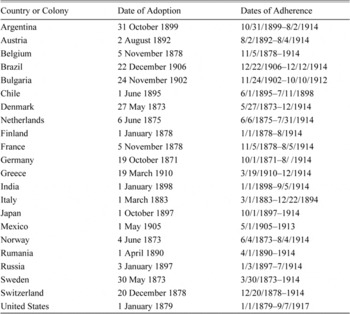
Convertibility under the gold standard was generally established by law or executive decree. In a few cases, such as France and the Austro-Hungarian Empire, maintenance of convertibility was left to the discretion of policymakers. Table 1 presents a timeline of gold standard adoption for every country that joined the gold standard in the period 1870–1914 and had short-term interest rates. (Source information is shown in Appendix 2.) Column 2 lists the dates of gold standard adoption, defined as the date a monetary authority initiated or resumed specie convertibility. Column 3 shows the period of gold standard adherence for 21 borrowers. By confining our analysis to countries or colonies that remained on the gold standard for at least two years, we provide a lower-bound estimate of currency risk.Footnote 15
The Economist reports annualized rates for both types of short-term debt instruments in our study. Appendix 1 describes the particular short-term interest rate used. For each borrower, we collected monthly or weekly quotes, whichever had the highest frequency as reported by the financial press. We take the lowest interest rate reported in the financial press for a given emerging market country to provide a lower-bound estimate of the currency risk premium.Footnote 16 By using the lowest reported interest rate, we account for the impact of the bid-ask bounce on short-term interest rates that might increase the size of the illiquidity premium.

CURRENCY RISK ESTIMATES DURING THE GOLD STANDARD ERA
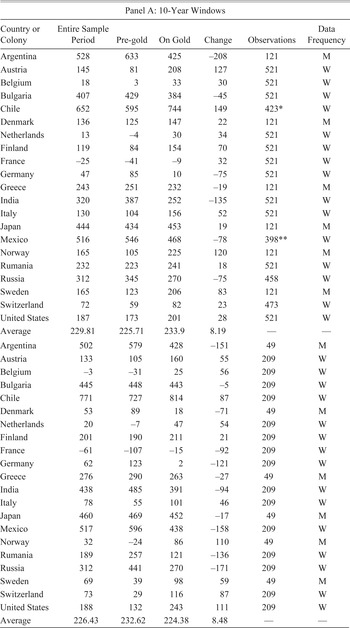
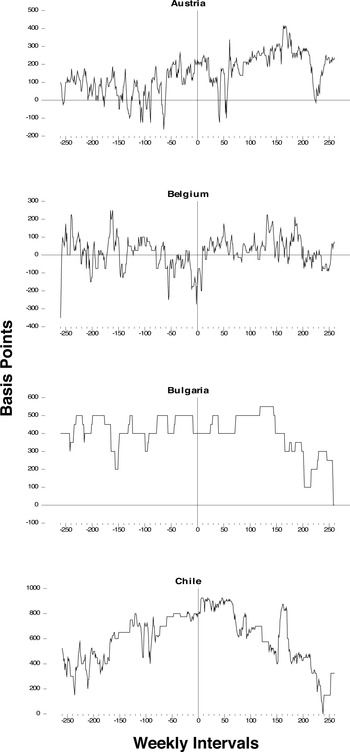
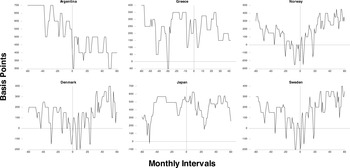
Using the United Kingdom as the base country, we measure the currency risk premia, as the interest-rate differential on short-term debt instruments between a given country or colony's open market rate and the gold-dominated U.K. trade bill. Table 2 presents currency risk premia for 21 economies. Panels A and B report average interest-rate differentials (in basis points) for the entire period and for ten-year and four-year windows around gold standard adoption dates. The fourth column displays the change in the risk premia, comparing the five-year or two-year period before adoption with the five-year or two-year period after joining gold. These windows are designed to measure long-run adherence to the gold standard by first calculating the currency risk premium at the weekly or monthly frequency. Then, we average the point-in-time estimates over the ten- and four-year windows to provide an unconditional measure of long-term credibility since that theory predicts that, after adoption, currency risk will, on average, be zero if the fixed-exchange rate regime is viewed as credible by financial markets.Footnote 17 Figures 1 and 2 show ten-year windows (or the largest available sample period) for 21 economies centered around the adoption date of the gold standard with weeks (or months) from that date shown on the x-axis. Declines in currency risk prior to adoption may reflect fiscal and monetary policy reforms made with the intention of improving the credibility of their fixed-exchange rate regimes.
Panel A of Table 2 shows that the currency risk premium for France was slightly negative and hardly different from the rate on British trade bills (–9 basis points) five years after the country joined the gold standard. Panel B shows similar results for the four-year window; after adoption, the currency risk premium averaged −15 basis points. The data for France suggest that markets viewed this peg as credible. Borrowing rates for Germany averaged ten basis points five years after adoption. Markets also appear to have assessed the pegs of a few other western European countries as fairly credible. Over the five years after Belgium and Netherlands pegged, the currency risk premia averaged 33 and 30 basis points, respectively. On the other hand, despite its level of development, our findings suggest that financial markets viewed the United States differently. Its currency risk premium averaged more than 200 basis points in the five years after it joined the gold standard. Even if we extend this analysis to cover the entire classical gold standard era, up until the outbreak of World War I, the currency risk premium for the United States averaged more than 150 basis points.
CURRENCY RISK PREMIA

Notes:
M=monthly, W=weekly. *Data sample constrained by adherence to gold standard; **sample size constrained by availability of newspaper. “Change” is computed as the currency risk premium when an economy is on gold minus the currency risk premium prior to gold standard adoption.
Sources:
Authors’ calculations based on data described in the text.
Notes:
M=monthly, W=weekly. “Change” is computed as the currency risk premium when an economy is on gold minus the currency risk premium prior to gold standard adoption.
Sources:
Authors’ calculations based on data described in the text.
Much of Continental Europe exhibits sizable currency risk premia in the five-year window after countries in that region joined the gold standard. Austria's currency risk premium averaged a little more than 200 basis points. For Italy, the currency risk premium averaged slightly more than 150 basis points. The currency risk premium was similar for Switzerland. For the Scandinavian countries like Denmark, Finland, Norway, and Sweden, currency risk premia averaged more than 140 basis points. Exchange-rate risk was also sizable in eastern and southern Europe. Markets asked for an additional 443, 263, and 121 basis points, respectively, for Bulgaria, Greece, and Rumania in the two-year period after they adopted gold. Even five years after these three countries joined the gold standard, the premia stood at 384, 232, and 241 basis points. The currency risk premium averaged 270 basis points for Russia two years after and five years after the country joined the gold standard in 1897.
Countries in other parts of the world also show considerable currency risk after gold standard adoption. For Argentina and Japan, their currency risk premia averaged more than 400 basis points in the five-year and two-year windows after they adopted the gold standard. It was more than 700 basis points for Chile's three years on the gold standard.
CURRENCY RISK PREMIUM


CURRENCY RISK PREMIUM

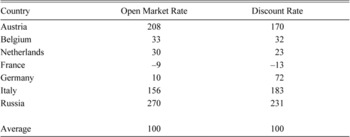
COMPARING RISK PREMIA USING DISCOUNT RATES AND OPEN MARKET RATES IN THE FIRST FIVE YEARS AFTER A COUNTRY JOINED THE GOLD STANDARD

Sources:
Authors’ calculations based on data described in the text.
Table 3 provides a robustness check by showing the average currency risk premia for seven countries on the gold standard for which we have data on the central bank discount rate as well as the open market rate. By using this subset of countries for which we have both types of rates, we are able to examine whether the results are sensitive to the data we employ. As Table 3 shows, the individual country differences are relatively minor when using either type of interest rate, and the average currency risk after gold standard adoption across all seven countries is identical under both measures—100 basis points. Our findings, therefore, do not appear to be driven by data selection. As a final robustness check, we also calculated the currency risk premium for a sample of gold and paper bonds issued by the same country during the classical gold standard period. The basic tenor of the results remains unchanged: emerging market borrowers exhibit large and persistent currency risk premia in the long-term bond market after they adopted the gold standard.Footnote 18
Overall, the time-series evidence suggests that the gold standard was likely credible for a small set of core European countries that included France, Germany, the United Kingdom, the Netherlands, and Belgium. A very different picture, however, emerges for other countries in the sample. Outside the core countries, the currency risk premium averaged more than 285 basis points five years after a country joined the gold standard, with a standard deviation of 163 points.Footnote 19 The currency risk premium for emerging market countries was greater than zero about 82 percent of the time. These new estimates of currency risk appear consistent with descriptive accounts of the operation of the gold standard on the periphery that it may have been more difficult for these countries to adhere to policies set by the core countries of the gold standard (Bordo and Kydland Reference Bordo and Kydland1995; Eichengreen 1996).
TESTS OF UNCOVERED INTEREST RATE PARITY
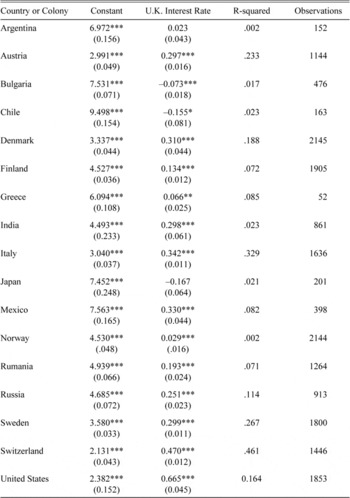
To examine whether pegged exchange rates were credible during the gold standard, we use equation (4) and test for UIP in the sample of emerging market borrowers. We regress the short-term interest rate of country i in period t on a constant and the British trade bill in period t (the base country). Because the sample periods in the single-country regressions correspond to when countries were on the gold standard (see Table 1), we can apply the UIP condition in a straightforward way. The no-arbitrage condition implies that the base rate should capture all the relevant movements in the interest rate of the borrowing country. Hence, if the peg is credible, then the estimated constant term should be zero and statistically insignificant.
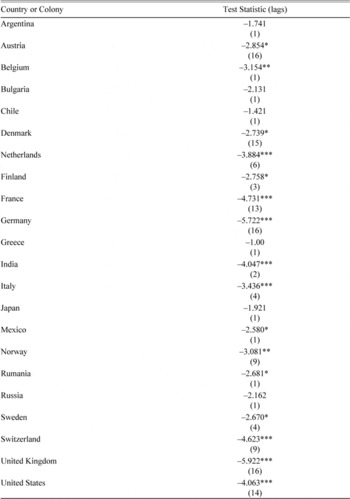
To implement UIP tests, we first explore the time series properties of the data. As seen in Table 4, DF-GLS tests reject the existence of a unit root in 16 of the 21 countries in our sample at standard confidence intervals. For the five countries that do not pass the unit root test (Argentina, Bulgaria, Chile, Greece, and Russia), we find additional evidence of a co-integrating relationship, suggesting stationarity in all the data series we consider.Footnote 20
The estimated coefficients on the constant terms shown in Table 5 (and measured in percentage points) are large and statistically significantly different from zero at the 1-percent level in all regressions. The constant is more than 400 basis points for most countries.Footnote 21 Chile has a constant greater than 900 basis points, while the intercept for Bulgaria, Greece, Mexico, and Japan is more than 600 basis points. Finland, India, Norway, Rumania, Russia, and Russia have estimated currency risk premia greater than 400 basis points. The estimated intercept for Austria, Denmark, Italy, and Sweden is between 290 and 400 basis points. Switzerland and the United States are the most credible hard pegs among emerging markets, with respective currency risk premia of 213 and 238 basis points. The estimated coefficients on the intercept term show that UIP conditions were not satisfied in emerging market economies—suggesting that market participants did not perceive their pegs to be credible.
DF-GLS UNIT ROOT TEST

* = Significance at the 10 percent level.
**= Significance at the 5 percent level.
*** = Significance at the 1 percent level.
Notes:
Lag lengths differ depending on whether the economy's data are weekly or monthly, as specified in Table 2. Interpolated critical values are taken from Elliot, Rothenberg, and Stock (Reference Elliot, Rothenberg and Stock1996).
Sources:
Authors’ calculations based on data described in the text.
CURRENCY RISK REGRESSIONS

* = Significance at the 10 percent level.
**= Significance at the 5 percent level.
*** = Significance at the 1 percent level.
Sources:
Authors’ calculations based on data described in the text.
PANEL DATA ESTIMATES OF CURRENCY RISK
To understand the extent to which country-specific factors account for the observed variation in currency risk, we constructed a monthly panel data set for the 21 borrowers over the sample period 1870–1914. We estimate the following equation:

where CURRENCYRISK it is the current yield on a short-term debt instrument for borrower i at time t minus the current yield on the British short-term trade bill and α is a country-specific intercept. We note that the test of the UIP condition will differ in the panel setting because the sample period spans the entire gold standard era and many countries joined after 1870. As a result, there are two key coefficients to consider for the UIP tests. The first is the date at which borrowers adopted gold (GOLD), a time-varying indicator variable denoting when the borrower was on the gold standard. GOLD indicates how much currency risk fell with the adoption of gold. If the gold standard conferred complete credibility, then its inclusion ought to eliminate the currency risk premium entirely. The second is the time-varying constant term, which as before, will be zero and statistically insignificant if the peg is credible. Since we have already established that it is positive and statistically significant in single-country regressions, the panel regressions provide an additional robustness check of our finding that the gold standard was not credible for emerging market economies.
The inclusion of borrower-specific economic and political factors as well as fixed-effects models allows us also to relax certain assumptions of UIP discussed earlier, such as default risk and liquidity risk across countries. In specifications omitting country dummies, γ i, we include a dummy variable for INDIA since it is part of the British Empire.Footnote 22 Because political events may also affect a variety of risk spreads, we include two measures of conflict using data from the Correlates of War database. INTRASTATE is an indicator variable, capturing years when the borrower was engaged in a conflict that predominantly took place within the recognized territory of that state and combatant fatalities were at least 1,000 within a 12-month period. The Russian Bloody Sunday (1905–1906) and the Romanian Peasant Rebellion (1907) are examples of intrastate wars meeting this threshold. The INTERSTATE indicator variable equals one when a state was at war with another colony or country, and sustained combat resulted in a minimum of 1,000 battle-related combatant fatalities within a 12-month period (Correlates of War Database). Examples include the First Sino-Japanese War (1894–1895) and the Franco-Prussian War (1870–1871).
We also include two time-varying, borrower-specific variables that proxy for market liquidity and financial development: STOCKMARKET and CENTRAL BANK. All else equal, short-term interest rates will be lower for countries with more liquid financial markets. The presence of a stock market indicates institutional development that would promote liquidity. The presence of either a stock market or a central bank indicates development of modern financial institutions.Footnote 23 Finally, because risk spreads may be affected by periods of domestic financial turmoil, we coded an indicator variable that takes a value of one if a country has at least one sovereign debt issue that is in default at time t.Footnote 24 Year dummies, λ t, are included in all specifications to capture the impact of international financial crises such as those occurring in the 1870s, 1890s, and 1907 as well as other time-varying economic factors that might influence the currency risk premium. Regressions are estimated with robust standard errors clustered at the country level.
Column 1 of Table 6 shows the results for the simple ordinary least square (OLS) pooled regression with year dummies. Three independent variables are statistically significant at conventional levels. Joining the gold standard appears to decrease the currency risk premium by almost 167 basis points. Debt default raises the currency risk premium by 112 basis points. Finally, our proxy for liquidity, STOCKMARKET, reduces the interest rate spread by nearly 192 basis points.
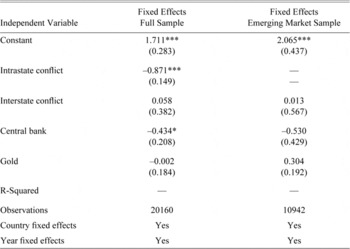
When we include country fixed effects and consider the fully-interacted model (column 2), GOLD and STOCKMARKET are no longer statistically significant, suggesting that the identification of these effects was from the cross-sectional variation. However, once we examine the within variation and control for unobserved differences across countries, the economic effects of adopting the gold standard are small in magnitude (less than ten basis points) and statistically insignificant. Debt default remains statistically significant at the 10-percent level. On the other hand, the constant term, which captures currency risk, remains statistically significant and economically meaningful—at more than 179 basis points.
Because the full sample includes some countries that are more economically developed, in the second two columns of Table 6, we consider specifications that exclude Belgium, France, Germany, and the Netherlands from the sample and focus on less-developed borrowers. The results using the sample of emerging market borrowers (columns 3 and 4) are qualitatively similar, but as expected, the average currency risk shown by the constant term is larger: 343 and 221 basis points in the pooled OLS and fixed effects, respectively. Thus, even after we control for time-specific shocks as well as for observed and unobserved differences across countries, we continue to find a large average currency risk premium for emerging market borrowers.
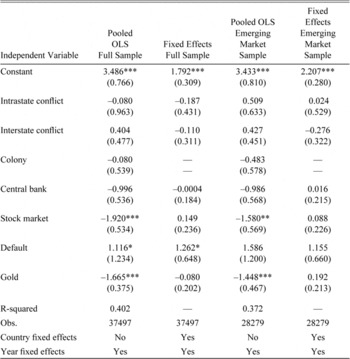
Because the sample uses a mixture of open market rates and discount rates for emerging market borrowers, as a final robustness check, we re-estimate the specifications using only the ten countries that have open market rates (as listed in Appendix 1). Open market rates constitute approximately 52 percent of our sample of interest rates. As reported in Table 7, the estimated coefficients for GOLD and the constant term, the key coefficients, are quite similar to what was reported in the full sample. That is, the gold standard variable reduces currency risk in the pooled OLS specifications, but its statistical and economic significance disappears once country-fixed effects are included. By contrast, the constant term is large, positive, and statistically significant in all specifications. Using the emerging market sample of countries with open market rates, in the fixed effects specification, currency risk is estimated to be 207 basis points.
PANEL REGRESSION ESTIMATES OF CURRENCY RISK

* = Significance at the 10 percent level.
**= Significance at the 5 percent level.
*** = Significance at the 1 percent level.
Sources:
Authors’ calculations based on data described in the text and appendices.
PANEL REGRESSION ESTIMATES OF CURRENCY RISK USING OPEN MARKET RATES

* = Significance at the 10 percent level.
**= Significance at the 5 percent level.
*** = Significance at the 1 percent level.
Sources:
Authors’ calculations based on data described in the text and appendices.
IMPLIED DEVALUATIONS FOR EMERGING MARKET ECONOMIES
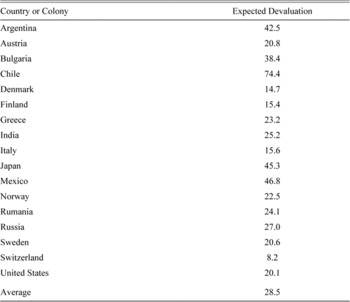
Following the methodology proposed in Sergio Schmuckler and Luis Serven (Reference Schmuckler and Serven2002), we estimate the size of the anticipated devaluation for our sample of 17 emerging market economies. Dividing the currency risk premium by the probability of a fall in the exchange rate yields the anticipated size of the devaluation:

As equation (3) shows, when the probability of a devaluation is higher, it reduces the size of the exchange rate movement. The probability of devaluation was likely influenced by a combination of country-specific shocks (such as those to a country's terms of trade or to fiscal policy) as well as common shocks operating across countries, such as financial crises. As the size of shocks or frequency of them increased, emerging market borrowers faced a greater risk of abandoning their hard pegs. Providing data on each country's fiscal and terms of trade shocks is beyond the scope of this article; however, we can use Bordo and Antu Murshid's (Reference Bordo and Murshid2006) annual estimates of the likelihood of a global financial crisis during the gold standard era to shed light on the expected devaluations implied by our measures of currency risk. They estimate that the likelihood of a crisis between 1870–1914 was between 10 and 14 percent. Using the lower of these two figures, Table 8 then computes the expected size of the devaluation for each of the 17 emerging-market economies. As the last row of the table shows, across all emerging-market economies, the data suggest that markets anticipated that exchange rates would fall by an average of more than 28 (annualized) percent over a 90-day period. Since the standard deviation of the currency risk premium is 16 percent, the estimated size of the decline in the exchange rate varies significantly across the sample. We estimate expected devaluations of more than 20 percent over 90 days for countries or colonies such as Argentina, Austria, Bulgaria, Chile, Greece, India, Japan, Mexico, Norway, Rumania, Russia, Sweden, and the United States.
IMPLIED DEVALUATION OF GOLD STANDARD ADOPTERS DUE TO A GLOBAL FINANCIAL CRISIS (Percent)

Notes:
The table shows the expected devaluation for borrowers based using the estimated probability of a global financial crisis during the sample period.
Sources:
Authors’ calculations. Global crisis probabilities for the gold standard era are based on Bordo and Murshid (Reference Bordo and Murshid2006).
CONCLUSION
Between 1870 and 1913, the gold standard was widely adopted, even by countries on the periphery. Given its global reach, the classical gold standard thus represents the most widely used peg in modern financial history. Focusing on country-specific risk, previous studies have argued that the regime appeared credible, at least among core countries. As we demonstrate, however, currency risk provides a more accurate assessment as to whether financial markets believed a country would maintain its pegged exchange rate.
We take advantage of the fact that from 1870–1913 capital markets were unfettered. Since governments did not impose capital controls, we are able to identify currency risk premia using interest-rate parity conditions. To measure whether the gold standard was credible, we examined whether interest-rate differentials existed and persisted between an emerging market economies and a base economy, the United Kingdom. Using a new database of weekly and monthly short-term interest rates, we analyze the currency risk premium for a sample of 17 emerging market economies during the gold standard era.
The empirical analysis suggests that the currency risk premium for these non-core economies averaged more than 220 basis points in the five-year period after they joined the gold standard. Standard uncovered interest parity tests show the existence of a large currency risk premia. These large risk premia do not disappear even when we control for time-varying, country-specific factors such as wars, market liquidity, colonial status, and debt default as well as for unobserved country specific factors captured in our fixed-effects estimates. Panel regressions also show that the results are not sensitive to the particular type of short-term credit instrument used. We find that there are large currency risk premia regardless of whether we use open market rates or central bank discount rates. Given the presence of common shocks that influenced the likelihood of devaluation, such as global financial crises, our analysis implies that financial markets expected the exchange rates to depreciate on average by approximately 28 (annualized) percent over any three-month period between 1870–1913. These findings suggest that for emerging markets, the gold standard was not credible because a high level of currency risk persisted long after gold standard adoption.
Appendix
Appendix 1 SHORT-TERM INTEREST RATE DATA FROM THE GOLD STANDARD ERA

Appendix 2 GOLD STANDARD ADOPTION DATES AND SOURCE INFORMATION
-
Argentina—The Law of Conversion was passed on 31 October 1899 restoring convertibility (della Paolera and Taylor Reference della Paolera and Taylor2001, p. 120).
-
Austria—Joined the gold standard by laws passed 2 August 1892 (Mitchell Reference Mitchell1898).
-
Belgium—Joined the gold standard 5 November 1878 (Helfferich Reference Helfferich and Infield1927, p. 180).
-
Brazil—“Under an act which went into effect December 22, 1906, a conversion fund was established by means of import duties collected in gold” (Monetary Systems of the Principle Countries of the World, p. 8).
-
Bulgaria—Joined the gold standard 24 November 1902 and left the gold standard 10 October 1912 (Dimitrova and Ivanov Reference Dimitrova, Fantacci and Tuncer2009, p. 63).
-
Chile—A new conversion law of 11 February 1895 set 1 June 1895 as the day for the redemption of notes. This continued until July of 1898 (Bordo and Kydland Reference Bordo and Kydland1995, pp. 437–38).
-
Denmark—Formed a monetary Union with Sweden that began May 1873 (Helfferich Reference Helfferich and Infield1927, p. 175).
-
Finland—Joined the gold standard 1 January 1878 (New York Times, June 11, 1877, p. 5).
-
France—Adopted the gold standard on 5 November 1878 (Pick and Sedillot Reference Pick and Sedillot1971, p. 587).
-
Germany—Joined the gold standard the week of 19 October 1871 (Investor's Monthly Manual, December 1871, p. 393).
-
Greece—Adopted the gold standard on 19 March 1910 (Bordo and Kydland Reference Bordo and Kydland1995, p. 439).
-
India—Scheme for adopting the gold standard published the week of 7 May 1898 (Investor's Monthly Manual, December 1898).
-
Italy—On 12 April 1884, the country adopted the gold standard. By 1894, it was back on a paper standard (Fratianni and Spinelli Reference Fratianni and Spinelli1997, p. 439).
-
Japan—Joined the gold standard 1 October 1897 (Helfferich Reference Helfferich and Infield1927, p. 201).
-
Mexico—The enabling act was passed on 9 December 1904, authorizing the establishment of a gold standard. On 25 March 1905, a decree promulgated the new system. The law went into effect on 1 May 1905 (Kemmerer Reference Kemmerer1944, p. 524).
-
Netherlands—Joined the gold standard 6 June 1875 (Helfferich Reference Helfferich and Infield1927, p. 176).
-
Norway—Money Act on 4 June 1873 established a gold standard (www.norges.no/en/about/history/norges-banks-history/).
-
Rumania—The Monetary Act of March 1890 established the gold standard (Dimitrova, Fantacci, and Tuncer Reference Dimitrova, Fantacci and Tuncer2009).
-
Russia—The country adopted the gold standard 3–15 January 1897 (Pick and Sedillot Reference Pick and Sedillot1971, p. 488).
-
Sweden—The country signed a convention in December 1872 instituting the gold standard (Morys Reference Morys2012, p. 41).
-
United States—Resumed specie convertibility following the Civil War on 1 January 1879 (Kemmerer Reference Kemmerer1916, p. 85).