I. INTRODUCTION
Some of B2-type (CsCl structure) compounds such as ZrCo show a high tensile strain of 7% at room temperature in spite of the relatively simple crystal structure. Reference Matsuda, Hayashi and Nishida1,Reference Yamaguchi, Kaneno and Takasugi2 It suggests that the Zr–Co based alloys are inherently ductile. Furthermore, the ZrCo compound has a good corrosion resistance, low atomic and thermal neutron absorption ability and is widely used in the field of biomedical materials and cladding material of nuclear reactor. However, monolithic B2 crystalline phase is soft and insufficient in strength. Reference Yamaguchi, Kaneno and Takasugi2–Reference Kaneno, Asao, Yoshida, Tsuda and Takasugi4 The improvement of ductility and strength has been achieved by adding alloy elements, i.e., Ni, Cu, Pd, and Be, controlling of microstructure, Reference Matsuda, Hayashi and Nishida1,Reference Li, Tan, Wang, Bednarčík, Zhu, Zhang, Stoica, Kühn and Eckert3,Reference Matsuda, Nishimoto, Matsunaga, Morizono, Tsurekawa and Nishida5–Reference Tan, Zhang, Stoica, Kühn, Mattern, Pan and Eckert13 and introducing the transformation induced plasticity (TRIP) associated with the deformation-induced martensitic transformation (DIMT). Reference Li, Tan, Wang, Bednarčík, Zhu, Zhang, Stoica, Kühn and Eckert3,Reference Matsuda, Nishimoto, Matsunaga, Morizono, Tsurekawa and Nishida5,Reference Matsuda, Iwamoto, Morizono, Tsurekawa, Takashima and Nishida7,Reference Li, Tan, Zhu, Zhang, Stoica, Kühn and Eckert11
Alloying is a traditional method of strengthening and toughening for Zr based metal materials. However, many alloy elements are toxic to the human body, such as nickel, copper, beryllium, or palladium, which makes them unsuitable for biological materials. Aluminum has been used as a typical alloying element due to its abundant content in the earth’s crust, low density, good corrosion resistant, and biocompatibility. Therefore, aluminum is regarded as a good candidate for preparing high performance Zr–Co based alloys. Additionally, Inoue et al. Reference Inoue, Zhang and Masumoto14 predicted that Zr–Co–Al alloys could be used as cladding materials of nuclear reactors and as biomedical materials with wide applications. For Zr based alloys, another effective approach of strengthening and toughening is to obtain the ductile B2 phase with ultrafine grains (UFG) through rapid solidification methods. Reference Li, Tan, Wang, Bednarčík, Zhu, Zhang, Stoica, Kühn and Eckert3,Reference Li, Tan, Zhu, Zhang, Stoica, Kühn and Eckert11 Rapid solidification is to make metal or alloy solidified with the speed of 104–106 K/s during the process of liquid to solid. Reference Kurz and Fisher15 Rapid solidification techniques can effectively optimize the microstructure and mechanical properties of the Zr–Co–Al alloys. Furthermore, the amount of Al element can inevitably change the glass forming ability (GFA) of the Zr–Co–Al alloys, which might bring better comprehensive mechanical properties than that of monotonic bulk metallic glass (BMG) or nano-grained (NG) materials. Reference Wang, Mattern, Bednarčík, Li, Zhang and Eckert16–Reference Meyers, Mishra and Benson18
At present, the studies on Zr–Co–Al alloys are mainly focused on the amorphous alloys with high Al content. Reference Tan, Pan, Zhang, Sun, He, Zheng, Stoica, Kühn and Eckert9,Reference Zhang, Yamamoto and Inoue19–Reference Qin, Tan, Li, Wang, Jiang and Zhou21 As a matter of fact, the limited researches on low Al content Zr–Co–Al alloys, except our previous works, Reference Li, Tan, Wang, Bednarčík, Zhu, Zhang, Stoica, Kühn and Eckert3,Reference Li, Tan, Zhu, Zhang, Stoica, Kühn and Eckert11 have hindered a further understanding of the deformation mechanism of these alloys. Therefore, it is vital to investigate the microstructure and mechanical properties through experimental or theoretical approach. Reference Li, Zhou and Gao22
In this work, Zr–Co–Al alloys with different Al contents in the range of 1 and 3 at.% were prepared by rapid solidification. The structure and mechanical properties of these alloys were investigated to reveal the strengthening and toughening mechanisms.
II. EXPERIMENTAL
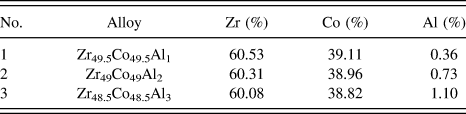
Zr49.5Co49.5Al1, Zr49Co49Al2, and Zr48.5Co48.5Al3 (nominal composition in atomic percent) pre-alloys were prepared from the constituting elements of Zr, Co, and Al (purity of 99.97% or higher) by arc melting in a Ti-gettered high purity argon atmosphere. The alloy ingots were remelted five times to ensure the uniformity of the components. Then, these ingots were melted and cast into cylindrical rods with a diameter of 2 mm and a length of at least 90 mm, using the water-cooled copper mold suction casting technique. The chemical compositions of the Zr–Co–Al alloys were calculated and listed in Table I.
Chemical composition of the Zr–Co–Al alloys (wt%).

Metallographic specimens were cut at the similar position (i.e., middle section) from these as-cast alloys, and then etched using a mixed solution of 5 g FeCl3 + 25 mL HCl + 4 mL C2H6O after ground and polished. The microstructure of the alloys was studied by means of optical microscopy (OM; Axio Scope A1, Carl Zeiss AG, Oberkochen, Germany) and scanning electron microscopy (SEM; QUANTA200, FEI Company, Amsterdam, The Netherlands). Compression test of these samples (height-to-diamond ratio 2:1) were conducted by using universal testing systems (AG-X 100KN, Shimadzu corporation, Kyoto, Japan) at a constant strain rate of 5 × 10⁻⁴ s−1 and at an ambient temperature. The constitutional phases were examined by X-ray diffraction (XRD; D/Max2400, Rigaku Corporation, Tokyo, Japan) with Cu Kα radiation (λ = 1.54056 Å) and an image plate detector over the 2θ range of 30–110° at a scanning speed of 2°/min. Slices of the alloys were ground down to a thickness of less than 100 μm and then electro-polished to perforation using the twin-jet technique in the etching solution. The morphologies and the atomic-level structure of the specimens were investigated using high resolution transmission electron microscopy (HRTEM) (FEI-TecnaiG2-TF30 S-Twin, FEI Company) with an accelerating voltage of 300 kV.
III. RESULTS AND DISCUSSION
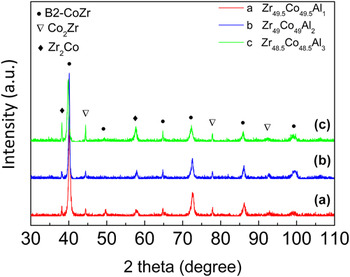
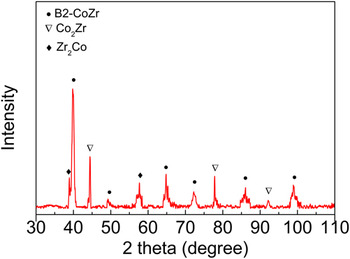
The XRD patterns of the as-cast Zr–Co–Al alloys are shown in Fig. 1. It indicates that the phases of the alloys mainly consist of the B2 ZrCo phase and a small quantity of Co2Zr and Zr2Co intermetallic compounds. The secondary phase strengthening is a main way to improve the mechanical properties of alloys, and these compounds might play an important role in strengthening the Zr–Co–Al alloy through their dispersion distribution in the B2 matrix.
XRD patterns of the as-cast Zr–Co–Al alloys, including that all alloys mainly consist of the B2 ZrCo phase and a small quantity of Co2Zr and Zr2Co intermetallic compounds.

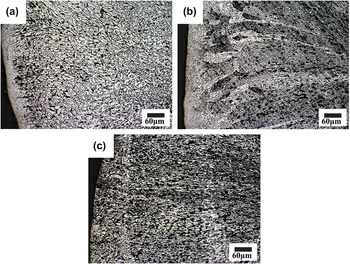
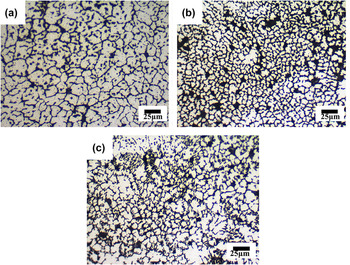
Figures 2 and 3 show the microstructure of the as-cast Zr–Co–Al alloys. As shown in Fig. 2, all the samples show typical cast microstructures which consist of columnar grains and equiaxed grains of the B2 phase at a marginal zone on the cross sections. Figure 3 ulteriorly reveals the microstructures composed of B2 equiaxed grains on the cylindrical surface of the samples. According to the works of Tan and Liu, Reference Tan, Pan, Zhang, Sun, He, Zheng, Stoica, Kühn and Eckert9,Reference Liu and Lu23 the GFA of the Zr–Co–Al alloys with low Al content is not sufficient to form a fully amorphous structure. On the other hand, the temperature of the copper mold wall was low, which promoted the heterogeneous nucleation of the alloys. The liquid metal in contact with the mold wall produced intense supercooling, which was a key to refine the structure of the ingot and a number of fine equiaxed grains were formed on the ingot surface layer. As a result of the release of the crystallization latent heat, the cooling rate of the internal residual metal liquid decreased, which could prevent the nucleation and lead to the formation of larger grains. Only the existing crystals that lie in the fine grain zone frontier could grow up to the centre of the ingot in the metal liquid and form columnar grains. Figure 3(a) shows that the grain size of the B2 phase in the Zr49.5Co49.5Al1 alloy is estimated to be 10–20 µm. However, as shown in Figs. 3(b) and 3(c), a lot of equiaxed B2 ultrafine grains have the size of 3–5 µm. It is known that UFG materials have excellent mechanical properties as compared with conventional crystalline materials. Reference Li, Tan, Wang, Bednarčík, Zhu, Zhang, Stoica, Kühn and Eckert3,Reference Li, Tan, Zhu, Zhang, Stoica, Kühn and Eckert11
Optical micrographs of cross section of the as-cast Zr–Co–Al alloy rods: (a) Zr49.5Co49.5Al1, (b) Zr49Co49Al2, and (c) Zr48.5Co48.5Al3.

Optical micrographs of the longitudinal section of the as-cast Zr–Co–Al alloy rods: (a) Zr49.5Co49.5Al1, (b) Zr49Co49Al2, and (c) Zr48.5Co48.5Al3.

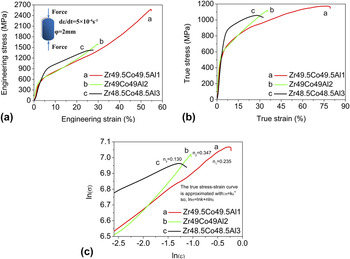
Figure 4 shows the typical monotonic compression stress–strain curves at the ambient temperature for Zr–Co–Al alloys with an aluminum content of 1–3 at.%, revealing a high nominal compression strength. After yielding, the stress–strain curves of the Zr–Co–Al alloys can be characterized by a linear relationship between stress and strain. The 0.2% offset yield strength (σy), ultimate compressive strength (UCS), and ultimate failure engineering strain (UFS) of different alloys are listed in Table II. The Zr49.5Co49.5Al1 alloy exhibited excellent mechanical properties, and the UCS and UFS reached 2.57 ± 0.02 GPa and 54.7%, respectively. For Zr49Co49Al2 alloy, the UCS and UFS are 1.61 ± 0.02 GPa and 29.8%, respectively. Compared with Zr49.5Co49.5Al1 and Zr49Co49Al2, the UCS and UFS reduced with the addition of 3 at.% Al, i.e., the UCS and UFS decreased to 1.42 ± 0.02 GPa and 26.4%, respectively. The results reveal that the yield strength of the Zr–Co–Al alloy increases with an increasing Al content, but the plasticity of the alloy decreases at the same time. In the previous work, it was found that, with the increase of Al content, the GFA of Zr–Co–Al alloy was promoted and the alloy was easier to change from a crystalline to an amorphous state. Reference Tan, Pan, Zhang, Sun, He, Zheng, Stoica, Kühn and Eckert9,Reference Wang, Zhang, Qiang, Wang, Wang, Li, Shek and Dong20,Reference Zhang, Wang, Qiang, Wang, Wang, Li, Shek and Dong24 Therefore, the alloy became hard and brittle, and the yield strength increased, but the UCS and the UFS reduced simultaneously. Reference Tan, Pan, Zhang, Sun, He, Zheng, Stoica, Kühn and Eckert9,Reference Wang, Zhang, Qiang, Wang, Wang, Li, Shek and Dong20,Reference Zhang, Wang, Qiang, Wang, Wang, Li, Shek and Dong24 For example, the UCS and the corresponding UFS of (CuZr)90Al10 was 1721 MPa and 0, respectively. Reference Wei, Sun, Guan, Terada and Shek25 The Zr56Co28Al16 amorphous alloy exhibited the UCS of 2136 MPa and the UFS of only 10.2%. Reference Tan, Pan, Zhang, Sun, He, Zheng, Stoica, Kühn and Eckert9,Reference Tan, Zhang, Stoica, Kühn, Mattern, Pan and Eckert13 The comprehensive mechanical properties of both above alloys are weaker than that of Zr49.5Co49.5Al1 studied in this work. Therefore, the results indicate that the addition of a small amount of Al element can change the microstructure of the ZrCo alloys and improve the comprehensive mechanical properties significantly.
Stress–strain curves of the as-cast Zr–Co–Al alloys obtained by monotonic compression tests at the constant strain rate of 5 × 10⁻⁴ s−1 and the ambient temperature: (a) engineering stress–strain curves, (b) true stress–true strain curves, and (c) natural logarithm curves of the true stress–true strain.

Mechanical properties of the Zr–Co–Al alloys, including the yield stress (σy), ultimate compressive strength (UCS), ultimate failure engineering strain (UFS), and average work-hardening index (n) obtained by monotonic compression tests at the constant strain rate of 5 × 10⁻⁴ s−1 and at the ambient temperature.

From the true stress–strain curves in Fig. 4(b), it can be observed that the typical work-hardening behaviors occurred during the compression process, and the work-hardening effect enhanced the plasticity of these alloys. Performance index of the work-hardening behavior of the Zr–Co–Al alloys was calculated by the following expression Reference Fischer, Reisner, Werner, Tanaka, Cailletaud and Antretter26 : σ = kε n , where σ and ε represent the true stress and the true strain of the material, respectively, k is the strength coefficient, and n is the work-hardening index. The work-hardening index can be obtained by fitting the natural logarithm curves of the true stress–true strain in Fig. 4(c), and the average values are listed in Table II.
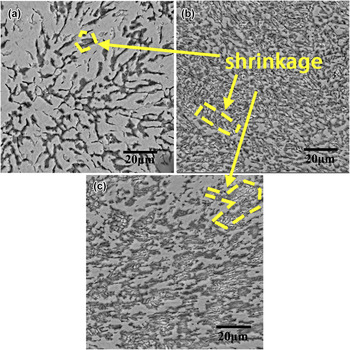
Generally speaking, the grain sizes of the Zr49Co49Al2 alloy and the Zr48.5Co48.5Al3 alloy are smaller than that of the Zr49.5Co49.5Al1 alloy which should lead to the improvement of the mechanical properties. But the average work-hardening index of the Zr49.5Co49.5Al1 and Zr49Co49Al2 alloys is 0.235 and 0.347, respectively, and both of them are higher than that of the Zr48.5Co48.5Al3 alloy. The Zr48.5Co48.5Al3 alloy exhibited a smallest n value of 0.130 which might be caused by the change of the microstructure due to the increase of the aluminum content. These results can be analyzed by the backscattered electron images of SEM which are shown in Fig. 5. The SEM images change little and no second phase precipitation in the alloys can be observed. On the other hand, many dispersed shrinkage are observed in the images (marked with yellow dotted lines). Therefore, the alloys had to face the problem that the dispersed shrinkage could make the local region susceptible to catastrophic failure during compression, which brought a lot of negative effects to the mechanical properties of the alloys. Reference Tan, Pan, Zhang, Sun, He, Zheng, Stoica, Kühn and Eckert9 The shrinked area in Zr49.5Co49.5Al1, Zr49Co49Al2, and Zr48.5Co48.5Al3 alloys is about 10%, 30%, and 50%, respectively. And the size of the shrinkage in the Zr49.5Co49.5Al1 alloy is relatively small about 8 µm. However, the size of the shrinkage in the Zr48.5Co48.5Al3 alloy is more than 20 µm. The size and amount of shrinkage increased with an increasing Al content, and the alloys became more vulnerable to an abrupt failure under the action of an external force. As a result, the UCS and the UFS of the alloy decreased with an increasing aluminum content.
SEM backscattered electron images of cross section of the as-cast Zr–Co–Al alloy rods: (a) Zr49.5Co49.5Al1, (b) Zr49Co49Al2, and (c) Zr48.5Co48.5Al3.

The grain size of equiaxed B2 phase in the Zr49Co49Al2 alloy is 3–5 µm which belongs to the scope of ultrafine grain Reference Iwahashi, Furukawa, Horita, Nemoto and Langdon27 and can improve the work-hardening index of the alloy. Hence, the n value of Zr49Co49Al2 reached 0.347, which is higher than that of the Zr49.5Co49.5Al1 alloy (n = 0.235). An alloy with a high work-hardening index generally has good plasticity, and therefore, the Zr49Co49Al2 alloy should have higher plasticity than Zr49.5Co49.5Al1 alloy theoretically. Nevertheless, the UFS (29.8%) of the Zr49Co49Al2 alloy is lower than that (UFS = 54.7%) of the Zr49.5Co49.5Al1 alloy in this experiment, which was mainly caused by the negative effect of the shrinkage. The negative effect of the shrinkage on the plasticity of the alloys is greater than the positive effect of a high work-hardening index.
It is well known that the work-hardening index in TRIP of ferrous alloys increases continuously with strain. Reference Fischer, Reisner, Werner, Tanaka, Cailletaud and Antretter26 However, Matsuda et al. reported that Zr–Co based alloys did not apparently show such a behavior, because the microcracks arising from the martensitic interface released the stress concentration. Reference Matsuda, Iwamoto, Morizono, Tsurekawa, Takashima and Nishida7 It can be seen from the trend of the curve in Fig. 4(c) that the work-hardening index of the Zr49Co49Al2 alloy increases with increasing the strain, and the work-hardening indices of the Zr49.5Co49.5Al1 alloy and the Zr48.5Co48.5Al3 alloy maintain a stable value generally. These results are different from Matsuda’s conclusions. It is generally known that the deformation-induced martensite is harder than the parent phase. Reference Matsuda, Hayashi and Nishida1,Reference Matsuda, Iwamoto, Morizono, Tsurekawa, Takashima and Nishida7 The microcracks arising from the martensitic transformation can release the stress concentration during the compression process, Reference Song, Pauly, Zhang, Scudino, Gargarella, Surreddi, Kühn and Eckert12 which will lead to a decrease in the work-hardening index. Reference Matsuda, Iwamoto, Morizono, Tsurekawa, Takashima and Nishida7 However, it can be seen from the microstructure of the low aluminum content Zr–Co–Al alloys in our previous work, only a small amount of martensites formed during the compression test. Reference Li, Tan, Wang, Bednarčík, Zhu, Zhang, Stoica, Kühn and Eckert3,Reference Li, Tan, Zhu, Zhang, Stoica, Kühn and Eckert11 That is to say, the microcracks arising from the boundaries between the martensites and the B2 matrix were few. Therefore, the relaxation of stress concentration by microcracks was not obvious, which did not lead to the obvious decline of the work-hardening index.
On the basis of the above analysis, the enhancement of the strength and plasticity of the Zr49.5Co49.5Al1 alloy can be attributed to the relatively high work-hardening index, stable deformation behavior, relatively less and smaller shrinkage, Al element solution strengthening, Reference Schneibel, Specht and Simpson28 and intermetallic compounds dispersion strengthening. To study the effect of other factors on the mechanical properties of the Zr49.5Co49.5Al1 alloy, the compressed Zr49.5Co49.5Al1 alloy rod was investigated by XRD and the XRD pattern is shown in Fig. 6. The diffraction peaks turned weak and broad, which was caused by residual stresses in crystals. The alloys also mainly compose of B2, Co2Zr, and Zr2Co phases, and no other phases can be observed in the XRD pattern. In other words, there was no martensite which had been observed in the previous work Reference Li, Tan, Wang, Bednarčík, Zhu, Zhang, Stoica, Kühn and Eckert3,Reference Li, Tan, Zhu, Zhang, Stoica, Kühn and Eckert11 in the compressed Zr49.5Co49.5Al1 alloy. The reason is possibly attributed to that the martensite induced by deformation is too little to be detected by XRD.
XRD pattern of the compressed Zr49.5Co49.5Al1 alloy rod.

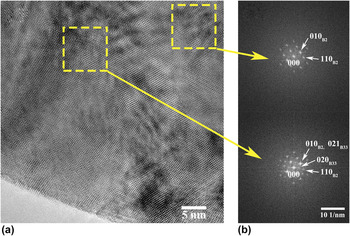
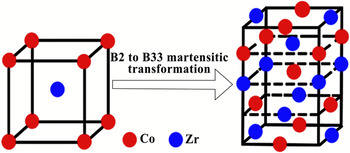
Figure 7 reveals the HRTEM micrographs of the Zr49.5Co49.5Al1 alloy after compressive deformation. The microstructure shown in Fig. 7(a) is located near a crack tip in the maximum deformation zone of the alloy. The fast Fourier transform (FFT) images taken from the area marked by the yellow dotted lines in Fig. 7(a) exposit that the B2 ZrCo and B33 martensite coexist in the compressed Zr49.5Co49.5Al1 alloy, as shown in Fig. 7(b). The lattice fringes of different orientations can be seen in the area surrounded by the yellow dotted lines, but the difference between the lattice fringe distances of the B2 parent phase and that of the B33 martensite is small. The relationship between the B2 parent phase and B33 martensite was determined to be (010)B2//(021)B33, which is similar to the work of Matsuda et al. Reference Matsuda, Nishimoto, Matsunaga, Morizono, Tsurekawa and Nishida5 The evolution of the crystal structure from B2 to B33 in the phase transition is shown in Fig. 8.
TEM images of the Zr49.5Co49.5Al1 alloy after compression at the ambient temperature: (a) HRTEM image and (b) FFT images of HRTEM image.

The sketch description of a B2 → B33 structure evolution.

In recent years, Matsuda et al. Reference Matsuda, Hayashi and Nishida1,Reference Matsuda, Nishimoto, Matsunaga, Morizono, Tsurekawa and Nishida5,Reference Matsuda, Iwamoto, Morizono, Tsurekawa, Takashima and Nishida7,Reference Matsuda, Nishimoto, Morizono, Tsurekawa and Nishida8 had carried out some researches on Zr–Co based alloys. It was concluded that the pronounced enhancement of the ductility can be attributed to the TRIP associated with the DIMT. Reference Li, Tan, Wang, Bednarčík, Zhu, Zhang, Stoica, Kühn and Eckert3,Reference Matsuda, Nishimoto, Matsunaga, Morizono, Tsurekawa and Nishida5,Reference Li, Tan, Zhu, Zhang, Stoica, Kühn and Eckert11,Reference Bendersky, Stalick, Portier and Waterstrat29 One possible scenario for the enhancement of the plasticity is as follows. The martensite formed and grew in the zone where the stress concentration occurred during a compressive deformation, which released the concentrated stress. Furthermore, the B33 martensite is harder than the B2 parent phase. Hence, the formation of martensite can prevent or postpone both further local deformation and the initiation and propagation of cracks in the stress concentration zone, and then increase the ductility of the Zr–Co–Al alloy. Therefore, the Zr49.5Co49.5Al1 alloy, in which B2 to B33 martensite transformation occurred, obtained higher strength and toughness.
IV. CONCLUSIONS
Microstructure and compression mechanical properties of ternary Zr–Co–Al alloys prepared by rapid solidification were investigated to reveal the strengthening and toughening mechanisms of these alloys.
-
(1) Ultrafine-grained Zr–Co–Al alloys were obtained by water-cooled copper mold casting, and the Zr49.5Co49.5Al1 alloy showed a high ultimate compression strength and ultimate compression engineering strain of 2.57 ± 0.02 GPa and 54.7%, respectively. The results indicate that the addition of a small amount of Al element can change the microstructure of the ZrCo alloy and improve its mechanical properties.
-
(2) The enhancement of the strength and plasticity of the Zr49.5Co49.5Al1 alloy was due to the work-hardening phenomenon, stable deformation behavior, intermetallic compounds dispersion strengthening, Al element solution strengthening, and martensite strengthening. Dispersed shrinkage made the Zr49Co49Al2 alloy and the Zr48.5Co48.5Al3 alloy prone to an abrupt failure and decreased their mechanical properties.
-
(3) B2 to B33 martensite transformation was observed in the Zr49.5Co49.5Al1 alloy compressed at the ambient temperature. The martensite formation of B33 can prevent or postpone both the further local deformation and the initiation and propagation of the cracks in the stress concentration zone. The pronounced enhancement of ductility of the Zr49.5Co49.5Al1 alloy can be attributed to the TRIP associated with the DIMT.
ACKNOWLEDGMENT
The authors thank the National Natural Science Foundation of China under Grant Nos. 51361017 and 51301078 for financial support.