Introduction
The genus Rinodina (Ach.) Gray is relatively well understood among the crustaceous lichen genera of North America (Sheard Reference Sheard2010). Nevertheless, new species and new records continue to be discovered (Sheard Reference Sheard2011; Sheard et al. Reference Sheard, Knudsen, Mayrhofer and Morse2011). Here we describe R. chrysidiata, an isidiate species that produces the xanthone secalonic acid A and occurs in eastern North America and eastern Asia. We compare the new species to R. xanthophaea (Nyl.) Zahlbr., a species with which it occurs in Japan, Korea and far eastern Russia. The two species have an identical secondary chemistry but differ in their method of asexual reproduction and are unlikely to be closely related since they possess different spore types. Rinodina chrysidiata has been found only once in the fertile state.
Materials and Methods
The study is based on material collected by the authors (JL, GT, TT) and loans from herbaria cited in the acknowledgements. Surface observations of specimens were made using a Wild M5 stereomicroscope. Measurements were taken at ×25 magnification and rounded to the nearest 0·05 mm. For Rinodina xanthophaea, internal ascomatal measurements were made on vertical sections (20–25 µm thick), cut with a Leitz freezing microtome, at ×50 magnification to an accuracy of 5 µm using a Wild M20 compound microscope. In the case of R. chrysidiata, sections were cut by hand in order to preserve the single apothecium available for study. Ascospore measurements were taken at ×500 magnification using a Wild vernier micrometer (scale of 0·1 µm) to an accuracy of 0·5 µm. Ascospore measurements are quoted as the range between the 25th and 75th percentiles with the 5th and 95th percentiles quoted in brackets. Observations of ascospore wall structure were made with an oil immersion lens at a magnification of ×1250. The scanning electron and light micrographs (SEMs and LMs) published here were prepared following the methods outlined by Lendemer & Elix (Reference Lendemer and Elix2010).
Taxonomy
Rinodina chrysidiata Sheard sp. nov
MycoBank No.: MB561585
Similis Rinodinae xanthophaea sed thallo isidiato et ascosporis Pachysporaria-typicus.
Typus: USA, North Carolina, Clay Co., Nantahala National Forest, 1–1·5 mi N of US 64 on Buck Creek Rd., c. 5 mi NE of Shooting Creek, mesic upland forest, on Liriodendron, 10 November 2007, J. C. Lendemer 10425 (NY—holotypus; BG—isotypus).
(Fig.1)
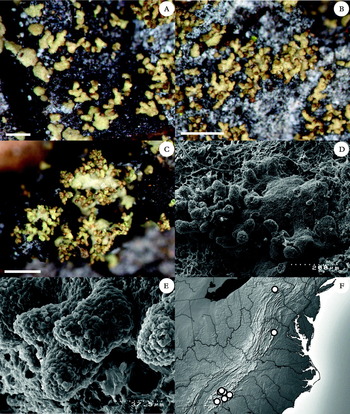
Rinodina chrysidiata. A, young thalli with sparse short isidia (Lendemer 7070); B, mature thalli with abundant coralloid isidia (Lendemer 7070); C, robust thallus with abundant isidia (Lendemer 14025); D & E, scanning electronic micrographs; D, thallus; E, detail of isidia; F, geographic distribution in North America based on specimens examined. Scales: A = 0·25 mm; B & C = 0·5 mm; D & E as indicated. In colour online.

Thallus thin, golden yellow, greyish yellow or grey-brown when shaded, then more strongly pigmented marginally; plane and matt; margin indeterminate; prothallus lacking; areolate, areoles isolated, 0·4–1·0 mm diam., minutely lobate, lobules 0·05– 0·15 mm wide; developing erect isidia to 0·10–0·15(–0·30) mm long, 0·05–0·10(–0·25) mm wide, slightly club-shaped and brownish tipped, marginal at first, then usually covering areoles, sometimes branched.
Apothecia very rare, sessile, c. 0·4 mm diam.; disc dark brown, margin concolorous with thallus, c. 0·1 mm wide; paraphyses c. 2·0 µm wide, apices to c. 3·0 µm, lightly pigmented, immersed in a dispersed pigment forming a red-brown epihymenium. Ascospores mostly immature, Pachysporaria-type I (Sheard Reference Sheard2010), 19·5–22·0 × 13·0–13·5 µm (n = 6), l/b ratio 1·5–1·6, locules rounded from first, lacking well-defined canals and with persistently thick lateral walls; torus prominent; walls pigmented.
Pycnidia not seen.
Chemistry. Secalonic acid A [major], atranorin [minor], and two unknown eumitrin derivatives [eumitrin Y (submajor), eumitrin U (minor)] detected by HPLC (TT 21838, 23039, J. A. Elix, pers. comm., 2009). Spot tests: K−, C+ yellow-orange, KC+ yellow-orange, P−, UV+ dull orange.
Etymology. The epithet is derived from ‘chrys-’, Greek for golden yellow, and an abbreviation ‘idiata’ of the Latin ‘isidium’. We selected ‘chrysidiata’ instead of ‘chrys[is]idiata’ to maximize its euphony.
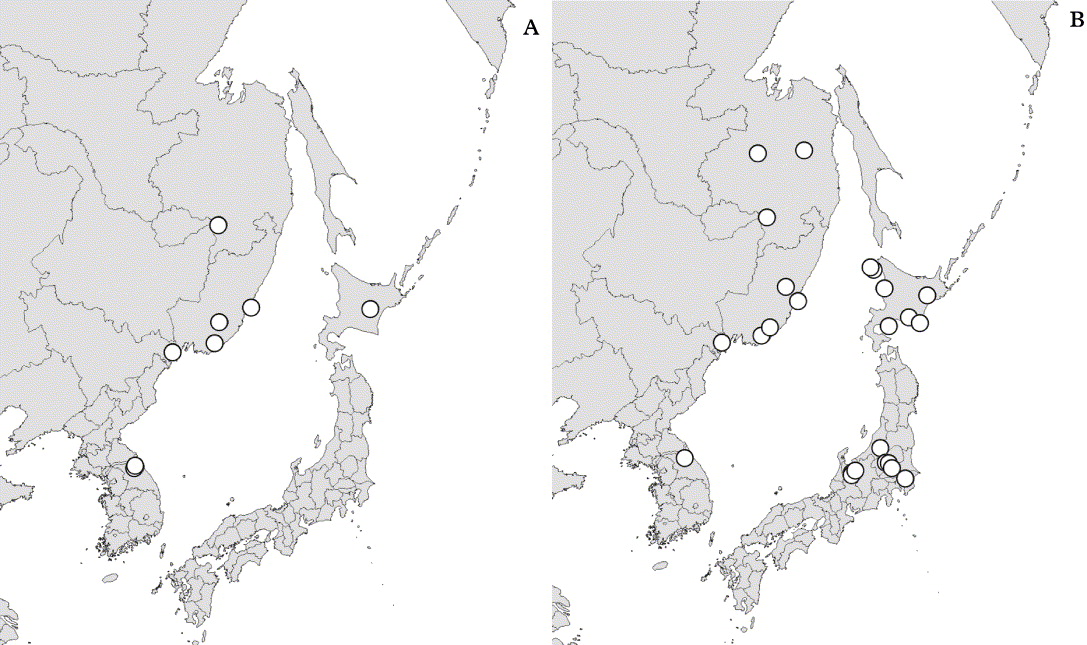
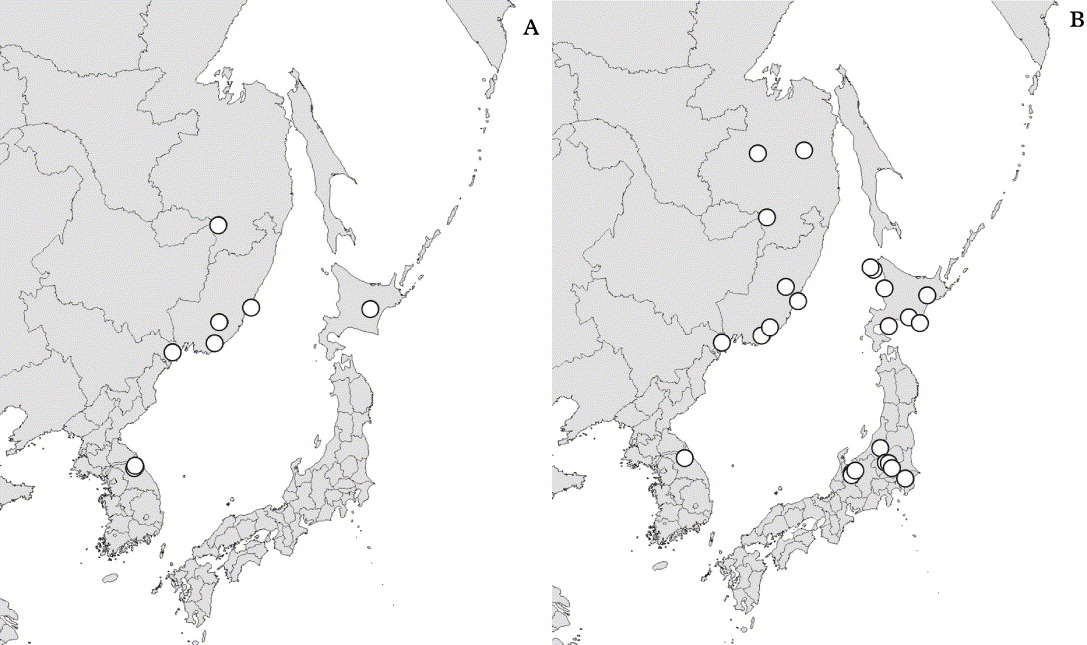
Ecology and distribution. Rinodina chrysidiata belongs to a group of species whose ranges centre in the Appalachian Mountains of eastern North America, but also have disjunct populations in eastern Asia (Yoshimura & Sharp Reference Yoshimura and Sharp1968; Culberson Reference Culberson1972; Sheard et al. Reference Sheard, Lendemer and Tripp2008). In North America, the species is most frequent in the southern Appalachian Mountains (Fig. 1F) where it occurs at middle to high elevations (700–1165 m in the specimens examined). In eastern Asia, R. chrysidiata is known from Japan, Korea, and far eastern Russia (Fig. 3A). Disjunct distributions between eastern Asia and eastern North America are long established among phanerogams (Boufford & Spongberg Reference Boufford and Spongberg1983) and are well-documented (Wen Reference Wen1999; Xiang et al. Reference Xiang, Soltis, Soltis, Steven and Crawford2000; Qian Reference Qian2002).
There is some debate regarding whether these disjunctions originated through long distance dispersal or represent fragmented relicts of a once continuous biota (Galanina et al. Reference Galanina, Yakovchenko, Tsarenko and Spribille2011). Based on the extensive studies of the lichen biota of eastern North America conducted by the first author and his colleagues, we support the latter hypothesis. This topic will be discussed further in a coming publication (Lendemer et al., Reference Lendemer, Harris and Tripp2012).
Though the majority of the known populations of Rinodina chrysidiata are from the southern Appalachians (Fig. 1F), additional populations occur in the central Appalachians (Pennsylvania) and the Blue Ridge Mountains (Virginia). These relatively isolated populations probably indicate that the species was once widely distributed in the Appalachians and that its range has been significantly reduced as a result of the extensive anthropogenic change (deforestation followed by reforestation) that has taken place in the region. If this is the case, additional populations may also be found in the few remaining high humidity habitats with primary or secondary hardwood forests in the central and northern Appalachians. Although the species is reported here from a number of localities, it should be stressed that it is not common and is never locally abundant. In fact, the vast majority of collections consist of small isolated thalli. In the North American specimens examined, for which substratum data was recorded, the species occurred on the bark of hardwoods (Acer, Aesculus, Carya, Liriodendron, Quercus) and the wood of a picnic table (Tønsberg 30897, BG). In eastern Asia, the species has been found on Betula and Quercus.
Like many other sterile, asexually reproducing crustose lichens in North America, Rinodina chrysidiata is almost certainly strongly negatively impacted by collector bias (Lendemer Reference Lendemer2009, Reference Lendemer2011; Harris & Lendemer Reference Harris and Lendemer2010). Thus it is likely to be more common in the southern Appalachians than the specimens cited here indicate. Nonetheless, its infrequent occurrences are restricted to high quality habitats and typically consist of small isolated populations. This may indicate that it requires some form of protection at the state or federal level.
Notes. Only a single apothecium has been detected in all of the collections studied (Tønsberg 21838, BG), and this was associated with greyer, non-isidiate areoles. However, on wetting, the yellow pigmentation was enhanced and became more similar to that of the bulk of the sample. The differences in pigmentation and reproductive state may reflect microhabitat differences. Given the small number of ascospores measured, their identification as belonging to Pachysporaria-type I must be considered tentative, although they fall within the range of species with smaller ascospores of this type, such as Rinodina griseosoralifera Coppins and R. roboris (Duf. ex Nyl.) Arnold, the latter being known to have variably sized ascospores (Giralt Reference Giralt2001; Sheard et al. Reference Sheard, Tønsberg and Johnsen2010).
Five other species of Rinodina are known to possess true isidia and, most interestingly, all have Pachysporaria-type ascospores. One of these species, R. citrinisidiata Aptroot & Wolseley (Aptroot et al. Reference Aptroot, Saipunkaew, Sipman, Sparrius and Wolseley2007), also has a yellow pigmented thallus but the xanthone is thiomelin rather than secalonic acid A. The chemical similarity suggests that R. citrinisidiata may be related to R. thiomela (Nyl.) Müll. Arg. (Aptroot et al. Reference Aptroot, Saipunkaew, Sipman, Sparrius and Wolseley2007) and R. lepida (Nyl.) Müll. Arg. (Sheard Reference Sheard2010). Rinodina isidioides (Borrer) Olivier (Giralt et al. Reference Giralt, Mayrhofer and Sheard1995; Giralt Reference Giralt2001; Mayrhofer & Moberg Reference Mayrhofer and Moberg2002) and R. fuscoisidiata Giralt, Kalb & Elix (Giralt et al. Reference Sheard2010a) have ascospores which may develop apical satellite lumina when mature to overmature, and possess atranorin. The remaining two species, R. brasiliensis Giralt, Kalb & H. Mayrhofer (Giralt et al. Reference Giralt, Kalb and Mayrhofer2009) and R. guianensis Aptroot (Aptroot Reference Aptroot1987), have ascospores with lumina surrounded by globular inclusions and lack secondary substances. However, this last species was included in R. colobinoides (Nyl.) Zahlbr. by Sheard (Reference Sheard2010). These five species, with the possible exception of R. guianensis, have ascospores which fit the description of Pachysporaria-type I ascospores (Sheard Reference Sheard2010). We agree that this spore type may be related to the Polyblastidium-type as suggested by Giralt et al. (Reference Giralt, Boom, Tønsberg and Elix2010b) for R. flavosoralifera Tønsberg.
As noted above, Rinodina chrysidiata has frequently been collected in the southern Appalachian Mountains and has been found as far north as Pennsylvania. It also occurs in eastern Asia and it has been collected twice with R. xanthophaea in far eastern Russia (Santesson 33184 UPS, Spribille 23934 pers. hb.), and also in Korea (Thor 20300 UPS). That species has the same chemistry and frequently reproduces vegetatively but never by means of true isidia. Labriform soralia develop from marginal lobes, deforming the lobes so that the soralia become circular, sometimes with a central pore. A similar developmental sequence occurs from overgrowing lobules in the centre of the thallus, with the result that soralia appear pustulate in non-marginal positions. Rinodina xanthophaea mostly has larger areoles than R. chrysidiata, 0·50–1·60 mm wide, before they coalesce to form a continuous thallus. The areole lobules are also larger than those of R. chrysidiata, ranging from 0·15–0·30 mm wide. On certain substrata a dark, fimbriate prothallus can sometimes be observed, and more rarely rhizohyphae are associated with soralia in the central parts of the thallus. Apothecia occur frequently in R. xanthophaea, sometimes in association with soralia. The frequently large apothecia produce variably sized, and sometimes very large, ascospores belonging to the Physcia-type. The different spore type suggests that there is no close relationship between R. chrysidiata and R. xanthophaea, despite their identical chemistries. Soralia, a prothallus and rhizohyphae have never been observed in association with the thallus of R. chrysidiata.
Specimens examined. USA: Georgia: Towns Co., Southern Nantahala Wilderness, Chattahoochee National Forest, Hightower Gap to Rich Knob, 35·08°N 83·62°W, J. C. Lendemer 10895 (NY). North Carolina: Buncombe Co., 1·55 mi SE Ridgecrest, Camp Ridgecrest, T. Tønsberg 21887 (BG); Clay co., Nantahala National Forest, vicinity of Doe Knob, 35·08°N 83·60°W, J. C. Lendemer 10425 (NY); Haywood Co., S Waynesville, Blue Ridge Parkway, Grassy Ridge Mine Overlook, T. Tønsberg 21875 (BG); Great Smoky Mountains National Park, Boogerman Loop Trail, 35·61°N 83·09°W, J. C. Lendemer 18831 (BG); Henderson Co., Pisgah National Forest, North Mill River Recreation Area, 35·40°N 82·67°W, J. C. Lendemer 7070 (NY); Jackson Co., 12 km EES of Highlands, just off Rd. 107, S of Bull Pen Rd., T. Tønsberg 21838 (BG, fertile); Nantahala National Forest, Panthertown Valley, 35·15°N 83·01°W, J. C. Lendemer 6928 (NY); Swain Co., Great Smoky Mountains National Park, Collins Creek Picnic Area, T. Tønsberg 30897 (BG); Great Smoky Mountains National Park, Beech Gap Trail, 35·62°N 83·22°W, J. C. Lendemer 19189A (NY); Transylvania Co., between Brevard and Highlands, T. Tønsberg 21812 (BG). Pennsylvania: Lycoming Co., Tioga State Forest, Algerine Swamp Natural Area, Gamble Run, 41·52°N 77·47°W, J. C. Lendemer 16960A (NY). South Carolina: Oconee Co., Sumter National Forest, 8·5 mi S of Cashiers, 34°N 83°W, Dey 13703 (NY). Tennessee: Cocke Co., Great Smoky Mountains National Park, Gabes Mountain Trail, 35·75°N 83·26°W, J. C. Lendemer 19074 (NY), E. A. Tripp 674 (NY). Virginia: Warren/Rappahannock Co., Shenandoah National Park, South Marshall Mountain, 38·76°N 78·21°W, J. Guccion 1238 (all NY).—Japan: Hokkaido: Tokachi Prov., Ashoro-gun, 42 km NNE Obihiro, 43·14°N 143·30°E, T. Tønsberg 23039 (BG).—Korea: Gangwon Prov.: Sorak San Nat. Park, Mt. Sorak, 38·10°N 128·29°E, K. H. Moon 691 (TNS); 38·07°N 128·27°E, G. Thor 20299, 20300 with R. xanthophaea (UPS).—Russia: Khabarovskiy Krai: 48·32°N 135·08°E, 1927, A. Oxner (photograph KW). Primorskiy Krai: Lazovskiy District, Tretylog, 43·11°N 133·58°E, R. Santesson 33184, with R. xanthophaea (UPS); Kedrovaya Pad' Reserve, along Poperechniy River, 43°N 131°E, 1935, N. Kabanov (photograph KW); Terneyskiy Rayon, Sikhote Alin' Mountains, 44·41°N 136·13°E, T. Spribille 23934 with R. xanthophaea, 23948; Sikhote Alin' Mountains, Verkhnaya Ussurskiy Biocoenotic Station, 44·02°N 134·13°E, T. Spribille 23418 (all pers. hb.).
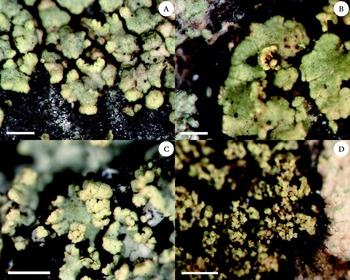
Rinodina xanthophaea. A, thallus in which some areoles lack diaspores while others begin to develop marginal soralia (Spribille 30559, SASK); B, detail of areole with marginal soralium (Spribille 30559); C, areole with abundant well-developed soralia (Spribille 30559, SASK); D, thallus in which the areoles have entirely dissolved into coarse soredia (note the black prothallus; Spribille 30559 in hb. Spribille). Scales: A & B = 0·25 mm; C & D = 0·5 mm. In colour online.

Geographic distributions of Rinodina species in Asia based on the specimens examined for this study. A, R. chrysidiata; B, R. xanthophaea.
Rinodina xanthophaea (Nyl.) Zahlbr
Cat. Lich. Univers. 7: 559 (1931).—Lecanora xanthophaea Nyl., Lich. Jap. 41 (1890); type: Japan, Magayesi, 1879, E. Almquist (H–NYL 29084—lectotype here designated; H–NYL 29085—isolectotype pro parte).
(Fig. 2)
Thallus thick, golden yellow or grey; areolate, areoles isolated at first, 0·50–1·60 mm wide, sometimes coalescing to form a continuous thallus, areole margins minutely lobate; lobules at first to 0·10–0·30 mm wide, then forming larger lobes which may overgrow each other, thallus then becoming continuous; surface otherwise plane and matt; vegetative propagules present or not, developing as marginal, labriform soralia, often becoming circular, c. 0·20–0·25(–0·35) mm diam., sometimes with a central perforation, then pustulate; soredia 40–50 µm diam., larger consoredia sometimes present which may develop into blastidia c. 0·25 ×0·10 mm; thallus indeterminate; prothallus typically present, black, entire, then sometimes thick, rimose-areolate, or fimbriate at the margins, particularly when overgrowing foliose lichens (Fig. 2).
Apothecia frequent but often absent in sorediate thalli, rarely contiguous, to 0·70–1·80 mm diam., narrowly attached; disc dark reddish brown, plane; margin concolorous with thallus, 0·15–0·25 mm wide, flexuose and persistent. Thalline exciple c. 70–140 µm wide laterally; cortex 10–25 µm wide, reddish orange crystals present in the cortex and medulla obscuring the structure of both, less dense in medulla; cortical cells to 4·5–6·5 µm wide, not pigmented; algal cells 7·5–16·0 µm wide; thalline exciple to 110–140 µm wide below, cortex to 20–60(–80) µm thick, columnar; medullary hyphae radiating and continuous with columnar hyphae of lower cortex; proper exciple often indistinguishable from the hymenium, c. 10 µm wide laterally, to 10–25 µm wide at the periphery; hypothecium 50–90 µm tall, hyaline throughout; hymenium highly gelatinized and often desiccated, 90–120 µm high; paraphyses 2·0–2·5 µm wide, apices to 3·0–5·0 µm wide, not pigmented but immersed in dispersed pigment forming an orange-brown epihymenium; asci c. 60–95 × 20–30 µm, with 2–8 ascospores. Ascospores with Type A development, Physcia-type, (19·5–)23·5–28·5(–36·0) × (10·0–)12·0–15·0(–18·5) µm, (n = 180), l/b ratio (1·6)1·8–2·1(–2·2), lumina becoming more rounded but mostly retaining apical wall thickening, sometimes slightly waisted; torus present; walls not ornamented.
Chemistry. Secalonic acid A [major], atranorin [minor or trace], and three unknown eumitrin derivatives [eumitrin Y (submajor), eumitrin X (minor), eumitrin U (minor)][TT 22986, 22308, (23028 no eumitrin X) J. A. Elix, pers. comm., 2009]. Spot tests: K−, C+ yellow-orange, KC+ yellow-orange, P−, UV+ dull orange.
Ecology and distribution. The species is known from Japan and far eastern Russia (Fig. 3B). It has been collected on Abies nephrolepis, A. sachalinensis, Betula costata, B. mandshurica, Fraxinus, Magnolia obovata, Phellodendron amurense, Picea jezoensis, Quercus mongolica, Tilia amurensis, wood and on detritus over rocks, at elevations of 70–1535 m. It is sometimes found growing over decaying thalli of Parmelia species.
Notes. The thallus morphology, pigmentation, and Physcia-type ascospores of Rinodina xanthophaea indicate a relationship with the saxicolous, Appalachian species R. chrysomelaena (Ach.) Tuck. (Lendemer & Sheard Reference Lendemer and Sheard2006; Sheard Reference Sheard2010), which has been rediscovered recently in the southern Appalachians (Lendemer et al., in press).
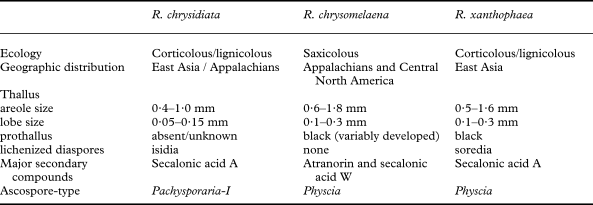
Despite their similar yellow pigmentation, the chemistries of the two species are different; Rinodina chrysomelaena contains atranorin and secalonic acid W as the major constituents rather than the secalonic acid A of R. xanthophaea. The relatively large ascospores of R. xanthophaea are similar in length to those of R. chrysomelaena. The two species also differ in their biogeographic patterns and the production of lichenized diaspores (see Table 1).
Comparison of characters distinguishing Rinodina chrysidiata, R. chrysomelaena and R. xanthophaea

Rinodina xanthophaea is a rather variable species with two reproductive morphotypes, one primarily with apothecia and the other primarily with marginal soredia. The latter has been described as forma sorediosa by Pczelkin (Reference Pczelkin1987). In the same paper, Pczelkin also described forma isidiosa. The types (LE) of these forms have not been available for study so it is not known if the latter corresponds to the rare blastidiate form of R. xanthophaea or to the isidiate R. chrysidiata which has been found growing with R. xanthophaea in eastern Asia.
This species is typically characterized by a black prothallus around the thallus margin and is frequently seen between the separate areoles in marginal regions of thalli. The prothallus is sometimes fimbriate at its margin, particularly when thalli are colonizing foliose lichens (mostly Parmelia spp.). Marginal rhizohyphae are rarely associated with soralia in the central regions of the thallus where lobules overgrow each other. The rhizohyphae are interpreted as being homologous with fibres of the fimbriate prothallus.
The new species, Rinodina chrysidiata, is chemically identical and has similar thallus characters but the vegetative propagules are true isidia rather than soredia. Also, this species tends to have smaller areoles and lobules, is never associated with a dark prothallus, and has smaller, Pachysporaria- rather than Physcia-type ascospores in the single fertile specimen (Table 1).
Specimens examined. Japan: Hokkaido: Iburi Prov., Tarumae, 42·41°N 141·21°E, H. Kashiwadani 14473 (TNS); Ishikari Prov., Mt. Ashibetsu, 1935, Y. Ashahina (TNS); Kitami Prov., Rishiri-to Island, 45·09°N 141·17°E, T. Tønsberg 22501, 22308, 22528 (all BG); Kushiro Prov., Akan-gun, E Akan Kohan, 45·09°N 141·17°E, T. Tønsberg 23028 (BG); Akkeshi-gun, 44 km E Kushiro, 42°N 144°E, T. Tønsberg 22986 (BG); Lake Akan, 43·26°N 144·08°E, Y. Ohmura 1890 (TNS); Teshio Prov., 28 km NE Obira, 44·08°N 141·58°E, G. Thor 13525 (UPS); Tokachi Prov., Mt. Rakko, 42·16°N 143·07°E, S. Kurokawa 70590 (TNS); Mt. Tsurgi, 42·51°N 142·54°E, H. Kashiwadani 7653 (TNS). Honshu: Aki Prov., Mt. Garyu, 34°N 132°E, H. Kashiwadani 2309 (TNS); Chiba Prov., Mt. Ohtaki, 35·58°N 140·07°E, T. Inobe 184 (TNS); Etchu Prov., 25 km ESE Toyama, 36·35°N 137·28°E, G. Thor 12662 (UPS); 33 km ESE Toyama, 36·34°N 137·34°E, G. Thor 12695 (UPS); Aramine, 36·29°N 137·27°E, 1936, Y. Asahina (TNS); Shimotsuke Prov., Kirigome, 36·45°N 139·37°E, 1931, Y. Asahina (TNS); Mt. Shirane, 36·23°N 139·51°E, M. Ogata 97 (TNS); Shinano Prov., 16 km NW Shinano-Ohmachi, 36·33°N 137·43°E, G. Thor 12720, 12721 (UPS); Mt. Shirouma, 36·45°N 137·45°E, K. Matsushima 101 (TNS); Teshio Prov., Rumoi-gun, 21 km ENE Obira, 44·09°N 141·55°E, T. Tønsberg 21958 (BG); Yamagata Prov., Murayama, 34°N 132°E, 1879, E. Almquist (H-NYL 29085, accompanying isolectotype).—Korea: Gangwong Prov., Sorak-san Nat. Park, 38·07°N 128·27°E, G. Thor 20300 with R. chrysidiata (UPS).—Russia: Khabarovskiy Krai: 48·32°N 135·08°E, 1927, A. Oxner [KW (photograph)]; Amgun' River Region, 51·30°N 135·14°E, Spribille 31390 (hb. Spribille); Bureinskij Zapovednik, 25 km SE Sofiysk, T. Spribille 32018 (GZU); Komsomolsk-De Kastri route, Khomi Mts., 51·05°N 138·57°E, T. Spribille 30559 (GZU), 30560 (GZU); Sredniy Khrebet Mountains, Polosataya Mtn., T. Spribille 31021 (GZU). Primorskiy Krai: Kedrovaya Pad' Reserve, along Poperechniy River, 43°N 131°E, 1935, N. Kabanov [KW (photograph)]; Sikhote-Alin' Mountains, Oblachnaya Mountain., 43·40°N 134·13°E, T. Spribille 23515, 23525, 23569, 23682 (all hb. Spribille); Terneyskiy Rayon, Sikhote-Alin' Mountains, 45·08°N 135·52°E, T. Spribille 23766, 23807, 23867, 23877, 23934 (all hb. Spribille); Sikhote-Alin'skiy Zapovednik, 45·08°N 135·52°E, T. Spribille 23820 (hb. Spribille); Zakharovskiy River, 1935, B. Kolesnikov [KW (photograph)]; “Lazovskiy Krai”, Tretylog, 43·11°N 133·58°E, R. Santesson 33184p.p. [with R. chrysidiata] (UPS), 33199 (UPS).
The authors are grateful to the curators of BG, GZU, H, NY, TNS, and UPS for the loan of specimens and to Toby Spribille for a loan from his personal herbarium. Jack Elix (CANB) kindly performed HPLC on a number of specimens. Olga Nadyeina (KW) was very helpful in supplying photographs of specimens for identification. Toby Spribille is thanked for drawing our attention to the paper by Pczelkin, and Viktoria Wagner for translation of the same. We are grateful for the helpful reviews of Mireia Giralt and Toby Spribille which have improved this contribution in important ways.