INTRODUCTION
Racial socialization remains a defining characteristic of the African American experience. For several decades now, scholars across various fields of study have examined the process by which Black parents prepare their children to survive and thrive in a society that has historically devalued its African Americans citizens (Bowman and Howard, Reference Bowman and Howard1985; Boykin and Toms, Reference Boykin, Toms, McAdoo and McAdoo1985; Brown and Lesane-Brown, Reference Brown and Lesane-Brown2006; Hughes and Chen, Reference Hughes and Chen1997; Jackson et al., Reference Jackson, McCullough, Gurin, Broman and Jackson1991; Lacy Reference Lacy2007; Lacy and Harris, Reference Lacy, Harris, Lareau and Conley2008; Murry et al., Reference Murry, Brody, McNair, Luo, Gibbons, Gerrard and Wills2005; Suizzo et al., Reference Suizzo, Robinson and Pahlke2008; Thornton Reference Thornton, Taylor, Jackson and Chatters1997; Thornton et al., Reference Thornton, Chatters, Taylor and Allen1990). These studies have advanced our understanding of the perceptual realm of race relations: they address the roles that culture and identity play in shaping parental messages about what it means to be Black. This article examines the determinants and substantive content of racial socialization strategies within the context of a new assimilation-based theory of adult Black identity—the investment in Blackness hypothesis. This framework posits that variation across assimilation trajectories drives attitudinal dissimilarity among African Americans. More specifically, it helps to further our understanding of precisely who in Black America teaches what during racial socialization.
Within the context of the present study, racial socialization refers to “messages and strategies used by Black parents to teach their children about Black American culture, [which] prepare them for potential experiences with racism and prejudice, and promote healthy mistrust of non-Blacks”Footnote 2 (Constantine and Blackmon, Reference Constantine and Blackmon2002, p. 324). Despite Black America's history of subjugation, “There is little consensus among Black parents regarding the relative importance assigned to racial issues in the socialization process” (Thornton et al., Reference Thornton, Chatters, Taylor and Allen1990, p. 402). For example, studies have shown that many Black parents do not overtly socialize their children to race (Bowman and Howard, Reference Bowman and Howard1985; Hill Reference Hill1997; Hughes and Chen, Reference Hughes and Chen1997; Hughes and Johnson, Reference Hughes and Johnson2001; Lacy and Harris, Reference Lacy, Harris, Lareau and Conley2008; Lareau Reference Lareau2002; Spencer Reference Spencer, Spencer, Brookins and Allen1985; Thornton et al., Reference Thornton, Chatters, Taylor and Allen1990). Moreover, those parents that do discuss race mattersFootnote 3 with their children convey an assortment of messages, including racial pride (Bowman and Howard, Reference Bowman and Howard1985; Brown and Lesane-Brown, Reference Brown and Lesane-Brown2006; Jackson et al., Reference Jackson, McCullough, Gurin, Broman and Jackson1991), Black achievements (Bowman and Howard, Reference Bowman and Howard1985; Lacy Reference Lacy2004), and the need for having to “work harder than Whites” (Hughes and Chen, Reference Hughes and Chen1997; Thornton Reference Thornton, Taylor, Jackson and Chatters1997). Despite these intriguing findings, studies have yet to address the larger conceptual meaning of this diversity. Researchers know very little about what factors explain the variation in racial socialization strategies. It is my contention that assimilation trajectories—as measured by class position, friendship networks, and cultural commitments—strongly influence what Black parents teach their children about race relations.
SOCIALIZATION, RACE, AND PARENTAL MESSAGES: AN OVERVIEW OF EXISTING STUDIES
Socialization is a fundamental activity of all social groups and societies. This process assists individuals in becoming familiar with roles, rights, statuses, and obligations associated with various dimensions of the social world (Arnett Reference Arnett1995). The adjustment to group membership is guided by a deeply embedded set of material and nonmaterial components of culture, such as values, behaviors, and technology (Gecas Reference Gecas, Burr, Hill, Nye and Reiss1979). Socialization is chiefly concerned with forwarding cultural content to children so that they may become adequate adult members of society (Child and Zigler, Reference Child and Zigler1973).
In addition to these more general socialization goals, Black parents in particular are challenged with the unique task of “raising physically and emotionally healthy children who are Black in a society in which being Black has negative connotations” (Stevenson Reference Stevenson1994, p. 447). As a result, many African Americans instruct their children to anticipate and endure racial discrimination while simultaneously not allowing it to become an explanation for underachievement or hopelessness (Brown and Lesane-Brown, Reference Brown and Lesane-Brown2006; Feagin and Sikes, Reference Feagin and Sikes1994; Hill Reference Hill1972; Hughes Reference Hughes2003; Lacy Reference Lacy2004). Family conversations about race matters are designed to prepare one's offspring for potentially hostile interracial interactions (Coard et al., Reference Coard, Wallace, Stevenson and Brotman2004; Feagin and Sikes, Reference Feagin and Sikes1994; Harrison Reference Harrison, McAdoo and McAdoo1985; Hughes and Chen, Reference Hughes and Chen1997; Jackson et al., Reference Jackson, McCullough, Gurin, Broman and Jackson1991; Lacy Reference Lacy2004; Lacy and Harris, Reference Lacy, Harris, Lareau and Conley2008; Peters Reference Peters, McAdoo and McAdoo1985; Suizzo et al., Reference Suizzo, Robinson and Pahlke2008; Thornton et al., Reference Thornton, Chatters, Taylor and Allen1990).
However, not all Black parents feel this way. While most Black parents employ race-conscious socialization strategies, others undertake race-neutral, race-avoidant, or class-conscious methods of cultural transmission (Tatum Reference Tatum2004). Parents utilizing “mainstream” (Thompson Reference Thompson1994), or nonracial, socialization methods tend to discuss race matters only when their children pose specific questions (Peters Reference Peters, McAdoo and McAdoo1985; Spencer Reference Spencer, Spencer, Brookins and Allen1985; Tatum Reference Tatum2004). To date, only a handful of studies have examined the likelihood of Black parents discussing race matters with their children. Findings from these analyses indicate that parents with lower socioeconomic status are less likely to socialize their children to race (Hill Reference Hill1997; Lacy and Harris, Reference Lacy, Harris, Lareau and Conley2008; Thornton et al., Reference Thornton, Chatters, Taylor and Allen1990). Moreover, parents with an acute sense of interracial hostility are more likely to do so (Hughes Reference Hughes2003; Hughes and Johnson, Reference Hughes and Johnson2001).
As for the substantive content of racial socialization messages, those parents who discuss race matters impart a wide variety of lessons to their children (although studies differ on the frequency and the interpretation of such messages). In addition to those mentioned earlier, Black parents more or less emphasize surviving prejudice and discrimination (Hill Reference Hill1972; Hughes and Chen, Reference Hughes and Chen1997; Lacy and Harris, Reference Lacy, Harris, Lareau and Conley2008; Peters Reference Peters, McAdoo and McAdoo1985), hurdling racial barriers (Bowman and Howard, Reference Bowman and Howard1985; Lacy Reference Lacy2004), learning Black history (Spencer Reference Spencer, Spencer, Brookins and Allen1985; Suizzo et al., Reference Suizzo, Robinson and Pahlke2008), participating in Black culture (Hughes and Chen, Reference Hughes and Chen1997; Murry et al., Reference Murry, Brody, McNair, Luo, Gibbons, Gerrard and Wills2005), racial/ethnic pluralism (Hughes and Johnson, Reference Hughes and Johnson2001), humanitarian values (Bowman and Howard, Reference Bowman and Howard1985; Brown and Lesane-Brown, Reference Brown and Lesane-Brown2006; Jackson et al., Reference Jackson, McCullough, Gurin, Broman and Jackson1991), getting along with other people (Lacy Reference Lacy2004; Peters Reference Peters, McAdoo and McAdoo1985), self-development (Bowman and Howard, Reference Bowman and Howard1985; Jackson et al., Reference Jackson, McCullough, Gurin, Broman and Jackson1991; Thornton Reference Thornton, Taylor, Jackson and Chatters1997), individual achievement (Bowman and Howard, Reference Bowman and Howard1985; Brown and Lesane-Brown, Reference Brown and Lesane-Brown2006; Hill Reference Hill1997; Jackson et al., Reference Jackson, McCullough, Gurin, Broman and Jackson1991; Thornton Reference Thornton, Taylor, Jackson and Chatters1997), and mistrusting Whites (Hughes and Chen, Reference Hughes and Chen1997; Hughes and Johnson, Reference Hughes and Johnson2001; Jackson et al., Reference Jackson, McCullough, Gurin, Broman and Jackson1991; Lacy Reference Lacy2004). However, as previously mentioned, studies have yet to explain the broader meaning of this variation. An analysis of this sort, for example, may reveal that African Americans with closer connections to the larger society are more likely to impart racially specific messages about individual achievement.
Finally, two studies, by David Demo and Michael Hughes (Reference Demo and Hughes1990) and David Harris (Reference Harris1995), have assessed the impact of parental socialization messages as determinants of adult Black identity. In both of these studies, the authors distinguish between those respondents who received no parental racial socialization messages and those who were imparted with individualistic/universalistic, integrative/assertive, or cautious/defensive messages. The results indicate that the variation in parental lessons promotes disparate beliefs across a range of African American identity indicators. Demo and Hughes (Reference Demo and Hughes1990) conclude that this diversity underscores the “multidimensionality” of adult Black identity.
This article contributes to the literature on racial socialization among African Americans in three important ways. First, I utilize the investment in Blackness hypothesis as a conceptual guide for understanding the determinants and substantive content of racial socialization strategies. This assimilation-based theory scrutinizes parental messages about race relations within the context of Milton Gordon's (Reference Gordon1964) classical argument about the sources of group identity. Gordon's work is important because it helps to establish a baseline for assessing variation across assimilation trajectories. Second, I utilize a group-specific approach whereby my multivariate models are operationally tailored to account for various cultural attributes associated with African Americans. Lastly, I distinguish between parental messages most frequently conveyed about two historically antagonistic groups: Blacks and Whites. These improvements permit one of the most comprehensive analyses to date of racial socialization strategies among African Americans. These contributions enhance our understanding of factors driving contrasting parental messages about race relations.
SOCIAL HERITAGE: THE CLASSICAL ROOTS OF A CONTEMPORARY THEORY OF ADULT BLACK IDENTITY
In his classic text Assimilation in American Life, Milton Gordon (Reference Gordon1964) asserts that U.S. racial/ethnic and religious minority groups individually possess a unique social heritage. Unfortunately, Gordon does not define nor explain this concept in detail. It is only mentioned intermittently and generally describes how the “way of life of a particular [subculture] at a particular time … involve[s] shared behavioral norms and patterns that differ somewhat from those of other groups” (Reference Gordon1964, p. 33).
In more concrete terms, Gordon (Reference Gordon1964, p. 39) associates adult commitments to group identity with three corresponding “characteristics”: the sense of peoplehood, cultural behaviors, and social participation in one's racial/ethnic or religious community. Gordon does not establish an association between social heritage and group-specific characteristics.Footnote 4 The sense of peoplehood refers to the feelings of commonality and identification with members of one's minority group. These sentiments address the extent to which individuals believe that “these are the ‘people’ of my ancestors, therefore they are my people, and they will be the people of my children and their children” (Gordon Reference Gordon1964, p. 29; emphasis added). Cultural behavior refers to group-based modes of social organization. These guidelines delineate “prescribed ways of behaving or norms of conduct, beliefs, values, and skills” (Gordon Reference Gordon1964, p. 33) endemic to the group. Finally, social participation refers to one's level of involvement in racial/ethnic or religious-based organizations and institutions. Such affiliations include childhood play groups, adolescent social cliques, college fraternities and sororities, mate-selection pools, church memberships, political organizations, and adult social clubs and networks.
However, not all group members are similarly committed to these aspects of group-based distinctiveness. To the contrary, Gordon (Reference Gordon1964) contends that upward mobility stimulates a changing (and ultimately declining) devotion to one's racial/ethnic or religious identity. The pursuit of mainstream socioeconomic rewards facilitates across-group interaction, which in turn widens one's social network and enhances familiarity with the wider American public. Consequently, he asserts that socioeconomic variation fosters ethclass divisions—the combined influence of minority status and class position evinces particularistic, stratum-specific interests and experiences (e.g., the Black middle class vs. the Black underclass). For example, Gordon theorizes that “people of different social classes tend to act differently and have different values even if they have the same [racial/ethnic or religious] background” (Reference Gordon1964, p. 52). This idea, which rests on powerful (yet underdeveloped) assumptions regarding the sources of intragroup variation, is a key facet of cultural assimilation: it signals the “disappearance of the [racial/ethnic or religious] group as a separate entity and the evaporation of its distinctive values” (Gordon Reference Gordon1964, p. 81).
THE INVESTMENT IN BLACKNESS HYPOTHESIS
The investment in Blackness hypothesis asserts that variation across assimilation trajectories drives attitudinal dissimilarity among African Americans. This theory establishes the relationship between social heritage and group-specific characteristics. It also clarifies the links between class position, commitment to group identity, and parental socialization messages. For example, I define social heritage as a constellation of group-specific outlooks, attributes, artifacts, traditions, and shared history that provides a framework for interpreting the meaning of one's group membership, as well as its social boundaries. This shared cultural legacy not only encompasses but also provides the basis for evaluating (e.g., markers for) group-specific characteristics, such as the sense of Black peoplehood, Black cultural behaviors, and social participation in historically Black organizations and institutions.
For some time now, the prevailing view among researchers in race relations (sociologists in particular) has been that assimilation theories are inappropriate for African Americans (see Lacy Reference Lacy2004, Reference Lacy2007 for notable exceptions). The notion that Blacks are “unassimilable” is based on two contentions. First, African Americans have faced centuries of racial domination and systematic exclusion. While the Black middle class has more than doubled in size since 1950 (Allen and Farley, Reference Allen and Farley1986; Conley Reference Conley1999; Wilson Reference Wilson1987), enduring inequality suggests that Blacks remain relegated to the margins of society (Hacker Reference Hacker2003; Massey Reference Massey2007; Nazroo et al., Reference Nazroo, Jackson, Karlsen and Torres2007; O'Connor et al., Reference O'Connor, Tilly and Bobo2001). Second, as a result of persistent racial discrimination, middle-class Blacks often espouse views that reinforce racial solidarity (Bobo Reference Bobo1988; Broman et al., Reference Broman, Neighbors and Jackson1988; Dawson Reference Dawson1994, Reference Dawson2001; Gurin et al., Reference Gurin, Hatchett and Jackson1989). This finding challenges the classical assumption that higher-status members of minority groups cast aside group-specific sensibilities in favor of closer connections with the wider American public (Gans Reference Gans1979; Gordon Reference Gordon1964; Steinberg Reference Steinberg1981; Waters Reference Waters1990).
These contentions underscore that Black/White tensions and disparities remain an ongoing feature of American life. While there is no doubt that racial discrimination impacts nearly all African Americans, researchers must not presume that past and present injustices and inequalities connote that native-born Blacks themselves compose a culturally monolithic group (e.g., that the legacy of interracial hostility drives intraracial uniformity). In fact, scholars are coming to realize the validity of Lacy's assertion that “sociologists mistakenly assume that persistent racial discrimination obviates the need for extensive consideration of the actual assimilation trajectories and strategies of middle-class Blacks” (Reference Lacy2004, p. 925).
The investment in Blackness hypothesis recognizes growing cultural complexity among African Americans. This theory accounts for the likelihood that African American assimilation trajectories do not follow the conventional “straight line” that is characteristic of many racial/ethnic and religious minority groups (Gans Reference Gans1979). Pervasive racial discrimination fragments African American assimilation trajectories; middle-class African Americans cannot completely dispense with racial identity as they experience upward mobility (Feagin and Sikes, Reference Feagin and Sikes1994; Hacker Reference Hacker2003; Lacy Reference Lacy2004). For example, there is evidence that higher-status African Americans practice strategic assimilation—the purposeful attempt to filter the impact of mainstream influences on one's life (Lacy Reference Lacy2004, Reference Lacy2007). Despite their achievements in the larger society, many middle-class Blacks believe that racism obstructs their ability to secure valued socioeconomic resources (Hochschild Reference Hochschild1995; Hwang et al., Reference Hwang, Fitzpatrick and Helms1998; Sniderman and Piazza, Reference Sniderman and Piazza2002). Consequently, many higher-status Blacks still “relish their associations with other Blacks and their connections to Black culture” (Lacy Reference Lacy2004, p. 913).
Within the context of the present study, the investment in Blackness hypothesis predicts that those African Americans who are strongly committed to Black social heritage are more likely to discuss race matters with their children. More specifically, respondents with a stronger sense of Black peoplehood (i.e., heightened beliefs about racial discrimination, feelings of intraracial closeness, and beliefs about collective racial fate), those in accordance with Black modes of cultural behavior (i.e., close familial bonds, an extended-family pattern, and heightened religious beliefs), and/or those that participate in Black organizations and institutions (i.e., churches and national groups aiming to uplift the Black condition) should be more likely to socialize their children to both Blackness and Whiteness. Figure 1 presents a conceptual model for predictions deriving from this theory.
Conceptual Model for Predictions Deriving from the Investment in Blackness Hypothesis
Notes: S H = Social Heritage; SES = Socioeconomic Status; C S F = Civic/Social Factors; → signifies that the effect of the variable on this line is “more likely” to influence racial socialization; ⇢ signifies that the effect of the variable on this line is “less likely” to influence racial socialization.

As for assimilation trajectories, African Americans with close friendships with Whites and those with a non-Democratic political party affiliation (i.e., civic/social factors) should be less likely to discuss race matters with their children. This prediction rests on the classical assumption that closer connections to the larger society hasten the demise of a minority group's “distinctive values.” However, those participants with higher levels of socioeconomic attainment should be more likely to socialize their children to both Blackness and Whiteness. This prediction reflects the contemporary complexity of the Black middle-class experience: higher-status African Americans discuss race matters with their children so as to develop their racial identities and to groom them to capitalize on conventional opportunity. I arrive at this conclusion on the basis of extant studies revealing higher-status Blacks' (a) awareness of the continuing significance of race (Feagin and Sikes, Reference Feagin and Sikes1994; Gurin et al., Reference Gurin, Hatchett and Jackson1989; Hochschild Reference Hochschild1995; Hwang et al., Reference Hwang, Fitzpatrick and Helms1998) and (b) enduring cultural affinity for Blackness (Broman et al., Reference Broman, Neighbors and Jackson1988; Gurin et al., Reference Gurin, Miller and Gurin1980; Lacy Reference Lacy2007; Lacy and Harris, Reference Lacy, Harris, Lareau and Conley2008; Sniderman and Piazza, Reference Sniderman and Piazza2002).
The investment in Blackness hypothesis also predicts that commitments to Black social heritage influence parental lessons about particular groups. As for messages about Blacks, those respondents who are strongly committed to Black social heritage should be more likely to impart parental messages about racial pride and Black history and heritage. Such lessons aim to imbue an understanding of Blackness that is less influenced by the lure of the larger society. However, these same participants should be less likely to impart parental messages about Blacks having to work hard (since this traditional U.S. value encourages mainstream participation). As for messages about Whites, respondents attuned to Black social heritage should be less likely to impart messages about equality or peaceful coexistence with Whites. African Americans who are strongly committed to Black social heritage would presumably advance more skeptical sentiments about race relations (e.g., a “healthy mistrust” of Whites).
As for assimilation trajectories, African Americans with close friendships with Whites and those with a non-Democratic Party political affiliation should be less likely to impart messages about racial pride and Black history and heritage. These same respondents should be more likely to convey conventional lessons about having to work hard. However, those participants with higher levels of socioeconomic attainment should be more likely to impart lessons about racial pride, Black history and heritage, and the need for having to work hard. These predictions also derive from the contemporary complexities underlying Black middle-class ideology: higher-status African Americans seek to “prepare their children to move back and forth between Black and White worlds” (Lacy Reference Lacy2004, p. 913). These privileged parents aim to imbue lessons that simultaneously emphasize Blackness and participation in the wider American public.
As for messages about Whites, African Americans with an elevated class position, a non-Democratic Party political affiliation, and those with close friendships with Whites should be more likely to transmit parental messages about racial equality and peaceful coexistence with Whites. These predictions rest on the presumption that socioeconomic prosperity and greater awareness of the larger society encourage the transmission of assimilation-based parental messages.
DATA AND RESEARCH METHODS
The data examined in this study are a subset from the 1979–1980 National Survey of Black Americans (NSBA). The NSBA is a multistage, full-probability sample (N = 1157) of all Black households within the continental United States (see Jackson and Gurin Reference Jackson and Gurin1997 for more complete discussion of the NSBA's sampling methodology). The NSBA is the most comprehensive data source available for analyses of racial socialization among African Americans. This data set also contains a range of culturally rich, group-specific measures, as well as several important assimilation measures. The models in this study are specified as follows below.
Dependent Variables
Discuss Blackness
Parental messages about Blacks are measured with four items. First, respondents with children were asked whether they socialized their offspring to Blackness. Next, respondents who answered this item affirmatively were asked to describe the parental message they imparted to their children. Responses to this open-ended item varied widely (Jackson and Gurin, Reference Jackson and Gurin1997).Footnote 5 The most common lessons included that being Black means having to “work hard,” that being Black means having “racial pride,” and that being Black means having a “history and heritage.” Table 1 displays survey questions/statements, answer selections, codes, and percentage distributions for all dependent variables.
Answer Selections, Codes, and Percentage Distributions for the Dependent Variables in the 1979–1980 National Survey of Black Americans

a The reference category for this item is No (0). A value of 0 on this item indicates that the respondent did not discuss race matters with his/her children.
b The reference category for this item is No (0). A value of 0 on this item indicates that the respondent did not convey the parental lesson examined here.
Discuss Whiteness
Parental messages about Whites are measured with three items. First, respondents with children were asked whether they socialized their offspring to Whiteness. Next, study respondents who answered this item affirmatively were asked to describe the parental message they imparted to their children. Responses to this open-ended item also varied widely (Jackson and Gurin, Reference Jackson and Gurin1997). The most common lessons included “equality” and “peaceful coexistence” with Whites.
Independent Variables
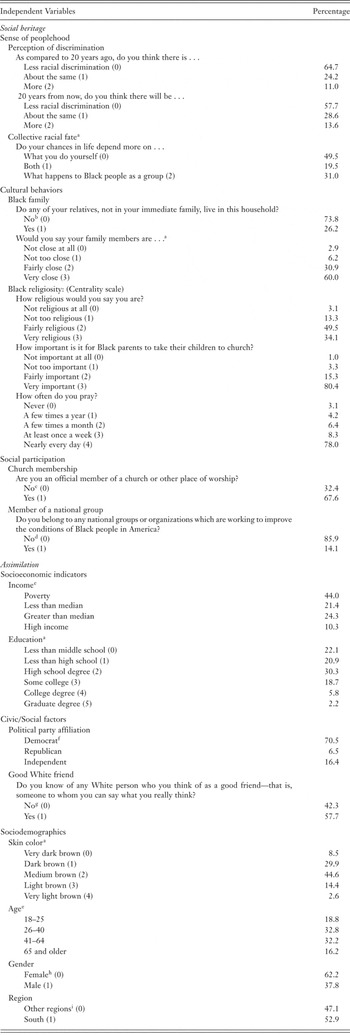
The seven dependent variables are regressed on a vector of independent variables associated with social heritage and assimilation. These categories include: (1) the sense of peoplehood, (2) cultural behaviors, (3) social participation, (4) socioeconomic indicators, (5) civic/social factors, and (6) sociodemographic characteristics. Table 2 displays survey questions/statements, answer selections, codes, and percentage distributions for all independent variables.
Answer Selections, Codes, and Percentage Distributions for the Independent Variables in the 1979–1980 National Survey of Black Americans

a Ordinal variable in analyses
b Reference category for extended family
c Reference category for church membership
d Reference category for national Black-group member
e Continuous variable in analyses
f Reference category for political party affiliation
g Reference category for whether respondent has a good White friend
h Reference category for gender
i Reference category for region
Sense of Peoplehood
The sense of peoplehood is operationalized by three measures:
Perception of discrimination
Recent studies have shown that these beliefs are strongly correlated with African American identity (Dawson Reference Dawson1994, Reference Dawson2001; Shelton and Wilson, Reference Shelton and Wilson2006). Principal component analyses indicate that the two items composing this scale load onto a single factor with an eigenvalue of 1.36 that explains 68.09% of the variance. Scores on the scale range from 0 to 4. The mean score is 1.02, while the standard deviation is 1.16. The Cronbach alpha reliability coefficient for this index is 0.53.
Feelings of closeness
This additive index includes eight items (descriptive data for this item are not displayed in Table 2 so as to preserve space). Respondents were asked: “How close do you feel in your ideas and feelings about things to Black people who are… ? poor, religious, young, middle class, working-class, older, elected officials, professionals.” The answer selections are coded: 0 (not close at all), 1 (not too close), 2 (fairly close), and 3 (very close). Principal component analyses indicate that each of these items load onto a single factor with an eigenvalue of 3.59 that explains 44.93% of the variance. Scores on the scale range from 0 to 24. The mean score is 18.91, while the standard deviation is 4.08. The Cronbach alpha reliability coefficient for this index is 0.82.
Collective racial fate
Gordon first theorized that these beliefs reflect “historical identification” with one's racial/ethnic or religious group (Reference Gordon1964, p. 53). As with Dawson (Reference Dawson1994) and Sniderman and Piazza (Reference Sniderman and Piazza2002), this study utilizes a single-item measure for beliefs about race-based collective destiny.
Cultural Behaviors
Cultural behaviors are operationalized by three items, including two measures of Black family life and one measure of Black religiosity.
Black family
Black scholars have long maintained that the Black family is the “backbone” of the Black community. From slavery to segregation, from the civil rights era to today's postindustrial economy, researchers have called attention to this fundamental feature of Black social heritage, including its extended-family pattern (Frazier Reference Frazier1939; Hattery and Smith, Reference Hattery and Smith2007) and the intensity of its emotional bonds (Hill Reference Hill1972; Suizzo et al., Reference Suizzo, Robinson and Pahlke2008).Footnote 6
Black religiosity
Another distinctive feature of Black social heritage is the centrality of religious beliefs (Ellison et al., Reference Ellison, Boardman, Williams and Jackson2001; Lincoln Reference Lincoln1974; Taylor et al., Reference Taylor, Chatters and Levin2004). The Black church has remained at the forefront of Black social organization for more than 200 years. Through the support of Black families, these institutions and church-related organizations have arguably become the most important vessels for leadership development, advancing Black progress, and enacting change within the Black community (Brown and Brown, Reference Brown and Brown2003; Karenga Reference Karenga1992). Principal component analyses indicate that the three items composing this scale load onto a single factor with an eigenvalue of 1.84 that explains 61.28% of the variance. Scores on the scale range from 0 to 10. The mean score is 8.44, while the standard deviation is 1.82. The Cronbach alpha reliability coefficient for this index is 0.66.
Social Participation
Social participation is operationalized by two items. The first item addresses whether the respondent is a church member. The second item assesses whether the respondent is a member of a national group aiming to improve conditions for Blacks (e.g., the National Association for the Advancement of Colored People, the Urban League).
Socioeconomic Indicators
Socioeconomic indicators are measured by two items: total household income and the respondent's education level.
Civic/Social Factors
Civic/social factors include measures for political party affiliation and friendship networks.
Political party affiliation
Political associations are important to assimilation research because racial/ethnic and religious minorities often develop coalitions with political parties. Since the 1960s, the overwhelming majority of African Americans have remained aligned with the Democratic Party (Dawson Reference Dawson1994, Reference Dawson2001; Gurin et al., Reference Gurin, Hatchett and Jackson1989; Tate Reference Tate1993).Footnote 7
Good White friend
Friendship networks are also important to assimilation research. As opposed to quantity, the variable analyzed here addresses the quality of one's association with a member of the dominant racial group in the United States.
Sociodemographic Characteristics
Finally, the sociodemographic characteristics include various measures for skin color, age, gender, and region of residence.
FINDINGS
Table 1 displays percentage distributions for all dependent variables. These preliminary results indicate that racial socialization messages widely differ. Nearly two-thirds (63.6%) of Black parents discuss Blackness with their children. Moreover, those parents that discuss race matters convey an assortment of messages. The most popular first responses include that being Black means having to work hard (22.1%), being Black means having racial pride (21.8%), and African Americans have a history and heritage (16.6%).
There is also variation in racial socialization to Whiteness. Study participants are nearly split down the middle (48.9%) on whether they discuss Whiteness with their children. Furthermore, parents that have such conversations impart a variety of messages. The most popular first responses include equality with Whites (23.7%), and peaceful coexistence with Whites (16.2%).
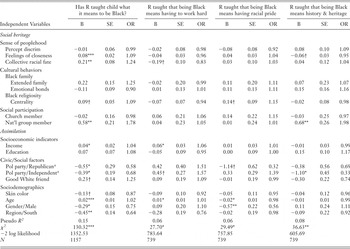
Table 3 displays results from logistic regressions for the determinants of racial socialization to Blackness. These findings indicate that respondents who are strongly committed to Black social heritage are more likely to discuss Blackness with their children. For example, those respondents with heightened feelings of intraracial closeness, those who believe that their life chances depend on Blacks as a group, those with greater religious centrality, and those who are members of national groups aiming to uplift the Black condition are significantly more likely to talk with their children about what it means to be Black, holding all other variables constant. Assimilation trajectories also influence whether parents discuss Blackness with their offspring. As predicted, African Americans with higher incomes are more likely than those with lower incomes to socialize their children to race. Furthermore, Blacks with a non-Democratic political party affiliation (both Republicans and Independents) are less likely to discuss Blackness with their children. Only one significant finding in this model challenges predictions deriving from the investment in Blackness hypothesis: participants with a good White friend are 1.25 times more likely than those who do not have a good White friend to socialize their children to race.
Logistic Regressions for (a) Whether Respondent Taught His/Her Child about What It Means to Be Black? If So, the Most Common Responses Include: (b) that Being Black Means Having to Work Hard, (c) that Being Black Means Having Racial Pride, and (d) that Being Black Means History and Heritage

† p < 0.10;
* p < 0.05;
** p < 0.01;
*** p < 0.001
a Democratic Party reference category; (two-tailed tests)
Table 3 also displays findings for the substantive content of parental messages about Blackness. As beliefs about collective racial fate intensify, respondents are 17% less likely to teach their children that being Black means having to work hard, controlling for all other variables. However, both higher-income earners and respondents claiming an Independent political affiliation are more likely to impart this message. These findings, when considered alongside the results for the previous model regarding racial socialization to Blackness, suggest that when respondents who believe in collective racial fate discuss Blackness with their children, they are less likely to teach them that being Black means having to work hard. In contrast, when higher-income earners and political Independents discuss Blackness, they are more likely to emphasize conventional U.S. values associated with hard work. These findings are consistent with predictions deriving from the investment in Blackness hypothesis.
As for parental messages about racial pride, as religious centrality increases, respondents are 1.15 times more likely to transmit messages regarding individual and group-based self-respect, controlling for all other variables. Conversely, as opposed to those with a Democratic Party affiliation, those claiming a Republican affiliation are 68% less likely to impart this message to their children. These findings, when combined with the results for the initial model concerning racial socialization to Blackness, suggest that when parents who are strong in their faith discuss Blackness, they are more likely to teach their children that being Black means having racial pride. Furthermore, although Black Republicans are less likely to discuss Blackness with their children, when they do, they are less likely to teach them about having racial pride. The results for this model are also consistent with the investment in Blackness hypothesis.
Regarding parental messages about Black history and heritage, as feelings of intraracial closeness intensify, respondents are 5% less likely to transmit this lesson to their children, holding all other variables constant. Political Independents are 67% less likely than Democrats to impart this message. However, members of national groups are nearly twice as likely as nonmembers to teach their children about Black history and heritage. These findings, when considered in tandem with the initial model, suggest that when Independents and those with heightened feelings of intraracial closeness discuss Blackness with their children, they are less likely to teach them about Black history and heritage. In contrast, when members of national groups discuss Blackness, they are more likely to transmit lessons about Black history and heritage. These findings provide mixed support for the investment in Blackness hypothesis. The effect for beliefs about interracial closeness challenges an assumption of this theory.
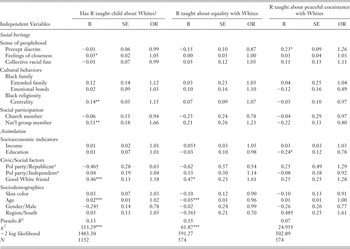
Table 4 displays results from logistic regressions for the determinants of racial socialization to Whiteness. These findings indicate that respondents who are strongly committed to Black social heritage are more likely to discuss Whiteness with their children. For example, those respondents with heightened feelings of intraracial closeness, those with greater religious centrality, and those who are members of national groups aiming to uplift the Black condition are significantly more likely to talk with their children about Whites, controlling for all other variables. As predicted, participants with a non-Democratic political party affiliation (in this case, Black Republicans) are less likely to socialize their children to race. Yet again, however, the effect of having a good White friend challenges a prediction stemming from the investment in Blackness hypothesis: these participants are 1.58 times more likely to discuss Whiteness with their children.
Logistic Regressions for (a) Whether Respondent Taught His/Her Child about Whites? If So, the Most Common Responses Include: (b) Equality with Whites, and (c) Peaceful Coexistence with Whites

† p < 0.10;
* p < 0.05;
** p < 0.01;
*** p < 0.001
a Democratic Party reference category; (two-tailed tests)
Table 4 also displays findings for the substantive content of parental messages about Whiteness. As income increases, respondents are 1.05 times more likely to teach their children about equality with Whites, holding all other variables constant. Similarly, those participants with close friendships with Whites are 1.61 times more likely to impart this message. This finding, when considered alongside the initial results for racial socialization to Whiteness, suggests that when respondents with a good White friend discuss Whiteness with their children, they are more likely to teach them about racial equality. The results of this model support the investment in Blackness hypothesis. African Americans with advanced assimilation trajectories seek to prepare their children for life in the larger society.
As for parental messages about peaceful coexistence with Whites, as the perception of discrimination increases, respondents are 1.26 times more likely to impart this message to their children, controlling for all other variables. This finding suggests that those Blacks with heightened beliefs about interracial hostility do not convey antagonistic lessons about Whites to their children. In contrast, as education increases, participants are 22% less likely to teach their children about peaceful coexistence. The results for this model pose the strongest challenge to the investment in Blackness hypothesis. The effects for education and perceived discrimination counter assumptions deriving from this theory.
Several important supplementary findingsFootnote 8 must be addressed. Across the models under analysis, the results for the sociodemographic characteristics indicate that age, gender, and region of residence impact racial socialization strategies among African Americans. Younger parents, males, and southerners are less likely to discuss race matters with their children. The effects for these measures also drive contrasting parental messages about Blacks and Whites.
CONCLUSION
The multivariate results of this study largely substantiate predictions deriving from the investment in Blackness hypothesis. Assimilation trajectories and commitments to Black social heritage strongly influence the determinants of racial socialization strategies among African American parents. Respondents with a stronger sense of Black peoplehood, those attuned to Black cultural behaviors, and those who participate in Black organizations are more likely to discuss race matters with their children. Moreover, assimilation trajectories confirm the cultural complexities of the contemporary African American experience: higher-income earners and those with a good White friend are more likely to socialize their children to race. However, participants with a non-Democratic Party political affiliation are less likely to do so. These findings suggest that structured variation drives differences in whether parents teach their children about race relations.
Assimilation trajectories and commitments to Black social heritage also influence the substantive content of parental socialization messages. Although these indicators show to be less consistent predictors, there is evidence that they drive contrasting parental messages about particular groups. For instance, African Americans who are strongly committed to Black social heritage tend to impart lessons that cultivate and reinforce Blackness. However, some African Americans with closer connections to the larger society are more likely to emphasize participation in mainstream society. These findings reflect the “tapestry of variegated socialization possibilities” available to Black parents (Boykin and Toms, Reference Boykin, Toms, McAdoo and McAdoo1985, p. 47).
The results of this study corroborate Demo and Hughes' declaration that “being Black means different things to different segments of the Black population” (Reference Demo and Hughes1990, p. 371). African Americans are not a culturally monolithic group. They differ in their commitments to Black social heritage, their awareness and familiarity with the wider American public, and the parental lessons they impart to their children about race relations. This diversity has prompted the emergence of culturally based intragroup tensions. For example, one participant in a recent ethnographic study stated that “it seems to me that a lot of people are all of a sudden defining what Blackness is. Like who's really Black, who's not…. It just doesn't go over well with me” (Tatum Reference Tatum2004, p. 124). Such sentiments—these from an Ivy League female with a privileged socioeconomic background—have become widespread in Black middle-class circles (see Graham Reference Graham1999; Lacy Reference Lacy2004, Reference Lacy2007; Pattillo Reference Pattillo2003). As Gordon (Reference Gordon1964) first theorized, these tensions are a by-product of a minority group's introduction to the U.S. mainstream.
The results of this study are also relevant to the larger debate over assimilation in the United States. African Americans do not appear to be completely “unassimilable.” Even after controlling for beliefs about contemporary racial discrimination, Blacks with advanced assimilation trajectories transmit parental messages that reflect the imprint of the larger society. Generally, these African Americans aim to prepare their children for accessing the mainstream.
However, African American assimilation trajectories are complicated, and do not follow a conventional “straight line” (Gans Reference Gans1979). Classical theory posits that minority group members with high socioeconomic status and close connections to the larger society are less inclined to socialize their children to group identity (Gans Reference Gans1979; Gordon Reference Gordon1964; Steinberg Reference Steinberg1981; Waters Reference Waters1990). The findings presented here do not support this conclusion. Black parents with advanced assimilation trajectories discuss Blackness and Whiteness with their children. However, they do so in order to demystify and empower their offspring to seize opportunities in the larger society.
Future studies of adult commitments to group identity should consider the application of the investment thesis. The fundamental thrust of this theory—that variation across assimilation trajectories drives within-group attitudinal differences—is germane to virtually all racial/ethnic and religious minority groups in the United States. Measures for the sense of peoplehood, cultural behaviors, and social participation can be operationally tailored to fit for nearly all minority groups (depending on the cultural richness of the data source).
Finally, future studies of racial socialization among African Americans should undertake longitudinal analyses of parental messages about race relations. It would be interesting to see whether race-based parental lessons differ across decades. Studies should also conduct intergenerational analyses among family members who came of age (a) before the civil rights movement, (b) before the turn of the twenty-first century, and (c) in the new millennium. Cultural complexity within Black America is becoming deeply rooted. In the meantime, debate over what it means to be Black will remain the subject of conversation from barbershops to board rooms, family reunions to university research centers.