Diverse social identities coexisting within the same society are often viewed as problematic for economic and political development. Diversity is said to provide a focal point for conflict,Footnote 1 poor governance,Footnote 2 low social capitalFootnote 3 and poor economic performance.Footnote 4
Skeptics might argue that cleavages based on ascriptive identities are inconsequential or endogenous. In the latter case, the causal agent is to be found in the factors that trigger the construction and mobilization of particularistic groups at specific times. Even so, few good things are attributed to diversity. This is especially true in the context of the developing world, where diversity is usually regarded as an obstacle to be overcome rather than a resource to be tapped.
For similar reasons, diversity is also generally viewed as problematic for the establishment and consolidation of democratic political institutions. Arguably, social diversity provides the basis for enduring conflicts and clientelistic relationships, which impede the development of more encompassing attachments to the state and nation. It may also pose co-ordination problems for opposition groups,Footnote 5 leading to outbidding.Footnote 6 None of this seems propitious for democracy.Footnote 7
To be sure, social divisions are never impassable, and a good deal of work has been devoted to identifying institutional arrangements that might heal, or at least mitigate, the destructive impact of cleavages grounded in ethnic, linguistic and religious identities.Footnote 8 Some studies suggest a positive view of diversity in specific countries and when certain background conditions are in place, for example India,Footnote 9 Tanzania,Footnote 10 IndonesiaFootnote 11 and Papua New Guinea.Footnote 12 Yet on balance, and ceteris paribus, the consensus seems to be that social diversity has either a negative or – at best – no relationship to democracy.
In addressing this issue, scholars usually regard social identity as a unified concept. At the same time, few would maintain that cleavages grounded in ethnic, linguistic and religious identities are interchangeable. This, in turn, suggests that different types of diversity might have divergent effects. In this study, we argue that religious diversity has a negative impact, and ethno-linguistic diversity a positive impact, on a polity’s propensity to develop and maintain a democratic system of government. In the first section of the article we present the theory and possible causal mechanisms. In the second section, we explore the issue empirically. The final section summarizes the conclusions and discusses the strengths and weaknesses of the theory.
ARGUMENT
We begin with some preliminary matters of definition and scope. The outcome of interest in this study includes elements of democracy that may be summarized as electoral and liberal. Democracy exists to the extent that regular mass suffrage elections are conducted in a free and fair manner and elections govern the selection of top decision makers, who are subject to constitutional constraints including civil liberties.Footnote 13 We regard this as a matter of degrees; countries are more or less democratic in the electoral/liberal sense. (Our use of terms such as ‘regime type’, which seem to suggest crisp categories, should be understood as representing ideal types along a continuum.) Other aspects of democracy, for example deliberation, participation and equality,Footnote 14 are tangential to the argument.
We understand religion as a belief system with supernatural elements that establishes one’s place and purpose in the universe. Religions involve specific rituals that distinguish members from non-members and are generally attached to a clerical organization.Footnote 15 Here, we are primarily concerned with religions that have a formal liturgy rather than with vaguely defined folk practices that are local and informal (for example, animist religions). In the modern world, the former have largely displaced the latter.
We understand ethnicity as a group identity based on descent, in which members of a group share a common history, a common homeland (at least by popular perceptions), and identifiable cultural attributes such as race, language and customs bearing on clothing, diet, coming of age, sex, marriage and death.Footnote 16
These are stylized concepts, as anyone familiar with the subject can attest. As such, they mask a good deal of heterogeneity within categories as well as blurriness in between (for example, modern Judaism within the United States). Nonetheless, religious and ethnic markers are usually distinguishable and rarely coterminous, which suggests the utility of these concepts. A religious group is not the same as an ethnic group, and this may matter to outcomes such as regime type.
Our discussion presumes a social context in which social group identities (religious and/or ethnic) matter – that is, they are identifiable and resonant. This probably describes the entire world a century ago and most of the world today. We do not presume that various religious and ethnic identities remain constant, or are equally salient, over time. Evidently, identities are socially constructed, and as such are inevitably influenced by political, economic and demographic forces and, to some extent, by individual choice.Footnote 17 Nonetheless, in most contexts these identities change slowly and thus may be treated as exogenous over the short term.
In any case, the key causal factor in our argument is not religious and ethnic identity per se; we are not concerned, for example, with the share of Protestants or African-Americans in the United States. Instead we are concerned with the degree of diversity that exists in a society. Importantly, the fact that individuals occasionally change group affiliations, or that groups grow or decline in size and saliency, may have a negligible impact on the overall level of diversity in a nation-state.
One further clarification is in order before we begin. In the literature on ethnicity and religion, violent conflict (for example, riots and civil war) is a common concern and frequent focus of study. It is important to bear in mind in this context that violent conflict is a threat not only to democracy but also to autocracy. In any case, we do not make claims about the role of diversity as a source of violent conflict.
Our theoretical interest is in cultural diversity as a possible cause of regime type. First, we argue that ethnic (but not religious) diversity lends itself to tolerance and compromise and therefore enhances the prospects for democratic rule. Secondly, we argue that ethnic diversity erects barriers to political legitimacy that can only be overcome by democratic institutions. As such, an ethnically diverse society exerts pressure on rulers to diffuse power, lest they lose control over revenue, territory or face challenges to their incumbency.
Why Religious – but not Ethnic – Diversity Might Promote Autocracy
While most work treats cultural difference as a unitary phenomenon (at least implicitly), we argue that religious differences are less amenable to a democratic framework than ethnic differences. Specifically, tolerance and compromise – defining features of any successful democracy – may be harder to achieve across religious lines than across ethnic lines.
Let us begin by considering the role of ethnic diversity. Ethnic norms are rarely invidious because they are parochial rather than universalizing. They pertain to those born into an ethnic group, not to outsiders. It is not (usually) offensive for a member of Group A to view members of Group B eating different foods, speaking a different language, wearing different clothes or enforcing different kin-group norms. How ‘they’ do things has little relevance to how ‘we’ do things. Although the beliefs and behavior of others may seem strange, and perhaps even inferior, they are not blasphemous.
Tolerance across ethnic groups is also fostered by spatial segregation. In rural areas, and even within cities, ethnic groups usually inhabit different territories. As such, practices that one group engages in do not directly impinge upon the practices of another.Footnote 18 Likewise, spatial segregation means that a devolution of power from the center to the periphery may resolve ethnic claims for autonomy without threatening the integrity of the state or the viability of a democratic form of rule – a solution for which India is a well-known case, as discussed below. Indeed, a democratic framework is virtually required if a federal arrangement is to function effectively.Footnote 19
Most important, inter-ethnic conflict tends to involve material goods, for example, property rights, job opportunities and other perquisites. As such, they are amenable to take-a-little/give-a-little compromises. It is possible to split the pie or to pay off all parties so that everyone feels like a beneficiary (even if some obtain more than others) and zero-sum conflicts are avoided. Consequently, ethnic politics often follows a ‘distributive’ logic.Footnote 20
It follows that when a political party or leader representing an ethnic group controls the state, they may be expected to provide extra material benefits to their members. But they would not be expected to impose their way of life on other groups. Moreover, because ethnic politics are usually localized, control of the central state apparatus may have few consequences for those living in the hinterland or in ethnic enclaves within large cities.Footnote 21
One exception is language policy. In a multilingual society, where a single tongue is declared the national language, and where government service and schools are enjoined to use only that language, this is likely to generate strife and may undermine the prospects for democracy. However, language policies are usually realistic: the state rarely attempts to achieve a uniform lexicon unless it can be done with minimal opposition. Thus the usual approach is to accept multilingualism where it cannot easily be overcome.Footnote 22 Because state actors are generally pragmatic when it comes to legislating practices,Footnote 23 diverse languages do not usually pose a barrier to democracy.
Religious diversity, by contrast, does not augur well for the achievement of many democratic virtues. Note that while most ethnic characteristics do not require national-level co-ordination (and hence can be resolved by individual choice or local-level statutes and norms) religious strictures often seem to demand national-level uniformity, and as such are often enshrined in constitutional law or national statute. This is true for religiously sanctioned holidays, dietary laws, special rituals and religious education.
Stepan’s work on ‘twin tolerations’ suggests that a certain level of separation of religion and state is required for democracy.Footnote 24 Unfortunately, in countries where religion is a highly salient divide, the formal separation of church and state is rarely achieved.Footnote 25 This may be because matters of religion are inextricable from matters of politics. When a party or leader representing a religious group comes to power in a religiously diverse society, laws pertaining to education, dress, comportment, dietary practices, the use of inebriants, holidays, inheritance, property rights, family law, the rights and status of women, religious worship and the management of sites deemed to be of special spiritual significance may change in fundamental ways, with deleterious consequences for members of religious out-groups. The latter may even be forced to conceal public expression of their religious beliefs, to convert or to emigrate. (Recent events involving the expansion of the Islamic State in Iraq and Syria demonstrate this pattern starkly.) The repression of minority religions is itself a violation of democratic principles. Even if the government does not pursue a policy of religious persecution, a regime that is solidly identified with one religion may be unacceptable to religious minorities, threatening the achievement of a democratic framework.Footnote 26
This core problem is rooted in differences between ethnic and religious practices, which we now review. First, there is an important difference between an ethnic custom and a moral law. Religions provide ‘cosmologies, moral frameworks, institutions, rituals, traditions, and other identity-supporting content that answers to individuals’ needs for psychological stability in the form of a predictable world, a sense of belonging, self-esteem, and even self-actualization’.Footnote 27 For our purposes, what is important is that the psychological stakes of religion are generally higher than those of ethnicity, and are therefore less prone to compromise when the views of different religions are in conflict. While ‘ethnic’ stakes often concern material goods, religious stakes concern core values and specific rituals.Footnote 28 In a society with religious differences, one must harmonize edicts that are laid down by law and sanctified by centuries of established practice. This is not an easy task, for one religion’s commandments are usually at variance with another’s, and any chosen solution thus serves as an insult to the core values of at least one group. Moreover, the quintessentially political act of compromise may be viewed as corrupt from a fundamentalist context. Thus there may be a tacit affinity between religious diversity and authoritarian rule that does not exist for ethnic diversity, for which ‘split-the-difference’ compromises are the norm. Religious beliefs are also particularly durable. Fox observes that ‘religious identities are more resistant to change than other aspects of identity’.Footnote 29 This may explain why religious conflicts tend to be more violent and intractable than other types of conflicts.Footnote 30
Secondly, religious norms are universalizing; they pertain, in principle, to everyone. One person’s god is, by implication, everyone’s god. Accordingly, it is offensive for a member of Group A to view members of Group B violating Group A’s spiritual norms and ecclesiastical strictures. Blasphemy is blasphemy, regardless of who is committing it. Transgressing a religious law is something that one cannot escape, regardless of one’s descent group or professed religion. It is therefore hard for a political party or leader with religious roots to ignore transgressions and conduct a live-and-let-live policy.
Thirdly, while ethnicity is generally defensive in nature – members seek to maintain their membership, but not to gain new members since membership is based on descent – religion is comparatively fluid. Anyone can convert, which means that religious competition in a plural society is a constant threat to each religion’s existence. Of course, some religions are more proselytizing than others, and attitudes to new converts may change over time. Nonetheless, all religions have experienced a moment of founding. And nearly all religions seek to attract new recruits and guard against apostasy. As such, religions are threatening to each other’s existence. Typically, the state is employed as the agent of conversion and coercion; hence, the importance of state control for creating and/or maintaining religious dominance.
Fourthly, competition among religions is zero sum. While one can be a member of more than one ethnic group (by virtue of mixed parentage) and one can speak more than one language (as most members of multi-linguistic societies do), it is more difficult to claim membership in more than one religion. Syncretism is common, but usually sub rosa and frequently subject to sanction. Consequently, followers of different religions compete not only over resources (as do ethnic groups), but also over members. This means that groups based on religion have clearer boundaries than those based on ethnic or linguistic ties. If mobilized for political purposes, these boundaries may not be conducive to democratic rules.
Finally, religious fractionalization is likely to enhance, rather than mitigate, religiosity within a society. Note that religious monopolies throughout the world are often characterized by the lax provision of religious services and a religious establishment that makes few demands on its members, which contributes to the slow secularization of society. By contrast, religious diversity is often thought to generate a competitive environment in which organized religions work hard to maintain and increase their flocks and to overcome free-riding by demanding strict adherence to the faith. As a result, overall religiosity may be enhanced and may become more fundamentalist.Footnote 31 Religious fractionalization, then, may increase the salience of religious divisions, making democracy more difficult to manage.Footnote 32
For all these reasons, we expect that religiously diverse societies will have a harder time establishing and maintaining a democratic form of rule than religiously homogeneous societies. We should acknowledge that the latter include theocracies such as present-day Iran or England under Henry VIII, neither of which is regarded as a hallmark of democratic practice (though Iran is more democratic than most countries in the region). However, we argue that the chances of transitioning are greater when a single religious tradition is widely shared in a nation-state than when it is not. Where one god is paramount, religion is apt to be depoliticized over time, and the stakes of politics lowered. Political compromise will be easier because religious differences are not present; there is no need to enlist the state apparatus to repress religious minorities, and there are no religious minorities to be offended by the religious overtones of state policy.
Consider that a democratic regime requires agreement on certain fundamentals, which are usually integrated into a country’s constitution. Religion is one such fundamental. Rarely, if ever, do countries agree to the separation of church and state, as we have observed.Footnote 33 Thus when there is a significant religious minority, the constitution of the state is apt to be contested. By contrast, language is the only constitutional issue implied by ethnicity, and it is easier solved by multilingualism – perhaps in conjunction with a territorial devolution of power – than the parallel solution of multi-religiosity.
Why Ethnic Diversity Might Promote Democracy
We have argued that religious – but not ethnic – diversity may promote autocratic outcomes. In this section, we will argue that ethnic (but not religious) diversity may promote democratic outcomes.
We begin with the assumption that many citizens in societies with ethnic divisions have a corporate view of citizenship. That is, they perceive their rights and interests from the perspective of the group they identify with.Footnote 34 For these citizens, political legitimacy flows from the political power their group enjoys. If this group controls the state, or is at least represented in the policy-making process – for example, it has a seat at the table where decisions are made, is able to exercise a veto or is protected from abuse by institutions such as an independent judiciary – members of that ethnic group are likely to view state authority favorably. Accordingly, they will feel comfortable delegating power to the state, or at least will not actively resist its dictates.
Yet if their group is excluded from the policy-making process and has no means of forestalling or redressing unfavorable decisions, they are likely to regard the state with hostility. They may view even routine acts of revenue extraction, policing and military deployment with suspicion. The ruler who orders such activities is likely to be perceived as ‘one of them’ rather than ‘one of us’.Footnote 35 Mistrust will be widespread, and this makes governing hard. It may enhance noncompliance with revenue collection and other state directives and, at the extreme, may lead to rebellion, assassination attempts or coups d’état.
To clarify, we are not claiming that inclusion is the only source of political legitimacy or that legitimacy is required for regime survival. Instead, we argue that inclusion is only one source of legitimacy, and that legitimacy (and the trust that flows from it) is one factor in regime survival.Footnote 36
We assume, secondly, that it is difficult – perhaps even impossible – for autocratic governments to accord meaningful inclusion to a wide range of ethnic groups because autocratic rule is, by definition, controlled by a single person or a very small clique. As such, it does not provide a mechanism for representing diverse groups or constraining the power of the sovereign.Footnote 37 To be sure, there may be legislatures, counsels, parties and informal channels of communication that may be fashioned explicitly to include out-groups. However, the sovereign is unable to make a credible commitment to guarantee the rights of such groups for the same reason he or she is unable to guarantee property rights into the future: promises made today may be broken tomorrow.Footnote 38
A democratic regime, by contrast, is capable of instituting meaningful power-sharing arrangements and establishing institutional checks – for example, federalism, independent courts, multi-party competition and a viable constitution – that serve to include and protect minority groups. This does not mean that all democratic regimes are zealous in preserving minority rights, but it does mean they perform a better job of this, on the whole, than autocratic regimes, and that they have mechanisms for ensuring credible commitment.Footnote 39 Accordingly, Gurr finds that democracies tend to outperform autocracies in their management of potential ethnic rebellions, as nonviolent protest becomes a viable alternative to violent conflict.Footnote 40
With these assumptions in place, we can envision how the character of society might interact with the character of a regime. In a relatively homogeneous society, both autocracies and democracies will be viewed as legitimate insofar as the overwhelmingly dominant ethnic identity is likely to be (almost out of necessity) in control of the state apparatus. In a heterogeneous society, by contrast, only a democratic regime is capable of establishing legitimacy throughout the population, for there is no opportunity for multiple groups to be represented at the slender apex of an autocratic government. In heterogeneous societies, therefore, democratic regimes enjoy an advantage. And the more heterogeneous the society, the greater this advantage appears to be, for the dynamic we have sketched becomes more acute the greater the fractionalization of society becomes.Footnote 41 (The in-group in charge of the autocratic state will be smaller and the out-groups excluded from power will be larger in number.)
Put differently, it is easier for an autocrat to extract taxes, keep order and protect borders in a country that perceives itself as unified around a single ethnic identity. There are fewer tensions to salve, fewer insecurities to reassure and fewer problems of legitimacy.Footnote 42 Consequently, the ruler of a homogeneous society may have fewer incentives to share power than the ruler of a heterogeneous society. Ethnic diversity may thus exert pressure to achieve a more democratic system of rule because problems of legitimacy are more severe in a diverse society, and can only be handled successfully over the long term by limiting the concentration of power at the apex.
Yet ethnic diversity also impedes co-ordination among out-groups, which may work to the autocrat’s advantage. However, the sort of opposition we are imagining does not require a united front; it may be exercised piecemeal, territory by territory, with each group mobilizing only on its own turf. Few autocrats are in a position to impose a military solution on all minority groups, which means they will have to make peace with at least some of those groups, paving the way for partial power sharing – a pattern that may later be extended to other groups. Alternately, if the autocrat refuses to devolve power, this refusal may lead to a violent overthrow of the regime. Whether gradual or sudden, a democratic transition is more likely to occur when the social base is diverse rather than homogeneous.
An Illustrative Case: India
The case of India may help illustrate the divergent impact of religious and ethnic diversity on regime type and the quality of democracy. India’s success at maintaining a democratic form of rule since independence in 1947 is sometimes regarded as surprising in light of the country’s extreme diversity.Footnote 43 Others see the matter differently. Hardgrave writes, ‘democracy is sustained because there is no single, monolithic, and permanent majority, but rather a shifting series of ruling coalitions made up of minorities’.Footnote 44
For our purposes it is significant that India’s ethnic diversity far outstrips its religious diversity. It has 1,635 languages (according to the 2011 census) – and no single national language – and over 200 tribal groups (according to the constitution), making India one of the world’s most ethnically diverse countries. Although there are many religions, two account for most of the country’s citizens: Hinduism (over 80 per cent of the population) and Islam (about 13 per cent). (We leave aside caste identities since this species of social group does not correspond neatly to ethnic or religious categories; while the caste system originated from Hindu theology, it is also present in Muslim and Christian communities.) In this light, India’s early transition to democracy and subsequent consolidation fits our theory well (Horowitz makes a similar argument).Footnote 45
Likewise, a perusal of the literature on democracy and conflict in India suggests that religious cleavages have been more threatening to democracy than ethnic cleavages.Footnote 46 Studies of inter-communal conflict in India focus on Hindu-Muslim violence rather than Hindu-Hindu inter-ethnic violence.Footnote 47 Likewise, various ‘hiccups’ in the history of India’s post-war democracy have generally centered on religious rather than ethnic differences. Despite obstacles coming from ethno-linguistic conflict in the years following independence and fears that such obstacles would doom Indian democracy,Footnote 48 India’s consociational system has largely managed to preserve democratic stability since its establishment.Footnote 49 While the devolution of powers and political compromise have cooled tensions between ethnic and linguistic groups, the same cannot be said for religion; hostility between groups remains high. This hostility, in turn, has proven threatening to Indian democracy in several instances. Indira Gandhi’s 1984 military operation against the holiest Sikh shrine, the Golden Temple, increased Hindu–Sikh tensions and led to her assassination at the hands of her Sikh bodyguards.Footnote 50 The demolition of the Babri Masjid in 1992 led to widespread rioting, the deaths of 2,000 people and a series of terrorist attacks. The 2002 Gujarat riots led to similar results and incited fear of an end to India’s secular system.Footnote 51 Recently, Narendra Modi’s election to the premiership has stoked concern about Muslim rights and sectarian coexistence. Varshney affirms that the nature of local diversity in India has allowed ethnic divisions to be overcome, and that ‘the only cleavage that has the potential to rip India apart is the divide between Hindus and Muslims’.Footnote 52
Thus, a schematic reading of India’s post-independence history suggests that ethno-linguistic divisions have proven surmountable, and have perhaps even exerted a favorable effect on Indian democracy insofar as they have encouraged a diffusion of power from the center, preventing any single clique from monopolizing power. Ethnic separatism can be contained by consociational arrangements, particularly when ethno-linguistic groups are territorially concentrated, as in India.Footnote 53 Religious divisions, by contrast, continue to bedevil the world’s largest democracy. This helps illustrate our argument that ethnic tensions are frequently tractable and amenable to compromise within a democratic framework while religious tensions are not, or are less so.
EMPIRICS
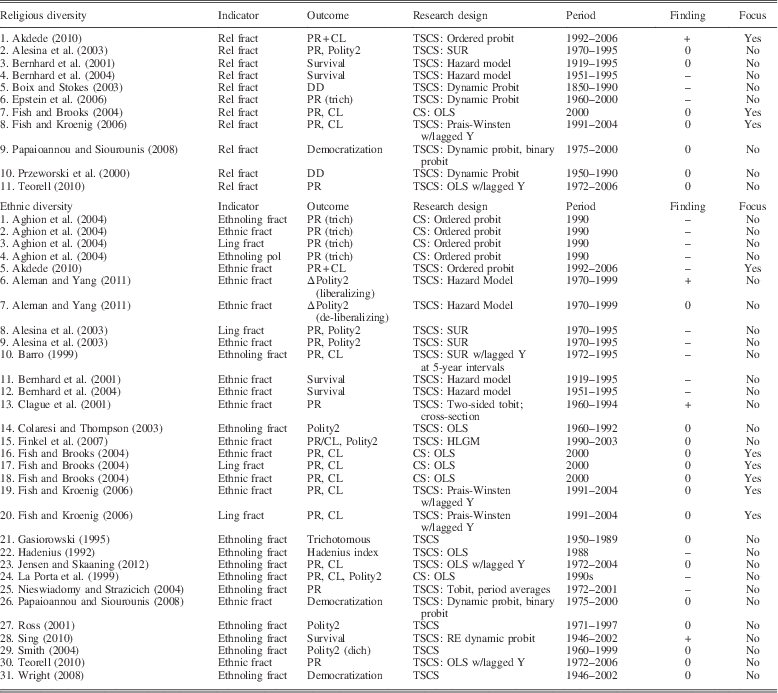
Recent empirical work on our topic consists largely of cross-national regression analyses. Table 1 summarizes twenty-seven studies, incorporating forty-two analyses for which some measure of ethnic or religious diversity is on the right side of a causal model and some measure of democracy is on the left side. As one might expect, these studies employ a variety of formats. Social group identity may be coded on the basis of religion, ethnicity (narrowly construed), language, or some combination of ethnicity and language. Because ethnic and linguistic practices tend to overlap – both empirically and conceptually – these are grouped together as measures of ethnic diversity (broadly construed). Diversity may be measured using a fractionalization index or, occasionally, as polarization. Most samples center on the contemporary era, while a few extend back further in time. A variety of estimators are employed.
Extant Cross-national Studies

Units of analysis = countries or country-years; Outcomes = outcome measures of democracy; Finding = diversity has a negative (–), positive (+) or null/mixed (0) relationship to democracy; Focus = the main focus of the study; Y = dependent variable; CS = cross-section focused on a single year; TSCS = time-series cross-section; SUR = seemingly unrelated regression; RE = random effects; HLGM = hierarchical longitudinal growth modeling; PR = political rights (Freedom House); CL = civil liberty (Freedom House); Polity2 = composite democracy/autocracy variable (Polity IV); Homog = homogeneity;.Heterog = heterogeneity; Ling = linguistic; Rel = religious; Fract = fractionalization; Pol = polarization; Dich = dichotomous; Trich = trichotomous.
While the results summarized in Table 1 are not exactly comparable, they offer a sizeable body of work to reflect upon. Of eleven analyses testing religious diversity, one shows a positive relationship to democracy, three show negative relationships, and the rest fail to reject the null hypothesis or report mixed results. Of thirty-one analyses testing ethnic or linguistic diversity, three report a positive relationship to democracy, thirteen report a negative relationship and the rest fail to reject the null hypothesis. Overall, these analyses seem to confirm the standard view of our subject: that diversity has a negative or null effect on prospects for democracy.
Nonetheless, there are reasons to be skeptical of extant work on this subject, and of the predominant ‘null’ finding. First, many studies employ a binary or trichotomous measure of democracy, often with the goal of testing whether right-side factors induce movements toward a democratic regime type.Footnote 54 While this is a plausible operationalization of democracy and an interesting substantive question, it also constrains variation in the outcome in ways that probably favor a null result. If regime type is dichotomized, one cannot measure important differences of degree. Note that both Papua New Guinea and Sweden are classified as democracies in most binary indices, despite variation in the quality of democracy in these two (democratic) nation-states.
Secondly, the specifications and estimators used in extant studies are not always appropriate for testing this hypothesis. In particular, we note the frequent absence of important control variables such as democratic diffusionFootnote 55 and the occasional inclusion of covariates that may be endogenous to diversity (thus introducing post-treatment confounding). For example, Aleman and Yang include covariates measuring inequality, military regime, coercive capacity, anti-government demonstrations, armed insurrections and general strikes – each of which may be affected by a country’s level of social diversity.Footnote 56
Thirdly, none of the studies reviewed presents extensive robustness tests focused on various ways of modeling the relationship between social diversity and regime type. Most present only a single table of results.Footnote 57
Fourthly, studies often focus on a single year or a very short panel, which raises questions of representativeness.Footnote 58 Results that seem to hold for one year or decade may be different for another; after all, the status of regimes has changed considerably over the past half-century. It is especially problematic if the author is attempting to interpret changes toward democracy in a very short time series and without any change in the independent variables of theoretical interest.Footnote 59
Finally, no study measures changes in religious or ethno-linguistic diversity over time or includes instruments for cultural diversity. This is perhaps the most important shortcoming of extant empirical work on the subject.
Thus although many cross-national studies of democracy have included a covariate measuring some aspect of religious or ethno-linguistic diversity, few have explored the topic in much detail. This is because most of these studies are about other theoretical questions, as signaled in the final column in Table 1. Only three of the studies reviewed here focus on the impact of cultural diversity on democracy.Footnote 60 In the other twenty-four studies, these factors serve as control variables. It would be gratuitous to criticize authors for incorrectly, or incompletely, analyzing a topic of peripheral concern. Thus we turn to our own analysis, which may constitute the first in-depth examination of the combined effect of religious and ethnic diversity on regime type.
Assumptions about the Data-Generating Process
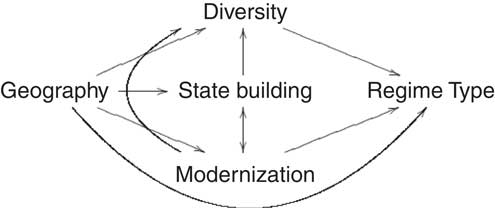
Before beginning, it is important to describe our assumptions about the data-generating process that underlies patterns observable at the national level. Our simplified account, diagramed in Figure 1, recognizes one entirely exogenous structural factor (geography), three institutional factors (modernization, state building and diversity) and the outcome of interest (regime type).
A historical reconstruction of the data-generating process

Geography is regarded as a prime mover. Some geographic factors impact regime type directly and may also affect diversity; we hope to condition these common-cause confounders in subsequent analyses. Other geographic factors affect diversity and perhaps state building and – via these factors – regime type. These are used as instruments in the two-stage analysis of ethnic diversity. Modernization, understood as the combined processes of economic development and urbanization, is regarded as a cause of diversity, state building and regime type.
State building is also regarded as an important influence on diversity. If states build nations and national identity is the primary alternative to religious or ethnic identity, then the extent to which subnational identities survive represents the extent of failure of a state-building process.Footnote 61 However, we do not believe state building has a direct influence on regime type; we assume that any such influence is registered through diversity or economic growth. Of course, this is a difficult matter to test, as we lack good measures of state capacity. However, proxy variables such as the date of state formation, the date of independence or measures of state historyFootnote 62 show no relationship to regime type once relevant covariates (such as per capita GDP) are taken into account.
This causal diagram informs subsequent conditioning strategies, which unfold in five stages: (1) initial tests using benchmark measures of religious and ethnic fractionalization and the Polity2 measure of democracy, (2) alternate measures of democracy,Footnote 63 (3) alternate measures of diversity, (4) an instrumental variable (IV) analysis of ethnic diversity and (5) additional robustness tests.
Initial Tests
Our baseline measure of religious fractionalization is drawn from Alesina et al., who classify religions prominent in each country from entries in the Encyclopedia Britannica.Footnote 64 With these categorizations, along with evidence of the size (share of population) of each religion, they construct a measure of country-level diversity using the well-known Herfindahl index,
 $$Fract_{j} \,{\equals}\,1{\minus}\mathop{\sum}\limits_{i\,{\equals}\,1}^n {s_{{ij}}^{2} }, $$
where s ij is the share of group i in society j (1 minus the summation of each group’s proportion of the total in a given country, squared.) The resulting index, which varies from 0 to 1, approximates the probability that two randomly chosen individuals within a society are members of different groups – a highly intuitive interpretation of what it means to live in a diverse society. A histogram of scores shows a fairly even distribution of values across the index (see Figure A1). Note that while there are several alternative measures of religious diversity (see Table 4), none are used as widely as the Alesina et al. index.Footnote 65
Our baseline measure of ethnic diversity is drawn from the Ethnic Power Relations (EPR) dataset developed by Lars-Erik Cederman, Brian Min and Andreas Wimmer.Footnote 66 This is the first dynamic and relatively comprehensive measure of ethnicity, comprising all politically relevant ethnic groups (N=733) in every sizeable country of the world from 1946 to 2005. An ethnic category is regarded as politically relevant ‘if at least one significant political actor claims to represent the interests of that group in the national political arena, or if members of an ethnic category are systematically and intentionally discriminated against in the domain of public politics’.Footnote 67 Countries are coded annually by regional and country specialists and verified by independent research and extensive deliberation.Footnote 68 On the basis of the EPR’s identification of ethnic groups and their relative share of each country’s population, the authors construct a measure of ethno-linguistic fractionalization using the Herfindahl formula. The resulting fractionalization index shows a relatively smooth distribution of observations across the sample with the exception of a mode at 0, where 21 per cent of the observations stack up (see Figure A2). Eighty per cent of the countries in our sample show some variation over time.
Our baseline measure of electoral-liberal democracy is the Polity2 variable drawn from the Polity IV database.Footnote 69 Whatever its flaws, Polity2 remains the industry standard and offers fairly comprehensive coverage of the period of interest. Missing data for micro-states is imputed using the Freedom House Political Rights Index. The Polity2 scale is then transformed to a 0–100 scale (100=most democratic) in order to facilitate comparisons with other indices.
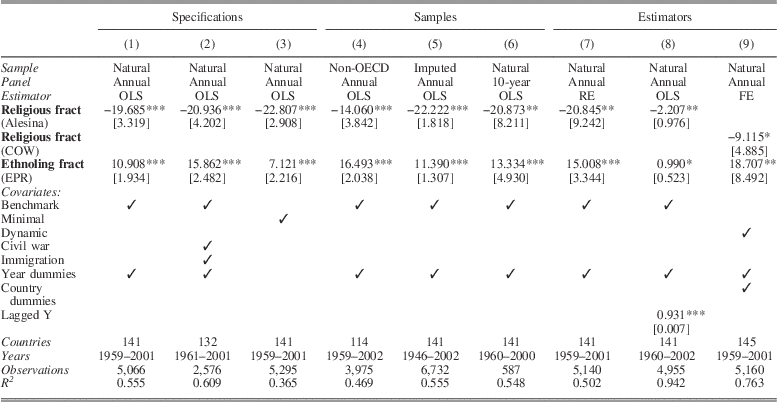
In the following tests, shown in Table 2, coefficients and standard errors are typically displayed only for the variables of theoretical interest (complete results for the benchmark model are shown in Table A5). Definitions and sources for all variables are included in Table A1 and descriptive statistics in Table A2.
Initial Tests

Outcome: Polity2 (Polity IV database), 0–100 scale; Benchmark covariates: GDP per capita, urbanization, diffusion, population, English legal origin, European language, Muslim, Protestant, oil production, land area, landlock, latitude, island, Africa, Asia, Latin America, Middle East, West Europe; Minimal covariates: latitude, island, diffusion, Muslim, Protestant; Dynamic covariates: GDP per capita, urbanization, diffusion, oil production; Estimators: OLS: ordinary least squares with Newey-West standard errors and AR(1) autocorrelation); RE = random effects; FE = fixed effects. ***p<0.01, **p<0.05, *p<0.10 (two-tailed tests). Right-side variables are lagged by one period.
In Model 1, Polity2 is regressed against our chosen measures of religious and ethnic diversity along with a large number of covariates drawn from the literature on democratization. This set of potential confounders includes: GDP per capita (natural logarithm), urbanization, diffusion (the average of Polity2 scores for all other countries weighted by the inverse of their distance), population (natural logarithm), English legal origin (dummy), European language (percent speaking), Muslim (percent), Protestant (percent), oil production (per capita), land area (natural logarithm), landlock (dummy), latitude (distance from the equator, natural logarithm), island (dummy) and dummies to represent various regions of the world (Africa, Asia, Latin America, Middle East, West Europe). We also include annual dummies to model possible trend effects. The estimator is an ordinary least squares estimator with Newey-West standard errors, incorporating a one-period lag structure to model autocorrelation.Footnote 70 This benchmark test assumes a predominantly cross-sectional format because the key independent variables are either time invariant (religious diversity) or sluggish (ethnic diversity).
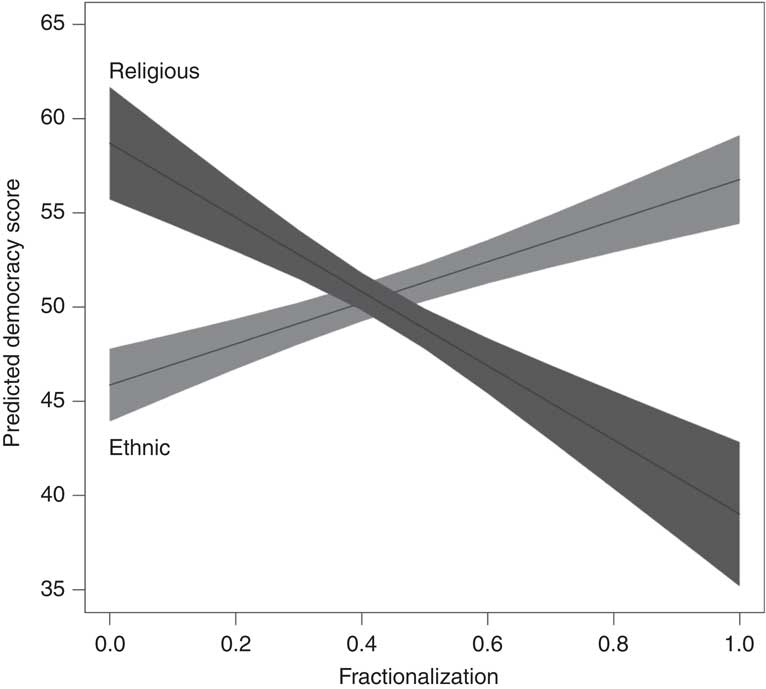
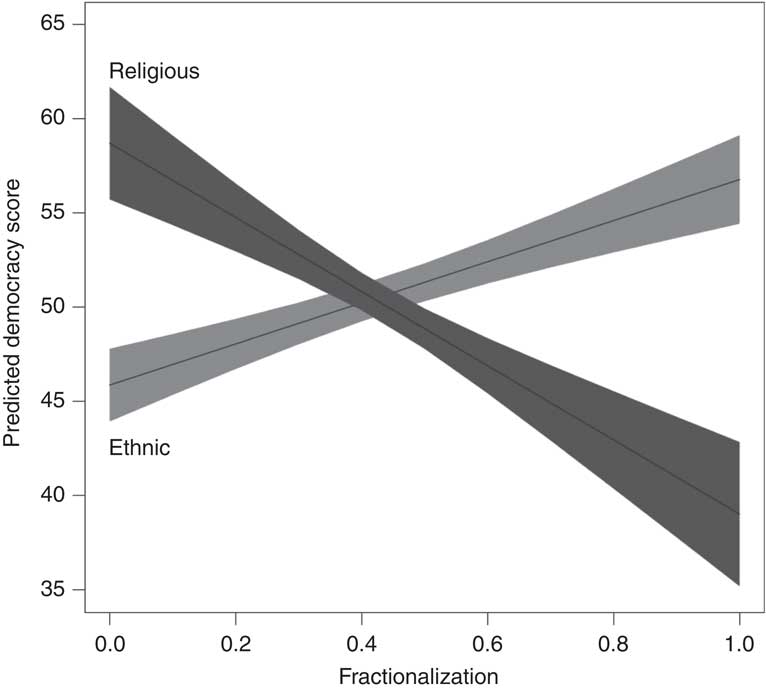
Evidently, many factors other than ethno-linguistic diversity affect a country’s regime type, and some of the action may be entirely stochastic (unexplainable in generalizable terms). It is not surprising, therefore, that diversity has only a modest estimated impact on regime type. Using the coefficients reported in Model 1, Table 2, along with the descriptive statistics reported in Table A2, we can see that a one-standard-deviation increase in religious fractionalization implies a five-point decrease in democracy (recall that Polity2 has been transformed to a 100-point scale), while a one-standard-deviation increase in ethnic fractionalization implies a 3.4-point increase in a country’s predicted level of democracy. Figure 2 illustrates the predicted effects for each level of religious and ethnic fractionalization. As suggested by our theory, the estimated lines cross each other.
Predicted democracy scores, by fractionalization Note: predicted scores from the benchmark model (Model 1, Table 2). Shaded regions indicate 95 per cent confidence intervals.
These are not trivial effects. Insofar as one may judge the significance of a predictor on the basis of standardized coefficients, they are comparable to (or greater than) many other structural (distal) factors that are commonly thought to influence regime types including Muslim, urbanization, population, diffusion, latitude, landlock, island, land area, Protestant, European language, oil production and dummies representing each major region of the world (Africa, Latin America, Western Europe, Asia, Middle East). Indeed, only two covariates – per capita GDP and English legal origin – show substantially greater predicted effects in our benchmark model (see Table A5).
Our next test probes potential endogeneities in the relationship between regime type and diversity. Specifically, if autocracies are successful at repressing religious and ethnic minorities, those identities may be submerged (at least in official statistics) or the groups may be forced into exile.Footnote 71 Likewise, if migrants are attracted to more open, democratic societies, then immigration decisions may be influenced by regime type.Footnote 72 These factors would introduce bias into our analysis, producing a spurious correlation between ethnic fractionalization and democracy.
Of course, biases in the other direction may also exist. A more open, democratic society may encourage the blending of ethnic groups and the loss of identity and consequent homogenization of society. In this narrative, acceptance depresses fractionalization while repression enhances it.Footnote 73 The dynamics of political competition may also lead to a merging of ethnic groups so that overall levels of ethnic fractionalization decline.Footnote 74
Likewise, it might be argued that cross-country migration is overwhelmingly driven by economic factors or coercion, in which case regime type is incidental. It is important to bear in mind that involuntary movements of population via slavery, indentured servitude or penal colonies account for much of the present-day ethnic diversity within countries around the world that have large non-indigenous populations.Footnote 75 Regime type was not at play in these migrations.
Controlling for such trans-historical factors in our analysis is not easy. However, a good proxy for state repression is provided by the Wimmer and Min dataset, from which we derive a variable (Civil War) that counts the number of ethno-nationalist civil war years experienced in the country between 1816 and the year of observation.Footnote 76 This is included in Model 2. Since ethno-nationalist civil wars are the most likely context for religious and ethnic cleansing, controlling for their frequency should account for the possibility that autocracies are successful at reducing religious and ethnic diversity through active suppression.
With respect to the force of immigration, it should be noted that neither the Alesina et al. nor the EPR datasets include recent immigrants in their calculation of diversity. Even so, we must reckon with possible longer-term (second-generation) effects of immigration. Thus, Model 2 includes an estimate of net immigration levels (per capita), which is calculated by counting the number of births and deaths as well as net population change in each country-year, then subtracting the net population changes caused by births/deaths from the total net population change. This estimation strategy provides a reasonable approximation of the net immigration level in a country-year (immigration).
Model 2 adds variables measuring civil war and immigration to the specification. It shows that the estimated coefficients for religious and ethnic fractionalization are slightly higher than in our benchmark model, suggesting that neither factor serves as a confounder in the analysis.
Model 3 adopts a minimal specification – including only latitude, island, diffusion, Muslim and Protestant – in order to avoid potential post-treatment biases by excluding covariates that might be affected by diversity. For example, if diversity affects long-term economic performance,Footnote 77 and economic development affects democracy,Footnote 78 then including per capita GDP on the right of the model will bias the estimated effect of diversity on democracy. Specifically, the positive effect of ethnic diversity on democracy may be spurious. Reassuringly, the estimated coefficients for our two measures of diversity are only slightly affected by this alternate specification.
The next set of tests explores variations in the sample. Model 4 is focused on non-OECD countries, where one might imagine the salience of religious and ethnic identities is higher and therefore more relevant to shaping political institutions. The coefficient for ethno-linguistic fractionalization is somewhat stronger in this model, while the coefficient for religious fractionalization is slightly weaker vis-à-vis the benchmark.
Model 5 imputes a full sample of sovereign countries from 1946–2002 using multiple imputation.Footnote 79 Although the sample size jumps by nearly 2,000 observations, the estimated coefficients for variables of theoretical interest are nearly unchanged relative to the benchmark.
Model 6 aggregates data at ten-year intervals so that the panel is decadal rather than annual. Here, the sample drops precipitously but the coefficients of interest remain stable (though with higher standard errors, as expected).
The final set of tests in Table 2 explores a different set of estimators. Model 7 adopts a random-effects model. Predictably, the coefficient for ethnic diversity (which exhibits change over time) is enhanced, while the coefficient for religious diversity (which is static) is virtually identical.
Model 8 includes a lagged dependent variable (LDV) on the right side of the model, along with year dummies, an approach to panel estimation that may block potential confounders and correct for temporal dependence in the data.Footnote 80 Though the estimated relationships between fractionalization and democracy are somewhat weaker in the LDV specification (judging by t statistics), long-term effects (judging by the coefficient and its relationship to the lagged outcome) are comparable to the benchmark model.
Model 9 adopts a fixed-effect estimator, including only dynamic covariates (per capita GDP, urbanization, diffusion and oil production) and year dummies. For this analysis, we adopt the Correlates of War (COW) measure of religious fractionalization, the only measure that varies over time. These analyses must be approached cautiously, as both the right-side variables of theoretical interest are sluggish and temporal patterns in the relationship with democracy over the observed period may be difficult to distinguish from background noise. Because of the rare-events nature of the independent variables, these results are sensitive to the inclusion or exclusion of countries that exhibit great temporal variation in religious or ethno-linguistic diversity. Likewise, we cannot rule out the possibility that changes in left- and right-side variables are driven by confounders or affected by X/Y endogeneity. Even so, fixed effects minimize threats to inference stemming from model specification. Specifically, by focusing attention on dynamic factors, a longitudinal analysis with country fixed effects requires only that we identify factors that (a) change during the sample period and (b) affect both X and Y. This is a much simpler specification problem than that encountered by models of spatial variation with a non-random treatment. Reassuringly, the results for key variables estimated from the fixed-effects model are robust.
Tests displayed in Table 2 offer strong corroboration of our overall argument. Religious fractionalization is negatively correlated with democracy, and ethno-linguistic fractionalization is positively correlated with democracy in all models. Although estimated coefficients are not stable – as one would expect when different specifications and estimators are employed – they retain statistical significance at standard threshold levels.
Alternate Measures of Electoral-Liberal Democracy
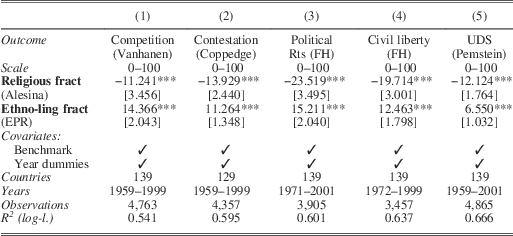
In Table 3, we replicate the benchmark model (Model 1, Table 2) using several alternate measures of democracy. Model 1 employs the Competition variable from Vanhanen, which relies primarily on the pattern of vote shares across incumbents and challengers – specifically, 100 minus the percent votes won by the largest party in presidential or parliamentary elections (or both, averaged).Footnote 81 Model 2 employs a summary index of Contestation constructed by Coppedge, Alvarez and Maldonado.Footnote 82 This index represents the first component generated by an exploratory principal components factor analysis including a wide variety of contemporary democracy indicators. Model 3 employs the Political Rights Index from Freedom House, which is based on expert judgments intended to incorporate a variety of considerations.Footnote 83 Model 4 employs the Civil Liberties Index from Freedom House, which is also based on expert judgments, but is focused on the extent of free speech, free assembly and human rights.Footnote 84 Model 5 employs the Unified Democracy Score from Pemstein et al., which is derived from a Bayesian latent variable model including a large number of democracy indicators.Footnote 85 All indices are transformed to a 100-point scale (100=most democratic) so they are directly comparable.
Alternate Measures of Electoral/Liberal Democracy

Benchmark covariates: GDP per capita, urbanization, diffusion, population, English legal origin, European language, Muslim, Protestant, oil production, land area, landlock, latitude, island, Africa, Asia, Latin America, Middle East, West Europe; Estimator: OLS with Newey-West standard errors and AR(1) autocorrelation. Right-side variables are lagged by one period. UDS = Unified Democracy Score. ***p<0.01, **p<0.05, *p<0.1 (two-tailed tests).
These alternate measures of democracy are highly correlated with each other, and with Polity2. In this light, it is no surprise that the relationships uncovered in Table 2 persist. Religious fractionalization is negatively correlated with democracy, and ethnic fractionalization is positively correlated with democracy, and both relationships pass high thresholds of statistical significance in all tests (p<0.01).
Note that all of the measures of democracy tested in Table 3 are consistent with the dominant electoral-liberal conception of democracy, which defines the bounds of our inquiry. We do not test other aspects of democracy such as participation or inclusion because we have no reason to suppose that ethnic diversity is related to these outcomes. Indeed, the research suggests that social diversity may depress voting and other forms of political and civil activity.Footnote 86
We also exclude binary measures of democracy.Footnote 87 This approach to measurement is highly reductive (reducing all features of democracy to 0/1 coding) and in some respects arbitrary (insofar as the results hinge on the index’s chosen threshold), and thus seems neither theoretically nor empirically compelling in the present context.Footnote 88
Alternate Measures of Diversity
Religious and ethnic identity are difficult to define and operationalize, as emphasized in our previous discussion. Mathematically, diversity may refer to (a) the total number of different group identities in a population, (b) the range separating the most divergent groups, (c) the share belonging to the largest group (a ‘homogeneity’ index), (d) the degree to which cleavages align so as to create two equally sized groups (a ‘polarization’ index) or (e) the overall distribution of groups (a ‘fractionalization’ index).Footnote 89 (Naturally, there are other possibilities, but these seem to be the most common understandings in everyday speech and in the academic literature.)
Most measures of ethno-linguistic diversity focus on fractionalization, implemented through the Herfindahl formula. However, there are other options that may be useful for certain analytic purposes. And of course there are many ways to code religious and ethnic identity within a given society, even if one is working with the same general definition of the concept. Thus it is no surprise to find a plethora of different variables that all purport to measure some aspect of diversity.
Twenty-one of these measures are broad enough in coverage and empirically distinct enough to justify inclusion in our analysis. Details about the construction and sources for each indicator are provided in Table A1 and descriptive statistics are shown in Table A2. A correlation table including all measures is included in Table A3. The correlations between our chosen indicators of religious and ethnic diversity and alternate measures of these concepts are quite strong.
In order to further probe inter-relationships among these indicators, we conduct a principal components factor analysis with an imputed dataset including all sovereign countries and a sample extending from 1960–2001. This analysis, shown in Table A4, reveals that most measures of ethno-linguistic diversity cohere closely to a single dimension, which explains nearly 60 per cent of the variance. Likewise, indicators of religious diversity cohere with each other, producing a common factor that explains 21 per cent of the variance across our sample. (The lower prominence of religious fractionalization is simply a product of the smaller number of religious fractionalization measures included in our sample, which in turn is a product of the greater attention scholars have bestowed upon ethnic diversity relative to religious diversity.) We use this analysis to construct summary indices of ethnic fractionalization (Component 1) and religious fractionalization (Component 2), which are added to our list of extant indices.
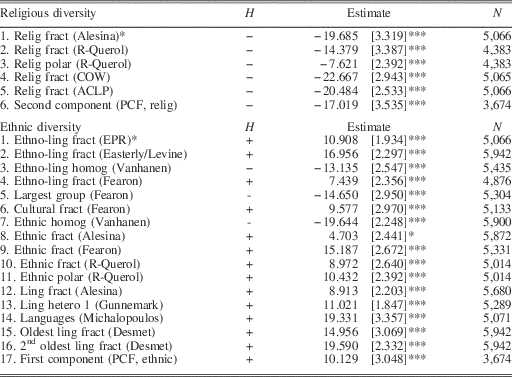
Each of these twenty-three alternative measures is tested, seriatim, in our benchmark model (Model 1, Table 2). The results for the key variables of theoretical interest are displayed in Table 4. In order to retain a consistent time period, we restrict this set of analyses to the 1970–2000 period, which is shorter than the analyses in Table 2, because most fractionalization indices are based on the Atlas Narodov Mira or later sources.Footnote 90 Because country coverage varies, sample size also varies, as indicated in the final column.
Alternate Measures of Diversity

Outcome: Polity2 (Polity IV database), transformed to 0–100 scale; Benchmark covariates: GDP per capita, urbanization, diffusion, population, English legal origin, European language, religious fractionalization, Muslim, Protestant, oil production, land area, landlock, latitude, island, Africa, Asia, Latin America, Middle East, West Europe; Estimator: ordinary least squares regression with Newey-West standard errors. Time-period: 1960–2002. ***p<0.01, **p<0.05, *p<0.1 (two-tailed tests); H: hypothesized relationship of an index of religious or ethnic diversity/homogeneity to democracy. The first row in each section reproduces results for our key indices of religious and ethnic diversity from Model 1, Table 2. In subsequent rows, alternative measures of diversity are substituted for these variables, seriatim, in the benchmark model.
The results are generally concordant. That is, indices of religious diversity are negatively correlated with democracy (as measured by Polity2). By contrast, indices of ethnic or religious diversity are positively correlated with democracy, and indices of ethnic or religious homogeneity are negatively correlated with democracy. The expected relationship fails to surpass standard thresholds of statistical significance in only one case: a measure of ethnic fractionalization drawn from Alesina et al.,Footnote 91 a result that corroborates findings reported in Jensen and Skaaning.Footnote 92 With this exception noted, we conclude that the relationship between ethnic diversity and regime type is unlikely to be a product of an idiosyncratic measure of religious or ethnic diversity.
Instrumental Variable Analysis
Having pursued a variety of conditioning-on-confounders strategies, we now proceed to an IV strategy. We can only apply this strategy to ethnic diversity, where extant studies point to a set of variables that may satisfy the requirements of this exacting form of causal inference.
Following the data-generating process diagramed in Figure 1, instruments may be constructed using proxies for state building along with geographic endowments that impact ethnic fractionalization but do not have a direct impact on regime type. Our approach builds on work by Michalopoulos, which attempts to explain the determinants of linguistic fractionalization.Footnote 93 From this dataset we draw the following instruments: agricultural suitability (mean), agricultural suitability (standard deviation), agricultural transition (thousands of years since), elevation (mean across regions), elevation (dispersion across regions), migratory distance (distance of centroid from Addis Ababa) and temperature (mean temperature, 1961–90). Our final instrument (gathered by the authors), state formation, measures the number of years since state formation or 1648 (whichever is later), transformed by the natural logarithm.Footnote 94 Exogeneous factors from our benchmark model (Model 1, Table 2) are included in both stages of the analysis.
The IV analysis, displayed in Table 5, employs an ordinary least squares estimator, following our benchmark model. The resulting second-stage estimate for ethno-linguistic fractionalization is very close to that reported in our benchmark model, suggesting that our initial results are not subject to unmeasured confounders.
IV Analysis of Ethnic Diversity

Outcome: Polity2 (Polity IV database), transformed to 0–100 scale; Estimator: two-stage least squares. Right-side variables are lagged by one period. ***p<0.01, **p<0.05, *p<0.1 (two-tailed tests).
Naturally, our choice of instruments might be questioned. However, the IV model is highly robust to alternate specifications. Subtracting any one of the chosen instruments – with the notable exception of state formation – does not affect the sign or significance of estimates for the key variable. Ahlerup and Olsson have identified state formation as one of the key determinants of ethnic diversity, so the importance of this instrument is understandable.Footnote 95 Likewise, adding additional instruments from Michalopoulos’ dataset has little impact on the result, which holds up even when all twenty-eight variables are included as instruments.
It is important to consider the extent to which our modeling strategy meets the demanding assumptions of IV analysis.Footnote 96 First, we require a strong instrument: conditional on covariates, the instrument must strongly predict the endogenous variable. Michalopoulos shows that our instruments are good predictors of ethnic diversity.Footnote 97 Furthermore, our first-stage F-statistic is 59.61, well above any conventional threshold for instrument strength. Secondly, the instruments must be ‘plausibly random’, that is, unrelated to unmeasured causes of the dependent variable.Footnote 98 Since most of our instruments are geographic and therefore assigned by nature, this assumption seems plausible. Thirdly, we must assume monotonicity, or an absence of ‘defiers’, which means that no states experienced more (less) ethnic fractionalization because their structural conditions favored less (more) diversity. This assumption is reasonable because there is little theoretical reason to expect that any state would develop patterns of ethnic group formation in defiance of the area’s structural conditions.
Finally, we must consider the exclusion restriction: conditional on the covariates included in the model, the instrument must affect the outcome only through the endogenous regressor. This is the highest hurdle, but we believe it to be plausible for a number of reasons. First, our model includes all of the plausible confounders that could link our chosen instruments to the dependent variable. A violation of the exclusion restriction would require an omitted variable that is correlated with (a) our instruments and (b) regime type. The large number of covariates and in this model makes such a situation unlikely. Furthermore, several recent studies have effectively used geographic variables as instruments for endogenous regressors in models of political and economic outcomes.Footnote 99 Thus prior practice also suggests that these instruments should meet the exclusion restriction; in other words, these variables should plausibly only impact many social and political outcomes through ethnic diversity.
Another interpretation treats our chosen instruments as potential confounders, with both direct and indirect effects on regime type. In this reading of the data-generating process, the IV model is unjustified and instruments should, instead, be included as covariates in our benchmark model. This model (not shown) enhances the apparent strength of the relationship between ethno-linguistic fractionalization and democracy. This result reinforces our sense that if the variables chosen as instruments are, in fact, confounders, their inclusion in the IV model biases that analysis against our hypothesis. Consider that most of the geographic factors chosen as instruments might have a (direct) negative impact on a country’s propensity to form and maintain a democratic form of government. By employing them as instruments, we are therefore establishing a conservative standard for testing a (positive) hypothesis.
We are unable to apply a parallel analysis to test the religious diversity/democracy relationship due to the absence of instruments for the former. Yet we surmise that threats to causal inference are somewhat less severe in this instance. Consider the daunting problem of X/Y endogeneity. If authoritarian regimes repress diversity, we should expect to find a positive relationship between diversity and democracy. The fact that we find the opposite relationship suggests that this threat to inference is not at work, or is only minimally effective.
Additional Tests
Several additional robustness tests are conducted in Appendix A. First, we examine the issue of functional form, for example, departures from linearity, as suggested by Reilly.Footnote 100 To do so, we employ non-parametric smoothing for ethnic diversity (Figure A3) and religious diversity (Figure A4) in our benchmark model.Footnote 101 These smoothing graphs provide a non-parametric estimate of predicted levels of democracy across the range of values for each independent variable of theoretical interest, adjusting for the control variables. In both cases, the relationship is almost entirely monotonic, though not perfectly linear. Departures from linearity may be regarded as stochastic (recall that a local average treatment effect is the product of a sub-sample of observations, and thus is more likely to be affected by stochastic error). Or they may be regarded as a sign of a more complex non-linear relationship that we have not been able to identify. We leave this matter for future research.
Another potential threat to inference arises from causal heterogeneity, where the impact of diversity on regime type varies according to (unaccounted for) background factors. For example, the impact of religious diversity on regime type may be mitigated wherever there is an effective separation of church and state. To test for this possibility, we return to our benchmark model, adding a new term – our religious fractionalization index interacted with a variable measuring government involvement in religion drawn from FoxFootnote 102 – along with the baseline measure of the latter. As Table A6 demonstrates, the interaction term has virtually no impact on model fit and is not statistically significant. Accordingly, we see no reason to conclude that the negative effect of religious fractionalization on democracy depends on religion-state arrangements.
DISCUSSION
Extant work disparages the role of diversity in development. This is true for human development, economic development and the quality of governance, as reviewed at the outset. With respect to regime type, studies have generally argued that diversity imposes an obstacle to democracy – or, at best, has no impact.
In this study, an extensive set of empirical tests – involving different measures of democracy, different measures of ethnic and religious diversity, different model specifications, spatially and temporally dominant estimators, as well as an IV analysis (of ethnic diversity) – shows a resilient pattern. Religious diversity is associated with a lower level of democracy, vindicating the dominant view of diversity. At the same time, ethnic diversity is associated with a higher level of democracy, suggesting a more positive view of diversity.
The evidence presented here falls far from the experimental ideal. The treatment is not randomized, units are not entirely independent over the observed time period, many potential confounders can be identified (one can only hope that they have been successfully measured and conditioned upon) and no standard model promises deliverance from potential specification problems. Under the circumstances, the results must be regarded as suggestive rather than conclusive. This is true, of course, for most studies based on observational data, especially when countries form the principal unit of analysis, as they generally do when democracy is on the right or left side of a causal model.Footnote 103 While we do not regard point estimates from our regression models as highly precise, the robustness of the results suggests that there may be a causal relationship between patterns of social group identity and regime type.
If so, we must consider the possibility that different types of diversity have different causal effects. We have suggested that religious diversity imposes a barrier to the development of a democratic form of government because it discourages toleration and compromise, generally regarded as hallmarks of democratic rule. By contrast, ethnic diversity may facilitate democracy by making it more difficult for any single clique to monopolize power over the long term.Footnote 104
Insofar as these arguments are correct, they open the way for a conceptualization of culture as a cause. Instead of bundling attributes together as interchangeable parts in a larger whole – ‘culture’, ‘identity’, ‘difference’, ‘diversity’, etc. – we are obliged to think carefully about the specificity of cultural attributes and the varying repercussions these attributes might bring.
Considered as ideal types, religions may be described as formal and universalist, while ethnicities are informal and parochial. From this central distinction, further implications flow. Religions compete for members, while ethnicities are not generally proselytizing. Religions propound laws intended to apply to everyone, while ethnicities impose their customs only on their own. Thus when a religious group controls the state, it may feel compelled to suppress other religions, while it would be rather farfetched for an ethnic group to try to suppress other ethnicities (excepting, in some cases, language policy). Religions usually do not have well-defined territorial boundaries within which they enjoy hegemonic status, while ethnicities are usually spatially segregated. The territorial nature of ethnicity has the effect of muting conflict (because groups are not in contact with each other) and depoliticizing national politics (because local affairs may be relatively unaffected by control over the state). Religions are doctrinal, generally with a written scripture that establishes prescribed and proscribed behavior, while ethnicities are comprised of loosely defined values, beliefs and customs that are more open to interpretation and adaptation. Religions are pietistic and absolutist, and thus unsuited to the give and take of distributive politics, while ethnicities are geared to material incentives such as those characteristic of partisan politics (whether programmatic or clientelistic). In future research, we hope to be able to test some of these mechanisms, along with various potential mediators that we have not had a chance to address in this initial foray.
While these contrasts are geared to explain divergent regime outcomes, they may have currency in other areas. For example, Montalvo and Reynal-Querol argue that religious diversity, but not ethnic diversity, has a negative impact on economic growth.Footnote 105 Reynal-Querol argues that religious differences are a better predictor of violent intranational conflict than linguistic differences (recall that linguistic identity is strongly correlated with ethnic identity and is often used as a proxy for the latter).Footnote 106 A common theme in this body of work is that religious identity is ‘fixed and nonnegotiable’.Footnote 107
These studies, combined with the present study, suggest that religious diversity may be a greater challenge to development than ethnic diversity in the contemporary era. It would be rash to propose a new synthesis on the basis of several recent published and unpublished studies, especially when the latter swim against a much larger tide of work suggesting that ethnicity and religion have similar attributes, or are indistinguishable. Nonetheless, we propose the ‘diverse effects of diversity’ as an important topic for future research.