I. INTRODUCTION
In recent years, much attention has been focused on pyroelectric materials with high pyroelectric effect and their applications. Infrared (IR) sensors made by pyroelectric materials have the advantages of high-temperature stability, high sensitivity, and low cost. Consequently, they are widely used in fire alarms, thermal imaging, and intruder detectors.Reference Whatmore1, Reference Rogalski2 Ferroelectric (FE) materials have been found to have a wide range of applications in pyroelectric devices.Reference Watton3 Up to now, FE ceramics, lead zirconate tantalate (PZT), and barium strontium titanate (BST) have been utilized for uncooled IR sensors. For PZT, a nonlinear change of spontaneous polarization occurs during the low-temperature rhombohedral to high-temperature rhombohedral FE phase transition induced by the change of temperature.Reference Clarke, Glazer, Ainger, Appleby, Poole and Porter4, Reference Shaw, Gupta, Stringfellow, Navarro, Alcock and Whatmore5 For BST, a noticeable change in the dielectric constant occurs when a ferroelectric–paraelectric phase transition takes place, thus allowing a large pyroelectric coefficient to be obtained.Reference Zhang, Jiang, Zeng, Zhang, Zhang and Yu6 PZT is used for traditional pyroelectric sensors and BST is for dielectric bolometer. In the dielectric mode, the pyroelectric coefficient can be written asReference Whatmore, Osbond and Shorrocks7

where D is the dielectric displacement, T is temperature, P s is spontaneous polarization, E is applied electric field, ε 0 is the permittivity of free space, and ε r is the permittivity of pyroelectric material. From Eq. (1), it can be seen that to get high pyroelectric response, the slope of the dielectric peak must be sharp as the direct current (DC) bias field is applied. However, for conventional phase transition materials, such as BST and BZT,Reference Kang, Han, Lee and Song8–Reference Padmini, Taylor, Lefevre, Nagra, York and Speck11 with the increase of DC fields, the dielectric peak is more and more broadened. This is detrimental to the pyroelectric response of IR sensors. Thus, further exploration on new materials is desirable in developing pyroelectric devices with high pyroelectric effect.
In the past several decades, Pb(Zr,Sn,Ti)O3-based materials have been widely used in applications as high-energy storage capacitors and high-strain actuators.Reference Berlinncourt12–Reference Pan, Dam, Zhang and Cross15 More importantly, for this kind of materials, with the increase of the applied DC bias field, the dielectric peak becomes sharper.Reference Yang and Payne16 According to Eq. (1), this provides a possibility for preparing IR sensors with high pyroelectric response. In this paper, (Pb0.87La0.02Ba0.1)(Zr0.75Sn0.25–xTix)O3 (PLBZST, 0.07 ≤ x ≤ 0.09) ceramics near AFE/RFE (relaxor ferroelectric) phase boundary were fabricated and their crystalline structure, dielectric and pyroelectric properties were measured and compared.
II. EXPERIMENTAL PROCEDURE
PLBZST (0.07 ≤ x ≤ 0.09) ceramics were prepared by conventional solid state synthesis using PbO, BaCO3, La2O3, TiO2, ZrO2, and SnO2 with the purity of over 99%. The powders were weighed according to the stoichiometric formula and ball milled for 6 h and then calcined in sealed Al2O3 crucibles at 900 °C for 6 h. These powders were ball milled again for 6 h, dried, and pressed into discs 15 mm in diameter and 0.8 mm in thickness using polyvinyl alcohol (PVA) as a binder. After burning off PVA, the pellets were sintered at 1200–1240 °C for 2 h with a double crucible method. Silver paste was fired on both sides of the samples at 550 °C for 10 min.
The crystal structures of sintered samples were determined by using an x-ray diffractometer (XRD; Philips Expert System, PANalytical B.V., Almelo, Netherlands). Polarization versus electric field (P–E) hysteresis loops and I–V loops were measured using a standard Sawyer–Tower circuit with high voltage power supply at various temperatures. The dielectric properties with variation of temperature and DC bias field were measured at 1-kHz frequency using a LCR analyzer (HP 4192; Hewlett Packard Ltd., Palo Alto, CA). The pyroelectric behavior was determined by a modified Byer–Roundy method.Reference Chen, Yao, Cross, Chen, Yao and Cross17 For this method, the sample in series with a DC bias field was connected to a picoammeter Keithley 6485 (Keithley Instruments Inc., Cleveland, OH) and heated in a temperature chamber. The temperature increased at a speed of 2 °C /min which could be achieved under process control. Pyroelectric coefficient, which was proportional to the current, could be measured directly.
III. RESULTS AND DISSCUSION
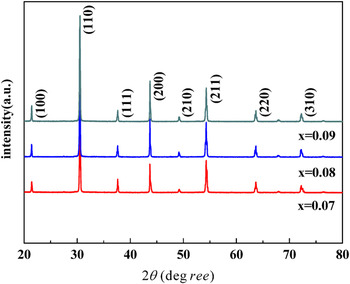
Figure 1 shows the XRD patterns of PLBZST ceramics with different compositions in the 2θ range of 20–80°. A pure perovskite structure without any second impurity phases could be confirmed.
X-ray diffractometer patterns between 20 and 80° of (Pb0.87La0.02Ba0.1)(Zr0.75Sn0.25–xTix)O3 (PLBZST) ceramics with different Ti content.

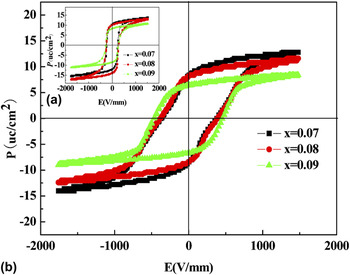
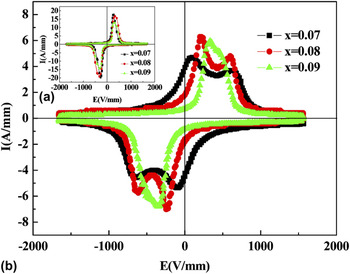
Figures 2 and 3 show the P–E hysteresis loops and I–V loops of PLBZST (0.07 ≤ x ≤ 0.09) ceramics at 25 and 60 °C, respectively. At 25 °C, all specimens are in the FE state, with good single hysteresis loops and single I–V loops. At 60 °C, the composition with x = 0.09 is still in the FE state. However, the specimens with x = 0.07 and 0.08 exhibit an AFE character from the P–E hysteresis loops and I–V loops, though the character of P–E hysteresis with pinch shape is not very obvious. Therefore, AFE/FE phase boundary is located between x = 0.08 and x = 0.09 at 60 °C.
Polarization versus electric field hysteresis loops of PLBZST ceramics with different Ti content measured at (a) 25 °C, (b) 60 °C.

I–U loops of PLBZST ceramics with different Ti content measured at (a) 25 °C, (b) 60 °C.

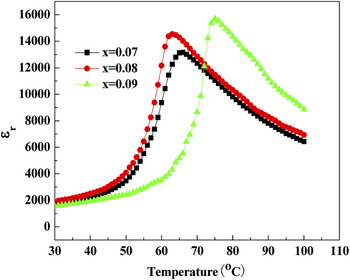
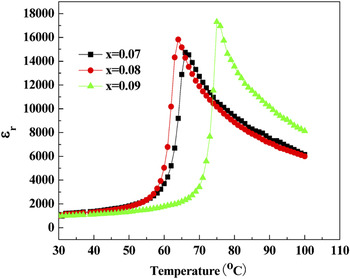
Figure 4 shows the variation in the permittivity of PLBZST specimens as a function of temperature and composition. As x increases from 0.07 to 0.09, the Curie temperature (T C) first decreases from 65 to 63 °C, then increases to 75 °C, and the peak value of dielectric constant increases from 13,000 to 16,000. In the AFE state, the decrease of T C is because the AFE phase becomes gradually unstable with the increase of Ti content. In the FE area, T C is higher, suggesting the FE phase is more stable.
Temperature dependence of dielectric constant for the PLBZST ceramics with different Ti content.

The dielectric constant of PLBZST specimens as a function of temperature and composition under a 500-V/mm DC bias field is shown in Fig. 5. From the figure, it can be seen that the dielectric constant is larger and the slope is steeper when a 500-V/mm DC bias field is applied for PLBZST ceramics. In the AFE state, the rapid increase of the dielectric constant under the DC bias field can be explained by the Lyddane–Sachs–Tellers relationship.Reference Yang and Payne16, Reference Lyddane, Sachs and Tellers18

Temperature dependence of dielectric constant for the PLBZST ceramics with different Ti content under a 500-V/mm direct current (DC) bias field.

where K 0 is the static dielectric constant as data presented in this article and K ∞ is the high frequency dielectric constant. μ is the reduced mass, (LRF) are the long-range Coulombic forces, (SRF) are the short-range forces, γT is the perturbation of the harmonic approximation from the anharmonic contribution, and (LRF) − (SRF) + γT represents the effective force constant of the soft mode.  and
 are the frequencies of the optical longitudinal and optical transverse phonon modes, respectively. In the AFE phase region, because of the decrease of (LRF) − (SRF) + γT which arises from the field-induced lattice softening,Reference Yang and Payne16K 0 increases. When the content of Ti is higher than 0.08, although the composition exhibits FE behavior, the dielectric constant still increases progressively. These responses can be modeled using a standard phenomenological theory via free energy (G) expansion of the transitionReference Liu, Wang, Cao, Mao, Cao and Dong19:


where P sc is the spontaneous polarization at T C. Under no field, α 0 = (ε 0C)−1 where C is Curie constant. The coefficients of α, β, and γ are dependent on the order of phase transition. Previous results have indicated that when the amount of Ba2+ is less, the FE ceramics undergo a first-order phase transition.Reference Pokharel and Pandey20 It has been known that, for the first-order transition, α > 0, β < 0, and γ > 0, when bias field E > 0, the field-induced dielectric constant and the transition temperature are both improved with the increase of E.
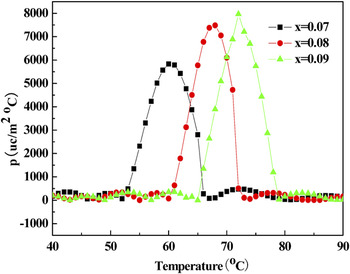
Figure 6 shows the pyroelectric coefficient of PLBZST specimens as a function of temperature and composition under a 500-V/mm DC bias field. It can be seen that the pyroelectric coefficient increases from 6000 to 7800 μC/m2·K with the increase of Ti content from 0.07 to 0.09. This may be attributed to the fact that the dielectric peak becomes steeper with the increase of Ti content.
Temperature dependence of pyroelectric coefficient for the PLBZST ceramics with different Ti content under a 500-V/mm DC bias field.

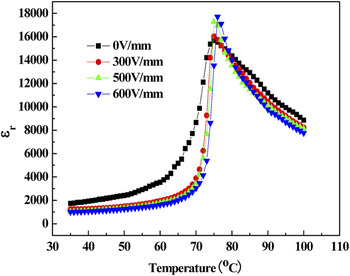
Figure 7 shows the dielectric constant of PLBZST specimens with x = 0.09 as a function of temperature and applied DC bias fields. As the DC bias field increases, the maximum dielectric constant and the T C increase and the slope of the dielectric peak becomes sharper. The good dielectric constant slope up to 600 V/mm suggests that specimens with reasonable pyroelectric responsivity can be expected.
Temperature dependence of dielectric constant for the PLBZST ceramics with x = 0.09 under different DC bias field.

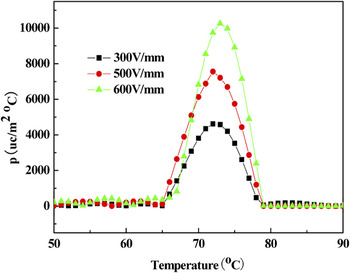
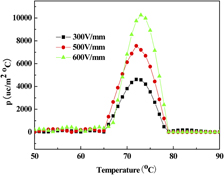
Figure 8 shows the pyroelectric coefficient of PLBZST specimens with x = 0.09 as a function of temperature and applied DC bias fields. The specimens under a 600-V/mm bias field achieve the maximum value of 10,500 μC /m2·K at T C, which is much larger than that of conventional phase transition materials BST.Reference Shaw, Gupta, Stringfellow, Navarro, Alcock and Whatmore5, Reference Lim, Han, Hahn and Lee21–Reference Yoo and Gao23 The large pyroelectric coefficient is due to the fact that the dielectric constant–temperature curve of the specimen under a 600-V/mm bias field has a larger dielectric constant and displays the sharpest shape near the T C, as shown in Fig. 7.
Temperature dependence of pyroelectric coefficient for the PLBZST ceramics with x = 0.09 under different DC bias field.

IV. CONCLUSION
PLBZST (0.07 ≤ x ≤ 0.09) specimens have been fabricated and their crystal structure, FE, dielectric, and pyroelectric properties were studied. The dielectric constant was improved with the increase of Ti content. When the DC bias field increased, the slope of the dielectric peak was sharper, and this was good for the pyroelectric response of IR sensors. When a 600-V/mm DC bias field was applied, the specimen with x = 0.09 showed the maximum pyroelectric coefficient of 10,500 μC /m2·K, which is much larger than that of conventional phase transition pyroelectric materials.
ACKNOWLEDGMENTS
This work has been supported by the Graduate Student Creational Fund (HF-08-08-2011-185). We thank Analytical and Testing Center of Huazhong University of Science and Technology.