For more than 60,000 years, Aboriginal and Torres Strait Islander peoples have had a continuing spiritual and cultural connection with this land. Despite the continuing resilience of these cultures, Aboriginal and Torres Strait Islander people fare worse in terms of equity and opportunity than other Australians (AIHW, 2011). Although there is great diversity between and within language groups and disadvantage is not universal (Reeve & Bradford, Reference Reeve and Bradford2014), it is the legacy of Australia's colonial history that, at the population level, Aboriginal and Torres Strait Islander people suffer greater levels of poverty, lower levels of educational attainment and higher rates of chronic disease, suicide, incarceration and violence than other Australians (AIHW, 2011). This stark difference in the quality of life culminates in a life expectancy for Aboriginal and Torres Strait Islander peoples that is more than 10 years shorter than for other Australians (AIHW, 2011) and is commonly referred to as ‘the gap’.
Facilitating positive developmental trajectories for Aboriginal and Torres Strait Islander youth is one way organisations serving youth can contribute to ‘closing the gap’. Aboriginal and Torres Strait Islander youth are more likely to be exposed to contextual and environmental factors that can have a detrimental effect on their developmental trajectory. For example, a child with a primary carer who is a member of the stolen generations is at greater risk of clinically significant emotional difficulties (ABS, 2005). Aboriginal and Torres Strait Islander youth are less likely to complete Year 12 regardless of socioeconomic status (De Bortoli, Thomson, & Australian Council for Educational Research, Reference De Bortoli and Thomson2010). The consequences of this educational marginalisation manifest in a range of settings beyond schooling including disengagement with further education and training, difficulties gaining employment, poor mental and physical health and greater representation in the criminal justice system (Purdie & Buckley, Reference Purdie and Buckley2010). There is, therefore, a pressing need to optimise youth development programs for Aboriginal and Torres Strait Islander youth.
Developed in parallel with the positive psychology perspective, the study of Positive Youth Development (PYD) involves the investigation of the pathways whereby youth become motivated, self-directed, competent, compassionate and psychologically vigorous adults (Larson, Reference Larson2000). The psychology of PYD takes into account the unique environmental influences upon the individual and views the individual as a source of strength to be developed rather than a problem to be solved (Damon, Reference Damon2004; Larson, Reference Larson2000). The context best suited to foster PYD is argued to be structured out of school activities involving adult supervision with an emphasis on skill building (Mahoney, Eccles, & Larson, Reference Mahoney, Eccles and Larson2004; Petitpas, Cornelius, Van Raalte, & Jones, Reference Petitpas, Cornelius, Van Raalte and Jones2005).
The PYD asset framework outlines 40 external and internal developmental assets, grouped into 8 categories of which one is ‘commitment to learning’ (Benson, Reference Benson1997). Within this category there are five assets related to education: achievement motivation, school engagement, homework, bonding to school and reading for pleasure. Commitment to learning is a substantial contribution to the PYD indicators and one way to identify individuals considered on a positive developmental trajectory (Benson, Reference Benson1997). Education is recognised by the World Health Organisation as a having an important role to play in the struggle against poverty, and is a key factor likely to reduce Aboriginal and Torres Strait Islander disadvantage (Heath, 2011). Improving engagement of the school system with Aboriginal and Torres Strait Islander students is an important consideration in the effort to close the gap in school attendance and retention (Schwab, Reference Schwab1999).
Participation in youth sport is one developmental context with the potential to foster PYD within mainstream schooling for Aboriginal and Torres Strait Islander youth. For the purpose of this research, youth sport is defined as sporting opportunities available to youth through their school and/or community. The learning and developmental correlates of participation in youth sport have been investigated in a number of large scale cross-sectional and longitudinal studies with student populations in North America. For example, Eccles and Barber (Reference Eccles and Barber1999) found that participation in youth sports predicted an increased in the likelihood of being enrolled in full time college at age 21. Similarly, Broh (Reference Broh2002) found participation in youth sports to have small but consistent benefits for academic performance. Marsh and Kleitman (Reference Marsh and Kleitman2003) also found students who participated in youth sports had higher grades and educational aspirations, spent more time on homework and applied to more universities. Participation in youth sport was found to be associated with improved self-esteem, time spent on homework and locus of control (Marsh & Kleitman, Reference Marsh and Kleitman2003). Although the causal nature of these findings is limited due to the correlational research designs, these studies do demonstrate a link between youth sport and better PYD in terms of educational outcomes.
There are some accounts of qualitative research investigating the developmental benefits of participation in youth sport. For example, Camiré, Trudel, and Forneris (Reference Camiré, Trudel and Forneris2009) found a number of life skills including team work, communication, time management and leadership, benefited from sports. Personal characteristics such as self-efficacy and confidence were also reported as benefiting from participation. The authors concluded that coaches contribute to positive development when engaging students in decision making, teaching life skills and discussing the transfer of life skills to other domains with their charges. In contrast, Holt, Tink, Mandigo, and Fox (Reference Holt, Tink, Mandigo and Fox2008) observed that student athletes were neither directly taught these skills nor did students report learning initiative through soccer participation. Rather, participation in sports provided the opportunity for student athletes to show initiative and responsibility as well as demonstrate their goal setting and time management skills. These smaller, contextually situated studies offer greater insight into the dynamic of how and why a student's developmental trajectory is influenced by participation in youth sport.
The wider literature contains a significant body of research pertaining to the educational and developmental benefits of participation in youth sports. It is also important to acknowledge that negative experiences in sports participation are also reported in the literature. For example, the stress, anxiety, injury, poor coaching behaviours and an overemphasis on winning associated with sport can have a detrimental effect on youth health, wellbeing and development (Merkel, Reference Merkel2013). In determining the contextual factors related to how positive outcomes are achieved, and negative outcomes can be avoided, the PYD framework can provide a holistic tool for research, programming and evaluation of youth sports programs (Fraser-Thomas, Côté, & Deakin, Reference Fraser-Thomas, Côté and Deakin2005).
The literature investigating the benefits of youth sports participation within a PYD framework is extensive; however, this literature is not comprehensive. One recent systematic integrated review of sports-based youth development literature included 185 articles and found that research in this area seldom accounts for the social, political context and organisational capabilities that are known to influence the facilitation of positive development through youth sports programs (Jones, Edwards, Bocarro, Bunds, & Smith, Reference Jones, Edwards, Bocarro, Bunds and Smith2016). This lack of research attention has resulted in a large literature linking positive developmental outcomes with participation in sport, with little information about how this process is facilitated by contextual factors such as program logic.
In the context of Aboriginal and Torres Strait Islander youth development, the paucity of findings related to the contribution of sport to educational and developmental outcomes is even more pronounced. This research gap is in particular need of attention given sport is often viewed as a panacea for Aboriginal and Torres Strait Islander youth (Purdie & Buckley, Reference Purdie and Buckley2010). Keddie, Gowlett, Mills, Monk, and Renshaw (Reference Keddie, Gowlett, Mills, Monk and Renshaw2013) examined the developmental benefits of a sport program offered at a culturally responsive school with a high proportion of Aboriginal and Torres Strait Islander students (25%) in Queensland. Culturally responsive teaching has been described as connecting to the knowledge and experiences that may resonate with a particular cultural group (Keddie et al., Reference Keddie, Gowlett, Mills, Monk and Renshaw2013). Using a qualitative approach, Keddie et al. found the sports program was instrumental in increasing participants’ engagement with schooling, had positive effects on student athletes’ self-esteem and facilitated positive intercultural relations.
Other sports-based programs that target Aboriginal and Torres Strait Islander students’ life skills, lifestyle choices and/or educational engagement through sports participation have been evaluated (Purdie & Buckley, Reference Purdie and Buckley2010). One such program is the Australian Football League (AFL) Kickstart program initiated in 1997 for Aboriginal and Torres Strait Islander youth across remote communities in Northern Queensland. Similar to many sports-based programs targeting Aboriginal and Torres Strait Islander youth, the Kickstart program is multifaceted, engaging youth in educational activities aimed at develop-ing life skills as well as offering sports participation opportunities. In contrast to other sports participation opportunities, such tailored programs offer a more holistic approach to youth development and often target youth at risk of educational disengagement, substance abuse and violence. A qualitative evaluation of the Kickstart program indicated that the program had merit in improving student engagement with schooling, and effected a reduction in destructive behaviours such as substance abuse and violence in communities (DinanThompson, Sellwood, & Carless, Reference DinanThompson, Sellwood and Carless2008).
Most other educational engagement through sports initiatives that target Aboriginal and Torres Strait Islander youth come under the auspice of the Sporting Chance Program (SCP). An evaluation of the SCP was undertaken in 2011 by the Australian Council for Educational Research (ACER, 2011). The ACER evaluation identified improvements in participants’ self-esteem as a key finding of the effects of the SCP and identified evaluation of positive developmental outcomes as an area in need of further research.
In summary, several large scale cross sectional studies have shown positive relationships over time across numerous educational and developmental outcomes including improved school attendance and higher educational aspirations (Broh, Reference Broh2002; Eccles & Barber, Reference Eccles and Barber1999; Marsh & Kleitman, Reference Marsh and Kleitman2003). Qualitative research has also found benefits for participation in sport during high school for life skills and personal characteristics such as self-efficacy, confidence, leadership and initiative (Camiré et al., Reference Camiré, Trudel and Forneris2009; Holt et al., Reference Holt, Tink, Mandigo and Fox2008). In the context of Aboriginal and Torres Strait Islander participation in youth sports, the limited research that has been undertaken indicates that youth sports participation has the potential to have a positive effect on educational engagement and developmental trajectory. It has been argued that many programs fail to contextualise the cultural and sociopolitical realities for minority youth and in doing so not only fail to adequately understand the youth they serve, but also fail to capitalise on unique cultural assets and strengths (Duke, Reference Duke2014). It is, therefore, possible that participation in youth sporting programs has further meaning in an Aboriginal and Torres Strait Islander context pertaining to culture and equity, as well as educational engagement. By investigating Aboriginal and Torres Strait Islander youth sports participants’ perspectives, there is also potential to contribute contextual knowledge to the understanding of PYD.
Therefore, the purpose of the current research was to develop an understanding of how participation in youth sport impacted on the education and development of Aboriginal and Torres Strait Islander youth using a qualitative design. Qualitative research has the potential to contribute to the body of knowledge pertaining to how education and development are enriched by participation in sport during high school for Aboriginal and Torres Strait Islander youth. In utilising a PYD framework, the current research investigated the nature of the influence of participation in sport holistically, including cultural and contextual factors that the participants perceived to influence their education and development. Understanding the impact of participation in sport during high school from an Aboriginal and Torres Strait Islander perspective is also important in informing the development of culturally relevant educational engagement strategies.
Methodology
The current research was conducted within a constructionist epistemology. The theoretical perspectives of hermeneutics and phenomenology underpin the method of Interpretive Phenomenological Analysis (IPA) (Smith, Larkin, & Flowers, Reference Smith, Larkin and Flowers2008). Constructionism holds that discourse is not a reflection of reality but knowledge produced by social interchange (Gergen, Reference Gergen1985), thereby, acknowledging the subjective nature of the production of knowledge. Within the philosophy of constructionism, phenomenology holds that the ‘life world’ of an individual, and the reality of their lived experience, is dependent upon the social and historical context in which they live (Husserl, Reference Husserl1971). IPA also draws upon a hermeneutical theoretical perspective that incorporates a broader view including analysis of past, future and cultural factors (Standing, Reference Standing2009). In drawing upon hermeneutics, there is acknowledgment in the IPA approach that the researcher is part of the research process in that they bring their own set of histories, bias and experiences that play a role in the interpretation of meaning arising from the data.
Aboriginal and Torres Strait Islander Australians maintain oral story telling traditions in the production and dissemination of knowledge (Bessarab & Ng'andu, Reference Bessarab and Ng'andu2010). In Australia, this method is often referred to as ‘yarning’ and is a culturally safe method of data collection with Aboriginal and Torres Strait Island populations (Bessarab & Ng'andu, Reference Bessarab and Ng'andu2010). Interpretive phenomenological methods are compatible with yarning and appropriate for research with Indigenous population worldwide as they provide a link between participants and their cultural traditions by incorporating these oral traditions (Struthers & Peden-McAlpine, Reference Struthers and Peden-McAlpine2005).
Participants
Sampling for this research was purposive. All participants were postsecondary school and ages ranged from 19 to 25 years. All participants had either completed Year 12 or gone on to TAFE or university, participated in a sporting program while at high school and identified as Aboriginal. It was decided to examine the perspectives of postsecondary school former youth sports participants, who had engaged in further education, as a means of identifying participants who could have benefited from youth sport. Participants were not immersed in the process of adolescent development when asked to reflect on the impact of participation in youth sport. There is support in the sports development literature for the place of retrospective recall in the process of development. For example, research comparing diary and retrospective interview accounts of sports development activity participation found very similar accounts for both methods; the authors concluded that retrospective recall was dependable (Hayman, Polman, & Taylor, Reference Hayman, Polman and Taylor2012).
A total of six participants were recruited for the current study; five of the participants were males and one was female. Participants were identified through the personal networks of the first and second author and invited to participate by the first author. The participants were from a diverse range of backgrounds including central Australia, outer and metropolitan Perth regions and the far north Kimberly. Four of the participants worked in the sport and recreation industry and continued to study in health and fitness related fields. One was a professional athlete returning to study in Business. One participant attended boarding school on an athletics scholarship and was attending first year at university. Four of the participants came from disadvantaged backgrounds, one who grew up in poverty, and two participants did not consider their background to be disadvantaged in any way. Three completed Year 12 and participated in school-based sporting programs. One of the school-based sports programs attended by one of the participants was part of the SPC program. Three did not complete Year 12 and participated in community-based sporting programs. All participants had engaged in education beyond high school.
Data Collection
This research was approved by the Human Research Ethics Committee of the university. The primary researcher contacted potential participants, invited them to participate in the study and scheduled the time and place for initial interviews. An information letter and a consent form were provided to the participants at the commencement of the interview process. Participants and schools were allocated pseudonyms to protect their identity.
Data collection was in the form of a semistructured interview. Interviews followed an interview schedule (‘Can you tell me your story of how the sporting program you were involved in impacted on your experience of school?’) and probes (such as ‘how did that event change the way you thought about school?’) were used to explore further what was important to the participant. Other questions were introduced seeking clarification, additional information or introducing new topics. Interviews ranged from 40 to 55 minutes and were recorded using digital voice recording.
After initial data analysis, a member checking session was held at the place of business for two of the participants in the interest of interpretive rigour. One of the participants was lost to follow up, one had returned home to his community and the remaining two were unavailable at the time of member checking. The member checking served the dual purpose of validating interpretations and ensuring participants were comfortable with any direct quotes the researcher intended to use as exemplars in final submission. Member checking is an important step not only in rigorous qualitative research, but also in research with Aboriginal and Torres Strait Islander populations as a means of building trust.
The researcher kept a journal throughout the research process from the initial interview to the completion of analysis, enhancing procedural rigour. The journal also served as a means of ensuring reflexive rigour in keeping an account of the researcher's actions, reactions and role in the research process (Creswell & Miller, Reference Creswell and Miller2000). It was particularly important for the primary researcher to account for her own subjectivities because she, like the other authors, was not Aboriginal. Journaling facilitates reflexive practice in order to allow for scrutiny of attitudes, behaviour and communication style, so as to ensure these subjectivities did not influence the analysis (Rix, Barclay, & Wilson, Reference Rix, Barclay and Wilson2014).
Analysis
The primary researcher transcribed the interview data verbatim, and then read the transcripts a number of times in order to become familiar with the data. During this time any thoughts, observations, reactions and connections noted by the researcher were recorded in the research journal. This recursive and inductive process of immersion in the details of the data allowed consideration of patterns, themes and interrelationships. The researcher continued this process of reading and reflection in analysing all of the transcripts. Themes and subthemes were developed, and pertinent quotes were extracted from the text to account for interpretations and explain the participants’ experiences. Connections between themes were explored, and prototypical statements were considered for use in illustration of themes. Analysis of data focused on both the process of sense-making and on the proximal processes that impacted on the participant's experience, rather than a straightforward description of events (Andrews, Squire, & Tamboukou, Reference Andrews, Squire and Tamboukou2008). These methods are consistent with the steps outlined by Smith et al. (Reference Smith, Larkin and Flowers2008) as fundamental to IPA and contributed to the interpretive rigour of this research. By the use of the procedures of journaling, reflection and member checking, the lead researcher established a rigorous process aimed at accounting for researcher subjectivities while developing an accurate representation of the participants’ perception of their own developmental trajectory and the role of sport in that trajectory. Initial analysis was conducted by the first author, triangulation of interpretations occurred in collaboration with all authors before member checking. After the completion of analysis, results were compared with the developmental assets framework and found to be compatible with this framework.
Findings and Interpretations
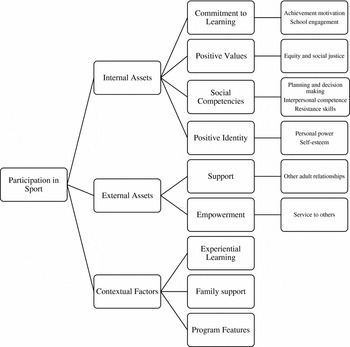
The combined data demonstrated an array of educational and developmental benefits of participation in youth sport for this group of now postsecondary school Aboriginal Australians. Findings are presented within the PYD asset framework. The internal and external assets participants perceived to have been developed by their participation in youth sport are shown in Figure 1.
The educational and developmental benefits for Aboriginal youth sports participants.

Internal Assets
The overarching theme of internal assets is comprised of four sub themes: commitment to learning, positive values, social competencies and positive identity.
Commitment to learning
Achievement motivation
For this group, participation in youth sport had a positive influence on their commitment to lifelong learning. This quote from Tim captures the participants’ recognition of the value of education and aspirations to lifelong learning: ‘I want to try and just move up and study as much as I can, get more knowledge, and the more knowledge I get, the better I'll get’. Participants were motivated to achieve in their postsecondary studies and careers. Jay stated ‘I definitely want to keep going. . .further study. . .people can look at me and say, “well he can be a manager one day”’. The skills and knowledge gained during their experiences in youth sport were a source of intrinsic motivation and inspired them to pursue further education and career goals.
School engagement
Most (four of six) participants discussed the positive influence participation in youth sport had on their school attendance. Tim explained, ‘I didn't attend [school] overly, before the football program came in . . .if you want to be in the football program you have to have a certain amount of attendance. . .so it was a big encouragement [to attend school]’. Jay also noted that, ‘you have to attend school on a regular basis to be able to gain the privileges to play sport. . .I absolutely didn't want to miss that, I made sure I was there on those days’. Participation in school-based sport meant access to activities that students enjoyed enough to motivate them to attend school through to completion of Year 12.
Positive values
Equality and social justice
Participation in youth sport was seen by the participants as a platform for meaningful engagement, a driver towards the development of more meaningful relationship and important in the breaking down of barriers between cultures. According to Bianca, ‘[Sport] is a massive thing for breaking down barriers between different cultures. . . you play a team sport, and you're a team, no matter where you're from’. Participation in sports impacted on the process of social judgements within their lives. According to Tim, ‘I was judging people I suppose, or the way I thought people were judging me. . .playing sport with them you realise that's not the way people usually think. . .it changes the way you think’. Danny also discussed the role of youth sports participation in combating stereotypes and promoting equality, ‘they [non-Aboriginal] really got an understanding “oh, they're not all screw-ups, they're just like us” and so. . .everyone was equal’. The participants perceived a positive shift in their own attitudes, and the attitudes of their peers, in relation to intergroup peer relationships and intragroup cultural relations, allowing for a more favourable outlook moving into their adult lives.
Social competencies
Planning and decision making
For some of the participants the experiences they were exposed to through their participation in youth sport affected the development of planning and decision-making assets. Three participants talked about time management as something they learnt experientially through sports participation. Danny talked about the need to manage his time and plan ahead to achieve his sporting and study goals while in high school, concluding that. . . . ‘It did make me think about the next day, think ahead, planning school wise’. Tim talked about how participation in sport changed his decision making process:
On the field you try and have an overlook of everything, whereas in life you only focus on one thing, but I slowly started thinking ‘you need to look at the wider spectre and think a bit differently to how you would normally think’. . .have a look at your options.
Interpersonal competence
The ability to work as an effective team member was mentioned by all of the participants as affected by participation in youth sport. Tim talked about the transferability of these skills; ‘[Sport] definitely helped me develop my team work skills. . . you don't really realise that sort of stuff until you leave that. . . environment and apply it to a different sort of scenery’. Declan describes his transition to leadership through sport; ‘You get comfortable knowing that everyone is equal and stuff like that, and that enables you to actually become more of a role model, more of a leader’. The participants were provided with opportunities to showcase their gains in confidence, and develop interpersonal competence, through experiences of team work and leadership.
Resistance skill
Five of the participants talked about the effect of participation in youth sport on the ability to resist destructive behaviours, such as drug and alcohol abuse and delinquent behaviours. The participants talked about their own decision making around behaviour as heavily influenced by their own desire to perform well at sport, as well as observing behaviour change in youth they now work with in sports development roles. For example, Todd, a professional athlete, discussed his involvement as a role model in a school sports program, ‘the kids weren't getting in anywhere near as much trouble, whether it was graffiti, break and enter, drinking alcohol at that age, just keeping them engaged in sport’. Jay also noted changes in the behaviour of youth sports participants he was working with ‘they make better decisions. . . those boys used to drink a fair bit. . .and now they got full time jobs, they don't drink that much, they go and play footy every weekend’. Sport was not touted as a panacea for issues facing Aboriginal youth, but as having great potential to draw students into a positive developmental trajectory.
Positive identity
Personal power
A number of participants expressed how sport during school impacted on what is termed ‘personal power’. Within the PYD developmental assets framework, ‘personal power’ refers to self-efficacy and locus of control (Benson, Reference Benson1997). This section describes the effect of participation in youth sport on the development of perseverance, emotional self-regulation, self-efficacy and self-esteem for the participants in this research. Four of the participants talked about the effect of participation in youth sports on the development of perseverance. Danny described how he was able to transfer the perseverance he learnt through participation in sport and the teaching of his grandfather into an academic setting:
One thing that rowing taught me, and my grandfather is always saying, ‘don't take the easy options, it's hard but it is worth going through’. Like at uni at the start of the year, I was struggling with work load, but I just thought, just keep pushing through, and I was surprised I passed most of my subjects for the first semester.
Four of the participants talked about learning to use physical exercise as a tool to reduce emotions of anger or irritation, to relieve stress and to ‘clear one's mind’. Tim also reflected on the way sport changed the way he processed his feelings, enhancing his emotional self-regulation ability:
I was a pretty angry kid. . .through sport, and the help of my family and coaches, it helped to settle me down. . .that definitely carried on from sport and then it helped me out in my life as well. If something happened outside of sport it wouldn't affect me as much, because you have an understanding that even though you mess up you don't have to get angry about it, you can just get over it and keep going.
Four of the participants recognised how their experiences affected their perception of their self-efficacy and self-esteem. Danny talked about self-efficacy learnt through participation in sport, and the increase in self-esteem he experienced from the recognition of peers as spectators to his football:
You can go further than what you think you can, rowing has given me that and I guess with footy, especially playing in front of heaps of people, it helped me come out of my shell a bit, I was pretty shy. . . but after a while people cheering you on helped my personality evolve.
For Declan, participation in youth sport had a profound impact on his self-esteem, ‘basically if I'd never done sport I wouldn't talk to people, I'd just be that person sitting in the corner, without a doubt’. The participants in this research perceived perseverance, emotional-self regulation tools, self-efficacy and self-esteem as positively influenced by participation in youth sports. The gains developed through experiences in sport and in education afforded these participants a stronger internal locus of control. The participants recognised the value of their own efforts towards achievement of their goals in sport, in education and in life.
External Assets
The overarching theme of external assets is comprised of two sub-themes: support and empowerment.
Support
Other adult relationships
Three of the participants finished Year 12 and were involved in school-based sporting programs. All of these participants commented on the pivotal role of sport in facilitating a more meaningful relationship with teachers and coaches, which in turn had a positive influence on their education. Danny explained, ‘he helped me through home sickness. . . he is also a PE teacher. . .I became pretty close with him, him and another coach. . .they were a big part of my sport and school life’. Jay talked about how having a teacher as his coach changed the nature of their relationship, ‘he was my maths teacher and my basketball coach, it was cool because I knew him on a different platform and a different level’. Forming a closer relationship with teachers through participation in sport improved educational engagement for these participants.
Empowerment
Service to others
Because of the reflexive nature of this research, it was possible for the participants to comment upon the influence of youth sports participation in their current and future civic engagement. To inspire young people and use sport as a vehicle to help others was something five of the participants talked about. These participants described their connection to their communities as driving their desire to make a positive difference by giving back through sport. ‘My big dream is I want to go back home and help my own people’, Tim mentions as he talks about his career in sport. Jay mentioned ‘it made me feel really good being able to teach them things. . .it was really rewarding’. Declan was also passionate about using his own experiences of youth sport as a platform to inspire community members to make positive choices ‘seeing the impact it could have on a community. . . tell my story and say “if I can do it, you can do it”, so why not give it a try. That's probably the main thing, try and give back’. Five of the participants in this research perceived their own educational and development gains through youth sports participation to be important in shaping the adults they had become. For this reason, they express a desire to pass this empowerment onto the next generation.
Contextual Factors
The overarching theme of contextual factors is comprised of three sub themes: experiential learning, family support and program features.
Experiential learning
Experiential learning was the way that educational and developmental gains were facilitated throughout the participants’ youth sport involvement. This was demonstrated repeatedly throughout the participants’ narratives by the use of phrases such as: ‘sport made me think about. . .’, ‘I had to. . .’, ‘when I started playing footy I started connecting. . .’, ‘before footy I wouldn't even. . .’, ‘playing sport with them you realise. . .’, ‘the perseverance that we had to show. . .’. Tim talked about how responsibility on the sporting field challenged him, ‘I got to captain a few games. . . that changed my perspective. . .people look to you to see what to do. . .that was pretty hard. . .something I had never experienced before, so I had to step up’. For the participants in this research, the experiences they were exposed to through participation in youth sport developed and gave them the opportunity to showcase a range of development assets.
Family support
A second contextual feature that was perceived to be important to the participants’ education and development was family support. For most of the participants, support from family facilitated their sports participation and encouraged their educational engagement. Declan explained, ‘I've got a lot of cousins that veered off into other things like drugs, partying and stuff like that. She [the participants’ mother] wanted me to stay in school doing right, and she knew that sport was a main key to that as well. So that's why she was taking me every weekend’. Family support is a developmental asset that may not have been influenced by participation in youth sport; however, it was perceived by the participants to be very influential in their youth sports involvement as well as their educational engagement.
Program features
A third contextual factor that influenced one of the participants’ involvement in youth sport and his education engagement was the specific nature of the program in which he was involved. Tim participated in a SCP program and perceived this program to be instrumental in his educational engagement, ‘they would help you without any questions. . . they always made sure we had our work in, they were really strict, if we didn't come to school we didn't get to go on trips and we didn't get to play footy.’ Tim rarely attended school before the SCP and credits the design of this program in raising his aspirations.
Discussion
The purpose of the current research was to develop an understanding of how participation in youth sport impacted on the education and development of six Aboriginal former youth sports participants. Findings show that participants in this research perceived a positive influence on both achievement motivation and school engagement. All of the participants had either obtained qualifications beyond secondary school or were enrolled in higher education. In 2008, just 28.5% of Aboriginal and Torres Strait Islander between the ages of 15 and 64 had completed Year 12 in comparison to 72.5% of other Australians (ABS, 2008). The educational engagement of the participants in the current research contrasts markedly with this population data. The participants perceived sport to be instrumental in the internalisation of the value of learning. School engagement was enhanced by structure, routine and the incentive of sports participation. The participants who finished Year 12 and participated in school-based sport discussed the impact of participation on their relationships with teachers who were coaches and cited these teachers as influential in their schooling. Educational benefits of participation in youth sport have also been found in previous research, including improved school attendance and educational attainment (DinanThompson et al., Reference DinanThompson, Sellwood and Carless2008; Eccles & Barber, Reference Eccles and Barber1999; Marsh & Kleitman, Reference Marsh and Kleitman2003).
Equality and social justice was one internal developmental asset that was influenced by involvement in youth sport for these participants. This is consistent with previous research finding benefits to cultural relations for participation in school sports (Keddie et al., Reference Keddie, Gowlett, Mills, Monk and Renshaw2013). Social competencies are also internal developmental assets that participants in this research perceived to have benefited from youth sport involvement in the domains of planning and decision making. The participants also experienced development in their team work and leadership skills. These findings are consistent with previous research where life skill development has been found to be associated with participation in sport including teamwork (Eime, Young, Harvey, Charity, & Payne, Reference Eime, Young, Harvey, Charity and Payne2013; Holt et al., Reference Holt, Tink, Mandigo and Fox2008), time management, communication and leadership skills (Camiré et al., Reference Camiré, Trudel and Forneris2009). The third asset of social competencies that was perceived to have been positively influenced by participation in youth sport was resistance. The participants in this research described the positive effect on their own life choices and those of the youth with whom they work.
The current research also found participation in sport to have a beneficial influence on the development of positive identity in the domains of perseverance, emotional self-regulation, self-efficacy and self-esteem. Previous research has also found benefits of participation in youth sport for positive identity in the domains of self-efficacy (Camiré et al., Reference Camiré, Trudel and Forneris2009), self-esteem (Broh, Reference Broh2002; Marsh & Kleitman, Reference Marsh and Kleitman2003) and emotional self-regulation (Eime et al., Reference Eime, Young, Harvey, Charity and Payne2013). The educational and developmental gains experience by the participants in this research through their participation in youth sport resulted in greater individual empowerment, as demonstrated by their desire to be of service to others.
Contextual factors, such as experiential learning, family support and program features, were important influences in positive development and sports participation. The current research found the educational and developmental benefits of participation in youth sports to be learnt as a consequence of experience, rather than being taught in any systematic manner. This is consistent with previous qualitative research with student athletes demonstrating experiential learning through participation in sport (Holt et al., Reference Holt, Tink, Mandigo and Fox2008). Participants noted the importance of family support in their sports participation and educational engagement. Features of school sports programs, such as having playing privileges linked to school attendance, had the effect of increasing school attendance. Findings showed that the educational and developmental benefits of participation in youth sport were consistent with previous research in this area.
The strength of the current research is in the reflexive nature of the data. Much developmental research has been undertaken when the actor is immersed in the experience of development. The current research was conducted with participants who had already completed their adolescent development and were asked to look back. This reflexive process provided rich data because participants had the opportunity to apply their learning to contexts beyond school and sport and could therefore realise and articulate their gains more fully.
The findings of the present study were limited by several factors. The current research selected participants who had engaged in education beyond high school in order to identify participants who may have benefited from youth sports participation. It is important to acknowledge that it is possible the perspectives investigated in the current research do not reflect the perspectives of youth sports participants who did not have positive experiences of their participation. The current research is also limited by the lack of female participants. It is possible that the perspectives of female youth sports participants differ from the perspectives explored here. Although IPA does not prescribe large participant numbers, the current study was quite small with a diverse group. For example, half attended community-based programs and half attended school-based programs, one of which was a targeted program tailored to cater for Aboriginal and Torres Strait Islander students.
The current research adds to the body of knowledge by exploring the perspectives of Aboriginal youth sports participants. Future research with more specific activity settings such as targeted programs, school-based programs and community-based programs may also give further insights into the educational and developmental benefits of such programs. Given the importance of family support found in the current study, future research with families and communities pertaining to the role of sport in the education and development of their youth would be beneficial in informing educational policy and youth sports programming for this population. Future research exploring the appropriateness of the PYD asset framework from an Aboriginal and Torres Strait Islander perspective will help to develop a culturally appropriate framework within which to conduct educational and developmental research with this population. It is important that researchers continue to consider the developmental experiences of Aboriginal and Torres Strait Islander youth from their own perspectives. In doing so researchers can provide opportunities for policy-developers to listen to, and learn from, Aboriginal and Torres Strait Islander voices in developing culturally responsive, youth development programs that empower individuals and communities in educational engagement and positive youth development.
In conclusion, this research shows that for this group of Aboriginal youth, participation in youth sport facilitated their educational engagement, attainment and aspirations. Participation in youth sport had a beneficial effect on their development as motivated, self-directed, competent adults who displayed the hall marks of positive youth development in their leadership, and civic engagement. The participants could see clear educational and developmental benefits to their participation in youth sport. In some cases, their love of sport and desire for access was sufficient to motivate profound behavioural change in terms of school attendance and career decisions, as well as set them on a positive development trajectory. Overall, for the Aboriginal participants in this research, the cumulative effect of the developmental and educational benefits of participation in youth sport had a life changing, positive impact on their higher educational attainment and developmental trajectory.
Acknowledgments
We acknowledge the traditional custodians of the land in which we live and work, the Nyoongar people. We would like to pay our respects to the Elders past and present.
About the Authors
Nicole Fitch is a PhD candidate in Psychology in the School of Arts and Humanities, Edith Cowan University. She continues to conduct research with Aboriginal and Torres Strait Islander communities in the area of positive youth development. She works within a constructionist paradigm and values a participatory, community-based approach.
Fadi Ma'Ayah is the Course Coordinator and Senior Lecturer in Sports Science and Football (Soccer) in the School of Exercise and Health Sciences, Edith Cowan University. His research interests centre on leadership, coaching and coaches’ behaviours. He has presented at conferences locally, nationally and internationally in the areas of sports science and football.
Craig Harms works as a Lecturer and a Researcher in the Discipline of Psychology in the School of Arts and Humanities, Edith Cowan University and as a Clinical Psychologist in private practice. His research and practice interests include factors impacting on and the psychological consequences of personal achievement (in sporting and academic settings), psychological aspects of health and exercise, resilience and emotional regulation.
Andrew Guilfoyle is a Teaching and Research Scholar teaching interpretative psychological research methods, and researching developing sustainable services for marginalised cultural groups such as Aboriginal, CaLD and refugee communities. He works within a constructionist, participatory, locational, community-based approach, identifying the utility and challenges of better service provision.