Introduction
Jatropha (Jatropha curcas L.) is a promising oilseed crop for biofuel production as it is not a food crop, except for some low-phorbol ester varieties from Mexico that can be cooked as snacks (Valdes et al., Reference Valdes, Sanchez, Perez and Caplan2013). There are reports indicating that the genetic diversity of J. curcas is too low for improving the existing varieties. The available germplasm has low seed yield, low number of inflorescences per year and uneven maturity. Tar et al. (Reference Tar, Tanya and Srinives2011) made crosses between J. curcas from Mexico, Myanmar and Thailand and found high heterosis for yield, yield components and agronomic characteristics. However, hybrid yield was still far too low from an economic standpoint. Fortunately, jatropha has many related species and genera, which allows for interspecific and intergeneric crosses. Bottleplant shrub ( J. podagrica) is a good donor for high oil yield with its seed oil content being over 50%, spicy jatropha ( J. integerrima) for profuse flowering year-round and coral plant ( J. multifida) for large fruit size (Ratha and Paramathma, Reference Ratha and Paramathma2009).
Establishment of genetic relationships through DNA information can be done for genetic improvement of J. curcas. Tanya et al. (Reference Tanya, Taeprayoon, Hadkam and Srinives2011) employed inter-simple sequence repeat markers to assess genetic variation among 30 accessions of J. curcas, two accessions of bellyache bush (J. gossypiifolia), two accessions of spicy jatropha, two accessions of bottleplant shrub and three accessions of castor bean (Ricinus communis). The genetic relationships among species can be used to predict the success of interspecific hybridization. Expressed sequence tag (EST)–simple sequence repeat (SSR) markers are good tools for such a study, owing to their co-dominance, high reproducibility and high polymorphism. Varshney et al. (Reference Varshney, Graner and Sorrells2005) reported high transferability of EST–SSRs across species and genera due to a higher level of conservation found in transcribed sequences compared with the level found in the other genomic regions. In this study, several F1 plants from crosses between J. curcas and J. integerrima, J. multifida, J. podagrica and R. communis were obtained. The hybrids were verified using EST–SSR markers developed earlier by our group.
Materials and methods
An accession of J. curcas was hybridized with one accession each of J. integerrima, J. podagrica, J. multifida and R. communis. In the direct cross, 100 female jatropha flowers were emasculated and hand-pollinated by pollen of each related species. In the reciprocal cross, 100 female flowers of each related species were hand-pollinated by pollen from J. curcas. The resulting hybrid seeds were germinated and maintained in the experimental field of the Department of Agronomy, Kasetsart University, Kamphaeng Saen, Thailand. Upon germination, hybridity was confirmed using EST–SSR markers developed by Laosatit et al. (Reference Laosatit, Tanya, Saensuk and Srinives2013). The genomic DNA was extracted from young leaves using the protocol of Tanya et al. (Reference Tanya, Taeprayoon, Hadkam and Srinives2011), while the polymerase chain reaction (PCR) and EST–SSR marker analysis were carried out using the protocol of Laosatit et al. (Reference Laosatit, Tanya, Saensuk and Srinives2013). These EST–SSR sequences were submitted to the NCBI Probe database with the assigned accession numbers from #PROBEDB_PUID 16586515 to 16586649. The PCR products were run on a 5% denaturing polyacrylamide gel and subsequently silver-stained to check for hybridity.
Results and discussion
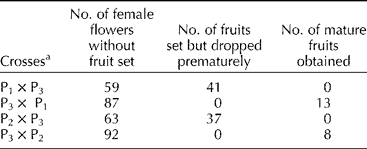
We were successful in producing a number of hybrid plants of J. curcas with J. integerrima, J. podagrica and J. multifida, but only one plant was obtained with R. communis. The hybrid nature was confirmed using both morphology and EST–SSR markers (Fig. 1). Sujatha and Prabakaran (Reference Sujatha and Prabakaran2003) and Basha and Sujatha (Reference Basha and Sujatha2009) reported earlier the success of crossing between J. curcas and J. integerrima, while Parthiban et al. (Reference Parthiban, Kumar, Thiyagarajan, Subbulakshmi, Vennila and Rao2009) tried to produce J. curcas× J. integerrima, J. multifida× J. curcas, J. maheshwari× J. curcas, J. gossypifolia× J. curcas and J. curcas× J. gladulifera with varying degrees of success. In this study, we were successful in obtaining seeds from J. podagrica× J. curcas as shown in Table 1. Kumar et al. (Reference Kumar, Parthiban, Hemalatha, Kalaiselvi and Govinda2009) reported an incompatibility in the cross J. curcas× J. podagrica due to bulging pollen tubes together with a reverse direction of pollen tube growth. Although the reciprocal cross was successful and six seeds were obtained, all of them aborted. We were successful in producing several mature F1 seeds from the reciprocal crosses that were able to germinate and grow (Fig. 1(b)). Our direct cross gave immature seeds with no endosperm and a very small embryo that could be observed only under 10 × stereo microscope. However only a single F1 plant was obtained for J. curcas× R. communis (Fig. 1(d)). The species-specific characteristics confirmed the true hybrid nature, as observed from flower colour, flower shape and leaf shape. The EST–SSRs developed by Laosatit et al. (Reference Laosatit, Tanya, Saensuk and Srinives2013), especially MPN078, MPN091, MPN119, MPN130, MPN134, MPN146, MPN150 and MPN155, clearly identified the hybrid progenies (Fig. 1). Behaviours with regard to flowering, seed setting and breeding of the F1 plants are being studied.
Expressed sequence tag–simple sequence repeat profile and morphology of (a) Jatropha curcas (P1) and Jatropha integerrima (P2) and their F1 hybrid assessed by the marker MPN081; (b) J. curcas (P1) and Jatropha podagrica (P2) and their F1 hybrid assessed by the marker MPN150; (c) J. curcas (P1) and Jatropha multifida (P2) and their F1 hybrid assessed by the marker MPN150; (d) morphology of the parents J. curcas and Ricinus communis and their F1 hybrid plant.

Results of interspecific crossing between Jatropha curcas and Jatropha podagrica and results obtained from pollinating 100 female flowers in each cross

a P1 and P2 are J. curcas and P3 is J. podagrica.
Acknowledgements
The senior author thanks the Royal Golden Jubilee PhD programme jointly funded by the Thailand Research Fund and Kasetsart University. The authors thank the Center for Advanced Studies in Agriculture and Food, Institute for Advanced Studies, Kasetsart University, the Chair Professor Project of Thailand's National Science and Technology Development Agency, and the Center of Excellence on Agricultural Biotechnology (AG-BIO/PERDO-CHE), Bangkok, Thailand.