Introduction
Chronic otitis media is one of the most common ear disorders in children in developing countries. It has been defined as a stage of ear disease in which there is chronic inflammation affecting the middle-ear cleft, and it may be accompanied by various pathological manifestations such as a perforated tympanic membrane and aural cholesteatoma. The patient may be troubled by signs and symptoms caused by a combination of these pathologies such as chronic otorrhoea and hearing loss.
Chronic otitis media is the main cause of hearing loss in developing countries and it is a major burden on the already limited resources of such countries. Hearing loss is considered to be the main health issue that affects quality of life, affecting approximately one-third of these populations. The World Health Report (1997) described hearing impairment as ‘a serious problem in young children because it retards language development and school progress, both of which have a significant impact in later life’. 1 In communities or countries where illiteracy is prevalent, ear and hearing diseases might impair a person's capacity to participate in normal conversation, thereby increasing the social and economic impact of these diseases.Reference Seely, Gloyd, Wright and Norton 2
Chronic otitis media is a major health problem in various regions around the world, affecting diverse racial and cultural groups living not only in temperate climates but also in extreme climates. In 1998, Bluestone proposed classifications for the prevalence of chronic otitis media founded on the analysis of approximately 50 reports published during the previous 30 years.Reference Bluestone 3 He classified India, which had an incidence rate of 2 per cent, as a low prevalence population. This was based on a study by Kapur (1965) in which 857 schoolchildren in southern India were screened.Reference Kapur 4 Since then, only two further studies have been conducted (by Jacob et al. (1997)Reference Jacob, Rupa, Job and Joseph 5 and Rupa et al. (1999),Reference Rupa, Jacob and Joseph 6 with 284 and 914 southern Indian children respectively). However, the prevalence of chronic otitis media in the northern part of the country is largely unknown. Our study is the only one that has been completed using a large population in northern India.
The World Health Organization considers chronic otitis media to be a major health problem for which prevalence data must be collected, particularly in developing countries such as India. The main goal of the current study was to determine the prevalence of ear disorders among schoolchildren in this subcontinent.
Materials and methods
This study was conducted by the Department of Otolaryngology, Maulana Azad Medical College, New Delhi over a period of three years from April 2008 to April 2011. Data were collected from 30 primary schools in New Delhi, the capital of India. Approval for this cross-sectional epidemiological study was obtained from the institutional review board and ethical committee.
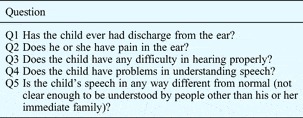
A pro forma was prepared for the screening of ear disorders within the schools. This was based on the World Health Organization's ‘Ten question screening index for disabilities’, 7 and was worded both in English and Hindi. It contained five questions pertaining to ear and hearing problems. This was completed by the parents or guardians of the children. It included simply worded questions pertaining to the presence of ear discharge, ear ache, and any hearing or speech problem (Table I). Consent for examination of the ear was included in this pro forma.
Questionnaire for ear disease screening in schoolchildren

A day before the screening, a visit was made to the schools and a meeting was held with the teachers of the primary sections. They were instructed regarding the objective and methodology of the study. They were informed about the common ear diseases that are prevalent among children and the need to identify these. On the day of the survey, a team of four otolaryngologists visited the schools, all of whom had undergone training in diagnosing ear disorders.
The study comprised the following activities. (1) A promotional talk: a brief talk was held in the morning, before the actual screening. This talk included discussion of the importance of healthy ear care habits and the principles of good ear and hearing hygiene. (2) Posters and charts were displayed in the schools for the duration of the study in order to promote good ear and hearing care habits. (3) All children (aged 5 to 12 years) were screened for ear disorders.
All of the children whose parents had consented for them to be a part of the study were subjected to an ear examination. The examination was performed using a headlight and an otoscope. Those with either a positive history of hearing or speech defects, or with a positive finding on examination, were subjected to a hearing assessment and/or tympanometry. Whenever cerumen was found obstructing the external auditory canal, an attempt was made to remove it. If attempts at removal failed, the children were referred to a nearby hospital for further management.
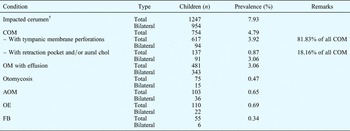
Once the screening survey had been completed, statistical analysis and point prevalence of various ear disorders were computed (Table II). The problems were coded as follows. (1) Requiring attention: children were to attend the ENT department at a nearby referral hospital for treatment. This category included children with hard impacted cerumen, otitis media with effusion, or those with a foreign body in the ear. (2) Requiring special attention: children were to be taken to the tertiary referral hospital for investigation and treatment. Children with acute and chronic otitis media fell into this category. (3) Requiring urgent attention: children were to attend the tertiary hospital for suitable treatment, at the earliest possible opportunity. This category included children suffering from chronic otitis media with aural cholesteatoma.
Point prevalence of ear morbidities*

* In the school population screened. †After reasonable attempts at removal. COM = chronic otitis media; chol = cholesteatoma; OM = otitis media; AOM = acute otitis media; OE = otitis externa; FB = foreign body (in ear)
Parents of children requiring further treatment were informed about their child's ear disorder and the need to address it, and a suitable time was arranged for them to attend at the hospital. A referral slip was also given to them to facilitate their visit to the referral hospital. This was made possible due to the fact that a large number of the families lived in the vicinity of their child's school and the parents often came to the school to pick up the children at closing time.
Results
In total, 15 718 children (aged 5 to 12 years) were screened in 30 schools over a period of 36 months (Table II). Of these, 7.93 per cent had hard impacted wax. A total of 4.79 per cent of children had chronic otitis media, subdivided into 3.92 per cent with chronic otitis media with perforation, and 0.87 per cent with chronic otitis media with either retraction pockets and/or aural cholesteatoma. In other words, 81.84 per cent of the chronic otitis media cases were associated with perforation and 18.16 per cent with retraction pockets and/or aural cholesteatoma. In total, 3.06 per cent of children had otitis media with effusion, 0.65 per cent had acute otitis media, 0.47 per cent had otomycosis and 0.34 per cent had foreign bodies in their external auditory canal. The types of foreign body included materials such as dead insects, wheat grains, rice grains, paper and cotton. All of these were removed at the time of screening.
Follow up of these children was undertaken in collaboration with the school teachers and principals. They were instrumental in motivating the parents of the children to take them for further management in the recommended centres.
Discussion
Despite improvements in public health and medical care, ear disorders such as chronic otitis media remain prevalent around the world. According to Bluestone,Reference Bluestone 3 the populations in whom chronic otitis media have been reported to be highest (12–46 per cent) are: the Inuit of Alaska, Canada and Greenland; Australian Aborigines; and certain Native Americans. Populations with moderately high rates (4–8 per cent) include the South Pacific islands, and some African populations such as Kenya, Nigeria, Gambia and Tanzania. Countries such as India, Korea and Saudi Arabia have low prevalence (1.4–2 per cent) of chronic otitis media. Developed countries such as the US, Denmark, Finland and the UK have the lowest prevalence (less than 1 per cent).
The prevalence of chronic otitis media in countries such as Saudi ArabiaReference Zakzouk and Hajjaj 8 and KoreaReference Kim, Jung and Yoo 9 has been studied and reported to be 1.31 per cent and 2.19 per cent respectively. A study of middle-ear disease in the adult British population states the prevalence of inactive otitis media and active otitis media to be 2.6 per cent and 1.5 per cent respectively.Reference Browning and Gatehouse 10
A study conducted by Godinho et al. (2001) in the city of Belo Horizonte in Brazil, placed the prevalence rate of chronic otitis media amongst schoolchildren at 0.94 per cent.Reference Godinho, Goncalves, Nunes, Becker, Becker and Guimaraes 11 In Malaysia, the prevalence in kindergarten children was 0.17 per cent.Reference Saim, Saim, Saim, Ruszymah and Sani 12 Studies amongst schoolchildren in SpainReference Rueda, Sanchez, Rodriguez, Sanchez and Guerrere 13 and JamaicaReference Lyn, Jadusingh, Ashman, Chen, Abramson and Soutar 14 have revealed prevalence rates of 0.7 per cent and 0.16 per cent respectively. Prevalence rates of 1.7 per cent have been detected in GambiaReference McPherson and Holborow 15 and 1.5 per cent in Riyadh.Reference Muhaimed, Zakzouk and Bafaqeeh 16 A prevalence of 3 per cent or higher was found in Swaziland (3.1 per cent)Reference Swart, Lemmer, Parbhoo and Prescott 17 and Kenya (3.5 per cent).Reference Hatcher, Smith, Mackenzie, Thompson, Bal and Macharia 18 Data collected by Kim et al. (1993)Reference Kim, Jung and Yoo 9 revealed prevalence rates of 5.6 per cent in Chileans and 8 per cent in Mexicans.
A study carried out by Chadha et al. (2006)Reference Chadha, Agarwal, Gulati and Garg 19 compared the prevalence of ear diseases in 1500 schoolchildren of lower and higher socioeconomic strata in the city of Delhi. The authors reported a 19.6 per cent prevalence of ear disease in the lower strata of that society compared with 2.13 per cent amongst the higher income group. However, even after an extensive review of the literature we found no large epidemiological studies on the point prevalence of chronic otitis media in the northern part of the Indian subcontinent.
Our study places the point prevalence of chronic otitis media at 4.79 per cent. Of these, 3.92 per cent were associated with tympanic membrane perforation and 0.87 per cent with retraction pocket and/or aural cholesteatoma. According to the classification proposed by Bluestone,Reference Bluestone 3 this places India amongst the high prevalence group along with other countries such as the Solomon Islands, Malaysia, Kenya, Nigeria and Tanzania.
The presence of impacted cerumen was the most common abnormality found in the otoscopic examination (the prevalence rate was 7.93 per cent). Children with cerumen in their external auditory canal were placed in the category requiring attention after reasonable attempts had been made to remove it. In these children, cerumen was hard in consistency and occupied the entire external auditory canal. Some of these children had associated complaints of hearing loss and/or otalgia. A study by Godinho et al. (2001) reported the prevalence of impacted cerumen to be 12.3 per cent amongst schoolchildren in Brazil.Reference Godinho, Goncalves, Nunes, Becker, Becker and Guimaraes 11 Similar values were found in Swaziland,Reference Swart, Lemmer, Parbhoo and Prescott 17 KenyaReference Hatcher, Smith, Mackenzie, Thompson, Bal and Macharia 18 and Malaysia.Reference Saim, Saim, Saim, Ruszymah and Sani 12 According to Hatcher et al. (1995), the obstruction of the external auditory canal by cerumen is relatively common because, in the great majority of cases, it is asymptomatic and is not therefore an indication to visit the doctor.Reference Hatcher, Smith, Mackenzie, Thompson, Bal and Macharia 18
The point prevalence of otitis media with effusion (OME) varies among several studies and partly depends on the researcher's method and the population characteristics. A study from KuwaitReference Holmquist, Fadala and Qattan 20 reported a point prevalence of 31.3 per cent. Similar studies from Holland,Reference Schilder, Zielhuis and Van Den Broek 21 Easter IslandReference Irander, Borres and Bjorksten 22 and RiyadhReference Sayed and Zakzouk 23 placed the prevalence of OME at 9.5 per cent, 10 per cent and 13.8 per cent respectively. A study by Apostolopoulos et al. (1998) reported a prevalence of 6.5 per cent in Greece.Reference Apostolopoulos, Xenelis, Tzagaroulakis, Kandiloros, Yiotakis and Papafragou 24 The prevalence rate of OME in our study was 3.06 per cent. The low prevalence could be attributed to racial and genetic factors. Reviewing 23 articles on this issue, Zielhuis et al. (1990) used an age-specific prevalence rate and came to the conclusion that the rate has two peaks: one around two years of age and the other around five years of age.Reference Zielhuis, Rach, Bosch and Broek 25 In our study, all of the children were above five years of age and this could be a cause of the low prevalence rate.
Various risk factors have been attributed to the high rates of chronic otitis media and include lack of breast feeding, overcrowding, poor hygiene, poor nutrition, passive smoking, high rates of nasopharyngeal colonisation with potentially pathogenic bacteria, and inadequate or unavailable healthcare. Another factor is inappropriate care of the infected ear, with continued reliance on traditional practices such as the instillation of plant juices and heated mustard oil. This leads to continuous otorrhoea following acute otitis media, and the increased prevalence of chronic otitis media in a predisposed population.
-
• This study determined the point prevalence of preventable ear disorders in northern Indian schoolchildren
-
• Prevalence of chronic otitis media was 4.8 per cent, putting India in the high prevalence group
-
• The study highlights the need for regular screening, primary ear care and health education to reduce the disease-related burden
Measures to reduce the prevalence of chronic otitis media should include the regular screening of schoolchildren. Children suffering from acute or chronic otitis media should be referred to an otolaryngologist for a specialist opinion. Public awareness regarding hearing impairment caused by otitis media and the need for management of these cases can help to reduce the disease-related burden. The National Programme for Prevention and Control of Deafness has already been initiated by the government of India and steps are under way to reduce the prevalence of chronic otitis media. 26