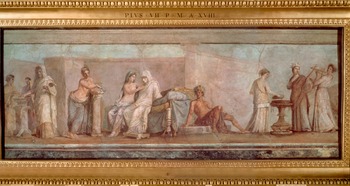
Unearthed in January 1601 in a vineyard belonging to the Carmelite friars, located near the Basilica of Santa Maria Maggiore in Rome, the Aldobrandini Wedding (Fig. 1) was an immediate sensation. The fresco's excellent quality and remarkable state of preservation led to its prompt extraction. At a time when remains of Roman frescoes were exceedingly rare, this extraordinary discovery significantly added to what was then known about ancient wall paintings. A letter written in 1601 by the French scholar Nicolas-Claude Fabri de Peiresc to his Paduan friend, Lorenzo Pignoria, preserves the earliest surviving description of the Aldobrandini Wedding. In addition to his careful documentation of the figures’ appearance, Peiresc's missive also contains the first reference to what would soon become the canonical interpretation of this captivating composition: a representation of “the ceremonies that were celebrated during a wedding and that the figure sitting on the ground is Hymenaeus.”Footnote 1 Soon purchased by Cardinal Pietro Aldobrandini, this precious fragment of Roman wall painting was transferred to his newly acquired villa on the Quirinal, where, beginning in 1602, it was displayed in a loggetta purposely refurbished as a private art gallery.
Aldobrandini Wedding, last quarter of the 1st c. BCE. From the Esquiline Hill, Rome. Detached fresco, h. 95 cm, w. 255 cm. Vatican Museums. © DeA Picture Library/ Art Resource, NY.

In its new setting, the Aldobrandini Wedding became an unmissable attraction for visitors to the Eternal City. Among the painting's many illustrious viewers were artists, such as Peter Paul Rubens, Nicolas Poussin, and Caravaggio, and literati, including Johann Joachim Winckelmann, the Marquis de Sade, and Stendhal. But by the late 18th and early 19th c., this celebrated fresco, which had earlier been compared to the works of Michelangelo and Raphael, began to fall out of favor with modern critics. The rediscovery of Herculaneum and Pompeii in the 1730s and ‘40s shifted intellectual and artistic attention further south. Moreover, the numerous frescoes unearthed in Campania stripped the Aldobrandini Wedding of its status as a rarity and provided viewers with comparanda, which led them to question its reputation as a masterpiece. De Sade, for instance, found fault with the composition's lack of perspective and its expressionless figures; Stendhal thought it inferior to the ancient wall paintings he had seen in Naples, remarking that, “Les Noces ne nous ont fait aucun plaisir.”Footnote 2
In 1818, Pius VII acquired the Aldobrandini Wedding, which thus entered the papal collection in the Vatican Museums. Since 1838, it has been exhibited in a room that bears its name. Though undeniably grand, this old-fashioned exhibition space has in many ways contributed to the public's diminishing interest in what was once one of Rome's most treasured and scrutinized works of art. Often closed to visitors and only accessible through special permission, the Sala delle Nozze Aldobrandine features an outdated lighting system that renders any attempt at close examination nearly impossible. Furthermore, the fresco's fragmentary state and poorly documented find context have gradually led to its suppression from more context-driven studies of Roman art. In fact, in the past 20 years or so, the most important studies published on the Aldobrandini Wedding have focused on the history of its discovery and subsequent reception in Baroque and Neoclassical Rome.Footnote 3 A significant exception to this trend has been, however, the work of F. G. J. M. Müller (M.) who, in 1994, published a monograph arguing against the traditional interpretation of the Aldobrandini Wedding as a representation of a Roman marriage ritual. Based on close iconographic analyses and a series of comparisons with other ancient works of art, M. instead proposed that this frieze-like composition was a depiction of the myth of Phaedra and Hippolytus.Footnote 4 The volume under review constitutes not so much a revision of his earlier findings as a reframing of his argument along with an expanded overview of the fresco's history from the time of its excavation to its relocation to the Holy See.
M.'s new book is divided into two main parts: Chapters 1–6 offer a synopsis of the scholarship on the Aldobrandini Wedding from 1990 to 2016, while Chapters 7–12 focus largely on questions of dating and interpretation. Through a careful analysis of surviving reports on the state of this painting in the years prior to its transfer to the Vatican, the first six chapters also attempt to reconstruct what the fresco's original composition would have looked like, a rather complicated question given that the Aldobrandini Wedding underwent several early “restorations,” which resulted in parts being sawed off and even repainted (18, 39–47). Having argued (mostly on a stylistic basis) that the Aldobrandini Wedding was produced in the last quarter of the 1st c. BCE (Chapter 7), M. then engages in a thorough refutation of earlier readings of its subject (Chapters 8 and 9) before (re)introducing his own theory that it depicts the tragic tale of Phaedra's love for her stepson (Chapters 10 and 11). Chapter 12 considers the historical implications of this fresco's findspot. The location of the Carmelites’ property on the Esquiline has led to speculations that it lay within the confines of Maecenas's famous horti,Footnote 5 a hypothesis that M. finds attractive (even if it remains unproven) and ultimately leads him to posit Augustus's close friend and advisor as the patron for whom the Aldobrandini Wedding was originally made (129–33). The Epilogue (Chapter 13) offers a recap of the book's key arguments and briefly considers the critical fortune of this painting, concluding that it “is not wholly devoid of artistic qualities” (144). Four appendices follow: Appendix I reproduces Peiresc's letter to Pignoria, a document that resurfaced in the early 1990s and was previously published by F. Cappelletti and C. Volpi.Footnote 6 Appendices II and III offer short studies of Roman-period Brautbilder (wedding scenes), including the erotic quadretti from the Villa Farnesina in Rome,Footnote 7 a pinax in Pompeii's Villa Imperiale, and the Nova Nupta relief in Palazzo Altemps. Lastly, Appendix IV, written by Carla Benocci and Valter Proietti (and published in Italian), discusses the architectural history of the so-called Loggia Vitelli, where the Aldobrandini Wedding was first displayed. Over the course of three centuries, this 16th-c. structure evolved from a garden pavilion into a miniature museum, and finally into a cozy reception room once the villa's most prized antiquity had been transferred to the Vatican.
As this summary of chapters and appendices makes clear, M.'s book offers a comprehensive study of the Aldobrandini Wedding, one that considers both the formal aspects of the painting's composition and the complex history of its discovery. M. also highlights how the circumstances surrounding the fresco's unearthing and subsequent preservation have impacted our understanding of this work of art. As such, this volume represents a useful synthesis of a wide range of studies on the Aldobrandini Wedding produced over the course of nearly three decades in multiple languages. The author's choice to publish the current book in English (the original Dutch manuscript was competently translated by G. Vos) will allow a greater number of scholars to consult its richly illustrated, informative pages. But despite the author's painstaking effort to collect all there is to know about the Aldobrandini Wedding in a single volume, his presentation remains problematic. Although M. pays great attention to the history of the fresco's reception, it is the interpretation of its subject matter that is the central focus of his work. His preoccupation with the correct identification of the depicted figures verges on an obsessive fixation with iconographic details and often devolves into ad hominem attacks on his critics.Footnote 8 Ultimately, M.'s desire to demonstrate that the Aldobrandini Wedding is a mythological painting that can (and should) be read in a specific way leads him to espouse rather far-fetched interpretations of the extant figures. And although toward the end of his study he sensibly admits that “due to its fragmentary state every interpretation of the Aldobrandini Wedding must of necessity always remain…a plausible hypothesis” (137), it is evident that (for him) there is only one hypothesis that is truly worth contemplating.
Central to all interpretations of the Aldobrandini Wedding is the figural group of two women who are shown seated on a couch and a scantily clad young man who looks at them from a short distance. There is an undeniably sensual aura to these characters: the women's physical closeness, the intimacy of their embrace, and the striking contrast between the heavily cloaked figure at the center of this triad and the seductively disrobed bodies that surround her suggest that whatever may be going on here has something to do with sexual desire. As M. points out, the poses of these two women recall those of Aphrodite and Helen on a Neo-Attic relief now in Naples that depicts the goddess persuading Menelaus's wife to fall in love with Paris, an iconography that also appears in a 1st-c. fresco of the same subject from the House of the Priest Amandus in Pompeii. Moreover, the gesture of wrapping one's arm around another person's shoulders (especially when both figures are seated on a couch or a bed) is a recurring motif in representations of mythological couples, such as Dido and Aeneas and Mars and Venus, in Campanian wall paintings (50–51). The problem, of course, is that there are no recognizable attributes that might clinch the identification of these three key figures in the Aldobrandini Wedding. In fact, the “anonymity” of the Aldobrandini Wedding's “bride” and her companions has been the fundamental reason why this complex composition has long been seen as representing a Roman marriage ceremony.
Since the 18th c., there have also been several other mythological interpretations of the Aldobrandini Wedding. In 1767, Winckelmann argued that this painting represents the marriage of Peleus and Thetis,Footnote 9 a theory later followed by identifications such as the wedding of Dionysus and Ariadne, the marriage of Liber and Libera, the union of Paris and Helen, the wedding of Dionysus and Cora, and the marriage of Heracles and Hebe (32–34).Footnote 10 M.'s own hypothesis that the fresco portrays scenes from the myth of Phaedra and Hippolytus fits within this larger hermeneutic tradition yet departs significantly from it. Unlike earlier critics who saw the Aldobrandini Wedding as a depiction of a divine (or quasi-divine) marriage, M. sees it instead as representing a story of unreciprocated desire that ultimately leads to the protagonists’ demise. He thus moves the interpretation of the Aldobrandini Wedding away from its traditional nuptial framework, a move that safeguards him from certain interpretive and iconographic pitfalls (e.g., the bride's lack of traditional bridal garments) that have long taxed the exegetic abilities of other scholars.Footnote 11
M. reads the Aldobrandini Wedding primarily through the lens of Euripides's Hippolytus (73–104).Footnote 12 For him, what we see in this painting are images related to the tragedy's initial scenes. The heavily cloaked woman on the couch is thus presented as the love-stricken Phaedra, here portrayed in Aphrodite's powerful grip. The young man, previously identified as Hymenaeus, is now recast as Hippolytus, whose vegetal crown M. sees as a reference both to the garland that the young hero places on Artemis's altar at the start of the play and to the tragedy's full title, Hippolytus Stephanophoros (86, 123). The woman standing by the basin on the left is identified as Phaedra's nurse, who tries to soothe the queen's discomfort by fanning her and applying damp cloths (shown hanging from the top of a column) on her febrile body. The partially disrobed young woman who pours the contents of an alabastron into a shell is identified as one of Aphrodite's companions (possibly Peitho), shown here in the act of preparing a magic philter meant to ensure that Phaedra will fall hopelessly in love with Theseus's son. Finally, the three women by the thymiaterion on the right are seen as representations of Artemis and her attendants, a reference to Hippolytus's devotion to this goddess and his own vow of chastity, which set in motion the tragic events recounted by Euripides.
M.'s analysis is not without its merits. First, it moves scholarly discussions about the Aldobrandini Wedding past the centuries-old intellectual straight-jacket of nuptial interpretations. Moreover, his proposed connection to Euripides's well-known play points to a possible explanation for why the many vignettes that make up this composition appear on a shallow, stage-like space. Reading the Aldobrandini Wedding through the lens of drama also helps explain the presence of divine characters in these scenes. Freed from the burden of allegorical signification, these figures (whose garments and adornments set them apart from the rest) are far more easily integrated into the depicted “narrative” when understood as depictions of Aphrodite, Artemis, and their attendants. But as M.'s critics have pointed out, his identification of the Aldobrandini Wedding as a representation of the tale of Phaedra and Hippolytus is complicated by the fact that it does not resemble the many surviving ancient portrayals of this myth: in Roman wall paintings and sarcophagi, visual representations of this story usually show Phaedra sitting on a throne-like chair (not a kline or couch), while Hippolytus is depicted leading a horse by the reins, a nod to both his name and his horrific, untimely death.Footnote 13
In response to these objections, M. presents a multilayered defense of his arguments. He begins by asserting that the Aldobrandini Wedding ought to be understood as an eclectic collage, a “Roman recreative fiction” that projects the illusion of being “a copy of a famous Greek original” (54, 122–24).Footnote 14 The idea that Roman artists inventively “repurposed” iconographic models to create new, original compositions in a self-consciously hybrid style is now widely accepted.Footnote 15 The problem is that M. uses this argument to explain why the Aldobrandini Wedding looks so different from other Roman representations of this particular myth, and his explanation does not quite work. For M. the fundamental reason the Aldobrandini Wedding differs from later depictions of Phaedra and Hippolytus in Roman art is that it is a creation of the late 1st c. BCE, a period when, according to him, well-attested iconographic formulae for portraying certain myths had not yet crystallized. M. remarks that all extant representations of the myth of Phaedra and Hippolytus postdate the Aldobrandini Wedding except for a mid-4th-c. Apulian volute krater by the Laodameia painter (now in the British Museum), whose subject matter is still debated (105–6). But how can the absence of iconographic precursors for the Aldobrandini Wedding assure us that M.'s interpretation of its subject is correct?
M.'s comparison between the Aldobrandini Wedding's eclectic composition and the evolution of Roman iconographies for other mythological couples, such as Io and Argus and Perseus and Andromeda, is also problematic (54, 124).Footnote 16 While Roman representations of these myths often deviate from earlier Greek models, it is not entirely clear when their imperial-period iconographies became “standardized.” The case of Io and Argus seems, in fact, to go against M.'s theory that late-1st-c. Roman art was characterized by an unfettered compositional fluidity, which was only later supplanted by a more limited pictorial repertoire. Take, for instance, the fresco of Io, Argus, and Hermes in the so-called tablinum of the House of Livia on the Palatine (ca. 30 BCE), which is the earliest known attestation of a popular iconographic type for this myth. Once thought to be an early imperial version of an original by Nikias, this painting is now seen as an imaginative pastiche designed to appeal to a refined contemporary Roman audience.Footnote 17 But the fact that this iconography continues to be reproduced (with only a few variations) into the late 1st c. CE suggests that mythological compositional formulae were, indeed, becoming crystallized in the period when the Aldobrandini Wedding was created. At the very least, the formal similarities between the Palatine fresco and later Pompeian depictions of Io and Argus (and sometimes Hermes) show that Campanian artists drew inspiration from iconographic models that were already in circulation when the House of Livia received its final politio. It is, of course, possible that the Aldobrandini Wedding may preserve an otherwise unattested depiction of the tale of Phaedra and Hippolytus, but the chronology presented by M. for the formation of a Roman iconographic “canon” does not withstand critical scrutiny. In any case, it is not enough to point to the inventiveness of Roman artists as an explanation for why there are no other ancient depictions of Phaedra and Hippolytus that resemble the Aldobrandini Wedding.
Then there is the question of M.'s identification of the painting's individual figures. Personally, I am open to his idea that the Aldobrandini Wedding offers a synoptic overview of Euripides's tragedy. I am also sympathetic to the proposition that the figures depicted by Roman artists do not have a single, fixed meaning and that compositions can therefore be ambiguous, especially when recognizable iconographic types are used to portray different characters in different narratives (123–24).Footnote 18 Thus, it seems plausible to me that the iconography associated with Aphrodite persuading Helen to betray Menelaus might also be used to portray Phaedra's own erotic conundrum. In this context, the veiled, melancholic figure on the couch (itself an erotically charged object) appears as an effective visual representation of Euripides's dejected, lovesick queen, who, reclining on a bed, asks her servants to uncover her head only to ask the nurse to cover it again a bit later (Eur. Hipp. 198–243). I also appreciate the polysemic nature of many of the objects depicted in the Aldobrandini Wedding and M.'s multifaceted interpretation of their meaning. The nurse's fan, for instance, might be seen as an amatory sign that references both her need to comfort Phaedra and the nature of Phaedra's discomfort (109–11). Similarly, the rectangular object shown leaning against the short column supporting a water basin is identified by M. as a writing tablet (84), a reference either to the letter Phaedra writes to Theseus in Euripides's tragedy or to the one she sends to Hippolytus in Heroides 4, a poem generally dated to the earliest phase of Ovid's career (ca. 25–15 BCE) and possibly contemporary with the Aldobrandini Wedding.Footnote 19 But M.'s mythological interpretation of this painting quickly becomes a new kind of Procrustean bed, one whose limitations are especially evident in his discussion of the figure identified as Hippolytus.
According to M., the partially disrobed youth who appears to the right of “Phaedra” perfectly matches the image described by Classical authors of the handsome prince for whom his stepmother burned. His tanned complexion should be understood as a reference to “the hero's healthy life in the outdoors” and enthusiasm for hunting, while his athletic physique marks him as a paradigm of male beauty. The wreath he wears on his head is both a reference to the title of Euripides's play, a symbol of his chastity, and an allusion to a passage by Ovid (Her. 4.71–74), where Hippolytus is said to wear a floral crown to the rites at Eleusis. Moreover, the way this figure turns his back to the women on the couch is seen by M. as an expression of the “controversial nature of the relationship between Phaedra and her stepson” (85–88).
There is ample cause for objection here: first, the young man's tanned complexion is characteristic of male figures in Roman wall painting, where skin tone is regularly used as a form of gender differentiation: as was the case with Egyptian art, men are generally portrayed as darker than women in Roman frescoes. As a result, this young man's physical appearance has more to do with widespread conventions for representing the male body in ancient art than with any effort toward characterization. It is also difficult to see how his pose could be indicative of his rejection of Phaedra's affection given that his eyes are unequivocally directed at the two women on the couch. Lastly, M.'s mention of Ovid's verses is not as illuminating as he might think. Questions regarding the exact date of Heroides 4 aside, Ovid's works rarely serve as the inspiration for specific iconographic details in Roman art. Although the emergence and popularity of certain mythological subjects in Campanian wall painting have been attributed to Ovid's retellings of those stories (e.g., Narcissus and Pyramus and Thisbe), only in two late-1st-c. paintings of the myth of Io from Pompeii do we find an unquestionable link between a character's attribute (i.e., Hermes's panpipes) and Ovid's verses (Met. 1.674–77, 688).Footnote 20
Given the Aldobrandini Wedding's fragmentary state and colorful history, it is quite possible that we will never arrive at a satisfactory consensus about this painting's meaning. But it is also an illusion to think that we would fully understand this composition if more of its frescoed surface and original context had been preserved. Think, for instance, of the famous figurative frieze from the Villa of the Mysteries in Pompeii: carefully excavated and preserved in situ, these frescoes have been meticulously documented, carefully studied, and painstakingly restored, and yet we are nowhere near understanding what they represent. Twenty years ago, Mary Beard and John Henderson remarked on how tantalizingly elusive these figures are. As with the Aldobrandini Wedding, interpretations of the frescoes from the Villa of the Mysteries have supposed that the key to their meaning lies in religion or ritual: an initiation to a cult or, perhaps, the preparation of a bride for her wedding. For Beard and Henderson, however, such explanations are inadequate not just because of a lack of definitive evidence, but because they offer a straightforward interpretation for images that deliberately thwart our attempts at elucidation: “There is an overwhelming sense that what is afoot may only be understood with a very special eye. The activities and figures depicted insistently call for explanation…Yet the more you look at the picture the more the images throw back at you the limitations of your ability to see and describe.”Footnote 21
It is humbling to admit that there are limitations to our ability to see, describe, and fully comprehend ancient art. Yet this is more than a necessary corrective. It is also an admonition that our approach to the study of antiquity must be generous enough to accommodate not only that which is difficult to understand, but also that which might be intentionally cryptic. The most recent cleaning of the frescoes in the Villa of the Mysteries (completed in March 2015) has revealed that several of the faces depicted in this enigmatic mural bear such individualized physiognomic traits that they might be portraits.Footnote 22 If so, this fact indicates that the meaning of these images might have been clear to only a very small group of individuals who, in the mid-1st c. BCE, chose to have themselves represented in these fantastical guises. Theirs would have been a very special eye, indeed. Could something similar be happening in the Aldobrandini Wedding? None of the faces in this painting look portrait-like to me. But this does not preclude the possibility that this painting, too, might have been made with a specific audience in mind; whether this was Maecenas and his circle or another group of viewers with their own preferences, interests, and sensibilities we will probably never know. But what remains true for both the paintings from the Villa of the Mysteries and the Aldobrandini Wedding is that they articulate an insistent call for explanation. And, in doing so, they point to a fundamental aspect of Roman wall paintings: that they were designed to hook the viewer by challenging him or her to make sense of them.Footnote 23 There is no question that the ancients would have had a leg up on us in this game, but the thrill of a good interpretive chase is not something we moderns have invented, nor are we the only ones to have enjoyed it.
M.'s book can, at times, prove frustrating. In matters of interpretation, his work often reads like an artifact of the past, a late example of a more rigid form of ancient art history. But this book is also a visual pleasure. Rarely in our field do we get to peruse such a lavishly illustrated volume. The book's spectacular images and M.'s erudition offer us a rare chance to look closely at a work of art that is endlessly fascinating. Ultimately, M.'s new study on the Aldobrandini Wedding should be understood as a challenge to other scholars not to take their eyes off this familiar yet confounding painting, a painting that draws us in with seductive, seemingly recognizable forms only to reveal the limitations of our own ways of seeing. The So-Called Aldobrandini Wedding: Research from the Years 1990 to 2016 will undoubtedly remain an invaluable resource for anyone interested in the history of Roman wall painting and its modern reception in the years to come. Given the fullness of the author's arguments and the vast corpus of images and texts he adduces, an index would have been a most welcome addition to this otherwise beautifully produced monograph.