1. Introduction
Evolutionary processes such as selection and drift are causes of population-level change. Matthen and Ariew (Reference Matthen and Ariew2002) and Walsh, Lewens, and Ariew (Reference Walsh, Lewens and Ariew2002) have recently challenged this claim, arguing that selection and drift are best understood as statistical trends rather than causes. Matthen and Ariew claim:
[N]atural selection is a mathematical aggregate of individual events. This seems to imply that it is not a causally connected process. The increase of fitness in a population by means of natural selection is, as we see it, a temporal sequence of aggregates, a running tally of lower level events; it is not a process within which the earlier events cause the later. (Reference Matthen and Ariew2002, 79)
And Walsh, Lewens, and Ariew claim:
Selection and drift are not forces acting on populations; they are statistical properties of an assemblage of ‘trial’ events: births, deaths, and reproduction. (Reference Walsh, Lewens and Ariew2002, 453)
We think these positions confuse the broad question of whether evolutionary processes are causal factors at all with the narrower question of whether drift and selection should be described as forces in the Newtonian sense. On their view, for selection and drift to be causal they must be forces causing individual-level events such as births and deaths of individuals within a population. We disagree. Whether evolutionary processes should count as ‘forces’, and what this entails about nature of causation are interesting but peripheral questions.Footnote 1 We will focus on the broad causal status question and argue that drift and selection are, in an important and explanatory sense, population-level causes of evolutionary change. Understanding evolutionary processes in this way, we maintain, makes sense of evolutionary biology as it is practiced.
Our defense will proceed as follows. First, we present a philosophical argument, based on a connection between manipulation and causation, that selection and drift are causes. Second, we augment the argument by looking at an exemplary study in evolutionary biology that manipulated the processes of selection and drift in a way that changed the dynamics of populations. Finally, we defend our interpretation of the study against a possible objection motivated by the statistical view.
2. Manipulation and Causation
We offer a simple argument for treating selection and drift as causes of population-level change. The argument does not rest on a philosophical account of what causal relations are, but, rather, on a condition that is useful for identifying causal relations. Loosely stated, the condition is as follows: if an appropriately controlled manipulation of variable A results in a systematic change in variable B, then A is a cause of B. We will refer to this condition as the manipulation condition (MC). The structure of our argument is as follows:
1. The manipulation condition.
2. Manipulating the character of selection and drift can result in systematic changes to population-level dynamics.
3. ∴ Selection and drift are causes of population-level dynamics.
In this section, we briefly elaborate upon and defend our two premises. Our conclusion follows deductively.
To begin with the first premise, what do we mean by ‘manipulation’, and why is manipulation relevant to causation? To manipulate a variable is to cause the variable to change. In a controlled manipulation of A with respect to B, we manipulate the value of A and look for resulting changes in B while holding fixed certain other, potentially confounding, variables in the system. Basically, we are referring to the ordinary scientific concept of a well-controlled experiment for investigating the relationship between two variables. Woodward (Reference Woodward2003) provides a good explication of the manipulations that occur in well-controlled experiments with his concept of an intervention. According to Woodward, “an intervention on some variable X with respect to some second variable Y is a causal process that changes the value of X in an appropriately exogenous way, so that if a change in the value of Y occurs, it occurs only in virtue of the change in the value of X and not through some other causal route” (Reference Woodward2003, 94).
The idea behind MC is that conducting controlled manipulations is a reliable strategy for identifying causal relations; when you have an appropriately controlled manipulation of A with respect to B, and you find a systematic relationship between the value of A and the value B, then it is safe to conclude that A is a cause of B. We take it that MC is a well-established and widely understood principle of experimental science. It is possible to give a deeper philosophical analysis and justification for MC (Cartwright Reference Cartwright1983; Woodward Reference Woodward2003), but we will not labor the point here. Also, some philosophical accounts of causation give manipulation a central role (again, see Woodward Reference Woodward2003), but one need not accept such an account of causation in order to accept MC. Our point is simply that MC is a reliable strategy for identifying causal relations. Any plausible theory of causation will have to make sense of that fact.
Now consider the second premise. The character of selection and drift in a population can be experimentally manipulated. Natural selection occurs when individuals in a population vary, and through interaction with the environment, different types of variants have different expected rates of survival or reproduction. This means we can manipulate which types are favored by selection or how strongly selection favors some types over others by manipulating those factors (genetic, phenotypic, environmental, or otherwise) that influence the expected rates of survival or reproduction. Drift occurs when there are fluctuations in survival or reproduction due to contingent environmental events or finite population size. The strength of these fluctuations are proportional to population size; the smaller the size of the population, the stronger the fluctuations. This means we can manipulate the strength of drift in a population by manipulating the size of the population.
When selection occurs in a finite population then selection and drift can interact. The interaction of these two processes depends on the effective size of the population (N) and the strength of selection acting on a given trait (s). Generally, drift can produce evolutionary change when there is no selection, when s or N are small (i.e.,
 $Ns\ll 1$), or when some beneficial trait t exists at a very low frequency. Selection can produce evolutionary change when s or N are large (i.e.,
 $Ns\gg 1$), and t overcomes the risk of initial loss by drift. Thus, a manipulation of N while controlling for s (or vice versa) can influence the evolutionary dynamics of a population.
How selection, drift, and their interaction affect the evolutionary change of a trait distribution in a population will depend on the empirical details of the case. The effects of these processes can be investigated by manipulating N or s in replicates of the population while controlling for other factors. Indeed, clear strategies exist for the experimental manipulation of selection and drift, and such manipulations do result in population-level change (Endler Reference Endler1986, 75–81; Travisano et al. Reference Travisano, Mongold, Bennet and Lenski1995). The Dobzhansky and Pavlovsky (Reference Dobzhansky and Pavlovsky1957) study we consider in the next section is an example of such an experimental manipulation.
To summarize, we have articulated a condition for identifying causal relations and we have argued that the relationship between evolutionary processes, such as selection and drift, and population-level change meets this condition.
3. An Experimental Study of Selection and Drift
To show that the practice of evolutionary biology supports our causal interpretation of selection and drift we will examine an experimental study conducted by Dobzhansky and Pavlovsky (Reference Dobzhansky and Pavlovsky1957). They manipulate a population-level parameter to test how selection and drift interact to produce evolutionary change. As we would expect from MC, they justifiably interpret the results of their manipulations as evidence for a causal relation between drift and a kind of population-level change.
To test the efficacy of drift, Dobzhansky and Pavlovsky set up an experiment with twenty replicate populations, ten with a large initial population (of about 4,000 flies) and ten with a small initial population (of 10 male and 10 female) all drawn from a source population. In the experiment they tracked the frequencies of two genetic types: different inversions on the third chromosome (PP and AR). Each type was isolated from a different geographical population and through careful crossing both types had an initial frequency of 50% in each replicate population.
Varying the size of the initial population manipulates the founder effect—small replicates tend to have a smaller fraction of the total genetic variation available in the source population. Since founding members have a random subset of the total genetic variation available in the source population, this is usually considered a kind of drift. The total amount of genetic variation in the replicate populations should affect the outcome of subsequent selection on the populations. After setting up the small and large replicates, Dobzhansky and Pavlovsky let all populations grow to the same size and subjected them to uniform selection pressures. Thus, the experiment manipulates the founder effect while controlling for subsequent population size and selection pressures. Based on previous experiments, Dobzhanksy and Pavlovsky expected that the two types would be subject to balancing selection, a form of selection where both types are maintained in the population at some equilibrium frequency. In this case, heterozygotes do better than either homozygote. Thus the experimental design tests a sequential interaction between a kind of drift (the founder effect) and selection (Figure 1).
Dobzhansky and Pavlovsky vary the strength of the founder effect by varying the initial population size of replicates. They then let all populations reach the same stable size and impose uniform selection pressures. By holding selection and later population size constant, their experiment tests the effect of drift on the equilibrium frequencies produced in each replicate via this sequential interaction.

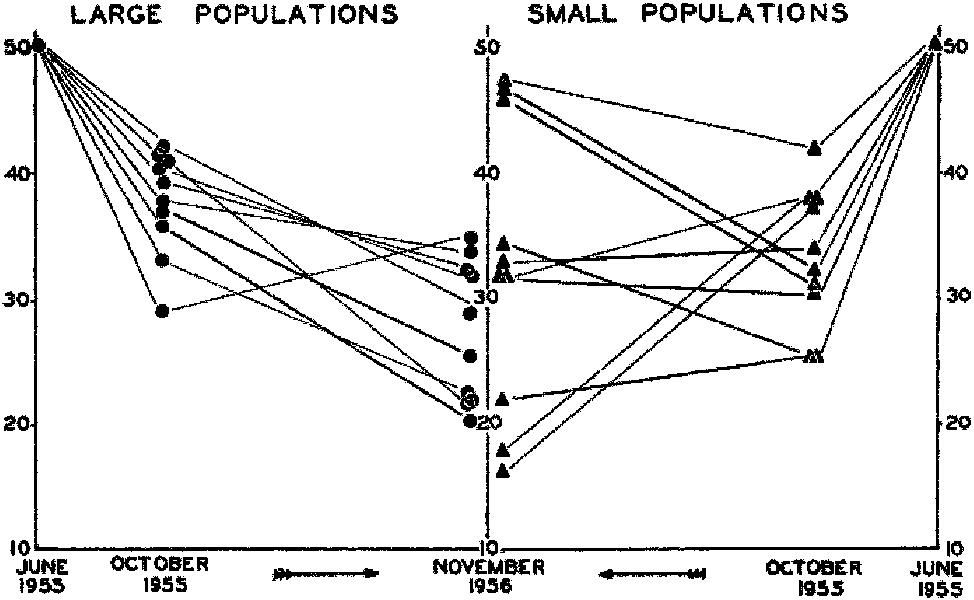
In the experiment, Dobzhansky and Pavlovsky recorded the effects of their manipulation by sampling the frequency of genetic types in each replicate population, once after 4 generations, and again after enough generations had passed for each replicate to reach equilibrium. Their results are summarized in Figure 2. In every replicate, the frequency decreased from the initial state. Also, each replicate reached a different equilibrium frequency. The most interesting result is the significant difference between the heterogeneity observed in small and large replicates; the variation in equilibrium frequencies in the small treatment is much greater than the variation in the large treatment (Dobzhansky and Pavlovsky Reference Dobzhansky and Pavlovsky1957, 316).
The initial frequency of large replicates is given on the left, and the initial frequency of small replicates, on the right (all 50% PP). The two samples, after four generations and after replicates reached equilibrium, are plotted from outside in. The equilibrium frequencies of the large and small replicates are compared on the center axis (from Dobzhansky and Pavlovsky Reference Dobzhansky and Pavlovsky1957, 315). The founder effect had a stronger influence in the small treatment.

Dobzhansky and Pavlovsky identified selection for a stable polymorphic equilibrium as the cause of the change in PP frequency from 50% to equilibrium within each replicate population:
Heterozygotes that carry a PP and an AR third chromosome are superior in adaptive value to the PP and AR homozygotes. Therefore, the frequencies of PP and AR chromosomes in the experimental populations are controlled by natural selection. (Reference Dobzhansky and Pavlovsky1957, 318)
They identified random drift, in the form of the founder effect, as the cause of the heterogeneous results produced by selection in both large and small replicates, and as the cause of the statistically significant difference between large and small replicates:
[R]andom drift caused different segments of the this gene pool to be included in the foundation stocks of each population, especially in the small ones; natural selection produced divergent results in different populations, especially again amongst the small ones. (Reference Dobzhansky and Pavlovsky1957, 317)
Their conclusions are expressed using causal language: selection “controlled” the equilibrium frequencies of chromosomes; drift “caused” different subsets of genetic variation to be included in the founding populations; the same selection pressure “produced” divergent results. They treated drift, selection, and their interaction as causes of the evolutionary change observed in replicate populations. They neither tried to decompose selection and drift into component forces, nor attempted to identify how selection and drift cause individual births or deaths. Instead, Dobzhansky and Pavlovsky manipulated the founding population size to test whether it altered the evolutionary changes produced by identical selection pressures.
According to MC, the founder effect is a cause of increased heterogeneity in the small treatment.Footnote 2 A similar conclusion probably holds for selection as well. For example, if a manipulation were to change the fitness structure (while controlling for population size) such that one homozygous type had the greatest fitness, then that type would fix in almost all replicates. Following MC, selection would be a cause of the increase in frequency. Thus, not only is scientific practice consistent with a causal interpretation of evolutionary theory, but the practice has a sound basis with MC.
4. The Noncausal Alternative
So far we have articulated the positive case for treating evolutionary processes such as selection and drift as causes of population-level change. Our thesis opposes the noncausal view of selection and drift favored by Matthen and Ariew (Reference Matthen and Ariew2002) and Walsh, Lewens, and Ariew (Reference Walsh, Lewens and Ariew2002). According to this view, the only causes of the evolution of a population are individual-level events, such as the myriad births, deaths, and reproductive events of the individuals within the population. It follows that selection and drift are not really causes of population-level change; they are merely statistical summaries of events taking place at the individual-level.
Advocates of the noncausal view may object to our philosophical interpretation of the Dobzhansky and Pavlovsky experiment. We claim that Dobzhanzky and Pavlovsky manipulated a population-level variable to test the effect of drift on replicate populations. Yet, there is an alternative description of the experiment such that the manipulation took place on individual-level causal factors, not population-level ones. On the alternative description, the manipulation of founding population size amounts to randomly picking particular individuals from the experimental stock. This manipulation causes some individuals to be in the founding population rather than others. Since the founding individuals of each replicate population differ in their individual genetic properties, the evolutionary trends observed in each replicate also differ. Choosing more founding individuals for large replicates than for small replicates has consistent downstream causal consequences for individual births and deaths occurring within each replicate. So there is a statistical difference between the large and small replicates, but this difference is caused by manipulating individual-level events, not by manipulating the strength of drift; ‘strength of drift’ is merely a label for the statistical difference between individuals in the large and small replicate populations.
This tactic of situating all of the causal action in evolution at the individual-level can be repeated for any purported manipulation of population-level causes. It is thus not only a threat to our interpretation of the Dobzhansky and Pavlovsky experiment, but to the second premise of our argument in Section 2. How should we respond to this threat? First off, we want to be clear that we readily accept that there are individual-level causes that operate in the Dobzhansky and Pavlovsky experiment. However, we think that in addition to these individual-level causes, there are also population-level causes, and that is what drift and selection are. Moreover, we maintain that it makes sense to describe Dobzhansky and Pavlovsky as having manipulated a population-level variable. There are three reasons for this.
First, the obvious reason to suppose that they manipulated a population-level variable is that their design for the experiment contains no description of individual-level variables. They adjusted founding population size without regard to which particular individuals were chosen for the founding population; so long as all large replicates had 4,000 founding members and small replicates had 20, they could test for the effects of this population-level manipulation. In fact, one reason for using multiple replicates is to wash out individual-level differences between treatments in order to get a clearer understanding of the population-level changes produced by the manipulation of founding population size.
Second, to deny the reality of selection and drift as macrolevel variables seems to involve an implicit metaphysical assumption that only microlevel variables have any causal reality. For example, Walsh, Lewens, and Ariew write that “the only genuine forces going on in evolution are those taking place at the level of individuals (or lower) and none of these (and no aggregate of these) can be identified with either selection or drift” (Reference Walsh, Lewens and Ariew2002, 453). We agree that no individual-level events or aggregate of such events can be identified with either selection or drift. The reason for this is that the grain at which selection and drift are described is multiply realizable by any number of possible individual-level causal histories. Yet the fact that these processes are multiply realizable does not imply that they are not real or that they are noncausal. Fodor (Reference Fodor1974, Reference Fodor1997) effectively defends the claim that there may be causal generalizations in the special sciences that supervene upon, but do not reduce to, causal generalizations at lower levels of analysis. Following Fodor, we suggest that whether there are causal generalizations at higher levels of analysis in biology is a question to be settled by scientific investigation, not philosophical reflection. Dobzhansky and Pavlovsky conduct just such an investigation. Given that they detected a systematic relationship between varying the strength of drift and heterogeneity of gene frequencies across replicates, why should they be barred from describing this relationship as a casual one?
Finally, and most importantly, if Dobzhansky and Pavlovsky had only manipulated their system at the individual-level, there would be no additional information gained by a population-level description of the manipulation. But, following a suggestion made by Jackson and Pettit (Reference Jackson and Pettit1992), we suggest that microlevel and macrolevel descriptions of the evolutionary process convey different information. Jackson and Pettit identify two types of information that may be provided by an explanation of an event. The first type tells us about the precise causes of the event as it actually occurred. The second type identifies parallels between the way in which the event actually occurred and the ways in which it might otherwise have been. They call the first type of information modally contrastive because it identifies differences between the actual world and other possible worlds. They call the second type of information modally comparative because it identifies similarities. Our contention is that selection and drift are not merely statistical summaries of individual-level events because descriptions of evolution that appeal to these processes provide modally comparative information not contained in individual-level descriptions.
If modally contrastive information were all that mattered to explaining an event, the most informative explanation would always be a description of the causal history of the event at the smallest microlevel available to us. For example, we could explain the evolutionary change of an actual population by describing the causal histories of the individuals within the population. (Or better still, we might attempt to describe the whole scenario at the level of fundamental particles.) Yet, we could be in possession of such information without knowing something important: namely, how sensitive the changes in the population were to those microlevel causal details. That is what modally comparative information provides. Kim Sterelny (Reference Sterelny1996) prefers to call modally comparative information robust-process information because it points to features of a causal outcome that resulted from a robust process such that those features would have turned out much the same even if the microlevel details had been different. Jackson and Pettit suggest that microdescriptions of an event tend to convey more modally contrastive information about it, whereas macrodescriptions tend to convey more modally comparative information. Macrodescriptions may thus contain information relevant to an event's causal history that is not contained within a microdescription of the same event. Dobzhanksy and Pavlovsky's experiment supports a macrolevel generalization involving two macrolevel variables: founding population size and the equilibrium gene frequencies. This macrolevel generalization provides modally comparative information about how drift and selection affect the downstream causal history of populations, information not contained in a microlevel description. Yet the experimental support for the macrolevel generalization is only evident once we see that Dobzhanksy and Pavlovsky manipulated their system at the macrolevel.
5. Conclusion
We have argued that the manipulation condition is a reliable strategy for identifying causal relations and that natural selection and random drift can be manipulated to produce different kinds of evolutionary change. It follows that selection and drift are causes of evolutionary change. To show that our causal interpretation of evolutionary processes coheres with the practices of evolutionary biologists, we examined an experiment conducted by Dobzhansky and Pavlovsky and argued that their experiment is best understood as manipulating the causal strength of drift to test its effects on subsequent evolution. Most biologists and philosophers are already comfortable using causal language to describe the influence of selection and drift on populations. They need not change their ways.