Nosocomial infections are an important reason for increased morbidity and mortality among patients in hospitals and, specifically, intensive care units (ICUs).Reference Boev and Kiss 1 The hands of healthcare workers (HCWs) are generally considered the most important source of transmission of hospital-acquired infections (HAIs).Reference Allegranzi and Pittet 2 Pathogens can be acquired on hands after contact with patients or with contaminated environmental surfaces. Many Gram-positive and -negative bacteria and fungal pathogens can persist for weeks to months on dry surfaces.Reference Kramer, Schwebke and Kampf 3 It has also been estimated that among device-related nosocomial infections, 20%–40% of pathogens are transmitted via HCW hands.Reference Weinstein 4 As such, good hand hygiene among HCWs is paramount to reducing the spread of pathogens. Despite the evidence showing the efficacy of regular handwashing to curb the transmission of pathogens from HCWs to patients, a significant problem remains with generally low compliance rates among HCWs regarding hand hygiene protocols. The introduction of alcohol-based hand rubs has helped improve compliance with hand hygiene practices,Reference Bischoff, Reynolds and Sessler 5 – Reference Maury, Alzieu and Baudel 6 largely due to the time savings of hand sanitizer application versus handwashing with soap and water.
Alcohol-based sanitizers have excellent activity against resident and transient skin microbiota and are recommended for routine hand antisepsis by the Centers for Disease Control and Prevention.Reference Hugonnet, Perneger and Pittet 7 However, alcohol-only sanitizers are short acting and confer no sustained antimicrobial activity. Chlorhexidine gluconate (CHG) has traditionally been used for skin antisepsis because it has broad-spectrum activity against Gram-positive and Gram-negative bacteria, yeasts, and enveloped viruses. Importantly, CHG also has persistent activity for several hours after application, which builds up with repeated use. The objective of this study was to use the rigor of a randomized, controlled trial to compare the immediate and persistent activity of 2 alcohol-based hand sanitizers (with and without CHG) when used in an ICU setting.
METHODS
This randomized, double-blind trial (NCT02258412) used a crossover design in which 2 hand hygiene products were compared: (1) hand sanitizer containing ethanol (61% w/w) plus chlorhexidine gluconate (1% solution; Avagard, 3M, Maplewood, MN ) and (2) hand sanitizer containing ethanol (70% v/v; Purell Advanced Foam, Gojo, Akron, OH). Participants used both hand hygiene products with a washout period between products. The study was conducted in 3 ICUs at a teaching hospital and was approved by the Institutional Review Board of the Cleveland Clinic. Informed consent was obtained from each participant. The HCWs involved with direct patient care (ie, registered nurses, residents, fellows, senior technicians, and attending physicians) were eligible to participate in the study. The HCW subject numbers were randomized to the order of product used. Randomization was achieved using a computer-generated treatment order with a block size of 10.
Eligible participants were not to use any CHG-containing products in the 72 hours prior to the study. The HCWs were randomly assigned to either ethanol-plus-CHG or ethanol-only hand hygiene products. On the first day of the study, after washing their hands with nonantimicrobial soap and water, each HCW applied the assigned product evenly to cover both hands until completely dry. The test products were dispensed through automated dispensers to deliver a single uniform volume of sanitizer. Both products are commercially available and were used according to the instructions on the manufacturer’s label.
To assess the efficacy on the resident microbiota, the nondominant hand was imprinted after using the hand sanitizer onto a nonselective tryptic soy agar handprint plate containing 0.01% lecithin and 0.5% polysorbate 80 to neutralize CHG (neutralizer incorporated into agar). This hand was then covered with a white cotton glove to avoid transfer of neutralizers to the other hand. The HCWs were then allowed to continue with their daily routine duties (eg, charting, keyboarding, phone calls, etc) in the ICU common areas. To assess the persistent efficacy of the sanitizers on the transient microbiota after spending time in the ICU common areas, HCWs provided an imprint of the ungloved dominant hand on a fresh agar plate, prior to leaving the area or entering a patient room. More than 3 days after the first participation (ie, the washout period), each HCW was invited to participate in the second arm of the study using the alternative product. Adverse reactions volunteered by the HCWs were collected. A formal medical evaluation was not planned.
All handprint plates were incubated at 35±2°C for 24±4 hours and observed for growth, and digital photos were taken. Image-Pro Premier was utilized to count the colonies. The numbers of aerobic colony-forming units (CFU) were compared for the 2 groups after log transformation. In addition, bacterial colonies consistent with staphylococci, enterococci, and Gram-negative bacilli were subjected to identification and susceptibility testing for methicillin-resistant Staphylococcus aureus (MRSA), vancomycin-resistant Enterococcus (VRE), and fluoroquinolone-resistant Gram-negative bacilli, respectively using standard microbiological methods. The HCWs were blinded to the product used (ie, product names were obscured and similar dispensers were used) although there were some physical differences in the products. The investigator measuring the CFUs and area of bacterial growth within each hand print was blinded to the products, as was the statistician.
The effectiveness of the neutralizer (ie, 0.01% lecithin and 0.5% polysorbate 80) for CHG was verified in an independent, third-party neutralization verification study using a method adapted from ASTM E1054-08 (2013): Standard Test Methods for Evaluation of Inactivators of Antimicrobial Agents. Serratia marcescens ATCC 14756 was used as a marker organism. The neutralizers were found to be effective and nontoxic (data not shown, available upon request).
Statistical Analysis
Colony-forming units were converted to log10 CFU to stabilize the variance (mean log10 CFU ± standard error of the mean). Differences between the treatment groups were assessed using t tests and Mann-Whitney U tests for continuous measures and Fisher exact tests for categorical measures. A P value < .05 was considered significant. Any identification of drug-resistant organisms was summarized. A sample size of 45 subjects using both treatments provided 80% power to detect a change of 0.3 log10 (doubling of CFU). Statistical analyses were performed using SAS version 9.2 software (SAS Institute, Cary, NC).
RESULTS
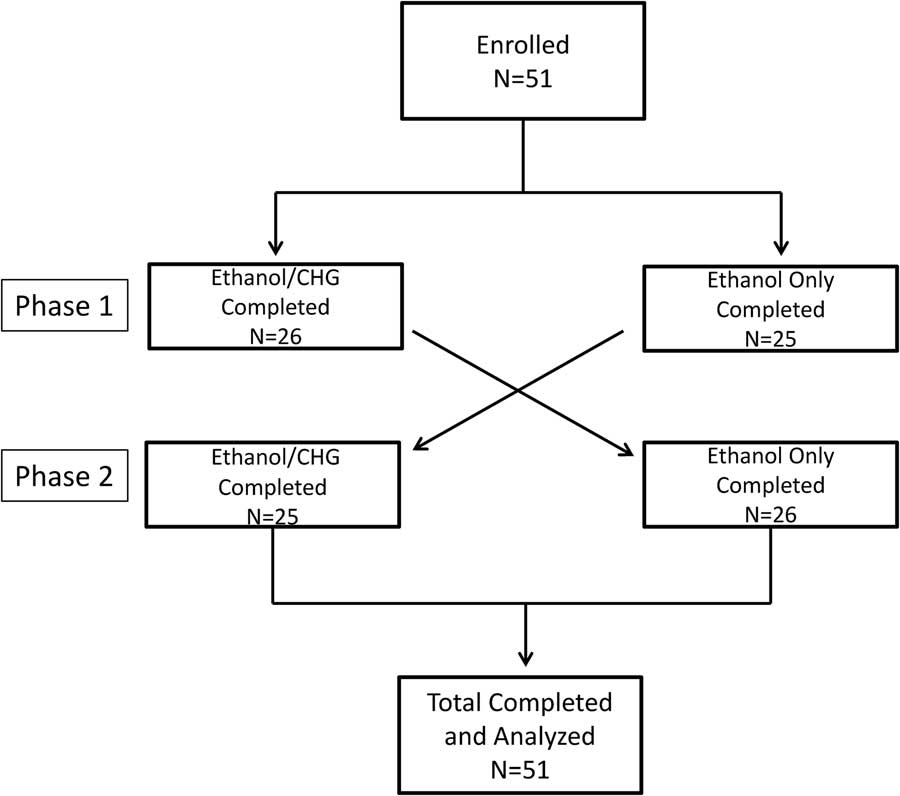
A total of 51 HCWs from the 3 study ICUs entered the study and all completed testing for both products. The randomization of HCWs to each product is shown in Figure 1. Both sanitizers were well tolerated, and there were no reports of increased skin irritation or dryness. The duration of time spent by HCWs in the ICU common area prior to HCW handprints being sampled for persistent efficacy was 4–7 minutes.
CONSORT flow diagram depicting the flow of participants through the crossover trial.

Immediate Efficacy
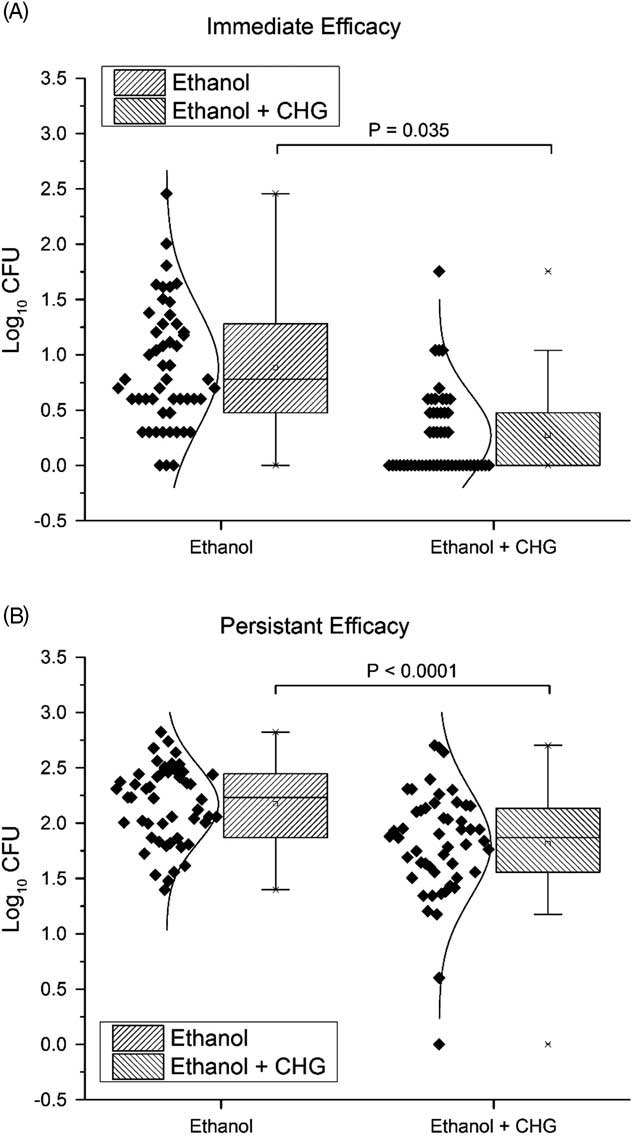
In comparison to the ethanol-only product, use of ethanol plus CHG was associated with a significantly lower recovery of aerobic CFU counts after immediate use of the hand sanitizers (0.27 ± 0.05 log10 CFU vs 0.88 ± 0.08 log10 CFU; P = .035) (Figure 2A).
(A) Box plot comparing the recovery of aerobic colony-forming unit (CFU) counts after immediate use of ethanol-only and ethanol-plus- chlorhexidine gluconate (CHG) hand sanitizers. (B) Box plot comparing the recovery of aerobic CFU counts of ethanol-only product and ethanol-plus-CHG hand sanitizers after spending time in the intensive care unit (ICU) common areas. Box plots depict the median (thick horizontal line), first and third quartiles (box), maximum and minimum values (whiskers), and outlying values (cross mark). The individual data points (diamonds) and their distribution curve is provided to the left of the box plot.

Persistent Efficacy
In comparison to the ethanol-only product, the use of ethanol plus CHG was associated with a significantly lower recovery of aerobic CFU counts (1.81±0.07 log10 CFU versus 2.17±0.05 log10 CFU; P < .0001) after spending time in the ICU common areas (Figure 2B).
Antibiotic-Resistant Organisms
No methicillin-resistant S. aureus (MRSA), vancomycin-resistant enterococci (VRE), or fluoroquinolone-resistant Gram-negative bacteria were isolated immediately after use of either sanitizer. However, after spending time in the ICU common areas, 6 isolates of MRSA (1 in the alcohol plus CHG group and 5 in alcohol only group; P = .20) and 5 isolates of fluoroquinolone-resistant Gram-negative bacteria (Klebsiella, Pseudomonas spp; 2 in the alcohol plus CHG group, and 3 in the alcohol only group; P =1.0) were detected. No vancomycin-resistant enterococci were isolated. Overall, 3 participants in the alcohol plus CHG group had hand contamination with ≥1 of the resistant pathogens versus 8 in the alcohol-only group.
DISCUSSION
Use of alcohol-based hand sanitizer before and after patient contact is recommended to reduce the risk for transmission of pathogens in healthcare settings. In the current study, use of a hand sanitizer containing ethanol plus CHG was associated with significantly lower aerobic bacterial counts on hands of HCWs, both immediately after use and after spending time in ICU common areas. Moreover, we observed a trend toward less frequent acquisition of antibiotic-resistant pathogens on hands in the ethanol plus CHG group. Both products used in the study are commercially available and were used in line with the instructions on the label under real-world clinical conditions. Our findings suggest that the addition of CHG to alcohol-based hand sanitizers could be an effective approach to enhancing and extending the duration of antimicrobial activity.
Alcohols are very fast acting on a wide variety of pathogens and are recommended for routine hand antisepsis in healthcare facilities. Persistent antimicrobial activity may be beneficial for HCWs involved with patient care because flora on the skin regrows over time following the use of an alcohol-based sanitizer alone. An additional concern is the acquisition of bacteria on hands after contact with inanimate objects such as telephones and keyboards. Our findings are consistent with previous studies demonstrating that the persistent antimicrobial activity of CHG may be beneficial in reducing bacterial contamination on hands for up to several hours after application. 8 Also, after repeated use, CHG accumulates on skin, resulting in increased immediate bacteriocidal effects (cumulative efficacy).
In studies of CHG on bacterial activity, results can be skewed to show artificially high bacterial load reductions due to the continued bacteriocidal activity of CHG in the sampling medium.Reference Olson, Morse, Duley and Savelle 9 For this reason, an independent verification of the neutralization of CHG in our sampling medium was conducted, which confirmed that the neutralizer used in this study was both effective and nontoxic. Some antiseptic products or lotions contain thickeners or emulsifiers that dramatically reduce the persistent activity of CHG.Reference Kampf, Reichel, Hollingsworth and Bashir 10 , Reference Kaiser, Klein, Karanja, Greten and Newman 11 Therefore, when using hand sanitizers containing CHG, it is important that other products applied to the hands are compatible with CHG.
Our study has several limitations. A crossover design was chosen due to the heterogeneity (lack of uniformity) among HCWs. However, each HCW served as his or her own control, which reduced variation and increased study power. The study was not powered to detect a difference in hand contamination with resistant bacterial pathogens. Nevertheless, there was a trend toward a reduction in acquisition of resistant bacteria on hands of the ethanol plus CHG group in comparison to the ethanol only group. Bacterial contamination was assessed using agar hand prints rather than the glove juice technique. The latter technique is more effective in recovering a complete bacteria burden simply because it recovers bacteria from the entire hand, including between the fingers, the top of the hand, and the fingernails, whereas the handprint method only provides bacteria information from the bottom of the hand. The study was conducted in the ICU common areas. The hand cultures obtained after spending time in the ICU common areas were taken after only ~4–7 minutes rather than the 6 hours typically used in volunteer studies to assess persistence. Studies are needed that have longer periods of follow-up and involve patient rooms. Finally, it should be acknowledged that there is considerable debate regarding the value of adding CHG to alcohol-based surgical scrubs and hand sanitizers, including the potential for developing acquired resistance to CHG.Reference Macinga and Edmonds 13 – Reference Kampf 17 Additional studies are needed to provide a more complete assessment and understanding of the risks and benefits of this approach in ICUs and high-risk patient areas.Reference Kampf 17
In conclusion, this study demonstrates that alcohol-based hand sanitizer containing CHG is associated with significantly lower aerobic bacterial counts on the hands of HCWs (compared with sanitizer without CHG), both immediately after use and after conducting normal activities in ICU common areas. Further studies are needed to determine whether the use of CHG-containing sanitizer results in sustained antimicrobial protection against healthcare-associated pathogens.
ACKNOWLEDGMENTS
The study was designed in collaboration between the sponsors and authors. The sponsors had no role in study conduct and implementation, data collection, data interpretation and decision to publish.
Financial support: The study was funded by 3M.
Potential conflicts of interest: A.D. has received research funding from Steris, 3M, and Clorox. C.J.D. is on the advisory board of 3M and has received research funding from Gojo, Ecolab, and Clorox. S.D. is on the advisory board of 3M. All other authors report no conflicts of interest relevant to this article.