In 1944, a small group of Scottish architects were tasked with crafting a plan for the Edinburgh region's development, as part of a larger effort to meet the economic and social needs of Scotland's population through postwar reconstruction and state welfare. Commissioned by the charismatic Secretary of State Tom Johnston, the “uncrowned king” of Scotland during World War II, and lead by Sir Frank Mears, a prominent urban planner (and both a follower of and son-in-law to the great Edinburgh urbanist and sociologist Patrick Geddes), the team was allocated the whole of the Forth Valley to survey, a region that, like the rest of Scotland, had weathered economic decline and rural depopulation. Meanwhile, in Glasgow a larger team was given the more prestigious and demanding job (because of its region's larger population and industrial importance) of developing a plan for the Clyde Valley.
Like government planners working elsewhere throughout this period, both teams embraced the task of generating and applying social knowledge, at a very large scale, in order to produce change (see Rabinow Reference Rabinow1989). When it was issued in 1948, the Forth Valley report included recommendations for the planned “redistribution of the people,” increased coal mining, and the expansion of infrastructure, especially electrification, to fuel a broad economic and social revival of the region (Mears Reference Mears1948: 39–42; see Finlay Reference Finlay2004: 200–8). However, the Forth Valley planners also produced a document strikingly more concerned with history, solidarity, and local political traditions than with the rationally composed, orderly modernity stereotypically associated with planners and their plans (Holston Reference Holston1989; Scott Reference Scott1999; Mitchell Reference Mitchell2002). Their report emphasized “renucleation” around historic “burghs” to strengthen existing patterns of settlement and included sections that described the traditional ways of life, civic institutions, and building styles of southeastern Scotland's fishing villages and small burghs (Mears Reference Mears1948: 135–39, 147–48; see Glendinning, MacInnes, and MacKechnie Reference Glendinning, MacInnes and MacKechnie1996: 434). These planners drew from a Geddesian planning tradition that treated regions as comprised of varied geographical, social, and political forms in interaction (Tomaney Reference Tomaney and Miller2005), while extending Geddes’ own vitalist concern with “planning for evolution” (Khan Reference Khan2011). Overall, their report paid well-nigh ethnographic respect to what one of their number, the Edinburgh architect Robert Hurd, described elsewhere as the Scottish burghs’ “general homely air of self-respect” (Reference Hurd and Meikle1947: 182).Footnote 1
The Forth Valley plan was ultimately overshadowed by the more wide-reaching and radical proposals of the Clyde Valley planners, which set forth a program of urban de-concentration and new-town development embracing the whole of the central belt of Scotland. However, the Forth Valley document remains important because it provides a clear example of the kinds of historicist knowledge, aesthetic judgments, and affective attachments that politicians and experts routinely worked into the very modernist projects and plans of a rationalizing government in Scotland in these years.Footnote 2 Moreover, for the Forth Valley planners, the application of knowledge and formal innovation were not only modernist aesthetic imperatives, but also were intended to serve a wider revival of a historic, rooted, and distinctively Scottish socio-political order. In this article, I examine this combination of modernist technique, historical consciousness, and attention to form in the career of one member of the Forth Valley planning team, Robert Hurd (1905–1963), a nationalist intellectual, architect, and now-forgotten but then-prominent public figure (see Image 1).
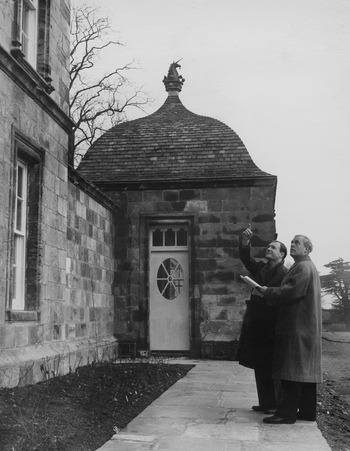
Robert Hurd (on right, with papers) and his associate Harry Bunch in front of the Culross Abbey House, 1955. © Courtesy of Historic Environment Scotland (Hurd Rolland).

Hurd was a noted historic-conservation architect who also designed power stations and housing developments in the Highlands and southeastern Scotland, and wrote popular essays and radio broadcasts on the Scottish architectural tradition. He was sometime president of the Saltire Society, Scotland's leading cultural association, and a founding member of the Scottish National Party (currently in government in Scotland). Beyond party affiliation, Hurd was a nationalist in a broad sense, advocating the political independence of Scotland as a necessary, but not sufficient, precondition for a “perfected state of national being” (Handler Reference Handler1988: 6). A skilled interpreter of modernist idioms in architecture and a proponent of formal “experiment and independence” (Hurd Reference Hurd and Allan1938: 127), Hurd also maintained both political affiliations and aesthetic opinions of conservative and rather aristocratic stripe, not least in his cultural work to promote, through the Saltire Society, “the best” of Scotland's traditional arts and crafts.Footnote 3 Most importantly for my purposes, in the 1950s he spearheaded a comprehensive reconstruction of Edinburgh's historic Canongate, near where the new home for the revived Scottish parliament was built at the turn of this century.
Hurd's contributions as a nationalist and a planner to “building Scotland” (a phrase he used as an essay-title more than once) are also worth revisiting because they pose an interpretive challenge to recent approaches in political anthropology, especially the turn to border-crossing, scale-less infrastructures, and material assemblages as sites of both study and explanation. Recently, the “material turn” in political anthropology has staked its analyses to open-ended, unbounded, iterative processes of assembly and interaction operating upon discrete, heterogeneous bodies. Questions that previously might have involved a focus on publics, audiences, citizens, and even nations, as relatively bounded and organized “groups,” have instead been framed by pluralizing, massifying, ramifying concepts like “networks, crowds, swarms, infrastructure, the multitude” (Hirschkind, Abreu, and Caduff Reference Hirschkind, de Abreu and Caduff2017: S6). In Brian Larkin's recent critical formulation, “The material turn has tended to prefer [the] unformed [and its] synonyms: matter, material, objects, or things” (Reference Larkin2015). These observations indicate that significant questions of political form have been left open—not least, of the “nation-form” (Balibar Reference Balibar, Balibar, Wallerstein and Turner1991).
To be sure, there are good critical reasons to opt, interpretively, for sociohistorical openness and contingency in process and inter-action. Many scholars who study infrastructures, flows, and complex, multi-scalar interactions explicitly aim at conceptual innovation beyond the categories of “conventional political analysis” such as state, nation, people, and even region, and seek to capture a real eclipse of the kinds of social organization to which these terms refer (Knox Reference Knox2017: 380; Barry Reference Barry2013; Harvey, Bruun Jensen, and Morita Reference Harvey, Jensen, Morita, Harvey, Jensen and Morita2017). Such categories, however, are not only mystifying and obscuring, offering a misplaced or simply anachronistic concreteness in place of real, violent, and materially-ordering processes that work across scales and boundaries. They also describe points of affective identification and practical political engagement, and as they are mobilized in particular contexts they become a means of granting knowable, workable form to always-diffuse relations, circulations, and interactions (Coleman Reference Coleman2017: 15; Strathern Reference Strathern1996: 530–31; Cody Reference Cody2011). Overall, the anthropology of infrastructure's analytic commitment to the micro–level of assembly and interaction has resulted in a concomitant “macrophobia,” as Michał Murawski (Reference Murawski, Bille and Sørensen2016) has put it: a near-total rejection of the material and symbolic effects of form and scale, what we might call architectural effects.
By contrast to recent anthropological descriptions of infrastructure, Hurd's planning work involved more than just laying out roads, wires, pipes, and material connections; he also configured them into ensembles that, he hoped, might express historic solidarities and foster renewed belonging. Across his critical writing and preservation work, Hurd focused closely on Scottish examples and exemplars, survivals from a national past that could inform constructive work in a present that, for his depression-era generation, threatened to foreclose future growth and change. Hurd promoted a sense of architectural form as something that emerged, or evolved, in response to shifting social needs, but that also contained and conveyed particular cultural and political values, demanding aesthetic discernment and careful preservation to sustain those values.
To borrow a phrase, Hurd was an “artisan of nationalism,” someone whose career involved giving “praxical substance to conceptually abstract formulations like the nation, while also articulating schemes and settlements of cultural knowledge and difference” (Boyer and Lomnitz Reference Boyer and Lomnitz2005: 105, 107). His political activities, architectural writings, and restoration work together reveal the formal and intellectual labor that went into making spaces that remain affectively powerful and materially durable sites of Scottish national identity. They also allow instructive comparisons with the work of planner-architects in other contexts, both postcolonial and socialist (Hull Reference Hull2011; Murawski Reference Murawski, Bille and Sørensen2016; Zarecor Reference Zarecor2011), and with the moral discourses of nation and solidarity that still infuse even the most apparently material regimes of heritage preservation (Muehlebach Reference Muehlebach2017; Collins Reference Collins2012).
Through this critical biographical account of Hurd as an architect, political activist, and intellectual, I seek to explore how personal affiliation with and cultivated affection for place and nation can be given form, organized into patterns, narratives, or dramas with specific densities, symmetries, centers, and repetitions (see Abu-Lughod Reference Abu-Lughod2005). These are precisely the registers on which cultural intellectuals and “artisans of nationalism” like Robert Hurd do their work.
In what follows, I first discuss briefly some comparative debates about nationalism, its sources, and its narratives, which explicitly oppose the rationality of government to mythic constructions of legitimacy (I do not address here influential debates about how Scottish nationalism reflects unevenness in capitalist development).Footnote 4 I then move on to a biographical sketch that traces the origins of Hurd's dual career in nationalism and architecture. In the two sections that follow I examine his efforts to foster support for “good design” and, through experiment and innovation, “rescue Scotland … from provincialism” (Reference Hurd and Allan1938: 127). I explore in detail Hurd's attention to “the small burgh” as a wellspring of formal and political resources for reviving both national politics and architecture, and his interventions in the Canongate to give form to a new, urban conviviality. In the Canongate, Hurd undertook a typically modernist task of clarifying spatial relations, disaggregating functions, and speeding circulation. Stylistically, meanwhile, his new buildings there were exemplary of a vernacular modernism then predominant in Scottish architecture: simple volumes massed together and clad in rough materials, frequently with odd asymmetries or distinctive features emerging from the needs of the architectural program and yet also putting a recognizable stamp upon utilitarian structures. But Hurd invested this program and style alike with great significance, as a renewal of an old Scottish way of building and a way of cleaving to Scottish tradition while shaping new, modern possibilities and potentials—not least, possibilities of independence. That is, he used modernist architectural forms to shape and convey national knowledge in ways that affected both.
MYTH AND FORM
Scottish national culture, political institutions, and folklore have of course been romanticized and ironized in just about equal measure since at least Walter Scott.Footnote 5 Scotland offers the type-case of the pseudo-historical, but legitimating, “invention” of national traditions and elaboration of “whiggish” narratives of national moral progress. Both the putatively “organic” traditions and whiggish narratives at stake in these legitimating narratives have been debunked by historians and sociologists (Hobsbawm and Ranger Reference Hobsbawm and Ranger1983; Trevor-Roper Reference Trevor-Roper2008; McCrone Reference McCrone1992). But the very idea of the “invention” of tradition poses anthropological questions that it cannot, on its own historicist terms, answer: Why does such historical fakery or ideological storytelling have any hold whatsoever on people who usually know their own lives and histories better than the pedagogues and intellectuals who retail nationalized, simplified versions of them? How can such openly ideological work support any consensus about the legitimacy of institutions, let alone a sense of solidarity and common destiny adequate to generate the passions and often bloody conflicts of nationalism (Feeley-Harnik Reference Feeley-Harnik1985: 306; Calhoun Reference Calhoun1993; Eriksen Reference Eriksen1993)?
Informed by just such questions about the mysterious efficacy of a nation's myths and inventions, another body of work has sought to examine how imperial histories and racial ideologies, often taking shape as hidden truths, awkward complicities, or secrets, fuel both horizontal solidarities and hierarchical distinctions (Stoler Reference Stoler1995; Herzfeld Reference Herzfeld2005; Steinmetz Reference Steinmetz2007). These analyses are particularly relevant to the conservative, aesthetically minded, and even somewhat romantic nationalism of a figure like Hurd, in particular as he described the evolutionary emergence, threatened loss, and modern renewal of a distinctively Scottish architectural tradition over time. In the Scottish case, moreover, it is worth noting that a conservative unionism and imperialism both have been important, if seemingly paradoxical, foundations for articulations of Scotland's national identity and cultural distinctiveness; Scotland's role within Britain's union state and empire has been as central to national self-understandings as its historic independence and separate institutions (Kidd Reference Kidd2008; Colley Reference Colley2014).
In his lectures “Society Must Be Defended,” Michel Foucault offered a distinctive account, in this vein, of the formation of the nation-state in Europe as a product of interactions between distinct and even contradictory “grids” of knowledge imposed on bodies and territories alike. The first grid was comprised of now-familiar Foucauldian governing projects and statist knowledges; but the other was formed differently, and involved stories of struggle, conquest, and historic defeats. Such stories, Foucault argued, were originally devised to defend, or commemorate, aristocratic rights threatened by monarchical power and revolutionary fervor alike (Reference Foucault and Macey2003). An originally marginal, counter-revolutionary historiography that recalled in mythic terms the struggle for survival of an aristocracy, and tied political legitimacy to a threatened inheritance of blood and honor, provided an idiom for later narrations of the nation in terms of race and security (see also Balibar Reference Balibar, Balibar, Wallerstein and Turner1991). Such narrations—“historically anchored and [originally] politically decentered” (Foucault Reference Foucault and Macey2003: 53)—were rehearsed and repeated in ever-more strident tones across the nineteenth century, first as quasi-ethnographic accounts of a noble past, then in scientific racism, and finally by a new aristocracy of (colonial) bureaucrats. Such discourses helped give discrete form and local substance to the limitless infrastructures of disciplinary power, making them operate for a given population and against another (see Steinmetz Reference Steinmetz2007). Foucault argued, thus, that neither the liberal state's own legitimating myths of mutual recognition and common progress, nor the material circulation and increase of goods, could explain the historical formation of solidary nations. Rather, attention should be paid to disavowed and subjugated aristocratic and counter-revolutionary historiographies of struggle, conquest, subordination, and survival, not because these were more true or less ideological, but rather because they were, differently, effective at marking boundaries and enforcing distinctions (Foucault Reference Foucault and Macey2003; Valverde Reference Valverde, Dillon and Neal2008).Footnote 6 We might think here of antiquarian accounts of Scotland's aboriginal races as the true Britons, or of their political survival in the face of Roman or Norman invasions, and also more up-to-date nationalist narrations of the history of Scotland as one of conquest and clearance (Kidd Reference Kidd2016).
We would be entirely wrong to think, Foucault argues, that knowledge of the deep past of a nation, of its “dark” “violent” and struggle-filled antiquity, constitutes “a sad, gloomy discourse, a discourse for nostalgic aristocrats or scholars in a library.” Such a historical narrative, rather, directly contributes to modern political powers’ organization into bounded nations because it “twins subtle knowledge and myths that are—I wouldn't say crude, but they are basic, clumsy and overloaded” (Reference Foucault and Macey2003: 56). This combination (of subtle and clumsy, which is itself a formal distinction) is what for Foucault helps turn a politically-marginal historical and social schema crafted for a solidary, beleaguered aristocracy into a “discourse of a centered, centralized, and centralizing power” (ibid.: 61): namely, that of the race-nation.
Ann Stoler (Reference Stoler1995) picked up on Foucault's point about the solidarizing efficacy of historical narratives of conquest and always-threatened defeat to argue that it was in the project of imperialism (not solely within the bounds of the state-nation) that European ruling classes came to recognize a commonality with the masses “at home,” making way for the emergence of the people as a nation, united in their common difference from the colonized. In a kind of mirror-image of this last argument, Gyan Prakash (Reference Prakash1999) has shown that anticolonial Indian nationalists did not just construct an image of the Indian nation by borrowing from the repertoires of liberal imperialism or European nationalism, but first crafted an “image of the archaic”—that is, a history of India's own subjugated traditions and antique institutions—to provide, at once, historical grounds, political boundaries, and a mythic charter for their scientific, constitutional, and infrastructural project of nation-building.
Each of these critical accounts of knowledge of race and nation in modern times—knowledges of distinction and difference, above all—emphasizes the formal and mythopoetic features of accounts of belonging, shared distinction, and common difference: marking (spatial and racial) divisions and forging (temporal) continuities between past and present. In Stoler's gloss on Foucault's formal point above, it is the combination of “erudite and subjugated knowledges”—in tales of historic struggles that also hint at present threats to privilege and status—that guarantees such a discourse's “broad dissemination and wide appeal” (Reference Stoler1995: 64). Stoler further stresses that the effectiveness of this discourse depends on the familiarity of its modes, comprised of “distillation[s] of earlier discursive imprints, remodeled in new forms” (ibid.: 68).
Following these accounts, the power of national histories and myths of commonality is neither to be accounted for by the “thin,” ideological, but wide-recruiting traditions they promote (Hobsbawm's notion), nor by the sense of individual power and participation they enable for the citizen (Hearn's Reference Hearn2002 contribution, building on Cohen Reference Cohen1996), nor by democratic institutions’ legitimating claims of recognition and representation (the “whiggish” story). Instead, the power of an “invention” comes precisely from its clumsy, overloaded rhetoric, its “partiality,” limited appeal, and affectively-rich distortion of familiar modes. As we will see, these are all formal features that Hurd found in abundance in the Scottish architectural past. The general point is that such features come together to mark out distinctions, enforce divisions, and help create symbolic and material pivots around which lives and (political and bureaucratic) careers can turn.Footnote 7 Careers, perhaps, like Robert Hurd's, spanning planning and preservation and nationalism.
INDIGENOUS TO MODERN SCOTLAND
Robert Hurd's pathway to Scottish nationalism was somewhat less direct than we might expect, beginning with youth in England, winding through aesthetic cultivation at Cambridge and an apprenticeship in urban planning in Edinburgh, and ending up firmly within Scotland's civic and aristocratic establishment. Hurd was a younger son of a prominent English and Tory political family, with a connection to Scotland through his Dundee-born mother, the daughter of a Presbyterian minister (admittedly, a pretty strong and almost stereotypically Scots connection). He was educated at Marlborough, an English public school, and after taking some classes in architecture in London he went to Cambridge where, through his schoolmate Ian Gordon Lindsay (later an important historic-conservation architect in Scotland) he became a part of the circle around the literary scholar and aesthete Mansfield Forbes.Footnote 8
Forbes was a founder, with the critics I. A. Richards and F. R. Leavis, of the modern study of English literature at Cambridge University as a national literature and a vehicle for moral cultivation, and he had special antiquarian and folkloric interests in Scotland. Forbes's biographer Hugh Carey writes that “he was widely reputed to know more about Scotland than anyone else [in Cambridge, presumably], its archaeology and architecture, history and folklore, but the donkey-work of writing it down never appealed to him; to fire others with a like enthusiasm, in conversation and with pictures spread all over the floor … seemed much more purposeful” (Reference Carey1984: 52).
Forbes presided over a salon in Cambridge at his elaborately redecorated house, “Finella,” which was a “gathering place for young architects” and itself an exemplar of a “narrative [and] symbolic modernism” (see Darling Reference Darling2011: 127–28). He appears to have encouraged Hurd, in much the way Carey describes, to cultivate his own interests in Scotland. The two of them are said to have spent a summer together walking from Aberdeenshire to Edinburgh, studying medieval ruins, and it is likely that Hurd gleaned much from Forbes's aesthetic preferences and his connoisseurship of Scottish architecture.Footnote 9 However much (or little) education he gained from Forbes, Hurd ultimately decided to settle in Edinburgh and complete his architectural training there.
In Edinburgh, Hurd became an apprentice to Frank Mears, the Geddes-related planner-architect he would later work with on the Forth Valley plan, and from the very first he was active in intellectual, nationalist circles, carving out a niche for himself as a writer on architecture and planning. He published essays with other young and cosmopolitan Scottish intellectuals, sharing with them a concern for “good” design and a rather conventional modernist disdain for nineteenth-century popular romanticism, which he and others also routinely dismissed as inauthentic expressions of a dominated Scottish culture. His early article “Building Scotland” (Reference Hurd and Johnson1932) appeared in a volume that included George Scott-Moncrieff's famous article “Balmorality,” a broadside against Scotland's loss of self-confidence and reduction to aesthetic self-parody under (and within) British imperial power. Hurd's contribution is a general account of Scotland's “native tradition” in architecture, and he argues that by drawing on this tradition, planners and architects could develop a modern, yet authentically Scottish and morally purposeful, approach to problems of urban planning.
In addition to maintaining connections with Scotland's young bohemia and intellectual set, Hurd also moved in Edinburgh's conservative and aristocratic society. Both the bohemian and the aristocratic groups decamped occasionally to Highland estates and remote island villages, and Hurd himself vacationed on Iona, with its artists’ colony, and visited maternal relatives who had retired near Fort William, while corresponding on intimate terms with landed aristocrats and visiting their estates. Throughout his career he remained somewhat distant from Glasgow's parallel intellectual and political circles with their own, more industrial, class-conscious, and self-consciously rationalist approach to questions both of planning and politics.
In 1932, Hurd joined a smattering of aristocratic landowners, worthies, and conservative cultural intellectuals to found the Scottish Party. This nationalist grouping was meant to provide a conservative counterweight to the National Party of Scotland (NPS), itself founded by student activists only a few years earlier. The Scottish Party was distinguished from the more radical NPS by its emphasis on Scotland's ongoing role in the British Empire; Scottish Party members compared Scotland's constitutional situation unfavorably with the self-rule recently won by white settler dominions in the British Commonwealth, like South Africa and Australia, and promoted a vision of Scotland as an independent “mother country” of empire (Mitchell Reference Mitchell1996: 181–82; Finlay Reference Finlay1994: 93–99). The Scottish Party was, however, very short lived and merged with the NPS in 1934 to form the Scottish National Party (SNP).Footnote 10 Hurd stayed active in the SNP long after the merger, unlike many of the former adherents of the Scottish Party, and only resigned in 1943 when the SNP split over wartime conscription and other issues.
Through all this, Hurd was building an architectural practice of his own in partnership with Norman Neil, and in the mid-1930s they developed a daring (for Edinburgh) set of luxurious mansion-block flats at Ravelston Gardens, with three four-story butterfly-plan buildings in white concrete set in a row. While some authors think that Hurd himself had little hand in the design of these flats, since they show scant reference to the Scottish traditions he is better known for writing about, they are clearly related to the modernist strand of his intellectual and political work, and are echoed in designs elsewhere in his career.
In fact, Hurd's first serious publication, while he was still a student in England, was a review in Architects’ Journal of the “functionalist” architecture at a Swedish trade exhibition (Reference Hurd1930). He travelled to Stockholm to inspect at first hand the light aluminum and glass pavilions in a variety of unusual forms, with their brightly colored awnings wrapping around spherical restaurants and towers of electric signs, and he reported on them with unstinting enthusiasm. His later restaurant and commercial interiors in Edinburgh would adopt just such a Scandinavian modernism, with patterned hangings and spare furnishings in wood and laminate, while late in life he consistently praised the structural lucidity of such modernist temples as dams and powerhouses, and designed several himself.
Overall, Hurd's early and abiding enthusiasm for “functionalism boldly expressed” (ibid.) was tempered but neither contradicted nor subsumed by his social and political commitments, his interest in historical preservation, and his conservative, historically minded nationalism. In the late-1930s, for example, he wrote a volume of essays on buildings preserved by the National Trust for Scotland and its founder and patron, the 4th Marquess of Bute (with whom Hurd himself worked closely on several renovation projects in the 1930s). In his introduction, Hurd tied together the demands of tradition and modern innovation in their mutual relation to Scotland and its places. “While pioneers, whom we are perhaps a little too ready to call cranks,” he wrote, “are forging tentative new experiments in architecture, music, literature, politics, fine arts, and industrial arts (all indigenous to modern Scotland), the more ‘conservative’ sections of society—the term is used for want of a better word—have set their hands to the worthy task of patiently safeguarding the valuable natural and historical features of this country, without which much of her essential character would pass away” (Reference Hurd1939a: xii, punctuation altered). Indigenous and modern, pioneering and preservationist. Although contrasts between “outward-looking innovators and conservative homebodies” are repeated throughout the historiography of Scottish nationalism (Hearn Reference Hearn2002: 762), Hurd tried to bring these countervailing tendencies together in the ongoing formation of Scotland's “essential character.” Moreover, his thought and practice also depended upon, and reflected, the differences of historical consciousness, cultural practice, moral qualities, and social position that gave these distinct poles their real, embodied, personal existence: pioneering, progressive, experimental “cranks” on the one side, and conservative, patient, essential “worthies,” on the other.
FROM A SCOTTISH CENTER
During World War II Hurd, exempt from conscription because of a limp from childhood polio, found himself doing war work in Edinburgh and ever more deeply involved in both planning and nationalist-cultural projects. By the 1940s, he had written for a decade about Scotland's architectural traditions, arguing that they provided resources for meeting modern needs and could inspire a formally-innovative national architecture. In this period, however, he stepped back from party-political work—resigning from the SNP in 1943—and took on the presidency of the “non-party” Saltire Society.
The year of Hurd's resignation from the SNP is also something of a watershed in the history of the SNP. Hurd left just as the libertarian-leaning medical doctor Robert MacIntyre was beginning to exert control over the party. MacIntyre was a charismatic and pragmatic politician who had little patience with the romantic collectivism both right and left of many nationalists (to say nothing of romantic imperialism). In a sense, MacIntyre set the template for the contemporary SNP's neoliberal, small-country, and in some ways individualistic nationalism (a variety of nationalism which, ethnographically, extends far beyond party affiliation: see Cohen Reference Cohen1996; Hearn Reference Hearn2002; Rapport Reference Rapport2012).Footnote 11 MacIntyre's leadership style and his firmly individualistic ideology all contrasted sharply with Hurd's more tradition-minded and public-spirited form of nationalism.
This shift in Hurd's career was also influenced by the ascent to power in Scotland of Thomas Johnston, the Labour politician and onetime Clydeside radical who was appointed Secretary of State for Scotland by Winston Churchill in early Reference Hurd1941 and immediately set about securing as much power and authority as possible for Scotland's government departments. Confronted with the growing power of government departments in London, both under wartime imperatives and in the British welfare state that was clearly on the horizon, Johnston successfully insisted, as he himself put it in his memoirs, that “centralisation must stop south of the Cheviots” (that is, at Scotland's historic border with England) (Reference Johnston1952: 166).Footnote 12
Standing firm, now, on professional expertise and even some government patronage rather than party-political affiliation, while remaining a forthright proponent of national independence as an ultimate goal, Hurd began to wind tighter connections between Scottish architectural traditions and modern planning. Preservation and planning together became, in his writing, a means of both recognizing and reorganizing Scotland's distinctive political life, and ultimately a pathway by which to achieve constitutional changes in the relations between Scotland and England. He promoted planning and architectural expertise as tools that could be employed to create up-to-date political institutions and material infrastructures for the country, while preserving all that was “best” about Scotland's existing cultural and political life. Hurd writes throughout this period about the political criterion for successful planning, and highlights the national nature of his own expertise. Scottish reconstruction could not be achieved by rational planning alone, Hurd said in Reference Hurd1941, but had to be pursued on the basis of Scottish experiences and Scottish experiments: “Our machinery must pivot from a Scottish centre” (Reference Hurd1941: 199).
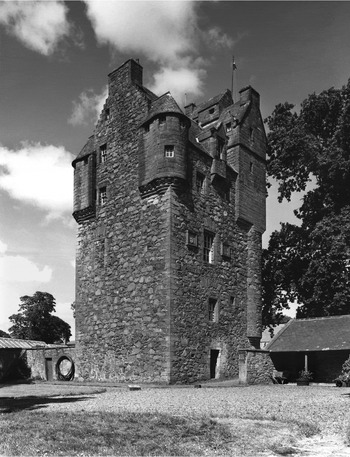
A key 1938 essay, “Design for To-day,” draws on all Hurd's work and training to that point to define a continuous Scottish tradition in architecture, and develops further his still-germinating argument about the tradition's relevance to contemporary problems of both political life and architectural form. The Scottish tradition culminated, Hurd argued on stylistic grounds, in the hands of Charles Rennie Mackintosh, who was also considered a genius of modernism among the cognoscenti. Yet this recent indigenization of modernism by a single Scottish architect provided a lesson not in modernist heroics but in the spirit of the country's native building tradition itself. “Of what does this essential traditional spirit consist?” Hurd asked. “I would say bold simplicity threaded by an odd streak of vanity” (Reference Hurd and Allan1938: 120). “Take any Scottish domestic building of the most national period round about 1600. The simple structure in stone rubble is made exciting by the daring projection of turrets and corbels which occur, not for the external display of some conceit, but to satisfy an internal need, maybe a dressing-closet or stair, so placed as not to interrupt the square shape of the main rooms…. External symmetry and balanced façade were of quite secondary importance to internal convenience” (ibid.: 120–21).
As he put it at greater length in a later essay, the Scottish architectural tradition was best exemplified by Scottish renaissance castles, which had been expanded from their origins as purely defensive structures to become palaces with “an exuberant architectural virtuosity of corbels, balustrades, turrets, and roofing which is unique, and which, although generally reminiscent of French chateaux, can properly be considered a native development” (Reference Hurd and Meikle1947: 182). Most importantly, this development was not (only) a response to the functional needs of the buildings’ occupants, but also reflected a creative spirit and a search for comfort and variety (see Image 2).
Amisfield Tower, a tower-house completed c. 1600. © Crown Copyright: Historic Environment Scotland.

That is, Hurd did not simply rehearse the received sense of early Scottish buildings as both bold and simple, stalwart responses to a harsh natural and political climate. Rather, he dwelt on the “vanities” of their exuberant forms, and postulated a creative, humane evolution spurred by vital processes of invention and innovation. He observed that, once Scottish lairds had built robust keeps to live in and weathered their inconveniences, “the fact that the upper stories of these towers were domestically the most pleasant [spaces] to live in, led to an astonishing outburst of architectural invention in the effort to expand living accommodation at this level…. In effect, a house was superimposed on the tower below, supported by more or less elaborate corbelling where it projected beyond the tower walls.” He went on to observe, finally, that if characterized by an “exuberance and naïve vanity” these buildings still maintained “an aesthetic ‘rightness’ … and exhibit none of those gaucheries of Victorian ‘castle’ architecture to which the ironical soubriquet ‘Scots Baronial’ has, perhaps a little unfairly, been attached” (ibid.: 182).
Hurd elaborates here a veritable ideology of form-in-evolution as the basis of Scottish architectural distinctiveness, with his insistence on the nobility of early forms and the virtuosity and “rightness” of their later development. The commonplace aesthetic prejudice against which Hurd wrote here was that which lumped all historical Scottish architecture with the Victorian and notably British imitation of its conventional forms. If he found an exuberance of towers and balustrades charming, naïve, and “native” in earlier, smaller buildings, it served a regrettable pomp at Balmoral, the Victorian royal residence in Scotland largely designed by Prince Albert (the target of Scott-Moncrieff's satire in “Balmorality”). The same stylistic habits that were the expression of an essential freedom and common sense in burghal ensembles and tower houses, moreover, could be nothing less than offensive when mass produced in the form of Scots Baronial suburban villas larded with corbelled turrets and ornamented gables.
This stylistic moralism is both class-bound and reflects a modernist ideology of form following function, of course. The more interesting underlying narrative, however, is one of a quest to satisfy needs giving way to comforts and ultimately spurring an “outburst” of formal invention. On this basis, Hurd was able to argue that the development of “modern assets to fit the new Scotland,” through both planning and the cultivation of “architectural good manners,” could in turn be the unique and modern vocation of Scots as a “cultured and logical people” (Reference Hurd1939b: 2, 7). One might not be mistaken to hear echoes here of the moral pedagogy for good citizenship that Mansfield Forbes and his colleagues instituted through the teaching of English literature at Cambridge. Indeed, for Forbes, good form and aesthetic value could be generated by accretions and additions that developed over time, provided they served to express a strong idea. In his sole publication on the topic of Scottish architecture, Forbes had written that renaissance castles revealed an organic “symmetry that requires movement, that is to say, a sequence of aspects, for its full appreciation.” He further stipulated that “Architects … have too narrow a conception of symmetry.… We find castles that are obvious organisms, and which, at the same time, express by the grouping of their features a definite architectural idea” (Reference Forbes1922: 142). Hurd added to this highly modernist connoisseurship of form-as-idea the thought that Scottish architecture could also express the equally definite, and equally native, political and sociological ideas just then pressing for articulation among nationalists. Good form went hand-in-hand with the recognition and amelioration of local needs; moreover, as good form thus helped foster a wider social utility, it would also serve to express Scottish logic and the political commonsense of the country.
In “Design for To-Day,” Hurd pointed his political moral by arguing that, far from being an innovation of mass industrial society, concentrated urban living had Scottish roots and reason, too. “The ideal form of dwelling for Scottish towns is the flat,” Hurd stipulated. “Our ancestors discovered that in the sixteenth century. It beats the weather, allows for our gregarious habits and tramples on social distinctions” (Reference Hurd and Allan1938: 122). In a BBC radio lecture (reprinted in The Listener) he was even more explicit, not to say folksy, evoking the already hoary myths of Scottish egalitarianism: “In plans for housing, care will have to be taken to avoid the segregation of workers into regrettably dreary colonies like Niddrie near Edinburgh. Segregation of that kind introduces into Scottish society artificial divisions which are wholly alien to it. War has taught us to mix better again; let us remember the lesson and revert more to the plain democratic way of life which in the old days permitted a laird from the country to live on the same public stair in Old Aberdeen or the Canongate [Edinburgh] as auld wife Jean” (Reference Hurd1941: 200).
Though he did not include this passage in the talk as published, in an earlier draft of this talk Hurd had also rejected any thought of a “British plan” that laid out uniform solutions. If planning for Scotland's social and political development were managed from London there would neither be adequate finance devoted to Scotland nor “freedom to experiment and develop on indigenous lines” (in National Library of Scotland [NLS] Acc. 9393/967). Likewise, in “Design for To-Day,” by envisioning a modern Scotland built on a template set by long-developed modes of habitation and formal habits, Hurd arrives at his paradoxical recipe for planning: to “rescue Scotland from the imminent threat of provincialism” through “experiment and independence” on terms already laid down by the history of the people (Reference Hurd and Allan1938: 127). A modern style of architecture and a planned urbanity could be seen twice as both an inner flourishing of a kind of universal common sense—meaning here not only “function,” but also comfort and social convenience—into form, and also the impress of a local political genius upon that form.
The comprehensive survey A History of Scottish Architecture notes of the period around World War II that new ideologies of national cohesion and imaginations of an organically integrated Scotland “prompted the emergence of a new generation of aggressively modernising traditionalists in architecture,” among whom it lists Hurd along with his better-known contemporaries Robert Matthew and Alan Reiach (Glendinning, MacInnes, and MacKechnie Reference Glendinning, MacInnes and MacKechnie1996: 409–10). The nearly oxymoronic turn of phrase “modernising traditionalists” captures well something that Hurd's wartime writing exemplifies: a seemingly paradoxical combination of technocratic rationalism, including promotion of industrial-scale plans for the reorganization of society (provided they were developed from a Scottish center) with an unrhetorical, humble attempt to grasp and realize the sources of a vibrant Scottish vernacular.
Another historian, less sympathetic to the youthful self-promotion inherent in some of Hurd's architectural polemic, mocks Hurd (by name) and his contemporaries for discovering “a singular similarity between Scots 17th-century architecture and the Cubist ideal of geometric shapes interacting in light” and for “selling [modernism] to the Scots as a rediscovery and reinterpretation of their roots” (McKean Reference McKean1987: 55–56). This critique, however, mistakes both the political and aesthetic purpose of Hurd's formal reading of the Scottish tradition. Hurd's account of Scotland's historic architecture does not merely justify his own, putatively “cubist” taste, but also allows him to develop sociological and political criteria against which formal innovations might be tested, while also embracing “exuberance” and vitality as aesthetic standards for evaluating the political implications of the new architecture of mass housing.
To be sure, Hurd's genealogy of Scottish architecture was selective, skipping over the nineteenth century and its urban forms. He always turned a skeptical eye on nineteenth-century building, complaining of “those mock ecclesiastical structures which be-tower the nineteenth-century town” (Reference Hurd and Johnson1932: 184). But rather than merely a prejudiced reflection of “cubist” aesthetic standards, this was political, too: a positive rejection of certain aspects of life in the modern British state, in particular a rejection of “bigness” and commercial and governmental centralization, and a quest for a different standard, or a different and more local center about which to turn. Moreover, Hurd's distinctive formal definition of Scottish traditions—with their “bold simplicity threaded by an odd streak of vanity” (Reference Hurd and Allan1938: 120)—functions less to reclaim them as modernist forms avant la lettre and more to make the traditional devices of Scottish architecture themselves into political instruments for remaking Scottish society. This is given further, fuller expression in his most celebrated and most characteristically architectural publication, Building Scotland, co-authored with Alan Reiach (Reference Reiach and Hurd1944).
BURGH TRADITIONS
Building Scotland: A Cautionary Guide is an architectural and political polemic in the form of a photobook with terse, monitory texts, which Hurd and Reiach put together for the Saltire Society in the early years of World War II (Reiach and Hurd Reference Reiach and Hurd1944). Intended to promote postwar planning and future investments in public works, it received a preface from Thomas Johnston himself, and it presented crisp black-and-white photographs of Scotland past, present, and future “structured into the good-bad oppositions traditional in architectural polemic since Pugin's Contrasts” (Glendinning Reference Glendinning2008: 67). Simple and, in their way, monumental village churches, market squares, and large farmhouses were set alongside what the authors presented as the degraded legacy of Victorian urbanism, including over-decorated cinema halls and drab streets of uniform bungalows. Finally, to represent what Scotland could have, Reiach and Hurd offered images of clean, modern flats, public buildings, and bridges and hospitals, mostly in Scandinavia and the United States.
A section entitled “The Small Burgh,” however, is at the literal and figural center of Reiach and Hurd's pamphlet, and offers a surprising sociological modulation of their formal contrasts. The burgh—the market town, more than a village and less than a city—stands for the aesthetic and moral unity toward which modern planning should aspire. Instructively, examples from Switzerland, Scandinavia, and the suburban United States are illustrated even here. “Possibly these examples may suggest solutions for Scottish problems,” Hurd writes, above a picture of a low-slung glass-and-stone public library in Waukesha, Wisconsin. “Whether or not this is so, they indicate a fresh approach both as regards social outlook and design and are therefore worth careful study” (Reference Reiach and Hurd1944: n.p.).Footnote 13
The simultaneously formal and political imaginary that could herald the burgh, despite its current marginality and decline, as a site and source of aesthetic and social renewal was given fuller expression in a more openly nationalist publication of Hurd's, “Planning and Building: An Architectural Survey,” included by the London Scots Self-Government Committee in a thick pamphlet of proposals for political, economic, and constitutional change in postwar Scotland (Hurd Reference Hurd1942). Hurd argued again that more attention should be paid to Scotland's historic burghs as centers of development. Moreover, in a text written at about the same time that the Forth Valley and Clyde Valley plans were getting underway, he makes explicit that burgh traditions offer an alternative to more cosmopolitan planning practices.
“In some circles,” he writes, “a ruthless attitude toward the older burghs is adopted. New satellite towns or new and entirely independent towns are urged to be the only way of redeeming the slum dweller and of housing … enterprise” (ibid.: 66). On one hand, then, taking the actually-existing burgh as a model could constrain such overweening rationalism. But the same model could also spur innovation, avoiding the rote replication of traditional forms out of dull habit and pure nostalgia (an equal danger, in Hurd's view). “In other [circles] there is an over-insistence on the permanent value of the small burgh prompted a little, perhaps, by a natural affection for the old buildings and the faded atmosphere of a once sturdy Scottish burghal life which still clings to many of these places” (ibid.). Given these unpalatable alternatives of planned novelty or sterile replication of what already exists, Hurd says (with a mildly ironic deployment of Scottish cultural stereotype) that “common sense and our native flair for the careful use of money … should help us to appreciate the possibilities … [of] developing the small burghal unit” (ibid.: 66–67, my emphasis).
Hurd continues, moreover, to insist that this recourse to the burgh as both a formal resource and an actual site and center of future development is more than a planning device: it is also (somewhat comically) a pathway to moral renewal and can help shape something of a rural idyll. By developing the burgh, “new dwellers would be recruited to the countryside who … would … gradually experience a more whole view of life, no doubt actually participating to some extent in rural activities” (ibid.: 67). Unless Hurd meant by “rural activities” the kinds of tours he took on foot and by car through Scotland's countryside or his occasional sojourns in the artists’ colony on Iona, there is little evidence that he himself embraced such a whole view of life. He chose to live in Edinburgh his entire adult life and in his writing he generally allies himself in taste and habits with the typical Edinburgh dweller, whom he elsewhere describes as “sheltered and sophisticated” (Reference Hurd1936: 42) as against the “somewhat slow-moving burgh citizen” (Reference Hurd1942: 66). Still, Hurd turned again and again to the aesthetic and political coherence of the burgh as a modernist formal model and a source of political ideas. He concludes that while “organised research” into Scotland's present needs should be undertaken, “a sound modern tradition in building design can only arise from an alliance between knowledge so gained and an aesthetic training that, remembering the best that has come down from the Scottish past, strikes out independently toward a new idiom” (ibid.: 73).
CANONGATE ARCADES
A decade after writing this, in 1951 Hurd was awarded the job of redeveloping and renewing the Canongate, a historic district at the far eastern end of Edinburgh's Royal Mile, near the royal residence at Holyrood, where the Scottish Parliament also now sits. Here, Hurd found the opportunity to put into practice the very principles of good form, moral unity, and public utility that he outlined with Reiach in Building Scotland: a “sound modern tradition,” a “new idiom” that might house a robust, egalitarian, urban society while recalling and renewing Scotland's distinctive architectural forms.Footnote 14
In the Canongate, Hurd was initially confronted with the tight-packed tenements of earlier centuries alongside a few modern buildings in a romantic, cod-medieval style, and the ruins and remnants of partially cleared industrial buildings: the whole a result of several earlier efforts to revive this part of the historic old town. Exercising the free hand with the palimpsest of past building that Geddes had called “conservative surgery,” Hurd demolished whole blocks—in part to meet the traffic department's demand for widening the road—and realigned the street-frontages to create a continuous series of buildings running up the hill. He preserved some old buildings, reconstructed certain historic facades at the realigned street frontage, and inserted some entirely new buildings in both historicist and plain, modernist styles.
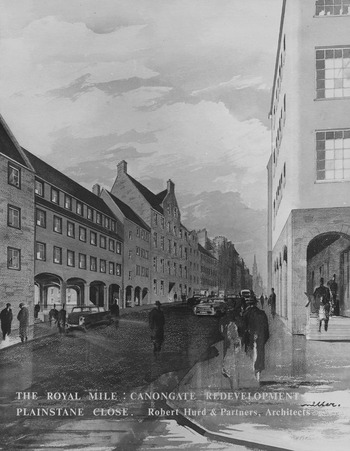
Seen in the round, Hurd's reconstruction of the Canongate represents a realization of his hopes for a modern Scotland. Of course, his Canongate is much less dense than the district as it had existed before, with tight-packed closes now converted into courtyards, and space opened up on parallel streets for university buildings and other new developments. But Hurd's plan also provided a number of modest flats throughout the area, an attempt to maintain it as a mixed-class residential district. Moreover, he exercised his formal ingenuity to create opportunities, in his modern apartment blocks, for the kinds of interactions and solidarities he imagined to have animated life in “auld” Edinburgh (see Image 3).
Rendering of Canongate Redevelopment, Hurd & Partners, with Chessel's Court on left. © Courtesy of Historic Environment Scotland (Hurd Rolland).

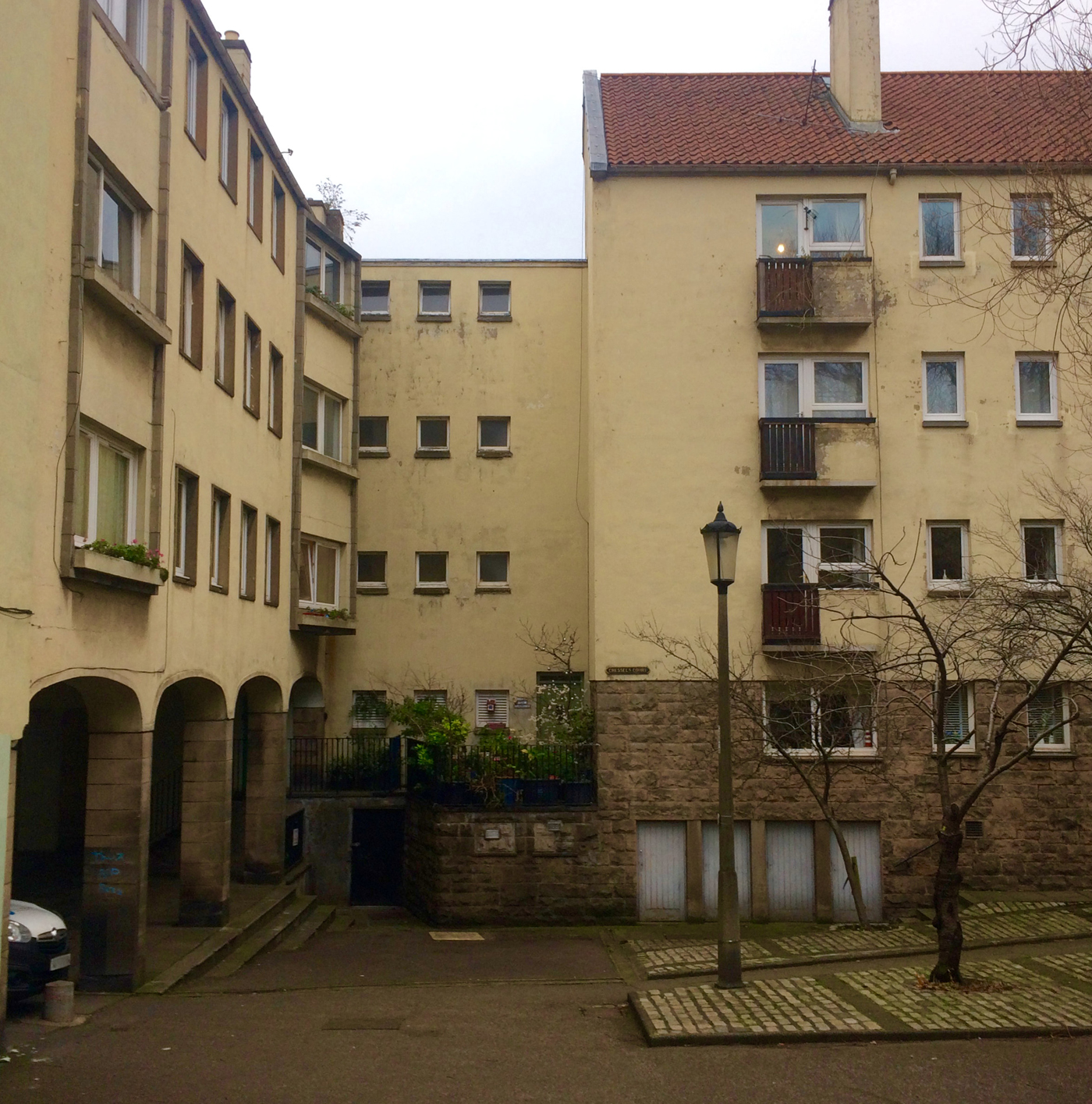
Hurd's major innovation was to construct some of the more modern apartment blocks above street level arcades. Early in his career, Hurd had restored a merchant tenement elsewhere in the Royal Mile, Gladstone's Land, that at some point in its history had acquired a two-bay arcade across its front; he borrowed this form to create small, sheltered walkways and parking bays along the Canongate, which were meant to contribute to the comfort and conviviality of the district (Oswald Reference Arthur1961). In his own comments on the Canongate, Hurd mentioned not only the somewhat singular historical model of Gladstone's Land as a source for his arcades, but also the crowded cafés in the arcades of Palais Royale in Paris. He may also have been inspired by central European urban architecture. A frequent visitor to Switzerland, Hurd's correspondence includes a postcard from Bern picturing the town's street-front arcades, which are strikingly similar to those he built under the flats on the Canongate (Hurd-Rolland Collection 6278). Be that as it may, he extended his use of this feature toward a modern extreme: in one of the new buildings on the Canongate, Chessel's Court (which was likely designed in collaboration with Hurd's young associate and later partner, Ian Begg), the arcades extend under the entire building, elevating the mass above like Corbusian pilotis.
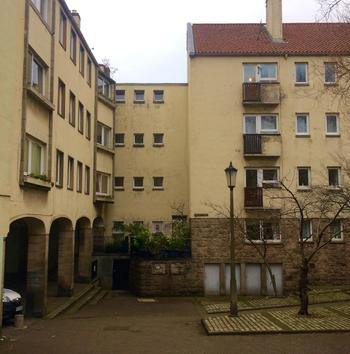
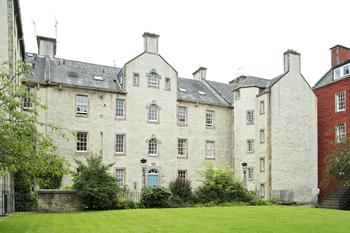
One other detail of Chessel's Court deserves notice. The building replaced an old close and backed onto a courtyard with a preserved eighteenth-century tenement on the other side. In apparent echo of the stair tower on the tenement, Chessel's Court features on its rear elevation a canted bay that angles the windows of one stack of apartments toward the courtyard (see Images 4 and 5). The unique, angled bay produces no doubt a more pleasant view from these windows, but it also introduces what I think we may legitimately call an odd streak of vanity into an otherwise plainly detailed group of flats.
Rear of Chessel's Court. Author's photo.
View of eighteenth-century tenement in Chessel's Court, with stair tower to right. © Crown Copyright: Historic Environment Scotland.

This architectural gesture summarizes the broader tendency, and the tensions, of Hurd's thought and practice. Hurd sought to define and employ a formal vernacular; this would be more than just the use of “traditional” materials and techniques, but a practice that picked up from and further developed the emergent form into which “native” energies had flowed and were still flowing. Rather than drawing straightforward images or architectural figures from the past, Hurd sought to express an inner logic which was itself the evolutionary product of materially sedimented ways of doing and living. Further, this logic did not arise of its own, nor was it simply the product of thoughtless, unreflective, repeated practice over time. It needed to be discerned, and cultivated, as part of a project of collective renewal, which itself depended upon aesthetic training and, most importantly, moral freedom and the space for experiments—conditions that Hurd consistently argued could only be secured by political independence.
CIVIC CENTERS: A FORMAL PROBLEM
Throughout his career, Hurd advocated respect for old centers and traditions, insofar as they could contribute to a new flourishing of Scottish political power, legitimacy, and communal well-being. At the same time, he elaborated alongside his contemporaries a low-key, vernacular modernism, one which continues to guide architectural practice in Scotland and long served as the standard idiom for government buildings, especially during the mid-twentieth-century growth of the welfare state. But how does this compare with other political uses of modern architecture and planning? We may associate political architectures more often with rational planning and the material delimitation of social life (as anthropological studies of planning have argued), or alternatively with spectacular, overawing monumentality. Hurd's work fits in neither category, and not because he was provincial, practiced in a dominated nation, or was marginal to the mainstream of his discipline. Rather, his work challenges the coherence of any such polar typology or singular reading of the politics of form.
Hurd was trained well before the professionalization of architectural education in Scotland—something only fully implemented after Hurd's death, by his better-known planner-architect contemporary Robert Matthew (as we have seen, Hurd's pathway to the profession was peripatetic). His professional correspondence on individual planning projects and his published writing both reveal a characteristic concern with composition, form, and aesthetic effect, modes of thinking about planning and even architecture that were already somewhat outdated in an era of massive, team-based efforts like the Clyde Valley plan. As for nationalist monumentality, apart from the renovation of the Canongate, the closest Hurd came to the expression of a distinctively Scottish monumentality was a renovation project for an aristocratic family: the Abbey House of the Elgin family in the historic burgh of Culross (see Image 1). This private house is part of a whole town center preserved by the National Trust for Scotland since the 1930s. Here, Hurd returned to renaissance glory, and to usefulness, a derelict large house dating to about 1610. Even here, though, Hurd's concern was with the faithful expression of the “most national” period of the surrounding town's development, and in the course of his renovations he removed two large towers that had been added to the house later, reducing its overawing size to more manageable proportions and restoring what he viewed as its historic integrity within a larger ensemble of estates.
Hurd was most typically modernist, perhaps, when he insisted that aesthetic and historical knowledge of Scottish architecture could be a political tool as well as a formal one, employed to craft new spaces, revive old centers, and foster ongoing, evolutionary changes. As Matthew Hull (Reference Hull2011) has shown in a study of American urban planners working in New Delhi, the professional discourses of regional and city planning in this period expressly treated urban form and territorial ensembles as the crucibles of democratic habits of egalitarian association. This followed a distinctively American understanding of democracy as being a matter of place, of neighborly identifications and associations. In the process of translation from its American sources to postcolonial and global locations, however, the planner's “neighborhoods” became empty shells, sociologically-neutral or purely formal “units” that could be built anywhere to foster democratic values. Hull nicely terms these simultaneously political and material planning conceptions “technologies of change” (ibid.: 779). Hurd was certainly aware of these American planning discourses. He wielded the very term “neighborhood unit” easily in his correspondence, but in his published writing it is not the sociologically-neutral neighborhood but rather a concept of the “burghal unit,” with its specific architectural heritage and traditions of local government, that shapes his recommendations.Footnote 15
A different comparison, albeit one that is less easy to link directly to Hurd's own practice, allows a further contrast with his political architecture. Eastern European postwar reconstruction (in the same period as Hurd's work in the Canongate and the work of American planners in New Delhi) proceeded under the Socialist Realist slogan of “national in form, socialist in content” (Zarecor Reference Zarecor2011), resulting in grand monumental and commemorative ensembles in city centers and extensive use of folk ornament, even on otherwise sternly functional buildings. This slogan represents an interesting inversion of Hurd's priorities, especially as it was worked out in the career of an architect like the Czech Stalinist Jiří Kroha, who maintained a modernist concern for functional order and large-scale planning while detailing his buildings with national ornament. By contrast, Hurd employed the formal and structural innovations of modernist functionalism to enrich and renew—or simply update—the “best” of the Scottish tradition, and to express a political logic he found inhering in that tradition. Rather than dressing functionally organized buildings in the forms of the national past, the national past gave meaning, content, and context to the functional forms of a social-welfare modernity.
However, both these comparisons—the rational, technocratic planning conception and the national idiom of Socialist Realism—indicate that similar demands pressed upon architects working in these distinct contexts, in Scotland, under Socialist Realism, or on postcolonial planning. They all sought to construct a relation between architectural and political form, a relation that might sustain, materially and symbolically, different but comparable imperatives of solidarity, sovereignty, and self-determination.Footnote 16 Indeed, modernist architectural thinkers in this period felt acutely the problem of planning for solidarity and democracy, or for the political becoming of a people.Footnote 17 As the architectural historian Jonathan Hill points out, the kinds of monumentality usually deployed by political regimes for propagandistic purposes were deeply problematic for modernist architects by the late 1930s (Reference Hill, Bille and Sørensen2016: 91). Monumentality was an architectural language for which functionalist experimentation had not yet generated a native idiom (this would be the task of the next generation of modernists, many working for postcolonial states). And yet it was also a register of architectural expression associated with fascism and with other imperializing and expansive forms of state power. This posed a formal problem—as Hill puts it, “the monumental architecture of a liberal society clearly needed to be different from that of a repressive one” (ibid.)—but it also presented an opportunity.
In a 1944 essay, “The Need for a New Monumentality,” the architectural historian and theorist Sigfried Gideon responded to this problem by imagining civic centers that could satisfy, in a future, democratic order, an ongoing “need for community” and a universal “love of festival.” Rejecting both fascist and American New Deal architectures of power, Gideon recommended an “ephemeral architecture” that would renew functionalism with “movement, color, and … the abundant [modern] technical possibilities” for spectacle (Reference Gideon and Zucker1944: 559–66). Carried out, Gideon's recommendations would have resulted in an architecture of pure affect, ambiance, and ephemeral spectacle, which is not of course the direction that modernist architecture ultimately pursued in its collaboration with both postcolonial states and an imperializing capitalism. However, there is something in Gideon's turn to exuberant forms, variation, and spectacle, to provide a new idiom for an architecture of mass democracy and collective belonging, that resonates with Hurd's arguments.
While Hurd and his Scottish contemporaries for the most part did not engage in international modernist (or Stalinist) polemics, their work does offer, in light of these comparative perspectives, some possibilities for navigating the historiographic and critical polarities that structure understandings of twentieth-century forms of state power and their heterogeneous expressions: monumental versus vernacular, political versus aesthetic, radical or revolutionary versus totalitarian and dominating, and rational versus organic. Drawing on Foucault's account of subjugated and marginalized but nation-forming historiographies, discussed earlier, the sociologist and legal scholar Mariana Valverde has precisely identified the structure of alternatives, across distinct regimes and organizations of political life, with which we have to deal. “Bureaucratic/scientific projects,” she writes, like those of rationalist planners everywhere, “may seem to be at odds with the highly concrete and openly emotional narratives” promoted by myths of a national spirit, a national tradition, and the struggle to maintain and express a form of life. “But in practice, heterogeneous and even conflicting epistemologies can and do co-exist very easily…. One paradigm does not drive out the other. They are not speaking to the same issues” (Reference Valverde, Dillon and Neal2008: 147, paragraphing altered).
Yet even this precise formulation leaves too much as a conceptual and critical matter, when what we want, anthropologically, is to examine the practices, like those of a nationalist intellectual or architectural practitioner, for whom these conflicting epistemologies may not only coexist, but also be equally necessary tools with which to meet the demands of the day. Hurd's career shows us a pathway through these oppositions as they are worked through in his own formal practice: rational program and affective force united under formal variegation and variety, in ways that even (as his tutor Forbes might have put it) can result in a kind of order, of symmetry, one that depends on movement to be perceived and that expresses a particular social idea.
Hurd's approach to planning and architecture was vernacular, aesthetic, evolutionary, and organic, but the “vernacular modernism” of which he was an influential proponent, patron, and (less influentially) practitioner also helped shape and promote a new idiom for the architectures of modernist governmentality in Scotland. Hurd's career hardly represents the whole story of Scottish architecture and politics in this era. Architectural histories and social histories of this era in Scotland rightly pay more attention to the tower blocks, new towns, mass housing, and the mid-twentieth-century welfare state than to the kinds of modest, bespoke projects and historic preservation campaigns on which Hurd worked. But even on quite large housing projects, Glasgow's tower blocks perhaps excepted, one can trace in the work of Hurd's contemporaries a concern with vernacular expression, formal variety, and astute manipulations of scale, as they sought to meet the needs of the nation. In this, they were experts not only of infrastructure, plans, or populations and their needs, but also of the mediation of such material facts into architectural form and, in a broader sense, forms of life.
Finally, Hurd's knowledge of, and handling of form, rather than any doctrinaire conservation ideology or sentimental attachment to a national tradition, is what gives his work its current relevance. His work was oriented toward unearthing and renewing a formal repertoire preserved in Scotland's historic architectures, one of defensive and political centers, evolved accretions, and outbursts of vanity. Ultimately, he aimed to organize environments, shape solidarities, through the preservation and elaboration of such forms from the past (see Muehlebach Reference Muehlebach2017: 123). He also hoped to use this formal tradition to repair modern fractures in solidarity. Most importantly, Hurd's formal architectural interventions (and those of his contemporaries)—all but invisible though some of them may remain to the untutored eye—are what make the Royal Mile, and arguably Edinburgh, what it is today: a space that encompasses reminders of the historic past and the novel institutions of Scottish autonomy, and composes both into a new symbolic center and site of political assembly for the nation.
CODA: FORMAL EXPERIMENTS
The Scottish parliament building in Edinburgh, opened in 2004, sits at Holyrood, near Edinburgh's renaissance royal palace and the ruins of an eponymous medieval abbey, and just down the road from Hurd's reconstructed Canongate. In many ways it represents a continuation of both the architectural and the political projects to which Hurd devoted his career. When the current Scottish parliament was established, following a popular referendum in 1997, it was imperative that its design, both institutional and architectural, express a rooted and popular power and be in keeping with the democratic and egalitarian arguments of the long campaign for devolution (for the latter, see Hearn Reference Hearn2000). Institutionally, the parliament is unicameral (because Scotland's pre-Union parliament was) and its members are elected both on a constituency and a regional, party-list basis. The “additional member” electoral system was an attempt to promote a pluralistic, consensus-driven, multi-party democracy rather than reproducing the oppositional structure of Westminster politics. Meanwhile, the Catalan architect Enrico Miralles won a competition for the Parliament's new home with a design composed of convoluted forms based on organic and folk models such as leaves and fishing boats, and that also recalled the modest wooden, earthen, and stone architecture of rural Scotland (Glendinning Reference Glendinning2004). I like to think that Hurd would have approved.
Neither the architectural nor the institutional forms of the Scottish parliament have determined the shape of the country's politics, of course, in part because of the pressure of the “clumsy and overloaded” mythic histories these forms are made to express (Foucault Reference Foucault and Macey2003: 56). When the SNP unexpectedly won a decisive majority in the Scottish parliamentary elections of 2011, a pattern of single-party dominance emerged, and it was strengthened in later elections. Although the party did not win the referendum on independence that it sponsored in 2014, its electoral successes have continued despite some recent vicissitudes. In fact, some critics have argued that the SNP in government is repeating one of the long-standing ironies of devolutionary and administrative government in Scotland: when Scottish institutions have won power from London this often has resulted in increased concentration of power within Scotland. As Colin Kidd has noted, the SNP in government “has been a determined centralising force, showing little regard either for genuine freedom of choice in local government or for the traditional hands-off autonomy enjoyed by other public institutions” (Reference Kidd2015: 21).
This still-evolving current history may indicate the political limits (or entailments) of using form as an analytic—with its attention to centers and symmetries, divisions and relations, parts and wholes—as opposed to a new materialist, thing-and-assembly oriented attention to unbounded process and contingency and becoming. To be sure, form is abstracting, limiting, and bounding, and it is true that Hurd's claims about burghs and his insistence on a single national tradition (albeit one shaped by internal variety and exuberance) could nevertheless tend toward an ideal perfection and closure rather than resulting in openness and pluralism. Such a stricture about the political-aesthetic tendencies of formalism conforms, also, to the facts of Hurd's political biography as a conservative, establishment figure in civil society and a nationalist: someone who singularly promoted independence and national becoming as solutions to the political problems of his day, rather than pursuing questions of political variation and dissensus. Yet Hurd's formalism, as I have tried to show here, paid more respect to the divisions and differences that were accommodated by the doughty burgh, and by the nation's historic architecture and institutions, than a superficial reading would credit. Moreover, his insight into the making and remaking of durable forms of national life is echoed in recent research that finds in the habitation and use of modern mass housing and efforts to preserve decaying public infrastructures a repertoire of material practices that work to maintain and extend valued solidarities (Schwenkel Reference Schwenkel2015; Fennell Reference Fennell2015). This latter kind of ethnography of infrastructures “means accounting for bodies and embodiment, rhythm and refrain, as well as for the built environment and infrastructures that allow for the generation of proximities, coordination, and likeness across difference,” as Andrea Muehlebach has written (Reference Muehlebach2017: 100).
On these more aesthetically attuned anthropological terms, at once more densely historical and affective, Hurd's architectural writing can profitably be re-read not despite but because of his attention to faded burghal units and aristocratic tower-houses as exemplars of formal evolution. He argued that the development of townscapes and patterns of habitation also expressed political habits and intentions. Most importantly, this was not an exercise in nationalist nostalgia, a purely traditionalist yearning for old ways of life in the face of disruptive changes, but instead an attempt to devise a formal repertoire, centered but not singular or narrowly symmetrical, that could serve novel and potentially more democratic orderings and organizations of social power. On Hurd's account, the notable, distinguishing feature of Scottish architecture is not its robust solidity, the coherence of tight-packed stones, or its defensive, centripedal tendencies, but rather how it is “threaded by an odd streak of vanity” (Hurd Reference Hurd and Allan1938: 120). Finally, the architectural point he was making with this description is more comparatively significant when read in the full context of the political and cultural life he led: Hurd, personally, took the forms of Scotland's architecture as a license and a warrant for experiment and independence also in the forms of political life.