Time to positivity (TTP) is the time from the start of culture incubation to the detection of organism growth. Evidence indicates that TTP may be used to direct antimicrobial therapy. Antibiotics are often continued until blood cultures have been negative for 48–72 hours, even when suspicion of infection is low.Reference Biondi1,Reference Lambregts2 Continuing unnecessary antibiotics can increase the risk for antimicrobial resistance, Clostridium difficile infection, and other adverse effects.Reference Barlam3 Antimicrobial stewardship programs should focus on the optimal selection, dose, route, and duration of antimicrobial therapy resulting in the best clinical outcome for the patient with minimal toxicity and minimal impact on subsequent resistance.Reference Barlam3 Knowledge that a clinically significant organism is unlikely to result after 24 hours could lead to a more accurate differential diagnosis and appropriate de-escalation or discontinuation of antibiotics. Retrospective studies analyzing TTP in adult neutropenic patients and infants with bacteremia have found that most blood cultures have a TTP ≤24 hours and that a TTP >24 hours for an organism of clinical significance is rare.Reference Biondi1,Reference Lambregts2 However, these studies may not be applicable to the general or veteran population.
The primary objective of this study was to determine what percentage of blood cultures grow an organism of clinical significance if initially negative at 24 hours (TTP, >24 hours). Secondary objectives were to determine whether isolates with a TTP ≤24 hours are more likely to be clinically significant than isolates with a TTP >24 hours; to determine differences in TTP between intensive care unit (ICU) and non-ICU patients; and to evaluate differences in organisms isolated with a TTP ≤24 hours and >24 hours.
Methods
This single-center retrospective cohort study at the Iowa City Veterans’ Affairs Medical Center included consecutive blood cultures from December 2014 through May 2018. The TTP, distribution of isolates among positive cultures, and other variables were evaluated. Blood cultures were excluded from review if the culture order was not performed (including records accessioned in error, duplicate orders, test patients, mislabeled specimens, and insufficient blood quantity). When evaluating the primary objective, isolates that had a TTP ≤24 hours were also excluded. All organisms from positive blood cultures were characterized as clinically significant, likely contaminant, or organisms that were unlikely to be significant as they were only gram stained and no additional formal work-up was performed or requested (eg, identification or susceptibly results). Clinically significant bacteria included Staphylococcus aureus, Streptococci, Enterococci, gram-negative organisms, and Candida. Coagulase-negative Staphylococci, diphtheroids (eg, Corynebacterium), and gram-positive or gram-negative organisms that were not further identified were deemed to be contaminants and not clinically significant when evaluating the primary outcome as many studies indicate it is rare for these organisms to be of clinical significance if the TTP exceeds 16–24 hours.Reference Martinez4–Reference Hall and Lyman9 Viridans group streptococci were not categorized as contaminants due to studies showing a lack of correlation between pathogenicity and TTP and contamination in only 50% of viridans streptococci cases compared to coagulase-negative staphylococci being in excess of 80%.Reference Swenson and Rubin7 Descriptive statistics were used to summarize blood culture results among positive isolates. Differences in the TTP (≤24 hours compared to >24 hours) were compared using a 2-tailed Pearson’s χ2 analysis. P values <.05 were considered statistically significant. Our local institutional review board determined that this study was a quality improvement project and not human subjects research.
Results
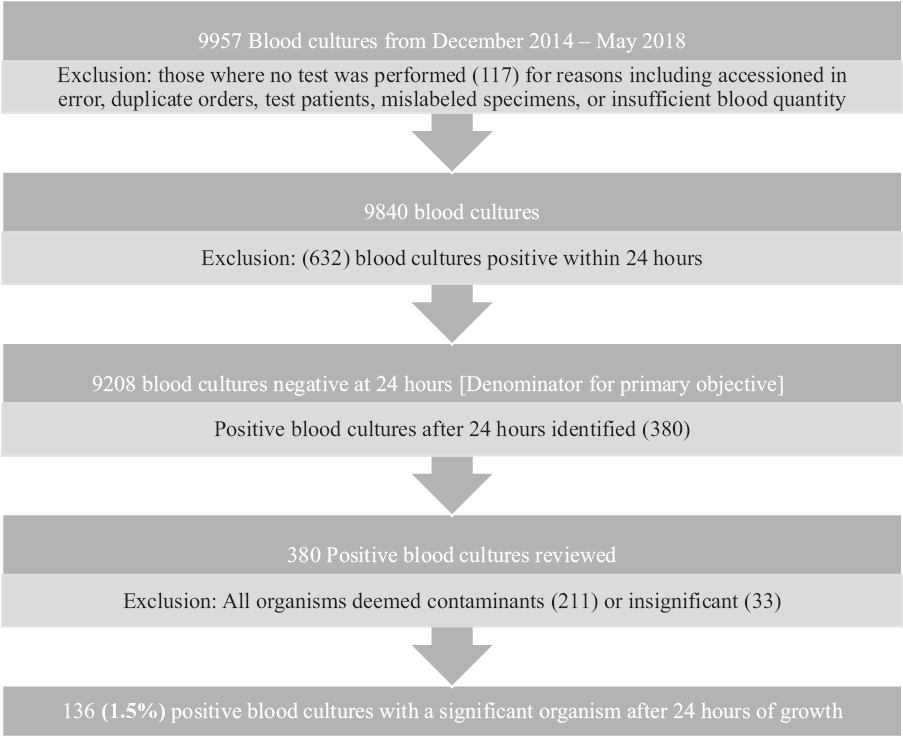
During the study period, 9,957 consecutive blood cultures were collected of which 9,840 met the initial inclusion criteria (Fig. 1). Of the 9,840 blood cultures, 9,208 (93.6%) were negative at 24 hours. Subsequently, 136 (1.5%) grew an organism of clinical significance (TTP, >24 hours). Of the 9,208 cultures that were negative at 24 hours, 994 were collected from ICU patients. Cultures collected from ICU patients were more likely to have a TTP >24 hours for a clinically significant organism (25 of 994, 2.5%) than non-ICU patients (111 of 8,214, 1.4%; P = .0063).
Probability of a clinically significant organism with a time to positivity >24 hours.

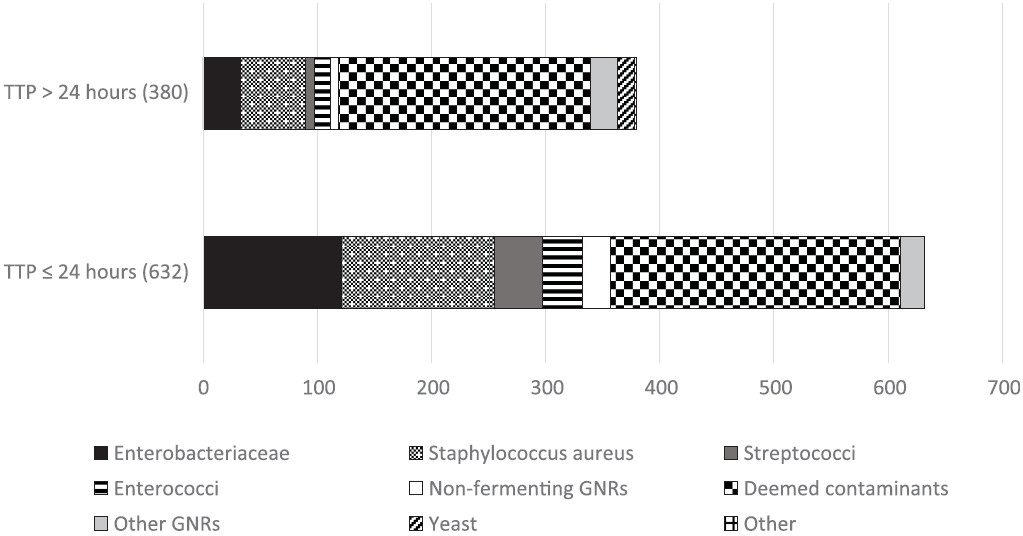
Overall, 1,012 positive cultures (10.3%) were identified from the 9,840 cultures that met initial inclusion criteria. Regarding TTP, 632 of 1,012 isolates had a TTP ≤24 hours, and 380 had a TTP >24 hours. A clinically significant organism was more common if the TTP was ≤24 hours (357 of 632, 56.4%) compared to >24 hours (136 of 380, 35.8%; P < .0001). Among cultures positive for a clinically significant organism, 357 of 493 (72.4%) had a TTP ≤24 hours. Staphylococci and Enterobacteriaceae were the most common organisms isolated, with Staphylococcus aureus being the leading pathogen regardless of the TTP (Fig. 2) or the clinical setting (ICU vs non-ICU, data not shown).
Positive blood culture isolates with respect to time to positivity (TTP).

Discussion
In this study, few blood cultures (1.5%) yielded a clinically significant organism after 24 hours of incubation, which is similar to the findings of other TTP studies. In this study, our population was more heterogeneous than those of previous studies.Reference Biondi1,Reference Lambregts2,Reference Martinez4 Furthermore, we evaluated all isolates, whereas other studies focused on specific organisms or a group of organisms.Reference Morioka, Ichikawa and Mori5–Reference Palmer8 Enterobacteriaceae was the second most common group of organisms isolated regardless of TTP or clinical setting, which may be reflective of the veteran patient population. The estimated rate of blood culture contamination was similar to those of other studies (30%–50%).Reference Hall and Lyman9,Reference Dargère, Cormier and Verdon10 Consensus has not been reached regarding how long to wait to discontinue or de-escalate antimicrobial therapy based on negative blood cultures. Our findings suggest that when suspicion for infection is low, it may be reasonable to stop antimicrobial therapy if blood cultures are negative after 24 hours. These data are likely not applicable when suspicion is high for presumed infection. In those cases, antimicrobial therapy may be de-escalated targeting the most likely pathogens based on presumed source(s) of infection and other variables.
Our study has several limitations. As a retrospective study, only associations can be determined. Given the single-center design within a VA population, the generalizability of our study is limited. Data did not include any patient-specific, pharmacologic, or clinical information; thus, our determination of clinically significant organisms was based on our a priori definitions (see the Methods section). We did not exclude repeat cultures due to lack of patient-specific information, which may have influenced our findings. Lastly, the data did not include quantification of bacterial load, blood culture volume, or relation of culture collection and administration of antibiotics, which could have aided in the determination of clinical significance.
In conclusion, this study demonstrated that few clinically significant organisms have a TTP >24 hours. Incorporation of microbiologic data, including TTP, with other clinical findings can be used to guide treatment decisions. Future prospective studies evaluating TTP and potential risk factors for clinically significant organisms are needed to guide appropriate and timely de-escalation and discontinuation of antimicrobial therapy.
Acknowledgments
We thank Daniel Livorsi MD, MSc, Jonathan Chapman, MLS (ASCP), QLI, and Amy Frank, MT(ASCP) for their contributions to this project and for their review of the manuscript.
Financial support
No financial support was provided relevant to this article.
Conflicts of interest
All authors report no conflicts of interest relevant to this article.