As tariff rates have steadily declined around the world, business firms have responded to import competition from foreign trade partners by using temporary trade barriers (TTBs). US firms that suspect countries of selling goods at less than fair value—that is, of “dumping” goodsFootnote 1 —can file antidumping (AD) petitions with the US Department of Commerce (DOC). If the AD petition is successful, AD duties are levied on the offending product from the originating country for a fixed period; these duties can bring significant economic advantage to filers.Footnote 2 AD petitions are by far the most commonly employed TTB worldwide.Footnote 3 AD filings are often triggered by import surges, especially from countries with undervalued currencies because foreign exchange rate undervaluation makes imports from undervaluing countries relatively cheaper.
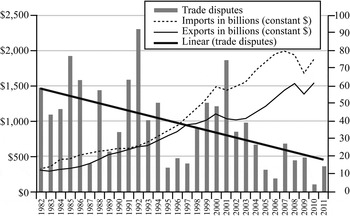
The number of AD trade filings by US firms has declined markedly over the past ten years, even though imports have increased, especially from countries with undervalued currencies (see Figure 1).Footnote 4 Firm-level variation in foreign direct investment (FDI) is critical to understanding this puzzling decline in AD filings. In the current era of increasing import competition, it is not a firm's sectoral advantages, its industry, or even its international orientation per se that determines its response to the policies of foreign trade partners. Rather, a firm's direct investments in, and trade relationships with, a specific country at a given point in time shape its economic and political activities: a salient political-economic cleavage divides firms with trade-related foreign affiliates from those without. Firms’ global sourcing activities drive their political and economic responses to the economic policies of US trade partners, particularly currency undervaluation.
Imports, exports, and total antidumping filings by firms in the United States, 1982–2011

Firm-level heterogeneity in international investment, trade, and global supply chains in US multinational corporations helps explain the decline in AD filings—increasing import competition, long-run trade deficits, and persistent foreign currency undervaluations notwithstanding. Firms that have investments in (and intrafirm trade with) a country are less likely to file against that country. As more firms undertake FDI and intrafirm trade with a country, especially a country with an undervalued currency, the likelihood of an AD filing against that country's firms diminishes markedly. As a growing number of multinational corporations (MNCs) engage in FDI and intrafirm trade across many industry segments, it becomes more difficult to meet the 25 percent market share threshold requirement for a US AD filing mandate in more and more product categories.Footnote 5
Recent advances in international economics offer theory and evidence to explain why some firms in an industry trade internationally and undertake FDI, whereas others do not. Firm-level characteristics within an industry—and not industry or factor advantages per se—are the fundamental determinant of trade and international investment activity.Footnote 6 The literature explains how firms with different characteristics respond differently to changes in the economic environment (for example, some firms expand their exports in response to trade liberalization, while others shut down).
This intraindustry heterogeneity is likely to have important political implications because many aspects of US trade, regulatory, competition, and tax policies have historically assumed that there is a high degree of economic and political homogeneity within industries.Footnote 7 We propose that firm-level variation in global production strategies will likely be associated with intraindustry heterogeneity in political preferences for economic policy. Changes in firms’ composition and characteristics might therefore make it harder over time for firms in an industry to organize politically to achieve policy goals.
We use US firm AD filings as an empirical context to explore the effects of variation in FDI among firms in the same industry on firms’ political activities. These intraindustry variations involve the location of foreign investment as well as diversity in trade relationships among firms with (and without) foreign affiliates.
Currency undervaluation is an important feature of the context of our study. Many studies have found that currency undervaluations in partner countries correlate robustly with AD filings.Footnote 8 Real exchange rates are also likely to influence firms’ choices regarding where to locate production, both for new FDI and potentially for shifting production (and possibly related-party [RP] imports for supply chain production) among existing plants. We explore the effects of foreign currency undervaluation on firms’ market location decisions as well as their nonmarket political strategies.
Global Sourcing Activities and Firm AD Filings
Three political-economic considerations motivate our analysis: the increasing prevalence of global supply chains found across most US industries;Footnote 9 persistent undervaluations in the home currencies of many US trade partners; and the ongoing opportunity for firms and industries facing competitive import pressures to use TTBs, including AD.
Empirical Puzzle
We examine AD filings in the United States where individual firms, groups of firms, and labor unions initiate AD investigations by filing a petition with the DOC. Once they petition, the International Trade Administration of the DOC then determines whether foreign goods have been dumped. Previous research finds that filings correlate strongly with policy changes by trade partners that are unfavorable to filers.Footnote 10 A couple of questions arise in light of prior findings: Why, if they provide benefits for successful filers, have AD filings declined over time? Do firm investment and trade activities explain why some firms are less likely to file?
Variation in Firms’ International Engagement
A firm's establishment of global supply chains (that is, its FDI and associated RP trade) is a crucial explanatory variable in explaining its responses to import competition from foreign trade partners. Prior scholarship has stressed the centrality of whether firms were internationally engaged for their political engagement on trade issues.Footnote 11 In this study, we allow for a firm's political engagement on trade issues to vary by country and over time according to the nature of its investment and trade relationships.
Empirical research provides a rich picture of firm participation in international trade and investment. First, engaging in international trade is rare among US firms. Only around 3 percent of US firms trade internationally (and just 1 percent of US firms both import and export).Footnote 12 Most firms that trade do so only at arm's length, that is, with unaffiliated parties.
However, MNCs establish affiliates in foreign countries, some for the purpose of exploiting differences in relative factor endowments to lower production costs (vertical FDI). According to an accounting definition, FDI precedes RP, or intrafirm trade with foreign affiliates. Although exporters are larger, more productive, and more capital intensive than nonexporters, multinationals are even larger and more productive than firms that strictly export.Footnote 13 MNCs anchor global supply chains, mediating more than 80 percent of US exports and importsFootnote 14 —which includes, by definition, all RP trade and the vast majority of arm's-length imports and exports. Although MNCs may choose to source from unaffiliated parties (that is, to operate at arm's length), only intrafirm trade implies investment in, and thus greater economic integration with, foreign host countries. In addition to mediating a large share of international trade, MNCs account for a sizable share of economic activity in the United States, representing more than 27 percent of employment in 2000 and accounting for more than one-third of net job creation in the private sector from 1993 to 2000.Footnote 15
The globalization of production through vertical FDI and intrafirm trade is common across US industries. Ramondo, Rappoport, and Ruhl provide evidence that while most affiliates do not export to their parent, in all industries there are affiliates that do; and the intrafirm trade intensities of these affiliates are quite similar across industries.Footnote 16 Hence, there is significant heterogeneity in intrafirm trading intensity in all industries—the important dimension is firm-level heterogeneity, not industry or factor intensity.
The within-industry heterogeneity in firm internationalization and the greater size of MNCs relative to their domestic peers are relevant considerations for AD filings and trade protectionism more broadly for two reasons. First, AD filings must be supported by the producers of 25 percent of either the total volume or value of the production of the “domestic-like” product. Large firms with vertical FDI are unlikely to seek protection from import competition from countries with undervalued currencies through AD petitions, even in the face of increased import competition from these countries, if they are benefiting from investments in or have trading relationships with the undervalued country. The greater the number of large firms with trade linkages to a particular country, the more difficult it becomes to organize the relevant filing coalition against that country.Footnote 17 The largest producers in an industry, which tend to be MNCs, are likely to have greater legal standing in either filing or refusing to file petitions.
Second, as Greir, Munger, and Roberts noted, larger firms have been more successful at overcoming collective action problems in politically organizing industry rivals compared with more atomistic industries composed of smaller firms.Footnote 18 MNCs are therefore not only economically consequential; their size gives them greater capacity to organize politically for (or against) filings.
We therefore propose that variation in FDI positions, and subsequent RP trade flows, will affect a firm's decision to initiate (or join with industry peers in) an AD filing.Footnote 19 We develop the argument that MNCs with FDI abroad are less likely to file AD petitions against countries they invest in, and as the number of firms with international investment activities grows—especially in countries with undervalued currencies—the number of AD filings is likely to fall.
Our explanation departs from much of the prior literature on the political economy of trade that considers divisions over trade policies by industries or sectors of the economy. Trade models that assume firms are homogeneous within either industries or sectors imply that trade affects firms in a given industry or sector in the same way.Footnote 20 By contrast, we examine the political implications of recent advances in the economics of international trade, which sees firms—not industries or sectors—as the central mediators of international commerce.Footnote 21
Undervaluation, Global Production Networks, and Firm AD Filings
Two ideal-type strategies regarding export promotion have been influential among emerging market economies in recent decades. The first is typified by the high-performing East Asian economies (most notably China), which have been characterized during their rapid growth by active exchange rate management policies that led to currency depreciation and export surges.Footnote 22 The second strategy, of which Mexico has been an exemplar, is characterized by extensive participation in bilateral and international trade agreements, open capital markets, and a floating (market-determined) exchange rate.Footnote 23 The latter strategy limits the use of systematic governmental currency undervaluation to promote exports.Footnote 24
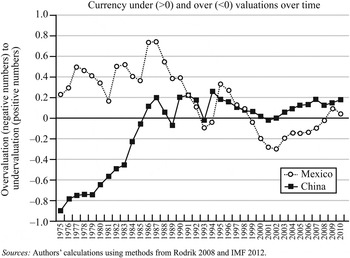
Figure 2 illustrates currency undervaluation versus overvaluation. It shows the evolution of currency valuations over time for China and Mexico, which—despite their differing policy stances—have very similar factor endowments.Footnote 25 Excluding the period of the Mexican peso crisis, the post-NAFTA Mexican peso ceased its long-run undervaluation and was on average overvalued for the 2000s relative to the US dollar. China, as part of its economic reforms in the 1980s, ended its long-standing currency overvaluation. Since the 2000s, China has sustained an undervalued exchange rate compared with the Mexican peso's overvaluation, which gave US producers an incentive to invest in (and source from) China rather than Mexico.
Real exchange rates of Mexican Peso and Chinese Yuan relative to the US dollar, 1975–2010

Currency undervaluation may be a particularly attractive growth strategy for governmentsFootnote 26 because the international trading system under World Trade Organization (WTO) rules does not proscribe countries from engaging in currency undervaluation for the purposes of export promotion.Footnote 27 Copelovitch and Pevehouse, for example, find that governments that have signed preferential trade agreements (PTAs) are likely to move to an undervalued currency vis-à-vis their PTA partners’ currency, possibly to enhance export competitiveness relative to these partners.Footnote 28
Although an undervalued currency may offer economic advantages to exporting nations and their firms, undervaluation risks backlash through other means by foreign trade partners. Some governments undertake policies to lessen the effects of the depreciation of trading partner currencies through competitive devaluations.Footnote 29
Firms and industries can respond to undervaluation by trade partners by filing for TTBs such as AD filings. Numerous studies have indeed found a strong correlation between domestic (home country) real exchange rate appreciation vis-à-vis trade partners and subsequent trade disputes.Footnote 30 This research's central inference is that AD filings represent the response of particular industries to undervaluation among their trade partners. In particular, Broz and Werfel show that the pass-through of exchange rate movements to prices, which varies systematically by industry, correlates with industry AD responses to domestic real exchange rate fluctuations.Footnote 31
Our argument predicts within-industry variation in firm responses to undervaluation. Firms integrated into global supply chains, particularly those in countries with undervalued currencies, will be less likely to pursue AD because they benefit from producing in a country with an undervalued currency. The comparative advantage motive for vertical FDI suggests that firms tend to produce abroad where they can take advantage of cheaper inputs.Footnote 32 A depreciated currency lowers the cost of labor and other host-country inputs relative to production costs at home. Although firms producing in an undervalued country for sale in that country (that is, horizontal, or market-seeking, FDI) do not benefit from the undervaluation because costs and revenues are both undervalued, firms that produce in an undervalued country for export to the MNC's home market or a third country (vertical FDI) benefit from the reduced costs from undervaluation (that is, costs are undervalued, but revenues are not). For firms that use FDI as a platform for export, a depreciated currency increases the competitiveness of exports from that platform.Footnote 33
A related way that firms integrated into global supply chains benefit from undervaluation (and thus are less likely to pursue AD) is that MNCs with a broad FDI portfolio can strategically respond to abrupt shifts in currency values in ways that firms without multiple production locations cannot. Kogut and Kulatilaka develop a model in which production in different countries offers MNCs a real option to change the location of production in response to currency fluctuations.Footnote 34 Firms that own production facilities in multiple currency zones can dynamically adjust their production to the lowest-cost location. FDI in countries that tend toward undervaluation serves as a real hedge against currency fluctuations. Bernard, Jensen, Redding, and Schott present evidence, consistent with the Kogut and Kulatilaka model, that US MNCs shifted production to their affiliates in the countries experiencing depreciations during the 1997–98 Asian financial crisis.Footnote 35
Additionally, firms will find undervalued countries attractive for investment because a depreciated currency makes the value of assets relatively cheaper in foreign currency terms by lowering the costs of investment by foreign firms and increasing the net worth of foreign bidders relative to domestic investors.Footnote 36 The undervaluation provides an additional incentive for investment.
In sum, large MNCs with production affiliates in multiple countries may choose to source from undervalued countries instead of pursuing trade remedies. Large firms (including MNCs) without trade or investment relationships with an undervalued country are likely to pursue trade remedies, especially if they compete with relatively cheaper imports from countries with undervalued currencies.Footnote 37 Small firms are unlikely to file for AD protection (because it is difficult to organize a coalition) or source from undervalued countries (because this, too, is costly).Footnote 38 As the share of MNCs with operations in undervalued countries increases, the natural constituency for AD protection diminishes.
Empirical Implications of Our Argument
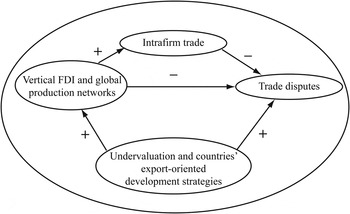
The diagram in Figure 3 represents a summary of the argument and points to several of the empirical relationships that we examine. We examine four implications at the firm level. The first is that, ceteris paribus, larger firms will be more likely to file AD petitions for two reasons: (1) filing incurs costs and (2) they are in a better position to organize a coalition to meet the 25 percent filing threshold.
The relationships between and among currency undervaluation, FDI, and trade disputes

Second, we expect differences in international investment positions and the composition of trade flows between firms that file AD petitions and those that do not. Compared with their nonfiling peers, filers will conduct less RP trade with filed-against countries, particularly in their product category.
Third, MNCs will find undervalued countries more attractive for vertical than for horizontal FDI. Profits tend to be higher for vertical FDI in undervalued countries because costs are incurred in an undervalued currency and revenue is realized in a different currency; horizontal FDI for local demand has both costs and revenues in the undervalued currency and thus does not benefit from the undervaluation.
The fourth and final firm-level implication that we examine is that RP trade will reduce the likelihood that a firm will file an AD petition. Firms that have vertical production networks in a country will be less likely to file an AD petition against that country.
At the country level we follow the recent literature, which has examined the specific relationship between undervaluation and AD filings. Our argument extends the literature: we expect that the impact of undervaluation on AD filings will depend on the composition of trade flows originating from countries pursuing undervaluation; that is, at the country-level, we expect RP imports to moderate the relationship between undervaluation and disputes. If undervaluation attracts vertical FDI, and if firms with RP trade are unlikely to file against their host countries, undervaluation will be associated with fewer AD filings against countries from which higher levels of US intrafirm imports originate. If MNCs with operations in undervalued countries are less likely to file against that country, and if the activities of MNC in undervalued countries are increasing, AD filings should diminish.
Although we expect this pattern to hold probabilistically across US trade partners, AD filings and trade disputes with China are likely to represent a special case because China is almost uniquely classified as a “nonmarket economy” under both the terms of its accession to the WTO and its prior treatment under US trade legislation.Footnote 39 Over the past three decades, US AD petitions against China account for 13.8 percent of all filed disputes. The growing direct investments by US MNCs in China, and the resulting RP trading with China, will change the political calculus of these firms regarding AD duties. MNCs with resource-seeking operations in China benefit from low-cost intermediate goods produced and final goods assembled in China, while firms without such operations (and which compete with Chinese exports) will be harmed by an undervalued yuan.
Empirical Analysis
Characteristics of AD Petition Filers
Our hypothesis is that large firms engaged in trade with a country, particularly RP trade with their foreign affiliates, will be less likely to file AD petitions. We compare filers with nonfilers in the same product market for evidence that filers are different. We focus specifically on the relative size of filers, their overall international engagement (imports and exports), and their engagement with the country against which they file (in terms of arm's-length trade and RP trade).
Our data source for AD petitions is the May 2012 update of the Global Antidumping Database (GAD) created by Chad Bown.Footnote 40 Our source of firm-level data is the Census Bureau Linked/Longitudinal Firm Trade Transaction Database (LFTTD), which covers the universe of firms in the scope of the economic census.Footnote 41 A total of 559 organizations—including firms, trade associations, unions, and other organizations—filed AD petitions from 1993 to 2009. We are able to match 425 (76 percent) of these organizations to the Census Bureau's Business Register, which is excellent considering that not all filers are private sector firms.
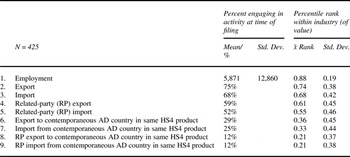
Table 1 presents the results. Consistent with our expectations regarding firm size, we find that firms that file AD petitions are relatively large within their industries, with an average rank in the 88th percentile in terms of employment within their product market industry (line 1). At least 75 percent of the AD petition filers are engaged in international trade, and they are above the median in terms of the value of merchandise exports and imports: filing firms have an average rank in the 74th percentile in terms of overall exports (the sum of arm's-length and RP exports) and the 68th percentile in terms of overall imports (lines 2 and 3, respectively). Most of the filing firms are vertically integrated MNCs: nearly 60 percent engage in RP trading, and the percentile rank of value is high. Relatively few of the filers are purely exporters to, or importers from, unaffiliated parties. In sum, we find that the average AD filing firm is a very large, internationally engaged firm. We find, perhaps not surprisingly, that only roughly one-quarter of AD filers are exporting or importing in the product category with the filed-against countries; these firms are below the median in terms the value of overall imports and exports.
Filer characteristics at date of filing (pooled, 1993–2009)

Notes: This table presents statistics for firms that filed AD petitions over the period 1993–2009. The table reports the firms’ average rank within their six-digit NAICS industry and the share of firms engaging in a particular form of international trade. The percentile rank column reports the average of the firms’ rank within their industries for the value of these trade volumes. Std. Dev. = the standard deviation of the series.
A key finding, consistent with our argument, is that filers rarely engage in RP trade in the product category with the target country. Only 12 percent engage in RP trading in the same product category; of this number, the value traded is modest compared with industry peers. The vast majority of filers (88 percent) have zero RP imports and exports with the country against which they file. Consistent with our argument, AD filers, on average, have either no or much smaller investment and trade relationships with targeted countries in the product categories in which they file.
These results suggest that intraindustry differences in firm behavior, in this case international trade and investment, are associated with differences in firm AD filing behavior. AD-filing firms are less likely to be engaged with countries they file against.
Changes in Engagement with Undervalued Countries
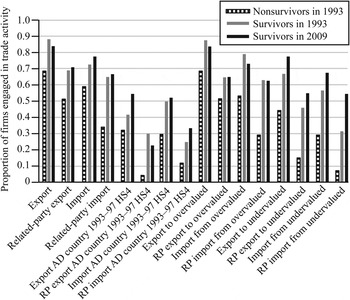
To examine how firms’ engagement in international trade and investment has evolved over time, we first examine the international trade characteristics from 1993 of the eighty-nine firms that filed during 1993–97 (see Figure 4).Footnote 42 Surviving firms were generally more engaged in exporting, importing, and RP exporting in 1993, relative to all firms and to nonsurviving filers. At least one-quarter of the forty-eight survivors were engaged in trade in the four-digit product with the set of countries filed against for the period 1993–97.Footnote 43 In contrast, a much smaller proportion of the forty-one failing firms engaged in RP trading in the product with the set of countries filed against in 1993–97.
Proportion of firms filing antidumping petitions 1993–97 engaging in international trade activities of various types: Nonsurvivors (41) in 1993 and survivors (48) in 1993 and 2009

The general profile of the surviving filers had changed little twenty-six years later: they remained larger and more internationally engaged than their product market peers (percentile ranks available on request). The share of surviving filing firms that was exporting to a country that was filed against in 1993–97 increased by 13 percent by 2009, and the share of surviving filing firms engaged in RP importing from a filed-against country increased by 8 percent.
As illustrated in Figure 4, we also observe a large increase in firms’ engagement with countries with undervalued currencies compared with those with overvalued currencies. We separate countries into two groups based on the average value of our undervaluation index from 1990–2009: countries with sustained undervalued currencies and those with sustained overvalued currencies.Footnote 44 Figure 4 shows that the share of surviving filing firms that traded with undervalued countries increased significantly—particularly RP importing, which increased by 23 percent—whereas the share of firms engaged with overvalued countries marginally decreased. AD filing firms that survived increased their international trade with countries with undervalued currencies. If, as we show, firms with vertical affiliates are less likely to file AD petitions, then disputes against countries pursuing undervaluation should decline.
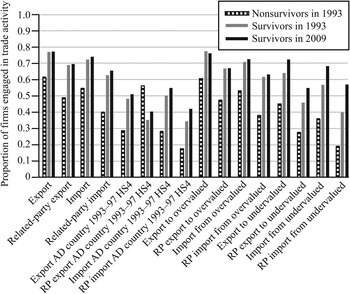
We explore whether similar changes in trading relationships are also evident in the sample of all surviving manufacturing firms. Figure 5 presents the same statistics as those reported in Figure 4, but uses employment-weighted shares as a proxy for market share. Although the overall engagement in international trade (exporting, importing, RP exporting, RP importing) changed little among surviving manufacturing firms during the study period, firms modestly increased their engagement with countries that were filed against in 1993–97, but significantly increased trade with undervalued countries. The share of employment at firms with imports from undervalued countries increased by 11 percent. The share of employment at firms that engage in RP imports from undervalued countries increased by 17 percent, and by 2009 was nearly three times greater than the share of nonsurvivors with intrafirm imports from undervalued countries in 1993. If firms with vertical affiliates are less likely to file, as our results indicate, then a pro-undervaluation constituency appears to be growing over time. We observe similar changes in the activities of firms when we examine the complete universe of manufacturing firms between 1993 and 2009.Footnote 45
Proportion of manufacturing firms engaging in international trade activities of various types: Nonsurvivors (206,200) in 1993 and survivors (88,800) in 1993 and 2009 (weighted by employment as a proxy for market share)

Currency Undervaluation and Vertical FDI
A corollary to these findings, which to our knowledge has not been previously explored in the literature, is that currency undervaluation is likely to be associated with increased investment by US MNCs. To further examine this claim, we pay particular attention to affiliates that are vertical (the affiliate exports to the US parent or to other related parties)—which we expect to be influenced by currency undervaluation—rather than horizontal (the affiliate does not export), which we do not expect to be influenced by undervaluation. Using detailed sales data from the US Bureau of Economic Analysis (BEA) at the foreign affiliate level, we capture the overall presence of MNC affiliates in foreign countries and the presence of vertical and horizontal affiliates specifically.Footnote 46
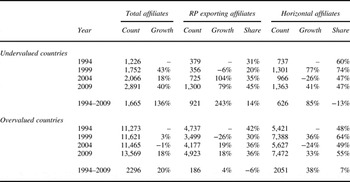
We link the total number of each affiliate type with our country-level measure of undervaluation to observe changes in investment patterns over the period. Table 2 reports the numbers of foreign affiliates of US MNCs present in countries with either undervalued or overvalued exchange rates. The data come from the quinquennial Benchmark Survey conducted by the BEA between 1994 and 2009.Footnote 47 For the groups of countries with undervalued and overvalued real exchange rates, we report total affiliates, along with counts of affiliates that export to related parties and those that do not export.
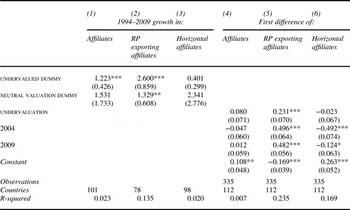
Undervaluation and MNC investment (BEA data at the affiliate level)

Notes: The sample is the population of US multinationals with majority-owned affiliates taken from the quinquennial BEA Benchmark Surveys over the period 1994–2009. Countries are grouped by sustained currency overvaluation (1990–2009 period average ≤ −.1) and sustained currency undervaluation (1990–2009 period average ≥ .1). The numbers of RP exporting affiliates and horizontal affiliates do not necessarily sum to total affiliates. The unreported residual category is affiliates that solely export to unaffiliated parties. See the data appendix for details.
We compare growth rates of affiliates in countries with undervalued real exchange rates to affiliate growth rates in countries with overvalued real exchange rates. The key comparison concerns RP exporting affiliates versus nonexporting (“horizontal”) affiliates. In countries with sustained undervaluation, we observe a 243 percent increase in the number of vertical affiliates. This high growth rate far exceeds the 85 percent increase in the number of horizontal affiliates in undervalued countries. Furthermore, we note that the share of affiliates conducting trade with related parties increases from 31 percent to 45 percent in undervalued countries. In overvalued countries, by contrast, the growth of horizontal affiliates (38 percent) far exceeds the minimal (4 percent) growth in RP exporters, and the share of affiliates conducting RP trade decreases over the period. Our findings indicate that the nature of firms’ global investment activities is shaped in part by real exchange rate valuations.
We further examine the relationship between undervaluation and investment and report the results in Table A1 of the appendix. In columns (1) to (3), we examine affiliate growth rates between 1994 and 2009, and find that undervaluation is statistically significantly associated with growth of RP affiliates, but not with horizontal affiliates. In columns (4) to (6), we report panel models of changes in the logged number of affiliates in each affiliate category regressed on undervaluation during the prior five-year period, and year dummies. In these models, undervaluation varies at the country-period level.Footnote 48 The results are consistent throughout: undervaluation is strongly associated with increases in the number of affiliates that export to related parties, but not with increases in the numbers of horizontal affiliates.Footnote 49 The analysis suggests that MNCs respond to foreign exchange rate undervaluation by setting up vertical affiliates in these countries.
Intrafirm Trade and AD Petition Filings by US MNCs
We have provided evidence of intraindustry heterogeneity between and among AD filing firms and firms that do not file. We also demonstrated that firms have increased their engagement with countries with undervalued currencies—raising a key empirical implication of our heterogeneous firm argument, which is that MNCs with extensive vertical FDI and large volumes of trade with their global affiliates will be less likely to file AD petitions. Now we use a regression framework to examine how firms’ vertical FDI affects their filings.
To that end, we link trade data from the universe of US multinationals included in the BEA Benchmark Surveys from 1989–2009 with the data on AD petition filers to examine the correlates of AD filings at the firm level.Footnote 50 The BEA data allow us to observe the value of trade (total imports and exports) conducted by the headquarters of all US MNCs. The import and export values are further disaggregated according to the headquarters firms’ relationships with trade partners: unaffiliated trade is conducted with firms and organizations that are not foreign affiliates of the headquarters firm; RP trade is with foreign affiliates of the MNC.Footnote 51
We examine the correlates of AD petition filings at the firm level by estimating variations of the following model of the number of dispute filings for firm i:
 $$\eqalign{Dispute{s_i} = & \alpha + \beta \,Related\,Party\,Trad{e_{i,\,t}} + \gamma \,Arms\,Length\,Trad{e_{i,\,t}} + \theta \,Sale{s_{i,\,t}} \cr & + {\varepsilon _i},}$$
where t corresponds to each year of the quinquennial BEA Benchmark Survey from 1989 to 2009. Disputes are summed for each MNC over a five-year period beginning with benchmark year t, that is,
 ${\sum\nolimits_{j = t}^{t + 4} {Disputes} _j}.$
Our specification includes year fixed effects to capture global trendsFootnote
52
and sector dummies to account for sectoral correlates of AD filings and trade flows. Firm fixed effects are inappropriate in this context because only firms with filings would enter the analysis, which would produce a biased sample. We relax the assumption of independent and identically distributed (i.i.d.) standard errors and report estimates that allow for firm-level clustering.
The dependent variable is highly overdispersed, with more than 99.8 percent of summed AD dispute observations equal to zero. To address overdispersion in the data, we follow the literature in assuming and testing that the data are best examined with a zero-inflated negative binomial (ZINB) model because of the large number of zeroes.Footnote 53
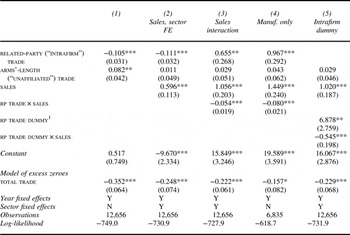
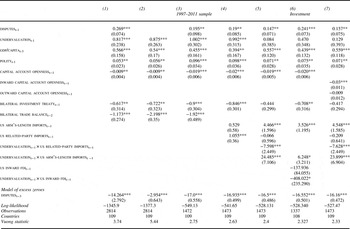
We report the estimates of AD dispute filings at the level of the US MNC in Table 3. The estimates from the parsimonious specification reported in column (1) indicate that the volume of trade conducted with global affiliates (related-party trade) is associated with fewer AD dispute filings, while arm's-length trade is associated with greater numbers of filings. In Model 2, we introduce the log of total MNC sales as a proxy for firm size, and sector fixed effects. related-party trade retains a negative and statistically significant coefficient, but the coefficient corresponding to arm's-length trade is dramatically reduced and is far from statistical significance. Also consistent with the results presented in a previous section, size (measured as the log of total sales) is statistically significantly associated with increased filings, all else equal.
Related-party trade and MNC AD dispute filings, 1989–2009 (BEA data at the MNC headquarters level)

Notes: The table reports the results of zero-inflated negative binomial models of the number of AD petitions filed by US multinational corporations, 1989–2009. The variables are all measured at the level of the MNC. The values of related-party trade, arm's-length trade, sales, and total trade represent the natural log transformations of the reported value (plus one). The sector fixed effects correspond to the following categories: construction; agriculture and mining; manufacturing; telecommunications and utilities; wholesale and retail; and services. Standard errors are reported in parentheses. *p < .1; **p < .05; ***p < .01.
1. rp trade dummy is 1 if rp trade is positive.
Our theory suggests that the lower propensity of large firms with international investments to file AD petitions has contributed to the secular decline in filings over time. In columns (3) to (5) of Table 3 we examine whether large firms with high levels of RP trade file fewer disputes by including the interaction of related-party trade and sales in the model. The results in Model 3 indicate that related-party trade is associated with fewer disputes among large firms, and that large firms without RP trade file more disputes. The result holds for firms in the manufacturing sector (Model 4).Footnote 54 For firms with zero intrafirm trade, a one-unit increase in the logged value of sales is associated with a roughly 200 percent increase in the predicted number of filings (based on results from Model 3).
To facilitate the interpretation of the results, we examine the interaction between a dummy variable indicating positive related-party trade and sales volume in Model 5.Footnote 55 The results indicate that as sales increase, the predicted number of filings by firms with positive intrafirm trade decreases relative to the predicted number of filings by firms without vertical affiliates. The interactive effect becomes statistically significant at around $1.3 billion in sales, where the coefficient estimates indicate that firms with vertically integrated affiliates are predicted to file 56 percent fewer disputes. Among the largest firms in our sample (firms with over $100 billion in sales), those with vertically integrated affiliates are predicted to file 97 percent fewer disputes.
The evidence is consistent with our argument that increases in vertical FDI lessen demands for TTBs during an era of currency undervaluation and increased import competition. In disaggregating MNC trade flows, we find that intrafirm trade, which indicates ownership of trading affiliates and serves as our main proxy for firm global production activities, is associated with fewer dispute filings. Although firms may also engage in global production by trading at arm's length, we find no evidence that trade with unaffiliated parties is associated with fewer disputes. The results are consistent with the view that vertical FDI by large firms explains the reduction in the number of US AD dispute filings.
Currency Undervaluation, Trade Flows, and AD Filings at the Country Level
A robust finding in the literature is that currency undervaluation among trade partners is associated with increased AD filings. This result may be incomplete, since responses to undervaluation will vary depending on firms’ vertical FDI in the undervalued country. Our argument also suggests that the effect of undervaluation on AD filings will depend on the composition of trade flows from the undervalued country. In the context of undervaluation, high levels of intrafirm trade may diminish trade disputes.
Our sample includes all countries for which currency undervaluation data are available. A major advantage of our approach is that our explanatory variables are specific to countries outside the United States. In contrast to the majority of studies—which model AD filings as a function of filing country and industry characteristics—we match exchange rate, investment, and other macroeconomic data to the countries named (and not named) in the AD disputes.
We report the estimates of the country-level determinants of AD filings by US firms over either 1982–2011 or 1997–2011. In terms of the dependent variable, we count the number of AD petitions filed in the United States against each country for each year in our sample. The yearly count of AD disputes ranges from zero to a maximum of twelve. The variable is strongly skewed: about 85 percent of the observations equal zero, and many countries have no filings against them. (Panel unit root tests, not reported to save space, strongly reject the null of a unit root.) To address overdispersion in the data, we follow the firm-level analysis and estimate a zero-inflated negative binomial model.Footnote 56
One main independent variable in our analysis captures real currency undervaluation for all countries in our sample. Another pair of key independent variables is the presence of US-based global production networks, which we gauge by incorporating measures of intrafirm (or RP) from each country into the United States as a share of US GDP, 1996–2010.Footnote 57
We include two indicators of a country's openness to FDI flows. The first is an indicator of capital account openness from Quinn and Toyoda.Footnote 58 Countries with open capital accounts have a limited capacity to restrict US FDI and a diminished capacity to manage exchange rate targets. Capital account openness is therefore likely to decrease the likelihood of AD filings for two reasons: (1) countries with open capital accounts, especially on resident outflows, have increased difficulty in maintaining a given currency undervaluation (owing to Mundell-Flemming effects) and (2) countries with fewer inward capital account restrictions tend to see increased investment and increased RP trading. The second indicator measures whether a country has a bilateral investment treaty (BIT) with the United States, which may enable or enhance vertical integration by US firms.
We also control for a host of variables identified in the literature as correlates of trade disputes and of our main explanatory variables. The Polity 2 index measures democracy because prior studies have found democracy to be a positive correlate of trade disputes.Footnote 59 Gross domestic product (GDP) per capita proxies for wealth and overall institutional quality, both of which are positive correlates of trade disputes.Footnote 60 In the models in which data for US intrafirm trade are not available, we include a measure of the bilateral trade balance with the United States as a share of US GDP, with positive numbers indicating a US trade surplus with the other country.
Since initiating an AD filing requires firms to evaluate the material injury they have suffered, we expect a nontrivial delay between real exchange rate movements and the dependent variable. We therefore introduce all of our regressors with a one-year lag, except for GDP per capita, which we lag three years in keeping with the estimation choice in Knetter and Prusa and the trade balance, which we lag two years.Footnote 61
The full model estimated for the longest-available data is the following:
 $$\eqalign{& Dispute{s_{i,\,t}} = {\beta _0} + {\beta _1}\left( {Dispute{s_{i,\,t - 1}}} \right) + {\beta _2}\left( {Undervaluation{\,_{i,\,t - 1}}} \right) \cr &+ {\beta _3}\left( {GDP/Per\,Capit{a_{i,\,t - 3}}} \right) + {\beta _4}\left( {Polity{\,_{i,\,t - 1}}} \right) \cr &+ {\beta _5}\left( {Captial\,Account\,Opennes{s_{i,\,t - 1}}} \right) + {\beta _6}\left( {Bilateral\,Investment\,Treat{y_{i,\,t - 1}}} \right) \cr &+ {\beta _7}\left( {Bilateral\,Trade\,Balance{\,_{i,\,t - 2}}} \right) + \gamma, \,t + {\varepsilon _{i,t}}\;t = 1982 - 2011,\,i = 109 - 113} $$
To test our argument with regard to firms and their investment and trade relations, we estimate a version of equation (2), substituting arm's-length and related-party imports data for the bilateral trade balance, and adding appropriate interaction terms with undervaluation in the following:
 $$\eqalign{& Dispute{s_{i,\,t}} = {\rm} {\beta _0} + {\beta _1}\left( {Dispute{s_{i,\,t - 1}}} \right){\rm} + {\rm} {\beta _2}\left( {Undervaluatio{n_{i,\,t - 1}}} \right){\rm} \cr &+ {\rm} {\beta _3}(GDP/Per{\rm} \;Capit{a_{i,\,t - 3}}) + {\rm} {\beta _4}\left( {Polity{\,_{i,\,t - 1}}} \right){\rm} + {\rm} {\beta _5}(Capital\,Account\,Opennes{s_{i,\,t - 1}})\; \cr &+ {\rm} {\beta _6}\left( {Bilateral\,Investment\,Treat{y_{i,\,t - 1}}} \right) + {\rm} {\beta _7}(Arm^{\prime}s\,Length\,Imports/GDP{\,_{i,\,t - 1}})\; \cr &+ {\rm} {\beta _8}\; (Related\,Party\,Imports/GDP{\,_{i,\,t - 1}}) + {\rm} {\beta _9}(Arm^{\prime}s\,Length \ast Undervaluatio{n_{i,\,t - 1}})\; \cr &+ {\rm} {\beta _{10}}(Related\,Party \ast Undervaluatio{n_{i,t - 1}}) + \gamma, \,t\; \cr &+ {\rm} {\varepsilon _{i,\,t}}\; \; t{\rm} = {\it 1997 - 2011,\,i{\rm} = {\it 109 - 113}}}$$
The models in Table 4, columns (1) and (2) represent the longest-available sample of AD filings. The models in Table 4, columns (4) to (7), contain theoretically relevant variables, especially indicators of RP and arm's-length imports to the United States, but the sample is limited to 1997–2011.
Bilateral real exchange rate undervaluation and trade disputes, 1980–2011 or 1997–2011

Notes: The table reports the results of panel zero-inflated negative binomial estimates of annual bilateral AD filings in the United States, with and without a lagged endogenous variable (1 and 2, respectively). Models 3 to 7 examine filings over the period 1997–2001. The variables are defined in the text. Standard errors are reported in parentheses. *p < .1; **p < .05; ***p < .01.
The models reported in Table 4 estimate the relationship between bilateral real exchange rate undervaluation and AD disputes for nonbanking center countries, excluding China. As noted earlier, China is analyzed separately because it is categorized under US trade law as a “nonmarket economy,” which involves a different process of initiating and adjudicating disputes.Footnote 62 Moreover, the Vuong test suggests that a zero-inflated negative binomial model is inappropriate for analyzing Chinese data.Footnote 63
The results in column (1) suggest that undervaluation is associated with increases in the number of trade disputes, which is similar to prior findings in the literature. In particular, a one-standard-deviation increase in undervaluation increases the predicted number of AD filings by about 125 percent.Footnote 64 The results are robust to the omission of the lagged endogenous term (column 2).Footnote 65 The model estimated in column (1) fits the data very well.Footnote 66 The estimated results of the other variables are broadly consistent with prior findings.
The results in columns (4) to (7) explore the core theory about the relationship between and among undervaluation, trade flows, and trade disputes. Specifically, we examine how RP import shares (and arm's-length import shares) relate to trade disputes in the context of undervalued currencies. The sample is necessarily shorter, owing to the unavailability of RP trade data from the US Census Bureau before 1996. To assess whether the parameter estimates differ because of changes in the length of the sample, the model in column (1) is reestimated using the shorter sample (1997–2011) in column (3). The signs, magnitudes, and levels of statistical significance of the parameter estimates are similar between column (1) (1982–2011) and column (3) (1997–2011).
The estimates reported in column (4) indicate that the unconditional relationship between RP imports is positive: countries from which US intrafirm imports represent a higher share of US GDP are more likely to incur trade disputes. Higher (lower) levels of undervaluation are associated with increased (decreased) AD filings.
Our theory, however, proposes an interactive, or moderating, effect between intrafirm trade flows and undervaluation. The results in column (5) (with trade shares and the interactions with undervaluation) are consistent with the hypothesis that firm vertical FDI and subsequent intrafirm trade moderates the relationship between undervaluation and AD dispute filings.Footnote 67 In particular, we find that undervaluation increases or decreases the predicted number of trade disputes depending on the composition of imports. Undervaluation is associated with an increased likelihood of AD filings against countries from which more arm's-length US imports originate, and with fewer disputes against countries from which US RP imports represent a greater share of US GDP. When the lagged dependent variable is omitted, the results change very little.
As a robustness test, in column (6) we substitute US inward FDI for RP trade under the assumption that FDI precedes US intrafirm imports. The intuition is that RP imports arise from either US FDI in the host country or FDI in the US. We find that arm's-length trading is only modestly correlated with FDI. Our results indicate that FDI lessens trade disputes in the context of undervaluation, controlling for the effects of arm's-length imports into the United States. In sum, our results are consistent with the view that firm vertical FDI and intrafirm trade flows decrease AD filings in the context of undervaluation.Footnote 68
It is plausible that different types of imports could be endogenous to AD filing.Footnote 69 We test for the exogeneity of both arm's-length and RP imports using the control function approach outlined in Cameron and Trivedi.Footnote 70 The procedure has difficulty estimating models with more than two plausibly endogenous variables, and so we isolate on the sample of countries with sustained undervaluation, and test for the exogeneity of arm's-length and RP imports to trade disputes in each subsample. The tests for exogeneity fail to reject the null hypothesis of exogeneity, which indicates that both types of imports are plausibly exogenous to filings.Footnote 71
We nonetheless estimate two types of instrumental variable models: an Instrumental Variable (IV) Poisson model and Generalized Method of Moments (GMM)-system two-step models. Both models have valid instruments, although both IV estimators have undesirable properties. The GMM-system estimate, in particular, gives rise to negative predictions for trade disputes for 40 percent of observations; negative disputes, are, of course, impossible. In the case of the IV Poisson model, on identical models and samples, the sum of squared errors (SSE) for the ZINB models is 20 percent the size of the SSEs for the IV Poisson models.
Despite the undesirable estimation properties, the resultsFootnote 72 are very similar results to the ZINB models. The main difference is that, in the GMM estimate model, the interaction effect between arm's-length imports and undervaluation is not statistically significant at conventional levels and is not reported. RP imports and undervaluation continue to have a negative and statistically significant effect.Footnote 73 We also estimate models constraining the samples to countries with long-run undervaluations of 20 percent and 10 percent,Footnote 74 and the results are consistent with those in the main tables.
Although the control variables are not the main focus, we find, consistent with other studies, that US firms are more likely to file AD disputes against firms in countries that are more democratic, wealthier, and with whom the United States has a trade deficit. We find, to our knowledge uniquely, that greater openness to international capital flows is associated with fewer AD filings (see Table 4, columns 1 to 6). As an empirical experiment, we distinguish between openness to nonresident (inward) and resident (outward) flows (column 7).Footnote 75 If the main effect of capital account openness is a nonresident inflow effect (from the liberalization of, for example, FDI), the inward restrictions (but not the outward restrictions) will contain the identifying variance. It is, indeed, the indicator of openness to nonresident inward investment, and not the indicator of openness to resident outflows, that contains the identifying variance in the capital account openness data. This is an area for future investigation.
We proposed earlier that a BIT with the United States might also increase US FDI, thereby reducing AD filings. The estimated coefficient estimate of the BIT variable is always negative. In some models, however, the estimates do not achieve conventional levels of statistical significance. This is another area for future research.
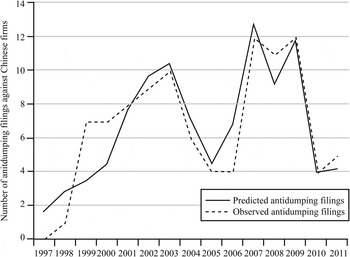
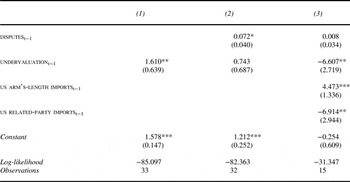
As we note, China is likely to be an unusual case, both because of its special status under US trade law and because of the large effects its economic activities have on the US market.Footnote 76 We investigate the China case explicitly and report the results in Table 5, which indicate that increased arm's-length imports from China are associated with increases in trade disputes, while RP imports are strongly negatively correlated with filings. Figure 6 shows that the predictions from our model very closely match the number and timing of actual AD petitions by US firms against China.
US antidumping filings against China: Observed and predicted (derived from results in Model 3, Table 5)

Undervaluation, imports, and antidumping filings against Chinese firms

Notes: The table reports the results of negative binomial estimates of annual AD filings against China by complainants in the United States. The independent variables are country-year values corresponding to China. The undervaluation index is defined in the text; higher values indicate greater real exchange rate undervaluation relative to the US dollar. Related imports and arm's-length imports measure US imports from China by affiliated and unaffiliated parties, respectively, as a share of US GDP. Standard errors are reported in parentheses. *p < .1; **p < .05; ***p < .01.
Conclusion
Recent scholarship in international economics demonstrates that firm-level heterogeneity within an industry is a main driver of trade and international investment activities. The political implications of “heterogeneous firm” (or “new, new”) trade theory are, however, largely unexplored thus far.
Much can be learned about political and regulatory outcomes by shifting the investigator's focus from factors and sectors to the level of individual firms. We use US firm AD filings as a prism through which to explore the utility of heterogeneous firm trade theory. The specific locations of firm vertical FDI and intrafirm trade at a point in time help explain the recent puzzling decline in firm AD filings, and we use both microlevel firm and macrolevel national data to examine our claims.
We demonstrate empirically that (1) intraindustry firm heterogeneity exists between AD filers and nonfilers and (2) the changing composition and characteristics of firms have important implications for this activity. Firms that file AD petitions are different from industry peers that do not file: they are larger and more internationally engaged in trade, though not with the countries that are filed against. Among firms that have investment or trade positions in foreign countries—especially once they set up vertical affiliates with which they trade—AD filings become much less likely, even in the context of currency undervaluation and rising import competition.
The increasing engagement of US-based MNCs with undervalued countries, as we documented in this study, has reduced the scope for effectively organizing AD coalitions. The rising share of economic activity accounted for by firms with global production affiliates in countries with undervalued currencies makes organizing a coalition that represents 25 percent of the activity in a product market increasingly difficult. Given the rapid expansion of global supply chains, our findings offer a partial explanation for the decline in AD filings and the puzzling dearth of protectionism in the wake of the global financial crisis.Footnote 77
Firm-based theories and empirical approaches are likely to prove effective in addressing a range of political questions in international political economy. Conflicts over international economic policies and outcomes are likely to divide firms within industries, separating firms with the capabilities to expand (and thus benefit from further integration) from those that cannot compete. By shifting the unit of analysis to individual firms, we expect that future scholarship will better explain the location and form of political activities as well as the distributional effects of changes in the global economy. Firm-level approaches are likely to illuminate individual and firm preferences and political behavior across a range of issues including corporate taxation, international trade and investment, and financial regulation.
Appendix
Data
AD Petition Data
Undervaluation and MNC investment, 1994–2009

Our data source for AD petitions is the May 2012 update of the GAD, which includes all AD petitions filed in the United States since 1980, including the name of the petitioner, a detailed product code corresponding to the product(s) under investigation, the country host of the firm against which the dispute is filed, and the date of the initiation of the investigation.Footnote 78
Firm- and Intra-Industry Level International Engagement Data
To examine the behavior of individual firms in an industry context, we use the LFTTD, which links individual US trade transactions to US firms using a longitudinal database of US enterprises that tracks almost all private-sector firms in the United States.Footnote 79 For each export and import transaction, we observe the ten-digit Harmonized System classification, the (nominal) value and quantity shipped, the shipment date, the destination or source country, the transport mode, and whether the transaction takes place at “arm's length” or between “related parties.” Export partners are “related” if either party owns, directly or indirectly, 10 percent or more of the other party. For imports, the ownership cutoff is 6 percent.
We match the AD firm filings data compiled by BownFootnote 80 with the Census Bureau's Business Register using the name of the filing organization. (Some of the filers are not firms; filing organizations include, for example, labor organizations, farm produce coops, and cities.) Once the AD filing firms are matched to the Business Register, we use a common identifier to match to the LFTTD and the Census Bureau's Longitudinal Business Database (LBD), which contains information on industry and employment for almost all private sector establishments in the US.Footnote 81 The combination of the LBD and the LFTTD allows us to construct a detailed and comprehensive picture of US firms’ domestic operations and international trade relationships.
We classify firms into product markets based on the six-digit NAICS industry in which the firm is active and in which it has the most employment (using information from the Census Bureau's Longitudinal Business Database) for each year.Footnote 82 All firms are classified into a single six-digit industry, and we restrict the sample to the manufacturing sector.
US Multinational Company Data
We rely on confidential firm-level data from the BEA quinquennial Benchmark Surveys of US Direct Investment Abroad, which are the most comprehensive in scope and coverage of the BEA surveys. Any US person is considered to have a foreign affiliate if she has direct or indirect ownership of 10 percent or more of the voting securities of an incorporated, non-US business enterprise or an equivalent interest in an unincorporated, non-US business enterprise at any time during a benchmark year. A US multinational company consists of a US parent (headquarters) company and each of its foreign affiliates. The International Investment and Trade in Services Survey Act requires owners of foreign affiliates to complete the BEA surveys detailing their financial and operating activities for each foreign affiliate and to provide information on the value of transactions between the affiliate and other parties, including the US parent.
Our analysis of firm responses to undervaluation uses affiliate-level data from the 1994, 1999, 2004, and 2009 benchmark surveys.Footnote 83 The specific survey forms that the US MNC is required to complete vary by year, the size of the affiliate (measured as assets, sales, or the absolute value of net income),Footnote 84 and the US parent's percentage of ownership of the affiliate. The affiliate-level data allow us to disaggregate affiliate sales to a variety of buyers, including the US parent, the host country, and other foreign affiliatesFootnote 85 to generate the following affiliate categorizations:
-
• Total affiliates
-
• RP exporting affiliates: the total number of affiliates that export to the US parent or to other foreign affiliates
-
• Horizontal affiliates: the total number of affiliates that do not report positive exports.
Computing Undervaluation vis-à-vis the United States
The real exchange rate can be thought of as the price of tradable goods relative to nontradable goods. Our bilateral real exchange rate index captures the unique yearly value of a country's goods, relative to those in the United States at the prevailing nominal exchange rate. To generate our index, we rely on price-level data from the Penn World Tables 7.1.Footnote 86 In particular, we compute the following:
 $$RERunad{\,j_{it}} = {\rm In}\left( {XRA{T_{it}}/PP{P_{it}}} \right).$$
We adjust for two well-known determinants of the real exchange rate. First, to account for the Balassa-Samuelson effect (that is, that relative prices of nontradable goods tend to increase with country wealth), we adjust for GDP/capita: GDPPC it . This procedure is standard, and is used, for example, in Copelovitch and Pevehouse.Footnote 87 Second, following the IMF,Footnote 88 our index captures capital controls using data from Quinn and Toyoda.Footnote 89 Our undervaluation index is the residual ε it of the following regression:
 $$RERunad{\,j_{it}} = \alpha + \beta {\rm In}GDPP{C_{it}} + \delta CAOPE{N_{it - 1}} + {\gamma _t} + {\varepsilon _{it}},$$
where γ t is a year fixed-effect term, and CAOPEN it−1 is the Quinn/Toyoda capital controls index for country i in year t−1.Footnote 90
Following Lane and Milesi-Ferretti,Footnote 91 we exclude banking center/tax haven countries from the analysis because the exchange rate valuations and trade data for these countries are affected by the tax allocation strategies of multinational companies as much (or more than) the economic fundamentals of those countries.Footnote 92
Supplementary Material
Supplementary material for this article is available at http://dx.doi.org/10.1017/S0020818315000247.