The merits of an “urban services” perspective
Contention about the use of explosive weapons in populated areas is usually centred on law and ethics, rather than infrastructure, and the basis for the expanded or constricted use of explosive weapons tends to be laid more by lawyers, social scientists and military planners than by engineers. Yet, as this analysis of the factors that determine the spatial and temporal impact of explosive weapons on urban services shows, a grounded technical awareness adds considerable substance to the discussions and debate surrounding this issue.
The analysis builds upon the growing body of research that explores the impact of explosive weapons upon people and structures, notably the work circumscribing the legal parameters for the use of explosive weapons in populated areas,Footnote 1 “forensic architecture”-type studies,Footnote 2 epidemiological studies,Footnote 3 operational resilience and systems thinking,Footnote 4 and disaster risk reduction.Footnote 5
In the analysis, the nature and extent of the impact of all forms of explosive weapons (not just those “with wide-area effects”) on urban services is queried across space and over time. With a focus on drinking water services, that impact is understood in terms of direct effects and reverberating effects. Though explosive weapons may impact any of the components necessary for the functioning of a service (i.e., people, consumables or hardware), their impact is most commonly observed in service infrastructure, and is determined chiefly by the extent of the damage to the functionality of any component. The analysis finds that the spatial extent of the impact on urban services is found to be determined chiefly by the position of the damaged component within the hierarchy of the service, with attacks on so-called upstream components (i.e., those which produce the action or commodity that the service provides) typically having the most widespread impact. The duration of the impact is determined primarily by the “baseline resilience” of the service prior to the explosion, which is a function of the nature of system redundancies and capacity for emergency preparedness and response. These findings feed directly into the debates about the implications of such attacks for the rules on proportionality and precaution in attack,Footnote 6 by shedding light on what impact on urban services can be considered “reasonably” foreseeable.
Methodology
The analysis is based on public and confidential records, and experience in restoring or maintaining service provision. In particular, the research draws on the prolonged experience of the International Committee of the Red Cross (ICRC) in providing support to municipal service providers and utilities in Gaza, Iraq and Syria. The analysis also builds directly on the ICRC report Urban Services during Protracted Armed Conflict (ICRC Urban Services Report),Footnote 7 as well as discussions stimulated by the authors at the ICRC Expert Meeting on Explosive Weapons in Populated Areas (EWPA),Footnote 8 the 16th Bruges Colloquium on International Humanitarian LawFootnote 9 and the 32nd International Conference of the Red Cross and the Red Crescent side event on EWPA.Footnote 10
Features of urban services
This section lays the technical foundation of urban services required to assess the factors which determine the impact that explosive weapons have upon them.
Components of urban services
The term “service” is used here to mean the provision of commodities, actions or other items of value to an urban population, and could include electricity, health care, water, waste-water collection and treatment, and solid waste disposal.Footnote 11 Urban services are increasingly complex systems, and the general public's limited knowledge of their internal workings is contrasted by its near-total dependence upon them.
Most urban services are dependent upon each other. For example, a damaged electrical transformer can cut the power to a water booster pumping station, and so disrupt the water supply to an entire neighbourhood and/or to the local hospital. Furthermore, each urban service requires three components in order to function: people (e.g. service provider staff, private sector contractors and entrepreneurs), consumables (e.g. fuel, chlorine, medicines), and hardware (e.g. equipment, heavy machinery, infrastructure). The bulk of the focus of this article is on the infrastructure element of the hardware component in relation to its function and position within the broader system of any given service.
Each component of a service affects the others. For example, even with well-maintained water infrastructure, experienced water utility staff cannot provide water to consumers if there is no power to run the booster pumps that maintain the pressure in the distribution network.
“Upstream” and “downstream” components
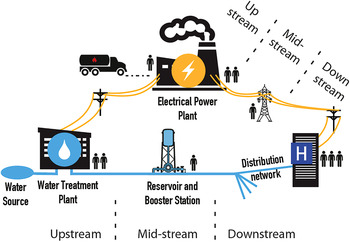
There is a hierarchy of importance within the components of a service, as some elements of each component are more important for the effective functioning of the service, particularly for infrastructure. Infrastructure that is disabled at the supply end of an infrastructure system is more disruptive to more people than are elements of infrastructure that deliver the product halfway down the line, or to the end user, for example. At the top of this hierarchy is what are referred to here as “upstream” components, as shown in Figure 1. Upstream components produce the items of value that the service delivers (typically a commodity or an action), such as water treatment plants, waste-water treatment plants or electrical power plants. “Midstream” components are those that are necessary for the storage or delivery (but not production) of the bulk of the commodity, action or other items of value, such as water reservoirs and booster pumping stations, or an on-grid electrical substation and transmission lines. “Downstream” components of any service are those that ensure the storage or delivery to the end users of the service, such as a water distribution network or an electrical transformer. The significance of the distinction is related to scale; upstream components of a service (read: elements of infrastructure) provide for the largest coverage area and hence the greatest number of people served, while downstream components provide for a smaller coverage area and hence fewer people served.
Sketch showing the hiearchy of components within water and electricity services.

The hierarchy of importance of components also holds true for the people and consumable components of a service, if to a lesser degree. For a drinking water service, so-called upstream people include the key operations personnel required for a service to run, while maintenance, planning and administrative staff can be considered key midstream people, and consumers downstream. In terms of consumables, fuel to run the water treatment plant is considered upstream, while treatment chemicals (such as chlorine for dosing at booster pumping stations) are a midstream consumable, and fuel or chlorine tablets for household treatment are downstream consumables.
Baseline resilience
The condition of a service prior to an attack is also a consideration, as existing underlying vulnerabilities can in some cases be greatly exacerbated by an attack. An impoverished and poorly governed service provider (e.g. Basrah in 2004) can be expected to have fewer options than a well-governed and financially secure one (e.g. Geneva in 2016), in short because the latter is more resilient.
“Service resilience”Footnote 12 may be measured in terms of redundancies (replication of elements of infrastructure, substitute staff) and level of preparedness or ability to respond (e.g. number of qualified staff, volume of prepositioned stocks of consumables, quality of infrastructure).Footnote 13 Of the two, the ability to respond may be the more important measure, as it captures the combined ability to make the best use of built-in redundancies while ensuring that viable alternatives act as a capability for restoring the service. To return to the previous example, Geneva's current drinking water service is considered more resilient than that of Basrah in 2004, in both qualitative and quantitative terms. Each has redundancies designed and built into it (and the Basrah service may have developed more of these redundancies while coping with the effect of armed conflict and sanctions),Footnote 14 but the former is likely to have a larger and more reliable supply of stocks, well-operated and well-maintained infrastructure, and systems to support the personnel responsible for implementing emergency preparedness plans.
Factors that determine the impact of explosive weapons on urban services
This section establishes the factors that determine the extent of the impact of the use of explosive weapons on urban services in space and over time. “Explosive weapons” is understood here to mean weapons that use high explosives to project a blast wave, fragmentation or thermal energy from a point of detonation.Footnote 15 Types of explosive weapons include artillery shells, missiles, rockets and improvised explosive devices.
Direct and reverberating effects
The ICRC Urban Services Report stressed how the direct and indirect impacts of protracted armed conflict and trade sanctions accumulate over time. Such impacts accumulate as repeated bouts of violence within the protracted conflict degrade the service (whether its people, hardware or consumables) to a point where its restoration is no longer economically feasible under the prevailing conditions, if possible at all. This section adapts this approach in order to examine in particular the impact of explosive weapons on urban services, with “impact” understood in terms of both direct and reverberating effects.
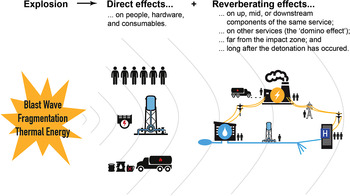
As shown in Figure 2, the impact of the detonation of explosive weapons on urban services is gauged in terms of direct and reverberating effects. Direct effects of explosive weapons on urban services refers here to the immediate and physical impact caused by the explosion. Examples include the death or injury of operations and maintenance crews, damage to a water reservoir, or damage to a warehouse of spare parts and consumables. The direct effect of the explosion can have consequences on other components of the same service when they are interdependent. Reverberating effects of explosive weapons on urban services refers to such consequences, as discussed further below.
Depiction of the direct and reverberating effects of the detonation of an explosive weapon on the components of an urban service.

The consequences of explosive weapons can feed into the vicious cycles and other dynamics (e.g. trade sanctions, brain drain) of the indirect and cumulative impact of protracted armed conflict upon urban services, whether on the whole system of the same service, or on other services. An increased spread of communicable disease due to disrupted water supply is just one example,Footnote 16 though this is possible even in more acute conflicts. More immediate and generally less enduring are the reverberating effects on the urban services themselves. While the consequences of the use of explosive weapons in general “are not limited to death, physical injury and disability, but also include long-term impacts on mental well-being”,Footnote 17 the reverberating effects of explosive weapons on urban services are relatively bounded in space and over time. More specifically, the reverberating effects of explosive weapons on urban services are limited by the extent of the damage to upstream and midstream infrastructure, by the spatial distribution of the reverberations, and by the time required to restore the service.Footnote 18
The reverberating effects of explosive weapons on urban services also vary with each particular component of a service. The reverberating effects on an infrastructure systemFootnote 19 can be seen upstream, as when damage to a public water reservoir renders the transmission line and water treatment plant upstream useless, or downstream, as when damage to a domestic water reservoir eliminates the storage capacity and hence the supply of water to an entire neighbourhood. The maximum theoretical spatial extent of the reverberating effects is thus limited to the breadth of the service area (for example, the physical footprint of the service infrastructure).Footnote 20 The duration of the reverberating effects varies: for example, the buffer and storage function of a downstream water reservoir (i.e., one that serves an entire neighbourhood) can in some cases be restored to a limited degree by the installation within hours or days of temporary water tanks, or it can be repaired to full functionality within weeks.Footnote 21 In other cases, such as when the water reservoir cannot be repaired and its storage function cannot be bandaged with “quick fixes”, the continuity of the supply and pressure in the line is interrupted, leading to undue stress on distribution pipes further downstream and resulting in a less reliable service for the end user. And the restoration of a booster pumping station can take several months or even over a year, particularly if the pumps and electrical panels need to be imported.Footnote 22
The people and consumables so important to the effective functioning of an urban service also suffer from explosive weapons, of course. Whether an explosive weapon were to completely destroy the sole warehouse of spare parts and consumables, or kill or maim a large number of the municipal staff, the spatial extent and duration of the reverberating effects would likely be similar to those observed in infrastructure. Cases where the effects of the use of explosive weapons will reverberate upstream or downstream on people or consumables are relatively few, however, and the consequences are generally more contained both in space and over time. For instance, if a warehouse full of spare parts has been destroyed, the reverberating effects on the system will be felt in space at the related infrastructural points that have broken down or failed, whereas the impact over time is a function of the time required to procure and install the replacement parts (as well as the replacement spare parts required to retain the pre-explosion level of preparedness).
Furthermore, the damage caused by explosive weapons on any component of a service can have a “domino effect” on other services.Footnote 23 Damage to an electrical substation can halt the municipal drinking water supply, and this “toppling” type of reverberating effects can lead to loss of sterilization capacity in the operating theatre,Footnote 24 as just one example.
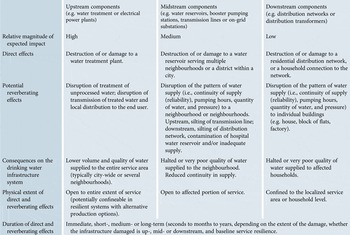
The potential reverberating effects of explosive weapons on infrastructure at different levels of the hierarchy of service components are presented in Table 1. Consider as a hypothetical example the reverberating effects of a direct strike on an upstream water treatment plant that damages three of six of the main transmission pumps. If the plant was normally operated with four pumps, with the other two remaining reserved for scheduled switchover, the maximum volume of water that could be supplied to residents after the attack would be three quarters of the normal amount. Depending on the configuration of the drinking water distribution network (i.e., whether closed-loop, meaning a more effective circulation of water, or open-ended, which has much more vulnerable sections), this could result in one quarter of the users near the end of the distribution network receiving less water than normal, as well as silting in the unused distribution (and possibly also transmission) pipelines. There would also be the reverberating effect of an undue amount of wear on those pumps that still function. These pumps would be likely to fail earlier than they normally would have, thus threatening the entire drinking water service. Similar cases have been documented for Beirut,Footnote 25 Baghdad,Footnote 26 Grozny,Footnote 27 Huambo,Footnote 28 Kabul,Footnote 29 Jenin,Footnote 30 Gaza,Footnote 31 southern LebanonFootnote 32 and other places.
Examples of the direct effects, reverberating effects and consequences of explosive weapons on up-, mid- and downstream elements of a drinking water infrastructure system, and indication of their magnitude in space and in time

In this example, the cumulative impact of the partial damage to the pumps is an entire breakdown of the drinking water service, the result of direct and reverberating effects, and is likely to have a domino effect on other services (e.g. health). The extent to which such impact will be considered reasonably foreseeable is a function of a number of factors that will be discussed below.
Consideration of the reverberating effects of a strike affecting a downstream component of a service demonstrates the importance of incorporating the hierarchy of components of any service into the analysis. Particularly when alternative water supplies are of poor quality or risky to access, the (downstream) household connection to the network is a crucial component for the well-being, health and dignity of all of the household's members. The consequences for a family when its connection is damaged by an explosion can be devastating, in terms of dignity, public health or displacement. From a services perspective, however, the damage is of relatively less consequence than the disabling of a domestic water reservoir, or other midstream or upstream components.Footnote 33
Baseline resilience
The deaths of hundreds of doctors in Iraq and SyriaFootnote 34 have demonstrated how the direct effect of explosive weapons on the people on which a service depends can have reverberating effects (on that service). In situations of protracted conflict, the direct effect of explosive weapons can be expected to reverberate more pervasively than in conflicts of a short duration, because of their eventual contribution to cumulative impact induced over time by the repeated interplay of direct and indirect impacts. A singular attack on any part of a service in a city that has no ongoing armed conflict (say, again, Geneva) is not likely to induce the same extent of brain drain as would repeated attacks in a city living through protracted conflict (as currently seen in Aleppo, for example), because the ability to adapt of those involved has not been repeatedly tested.Footnote 35
This example demonstrates how the reverberating effects of explosive weapons on urban services can be dampened or amplified by the resilience of the service prior to the explosion – what is referred to here as baseline service resilience. From a perspective of the rules of proportionality and precaution in attack, this baseline service resilience would form part of what Robinson and Nohle call the “contextual factors”.Footnote 36
As previously discussed, service resilience may be measured in terms of redundancies and the level of emergency preparedness and ability to respond. A drinking water system that has diversified water sources (or multiple water reservoirs that are pre-designed for operational flexibility with the same service areas within an urban area) is resilient because each replication subdivides the service, and so limits the physical extent of, and number of people affected by, any damage.Footnote 37 The subdivisions also allow for quicker repair work, as parts of transmission and distribution networks can be isolated without disrupting the entire service area. Furthermore, this type of systems design allows for relatively quick modifications (i.e., reconfiguration of part of the system) to restore service delivery.
The “preparedness and response” measure of a service may be thought of as the ability and time required to restore a service after receiving a direct impact and/or the immediate reverberating effects of an explosion. Especially if the impact occurs at the beginning of hostilities or in a situation of limited armed conflict, consumables lost to the violence (like chlorine stocks) may be replaced, and problems with damaged infrastructure can be worked around through temporary measures (such as water trucking), or soon repaired (e.g. a patch welded to a steel reservoir pierced by a single tank shell). The absence of a small number of staff in the short term can be handled relatively easily through replacement staff, such that the service keeps running.
The ability of local authorities or relief providers to respond to the direct or reverberating effects of explosive weapons is itself a question of both the scale of the damage and the state of the service prior to the explosion. For example, the total destruction of a water reservoir obliges the temporary installation of a temporary water tank to maintain storage capacity, but this will be a fraction of the original capacity, at best.Footnote 38 The partial destruction of a water booster pumping station is typically more difficult to work around, repair or replace than a reservoir, meaning that considerably more time is likely necessary to restore the service. Because the technologically sophisticated equipment is not readily repairable on-site (or sometimes in-country), it is not uncommon that it must be shipped out for repair to special machine shops or even to the original manufacturer, which is both expensive and logistically difficult.Footnote 39 This is particularly the case if the quality of local production is poor or stocks have been depleted during the protracted conflict. In Iraq, for example, chlorine tablets were used instead of the chlorine gas that water treatment plants were designed to operate with,Footnote 40 meaning there is no assurance that the water was treated to a safe level. The baseline resilience of a service in protracted conflicts is constantly changing (improving after repairs, but generally degrading over time), and is thus – for the purposes of this analysis – a factor that to the extent possible should be considered prior to an attack.
Impact in space and over time
By definition, the direct impact of explosive weapons on urban services is confined to the physical “impact area” of the explosive being considered. The impact area varies considerably with the type of explosive weapon used, but is defined as the distance over which the initial blast wave creates pressure,Footnote 41 as well as the distance of any fragmentation delivered, and the dissipation of thermal energy. The blast wave dissipates within milliseconds, while the fragmentation and thermal energy dissipates typically within seconds. For example, explosive weapons with wide-area effects like the surface-to-surface Scud missile or an Mk-84 bomb can damage a water reservoir, a warehouse for spare parts and a water supply operator within a target area of hundreds of square metres, simultaneously.
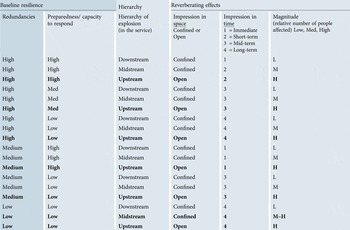
As shown in Table 2, the extent of the reverberating effects of explosive weapons on urban services changes in space and time depending on the pre-attack baseline resilience of the service. To recall – for a service that is quite resilient prior to an attack, the reverberating effects of explosive weapons are expected to be dampened because the service's redundancies can provide alternative supply options and/or routes, and the spare parts and people required to install them are still available. By contrast, the reverberating effects of explosive weapons on a service that has low baseline resilience prior to the attack – that is to say, one that is already “on its knees” – can extend much further afield and forward in time.
Summary of the factors that determine the extent of the impact of explosive weapons in space and time, according to different scenarios of baseline resilience

The magnitude, delivery method and contact area of the explosive are assumed constant in each scenario. Entries in bold are those with the highest magnitude in terms of the relative number of people affected.
Investigating the determinants of the impact of the reverberating effects of explosive weapons on urban services thus obliges tackling several sets of variables: the three components of each service; the interdependencies of services; direct effects; reverberating effects; and the up-, mid- and downstream hierarchy. Table 2 clarifies the dynamics through a systematic summation of alternatives of the different sets of variables in different scenarios. The summary reveals the extent to which the baseline conditions and hierarchy influence the expected impact of the explosive weapons in space and time.
A close reading of Table 2 reveals a number of relevant dynamics. The first is that the greatest impacts (i.e., those scenarios classed as “Open” in the space column, and graded “3” or “4” in the time column) occur where the explosive weapon is used on an upstream part of a service that is low both in terms of quality and in capacity to respond. This confirms conventional thought on the subject – i.e., that the attacks which are the most likely to cause direct or reverberating effects over the largest area and for a prolonged period of time are those on the supply-end (i.e., upstream) infrastructure, especially if this is already degraded.
Secondly, the expected impact of explosive weapons across space is found to be shaped primarily by the hierarchy of the component within a service. That is, the spatial extent of the reverberating effects of explosive weapons on downstream elements of an infrastructure system can be expected to be “confined” (typically to a localized neighbourhood or even household level). The reverberating effects of explosive weapons on upstream elements of a service are more open – limited only by the extent of the infrastructure of the network, which often spans dozens of kilometres and can serve upwards of hundreds of thousands of people.
Thirdly, the expected impact of explosive weapons on urban services in time is found to be determined primarily by the baseline resilience of the service. That is, the reverberating effects upon any component of a service (whether people, hardware or consumables, or located up-, mid- or downstream) are likely to be shorter when the pre-attack quality of the service and its ability to respond are high. Reverberating effects of explosive weapons on the service are expected to last much longer when the baseline conditions of the service are poor; generally, a service that is already vulnerable is more likely to be disrupted for a longer period than one that is robust. The reverberating effects can span from days to decades, and are distinct from other reverberating effects (e.g. on public health or markets), which might not be similarly bound in time).
There is also considerable differentiation in the impact on time within each scenario. For services of the same baseline quality, for example, the magnitude of the reverberating effects varies directly with the ability to respond. Likewise, in situations of equal ability to respond, the magnitude of the reverberating effects varies directly with the quality of service.
Implications for proportionality and precaution in attack
The analysis has demonstrated how the impact of explosive weapons on any component of a service can be direct and reverberate within the same service or other services. The duration and spatial extent of the direct and reverberating effects depend primarily on the extent of the damage to the functionality of a service component. The overall impact across space varies significantly, being determined primarily by the hierarchy of the component suffering the direct effect (damage on upstream components typically having the most widespread impact). The duration of the overall impact is determined mainly by the pre-explosion operational resilience of the service, as measured in terms of system redundancies and emergency preparedness and response. More specifically, and in the majority of cases seen, the greatest impact of explosive weapons on urban services is a function of the extent of the damage to upstream or midstream infrastructure (i.e., that which produces or delivers the bulk of the service), the nature and extent of the reverberations downstream of the elements of any service component, the “domino effect” onto other services, and the time required to restore the service.
The findings hold a number of implications for the rules on proportionality and precaution in attack, as they shed light on what impact on urban services can be “reasonably foreseeable”. As Robinson and Nohle discuss, the rules oblige attackers “to take into account the expected incidental loss of civilian life, injury to civilians or damage to civilian objects arising from a particular attack”, which the ICRC interprets to include the foreseeable reverberating effects of an attack.Footnote 42 The relevant question when carrying out a proportionality assessment for an attack on a military objective expected to cause damage to a service is: to what extent are the direct impact and reverberating effects reasonably foreseeable?
The analysis has emphasized that service hardware is the chief component of concern regarding the use of explosive weapons, and that upstream and midstream infrastructure have primacy within that particular service component. A number of features of such primary service hardware should be considered. First, the detailed layout of the service system is often only known by the staff of the service provider that operates the service (typically at the municipal level), even if the original layout is sometimes recorded in as-built plans or standard operating procedures. Regardless of whether an attack is planned with the luxury of time or a result of dynamic targeting (i.e., time-sensitive), access to this level of information is not likely to be readily available. However, in some circumstances, with time and experience a greater level of information and knowledge will have been acquired (e.g. in protracted conflict, or during periods of prolonged occupation), and hence could be expected to inform any proportionality assessment.Footnote 43 Given the fact that “collateral damage” is assessed, this analysis suggests that resource personnel can and should be used wherever possible to gain knowledge of the basic layout and functioning of the service. In the absence of such information, the alternative is to rely on the expert opinion of engineers specialized in a particular urban service (i.e., water supply, waste-water collection and treatment, or power supply).
Second, it happens that most of this upstream and midstream infrastructure is identifiable, in that it is typically located at ground level and takes on familiar spatial or design patterns. For example, the clarifying tanks emblematic of water treatment plants are readily distinguishable as being circular and about 3–15 metres in diameter. They are also quite distinct from conventional electrical power plants or conventional waste-water treatment plants. Secondary booster pumping stations and ground-level and elevated water reservoirs are clearly distinguishable if not covered, and so also discernible to a trained eye. If such infrastructure is identifiable from the air (or from the ground when in the line of sight), it follows that a weapons controller could be trained to distinguish it from other parts of an urban landscape.
Third, there is considerable specialist knowledge of the direct effects of the use of explosive weapons on urban services, at least on infrastructure. This lies with militaries,Footnote 44 local authoritiesFootnote 45 and some humanitarian organizations.Footnote 46 In terms of both physical protection of infrastructure and preparedness for a particular event, it is also documented in internal or open-source publications.Footnote 47
Given these three characteristics, even without access to the as-built plans of infrastructure, much of the impact caused by explosive weapons upon urban services is reasonably foreseeable. This statement holds true whether the weapons have “wide-area effects” or not. However, such reverberating effects are not yet as routinely catalogued (or perhaps even conceptualized) by belligerents, local authorities and relief agencies. Amongst other implications that are to be addressed in separate analysis,Footnote 48 then, the findings suggest that the process of carrying out a proportionality assessment which involves urban service infrastructure would benefit from (i) the direct and consistent engagement of specialized engineers within the targeting cell, and (ii) greater familiarity of the weapons controller with services, infrastructure and systems in urban areas (and when possible in theatre). The latter will ensure a greater likelihood of identifying civilian objects (which are static) and associating them with the foreseeable reverberating effects (including those that are immediate and within systems).
The analysis holds two further implications for discussions about rules on proportionality and precaution in attack. It is worth returning to the articulation in footnote 19, above, of reverberating effects on urban services as a subset of the “foreseeable reverberating effects of an attack” in the general sense, as described by Robinson and Nohle.Footnote 49 The former are not only generally more bounded in space and over time as this analysis shows, but are also arguably even more easily foreseeable than the latter (which extend, according to the definitions employed here, beyond the reverberating effects on urban services themselves).
Finally, the analysis further contributes to a related debate about the ability to mitigate the impact of explosive weapons on urban services (whether reasonably foreseeable or not). As the ICRC Urban Services Report states, “[a]lthough the rules on the conduct of hostilities do not specifically state that an attacker must take account of the decreased capacity of essential services caused by previous attacks, to the extent that such decreased capacity is foreseeable, it must be taken into account”.Footnote 50 The analysis has shown that the ability of a system to respond to damage or disruption is one of the key elements of the baseline conditions that determine the extent of the reverberating effects, most notably over time.